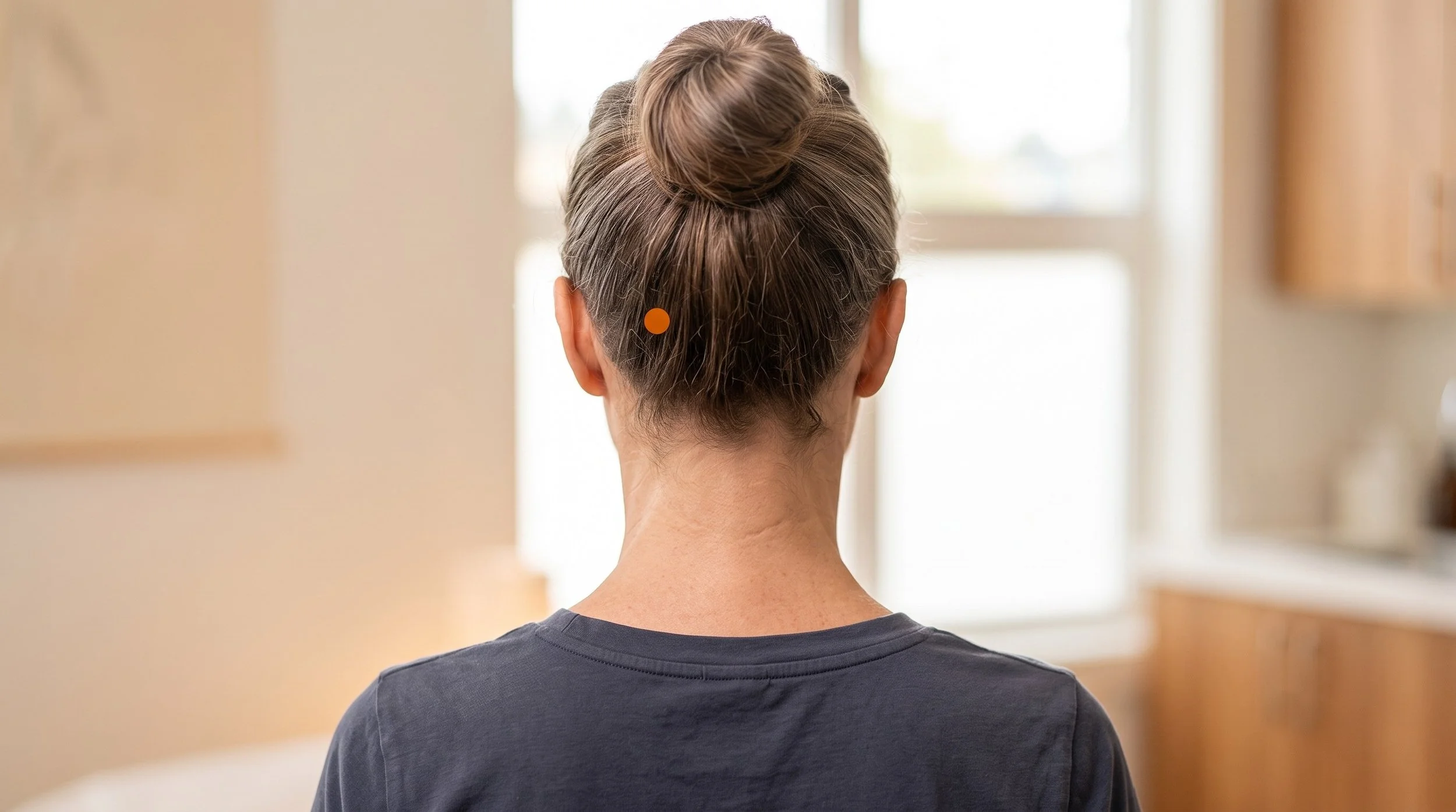
GB19 Acupuncture Point (Naokong)
The Brain Hollow Above the Wind Pool: Anatomy, Mechanism, and Why This Occipital Point Supports Headache and Neck Pain Treatment
GB19 (Naokong, often translated as Brain Hollow or Brain Cavity) is the nineteenth point of the Gallbladder channel and sits on the back of the head, directly above GB20 at the level of GV17, just off the midline above the bony bump you can feel at the base of the skull.
In plain terms, the gb19 acupuncture point is a scalp point on the occiput, threaded flat under the skin rather than pushed deep, and it lands in territory supplied by the greater occipital nerve. That location is the reason gallbladder 19 keeps showing up in treatment plans for occipital headache, one-sided head pain, a heavy or foggy head, and neck stiffness that makes turning the head uncomfortable. It's rarely the only point used, but as an anchor over the upper attachment field of the neck extensors it gives clinicians a way to address the back of the head and the top of the neck in the same treatment.
- Naokong point location is straightforward once you find GB20: slide upward onto the occipital bone, staying level with GV17 above the external occipital protuberance. If that bump is hard to feel, the classical alternative places gb 19 occiput about one quarter of the way from GB20 up toward GB18.
- Layer by layer, the needle passes through skin, subcutaneous tissue and the scalp aponeurosis, sitting over the occipital bone near the upper attachments of trapezius and the underlying suboccipital fascia. Because bone lies directly beneath, the point is needled transversely along the scalp rather than perpendicular.
- Traditional sources classify GB19 as a meeting point of the Gallbladder channel with the Yang Linking vessel and credit it with benefiting the head, easing pain, settling wind and clearing the sense organs. Translated into modern language, those categories describe a point used for head pain, dizziness and sensory complaints arising from the upper cervical and occipital region.
- The mechanism story is nerve based. GB19 sits in greater occipital nerve (C2) territory, and cervical afferents from this region converge with trigeminal afferents onto shared second-order neurons in the trigeminocervical complex, which helps explain why neck-derived input is felt as headache in the front and side of the head (Bartsch & Goadsby, 2002).
- Needling recruits small-diameter afferents that engage descending inhibitory pathways using endogenous opioid, serotonergic and noradrenergic signaling (Zhao, 2008), and pooled patient-level data across chronic pain conditions, including headache and neck pain, show modest but persistent benefits over sham and usual care (Vickers et al., 2018).
- Patients usually describe de qi at GB19 as a dull, spreading pressure or a tight, warm ache that may fan across the back of the head. Sharp or electric sensations are not the goal, and the needle is angled and depth adjusted if they occur.
Headaches That Start at the Base of Your Skull?
If your headaches build from the back of the head, tighten across one side, and arrive with a heavy, hard-to-think feeling, the occiput is worth examining directly. At Morningside Acupuncture we use GB19 with GB20 and nearby scalp points, then add dry needling of the suboccipitals and upper trapezius when the exam points there. Treatment is paired with simple posture and jaw habits that reduce load on the upper neck between visits. Schedule a session and we'll map where your headache pattern actually begins.
Schedule NowAnatomy of GB19: Why the Occipital Shelf Above GB20 Is Such an Important Location
GB19 sits on the back of the skull, off the midline and above GB20, in a zone where several tissue layers stack tightly over bone. From the surface, a needle passes through skin, a thin subcutaneous layer rich in small vessels and nerves, and the tough scalp aponeurosis that blends posteriorly with the occipitalis. Just below and around this area lie the upper attachment fields of trapezius and semispinalis capitis, along with the dense suboccipital fascia that ties the neck extensors to the skull.
This region takes a load all day: sustained forward head posture at a desk, phone use, driving, carrying bags on one shoulder, and clenching or grinding all increase tension in the muscles that anchor here. Over time that translates into tender, thickened tissue right where gallbladder 19 and its neighbors are located.
The nerve geography is what makes this location clinically interesting. The occipital scalp around GB19 is supplied mainly by the greater occipital nerve, a branch of the C2 spinal root, with contributions from the third occipital nerve. Experimental work has shown that a population of dorsal horn neurons receives convergent input from both the greater occipital nerve and the supratentorial dura, and that stimulating the occipital nerve increases the central excitability of that dural input (Bartsch & Goadsby, 2002).
That convergence is the neuroanatomical basis for why upper cervical and occipital tissues can produce pain that patients feel over the temple, forehead or behind the eye, and why treating the occiput can influence headache patterns that seem to live somewhere else. Needling in this territory also recruits small-diameter afferents that activate descending inhibitory control from the brainstem, involving opioid, serotonergic and noradrenergic mechanisms (Zhao, 2008), which is a plausible route for the broader analgesic effect patients report after treatment.
The deep structure at GB19 is simply the occipital bone, which is a mechanical advantage. Unlike GB20, where the angle of insertion matters a great deal because of the structures near the foramen magnum, GB19 is threaded flat under the skin along the scalp. Standard practice is transverse insertion of roughly 0.5 to 1.5 cun, and some texts prefer a shallower subcutaneous technique of about 0.3 to 0.5 cun. Branches of the occipital artery and vein run through this layer, so a little more bleeding or bruising than average is possible, and practitioners apply firm pressure after withdrawal. Clean technique, single-use sterile needles, and attention to hair and scalp condition are all routine here.
Related Best Acupuncture Points For Headaches Related Acupuncture For Neck PainGB19 at a Glance: Classification, Location, and Clinical Use
| Category | Detail |
|---|---|
| Traditional Name | Naokong (Brain Hollow, also translated as Brain Cavity) |
| Channel Classification | Gallbladder channel, point 19 of 44, on the lateral occiput |
| Point Categories | Meeting (crossing) point of the Gallbladder channel with the Yang Linking vessel (Yang Wei Mai). No five-shu, hui-meeting or other special designations are attributed to this point in the classical sources. |
| Precise Location | In the occipital region directly above GB20, level with GV17 above the external occipital protuberance; alternatively, one quarter of the distance from GB20 up toward GB18. |
| Tissue Stimulated | Scalp aponeurosis and occipitalis over the occipital bone, with the upper attachment field of the trapezius and the underlying suboccipital fascia nearby |
| Needle Depth / Direction | Transverse insertion along the scalp, roughly 0.5 to 1.5 cun; shallow subcutaneous technique of 0.3 to 0.5 cun is also used. Never perpendicular. |
| De Qi Sensation | Dull, spreading pressure or a tight, warm ache across the back of the head, sometimes with a mild sense of the scalp lifting or drawing; sharp or electric sensations mean the needle should be adjusted |
| Primary Clinical Uses | Occipital and one-sided headache, heaviness or fogginess of the head, neck stiffness with limited rotation, dizziness, and classically eye pain and nasal congestion |
| Common Point Combinations |
|
Classical sources gather a wide range of complaints under this small occipital point. A Manual of Acupuncture lists GB19 for headache, head wind, one-sided head pain and heaviness of the head, for neck stiffness and pain with difficulty turning the head, and for dizziness, alongside sensory complaints such as red, swollen or painful eyes, ringing in the ears, and nasal pain, congestion or bleeding. A third grouping covers agitation and fright, mood disorders, wasting conditions and heat in the body, which is the traditional framing rather than a modern clinical claim.
The same text repeats a story from the Great Compendium of Acupuncture and Moxibustion in which the physician Hua Tuo is said to have relieved a general's head wind, mental confusion and visual dizziness by needling GB19, while noting that an older telling of the same episode names KI1 instead. Traditional actions attributed to the point are to benefit the head and relieve pain, and to settle wind and clear the sense organs.
What is striking is how consistently the classical indication list circles back to one anatomical story: pain, heaviness and sensory disturbance in the head, paired with a stiff upper neck.
Why GB19 Is Used for Headaches That Seem to Live Behind the Eyes
Patients are often surprised when a practitioner needles the back of the head for pain felt in the temple, forehead or behind the eye. The explanation is convergence. Sensory fibers from the upper cervical roots, especially C2 traveling as the greater occipital nerve, terminate in the same brainstem and upper spinal cord region that receives trigeminal input from the face and the coverings of the brain.
Recordings from these neurons show that many of them respond to both dural stimulation and stimulation of occipital skin and neck muscles, and that occipital nerve input can raise the excitability of those shared neurons (Bartsch & Goadsby, 2002). Practically, that means irritable tissue at the occiput can amplify head pain that a patient experiences somewhere entirely different, and calming input from that same territory is one of the levers available.
The second half of the story is systemic. Needling activates small-diameter afferents that trigger descending inhibitory control from the periaqueductal gray and rostral ventromedial medulla, with endogenous opioid, serotonergic and noradrenergic signaling doing much of the work (Zhao, 2008). This is why a treatment that includes GB19 usually also includes distal points, and why patients frequently report a general settling and drowsiness during a session rather than a purely local change.
There are also local effects that matter clinically: needling changes blood flow in the treated tissue and reduces the tenderness of taut, irritable bands in nearby muscle.
None of this makes GB19 a headache switch. It's better understood as one useful access point to a nerve territory that participates in a large share of everyday head pain. When we choose it, it's because the exam shows tenderness, tissue change or reproduction of symptoms in the occipital shelf, not because the point appears on a list.
What the Research Shows for GB19
There's no clinical trial of GB19 on its own, and that's true of nearly every individual acupuncture point. Reviews test whole protocols, which for headache and neck complaints typically include occipital and scalp points such as GB20, GB19, BL10, GV20 and Taiyang alongside distal points. So the fair reading is that the evidence supports the treatment approach that GB19 belongs to, not the point in isolation, and the studies below should be read with that limitation in mind.
| Study | Type | Focus | Key Finding |
|---|---|---|---|
| Linde et al., 2016a | Cochrane systematic review | Acupuncture for the prevention of tension-type headache | Pooled trial data suggested acupuncture may reduce headache frequency compared with usual care and sham, though effect sizes over sham were small and quality of evidence varied. |
| Linde et al., 2016b | Cochrane systematic review | Acupuncture for the prevention of episodic migraine | Adding acupuncture to usual care was associated with fewer migraine days, with modest advantages over sham acupuncture and effects broadly comparable to prophylactic medication. |
| Vickers et al., 2018 | Individual patient data meta-analysis | Chronic pain conditions including headache and neck pain | Acupuncture outperformed both sham and no-acupuncture controls, with benefits that persisted at twelve months rather than fading immediately after treatment. |
| Pourahmadi et al., 2021 | Systematic review and meta-analysis | Dry needling for tension-type, cervicogenic and migraine headache | Dry needling of head and neck musculature showed favorable short-term effects on headache intensity and related disability, with the strongest signal in cervicogenic headache. |
| Bartsch & Goadsby, 2002 | Experimental electrophysiology study | Convergence of occipital nerve and dural input in the trigeminocervical complex | Occipital nerve stimulation increased the central excitability of dural afferent input, offering a mechanism for pain referral between the upper neck and the head. |
| Zhao, 2008 | Narrative neurophysiology review | Neural mechanisms of acupuncture analgesia | Needle stimulation engages spinal and supraspinal inhibitory circuits using opioid, serotonergic and noradrenergic transmitters, supporting effects beyond the treated site. |
Neck Too Stiff to Turn Comfortably?
Limited rotation, a locked-up feeling on one side, and pain that creeps up behind the ear often trace back to the upper cervical segments rather than the mid neck. GB19 gives us access to the occipital shelf above GB20, and we combine it with local channel points, distal points, and targeted needling of the muscles that keep reloading the area. Most patients notice changes in range of motion within the first few sessions. Book a visit and we'll assess your neck, jaw and shoulder mechanics together.
Schedule NowGB19 in the Context of Trigger Point Work
The area around GB19 overlaps with muscles that are well documented as sources of referred head pain. Trigger points in the suboccipital group, semispinalis capitis and the upper trapezius are all described as projecting pain into the back and side of the head, with upper trapezius referral typically wrapping toward the temple and semispinalis producing a band-like pain around the head (Simons et al., 1999).
GB19 itself sits over the bony attachment field rather than in a muscle belly, so it's needled flat along the scalp, while the muscular targets are addressed separately with dry needling at safer angles and depths.
At Morningside Acupuncture, a typical session for occipital headache with neck stiffness starts with palpation to see which tissues reproduce the patient's familiar pain. If the suboccipitals and upper trapezius are involved, we treat those directly with dry needling, then add channel points including GB19 and GB20 to work the occipital shelf and nearby scalp. Distal points support the descending inhibition side of the response, and we finish with range of motion work and specific homework so the tissue isn't simply reloaded on the way back to a desk.
Acupuncture and dry needling both use an acupuncture needle, and combining the two styles in one visit is usually more efficient than choosing between them.
GB19 Headache and Neck Pain Treatment at NYC's Highest-Rated Acupuncture Clinic
Morningside Acupuncture is the highest-rated acupuncture and dry needling clinic in New York City with over 500 five-star Google reviews. Our treatments blend classical point selection, including occipital points such as GB19 and GB20, with orthopedic assessment and trigger point dry needling of the head and neck musculature. Every plan is built around your exam findings rather than a fixed protocol. Schedule your appointment and let's build a plan for your headaches and neck pain.
Schedule NowFrequently Asked Questions
What does GB19 feel like when needled?
Because GB19 is threaded flat under the scalp, most people feel a brief prick at insertion and then a dull, spreading pressure or a tight, warm ache across the back of the head. Some describe a mild pulling or lifting sensation in the scalp, and a few notice a wave of heaviness or relaxation that runs down the neck. Sharp, burning or electric sensations aren't expected, and if they occur the practitioner will adjust the angle or depth. Scalp points can also be more sensitive on days when the occipital tissue is already irritable, which often eases as the tension settles.
Why needle the back of the head when my pain is in my forehead or behind my eye?
Sensory nerves from the upper neck and occipital scalp share second-order neurons in the brainstem with nerves from the face and the coverings of the brain, and experimental work shows that occipital nerve input can increase the excitability of that shared pathway (Bartsch & Goadsby, 2002). This is why irritation at the occiput can be experienced as pain in the front of the head, and why treating the occipital region may influence a headache that seems to be located elsewhere. It's the same reason a physician might consider a greater occipital nerve block for headache felt in the front of the head.
Can I press GB19 myself between sessions?
Yes, and it's an easy point to self-treat. Find the bony bump at the center of the base of your skull, move about an inch to one side and then slightly upward onto the curve of the occipital bone, just above the hollow where GB20 sits. Use your fingertips or thumb pads and apply steady, moderate pressure with small circles for 30 to 60 seconds per side, repeating two or three rounds, once or twice a day. You can also let your head rest back into your fingers so gravity does the work. Pressure should feel like a satisfying ache, never sharp, and you should stop if it triggers dizziness, nausea or worsening head pain. Acupressure is a reasonable maintenance tool, not a substitute for evaluation if headaches are frequent or changing.
Is GB19 safe to needle?
In trained hands, yes. The occipital bone lies directly beneath the point, and the standard technique is a transverse insertion along the scalp rather than a perpendicular one, so there's no path toward deeper structures the way there is at GB20. The main practical considerations are small vessels in the scalp, which can mean occasional bleeding or a bruise, and ordinary temporary effects such as soreness or lightheadedness. Practitioners use single-use sterile needles and apply pressure after withdrawal. Anyone taking blood thinners, with a bleeding disorder, or with an active scalp infection or skin lesion should mention it before treatment. New, severe, or rapidly changing headaches always warrant medical evaluation first.
Where exactly is GB19 located?
GB19 is in the occipital region, directly above GB20 and level with GV17, which sits in the depression just above the external occipital protuberance (the bony bump at the center of the base of the skull). If that bump is hard to identify, the classical alternative for naokong point location places GB19 about one quarter of the distance along the line from GB20 up to GB18. In practice, clinicians find GB20 in the hollow between the neck muscle attachments, then move upward onto the occipital bone until they reach the level of GV17.
References
- Deadman, P., Al-Khafaji, M., & Baker, K. (2009). A manual of acupuncture. Journal of Chinese Medicine Publications.
- Cunningham, P. M. (2000). Acupuncture points: A practical guide to classical and modern usage. Odyssey Press.
- Kim, H. (2008). Handbook of Oriental medicine (3rd ed.). Harmony & Balance Press.
- Maciocia, G. (2005). The foundations of Chinese medicine: A comprehensive text for acupuncturists and herbalists (2nd ed.). Elsevier Churchill Livingstone.
- Simons, D. G., Travell, J. G., & Simons, L. S. (1999). Travell & Simons' myofascial pain and dysfunction: The trigger point manual, Vol. 1: Upper half of body (2nd ed.). Williams & Wilkins.
- Bartsch, T., & Goadsby, P. J. (2002). Stimulation of the greater occipital nerve induces increased central excitability of dural afferent input. Brain, 125(7), 1496-1509. https://doi.org/10.1093/brain/awf166
- Linde, K., Allais, G., Brinkhaus, B., Fei, Y., Mehring, M., Shin, B. C., Vickers, A., & White, A. R. (2016a). Acupuncture for the prevention of tension-type headache. Cochrane Database of Systematic Reviews, 2016(4), CD007587. https://doi.org/10.1002/14651858.CD007587.pub2
- Linde, K., Allais, G., Brinkhaus, B., Fei, Y., Mehring, M., Vertosick, E. A., Vickers, A., & White, A. R. (2016b). Acupuncture for the prevention of episodic migraine. Cochrane Database of Systematic Reviews, 2016(6), CD001218. https://doi.org/10.1002/14651858.CD001218.pub3
- Pourahmadi, M., Dommerholt, J., Fernández-de-Las-Peñas, C., Koes, B. W., Mohseni-Bandpei, M. A., Mansournia, M. A., Delavari, S., Keshtkar, A., & Bahramian, M. (2021). Dry needling for the treatment of tension-type, cervicogenic, or migraine headaches: A systematic review and meta-analysis. Physical Therapy, 101(5), pzab068. https://doi.org/10.1093/ptj/pzab068
- Vickers, A. J., Vertosick, E. A., Lewith, G., MacPherson, H., Foster, N. E., Sherman, K. J., Irnich, D., Witt, C. M., & Linde, K. (2018). Acupuncture for chronic pain: Update of an individual patient data meta-analysis. Journal of Pain, 19(5), 455-474. https://doi.org/10.1016/j.jpain.2017.11.005
- Zhao, Z. Q. (2008). Neural mechanism underlying acupuncture analgesia. Progress in Neurobiology, 85(4), 355-375. https://doi.org/10.1016/j.pneurobio.2008.05.004
Disclaimer: This web site is intended for educational and informational purposes only. Reading this website does not constitute providing medical advice or any professional services. This information should not be used for diagnosing or treating any health issue or disease. Those seeking medical advice should consult with a licensed physician. Seek the advice of a medical doctor or other qualified health professional for any medical condition. If you think you have a medical emergency, call 911 or go to the emergency room. No acupuncturist-patient relationship is created by reading this website or using the information. Morningside Acupuncture PLLC and its employees and contributors do not make any express or implied representations with respect to the information on this site or its use. For any legal interpretation of scope of practice in your state, consult a licensed attorney or regulatory authority.
Read more from our blog



