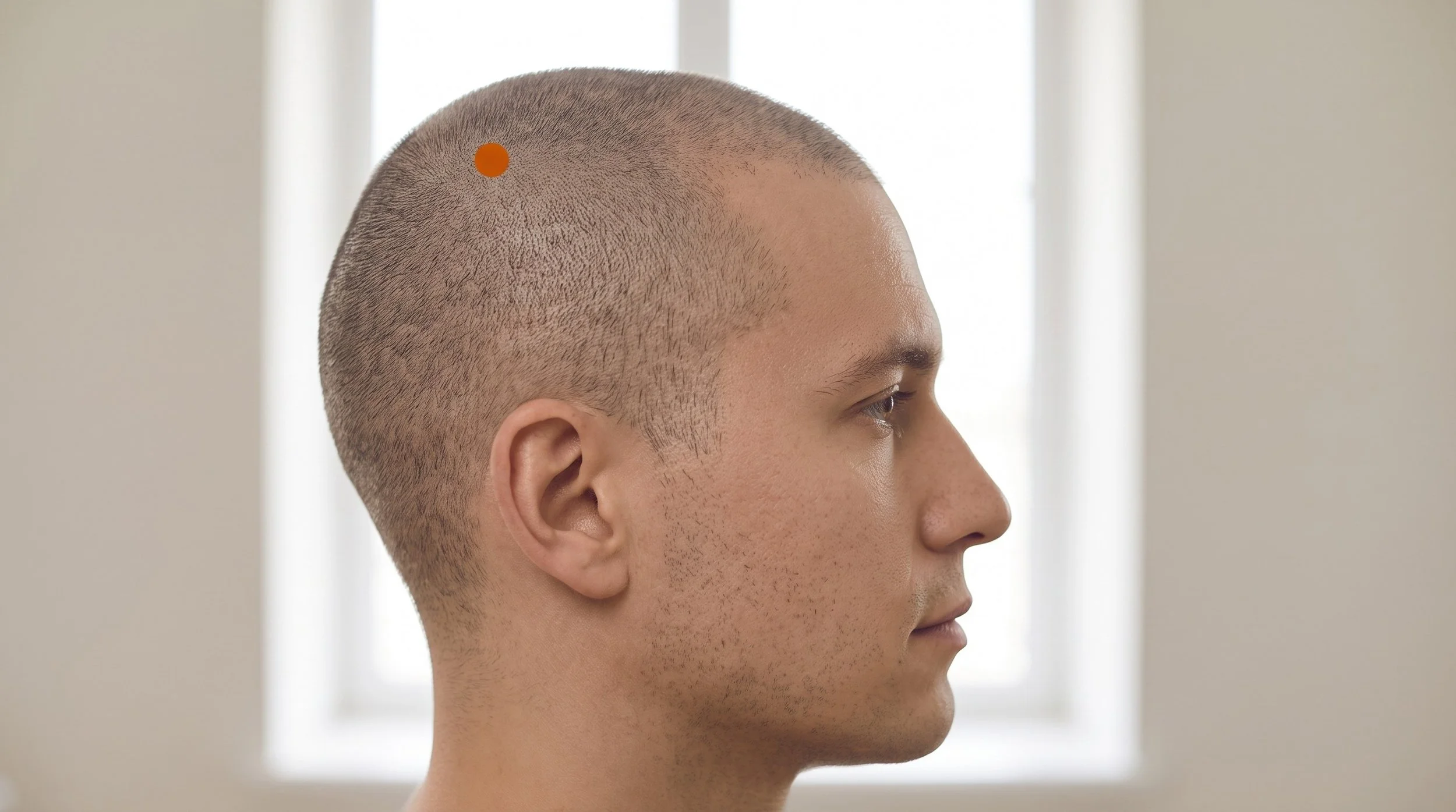
GB18 Acupuncture Point (Chengling)
Support Spirit Beside the Crown: Anatomy, Mechanism, and Why This Parietal Scalp Point Bridges Headache, Dizziness, and Nasal Symptoms
GB18, known in Chinese as Chengling and usually translated as Support Spirit (some texts render it Spirit Receiver or Contain the Spirit), is the eighteenth point of the Gallbladder channel and one of the four points that march across the top of the head between the forehead and the occiput.
In plain terms, it sits on the upper scalp roughly two finger-widths out to the side of the very top of the head, level with GV20 at the crown and about 1.5 cun behind GB17. That position matters clinically: the point is threaded flat under the skin into the tough tendinous sheet of the scalp, in territory supplied by branches of the greater occipital nerve, which makes the gb18 acupuncture point a practical option when a patient describes pressure at and around the crown, a band of tightness spreading from the back of the head forward, or dizziness that travels with neck and head tension.
Classical sources add a second, less obvious use: gallbladder 18 was also employed for nasal congestion, nosebleed, and cough with sensitivity to wind, a pairing of head and nose indications that still shapes how the point is chosen today.
- Location and layers: GB18 lies on the parietal scalp about 2.25 cun lateral to the midline, directly to the side of GV20 and 1.5 cun posterior to GB17, roughly 4 cun above the front hairline. The needle stays superficial, passing through skin and dense subcutaneous tissue into the galea aponeurotica rather than into any bulky muscle, which is why insertion is transverse rather than perpendicular (Deadman classical texts and standard point manuals).
- Traditional categories, read anatomically: gallbladder 18 is described in the classical literature as a meeting point of the Gallbladder channel with the Yang Linking vessel (Yang Wei Mai), a pathway that sweeps the lateral body wall and lays a chain of points across the side and top of the head. Translated into modern terms, this is a map of a shared innervation and referral territory rather than a description of energy moving through a tube.
- Nerve geography: the scalp here is supplied by branches of the greater occipital nerve, with contributions anastomosing forward toward supraorbital territory and vascular supply from branches of the occipital artery and vein. Second cervical afferents and trigeminal afferents converge in the trigeminocervical complex, which is the accepted anatomical basis for pain that starts in the upper neck and is felt over the crown and forehead.
- Mechanism: needling activates A-delta and C-fiber afferents that recruit segmental inhibition in the dorsal horn and descending pain-modulating pathways involving endogenous opioid and monoaminergic systems (Zhao, 2008). Scalp needling has also been studied with functional near-infrared spectroscopy, where clustered scalp insertion was associated with changes in cerebral hemoglobin levels alongside clinical improvement (Chen et al., 2020).
- Research picture: Cochrane reviews support acupuncture as a reasonable preventive option for tension-type headache and episodic migraine, with at least six sessions in most protocols (Linde et al., 2016a; Linde et al., 2016b), and individual patient data from chronic pain trials show effects that persist beyond the treatment course (Vickers et al., 2018). None of these trials isolate GB18, so its role is best described as one component of a multi-point plan.
- What it feels like: because scalp tissue is dense and tightly bound to the galea, patients usually report a brief pinch at insertion followed by a heavy, spreading pressure or a dull ache that can extend a few centimeters along the scalp. De qi at GB18 is rarely electrical, and a soft warm or tingling wash across the top of the head is common.
Tired of Pressure at the Top of Your Head That Never Fully Lifts?
Crown and band-like headaches often come from a combination of upper cervical irritation, jaw and scalp muscle load, and stress-driven autonomic arousal. At Morningside Acupuncture we use GB18 alongside neighboring parietal points and dry needling of the suboccipital and upper trapezius muscles to address both the local scalp tension and the neck segments feeding it. Treatment plans are built around your specific headache pattern rather than a generic protocol. Schedule a visit and let's map where your headache actually starts.
Schedule NowAnatomy of GB18: Why the Parietal Scalp Beside the Crown Is Such an Important Location
The scalp at GB18 is built in layers that are unusually tightly bound together. Under the hair-bearing skin sits a dense subcutaneous layer packed with fibrous septa, small arteries, veins, and cutaneous nerves, and beneath that lies the galea aponeurotica, the tough tendinous sheet that links the frontal and occipital bellies of the occipitofrontalis muscle. Below the galea is a loose areolar plane, then the pericranium and the parietal bone.
Because the vessels and nerves are tethered inside that dense middle layer rather than floating free, sustained tension in the frontalis, occipitalis, temporalis, and posterior cervical muscles gets transmitted across the galea, which is one reason people describe scalp tenderness and a hat-band sensation during long headache episodes. Prolonged screen posture, clenching, and chronically shortened suboccipital muscles all load this system.
The sensory supply here comes largely from branches of the greater occipital nerve, a C2 cutaneous nerve that pierces the upper neck fascia and fans forward over the back and top of the head, meeting branches from frontal territory near the vertex. That anatomy sets up the central point of the mechanism story: second cervical afferents and trigeminal afferents converge on shared second-order neurons in the trigeminocervical complex, so input arriving from the upper neck and scalp can be perceived as pain across the crown, temple, and behind the eye.
Needling into this territory delivers a controlled afferent barrage that engages segmental inhibition in the dorsal horn and recruits descending inhibitory pathways using endogenous opioids, serotonin, and noradrenaline (Zhao, 2008). Scalp needling has additionally been examined for local and cerebral hemodynamic effects, with clustered scalp insertion associated with measurable changes in cerebral hemoglobin levels (Chen et al., 2020), which is a plausible partial explanation for the sensation of the head feeling lighter after treatment.
Vascularly, the region is fed by branches of the occipital artery and vein, and the scalp bleeds readily because the vessels are held open by fibrous attachments. That is a cosmetic and comfort issue more than a danger, but it drives the standard technique. GB18 is needled transversely, sliding the needle along the plane of the scalp for roughly 0.5 to 1.5 cun so the shaft rests in the subcutaneous and galeal layers, never perpendicular toward bone.
Practitioners apply firm pressure after withdrawal to limit bruising, take extra care with patients on anticoagulants, and avoid scalp needling over any surgical hardware, cranial defect, unfused fontanelle, or area of broken or infected skin.
Related Best Acupuncture Points For Headaches Related Acupuncture Tension Headache ResearchGB18 at a Glance: Classification, Location, and Clinical Use
| Category | Detail |
|---|---|
| Traditional Name | Chengling (承靈), commonly translated as Support Spirit, and rendered elsewhere as Spirit Receiver or Contain the Spirit |
| Channel Classification | Eighteenth point of the Gallbladder channel of Foot Shaoyang, in the parietal group of scalp points running from GB15 at the forehead back to GB20 at the occiput |
| Point Categories | Meeting point of the Gallbladder channel with the Yang Linking vessel (Yang Wei Mai). No five-shu, yuan-source, luo-connecting, xi-cleft, or hui-meeting designation is assigned to this point in the classical literature. |
| Precise Location | On the parietal scalp, 1.5 cun posterior to GB17 on the curved Gallbladder line running from GB15 to GB20, directly lateral to GV20 at the crown and 2.25 cun from the midline (approximately 4 cun above the anterior hairline) |
| Tissue Stimulated | Hair-bearing skin, dense fibrous subcutaneous layer, and the galea aponeurotica connecting the frontal and occipital bellies of occipitofrontalis, in greater occipital nerve territory; frequently combined with myofascial work mapped on our Pain Finder Head Neck guide |
| Needle Depth / Direction | Transverse (subcutaneous) insertion 0.5 to 1.5 cun along the contour of the scalp, angled forward or backward along the Gallbladder line; never perpendicular. Moxibustion is described as applicable in standard texts. |
| De Qi Sensation | A brief pinch on entry, then heaviness, dull pressure, or a spreading tight ache across the scalp; some patients report warmth or a light tingling wash toward the temple or forehead |
| Primary Clinical Uses | Headache at and around the crown, band-like head tension, dizziness, and, in classical use, nasal congestion, nosebleed, and cough with aversion to wind |
| Common Point Combinations |
|
In the classical record summarized by Deadman and colleagues, Chengling is credited with two traditional actions: benefiting the head and easing pain, and benefiting the nose while directing Lung qi downward. Its listed indications gather into three groups: head symptoms (headache, so-called brain wind, dizziness, and eye pain), nose and airway symptoms (rhinitis, nasal congestion, nosebleed, cough, and labored breathing), and sensitivity to wind and cold.
Other commentaries add that the point's proximity to the crown made it useful in disorders described as affecting the mind and spirit, which is where its name, Support Spirit, comes from. What is striking about the classical pattern is the pairing itself. A point on the top of the head, needled almost flat under the skin, was reached for not only when the head hurt but when the nose was blocked or bleeding, a combination that only makes sense once you notice that these traditional attributions describe a single regional territory rather than separate organ systems.
Why GB18 Is Used for Nasal Congestion and Nosebleed as Well as Crown Headache
The first part of the answer is convergence. Sensory input from the upper cervical segments, including the greater occipital nerve territory covering GB18, and input from trigeminal branches serving the face, sinuses, and nasal lining terminate on overlapping second-order neurons in the brainstem and upper cervical cord. That shared wiring is why a tight, irritable upper neck can present as pain over the crown and behind the eyes, and why treatment applied at the scalp can influence how the whole head, including the face and nose, feels.
Needling GB18 sends a strong, well-localized afferent signal into that convergent pool, which is a more useful way to think about the classical head-and-nose pairing than any literal notion of energy flowing between the vertex and the nostrils.
The second part is modulation rather than blockade. Needle stimulation recruits descending inhibitory control from the periaqueductal gray and rostral ventromedial medulla, using endogenous opioid, serotonergic, and noradrenergic mechanisms, which reduces the gain of pain transmission over minutes to hours and, with repeated sessions, appears to shift the resting state of the system (Zhao, 2008).
Alongside that, needling produces local vasodilation and changes in autonomic tone, and studies of scalp needling using functional near-infrared spectroscopy have documented changes in cerebral hemoglobin levels during and after treatment (Chen et al., 2020). For nasal symptoms specifically, the mechanism is thought to involve autonomic and neuroimmune effects on the nasal mucosa, and reviews of acupuncture for allergic rhinitis report improvement in nasal symptom scores and quality of life compared with no intervention, though the certainty of that evidence is modest (Feng et al., 2015).
Practically, this means GB18 is rarely the whole treatment. It functions best as a local anchor at the crown, chosen when tenderness or a pressure sensation maps to that area, and then supported by upper cervical points, distal points, and trigger point needling of the muscles that actually refer into the head. Patients whose main complaint is congestion will typically also get facial and forearm points, since the scalp point alone is not the strongest tool for the nose.
What the Research Shows for GB18
There is no clinical trial that tests GB18 on its own, and that is worth saying plainly. Acupuncture research for headache, dizziness, and rhinitis evaluates multi-point protocols in which a scalp point like GB18 may or may not have been used, so the honest framing is that the evidence supports the treatment approach GB18 belongs to rather than the individual point. The reviews below are the ones most relevant to how the point is actually used, and several of them note limitations in trial quality that temper how confidently the results can be applied.
| Study | Type | Focus | Key Finding |
|---|---|---|---|
| Linde et al., 2016a | Cochrane systematic review | Acupuncture for the prevention of tension-type headache (12 trials, 2,349 adults) | A course of at least six sessions may be a worthwhile option for people with frequent tension-type headache, with acupuncture outperforming usual care and showing a small additional benefit over sham. |
| Linde et al., 2016b | Cochrane systematic review | Acupuncture for the prevention of episodic migraine (22 trials, 4,985 participants) | Moderate-quality evidence suggests acupuncture added to usual care reduces migraine frequency, with results at least comparable to prophylactic drug treatment in the trials that reported usable data. |
| Vickers et al., 2018 | Individual patient data meta-analysis | Chronic pain conditions including headache, neck pain, and musculoskeletal pain | Acupuncture was associated with modest but statistically significant benefits over both sham and no-acupuncture controls, and effects were largely sustained over twelve months. |
| Hou et al., 2017 | Systematic review and meta-analysis | Acupuncture for cervical vertigo (10 randomized trials, 914 participants) | Acupuncture appeared more effective than conventional medication for vertigo and associated headache, but the authors graded the evidence as low to very low quality, so the finding should be treated as preliminary. |
| Feng et al., 2015 | Systematic review and meta-analysis | Acupuncture for allergic rhinitis | Pooled results favored acupuncture for nasal symptom severity and quality of life, supporting the traditional nasal indications of head and scalp points without establishing which points drive the effect. |
| Chen et al., 2020 | Randomized clinical study with functional near-infrared spectroscopy | Cluster needling of scalp acupuncture in post-stroke cognitive impairment | Adding scalp needling to standard care was associated with improved cognitive scores and higher cerebral hemoglobin levels, offering one physiological line of evidence that scalp insertion is not inert. |
| Zhao, 2008 | Narrative review of mechanism research | Neural mechanisms of acupuncture analgesia | Analgesic effects are attributed to afferent-driven segmental inhibition plus descending control involving endogenous opioid and monoaminergic systems, which provides the framework for how scalp points may influence head pain. |
Dizziness, Head Fog, and Neck Tension That Travel Together?
When lightheadedness shows up with a stiff neck and a heavy head, the cervical spine and its nerve supply deserve a careful look. Our acupuncturists combine crown-level points like GB18 and GV20 with occipital and cervical work, and we screen carefully so that anything requiring medical evaluation gets referred out. Many patients notice their head feels lighter and their neck moves more freely within a few sessions. Book an appointment to get assessed properly.
Schedule NowGB18 in the Context of Trigger Point Work
GB18 does not sit over a discrete muscle belly, which changes how we use it in a dry needling session. It sits in the galea, the tendinous sheet that the frontal and occipital muscles pull on from opposite ends, so it is best understood as a point that treats the receiving surface of head pain rather than its generator. The generators are usually further down.
Trigger points in the suboccipital group, splenius capitis, upper trapezius, sternocleidomastoid, and temporalis are classic sources of referred pain into the vertex, temple, and behind the eye (Simons et al., 1999), and reproducing a patient's familiar headache by palpating those bands is often more diagnostic than anything they can tell us about the pain itself.
At Morningside, a typical session for crown-pattern headache pairs superficial transverse needling at GB18 and its neighbors along the parietal line with precise dry needling of the muscles that reproduced the symptom on examination, most often the suboccipitals and upper trapezius, plus jaw musculature when clenching is part of the picture. Because acupuncture is defined by the use of an acupuncture needle, the same tool covers both parts of the treatment, and there is no meaningful technical divide between the classical point and the trigger point.
We then layer in distal points and, when appropriate, breathing and posture work, since sustained forward-head loading tends to reload the same tissues between visits.
GB18 Headache Treatment at NYC's Highest-Rated Acupuncture Clinic
Morningside Acupuncture is the highest-rated acupuncture and dry needling clinic in New York City with over 500 five-star Google reviews, and headache care is one of the most common reasons patients find us. We integrate classical point selection, including scalp points like GB18 and GB20, with modern trigger point needling of the muscles that refer pain into the head. Sessions are unhurried, evidence-informed, and built around measurable change in your headache frequency and intensity. Schedule your first visit and start tracking real progress.
Schedule NowFrequently Asked Questions
What does GB18 feel like when needled?
Most patients feel a quick pinch as the needle passes through the dense scalp skin, then a heavy, spreading pressure or a dull ache that can travel a few centimeters along the top of the head. Because the needle lies flat under the skin rather than going deep, there is usually no strong electrical or radiating sensation. Some people report warmth, a light tingle toward the temple, or a sense that the head feels lighter once the needles are in. Scalp points can be briefly more sensitive on insertion than points on the arms or legs, but the sensation typically settles within a few seconds.
Why needle the top of my head when my pain feels like it starts in my neck?
Because the top of the head and the upper neck share nerve territory. Branches of the greater occipital nerve, which arises from the second cervical segment, run forward over the back of the skull to reach the crown, and those cervical afferents converge with trigeminal afferents in the brainstem. That convergence is the accepted explanation for why upper cervical irritation is felt across the vertex and forehead. Needling GB18 puts input into that shared territory, which is why we often treat the crown, the occiput, and the neck in the same session rather than choosing between them.
Can I press GB18 myself between sessions?
Yes, and it is easy to reach. Find the very top of your head by running a line up from the apex of each ear until the lines meet at the midline, then slide your fingertips about two finger-widths out to one side and slightly back. Press with the pad of your index or middle finger using firm, steady pressure, or make small circles, for 30 to 60 seconds per side, then repeat two or three times. Working both sides at once with both hands is comfortable for most people. Do this once or twice a day, or at the start of a headache, and stop if pressure sharpens the pain rather than easing it. Acupressure here pairs well with slow nasal breathing and a gentle chin tuck to release the suboccipital muscles.
Is GB18 safe to needle?
In trained hands, yes. The technique is transverse, sliding a fine needle just under the skin along the scalp for roughly 0.5 to 1.5 cun, so there is no path toward the brain or any deep structure. The main practical issues are minor: the scalp is vascular and can bruise or bleed a small amount, so the practitioner applies firm pressure on withdrawal. We take extra care with patients on blood thinners, and we avoid needling over surgical hardware, cranial defects, unfused fontanelles in infants, or any area of broken, inflamed, or infected skin. Anyone with sudden severe headache, new neurological symptoms, or unexplained recurrent nosebleeds should be evaluated medically first.
Where exactly is GB18 located?
GB18 is on the parietal scalp, 1.5 cun behind GB17 on the curved Gallbladder line that runs from GB15 above the pupil back to GB20 at the base of the skull. The most reliable way to find the chengling point location is to identify GV20 at the crown, where the line joining the ear apexes crosses the midline, then move 2.25 cun directly lateral along the Gallbladder line. That places it roughly 4 cun above the front hairline. On most adults this lands about two to two and a half finger-widths out from the very top of the head, and the spot often feels slightly tender or dense when a headache is active.
References
- Deadman, P., Al-Khafaji, M., & Baker, K. (2009). A manual of acupuncture. Journal of Chinese Medicine Publications.
- Cheng, X. (Ed.). (1999). Chinese acupuncture and moxibustion (Rev. ed.). Foreign Languages Press.
- Maciocia, G. (2005). The foundations of Chinese medicine: A comprehensive text for acupuncturists and herbalists (2nd ed.). Elsevier Churchill Livingstone.
- Cunningham, P. M. (2000). Acupuncture points: A practical guide to classical and modern usage. Odyssey Press.
- Simons, D. G., Travell, J. G., & Simons, L. S. (1999). Travell & Simons' myofascial pain and dysfunction: The trigger point manual, Vol. 1: Upper half of body (2nd ed.). Williams & Wilkins.
- Zhao, Z. Q. (2008). Neural mechanism underlying acupuncture analgesia. Progress in Neurobiology, 85(4), 355-375. https://doi.org/10.1016/j.pneurobio.2008.05.004
- Vickers, A. J., Vertosick, E. A., Lewith, G., MacPherson, H., Foster, N. E., Sherman, K. J., Irnich, D., Witt, C. M., & Linde, K. (2018). Acupuncture for chronic pain: Update of an individual patient data meta-analysis. Journal of Pain, 19(5), 455-474. https://doi.org/10.1016/j.jpain.2017.11.005
- Linde, K., Allais, G., Brinkhaus, B., Fei, Y., Mehring, M., Shin, B.-C., Vickers, A., & White, A. R. (2016a). Acupuncture for the prevention of tension-type headache. Cochrane Database of Systematic Reviews, 2016(4), CD007587. https://doi.org/10.1002/14651858.CD007587.pub2
- Linde, K., Allais, G., Brinkhaus, B., Fei, Y., Mehring, M., Vertosick, E. A., Vickers, A., & White, A. R. (2016b). Acupuncture for the prevention of episodic migraine. Cochrane Database of Systematic Reviews, 2016(6), CD001218. https://doi.org/10.1002/14651858.CD001218.pub3
- Hou, Z., Xu, S., Li, Q., Cai, L., Wu, W., Yu, H., & Chen, H. (2017). The efficacy of acupuncture for the treatment of cervical vertigo: A systematic review and meta-analysis. Evidence-Based Complementary and Alternative Medicine, 2017, 7597363. https://doi.org/10.1155/2017/7597363
- Feng, S., Han, M., Fan, Y., Yang, G., Liao, Z., Liao, W., & Li, H. (2015). Acupuncture for the treatment of allergic rhinitis: A systematic review and meta-analysis. American Journal of Rhinology & Allergy, 29(1), 57-62. https://doi.org/10.2500/ajra.2015.29.4116
- Chen, J., Li, H., Zeng, C., Li, J., & Zhao, B. (2020). Evaluation of the recovery outcome of poststroke cognitive impairment after cluster needling of scalp acupuncture therapy based on functional near-infrared spectroscopy. Brain and Behavior, 10(8), e01731. https://doi.org/10.1002/brb3.1731
Disclaimer: This web site is intended for educational and informational purposes only. Reading this website does not constitute providing medical advice or any professional services. This information should not be used for diagnosing or treating any health issue or disease. Those seeking medical advice should consult with a licensed physician. Seek the advice of a medical doctor or other qualified health professional for any medical condition. If you think you have a medical emergency, call 911 or go to the emergency room. No acupuncturist-patient relationship is created by reading this website or using the information. Morningside Acupuncture PLLC and its employees and contributors do not make any express or implied representations with respect to the information on this site or its use. For any legal interpretation of scope of practice in your state, consult a licensed attorney or regulatory authority.
Read more from our blog



