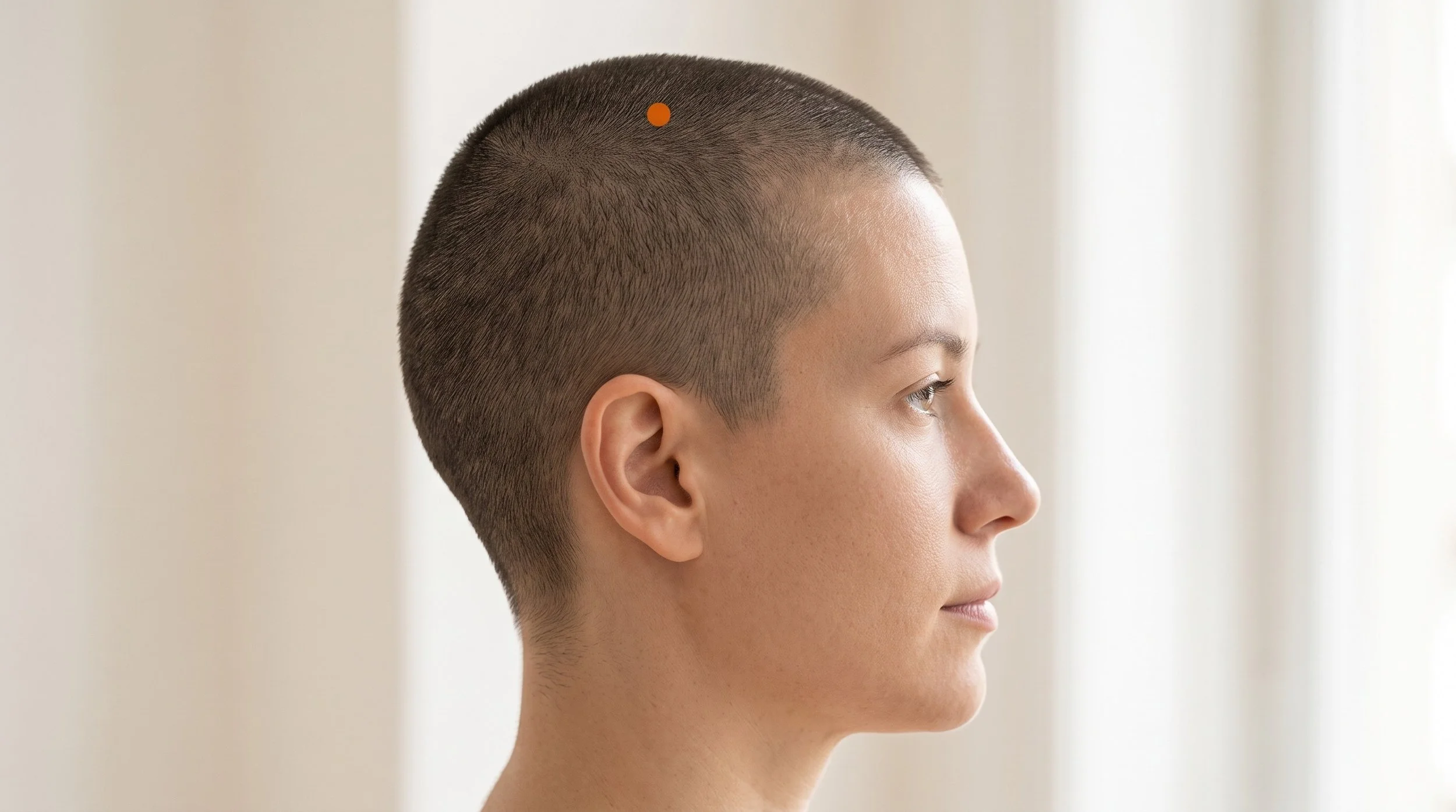
GB17 Acupuncture Point (Zhengying)
Upright Nutrition on the Parietal Scalp: Anatomy, Mechanism, and Why This Mid-Scalp Gallbladder Point Belongs in Headache and Dizziness Treatment
GB17, known in Chinese as Zhengying and usually translated as Upright Nutrition (some texts render it Top Convergence or True Nourishment), sits on the upper side of the head about two thirds of the way back along the curved Gallbladder line that runs from the front hairline toward the base of the skull.
In plain terms, if you slide a fingertip back from just above the outer edge of the eyebrow, over the crest of the head and toward the ear-side of the crown, GB17 lies in that band of scalp lateral to the vertex. It is a small point with a large amount of classical baggage: the tradition lists it as a meeting point of the Gallbladder channel with the Yang Linking vessel and credits it with easing one-sided headache, dizziness with nausea, and even upper jaw toothache.
Modern clinicians care about the gb17 acupuncture point for a more concrete reason: the scalp here is a crossroads where trigeminal and upper cervical sensory territory meet, which is exactly the neural real estate that matters in migraine and cervicogenic head pain.
- Location and layers: GB17 lies on the parietal scalp, 1.5 cun behind GB16 on the curved line drawn from GB15 toward GB20, or roughly two thirds of the way from GB15 to GB18 (Deadman et al., 2001). The needle passes through hair-bearing skin, a dense fibrofatty subcutaneous layer packed with vessels and nerves, and into or just above the galea aponeurotica over the parietal bone.
- Traditional categories, translated: classical sources call GB17 a crossing point of the Gallbladder channel with the Yang Linking vessel and assign it the actions of benefiting the head, easing pain, and pacifying the Stomach (Deadman et al., 2001). Read neurophysiologically, that is a description of a scalp site whose stimulation influences head pain and the nausea that often travels with it.
- Nerve geography: the scalp at gallbladder 17 sits where the anastomosing branches of the frontal (supraorbital, V1) nerve meet greater occipital (C2) territory (Chinese Acupuncture and Moxibustion, 1980). Trigeminal and upper cervical afferents converge on shared second-order neurons in the trigeminocervical complex, which is the accepted anatomical basis for pain referral across the head (Bartsch & Goadsby, 2003).
- Mechanism: needling recruits A-delta and C fiber input that engages segmental gating and descending inhibitory pathways involving opioid, serotonergic, and noradrenergic signaling, along with local vasoactive and autonomic changes (Zhao, 2008). Local effects at the scalp include changes in blood flow through the dense superficial temporal and occipital arterial network.
- Research picture: Cochrane reviews found acupuncture reduces headache frequency in episodic migraine and in frequent episodic or chronic tension-type headache, with effects that are modest but clinically meaningful (Linde et al., 2016a; Linde et al., 2016b). A large individual patient data analysis places headache among the pain conditions where acupuncture outperforms both sham and no-acupuncture control (Vickers et al., 2018).
- Clinical framing and de qi: GB17 is almost always a supporting player, threaded along the scalp with GB16 and GB18 and paired with GB20 and distal points rather than used alone. Because the needle lies flat under the skin, the sensation is typically a dull spreading pressure, a tugging or heaviness across the scalp, and sometimes a brief sharp pinch at insertion that settles within seconds.
Stuck With One-Sided Headaches That Keep Coming Back?
One-sided head pain rarely comes from one tissue, which is why we treat the scalp, the suboccipital muscles, and the jaw as a single system. At Morningside Acupuncture we use GB17 as part of a threaded parietal line, combined with GB20 at the base of the skull and distal points on the arms and legs. Sessions are unhurried, and we track headache frequency and intensity so you can see whether the plan is working. Schedule a visit and let's map out where your headaches actually start.
Schedule NowAnatomy of GB17: Why the Parietal Scalp Lateral to the Vertex Is Such an Important Location
The scalp is built in tidy layers, and at GB17 you can feel almost all of them. Under hair-bearing skin sits a tough subcutaneous layer of fibrous septa and fat that anchors arteries, veins, and cutaneous nerves so firmly that they cannot collapse the way vessels elsewhere do. Beneath that lies the galea aponeurotica, the broad tendinous sheet that ties the frontal and occipital bellies of occipitofrontalis together and blends laterally with temporoparietalis and the temporal fascia.
Then comes a loose areolar plane, the pericranium, and the parietal bone itself. What loads this tissue is rarely dramatic: sustained jaw clenching, hours of screen work with the head carried forward, chronic bracing through the temporalis and suboccipital muscles, and the low-grade tightening that many people describe as a hat-band or vise around the head.
The nerve map is the interesting part. Textbook descriptions place GB17 where branches of the frontal nerve, a division of the ophthalmic (V1) trigeminal nerve, anastomose with the greater occipital nerve arising from C2 (Chinese Acupuncture and Moxibustion, 1980). That is not a trivial detail.
Trigeminal afferents from the meninges and face and cervical afferents traveling in the greater occipital nerve converge on the same second-order neurons in the trigeminocervical complex, which is why upper neck input can be felt as frontal or orbital pain and why head pain so often spreads across territories that seem anatomically unrelated (Bartsch & Goadsby, 2003). Needling this scalp band feeds controlled afferent input into that shared pool.
Experimentally, acupuncture stimulation of this kind engages spinal and supraspinal gating along with descending inhibitory pathways using endogenous opioids, serotonin, and noradrenaline, which may reduce the excitability of sensitized second-order neurons (Zhao, 2008).
Vascularly, this is a rich neighborhood. Anatomical descriptions of GB17 note an anastomotic plexus formed where parietal branches of the superficial temporal artery and vein meet the occipital artery and vein (Chinese Acupuncture and Moxibustion, 1980). Practically, that means bruising is the most common minor event here, and it is why practitioners insert flat rather than deep. Classical needling convention for GB17 is transverse insertion along the scalp, from about 0.5 up to 1.5 cun depending on the source and on whether the practitioner is threading toward GB16 or GB18 (Deadman et al., 2001).
Shorter subcutaneous insertions of 0.3 to 0.5 cun are also described, and moxibustion is listed as applicable (Chinese Acupuncture and Moxibustion, 1980). The parietal bone lies directly beneath, so there is no deep structure at risk when the angle stays flat, but gentle pressure after withdrawal is a sensible habit.
Related Best Acupuncture Points For Headaches Related Pain Finder Head NeckGB17 at a Glance: Classification, Location, and Clinical Use
| Category | Detail |
|---|---|
| Traditional Name | Zhengying (Upright Nutrition, also translated as Top Convergence or True Nourishment) |
| Channel Classification | Gallbladder channel of Foot Shaoyang, parietal scalp segment |
| Point Categories | Meeting (crossing) point of the Gallbladder channel with the Yang Linking vessel (Yang Wei Mai); no five-shu, yuan, luo, xi-cleft, or hui-meeting designation |
| Precise Location | On the parietal scalp, 1.5 cun posterior to GB16 on the curved line running from GB15 toward GB20 and following the contour of the skull; equivalently, two thirds of the distance from GB15 to GB18. Commonly given as about 2.5 cun above the anterior hairline and 2.25 cun lateral to the midline. |
| Tissue Stimulated | Scalp skin, dense subcutaneous fibrofatty layer, galea aponeurotica over the parietal bone, with functional relationships to the suboccipital and jaw musculature including the lateral pterygoid |
| Needle Depth / Direction | Transverse (subcutaneous) insertion 0.5 to 1.5 cun along the scalp, often threaded toward GB16 or GB18; shorter insertions of 0.3 to 0.5 cun are also described. Moxibustion is listed as applicable. |
| De Qi Sensation | Dull spreading pressure or heaviness across the scalp, a tugging sensation under the skin as the needle advances, sometimes a brief pinch at insertion and occasionally a warm or tingling wash toward the temple |
| Primary Clinical Uses | One-sided headache and migraine-pattern head pain, headache with dizziness or visual dizziness, nausea accompanying head pain, stiff neck, and in classical use upper jaw toothache |
| Common Point Combinations |
|
Deadman, Al-Khafaji and Baker's A Manual of Acupuncture presents GB17 as a crossing point of the Gallbladder channel with the Yang Linking vessel and gives it two traditional actions: benefiting the head to relieve pain, and pacifying the Stomach. The indication list they compile from the classical record clusters into three loose groups. The first is head pain, especially one-sided head pain, along with toothache of the upper jaw.
The second is a dizziness and vomiting group, including visual dizziness, dizziness attributed in classical theory to phlegm-fluid, persistent vomiting, and nausea. The third is a mixed set of local and sensitivity signs: stiff neck, stiffness of the lips, aversion to wind and cold, and an aversion to hearing people talk. These are traditional attributions rather than modern diagnostic claims, but the bundling is striking.
Take a one-sided headache, add nausea, add dizziness, add an intolerance of sound, and you have described something that a contemporary clinician would recognize immediately as a migraine attack, assembled centuries before the term existed.
Why GB17 Is Used for Upper Jaw Toothache and Dizziness, Not Just Headache
The classical pairing of a scalp point with upper jaw toothache looks odd until you follow the nerves. The maxillary teeth are supplied by the maxillary division of the trigeminal nerve, and the scalp at GB17 sits in territory where the ophthalmic division's frontal branches meet cervical input from the greater occipital nerve (Chinese Acupuncture and Moxibustion, 1980). All three trigeminal divisions funnel into the spinal trigeminal nucleus, and cervical afferents join them there.
Because these inputs converge on shared second-order neurons, stimulation in one territory can influence processing in another, which is the same mechanism that explains why neck problems generate frontal pain and why dental pain sometimes refers into the temple (Bartsch & Goadsby, 2003). Classical practitioners could not have described that circuitry, but they noticed the clinical relationships it produces.
The dizziness and nausea side of the picture leans on a different arm of the same system. Head pain, autonomic symptoms, and nausea share brainstem territory, and needling appears to modulate that territory rather than acting on any single symptom. Experimental work indicates acupuncture stimulation activates descending inhibitory control from the periaqueductal gray and rostral ventromedial medulla, with opioid, serotonergic, and noradrenergic mediators, alongside changes in local blood flow and autonomic tone (Zhao, 2008).
None of this makes GB17 a standalone treatment for vertigo or vomiting, and dizziness always deserves a proper medical workup. It does explain why a scalp point kept turning up in formulas aimed at head pain that arrives with a queasy stomach.
In practice, we think of the gb 17 head location as a local input site layered on top of distal work. The scalp needle addresses the tissue and nerve territory where the patient actually feels pain; distal points on the hands, forearms, and legs recruit broader segmental and central effects. That layered approach is how acupuncture is delivered in most of the trials that show benefit, and it is how we build treatment plans in clinic.
What the Research Shows for GB17
No trial has isolated GB17 on its own, and it is worth saying that plainly. The research base tests whole protocols, usually a handful of local scalp and neck points combined with distal points, delivered over six to twelve sessions. So the honest framing is this: acupuncture protocols that include scalp points along the Gallbladder line have been studied for headache and migraine with generally favorable results, and GB17 is one plausible component of such a protocol rather than an independently validated intervention.
Effect sizes in the better reviews are modest, comparisons with sham are narrower than comparisons with usual care, and study quality varies considerably, especially among trials published in Chinese-language journals.
| Study | Type | Focus | Key Finding |
|---|---|---|---|
| Linde et al., 2016a | Cochrane systematic review | Acupuncture for the prevention of episodic migraine (22 trials) | Adding acupuncture to symptomatic care reduced headache frequency compared with usual care alone, with a small additional benefit over sham and results at least comparable to prophylactic drug treatment. |
| Linde et al., 2016b | Cochrane systematic review | Acupuncture for the prevention of tension-type headache (12 trials) | The authors concluded acupuncture appears effective for frequent episodic or chronic tension-type headache, while calling for more trials comparing it directly with other treatment options. |
| Vickers et al., 2018 | Individual patient data meta-analysis (39 trials, about 20,800 patients) | Chronic pain conditions including chronic headache and migraine | Acupuncture was superior to both sham and no-acupuncture control for chronic pain, with effects persisting over roughly a year rather than dissipating immediately. |
| Kim et al., 2023 | Systematic review and meta-analysis | Scalp acupuncture specifically for migraine | The pooled data favored scalp acupuncture over comparison treatments, though the authors noted that safety data were insufficient and evidence quality was limited. |
| Zhao et al., 2017 | Randomized clinical trial (249 participants) | Long-term acupuncture prophylaxis for migraine without aura | True acupuncture produced greater reductions in migraine days and attack frequency than sham acupuncture or a waiting list, with differences sustained through follow-up. |
| Bartsch & Goadsby, 2003 | Mechanistic review | Trigeminocervical convergence and headache referral patterns | Trigeminal and upper cervical afferents converge on shared brainstem neurons, providing the anatomical rationale for treating scalp and upper neck territory in head pain. |
Dizziness, Nausea, and Head Pressure Traveling Together?
When head pain arrives bundled with lightheadedness, queasiness, or sound sensitivity, the classical texts grouped those symptoms at points like Zhengying for a reason. Our licensed acupuncturists combine gentle scalp needling with autonomic-focused points and hands-on work at the neck, and we coordinate with your physician when a medical workup is warranted. Book an evaluation and we'll build a plan around your specific pattern.
Schedule NowGB17 in the Context of Trigger Point Work
Acupuncture, in our definition, is the use of an acupuncture needle, and that includes trigger point dry needling as one style among hundreds. GB17 itself is not a trigger point, since the galea is a tendinous sheet rather than a contractile muscle belly, but it sits squarely inside the referral field of several muscles that produce head pain.
The suboccipital group refers a deep, cap-like ache through the side and back of the head, upper trapezius sends pain up around the ear toward the temple, sternocleidomastoid refers into the vertex, forehead, and behind the eye, and temporalis refers into the side of the head and the upper teeth (Simons et al., 1999). That last referral pattern is worth pausing on given the classical link between GB17 and upper jaw toothache.
In clinic, we usually treat GB17 as a scalp-level input while dry needling the muscles that are actually generating referral. A typical session for one-sided headache might include threaded needling along GB16, GB17, and GB18, needling at GB20, and precise dry needling of the suboccipital group, upper trapezius, and, when jaw clenching is part of the picture, temporalis and the lateral pterygoid. Distal points such as LI4 and LV3 round out the treatment.
We then pair that with load management: screen height, jaw habits, sleep position, and short mobility breaks, because scalp needling works better when the tissues stop getting re-loaded the same way every day.
GB17 Headache Treatment at NYC's Highest-Rated Acupuncture Clinic
Morningside Acupuncture is the highest-rated acupuncture and dry needling clinic in New York City with over 500 five-star Google reviews, and headaches are one of the most common reasons people walk through our door. We blend traditional point selection with orthopedic assessment and trigger point dry needling of the muscles that refer pain into the scalp. Every plan is individualized, evidence-informed, and explained in plain language. Schedule your first session and start with a clear picture of your head pain.
Schedule NowFrequently Asked Questions
What does GB17 feel like when needled?
Because the needle is inserted flat under the skin rather than straight down, GB17 usually feels like a spreading dull pressure or heaviness across the scalp, sometimes with a tugging or dragging sensation as the needle threads along the tissue plane. Many people notice a brief pinch at the moment of insertion that fades within a few seconds. Some report a warm or tingling wash toward the temple or ear. Sharp, electric, or persistently burning sensations are not the goal, and you should tell your acupuncturist right away if you feel them so the needle can be adjusted.
Why needle a point on top of the head for a headache on the side of the head or for tooth pain?
Two reasons. First, the scalp at GB17 lies in a transition zone where branches of the frontal nerve (from the ophthalmic division of the trigeminal nerve) anastomose with the greater occipital nerve from C2, so the point is genuinely local to the sensory territory involved in lateral head pain. Second, trigeminal and upper cervical afferents converge on the same second-order neurons in the brainstem, which is why input in one part of that territory can influence pain processing in another, including maxillary tooth territory (Bartsch & Goadsby, 2003). The classical texts paired Zhengying with upper jaw toothache long before that circuitry was described, which is a nice case of clinical observation arriving ahead of the anatomy.
Can I press GB17 myself between sessions?
Yes, and the scalp responds well to self-pressure. Find the spot by placing a fingertip just above the outer end of your eyebrow, then tracing back over the head along a curved line toward the hollow at the base of your skull. GB17 sits roughly two thirds of the way along that line, in the band of scalp beside the crown. Use the pad of your index or middle finger and press firmly enough to feel a dull ache without pain, holding steady for 30 to 60 seconds or making small slow circles. Do two or three rounds per side, and treat both sides even if only one hurts. Repeat a few times a day. Stop if pressure sharpens the headache, and skip it entirely over any broken skin, recent injury, or surgical site.
Is GB17 safe to needle?
In trained hands it is a low-risk point, since the parietal bone lies directly beneath and the needle is angled flat along the scalp, so there is no deep structure to reach. The main consideration is vascular: the scalp here carries a dense anastomotic network of superficial temporal and occipital vessels, so small bruises or a drop of bleeding on withdrawal are the most common minor events, and firm pressure after needle removal usually prevents them. Practitioners take extra care with people on blood thinners, avoid the area over unclosed fontanelles in infants, and avoid needling over cranial implants, shunts, recent surgical sites, open wounds, or active skin lesions. As always, new, severe, sudden-onset, or progressively worsening headache needs medical evaluation before it is treated as a musculoskeletal problem.
Where exactly is GB17 located?
The standard zhengying point location is on the parietal scalp, 1.5 cun posterior to GB16, along the curved line that runs from GB15 (just above the outer eyebrow, half a cun inside the front hairline) back toward GB20 at the base of the skull, following the contour of the head. A useful cross-check is to locate GB18, which sits directly lateral to DU20 on the Gallbladder line, and then place GB17 two thirds of the way from GB15 to GB18 (Deadman et al., 2001). Other texts give it as approximately 2.5 cun above the front hairline and 2.25 cun lateral to the midline (Chinese Acupuncture and Moxibustion, 1980). On most heads that lands in the band of scalp between the crown and the top edge of the ear.
References
- Deadman, P., Al-Khafaji, M., & Baker, K. (2009). A manual of acupuncture. Journal of Chinese Medicine Publications.
- Cheng, X. (Ed.). (1999). Chinese acupuncture and moxibustion (Rev. ed.). Foreign Languages Press.
- Cunningham, P. M. (2000). Acupuncture points: A practical guide to classical and modern usage. Odyssey Press.
- Maciocia, G. (2005). The foundations of Chinese medicine: A comprehensive text for acupuncturists and herbalists (2nd ed.). Elsevier Churchill Livingstone.
- Cecil-Sterman, A. (2012). Advanced acupuncture: A clinic manual. Classical Wellness Press.
- Simons, D. G., Travell, J. G., & Simons, L. S. (1999). Travell & Simons' myofascial pain and dysfunction: The trigger point manual, Vol. 1: Upper half of body (2nd ed.). Williams & Wilkins.
- Linde, K., Allais, G., Brinkhaus, B., Fei, Y., Mehring, M., Vertosick, E. A., Vickers, A., & White, A. R. (2016a). Acupuncture for the prevention of episodic migraine. Cochrane Database of Systematic Reviews, 2016(6), CD001218. https://doi.org/10.1002/14651858.CD001218.pub3
- Linde, K., Allais, G., Brinkhaus, B., Fei, Y., Mehring, M., Shin, B.-C., Vickers, A., & White, A. R. (2016b). Acupuncture for the prevention of tension-type headache. Cochrane Database of Systematic Reviews, 2016(4), CD007587. https://doi.org/10.1002/14651858.CD007587.pub2
- Vickers, A. J., Vertosick, E. A., Lewith, G., MacPherson, H., Foster, N. E., Sherman, K. J., Irnich, D., Witt, C. M., & Linde, K. (2018). Acupuncture for chronic pain: Update of an individual patient data meta-analysis. Journal of Pain, 19(5), 455-474. https://doi.org/10.1016/j.jpain.2017.11.005
- Kim, C.-Y., Hwang, E.-H., Heo, I., Park, S.-Y., Shin, B.-C., & Hwang, M.-S. (2023). Effectiveness and safety of scalp acupuncture for treating migraine: A systematic review and meta-analysis. Complementary Therapies in Medicine, 78, 102991. https://doi.org/10.1016/j.ctim.2023.102991
- Zhao, L., Chen, J., Li, Y., Sun, X., Chang, X., Zheng, H., Gong, B., Huang, Y., Yang, M., Wu, X., Li, X., & Liang, F. (2017). The long-term effect of acupuncture for migraine prophylaxis: A randomized clinical trial. JAMA Internal Medicine, 177(4), 508-515. https://doi.org/10.1001/jamainternmed.2016.9378
- Bartsch, T., & Goadsby, P. J. (2003). The trigeminocervical complex and migraine: Current concepts and synthesis. Current Pain and Headache Reports, 7(5), 371-376. https://doi.org/10.1007/s11916-003-0036-y
- Zhao, Z. Q. (2008). Neural mechanism underlying acupuncture analgesia. Progress in Neurobiology, 85(4), 355-375. https://doi.org/10.1016/j.pneurobio.2008.05.004
Disclaimer: This web site is intended for educational and informational purposes only. Reading this website does not constitute providing medical advice or any professional services. This information should not be used for diagnosing or treating any health issue or disease. Those seeking medical advice should consult with a licensed physician. Seek the advice of a medical doctor or other qualified health professional for any medical condition. If you think you have a medical emergency, call 911 or go to the emergency room. No acupuncturist-patient relationship is created by reading this website or using the information. Morningside Acupuncture PLLC and its employees and contributors do not make any express or implied representations with respect to the information on this site or its use. For any legal interpretation of scope of practice in your state, consult a licensed attorney or regulatory authority.
Read more from our blog



