Dry Needling for Thoracic Outlet Syndrome
How Trigger Points in the Scalenes and Pectoralis Minor Compress the Brachial Plexus and Contribute to Arm Pain, Hand Numbness, and Vascular Symptoms
Thoracic outlet syndrome is one of the most frequently misdiagnosed conditions in upper extremity care, and tight, overloaded muscles at three distinct compression points are often at the center of it. This post explains how dry needling addresses the myofascial drivers behind TOS before surgery becomes a conversation.
- Thoracic outlet syndrome (TOS) describes compression of the brachial plexus, subclavian artery, or subclavian vein at three potential bottlenecks: the scalene triangle, the costoclavicular space, and the subcoracoid tunnel beneath the pectoralis minor.
- Neurogenic TOS, in which nerve tissue is compressed, accounts for the large majority of cases and often presents with arm pain, hand tingling (particularly along the ulnar border), and weakness that worsens with overhead or sustained postures.
- The anterior and middle scalene muscles form the walls of the scalene triangle, and trigger points within them can reduce the available space for the brachial plexus and subclavian artery even without a structural bony anomaly such as a cervical rib (Sanders et al., 2007).
- When compression exists at two or more points along the same nerve pathway, each site of reduced blood flow makes the nerve more vulnerable at adjacent sites, a concept described as the double crush phenomenon (Upton & McComas, 1973).
- Pectoralis minor shortening is a commonly overlooked compression contributor: when the muscle becomes hypertonic and shortened, it narrows the subcoracoid space and can compress both neural and vascular structures as they pass beneath it toward the arm.
- Conservative treatment, including dry needling, stretching, and posture retraining, is recommended before surgical options such as first rib resection or scalenectomy are considered (Povlsen et al., 2014).
- TOS is frequently misattributed to carpal tunnel syndrome, cervical radiculopathy, or rotator cuff pathology because the symptoms it produces overlap heavily with those conditions. Addressing the myofascial compression sites can clarify the diagnosis as much as confirm it.
Are arm tingling and neck pain keeping you from working comfortably?
Thoracic outlet symptoms often respond well to dry needling that targets the scalenes and surrounding muscles before they progress to the point of requiring surgical evaluation. Our practitioners work through the specific compression spaces relevant to your presentation.
Schedule NowThree Places the Brachial Plexus Can Get Squeezed
The brachial plexus, together with the subclavian artery and vein, travels from the cervical spine to the arm through a corridor that narrows at three anatomically distinct locations. Each of these sites has muscle tissue as a major contributing factor to its available diameter, which is why a myofascial approach to TOS makes mechanical sense.
The first and most proximate compression site is the scalene triangle, a wedge-shaped space bounded anteriorly by the anterior scalene, posteriorly by the middle scalene, and inferiorly by the first rib. The brachial plexus trunks and the subclavian artery pass through this triangle, while the subclavian vein runs in front of the anterior scalene and is not typically affected here. When the anterior or middle scalene becomes hypertonic, or when trigger points develop within their bellies, the triangle narrows and the structures passing through it are placed under sustained low-grade compression.
The second site is the costoclavicular space, the gap between the clavicle above and the first rib below. This space can narrow with postural changes that depress the shoulder girdle, particularly in people who carry heavy bags or hold a rounded shoulder posture for long periods. The subclavius muscle runs directly within this space and, when hypertonic, further reduces the available room for the neurovascular bundle.
The third site is the subcoracoid tunnel beneath the pectoralis minor, where the brachial plexus cords and the axillary vessels pass as they travel toward the arm. A shortened or hypertonic pectoralis minor pinches these structures against the coracoid process, particularly in any position that protracts or depresses the shoulder, including forward-head desk posture, backpack straps, and sleep positions with the arm overhead.
Related Scalene Trigger Points: Referred Pain Patterns and Treatment Related Pectoralis Minor Trigger Points: Chest, Shoulder, and Arm ReferralMuscles Involved by Compression Site
| Compression Site | Key Muscle(s) | Typical Symptoms | Aggravating Positions |
|---|---|---|---|
| Scalene Triangle | Scalenes (anterior, middle) | Arm pain, thumb and index finger tingling, radiating chest pain, subclavian artery pulsation changes | Turning head away from painful side, carrying loads at side, deep inhalation |
| Costoclavicular Space | Subclavius, depressed shoulder girdle posture | Arm heaviness, venous congestion, diffuse aching along the arm, occasional hand swelling | Downward shoulder depression (heavy bags, slumped sitting), military brace posture |
| Subcoracoid Tunnel | Pectoralis Minor | Ulnar border tingling (ring and little fingers), anterior shoulder pain, night arm pain in side-lying, vascular pallor in some positions | Arm raised overhead, reaching behind back, sleeping on side with arm above head |
| Contributing Posture Muscles | Upper Trapezius, Levator Scapulae, SCM | Neck pain, occipital headache, referred shoulder and arm aching that reinforces the compression pattern | Sustained forward head; elevated, rounded shoulder posture throughout the workday |
Neurogenic vs. Vascular TOS: Why the Distinction Matters for Treatment
Clinicians typically categorize TOS into neurogenic, arterial, and venous forms based on which structure is most compressed. Neurogenic TOS, in which the brachial plexus is the primary target, is by far the most common presentation, accounting for the vast majority of diagnosed cases. It produces the characteristic arm pain and paresthesia that patients most commonly report, and it responds most directly to myofascial treatment directed at the muscles surrounding the scalene triangle and subcoracoid space.
Arterial TOS, in which the subclavian artery is compressed, is rarer and produces vascular symptoms: arm pallor, coldness, or Raynaud's-like color changes, sometimes a palpable pulse difference between arms. Venous TOS, also called effort thrombosis or Paget-Schroetter syndrome, involves the subclavian vein and can produce arm swelling, bluish discoloration, and distended superficial veins. True vascular TOS requires vascular surgery evaluation. Myofascial treatment plays an adjunctive role in vascular forms by reducing the muscular contribution to compression, but it does not substitute for vascular assessment when frank arterial or venous compromise is present.
The practical point for most patients presenting with arm and hand symptoms: neurogenic TOS is often the working diagnosis when symptoms are position-dependent, reproduced by overhead activities or sustained neck rotation, and accompanied by scalene or pectoralis minor tenderness. These are the patients who tend to benefit most from a conservative muscle-focused approach before surgical consultation (Sanders et al., 2007).
Related Dry Needling for Arm Pain: Referred Pain vs. Nerve CompressionHave you been told it might be carpal tunnel, but nothing has worked?
When arm and hand tingling persists despite treatment aimed at the wrist, the compression source is sometimes further upstream, at the scalene triangle or beneath the pectoralis minor. Dry needling that addresses these proximal sites may clarify the picture. Our practitioners at Morningside evaluate the full pathway from neck to hand to identify where the bottleneck is.
Schedule NowThe Scalenes as the Primary Myofascial Driver
Among all the muscles involved in TOS, the scalenes receive the most attention in clinical practice, and for good reason. The anterior and middle scalenes form the actual walls of the scalene triangle, meaning their resting tone directly determines the available space for the brachial plexus and subclavian artery. Unlike most muscles that refer pain only into adjacent territory, scalene trigger points can refer pain down the entire arm and into the thumb, index, and middle fingers, a distribution that closely mimics cervical radiculopathy from C6 and makes accurate diagnosis challenging (Simons et al., 1999).
The scalenes are also respiratory accessory muscles, which creates a secondary load pattern worth noting. People who breathe primarily from the upper chest rather than the diaphragm use their scalenes with every breath, adding thousands of low-level contractions per day on top of any postural or carrying loads the muscles already sustain. Desk workers, people with anxiety-related shallow breathing, and anyone who has experienced a period of respiratory illness often develop scalene trigger points through this accessory breathing mechanism alone.
A third load pattern affects the scalenes specifically: lateral head tilt. When the head is held laterally flexed toward one side, as it is when cradling a phone, sleeping in certain positions, or reaching persistently to one side of a keyboard, the contralateral scalenes are placed under sustained eccentric load. Over time, this can produce trigger points on the side opposite to where a person feels their neck tightness, a finding that surprises patients who expected tenderness only where the pain was.
Pectoralis Minor: The Distal Compression That Gets Overlooked
Pectoralis minor shortening is a second-order compression mechanism that compounds the neurogenic load when scalene compression already exists. Research on myofascial referred pain suggests that when nerve tissue is sensitized proximally, it becomes more vulnerable to compression at secondary sites along the same pathway, Shah et al. (2015) documented the biochemical environment at active trigger points that contributes to this sensitization. The result is that a patient with scalene trigger points and pectoralis minor shortening may experience symptoms far more severe than either compression site would produce in isolation.
Pectoralis minor shortening is closely associated with the rounded-shoulder, forward-head posture that characterizes prolonged desk work. The muscle attaches from the third, fourth, and fifth ribs to the coracoid process of the scapula, meaning it pulls the scapula anteriorly and inferiorly when short. This protracted scapular position narrows the subcoracoid tunnel and places the cords of the brachial plexus under sustained low-grade traction as they wrap around the shortened muscle belly.
Related Dry Needling NYC: How It Works and What to ExpectThe Double Crush Mechanism in TOS
Upton and McComas (1973) proposed that a nerve subjected to compression at one point becomes more susceptible to injury at a second point along its path, because impaired axoplasmic flow at the proximal site reduces the nerve's capacity to tolerate mechanical insult distally. In TOS, this means a patient with scalene triangle compression may develop symptoms in the hand at pressures that would not affect a nerve with a normal proximal segment. It also means that treating only the wrist or elbow, the more distal and often more symptomatic sites, may produce only partial relief until the proximal compression at the scalene triangle or beneath the pectoralis minor is addressed.
This double crush framework is one reason why some patients with apparent carpal tunnel syndrome fail to improve after carpal tunnel release, or why those with apparent cubital tunnel syndrome note only modest changes after ulnar nerve transposition. The proximal compression at the thoracic outlet continues to sensitize the entire nerve pathway, and the distal symptoms return or persist. Identifying and treating TOS as part of a comprehensive nerve compression evaluation, rather than as a last resort after distal procedures have failed, tends to produce better overall outcomes.
How Dry Needling Addresses TOS
Conservative management of neurogenic TOS, including dry needling, physical therapy, and postural retraining, is consistently recommended as the first-line approach before surgical options are considered (Povlsen et al., 2014). Dry needling contributes to this conservative pathway by targeting the trigger points that reduce the diameter of the scalene triangle and subcoracoid tunnel, specifically by eliciting a local twitch response in the anterior and middle scalenes that signals a sudden release of sustained sarcomere contracture at the motor endplate level.
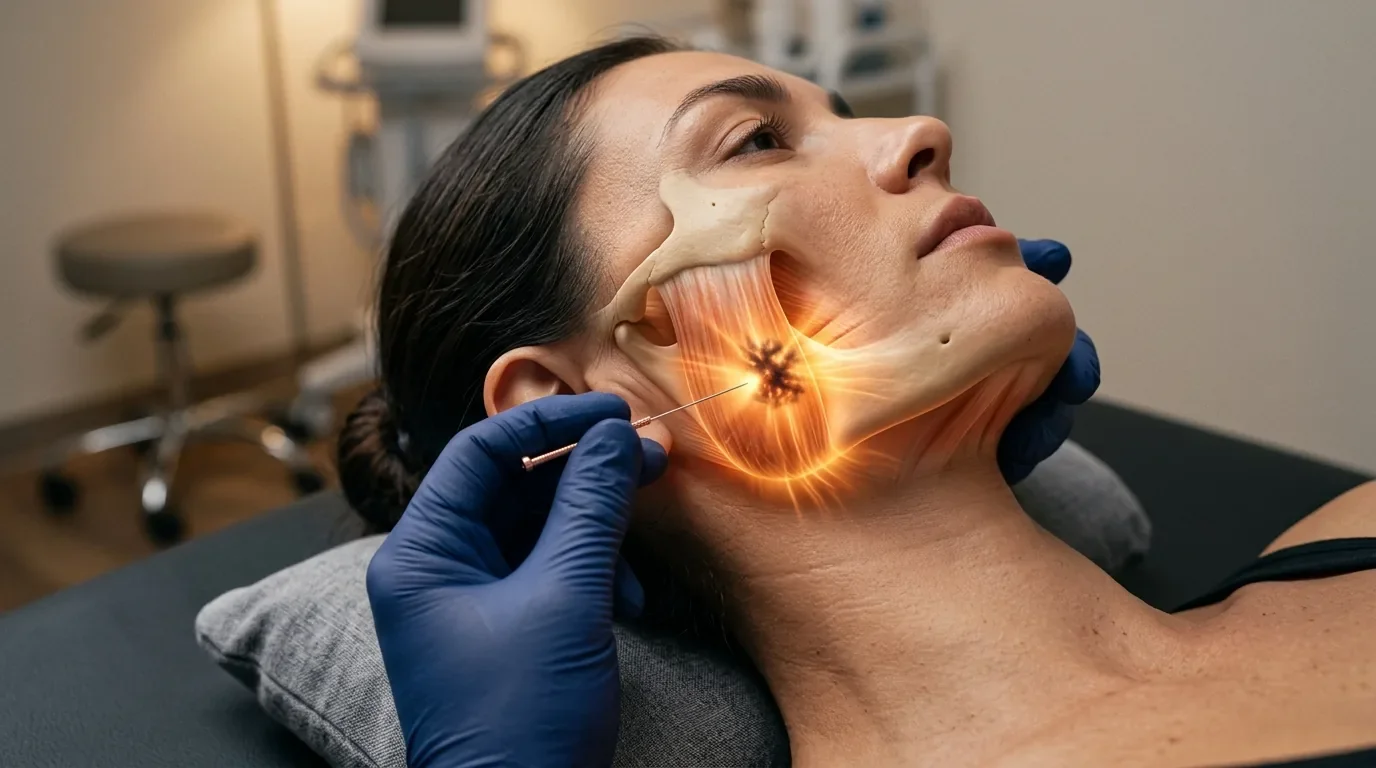
In practice, scalene needling requires anatomical precision and practitioner experience because the lung apex sits immediately adjacent to the scalene triangle. Practitioners familiar with this anatomy approach the scalenes from lateral and posterior angles to maximize safety margins, typically targeting the mid-belly of the anterior and middle scalenes where trigger point bands are palpable. The local twitch response in the scalenes is often dramatic, producing a referral into the arm or thumb that temporarily reproduces the patient's symptoms before subsiding as the trigger point releases.
Pectoralis minor needling is generally more accessible, with the muscle approached from the anterior chest wall between the ribs. Subclavius trigger points, located just below the clavicle in its medial third, are needled carefully with awareness of the underlying structures. Upper trapezius, levator scapulae, and SCM trigger points are typically treated in the same session to address the postural loading pattern that perpetuates scalene overload.
Dry needling alone rarely produces lasting change without addressing the postural and breathing patterns that overload these muscles. Diaphragmatic breathing retraining, pectoralis minor stretching, and scapular retraction exercises are the most commonly recommended adjuncts, and the period immediately following dry needling, when the treated muscles are in a temporary window of reduced tone, appears to be an effective time to introduce these movement patterns.
Related Trigger Point Treatment at Morningside AcupunctureReady to address the source of your arm pain and hand tingling?
At Morningside Acupuncture, we are the highest-rated acupuncture and dry needling clinic in New York City with over 500 five-star Google reviews. We evaluate TOS presentations by examining the full compression pathway from the scalene triangle to the subcoracoid space, and we develop a treatment plan that addresses the muscles involved at each level. If you have been managing persistent arm pain, hand numbness, or symptoms that shift with your posture or arm position, we would be glad to evaluate what is driving your presentation.
Schedule NowFrequently Asked Questions
How do I know if I have thoracic outlet syndrome or carpal tunnel syndrome?
The distributions overlap, which makes distinguishing them difficult without a careful examination. Carpal tunnel syndrome classically affects the thumb, index, middle, and radial half of the ring finger, and symptoms are often worst at night or with sustained wrist flexion. TOS more commonly produces ulnar-side symptoms (ring and little fingers), arm heaviness, and tingling that worsens with overhead activities or sustained neck positions rather than wrist position. A practitioner can use positional tests and trigger point palpation to help narrow the picture, and in some cases both conditions are present simultaneously through the double crush mechanism.
Is dry needling safe near the neck and scalene muscles?
Dry needling in the scalene region requires a practitioner with specific training in cervical anatomy, because the lung apex is anatomically adjacent to the scalene triangle. When performed by an experienced practitioner using appropriate angles and needle depths, scalene dry needling is considered safe. At Morningside, practitioners are trained in cervical needling protocols and use laterally directed approaches to maintain adequate safety margins from the pleura.
How many sessions are typically needed for TOS?
Most patients with neurogenic TOS notice measurable improvement in arm tingling and positional symptoms within three to six sessions, though this depends on how long the condition has been present and whether postural contributors are being addressed alongside needling. Longstanding TOS with central sensitization may require a longer course of treatment combined with consistent postural and breathing work between sessions.
Can dry needling help me avoid surgery for thoracic outlet syndrome?
Surgical options for TOS, including first rib resection and scalenectomy, are generally reserved for cases that have not responded to a sustained trial of conservative care. Research supports conservative management including physical therapy and myofascial treatment as the recommended first step (Povlsen et al., 2014). While dry needling cannot address structural anomalies such as a cervical rib or fibrous band, it can significantly reduce the muscular component of compression, and some patients find their symptoms resolve sufficiently that surgery is no longer warranted.
Does Morningside Acupuncture treat thoracic outlet syndrome specifically?
Yes. Our practitioners regularly evaluate and treat patients presenting with TOS symptoms, including arm pain, hand tingling, and positional vascular symptoms. Treatment focuses on the scalenes, pectoralis minor, subclavius, and surrounding postural muscles, integrated with guidance on breathing patterns and posture adjustments that reduce the ongoing load on these tissues. We also coordinate with referring physicians when imaging or vascular evaluation is indicated.
References
- Sanders, R. J., Hammond, S. L., & Rao, N. M. (2007). Diagnosis of thoracic outlet syndrome. Journal of Vascular Surgery, 46(3), 601–604.
- Upton, A. R. M., & McComas, A. J. (1973). The double crush in nerve entrapment syndromes. The Lancet, 302(7825), 359–362. https://doi.org/10.1016/S0140-6736(73)93196-6
- Simons, D. G., Travell, J. G., & Simons, L. S. (1999). Travell & Simons' Myofascial Pain and Dysfunction: The Trigger Point Manual (2nd ed.). Williams & Wilkins.
- Shah, J. P., Thaker, N., Heimur, J., Aredo, J. V., Sikdar, S., & Gerber, L. H. (2015). Myofascial trigger points then and now: A historical and scientific perspective. PM&R, 7(7), 746–761. https://doi.org/10.1016/j.pmrj.2015.01.024
- Povlsen, B., Hansson, T., & Povlsen, S. D. (2014). Treatment for thoracic outlet syndrome. Cochrane Database of Systematic Reviews, (11), CD007218. https://doi.org/10.1002/14651858.CD007218.pub3
- Roos, D. B. (1976). Congenital anomalies associated with thoracic outlet syndrome: Anatomy, symptoms, diagnosis, and treatment. The American Journal of Surgery, 132(6), 771–778.
Disclaimer: This web site is intended for educational and informational purposes only. Reading this website does not constitute providing medical advice or any professional services. This information should not be used for diagnosing or treating any health issue or disease. Those seeking medical advice should consult with a licensed physician. Seek the advice of a medical doctor or other qualified health professional for any medical condition. If you think you have a medical emergency, call 911 or go to the emergency room. No acupuncturist-patient relationship is created by reading this website or using the information. Morningside Acupuncture PLLC and its employees and contributors do not make any express or implied representations with respect to the information on this site or its use. For any legal interpretation of scope of practice in your state, consult a licensed attorney or regulatory authority.
Read more from our blog