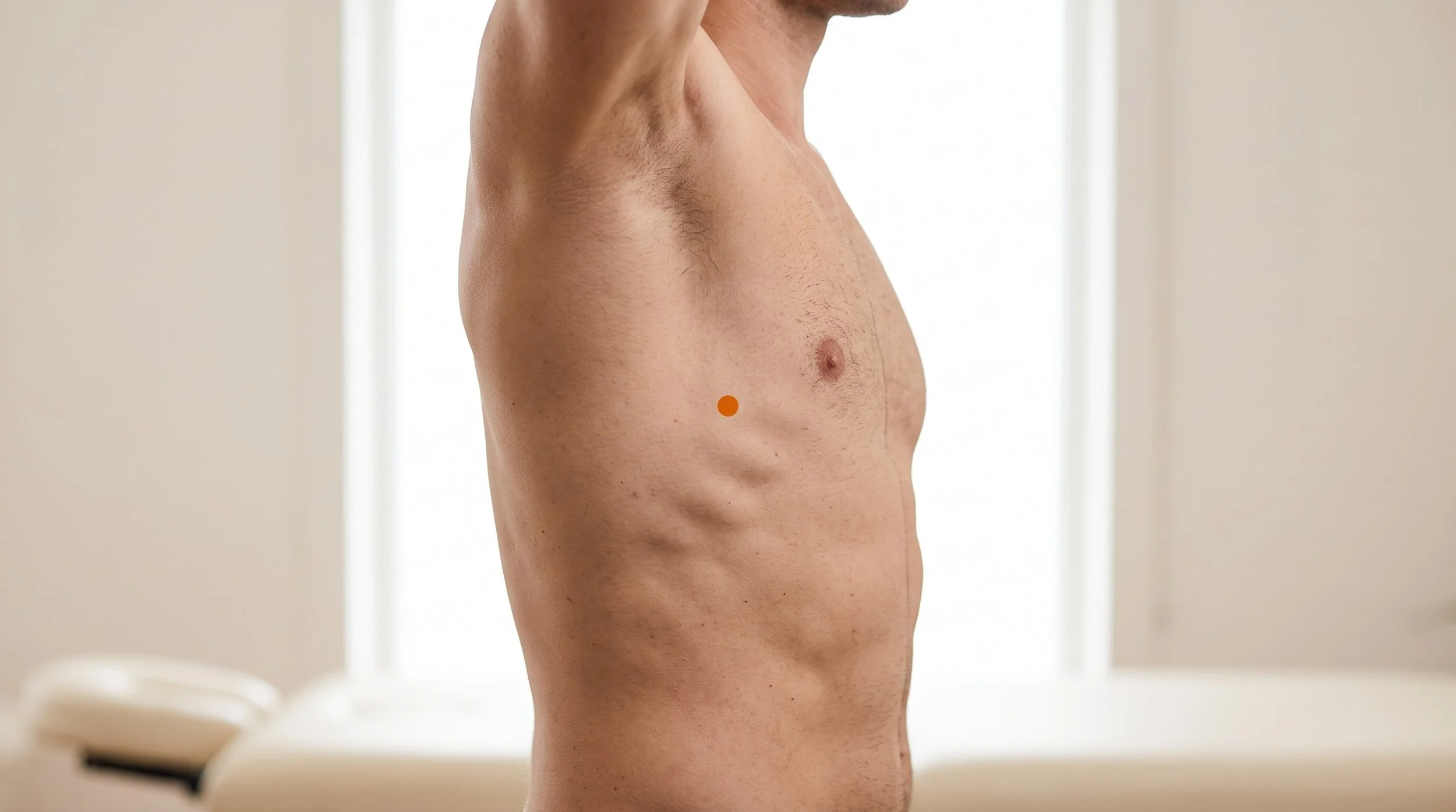
GB22 Acupuncture Point (Yuanye)
The Armpit Abyss on the Mid-Axillary Line: Anatomy, Mechanism, and Why This Side-Chest Point Belongs in Rib, Serratus, and Shoulder Treatment
GB22 (Yuanye), usually translated as Armpit Abyss, is the Gallbladder channel point on the side of the chest, sitting on the mid-axillary line in the fifth intercostal space roughly 3 cun below the apex of the armpit and about level with the nipple. It is the point clinicians reach for when pain lives in that awkward strip of ribcage under the arm: the band that aches when you take a full breath, reach overhead, sleep on one side, or carry a bag across the body.
Classical sources describe it as a point that unbinds the chest and benefits the axilla, and modern practice treats it as a precise, flat-angled way to reach the serratus anterior and the intercostal tissue over the fifth rib. Because the pleura lies beneath, the yuanye point location is one where technique matters as much as the map.
- Location and layers: GB22 sits on the mid-axillary line in the fifth intercostal space, about 3 cun below the apex of the axilla and near nipple level, with the needle passing through skin and subcutaneous tissue into the digitations of serratus anterior and the external intercostal fibers over the fifth rib space (Deadman et al., 2007).
- Traditional categories, translated: classical texts attribute to this point the actions of regulating qi, unbinding the chest, and benefiting the axilla. Read clinically, that describes a point used for restricted, guarded breathing and side-of-chest tightness rather than anything measured in energetic terms.
- Mechanism: needling here engages lateral cutaneous branches of the intercostal nerves and the serratus anterior territory supplied along the long thoracic nerve's descending course, feeding into the same thoracic spinal segments that carry chest wall pain, with descending inhibitory and endogenous opioid pathways contributing to the broader analgesic response (Zhao, 2008).
- Research picture: no trial isolates gallbladder 22 by itself. The relevant evidence is indirect, from individual patient data meta-analysis showing modest but persistent benefit of acupuncture in chronic pain (Vickers et al., 2018), a Cochrane review of shoulder pain that found the evidence base thin and inconclusive (Green et al., 2005), and a randomized trial in traumatic rib fracture pain reporting improvement in movement-related and breathing-related pain (Liu et al., 2022).
- Practice framing: GB22 is almost always a local or adjunct point, paired with distal Gallbladder points and with trigger point needling of serratus anterior and the intercostals when palpation reproduces the patient's familiar side-chest pain (Simons et al., 1999).
- De qi and safety: patients usually report a spreading heaviness or a dull ache that tracks along the rib space rather than a sharp signal. The needle is angled flat along the intercostal space because deep or perpendicular insertion in this region risks pneumothorax, the most frequently reported serious adverse event in the acupuncture safety literature (He et al., 2012).
Side-Chest or Rib Pain That Gets Worse When You Breathe In?
Pain along the ribs under the arm is often mechanical: serratus anterior, the intercostals, and the tissue that has to glide every time the ribcage expands. At Morningside Acupuncture we palpate that band carefully, use GB22 with flat, intercostal-angle technique, and add distal Gallbladder points so the treatment is not just local. Manual therapy and simple breathing drills go home with you so the change holds between visits. Schedule a visit and let's map where your rib pain actually lives.
Schedule NowAnatomy of GB22: Why the Mid-Axillary Line at the Fifth Rib Space Is Such an Important Location
Drop a vertical line from the apex of the armpit down the side of the chest, then count rib spaces from the second space at the sternal angle until you reach the fifth. That intersection is GB22. Under the skin and a thin subcutaneous layer sit the fanned digitations of serratus anterior, and beneath those, the external intercostal fibers bridging the fifth and sixth ribs. This is loaded tissue in daily life: serratus anterior protracts and upwardly rotates the scapula every time you reach, push, or carry, while the intercostals work continuously with the mechanics of breathing. Desk posture, side sleeping, heavy bags, swimming, throwing, and long coughing illnesses all leave their signature here.
The sensory story is segmental. Lateral cutaneous branches of the intercostal nerves surface right around this line, carrying input from the chest wall into the mid-thoracic spinal segments. Serratus anterior itself is innervated by the long thoracic nerve, which descends along this same lateral chest wall surface. When a needle is placed at GB22, it recruits afferents that converge in the dorsal horn with the very segments already receiving nociceptive traffic from an irritated rib space or a taut serratus band, which is a plausible route for local pain modulation.
Beyond that segmental level, needling recruits descending inhibitory control from the brainstem and endogenous opioid mechanisms that dampen pain signaling more broadly (Zhao, 2008). Palpation matters too, because serratus anterior trigger points are known to project pain along the side of the chest and down the inner arm, a pattern patients often describe before any imaging finds anything (Simons et al., 1999).
Deep to the intercostal layer is the pleura and lung, which is why technique at GB22 is non-negotiable. The standard convention is transverse or oblique insertion along the intercostal space to a depth of about 0.5 to 1 cun, never perpendicular and never deep (Deadman et al., 2007). Pneumothorax is the most commonly reported serious adverse event associated with acupuncture, and it is overwhelmingly a technique and anatomy problem rather than an inherent property of needling (He et al., 2012).
Several classical texts also list this point as contraindicated to moxibustion, although not every modern text agrees, so many clinicians simply skip moxa here and use gentle manual technique instead.
Related Serratus Anterior Trigger Points Related Intercostal Muscles Trigger PointsGB22 at a Glance: Classification, Location, and Clinical Use
| Category | Detail |
|---|---|
| Traditional Name | Yuanye (Armpit Abyss, also rendered Axilla Abyss or Gulf Fluid) |
| Channel Classification | Gallbladder channel of Foot Shaoyang, on the lateral chest wall |
| Point Categories | Not a five-shu, front-mu, or extraordinary vessel intersection point. Classically described as the meeting point of the three yin sinew (muscle) channels of the arm, and referenced in channel theory as the landmark from which the great connecting channel of the Spleen is described as emerging three cun below. Several classical texts list it as contraindicated to moxibustion, though modern texts differ on this. |
| Precise Location | On the lateral chest wall, on the mid-axillary line in the fifth intercostal space, roughly 3 cun below the apex of the axilla and approximately level with the nipple. Locate the second rib at the sternal angle, then count down three spaces. Some sources place the point in the fourth intercostal space. |
| Tissue Stimulated | Skin and subcutaneous tissue, serratus anterior digitations over the fifth rib, and the external intercostal muscles; lateral cutaneous intercostal branches and the long thoracic nerve territory lie nearby |
| Needle Depth / Direction | Transverse to oblique insertion along the line of the intercostal space, 0.5 to 1 cun. Perpendicular or deep needling is avoided because of pneumothorax risk. |
| De Qi Sensation | A dull, spreading heaviness or mild ache that often travels along the rib space toward the front of the chest or up into the armpit; sharp, electric, or breath-catching sensations mean the angle should be changed immediately |
| Primary Clinical Uses | Side-of-chest and rib pain, intercostal and chest wall tenderness, serratus-region tension, restricted or guarded breathing, and difficulty raising the arm; classically also axillary swelling and tenderness |
| Common Point Combinations |
|
In Deadman's A Manual of Acupuncture, GB22 is presented with two traditional actions, regulating qi to unbind the chest and benefiting the axilla, and its classical indication list clusters into three groups: respiratory and chest complaints such as cough, chest fullness, and alternating chills and fever; lateral costal pain; and swellings of the armpit including the nodular presentations older texts called scrofula and sabre lumps. A fourth group is purely musculoskeletal, covering shoulder and arm pain along with the inability to lift the arm.
The same source records a grouping from the Illustrated Supplement pairing this point with TE6, TE5, and GB41 for axillary lumps. These are traditional attributions rather than modern diagnoses, but what stands out is how tightly the classical list maps onto one anatomical zone. Ancient clinicians grouped breathing, rib pain, armpit swelling, and overhead reach at a single spot on the side of the chest, which is precisely the territory served by the intercostal segments and the serratus anterior that lie under the needle.
Why GB22 Is Used for Rib Pain That Flares With a Deep Breath
Patients with side-chest pain often describe a symptom that has nothing to do with the lungs but everything to do with breathing: a catch under the arm at the top of an inhale, a stab when they cough or laugh, a dull band that shows up after a night on that side. Once serious causes have been ruled out by a physician, what remains is usually mechanical, involving the intercostal tissue, the rib joints, and serratus anterior. GB22 sits directly in that zone.
Needling there stimulates afferents that enter the same thoracic spinal segments already handling the irritated tissue's pain signals, and this segmental convergence is one of the more reliable explanations for why local needling changes how a chest wall region feels and moves.
There is a second layer beyond the segment. Needle stimulation activates brainstem-mediated descending inhibitory pathways and endogenous opioid mechanisms that reduce the gain of pain signaling more broadly, which is why patients frequently report that the whole side quiets down rather than just the spot that was needled (Zhao, 2008). Clinically, that combination is what makes a local chest wall point worth including alongside distal points instead of relying on either alone.
Breathing itself is part of the treatment. When one side of the ribcage has been guarded for weeks, expansion becomes asymmetrical and the guarding perpetuates the tension. In the closest evidence to this clinical picture, a randomized controlled trial in patients with traumatic rib fractures reported that acupuncture was associated with improvement in pain during breathing and movement compared with sham laser control (Liu et al., 2022). That study used a multi-point protocol in a trauma population, not GB22 alone, so it should be read as supportive context rather than proof that this single point does the work.
What the Research Shows for GB22
It is worth being direct about the state of the evidence. No clinical trial has isolated GB22 as a standalone intervention, and it is unlikely one ever will, since chest wall protocols always use several points chosen for the individual. What we can point to are broader syntheses that tell us how acupuncture performs for pain overall, a Cochrane review specific to shoulder pain, one randomized trial in rib-related chest pain, mechanistic work on how needling modulates nociception, and a safety literature that explains exactly why the needling convention at this point is so conservative. Read together, these support GB22 as a reasonable component of a chest wall or shoulder treatment plan, not as a solution on its own.
| Study | Type | Focus | Key Finding |
|---|---|---|---|
| Vickers et al., 2018 | Individual patient data meta-analysis | Acupuncture for chronic musculoskeletal, headache, and osteoarthritis pain across roughly 20,000 patients | Acupuncture was associated with modest but statistically significant benefit over both sham and no-acupuncture controls, with effects that persisted over time rather than fading immediately. |
| Green et al., 2005 | Cochrane systematic review | Acupuncture for adults with shoulder pain, including rotator cuff disease and adhesive capsulitis | The reviewers found too few adequately powered trials to draw firm conclusions, with some short-term benefit reported but insufficient evidence overall to support or refute routine use. |
| Liu et al., 2022 | Randomized controlled trial | Acupuncture and laser acupuncture versus sham laser for pain from traumatic rib fractures | Needle acupuncture was associated with reduced pain during breathing, coughing, and turning, suggesting a possible role for chest wall needling in movement-related rib pain. |
| Zhao, 2008 | Narrative review of neurophysiology | Mechanisms of acupuncture analgesia, including segmental and descending pain control | Needle stimulation engages spinal segmental modulation, brainstem descending inhibition, and endogenous opioid release, offering a physiological framework for local point effects. |
| He et al., 2012 | Systematic review of adverse events | Acupuncture-related adverse events reported in the Chinese literature from 1956 to 2010 | Pneumothorax was among the most frequently reported serious events, reinforcing that shallow, angled technique over the ribcage is a safety requirement rather than a stylistic preference. |
Trouble Reaching Overhead or Sleeping on That Side?
Classical sources listed inability to raise the arm alongside axillary and side-chest complaints at this point, and modern shoulder patients often present exactly that way. We combine GB22 with serratus anterior and intercostal dry needling, scapular mechanics work, and shoulder channel points chosen from your exam rather than a template. Most patients notice their overhead reach and side-lying comfort respond together. Book an appointment and we'll build the plan around how you actually move.
Schedule NowGB22 in the Context of Trigger Point Work
The gb22 acupuncture point and the classic serratus anterior trigger point zone occupy nearly the same real estate on the lateral chest wall. Serratus anterior trigger points are described as referring pain along the side of the chest, around the lower scapular border, and sometimes down the inner arm, a pattern that can feel alarming to patients because it does not follow any obvious joint (Simons et al., 1999). Intercostal trigger points add a sharper, more breath-linked quality within a single rib space.
Because acupuncture is defined by the use of an acupuncture needle across hundreds of styles, including dry needling, treating the point and treating the taut band are the same physical act performed with different reasoning behind it.
At Morningside, gb 22 ribs work usually starts with palpation rather than a chart. We find the fifth space on the mid-axillary line, check whether pressure there reproduces the patient's familiar pain, and then needle flat along the space, adding serratus anterior and intercostal targets where the exam points. Distal Gallbladder points such as GB34 are often included so the treatment is not purely local, and scapular control drills and breathing work follow so the ribcage keeps its new range.
When a patient's presentation is mostly shoulder-driven, the same session may extend to rotator cuff and scapular stabilizer targets rather than staying on the chest wall.
GB22 Rib and Side-Chest Pain Treatment at NYC's Highest-Rated Acupuncture Clinic
Morningside Acupuncture is the highest-rated acupuncture and dry needling clinic in New York City with over 500 five-star Google reviews, and rib, chest wall, and shoulder complaints are a core part of what we treat. Every side-chest treatment is done with clean, conservative technique: flat angles along the rib space, careful palpation first, and clear explanations of what we are needling and why. You will leave knowing what is driving your pain and what to do about it. Schedule your session at our Upper West Side office today.
Schedule NowFrequently Asked Questions
What does GB22 feel like when needled?
Most people feel a dull, heavy, spreading sensation that runs along the rib space, sometimes drifting toward the front of the chest or up into the armpit. Because the needle is threaded flat rather than driven straight in, the sensation is generally mild and superficial. If serratus anterior is involved, you may feel a brief twitch or cramp-like grab, which usually settles within seconds. Anything sharp, electric, or that makes you catch your breath should be reported at once so the practitioner can adjust the angle.
Why needle the side of the chest for shoulder or arm symptoms?
Serratus anterior is a shoulder muscle even though it lives on the ribcage, and it has to work correctly for the shoulder blade to rotate upward when you reach overhead. When that tissue is tight or irritated, overhead reach and side-lying comfort both suffer. Classical sources noticed the connection too, listing shoulder and arm pain and inability to raise the arm among the traditional indications for Yuanye. Treating GB22 addresses the chest wall contribution that a shoulder-only treatment plan can miss.
Can I press GB22 myself between sessions?
Yes, acupressure here is safe because fingers cannot reach anything a needle can. Raise your arm, find the mid-axillary line by dropping straight down from the deepest point of the armpit, then slide down about three finger widths to roughly nipple level and feel for the tender rib space. Press with the pads of two fingers at moderate pressure, enough to feel a distinct ache but not enough to make you brace or hold your breath. Hold for 30 to 60 seconds, release, then repeat two or three times, and try a slow inhale during each hold so the ribcage expands under your fingers. Twice a day is plenty. Stop if pressure produces sharp pain, numbness, or any change in breathing, and see a physician for chest pain that is new, severe, or unexplained.
Is GB22 safe to needle?
It is safe in trained hands, and it is exactly the kind of point that shows why training matters. The pleura and lung lie beneath the intercostal layer, so the standard convention is transverse or oblique insertion along the rib space to no more than about 1 cun, never perpendicular and never deep. Pneumothorax is the most commonly reported serious adverse event in the acupuncture safety literature, and it is almost always associated with deep needling over the thorax rather than with careful, shallow technique (He et al., 2012). Several classical texts also list this point as contraindicated to moxibustion, and many practitioners follow that convention. Tell your practitioner if you have lung disease, emphysema, a history of pneumothorax, are very thin, or take blood thinners.
Where exactly is GB22 located?
GB22 lies on the side of the chest on the mid-axillary line, which is the vertical line dropped from the apex of the armpit, in the fifth intercostal space. That places it roughly 3 cun below the top of the armpit and about level with the nipple. The most reliable way to confirm the yuanye point location is to find the second rib at the sternal angle, identify the second intercostal space beneath it, and count down three more spaces. Some classical and modern sources place gallbladder 22 in the fourth intercostal space instead, so palpation for the tender, relevant space is more useful than counting alone.
References
- Deadman, P., Al-Khafaji, M., & Baker, K. (2009). A manual of acupuncture. Journal of Chinese Medicine Publications.
- Kim, H. (2008). Handbook of Oriental medicine (3rd ed.). Harmony & Balance Press.
- Cunningham, P. M. (2000). Acupuncture points: A practical guide to classical and modern usage. Odyssey Press.
- Maciocia, G. (2006). The channels of acupuncture: Clinical use of the secondary channels and eight extraordinary vessels. Churchill Livingstone Elsevier.
- Simons, D. G., Travell, J. G., & Simons, L. S. (1999). Travell & Simons' myofascial pain and dysfunction: The trigger point manual, Vol. 1: Upper half of body (2nd ed.). Williams & Wilkins.
- Vickers, A. J., Vertosick, E. A., Lewith, G., MacPherson, H., Foster, N. E., Sherman, K. J., Irnich, D., Witt, C. M., & Linde, K. (2018). Acupuncture for chronic pain: Update of an individual patient data meta-analysis. Journal of Pain, 19(5), 455-474. https://doi.org/10.1016/j.jpain.2017.11.005
- Zhao, Z. Q. (2008). Neural mechanism underlying acupuncture analgesia. Progress in Neurobiology, 85(4), 355-375. https://doi.org/10.1016/j.pneurobio.2008.05.004
- Green, S., Buchbinder, R., & Hetrick, S. (2005). Acupuncture for shoulder pain. Cochrane Database of Systematic Reviews, 2005(2), CD005319. https://doi.org/10.1002/14651858.CD005319
- Liu, C. T., Hsieh, T. M., Wu, B. Y., Huang, Y. C., Shih, C. H., Hu, W. L., Tsai, M. Y., & Chen, Y. H. (2022). Acupuncture analgesia in patients with traumatic rib fractures: A randomized-controlled trial. Frontiers in Medicine, 9, 896692. https://doi.org/10.3389/fmed.2022.896692
- He, W., Zhao, X., Li, Y., Xi, Q., & Guo, Y. (2012). Adverse events following acupuncture: A systematic review of the Chinese literature for the years 1956-2010. Journal of Alternative and Complementary Medicine, 18(10), 892-901. https://doi.org/10.1089/acm.2011.0825
Disclaimer: This web site is intended for educational and informational purposes only. Reading this website does not constitute providing medical advice or any professional services. This information should not be used for diagnosing or treating any health issue or disease. Those seeking medical advice should consult with a licensed physician. Seek the advice of a medical doctor or other qualified health professional for any medical condition. If you think you have a medical emergency, call 911 or go to the emergency room. No acupuncturist-patient relationship is created by reading this website or using the information. Morningside Acupuncture PLLC and its employees and contributors do not make any express or implied representations with respect to the information on this site or its use. For any legal interpretation of scope of practice in your state, consult a licensed attorney or regulatory authority.
Read more from our blog



