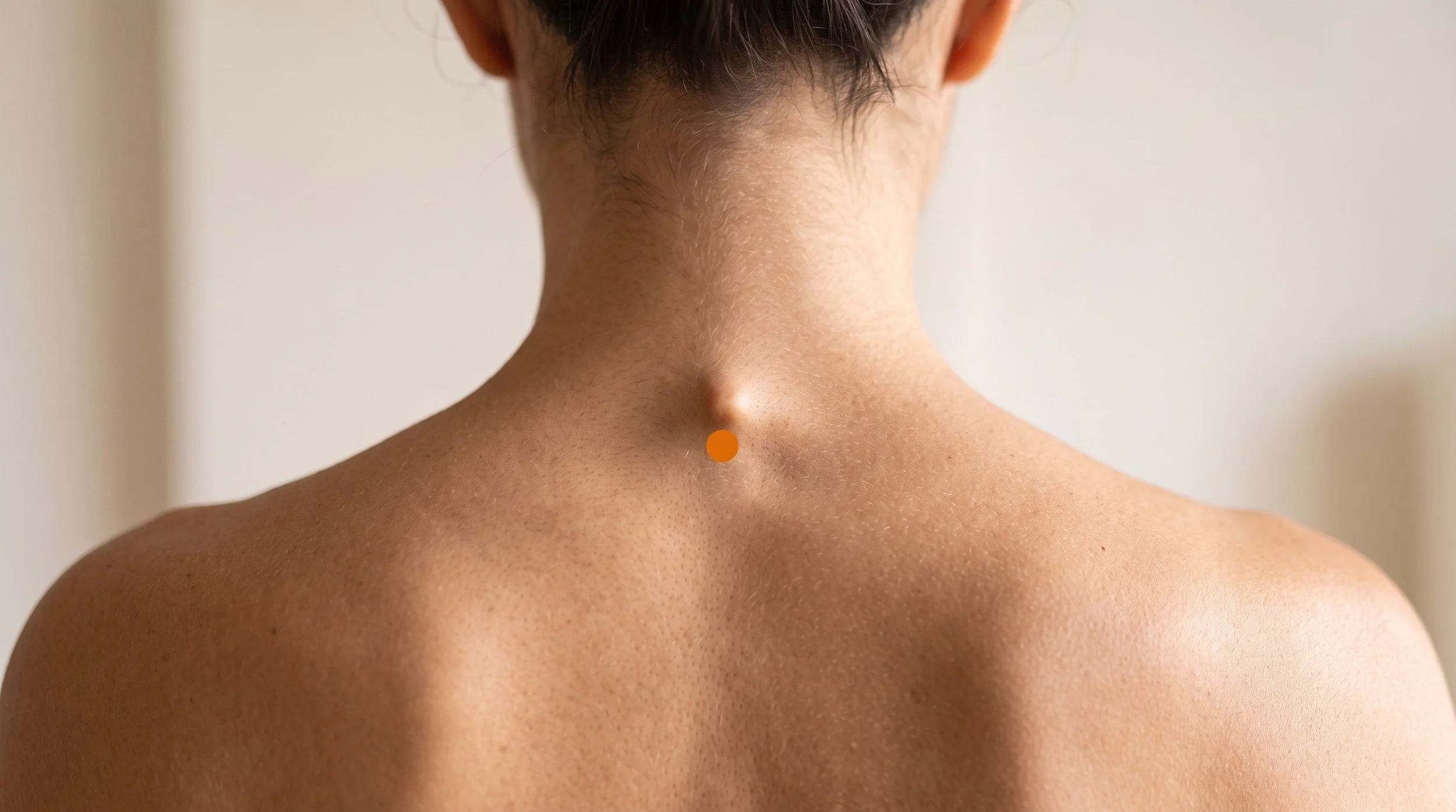
DU14 Acupuncture Point (Dazhui)
The Great Vertebra at the Base of the Neck: Anatomy, Mechanism, and Why DU14 Anchors Treatment of Neck Stiffness and Upper Back Tension
DU14 (Dazhui, "Great Vertebra"), also written GV14, sits in the small dip you can feel on the midline just below the bony bump at the base of your neck, the spinous process of the seventh cervical vertebra. It's the fourteenth point of the Governing Vessel, written in older texts as Du 14 or Governing Vessel 14, and classical sources treat it as the place where the Governing Vessel meets the six yang channels of the hand and foot. Anatomically it's a hinge: the transition from the mobile lower cervical spine to the stiffer upper thoracic spine, loaded all day by desk posture, phone use, and carrying bags on one shoulder.
That combination of dense, richly innervated midline connective tissue and a segmental level that shares nerve supply with the neck, shoulder girdle, and upper back is why the GV14 acupuncture point shows up in so many neck and upper back treatment plans at our clinic.
- DU14 lies on the posterior midline in the depression below the C7 spinous process, and a needle there passes through skin, subcutaneous fascia, the trapezius aponeurosis and nuchal ligament attachment, and into the supraspinous and interspinous ligaments of the C7 to T1 junction (Deadman et al., 2009).
- Classical texts list DU14 as the meeting point of the Governing Vessel with the six yang channels of the hand and foot and as an upper point of the Sea of Qi, traditional designations that translate neurophysiologically into a segmental level whose afferents converge with input from the neck, shoulders, and upper back (Deadman et al., 2009).
- Needling here stimulates C7 and C8 dorsal ramus territory and the deep dorsal ligamentous and paraspinal tissues, generating A-delta and group III afferent traffic that engages spinal segmental inhibition and brainstem descending pain control with endogenous opioid involvement (Zhao, 2008).
- For the conditions DU14 is used for most, the evidence base is moderate at best: a Cochrane review of acupuncture for neck disorders found moderate-quality evidence for better pain relief than sham in the immediate and short term, without clear long-term persistence, and that review has since been withdrawn pending updating (Trinh et al., 2016), while individual patient data pooling of chronic pain trials, including neck pain, suggests effects that exceed sham and decay only modestly over about a year (Vickers et al., 2018; MacPherson et al., 2017).
- Point-specific physiology exists but is preliminary: work using DU14 in healthy volunteers has examined cerebral blood flow velocity responses, and earlier laser stimulation studies at this point reported increases in basilar artery flow velocity (Lee et al., 2021), while broader mechanism reviews place DU14 among the acupoints commonly studied for neuro-immune and anti-inflammatory effects via cholinergic, vagal-adrenal, and hypothalamic-pituitary-adrenal pathways (Li et al., 2021).
- De qi at Dazhui is usually described as a deep, heavy, slightly achy fullness right at the base of the neck that can spread sideways toward one or both shoulder blades, often with a sense of warmth as the local muscles let go.
Stiff Neck That Won't Turn or Release?
If turning your head to check a blind spot or looking up at a monitor feels blocked, we start with a movement and palpation exam rather than a guess. DU14 is one of the points we use at the cervicothoracic junction, often paired with GB20 and with dry needling of the upper trapezius, levator scapulae, and semispinalis when those muscles test tender and restricted. Treatment is combined with practical loading and posture strategies so the change holds between visits. Schedule an evaluation and let's find out what's actually limiting your neck.
Schedule NowAnatomy of DU14: Why the C7 to T1 Junction Is Such an Important Location
Run a finger down the back of your neck and you'll meet a prominent bump where the neck flattens into the upper back. That's usually the C7 spinous process, and DU14 sits in the hollow just below it. From the surface inward, a needle at this site passes through thin skin, subcutaneous fat and fascia, the tendinous midline where the trapezius attaches, the lower fibers of the nuchal ligament, and then the supraspinous and interspinous ligaments spanning C7 and T1 (Deadman et al., 2009).
This is a mechanical crossroads. The lower cervical segments are built for rotation and flexion, the upper thoracic segments are braced by ribs, and the tissue in between absorbs the difference every time you hold your head forward over a laptop, sleep on a stack of pillows, or grip a subway pole. Sustained low-grade loading of these midline ligaments and of the semispinalis, multifidus, and trapezius fibers just lateral to them is one common reason the area feels dense, tender, and unwilling to move.
The nerve geography explains why a single midline point can influence a wide area. Sensory supply here comes from the dorsal rami of the lower cervical and upper thoracic nerves, whose medial branches innervate the spinous processes, interspinous ligaments, facet capsules, and deep paraspinal muscles. Those afferents enter the dorsal horn at levels that also receive input from the neck, shoulder girdle, scapular region, and parts of the upper limb, so a needle placed at C7 to T1 lands in a segment that shares processing space with the tissues patients actually complain about.
Stimulating it recruits A-delta and group III fibers that trigger segmental inhibition of dorsal horn nociceptive neurons and activate descending inhibitory pathways from the midbrain and brainstem involving endogenous opioids (Zhao, 2008). Deep paraspinal and midline structures are also classic sources of poorly localized referred pain that patients experience as a broad ache across the shoulders rather than a pinpoint spot, which is part of why local treatment at this level can change how a much larger region feels (Simons et al., 1999).
Depth discipline matters more here than at almost any other Governing Vessel point in this region. The spinal canal lies deep to the interspinous space, and classical texts place it roughly 1.25 to 1.75 cun below the skin surface depending on body build, which is why the standard convention is perpendicular or slightly superior oblique insertion of about 0.5 to 1 cun with no deep midline probing (Deadman et al., 2009).
In practice we angle slightly upward against the resistance of the interspinous ligament, stay clearly within the ligamentous layer, and stop advancing as soon as de qi arrives. When neck pain radiates laterally, the needle can be directed obliquely toward the affected side rather than driven deeper. Patients with cervical instability, prior cervical or upper thoracic surgery, spinal hardware, anticoagulant use, or very slight body build get shallower technique and closer monitoring, and any electrical or lancinating sensation means the needle is withdrawn and redirected immediately.
Related Best Acupuncture Points for Neck Pain Related Acupuncture for Neck PainDU14 (GV14) at a Glance: Classification, Location, and Clinical Use
| Category | Detail |
|---|---|
| Traditional Name | Dazhui (Great Vertebra), also recorded in classical sources under the alternative name Bailao (Hundred Taxations) |
| Channel Classification | Governing Vessel, point 14 (Du 14, Governing Vessel 14), on the posterior midline (also called the Du Mai or Du channel) |
| Point Categories | Meeting point of the Governing Vessel with the six yang channels of the hand and foot; upper point of the Sea of Qi together with DU15 (with ST9 in front); described in the Governing Vessel literature as a principal point for the exterior and for disorders of sweating |
| Precise Location | On the posterior midline, in the depression below the spinous process of the seventh cervical vertebra (C7), at the C7 to T1 interspinous space |
| Tissue Stimulated | Skin and subcutaneous fascia, trapezius aponeurosis and nuchal ligament attachment, supraspinous and interspinous ligaments of C7 to T1, with deep semispinalis and multifidus fibers just lateral; frequently treated alongside serratus posterior superior and upper trapezius myofascial targets |
| Needle Depth / Direction | Perpendicular or slightly superior oblique insertion 0.5 to 1 cun; for laterally radiating neck pain the needle may be angled obliquely toward the involved shoulder; never needled deeply toward the spinal canal, which lies roughly 1.25 to 1.75 cun deep depending on build |
| De Qi Sensation | Deep, heavy, spreading fullness or dull ache at the base of the neck, often radiating toward one or both shoulder blades, sometimes with local warmth; sharp or electrical sensations are not the goal and prompt immediate repositioning |
| Primary Clinical Uses | Neck stiffness and restricted rotation, upper back and shoulder girdle tension, cervicothoracic junction pain; traditionally used for fever support and immune support during and after upper respiratory illness |
| Common Point Combinations |
|
In Deadman, Al-Khafaji, and Baker's A Manual of Acupuncture, DU14 is presented as one of the busiest points in the classical literature, and the traditional reasoning is worth understanding on its own terms. Because the Governing Vessel was regarded as the sea of the yang channels and because Dazhui was where the six yang channels of the hand and foot were said to meet it, the point was credited with three traditional functions: clearing pathogenic influence from the exterior and firming that exterior, clearing yang heat, and tonifying qi and yang.
Traditional indication lists therefore stretch across categories that look unrelated to a modern reader: early febrile illness with chills, shivering, aversion to wind, and sore throat; high fever with agitation once the illness moved inward; alternating chills and fever, the pattern classical authors called malaria; disorders of sweating including spontaneous and night sweating; profound depletion and fatigue, reflected in the point's alternative name Bailao or Hundred Taxations and in its classification as an upper point of the Sea of Qi; interior wind patterns such as seizures; stubborn nosebleed; and, most familiar to us today, stiffness of the spine and of the nape with inability to turn the head.
What's striking is the internal logic of that list. A single site was asked to handle both the surface of the body under acute attack and the deepest exhaustion of the whole person, and the same point was expected to loosen a locked neck along the way.
Why DU14 Is Used for Fever Support and Immune Support, Not Just Neck Stiffness
The neck part is straightforward. DU14 sits at the C7 to T1 level, and its afferents enter the spinal cord where sensory input from the cervical spine, shoulder girdle, and upper back converges on shared dorsal horn neurons. When that pool of neurons is sensitized by weeks of postural loading, patients feel a diffuse, hard-to-localize band of tension rather than one tender spot. Needling into the dense ligamentous tissue at this segment feeds strong, well-defined input into exactly that pool, which can reduce the excitability of the pathway and change how the surrounding region reports itself (Zhao, 2008).
Because deep paraspinal and midline structures refer pain in broad, poorly bounded patterns, treatment at a single midline point can influence a surprisingly wide area of perceived tightness (Simons et al., 1999).
The fever and immune indications need a different explanation, and it should be read cautiously. Modern mechanism research describes acupuncture stimulation engaging neuro-immune circuits, including cholinergic anti-inflammatory signaling, vagal and adrenal pathways, and the hypothalamic-pituitary-adrenal axis, with DU14 appearing among the acupoints most often studied in this context, frequently in combination with points such as BL13 and ST36 (Li et al., 2021).
Point-specific human physiology at Dazhui is still limited, though studies in healthy volunteers have measured cerebral blood flow velocity responses to stimulation here, and earlier laser work at the same point reported increases in basilar artery flow velocity (Lee et al., 2021). Findings like these are consistent with autonomic and vascular effects rather than proof of a clinical antipyretic action.
So the honest framing is this: the traditional attribution says Dazhui releases the exterior and clears heat, and the physiological literature offers plausible autonomic and neuro-immune correlates, but neither replaces medical care. We use DU14 for comfort-focused support during and after upper respiratory illness while telling patients clearly that fever needs appropriate evaluation, and we're specific that acupuncture is not a treatment for infection.
What the Research Shows for DU14 (GV14)
One note on naming before the evidence: in the research literature this point is almost always listed as GV14, the WHO standard code, so GV14 is the term to search if you want to read the studies below in full.
Almost no clinical trial isolates a single point, so the research picture for DU14 has to be read at two levels. Reviews of acupuncture for neck disorders and chronic pain test multi-point protocols in which Dazhui is one component among several, which tells us something about the treatment approach DU14 belongs to but not about the point's independent contribution. Alongside those, a small body of point-specific physiological work and mechanism reviews looks at what stimulation at this location does to blood flow and to neuro-immune signaling.
Both levels matter, and both come with real limits: small samples, sham design problems, and short follow-up are common. What follows is a summary, not a promise of results.
| Study | Type | Focus | Key Finding |
|---|---|---|---|
| Trinh et al., 2016 | Cochrane systematic review (subsequently withdrawn pending update) | Acupuncture for acute, subacute, and chronic neck disorders across 27 randomized trials | Moderate-quality evidence suggested better pain relief than sham immediately after treatment and at short-term follow-up, with benefits that did not clearly persist long term. |
| Vickers et al., 2018 | Individual patient data meta-analysis | Chronic pain conditions including chronic neck and shoulder pain, nearly 21,000 patients | Acupuncture outperformed both sham and no-acupuncture controls by modest but statistically robust margins, supporting effects beyond expectation alone. |
| MacPherson et al., 2017 | Meta-analysis of treatment persistence | Durability of acupuncture effects after a completed course in chronic pain populations | Benefits appeared to decay only modestly over roughly twelve months, which supports periodic maintenance rather than indefinite weekly care. |
| Gattie et al., 2017 | Systematic review and meta-analysis | Trigger point dry needling for musculoskeletal pain, including cervical and shoulder girdle muscles | Low to moderate quality evidence favored dry needling over sham or no treatment for pain and pressure pain threshold in the short term, with long-term data lacking. |
| Lee et al., 2021 | Controlled physiological study in healthy volunteers | Cerebral blood flow velocity and CO2 reactivity with stimulation at DU14 | This line of work explores vascular responses to Dazhui stimulation, with earlier laser studies at the same point reporting increased basilar artery flow velocity; findings are preliminary and not clinical outcomes. |
| Li et al., 2021 | Narrative mechanism review | Anti-inflammatory and neuro-immune pathways engaged by acupoint stimulation | Describes cholinergic, vagal-adrenal, and HPA axis routes through which needling may modulate inflammation, with DU14 among the points commonly used in the studies reviewed. |
| Zhao, 2008 | Narrative review of neurophysiology | Mechanisms of acupuncture analgesia | Summarizes segmental dorsal horn inhibition and descending opioid-mediated modulation as the leading explanations for needling-induced pain relief. |
Upper Back Tension From Desk Work and Long Screen Days?
That burning band across the top of the shoulders and between the shoulder blades usually reflects sustained low-level load, not damage. We use DU14 along with local and segmental points and targeted needling of rhomboid, serratus posterior superior, and mid-scapular tissue to reduce sensitivity and restore easier rotation and extension. Sessions are unhurried, and we explain exactly what we're doing and why. Book a visit and get the tension addressed rather than tolerated.
Schedule NowDU14 in the Context of Trigger Point Work
DU14 isn't a muscle belly, so it isn't a trigger point target in the strict sense. It's a midline ligamentous site, and that's precisely why it pairs well with dry needling of the muscles that converge nearby. In a typical cervicothoracic session we'll use Dazhui for its segmental input at C7 to T1 and then address the tissues our exam implicates: upper trapezius, levator scapulae, semispinalis capitis and cervicis, the rhomboids, and serratus posterior superior beneath the scapula.
Those muscles refer pain in recognizable patterns that patients often describe as a headache creeping up the back of the head, a deep ache under the shoulder blade, or a band across the top of the shoulders (Simons et al., 1999). Treating the point and the muscles together tends to make more sense of a patient's whole complaint than either approach on its own.
Because acupuncture at Morningside means the use of an acupuncture needle across many styles, including dry needling, the same session can move fluidly between classical point selection and orthopedic trigger point technique without changing tools. Reviews of dry needling for musculoskeletal pain report short-term improvements in pain and pressure pain threshold compared with sham or no treatment, with quality of evidence ranging from low to moderate and little long-term data (Gattie et al., 2017), so we frame needling as one input inside a plan that also includes loading, mobility work, and workstation changes.
Depth discipline carries over from the point itself: at the midline we stay in the ligamentous layer, and when we needle laterally into thoracic paraspinals or serratus posterior superior we use flat, controlled angles that respect the ribs and underlying pleura.
DU14 Neck and Upper Back Treatment at NYC's Highest-Rated Acupuncture Clinic
Morningside Acupuncture is the highest-rated acupuncture and dry needling clinic in New York City with over 500 five-star Google reviews, and cervicothoracic complaints are among the most common reasons people find us. We integrate classical point selection such as Dazhui with modern orthopedic assessment and trigger point needling, all delivered with careful attention to depth and safety at this location. Whether your problem is a locked-up neck, chronic upper back tension, or headaches that start at the base of the skull, we build a plan around your exam findings. Schedule your appointment today.
Schedule NowFrequently Asked Questions
Is DU14 the same point as GV14?
Yes. DU14 and GV14 are two codes for the same point, Dazhui. DU comes from Du Mai, the Chinese name of the Governing Vessel, and it is the code used in most Chinese texts and many acupuncture schools. GV is the WHO standard abbreviation and the one you will see in most Western textbooks and research papers. You will also come across it written as Du 14, GV-14, or Governing Vessel 14. Whichever code is used, the location and the uses are the same.
What does DU14 feel like when needled?
Most people feel a brief pinprick at the skin, then a deep, heavy, slightly achy fullness right at the base of the neck. That heavy spreading sensation is de qi, and at Dazhui it commonly travels sideways toward one or both shoulder blades or upward into the lower neck, sometimes with a wave of warmth as the surrounding muscles release. It shouldn't feel sharp, electrical, or shooting down an arm. If it does, we withdraw slightly and redirect immediately.
Why does DU14 get used for problems that have nothing to do with the neck, like fever or immune support?
Traditionally, because Dazhui was considered the meeting point of the Governing Vessel with the six yang channels, it was credited with releasing the exterior and clearing heat, which put it at the center of classical formulas for chills and fever, sore throat, and sweating disorders (Deadman et al., 2009). Physiologically, mechanism research describes needling engaging neuro-immune and autonomic pathways including cholinergic anti-inflammatory signaling and the HPA axis, with DU14 frequently used in those studies (Li et al., 2021), and small human studies have examined blood flow responses to stimulation here (Lee et al., 2021). That's suggestive rather than conclusive. We use it as supportive comfort care and always direct fever and infection to appropriate medical evaluation.
Can I press DU14 myself between sessions?
Yes, and it's an easy one to find on yourself. Tip your chin toward your chest and slide a finger down the back of your neck until you reach the most prominent bump, then drop into the small dip just below it. Press straight forward with the pad of your thumb or two fingers at moderate, tolerable pressure, hold for 30 to 60 seconds, release, and repeat two or three times. You can do this two or three times a day, and pairing it with slow chin tucks or gentle rotations often helps more than pressure alone. Stop if you feel numbness, tingling, dizziness, or pain running into an arm. Acupressure is pressure only, so never attempt any kind of needling on yourself.
Is DU14 safe to needle?
In trained hands, yes, but it demands respect for depth. The spinal canal lies deep to the interspinous space at roughly 1.25 to 1.75 cun depending on body build, which is why the accepted convention is perpendicular or slightly superior oblique insertion of about 0.5 to 1 cun with no deep midline advancement (Deadman et al., 2009). We use shallower technique in slight or thin patients and take extra care with cervical instability, prior cervical or upper thoracic surgery, spinal hardware, and anticoagulant therapy. Clean needle technique, single-use sterile needles, and immediate withdrawal if any electrical sensation occurs are standard practice at our clinic.
Where exactly is DU14 located?
On the posterior midline, in the depression immediately below the spinous process of the seventh cervical vertebra, at the C7 to T1 interspinous space. To confirm C7, bend your neck forward and rotate your head: the spinous process that stays relatively still under your finger while the one above it moves is usually C7, since T1 tends to be the more fixed of the two prominent bumps. DU13 (Taodao) sits just below at the T1 to T2 level, so precise landmarking matters when the two are used in the same treatment.
References
- Deadman, P., Al-Khafaji, M., & Baker, K. (2009). A manual of acupuncture. Journal of Chinese Medicine Publications.
- Maciocia, G. (2005). The foundations of Chinese medicine: A comprehensive text for acupuncturists and herbalists (2nd ed.). Elsevier Churchill Livingstone.
- Simons, D. G., Travell, J. G., & Simons, L. S. (1999). Travell & Simons' myofascial pain and dysfunction: The trigger point manual, Vol. 1: Upper half of body (2nd ed.). Williams & Wilkins.
- Trinh, K., Graham, N., Irnich, D., Cameron, I. D., & Forget, M. (2016). Acupuncture for neck disorders. Cochrane Database of Systematic Reviews, 2016(5), CD004870. https://doi.org/10.1002/14651858.CD004870.pub4
- Vickers, A. J., Vertosick, E. A., Lewith, G., MacPherson, H., Foster, N. E., Sherman, K. J., Irnich, D., Witt, C. M., & Linde, K. (2018). Acupuncture for chronic pain: Update of an individual patient data meta-analysis. Journal of Pain, 19(5), 455-474. https://doi.org/10.1016/j.jpain.2017.11.005
- MacPherson, H., Vertosick, E. A., Foster, N. E., Lewith, G., Linde, K., Sherman, K. J., Witt, C. M., & Vickers, A. J. (2017). The persistence of the effects of acupuncture after a course of treatment: A meta-analysis of patients with chronic pain. Pain, 158(5), 784-793. https://doi.org/10.1097/j.pain.0000000000000747
- Gattie, E., Cleland, J. A., & Snodgrass, S. (2017). The effectiveness of trigger point dry needling for musculoskeletal conditions by physical therapists: A systematic review and meta-analysis. Journal of Orthopaedic & Sports Physical Therapy, 47(3), 133-149. https://doi.org/10.2519/jospt.2017.7096
- Lee, H. K., Moon, S.-K., Jin, C., Cho, S.-Y., Park, S.-U., Jung, W.-S., Park, J.-M., Ko, C.-N., Cho, K.-H., & Kwon, S. (2021). Effects of GV14 acupuncture on cerebral blood flow velocity in the basilar and middle cerebral arteries and CO2 reactivity during hypercapnia in normal individuals. Evidence-Based Complementary and Alternative Medicine, 2021, 9319413. https://doi.org/10.1155/2021/9319413
- Li, N., Guo, Y., Gong, Y., et al. (2021). The anti-inflammatory actions and mechanisms of acupuncture from acupoint to target organs via neuro-immune regulation. Journal of Inflammation Research, 14, 7191-7224. https://doi.org/10.2147/JIR.S341581
- Zhao, Z. Q. (2008). Neural mechanism underlying acupuncture analgesia. Progress in Neurobiology, 85(4), 355-375. https://doi.org/10.1016/j.pneurobio.2008.05.004
Disclaimer: This web site is intended for educational and informational purposes only. Reading this website does not constitute providing medical advice or any professional services. This information should not be used for diagnosing or treating any health issue or disease. Those seeking medical advice should consult with a licensed physician. Seek the advice of a medical doctor or other qualified health professional for any medical condition. If you think you have a medical emergency, call 911 or go to the emergency room. No acupuncturist-patient relationship is created by reading this website or using the information. Morningside Acupuncture PLLC and its employees and contributors do not make any express or implied representations with respect to the information on this site or its use. For any legal interpretation of scope of practice in your state, consult a licensed attorney or regulatory authority.
Read more from our blog



