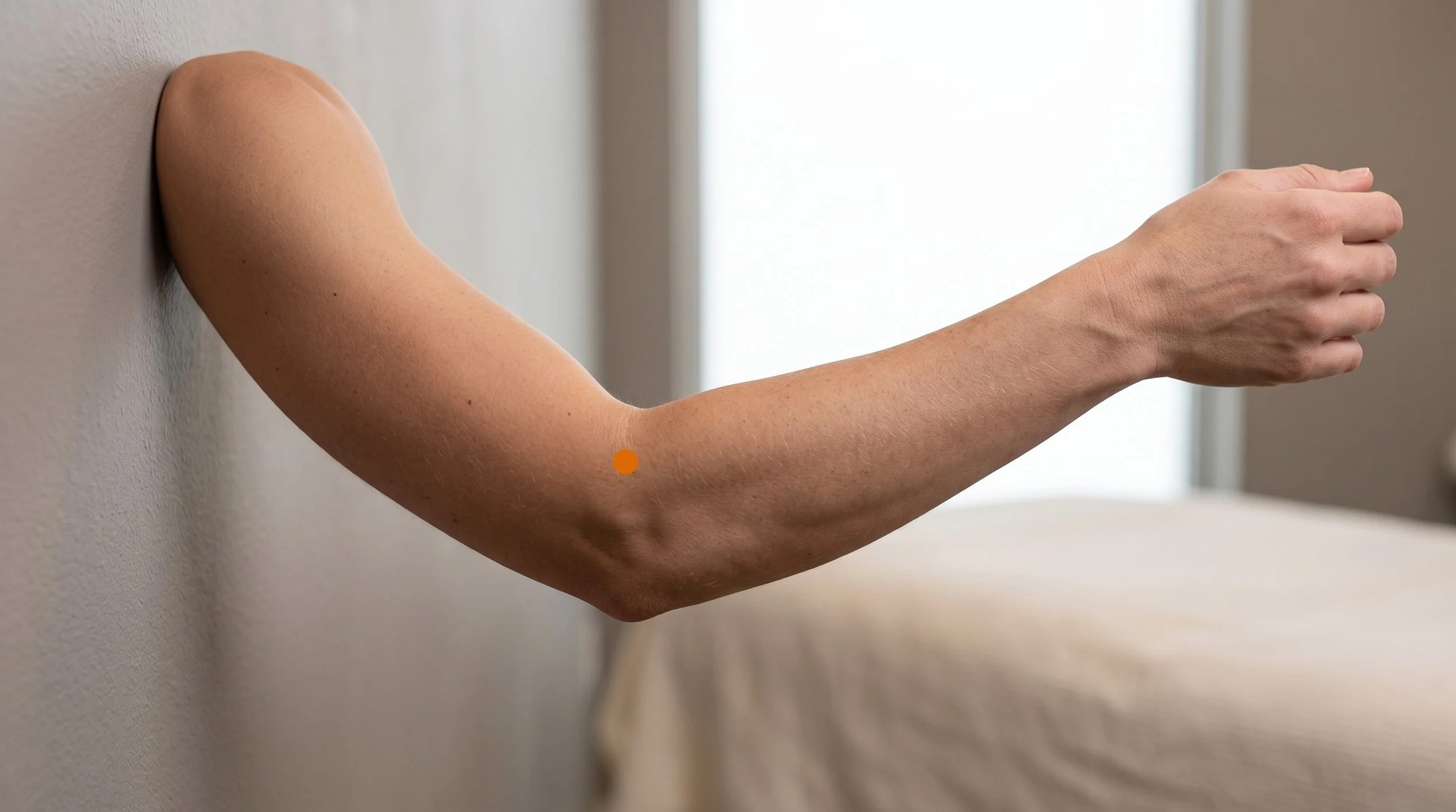
LI11 Acupuncture Point (Quchi)
The Pool at the Bend of the Elbow: Anatomy, Mechanism, and Why This He-Sea Point Anchors Treatment for Elbow Pain, Skin Complaints, and Whole-Arm Problems
LI11 (Quchi, often translated as Pool at the Bend or Crooked Pond) sits in the small hollow that appears at the outer end of the elbow crease when you bend your arm, roughly midway between the biceps tendon and the bony bump of the lateral epicondyle. It is the He-sea and Earth point of the Large Intestine channel, and in practical terms it is one of the most-used points on the arm: the needle lands right where the wrist extensor tendons take their origin, which is the same tissue implicated in tennis elbow, and the radial nerve trunk runs close by.
Classical texts assigned it a remarkably wide brief (fevers, itchy skin conditions, throat and eye complaints, weakness or spasm of the arm), while modern clinics use it mostly for lateral elbow pain, forearm and arm pain, skin conditions, and as a supportive point in fever and blood pressure protocols. Understanding the li11 acupuncture point is largely a matter of understanding what lies under that dimple.
- Location and layers: with the elbow flexed to about 90 degrees, LI11 lies at the lateral end of the transverse cubital crease, midway between LU5 Chize and the lateral epicondyle (Deadman et al., 2001). The needle passes through skin and subcutaneous tissue into the common origin of extensor carpi radialis longus and brevis, with brachioradialis just lateral, which is why the point doubles as a musculoskeletal target.
- Traditional categories, read in modern terms: texts list LI11 as the He-sea and Earth (mother) point of the Large Intestine channel, a Ma Dan-yang Heavenly Star point, and one of Sun Si-miao's ghost points under the alternate name Guitui (Deadman et al., 2001). Traditional actions such as clearing heat, cooling blood, dispelling wind and relieving itching, and activating the channel to relieve pain are best understood today as descriptions of clinical use rather than as physiology.
- Mechanism: needling here recruits somatic afferents in the C5 to C7 range, largely by way of the radial nerve, which projects into dorsal horn segments where cutaneous and deep tissue inputs converge and can be modulated (Zhao, 2008). Local effects on muscle tone, blood flow, and nociceptor sensitivity plausibly account for much of the relief patients report at the elbow.
- Research picture: a meta-analysis of randomized trials in lateral epicondylitis reported favorable results for acupuncture across several comparisons, although trial quality was mixed (Zhou et al., 2020), and a large individual patient data analysis supports modest, durable benefit of acupuncture for chronic musculoskeletal pain generally (Vickers et al., 2018).
- Point-specific evidence: a randomized trial in hemodialysis patients used LI11 alone for refractory uremic itching and reported lower itch scores than needling a nearby non-point (Che-Yi et al., 2005), and animal work has explored antipruritic effects of stimulation at this same site (Tsai et al., 2014). For blood pressure, a Cochrane review found no evidence of a sustained lowering effect, so LI11 is best framed as supportive rather than a treatment for hypertension (Yang et al., 2018).
- What it feels like: most people describe a deep, heavy, spreading ache in the elbow that may travel down the back of the forearm toward the wrist and thumb, and if the needle engages a taut extensor band there can be a brief twitch or cramp before the tissue softens.
Elbow Pain That Flares Every Time You Grip Something?
Lateral elbow pain rarely stays local: it shows up in your handshake, your laptop bag, your kettlebell, your racquet. At Morningside Acupuncture we use LI11 as a working hub for that pattern, combining it with nearby channel points and precise dry needling of the wrist extensors and brachioradialis. Treatment is paired with grip and loading advice so the tissue actually gets stronger between visits. Schedule a visit and let's find out how your elbow responds.
Schedule NowAnatomy of LI11: Why the Lateral Elbow Crease Is Such an Important Location
Bend your elbow and a shallow pool forms at the outer end of the crease. That is the surface landmark for LI11, sitting between the biceps tendon medially and the lateral epicondyle laterally (Deadman et al., 2001). Beneath thin skin and subcutaneous tissue, the needle meets the proximal fibers of extensor carpi radialis longus and brevis, with brachioradialis running just to the side. These are the muscles that stabilize the wrist during gripping, so they are loaded constantly by keyboard work, tool use, climbing, racquet sports, and carrying.
When their proximal attachments become sensitized, pain tends to localize almost exactly where this point sits, which is one reason LI11 shows up in nearly every elbow prescription.
The nerve geography matters just as much. The radial nerve trunk passes near this level before dividing, and the deep tissue here is innervated within roughly the C5 to C7 segmental range. Needling generates activity in small-diameter muscle and cutaneous afferents that enter the dorsal horn at those segments, where inputs from skin, muscle, tendon, and joint converge onto shared second-order neurons.
That convergence is the practical basis for segmental effects: stimulating the extensor origin can influence how the whole neighborhood of tissue is processed, not just the millimeter of muscle touched by the needle (Zhao, 2008). Ascending signals also engage brainstem circuits that send inhibition back down the cord, which helps explain why patients often report relief that outlasts the session and extends beyond the needled spot.
Deep to the point lie the radial collateral and radial recurrent vessels, and the radiohumeral joint capsule sits below the muscular layer. Standard practice is perpendicular insertion of 1 to 1.5 cun, angled and depthed according to the patient's build, and classical sources also describe joining LI11 through to HE3 Shaohai on the medial side with a long needle (Deadman et al., 2001).
In our clinic we favor conservative depth with attention to tissue feedback: if the sensation becomes sharp, electric, or radiates strongly into the hand, the needle is adjusted rather than pushed further, since the radial nerve is close enough to warrant respect.
Related Extensor Carpi Radialis Brevis Trigger Points Related Acupuncture For Brachioradialis PainLI11 at a Glance: Classification, Location, and Clinical Use
| Category | Detail |
|---|---|
| Traditional Name | Quchi (Pool at the Bend, also rendered Crooked Pond); alternate classical name Guitui, Ghost Leg |
| Channel Classification | Large Intestine 11, the eleventh point of the Hand Yangming Large Intestine channel |
| Point Categories | He-sea point of the Large Intestine channel; Earth point of the channel (its mother or tonification point); Sun Si-miao ghost point; Ma Dan-yang Heavenly Star point |
| Precise Location | With the elbow flexed, at the lateral end of the transverse elbow crease, midway between the biceps tendon (LU5 Chize) and the lateral epicondyle of the humerus |
| Tissue Stimulated | Common origin of extensor carpi radialis longus and brevis, adjacent brachioradialis, overlying fascia, and cutaneous tissue supplied within the C5 to C7 segments; radial nerve trunk passes nearby |
| Needle Depth / Direction | Perpendicular insertion 1 to 1.5 cun with the elbow flexed; classically may be joined by through-needling toward HE3 Shaohai; depth reduced in slim patients and when radiating sensation appears |
| De Qi Sensation | Deep heavy ache or fullness at the elbow, often spreading distally along the back of the forearm toward the wrist and thumb; a brief twitch or cramp if a taut extensor band is engaged |
| Primary Clinical Uses | Lateral elbow pain and tennis elbow, forearm and whole-arm pain, post-stroke arm weakness or spasticity, itchy and inflamed skin conditions, supportive use in fever and blood pressure protocols |
| Common Point Combinations |
|
In the Deadman, Al-Khafaji and Baker point compendium, LI11 is presented as the foremost heat-clearing point of a channel traditionally described as abundant in yang qi, and its classical indication lists are correspondingly broad: stubborn high fevers, thirst and dry hot skin, throat and eye inflammation, toothache, agitation and manic states, a long catalogue of itchy and eruptive skin complaints, abdominal pain with vomiting or dysenteric disorders, and a whole spectrum of arm problems from painful obstruction and numbness to spasm, contracture, and post-stroke weakness (Deadman et al., 2001).
These are traditional attributions rather than physiological claims, and the commentary is candid that hypertension was not a classical category at all but a modern reading grafted onto older statements about the yangming channel. What stands out is the internal logic: as the He-sea point where the channel was said to gather most deeply, and as one of the few Large Intestine points ever used to nourish rather than drain (specifically to strengthen a weak arm), LI11 occupies a hinge position between systemic and local uses.
That a point chosen for fevers and skin eruptions is also the point most often needled for a painful elbow is a striking reminder that classical categories were organized around channels and patterns, not around tissues.
Why LI11 Is Used for Itchy Skin and Blood Pressure Support, Not Just Elbow Pain
The elbow explanation is straightforward. LI11 sits in the tissue that hurts in lateral epicondylalgia, so needling it delivers input directly into the sensitized segment. Afferent fibers from this region enter the spinal cord around C5 to C7, where signals from skin, tendon, muscle, and joint converge on the same relay neurons. Adding a controlled, non-threatening stimulus into that pool can change how the region is processed, reducing local muscle guarding and altering blood flow in the tissue being treated (Zhao, 2008). This is also why we often needle LI11 alongside points further down the forearm: they feed the same segments from different angles.
Itch is where things get more interesting. Itch and pain are processed through overlapping spinal and supraspinal circuitry, which is why scratching or a competing sensory input can temporarily suppress itching. Needling is one such input, and it also engages descending inhibitory pathways from the brainstem that dampen dorsal horn transmission broadly rather than segment by segment (Zhao, 2008).
Point-specific work exists here: in a randomized trial, hemodialysis patients with refractory uremic itch who received needling at LI11 alone reported substantially lower itch scores than those needled at a nearby non-point, with the difference still present at three months (Che-Yi et al., 2005). Animal research has separately examined antipruritic effects of stimulation at this same location (Tsai et al., 2014). None of this makes LI11 a treatment for skin disease, but it does give the old association between this point and itching a plausible modern reading.
Blood pressure deserves the most caution. LI11 has been studied in Chinese trials, often paired with ST36, on the reasoning that somatic afferent stimulation can shift autonomic balance and vascular tone. A Cochrane review of acupuncture for primary hypertension, however, found only very low quality evidence for short-term change and no evidence of a sustained blood pressure lowering effect (Yang et al., 2018). We therefore describe this use as supportive at best: something that may accompany medication, diet, sleep, and exercise management, never something that replaces it.
What the Research Shows for LI11
A note on how to read the evidence below. Almost every trial tests a multi-point protocol, so no study isolates what LI11 contributes on its own, with the notable exception of the uremic pruritus trial that deliberately used this single point. Reviews in this area also draw heavily on Chinese-language trials with mixed methodological quality, and blinding acupuncture is genuinely difficult. The reasonable conclusion is that LI11 is a frequently included component of protocols that show modest benefit for musculoskeletal pain and skin symptoms, and a much weaker candidate for blood pressure claims.
| Study | Type | Focus | Key Finding |
|---|---|---|---|
| Zhou et al., 2020 | Systematic review and meta-analysis of randomized trials | Acupuncture for lateral epicondylitis (tennis elbow), ten trials with 796 participants | Acupuncture performed better than sham, medication, and injection comparators on efficacy and pain measures, though the authors noted limited reporting of randomization and generally modest study quality. |
| Vickers et al., 2018 | Individual patient data meta-analysis | Acupuncture for chronic musculoskeletal, headache, and osteoarthritis pain | Acupuncture was associated with statistically significant improvement over both sham and no-acupuncture controls, with effects that persisted over roughly a year, supporting its use for persistent elbow and arm pain. |
| Che-Yi et al., 2005 | Randomized controlled trial using LI11 as the sole point | Refractory uremic pruritus in 40 hemodialysis patients | Needling at Quchi LI11 three times weekly for one month reduced itch scores compared with needling a point 2 cm away, with the difference maintained at three-month follow-up. |
| Yao et al., 2016 | Systematic review of randomized trials | Acupuncture for chronic urticaria, six studies with 406 participants | The authors reported possible symptom improvement but concluded the evidence was too limited and methodologically weak to support firm recommendations. |
| Yang et al., 2018 | Cochrane systematic review | Acupuncture for primary hypertension, 22 trials with 1744 participants | Only very low quality evidence of a small short-term blood pressure reduction versus sham, with no evidence of a sustained effect, so blood pressure use should be considered supportive only. |
| Tsai et al., 2014 | Experimental animal study | Stimulation at the Quchi LI11 location and itch behavior in mice | Stimulation at this site reduced scratching behavior in an experimental model, offering preclinical support for the point's traditional association with itching. |
Itchy, Reactive Skin and Not Sure Where to Start?
Traditionally, LI11 was one of the first points reached for in hot, itchy, inflamed skin presentations, and it remains a common choice in modern protocols alongside SP10. We use it as part of a broader plan that respects your dermatologist's care rather than replacing it, and we set realistic expectations about what needling may and may not change. Sessions are calm, unhurried, and built around your specific triggers. Book a consultation to talk it through.
Schedule NowLI11 in the Context of Trigger Point Work
LI11 is one of the clearest examples of a classical point that lands squarely on a myofascial target. The extensor carpi radialis longus and brevis take origin at and just distal to this level, and taut bands in these muscles are described as referring pain toward the lateral elbow and down the radial forearm into the wrist and hand (Simons et al., 1999). When we palpate before needling, patients with gripping-related elbow pain frequently point to the same dimple that defines the point.
In those cases the distinction between needling LI11 and dry needling the proximal extensor group is largely semantic: it is the same needle in the same tissue, described in two vocabularies.
In practice we treat the region rather than the single spot. A typical session at Morningside might use LI11 with LI10 further down the extensor mass, add the brachioradialis if forearm rotation reproduces symptoms, check extensor carpi ulnaris when the pain tracks toward the little finger side, and finish with LI4 for a broader channel effect. Where a taut band is present, an eliciting technique may produce a brief local twitch followed by softening, and we keep dosage conservative because this area can be tender for a day afterward. Needling is always paired with graded loading of the wrist extensors, since restoring tolerance to grip is what keeps the elbow quiet long term.
LI11 Tennis Elbow Treatment at NYC's Highest-Rated Acupuncture Clinic
Morningside Acupuncture is the highest-rated acupuncture and dry needling clinic in New York City with over 500 five-star Google reviews, and lateral elbow pain is one of the conditions we see most. Every session blends channel-based point selection around LI11 with orthopedic assessment and targeted needling of the muscles that actually load your elbow. You will leave with a clear plan rather than a vague promise. Schedule your appointment today.
Schedule NowFrequently Asked Questions
What does LI11 feel like when needled?
Most people feel a dull, heavy, expanding ache right at the outer elbow, sometimes with a sense of pressure or warmth that spreads down the back of the forearm toward the wrist and thumb. If the needle contacts a taut band in the wrist extensors, there can be a quick involuntary twitch or a brief cramping sensation that fades within seconds and is usually followed by the tissue letting go. Sharp, hot, or strongly electric sensations shooting into the hand are not the goal, and we adjust the needle immediately if they occur. Mild tenderness at the site for a day or so afterward is common, particularly when dry needling has been part of the session.
Why needle the elbow for a wrist problem, or the arm for itchy skin?
Two reasons, one anatomical and one neurological. Anatomically, the muscles that control your wrist and fingers originate near the elbow, so wrist and hand symptoms are often driven by tissue at LI11 rather than at the site of the pain. Neurologically, the afferents from this region enter the spinal cord at levels shared by the rest of the forearm and hand, so treatment here can influence how a wider area is processed (Zhao, 2008). Itch is a further step out: itch and pain share overlapping spinal circuitry and both are subject to descending inhibition, which is one plausible reading of the classical association between this point and itchy skin, supported by a trial that used LI11 alone for uremic pruritus (Che-Yi et al., 2005).
Can I press LI11 myself between sessions?
Yes, and it is an easy li11 pressure point to find on yourself. Bend your elbow to about 90 degrees, find the crease, and slide your thumb laterally until you feel the bony bump of the outer elbow; the point sits in the soft hollow just before that bump. Press with your thumb at a firmness that feels like a strong, tolerable ache rather than a sharp pain, hold for 30 to 60 seconds, release, and repeat two or three times. You can do this two or three times a day, and gentle circular pressure or slow strokes down the forearm afterward often feels better than static holding alone. Skip it over broken or inflamed skin, ease off if soreness lingers into the next day, and remember that acupressure is a maintenance tool between visits, not a substitute for treatment or for medical care of a skin condition or high blood pressure.
Is LI11 safe to needle?
In trained hands it is a low-risk point. There is no cavity or major organ beneath it, and the usual convention is perpendicular insertion of 1 to 1.5 cun with the elbow flexed (Deadman et al., 2001). The main considerations are the radial nerve trunk and the collateral vessels deep to the muscle layer, so practitioners work with clean technique, avoid forcing through strong radiating sensation, and modify depth for slim arms. Bruising is the most common side effect, since the area is vascular. Anyone taking anticoagulants, living with a bleeding disorder, or dealing with local infection, an unhealed fracture, or a recent surgical repair at the elbow should mention it before needling so the plan can be adapted.
Where exactly is LI11 located?
For accurate li 11 point location, flex your elbow to roughly a right angle so the transverse crease appears. Large Intestine 11 sits at the lateral end of that crease, midway between the biceps tendon at the center of the crease (the LU5 Chize position) and the lateral epicondyle, the bony prominence on the outer side of the elbow (Deadman et al., 2001). With the arm bent you can usually feel a distinct depression there, and pressing into it typically produces a firm ache in people with elbow or forearm complaints. If you straighten the arm the landmark flattens out and the point becomes hard to locate, so always find it with the elbow bent first.
References
- Deadman, P., Al-Khafaji, M., & Baker, K. (2009). A manual of acupuncture. Journal of Chinese Medicine Publications.
- Simons, D. G., Travell, J. G., & Simons, L. S. (1999). Travell & Simons' myofascial pain and dysfunction: The trigger point manual, Vol. 1: Upper half of body (2nd ed.). Williams & Wilkins.
- Zhao, Z. Q. (2008). Neural mechanism underlying acupuncture analgesia. Progress in Neurobiology, 85(4), 355-375. https://doi.org/10.1016/j.pneurobio.2008.05.004
- Vickers, A. J., Vertosick, E. A., Lewith, G., MacPherson, H., Foster, N. E., Sherman, K. J., Irnich, D., Witt, C. M., & Linde, K. (2018). Acupuncture for chronic pain: Update of an individual patient data meta-analysis. Journal of Pain, 19(5), 455-474. https://doi.org/10.1016/j.jpain.2017.11.005
- Zhou, Y., Guo, Y., Zhou, R., Wu, P., Liang, F., & Yang, Z. (2020). Effectiveness of acupuncture for lateral epicondylitis: A systematic review and meta-analysis of randomized controlled trials. Pain Research and Management, 2020, 8506591. https://doi.org/10.1155/2020/8506591
- Che-Yi, C., Wen, C. Y., Min-Tsung, K., & Chiu-Ching, H. (2005). Acupuncture in haemodialysis patients at the Quchi (LI11) acupoint for refractory uraemic pruritus. Nephrology Dialysis Transplantation, 20(9), 1912-1915. https://doi.org/10.1093/ndt/gfh955
- Yao, Q., Li, S., Liu, X., Qin, Z., & Liu, Z. (2016). The effectiveness and safety of acupuncture for patients with chronic urticaria: A systematic review. Evidence-Based Complementary and Alternative Medicine, 2016, 5191729. https://doi.org/10.1155/2016/5191729
- Yang, J., Chen, J., Yang, M., Yu, S., Ying, L., Liu, G. J., Ren, Y. L., Wright, J. M., & Liang, F. R. (2018). Acupuncture for hypertension. Cochrane Database of Systematic Reviews, 2018(11), CD008821. https://doi.org/10.1002/14651858.CD008821.pub2
- Tsai, K. S., Chen, Y. H., Chen, H. Y., Shen, E. Y., Lee, Y. C., Shen, J. L., Wu, S. Y., Lin, J. G., Chen, Y. H., & Chen, W. C. (2014). Antipruritic effect of cold stimulation at the Quchi acupoint (LI11) in mice. BMC Complementary and Alternative Medicine, 14, 341. https://doi.org/10.1186/1472-6882-14-341
Disclaimer: This web site is intended for educational and informational purposes only. Reading this website does not constitute providing medical advice or any professional services. This information should not be used for diagnosing or treating any health issue or disease. Those seeking medical advice should consult with a licensed physician. Seek the advice of a medical doctor or other qualified health professional for any medical condition. If you think you have a medical emergency, call 911 or go to the emergency room. No acupuncturist-patient relationship is created by reading this website or using the information. Morningside Acupuncture PLLC and its employees and contributors do not make any express or implied representations with respect to the information on this site or its use. For any legal interpretation of scope of practice in your state, consult a licensed attorney or regulatory authority.
Read more from our blog



