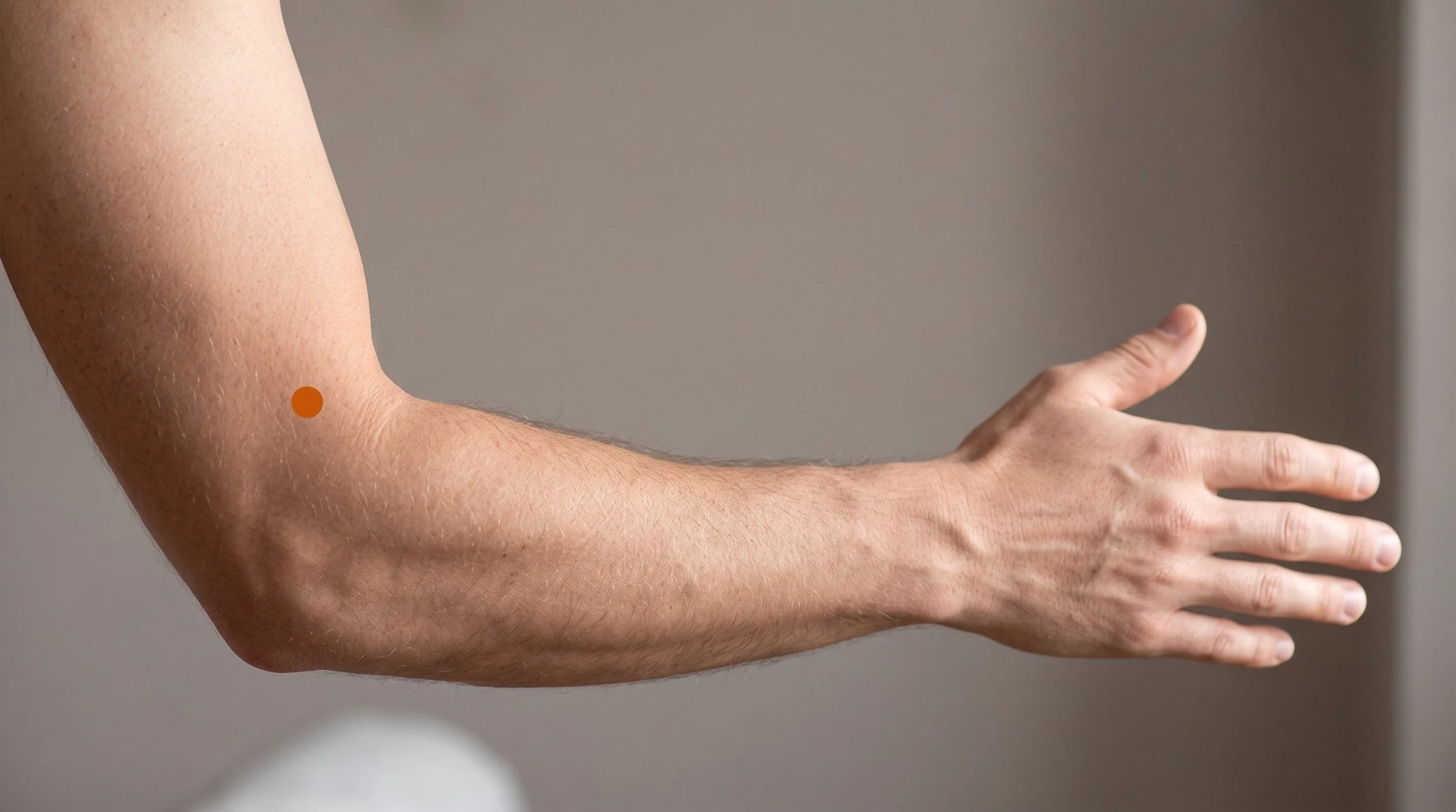
LI12 Acupuncture Point (Zhouliao)
The Elbow Crevice Above the Lateral Epicondyle: Anatomy, Mechanism, and Why This Small Bony Point Matters in Tennis Elbow Care
LI12 (Zhouliao, often translated as Elbow Crevice or Elbow Seam) is the Large Intestine channel point that sits just above the bony bump on the outside of your elbow. To find it, bend the elbow and move about one thumb-width up and one thumb-width outward from LI11, landing in a small cleft on the lateral border of the humerus, right in front of the supracondylar ridge.
That location puts the needle at the upper edge of the common extensor origin, the tissue that takes the load in lateral epicondylalgia, which is why the li12 acupuncture point tends to show up in treatment plans for tennis elbow, stubborn elbow stiffness, and forearm pain that climbs toward the upper arm rather than staying at the joint line.
- Location and layers: with the elbow flexed, large intestine 12 lies roughly 1 cun proximal and 1 cun lateral to LI11, over the lateral humerus between the brachialis and the lateral head of triceps, near the top of the extensor and anconeus attachment field (Deadman et al., 2001; Cunningham, 2015).
- Traditional attributions: classical texts credit LI12 with activating the channel, easing pain, and benefiting the elbow joint, with indications covering elbow pain and stiffness, contracture, numbness, and heaviness or immobility of the upper arm (Deadman et al., 2001).
- Mechanism: needling here stimulates radial nerve territory tissue at segments that overlap the wrist extensors, so the input converges in the same spinal cord levels that carry lateral elbow pain, a convergence and gating story described in acupuncture analgesia research (Zhao, 2008).
- Research picture: reviews of acupuncture for lateral elbow pain suggest short-term relief but rate the trial quality as limited, while dry needling reviews report meaningful gains in pain, disability, and grip strength (Green et al., 2002; Zhou et al., 2020; Navarro-Santana et al., 2020; Ma et al., 2024).
- Clinical framing: LI12 is rarely used alone; it is typically the adjacent point above the joint in a lateral elbow cluster with LI11 and LI10, sometimes with a contralateral leg point for balance (Maciocia, 2006).
- De qi: patients usually report a firm, dull ache or spreading pressure right on the bone edge, occasionally trailing down the forearm extensors, and the spot is often already tender before the needle arrives (Cunningham, 2015).
Is Your Tennis Elbow Pain Traveling Up Your Arm?
When lateral elbow pain refuses to stay at the elbow and creeps toward the upper arm, we look above the joint, and LI12 is one of the first places we check. Our licensed acupuncturists palpate the extensor origin, the lateral humerus, and the forearm muscles before choosing points, so the treatment matches what your tissue is actually doing. We pair needling with loading advice so the gains hold between visits. Schedule a visit at Morningside Acupuncture to get assessed.
Schedule NowAnatomy of LI12: Why the Lateral Supracondylar Ridge Is Such an Important Location
Slide your thumb up from the bony bump on the outside of your elbow and you will feel a sharp ridge running up the humerus. LI12 sits in the small depression just in front of that ridge, above the lateral epicondyle. Under the skin and a thin layer of fascia, the needle meets the interval between the brachialis in front and the lateral head of the triceps behind, right where the wrist extensors and the anconeus begin their attachment onto bone (Deadman et al., 2001; Cunningham, 2015).
This is a high-load zone: every time you grip, type, swing a racquet, or carry groceries with the palm down, tension funnels through this attachment field. That mechanical reality explains why the tissue here is so often tender in people with tennis elbow, and why the spot is easy to find by palpation rather than measurement alone.
The neural geography matters just as much. The area is supplied by branches of the radial nerve and the posterior cutaneous nerve of the arm, and the radial nerve itself spirals from the back of the humerus toward the front just above this level (Shanghai College of Traditional Chinese Medicine, 1981). Sensory fibers from the point and from the painful extensor origin feed into overlapping segments of the cervical spinal cord, so needling LI12 delivers a strong, well-localized signal into the exact dorsal horn neighborhood that is processing your elbow pain.
Experimental work on acupuncture analgesia describes how this kind of input recruits inhibitory interneurons and activates descending pathways from the brainstem that dampen incoming nociceptive traffic (Zhao, 2008).
In plain terms, the needle gives the nervous system a competing, non-threatening signal in the same territory as the pain, and the system often turns the volume down.
Deep to the point is bone, along with the radial collateral artery running in the intermuscular septum, which sets the practical needling conventions. Standard technique is perpendicular insertion of about 0.5 to 1 cun, and some texts describe an oblique approach angled along the anterior margin of the humerus to a slightly greater depth (Deadman et al., 2001; Shanghai College of Traditional Chinese Medicine, 1981; Kim, 2018). Because the humerus is close and the radial nerve is nearby, careful angling and gentle technique matter more than depth.
In a trained clinician's hands, LI12 is a straightforward and well-tolerated point, and the most common sensation is a heavy local ache rather than anything sharp or electric.
Related Large Intestine Channel Related Acupuncture For Tennis ElbowLI12 at a Glance: Classification, Location, and Clinical Use
| Category | Detail |
|---|---|
| Traditional Name | Zhouliao (Elbow Crevice, also translated Elbow Seam) |
| Channel Classification | Large Intestine channel (Hand Yangming), 12th point of the channel, on the lateral upper arm just above the elbow |
| Point Categories | No five-shu, meeting, hui-gathering, or extraordinary vessel designations are attributed to this point in the classical sources consulted; it is described as a local and adjacent point for the elbow joint |
| Precise Location | Elbow flexed, in the depression 1 cun proximal and 1 cun lateral to LI11, directly above the lateral epicondyle of the humerus and just anterior to the lateral supracondylar ridge |
| Tissue Stimulated | Skin, subcutaneous fascia, the interval between brachialis and the lateral head of triceps, the upper attachment field of the wrist extensors and anconeus, and the periosteal edge of the lateral humerus; often combined clinically with extensor carpi radialis brevis and extensor digitorum needling |
| Needle Depth / Direction | Perpendicular insertion 0.5 to 1 cun; some sources describe an oblique insertion angled along the anterior margin of the humerus to about 1 to 1.5 cun. Moxibustion is traditionally permitted. |
| De Qi Sensation | A firm, dull, spreading ache or distension at the bone edge, sometimes trailing down into the forearm extensors; the point is frequently tender on palpation before needling |
| Primary Clinical Uses | Lateral elbow pain including tennis elbow, especially when pain radiates up the arm; elbow stiffness and reduced range; forearm and arm numbness or heaviness in classical use; difficulty raising the arm in classical use |
| Common Point Combinations |
|
Traditional sources keep LI12 modest and focused. Deadman, Al-Khafaji, and Baker's A Manual of Acupuncture assigns it two actions in the classical framework, moving the channel to relieve pain and benefiting the elbow joint, and its indication list stays in one clinical territory: elbow pain and stiffness, plus contracture, numbness, and difficulty moving the upper arm, all described in the older literature under a wind and taxation pattern that also mentions drowsiness and depletion from overwork.
The commentary presents it mainly as a local point, and singles out tennis elbow in which the pain runs upward toward the shoulder as its most characteristic use. Older formularies echo this: the Great Compendium groups it with LI15 and SI4 for a swollen, reddened arm with elbow pain, and Preserving Life pairs it with LI14 when a patient cannot lift the arm.
What is striking is how well that narrow classical portrait maps onto a modern presentation, since the pattern of local elbow tenderness combined with a heavy, weak, hard-to-lift arm is exactly what many patients with chronic lateral epicondylalgia describe today.
Why LI12 Is Used for Tennis Elbow Pain That Climbs Toward the Shoulder
Patients with lateral epicondylalgia often say something that surprises them: the elbow hurts, but so does a vague band running up the outer arm. That pattern makes anatomical sense. The wrist extensors attach into a shared origin that extends upward along the supracondylar ridge, and the myofascial referral patterns of these muscles are described as spreading beyond the elbow itself (Simons et al., 1999).
Because sensory fibers from the point, the tendon origin, and the extensor muscle bellies all converge on overlapping cervical spinal segments, a needle placed at LI12 is reaching the same processing hub that is handling the diffuse arm ache, not just the pinpoint at the epicondyle (Zhao, 2008).
Beyond that segmental effect, needling appears to recruit descending inhibitory pathways involving endogenous opioid and monoaminergic systems, which is why relief is often felt more broadly than the needled spot and can outlast the session (Zhao, 2008). There are also local effects worth mentioning: needle stimulation at a tender attachment site can alter blood flow and mechanically disturb sensitized tissue, and in myofascial work eliciting a local twitch response is associated with better outcomes (Ma et al., 2024).
This combination of local, segmental, and central effects is the most defensible explanation for why a small point above the elbow may reduce pain that feels like it belongs to the whole arm.
None of this makes LI12 a standalone answer. Lateral elbow pain is a loading problem as much as a pain problem, and the strongest results in practice come from combining needling with graded strengthening of the wrist extensors and sensible modification of the activities that provoke symptoms. The point earns its place by making that rehabilitation more tolerable, not by replacing it.
What the Research Shows for LI12
There is no trial that tests LI12 by itself, and it would be unusual if there were. Acupuncture research on lateral elbow pain studies multi-point protocols, and LI12 typically appears inside a local cluster with LI11 and LI10 rather than as an isolated variable. The reviews below therefore tell us about the approach LI12 belongs to, not about the point in isolation. They also come with real caveats: many included trials are small, blinding is difficult, and heterogeneity between studies is high.
Read the findings as cautiously encouraging support for needling as part of a broader plan for tennis elbow, not as proof that any single point does the work.
| Study | Type | Focus | Key Finding |
|---|---|---|---|
| Green et al., 2002 | Cochrane systematic review | Acupuncture for lateral elbow pain in adults | The reviewers concluded that acupuncture may offer short-term relief for tennis elbow but that the available trials were too few and too limited to support firm conclusions. |
| Zhou et al., 2020 | Systematic review and meta-analysis of RCTs | Acupuncture for lateral epicondylitis across ten trials involving 796 participants | Pooled results favored acupuncture over sham, medication, and blocking therapy on pain and efficacy outcomes, though the authors cautioned that trial quality was low and larger rigorous studies are needed. |
| Navarro-Santana et al., 2020 | Systematic review and meta-analysis | Trigger point dry needling for lateral epicondylalgia of musculoskeletal origin, seven trials and 320 patients | Dry needling, alone or added to other care, was associated with large reductions in pain intensity and related disability, with the usual caveats about small samples and study quality. |
| Ma et al., 2024 | Updated systematic review and meta-analysis | Dry needling techniques for lateral epicondylitis across 17 studies and 979 subjects | Dry needling showed benefit for short-term pain, elbow disability, and grip strength, and the authors reported that eliciting a local twitch response appeared important when targeting trigger points. |
| Vickers et al., 2018 | Individual patient data meta-analysis | Acupuncture for chronic musculoskeletal, headache, and osteoarthritis pain | Acupuncture was more effective than both sham and no-acupuncture control for chronic pain, with effects that persisted over a year, supporting its use as a reasonable option within broader care. |
Struggling With Grip Strength and Elbow Stiffness?
Weak grip, morning stiffness, and pain when lifting a coffee cup usually mean the extensor origin is irritated and the surrounding muscles are guarding. We use LI12 alongside LI11, LI10, and targeted dry needling of the forearm extensors to reduce sensitivity and restore comfortable movement. Every session includes practical guidance on load, rest, and progression. Book an appointment and let's get your arm working again.
Schedule NowLI12 in the Context of Trigger Point Work
At Morningside Acupuncture, LI12 usually enters a session as part of a broader map rather than as a point on a list. Because it sits at the upper end of the common extensor attachment, it frequently overlaps with the tissue clinicians target when treating extensor carpi radialis brevis and extensor carpi radialis longus, whose referral patterns cover the lateral elbow and forearm and can reach into the hand (Simons et al., 1999).
A typical plan combines needling at LI12 and LI11 with trigger point work in the extensor bellies further down the forearm, so both the irritated attachment and the taut, overworked muscle are addressed in the same visit. Acupuncture here means the use of an acupuncture needle, which covers both classical point selection and modern dry needling technique, since the tool and the tissue response are the same.
Technique choices are individualized. In an acutely painful elbow, we often keep stimulation gentle at the attachment itself and do more of the work in the muscle bellies, then progress to more direct work as sensitivity settles. Where trigger points are clearly involved, current dry needling evidence suggests that eliciting a local twitch response is worth pursuing, and that pain, disability, and grip strength are the outcomes most likely to shift (Ma et al., 2024; Navarro-Santana et al., 2020).
We then reinforce those changes with isometric and eccentric loading for the wrist extensors, because needling reduces sensitivity while progressive loading is what builds tolerance over the following weeks.
LI12 Tennis Elbow Treatment at NYC's Highest-Rated Acupuncture Clinic
Morningside Acupuncture is the highest-rated acupuncture and dry needling clinic in New York City with over 500 five-star Google reviews, and lateral elbow pain is one of the conditions we see most. We combine classical point selection like LI12 and LI11 with modern trigger point needling of the wrist extensors, all delivered by licensed acupuncturists in a calm Upper West Side setting. Treatment plans are short, specific, and built around measurable changes in grip and function. Schedule your visit today.
Schedule NowFrequently Asked Questions
What does LI12 feel like when needled?
Most people describe a deep, heavy ache or a spreading sense of pressure right at the bone edge above the elbow, sometimes drifting down into the forearm extensors. That sensation is what practitioners call de qi, and it is normal and usually short-lived. Because the point sits over tissue that is already irritated in tennis elbow, it can feel tender on contact, so tell your acupuncturist if the intensity is more than a strong ache. Sharp or electric sensations should be reported immediately so the needle can be adjusted.
Why needle above the elbow instead of directly on the sorest spot?
Needling only the most painful point can be provocative in an already sensitized tendon attachment, and it misses the tissue that is loading that attachment. Classical practice deliberately adds a point just above an affected joint, and LI12 is that point for the elbow (Maciocia, 2006). Anatomically, it reaches the upper part of the extensor origin and the interval between brachialis and triceps, which feeds the same spinal segments that carry the pain (Zhao, 2008). In practice, most treatments include both the local sore area and points above and below it.
Can I press LI12 myself between sessions?
Yes, acupressure at this spot is simple and safe for most people. Bend your elbow, find the bony bump on the outside, then move about one thumb-width up and one thumb-width outward until you feel a small cleft in front of the ridge; it will usually feel tender. Press with your opposite thumb at a moderate, tolerable pressure for 30 to 60 seconds, release, and repeat two or three times, ideally two or three times a day. You can add slow, gentle wrist flexion and extension while holding pressure. Keep the pressure below the level that leaves you sore afterward, and stop if it increases your pain.
Is LI12 safe to needle?
In the hands of a licensed practitioner, yes. Standard depth is perpendicular insertion of roughly 0.5 to 1 cun, with the humerus sitting close beneath the point (Deadman et al., 2001; Kim, 2018). The main considerations are the radial nerve, which spirals forward near this level, and the radial collateral artery in the intermuscular septum, so angle and depth are chosen conservatively. Minor bruising or brief post-needling soreness can happen. Tell your acupuncturist about blood thinners, bleeding disorders, or any prior elbow surgery or hardware.
Where exactly is LI12 located?
Bend your elbow to about 90 degrees. First locate LI11 at the outer end of the elbow crease, midway between the crease end and the lateral epicondyle. From there, move one thumb-width up the arm and one thumb-width outward, and you should land in a small depression directly above the lateral epicondyle, just in front of the lateral supracondylar ridge (Deadman et al., 2001; Cunningham, 2015). For zhouliao point location, palpation beats measurement: in people with lateral elbow pain, the correct spot is usually distinctly tender compared with the surrounding tissue.
References
- Deadman, P., Al-Khafaji, M., & Baker, K. (2009). A manual of acupuncture. Journal of Chinese Medicine Publications.
- O'Connor, J., & Bensky, D. (Eds. & Trans.). (1981). Acupuncture: A comprehensive text. Shanghai College of Traditional Medicine. Eastland Press.
- Cunningham, P. M. (2000). Acupuncture points: A practical guide to classical and modern usage. Odyssey Press.
- Kim, H. (2008). Handbook of Oriental medicine (3rd ed.). Harmony & Balance Press.
- Maciocia, G. (2006). The channels of acupuncture: Clinical use of the secondary channels and eight extraordinary vessels. Churchill Livingstone Elsevier.
- Simons, D. G., Travell, J. G., & Simons, L. S. (1999). Travell & Simons' myofascial pain and dysfunction: The trigger point manual, Vol. 1: Upper half of body (2nd ed.). Williams & Wilkins.
- Green, S., Buchbinder, R., Barnsley, L., Hall, S., White, M., Smidt, N., & Assendelft, W. J. J. (2002). Acupuncture for lateral elbow pain. Cochrane Database of Systematic Reviews, 2002(1), CD003527. https://doi.org/10.1002/14651858.CD003527
- Zhou, Y., Guo, Y., Zhou, R., Wu, P., Liang, F., & Yang, Z. (2020). Effectiveness of acupuncture for lateral epicondylitis: A systematic review and meta-analysis of randomized controlled trials. Pain Research and Management, 2020, 8506591. https://doi.org/10.1155/2020/8506591
- Navarro-Santana, M. J., Sanchez-Infante, J., Gómez-Chiguano, G. F., Cleland, J. A., López-de-Uralde-Villanueva, I., Fernández-de-las-Peñas, C., & Plaza-Manzano, G. (2020). Effects of trigger point dry needling on lateral epicondylalgia of musculoskeletal origin: A systematic review and meta-analysis. Clinical Rehabilitation, 34(11), 1327-1340. https://doi.org/10.1177/0269215520937468
- Ma, X., Qiao, Y., Wang, J., Xu, A., & Rong, J. (2024). Therapeutic effects of dry needling on lateral epicondylitis: An updated systematic review and meta-analysis. Archives of Physical Medicine and Rehabilitation, 105(11), 2184-2197. https://doi.org/10.1016/j.apmr.2024.02.713
- Vickers, A. J., Vertosick, E. A., Lewith, G., MacPherson, H., Foster, N. E., Sherman, K. J., Irnich, D., Witt, C. M., & Linde, K. (2018). Acupuncture for chronic pain: Update of an individual patient data meta-analysis. Journal of Pain, 19(5), 455-474. https://doi.org/10.1016/j.jpain.2017.11.005
- Zhao, Z. Q. (2008). Neural mechanism underlying acupuncture analgesia. Progress in Neurobiology, 85(4), 355-375. https://doi.org/10.1016/j.pneurobio.2008.05.004
Disclaimer: This web site is intended for educational and informational purposes only. Reading this website does not constitute providing medical advice or any professional services. This information should not be used for diagnosing or treating any health issue or disease. Those seeking medical advice should consult with a licensed physician. Seek the advice of a medical doctor or other qualified health professional for any medical condition. If you think you have a medical emergency, call 911 or go to the emergency room. No acupuncturist-patient relationship is created by reading this website or using the information. Morningside Acupuncture PLLC and its employees and contributors do not make any express or implied representations with respect to the information on this site or its use. For any legal interpretation of scope of practice in your state, consult a licensed attorney or regulatory authority.
Read more from our blog



