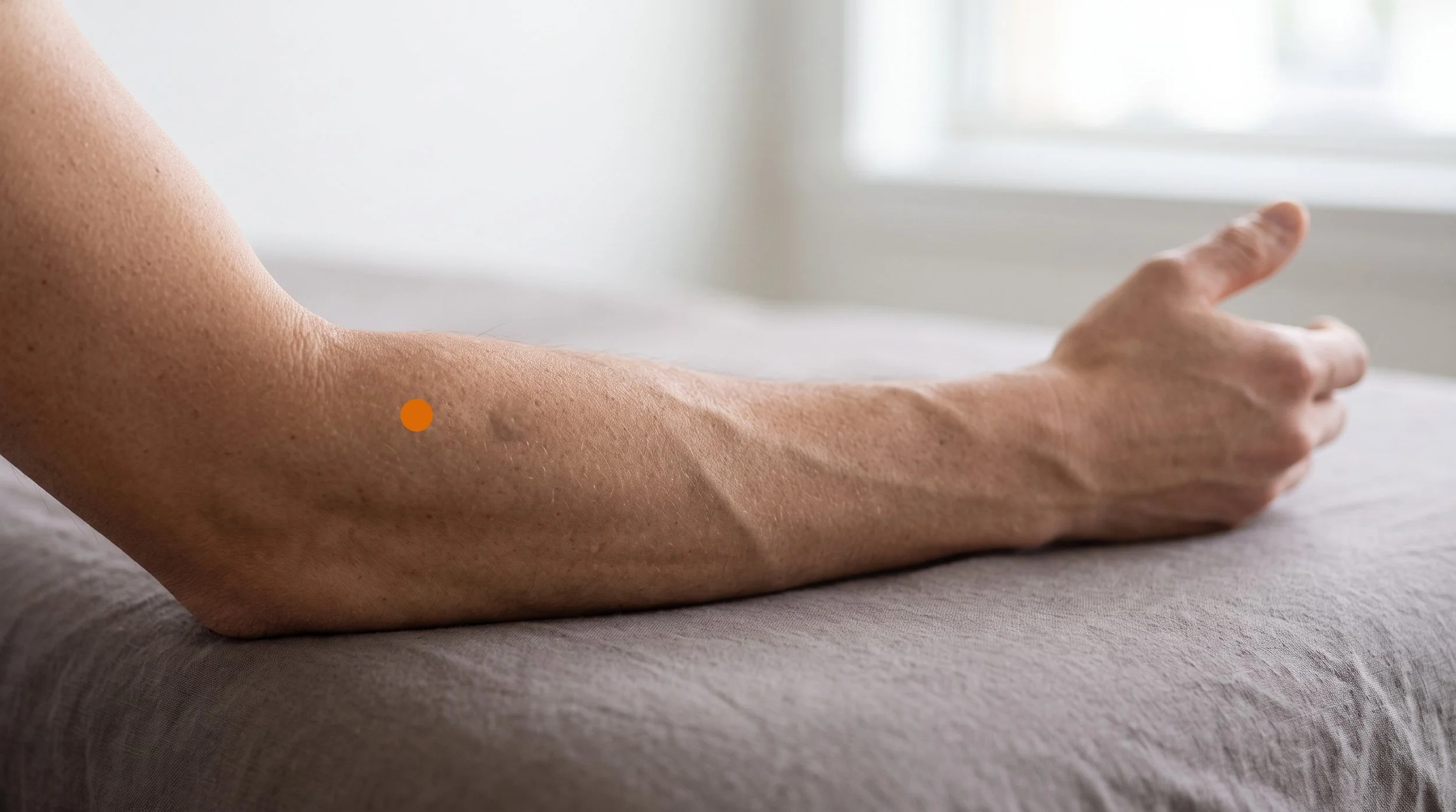
LI10 Acupuncture Point (Shousanli)
Arm Three Miles Below the Elbow: Anatomy, Mechanism, and Why LI10 Anchors Treatment for Tennis Elbow, Forearm Pain, and Grip Fatigue
LI10, known in Chinese as Shousanli and usually translated as Arm Three Miles, sits in the thick muscular wad of the upper radial forearm, about two cun (roughly two thumb widths) below the elbow crease on the line running from LI11 toward LI5 at the wrist.
In plain terms, if you bend your elbow, turn the thumb side of the forearm upward, and press into the firm bulge of muscle just past the joint, the sorest spot you find is usually the li10 acupuncture point. That tenderness is not a coincidence: the point lands directly over the extensor carpi radialis longus and brevis, the muscles that fail first in tennis elbow, gripping injuries, and long days of typing or tool use.
Classical texts grouped it with the great tonifying point ST36 and used it for pain, weakness, and numbness through the whole arm, and modern practice keeps it near the top of the list for lateral elbow and forearm complaints.
- Large intestine 10 lies in the proximal extensor wad of the forearm, over extensor carpi radialis longus and brevis with supinator lying deeper, which is exactly the tissue overloaded in lateral elbow tendinopathy (Deadman et al., 2001; Cheng, 1987).
- Traditional sources describe LI10 as regulating qi and blood, opening the channel, and easing pain in the arm, with a lesser role in digestive complaints; read neurophysiologically, that maps onto local muscle and tendon effects plus segmental modulation at the C6 and C7 spinal levels (Deadman et al., 2001).
- Needling here recruits group III and IV afferents in muscle, which drive segmental inhibition in the dorsal horn and engage descending pain control and endogenous opioid pathways (Zhao, 2008).
- For lateral elbow pain the evidence base is real but modest: older reviews found short-term analgesia with methodological limits (Green et al., 2002; Trinh et al., 2004), and later meta-analyses reported favorable but low-certainty results (Zhou et al., 2020; Navarro-Santana et al., 2021).
- In clinical practice LI10 is rarely used alone; a prescription analysis of published acupuncture protocols for lateral epicondylitis found LI11 paired with LI10 to be the most strongly supported point combination (Xu et al., 2026).
- De qi at this point is usually a heavy, distending ache that spreads toward the wrist or thumb, and because the site so often overlaps a taut band in the extensor muscles, a brief twitch response is common (Simons et al., 1999).
Struggling With Tennis Elbow or Forearm Pain That Will Not Settle?
At Morningside Acupuncture we treat lateral elbow pain by needling LI10 and LI11 in the extensor wad, then adding dry needling of the specific muscles that reproduce your symptoms on palpation. Most patients feel a distinct ache during the treatment and a looser, less guarded forearm afterward. We pair the needling with load management and simple grip and wrist extensor progressions so the tissue keeps improving between visits. Schedule a session and let us map exactly where your elbow pain is coming from.
Schedule NowAnatomy of LI10: Why the Proximal Extensor Wad Is Such an Important Location
Under the skin and thin subcutaneous layer at LI10 sits the bulk of the radial extensor group: extensor carpi radialis longus and, just deep and distal to it, extensor carpi radialis brevis. Deeper still lies the supinator, wrapping around the proximal radius. This is the tissue that works every time you stabilize the wrist against a load, so gripping a racquet, carrying grocery bags up subway stairs, holding a phone for hours, using hand tools, or resting a wrist on a desk edge while mousing all load the same few centimeters of muscle.
Because extensor carpi radialis brevis has a small, poorly vascularized attachment at the lateral epicondyle, repetitive demand tends to show up as tenderness both at the bony origin and in the muscle belly right where LI10 is located.
The overlying skin is supplied by the posterior and lateral antebrachial cutaneous nerves, while the muscles themselves are radial nerve territory, drawing motor supply from the C5 to C7 segments. This matters clinically: LI10, the lateral epicondyle, the radial forearm, and the lower cervical spine all report to overlapping segments of the dorsal horn.
Needling into a tender muscular band at LI10 generates a burst of group III and IV afferent input that inhibits transmission in those shared segments and recruits descending inhibitory pathways from the brainstem, along with endogenous opioid mechanisms (Zhao, 2008). That is one plausible reason a needle in the mid-forearm can change how sensitive the epicondyle feels within a single session, and why individual patient data from large chronic pain trials show effects that persist beyond the treatment hour (Vickers et al., 2018).
Deep to the muscle layer run branches of the radial recurrent artery and vein, and the deep branch of the radial nerve (the posterior interosseous nerve) passes through the supinator not far from this level (Cheng, 1987). Standard practice is a perpendicular insertion of roughly 1 to 1.5 cun into the muscle belly, with classical sources allowing 0.5 to 1.5 cun perpendicular or oblique (Deadman et al., 2001).
Clinicians keep the needle within the muscle rather than driving repeatedly toward the radial tunnel, use moderate rather than aggressive stimulation if a sharp electrical sensation shoots into the hand, and keep electroacupuncture intensity comfortable. With sterile single-use needles and reasonable depth control, LI10 is a low-risk site, and the most common side effects are brief soreness or a small bruise.
Related Extensor Carpi Radialis Brevis Trigger Points Related Large Intestine ChannelLI10 at a Glance: Classification, Location, and Clinical Use
| Category | Detail |
|---|---|
| Traditional Name | Shousanli (Arm Three Miles), LI10, also written L.I.-10 and large intestine 10 |
| Channel Classification | Hand Yangming Large Intestine channel, forearm segment, between LI9 and LI11 |
| Point Categories | A regular point of the Large Intestine channel with no five-shu, luo-connecting, xi-cleft, or extraordinary vessel designation. Classical actions attributed to it are regulating qi and blood, activating the channel to relieve pain, and, secondarily, harmonizing the intestines and Stomach (Deadman et al., 2001). It is traditionally paired conceptually with ST36 because of the shared name and the analogous position just distal to a major joint. |
| Precise Location | Radial side of the dorsal forearm, 2 cun distal to the cubital crease on the line joining LI11 and LI5. Locate with the elbow flexed and the thumb side of the forearm facing up; the spot is usually noticeably tender to palpation. |
| Tissue Stimulated | Extensor carpi radialis longus and extensor carpi radialis brevis, with supinator deeper; posterior and lateral antebrachial cutaneous nerve territory, radial nerve C5 to C7 myotome, near the posterior interosseous nerve region |
| Needle Depth / Direction | Perpendicular insertion 1 to 1.5 cun into the muscle belly (classically 0.5 to 1.5 cun, perpendicular or oblique); moxibustion is traditionally applicable |
| De Qi Sensation | Heavy, distending ache or fullness in the extensor mass, often spreading toward the wrist and thumb and occasionally upward toward the shoulder; a brief involuntary twitch is common when a taut band is engaged |
| Primary Clinical Uses | Tennis elbow and lateral elbow pain, forearm pain and heaviness, grip fatigue and weakness, arm numbness and stiffness after stroke or immobilization, and traditionally toothache of the upper jaw and digestive complaints |
| Common Point Combinations |
|
In Deadman, Al-Khafaji and Baker's A Manual of Acupuncture, LI10 is presented as the arm counterpart of ST36: same name, same position just below a major joint, and a shared but unequal ability to settle the stomach and intestines, which the authors treat as a secondary and comparatively minor function here. The main traditional attribution is different and more specific.
Because the Yangming channels were said to be rich in qi and blood, LI10 was regarded as the point for invigorating circulation through the entire upper limb, and it appears repeatedly in the classical literature for painful obstruction, atrophy disorder, hemiplegia, numbness, and stiff, immobile arms, often chained with LI15 and LI4 across the limb.
The text also notes that practitioners alternate LI10 with LI11 across long courses of treatment for chronic channel disorders so the same few points are not needled session after session, and that LI10 with LI11 is a standard adjacent pairing for elbow disease, tennis elbow in particular.
What is striking about the classical pattern is how anatomically honest it turns out to be: a point chosen centuries ago to move blood and relieve heaviness in the whole arm sits precisely in the muscle group that modern clinicians identify as the engine of lateral elbow pain.
Why LI10 Is Used for Tennis Elbow, Grip Fatigue, and Sometimes for Stiff Neck and Acute Low Back Pain
The tennis elbow logic is straightforward. Lateral epicondylalgia is rarely just a problem at the bone. The extensor carpi radialis brevis and longus muscle bellies, along with supinator and brachioradialis, are usually thickened, tender, and holding taut bands, and these tissues share segmental innervation with the painful epicondyle. Needling LI10 into that tissue delivers strong afferent input from the same C6 and C7 territory as the symptomatic tendon, which can reduce dorsal horn excitability and lower local pressure sensitivity for hours to days (Zhao, 2008; Simons et al., 1999).
Add LI11 at the joint line and LI4 in the hand and you have coverage of the whole channel path, which is precisely the arrangement prescription analyses most often find in published protocols (Xu et al., 2026).
A second effect is motor rather than purely analgesic. A sham-controlled trial in healthy participants needled a six point protocol that included LI10, LI11, LI4, SI8, TE10, and TE5, and measured isokinetic elbow performance and surface EMG before and after. Torque, work, power, and muscle activity increased after real needling relative to sham, and the change was time-limited, lasting roughly seven to twenty-one minutes after treatment (Su et al., 2022).
That is a small study in healthy volunteers, not proof of clinical benefit, but it fits what patients describe: a temporarily freer, stronger-feeling forearm right after needling, which is a useful window for loading exercises rather than a lasting fix on its own.
The less obvious uses come from the classical record and Chinese clinical reports, where LI10 is needled distally for stiff neck and acute lumbar strain, often with active movement of the painful area during stimulation, and Deadman's indication list includes lumbar pain with inability to lie down (Deadman et al., 2001; Yi, 2009). Mechanistically this is best explained as a distal, heterosegmental effect: strong needle stimulation anywhere in the body can recruit diffuse descending inhibition, and pairing it with gentle movement takes advantage of that brief window of reduced guarding (Zhao, 2008).
We frame this as an adjunct worth trying rather than a primary treatment for back or neck pain, and the evidence for it is far weaker than the evidence for the elbow.
What the Research Shows for LI10
One caveat frames everything below: almost no trial tests LI10 on its own. Studies of acupuncture for tennis elbow use multi-point protocols in which LI10 is one component, usually alongside LI11 and local ashi points, so the research tells us about the treatment package rather than the individual point. The literature also skews toward small trials with short follow-up and variable blinding, which is why reviews tend to describe short-term benefit with low to moderate certainty rather than durable effects.
With that in mind, the picture for lateral elbow pain is cautiously encouraging, and the dry needling literature aimed at the same muscles LI10 sits over adds a parallel line of support.
| Study | Type | Focus | Key Finding |
|---|---|---|---|
| Green et al., 2002 | Cochrane systematic review | Acupuncture for lateral elbow pain | Found insufficient evidence to support or refute acupuncture overall, with the small included trials suggesting only short-lived pain relief. |
| Trinh et al., 2004 | Systematic review | Acupuncture for lateral epicondyle pain | Concluded that acupuncture appears effective for short-term relief of lateral elbow pain, with no reliable data on longer-term outcomes. |
| Zhou et al., 2020 | Systematic review and meta-analysis | Acupuncture versus sham, medication, and injection therapy for lateral epicondylitis | Reported better pain and efficacy outcomes for acupuncture across ten trials, while noting that methodological quality was too limited for firm conclusions. |
| Navarro-Santana et al., 2021 | Systematic review and meta-analysis | Manual acupuncture and electroacupuncture for lateral epicondylalgia | Found short-term improvements in pain and pain-related disability, with the certainty of evidence downgraded by heterogeneity and small samples. |
| Navarro-Santana et al., 2020 | Systematic review and meta-analysis | Trigger point dry needling of the forearm extensors in lateral epicondylalgia | Low to moderate evidence suggested short-term reductions in pain and disability and improvements in pressure pain threshold and grip strength. |
| Su et al., 2022 | Randomized controlled trial (sham-controlled) | Elbow muscle endurance after needling a protocol including LI10 | Real needling increased isokinetic performance and EMG activity compared with sham, with effects that faded within roughly twenty minutes. |
| Xu et al., 2026 | Data mining analysis of clinical prescriptions | Acupoint patterns used for lateral epicondylitis in published trials | Identified LI11 combined with LI10 as the most strongly supported point pairing across the analyzed protocols. |
| Vickers et al., 2018 | Individual patient data meta-analysis | Acupuncture for chronic musculoskeletal, headache, and osteoarthritis pain | Found acupuncture superior to sham and to no-acupuncture control, with effects that persisted over twelve months rather than dissipating immediately. |
Is Your Grip Giving Out at the Gym, the Keyboard, or the Climbing Wall?
Forearm fatigue and weak grip usually reflect overloaded extensor and supinator tissue rather than anything structurally alarming. We use LI10 with LI4 and LI11 to address the whole upper limb, and we needle the taut bands in extensor carpi radialis brevis, brachioradialis, and supinator that show up during the exam. Treatment is combined with practical advice on grip width, mouse setup, and training volume. Book an appointment and get a clear plan for your forearm.
Schedule NowLI10 in the Context of Trigger Point Work
LI10 is one of the clearest examples of a classical point sitting on top of a well-described myofascial target. The extensor carpi radialis longus and brevis both harbor trigger points that refer pain toward the lateral epicondyle and down into the back of the wrist and hand, and supinator trigger points refer to the lateral elbow and the web space of the thumb (Simons et al., 1999).
When a patient with tennis elbow points to the epicondyle but the tender, band-like tissue is two centimeters distal in the muscle belly, the acupuncturist and the dry needling clinician are aiming at the same place from different traditions. Needling here often produces a local twitch response, and meta-analytic data on trigger point dry needling in lateral epicondylalgia suggest short-term gains in pain, disability, and grip strength (Navarro-Santana et al., 2020).
At Morningside Acupuncture we treat LI10 as the hub of a regional approach rather than a single stop. A typical session for lateral elbow pain includes needling at LI10 and LI11, dry needling of extensor carpi radialis brevis and longus, brachioradialis, supinator, and sometimes extensor digitorum, plus a check of the cervical spine and shoulder when symptoms extend past the forearm. Because acupuncture in our clinic means the use of an acupuncture needle across many styles, including dry needling, there is no artificial line between the channel point and the muscular target.
Needling is then paired with progressive isometric and eccentric wrist extensor loading, since needling reduces sensitivity while loading rebuilds tolerance.
LI10 Tennis Elbow Treatment at NYC's Highest-Rated Acupuncture Clinic
Morningside Acupuncture is the highest-rated acupuncture and dry needling clinic in New York City with over 500 five-star Google reviews, and lateral elbow pain is one of the conditions we see most often. Every session begins with a hands-on assessment of the elbow, forearm, and neck, because arm symptoms sometimes track back to the cervical spine. LI10 is one of the anchors of our upper limb protocol, needled alongside orthopedic dry needling of the extensor group. Schedule your visit at our Upper West Side office and start working on the elbow.
Schedule NowFrequently Asked Questions
What does LI10 feel like when needled?
Most people feel a dull, spreading heaviness or a strong distending ache in the forearm rather than a sharp pain. The sensation often travels toward the wrist or thumb, and some patients feel it drift up toward the shoulder. Because the point commonly sits on a taut band, the muscle may twitch briefly, which can feel like a deep cramp for a second or two before it releases. Mild soreness for a day afterward is normal, similar to how a muscle feels after unfamiliar exercise.
Why needle LI10 in the forearm when my pain is at the elbow?
The tissue that hurts at the lateral epicondyle is the attachment site of muscles whose bellies sit right where LI10 is located, and both share innervation from the same C6 and C7 spinal segments. Needling the muscle feeds strong sensory input into those shared segments, which can reduce the sensitivity of the whole region rather than only the spot you can point to (Zhao, 2008). Practically, treating only the bony attachment often misses the taut, tender muscle that is generating and maintaining the load, which is why LI10 and LI11 are usually used together (Xu et al., 2026).
Can I press LI10 myself between sessions?
Yes, and it is one of the easier points to self-treat. Bend the elbow, turn the thumb side of the forearm upward, and slide your opposite thumb about two thumb widths down from the elbow crease into the muscular bulge; the tender spot is usually obvious. Press with steady, moderate pressure at an intensity you would rate about a four to six out of ten, hold for thirty to sixty seconds, then release, and repeat two or three times per side. You can also make small circles for one to two minutes or gently open and close your fist while holding pressure, which adds movement to the input. Two or three short sessions a day is plenty; stop if pressing produces numbness, tingling, or shooting sensations into the hand, and skip it over broken skin, a rash, or a recent injury with swelling.
Is LI10 safe to needle?
In trained hands it is a low-risk point. There is no lung or major organ underneath, and the main structures to respect are the deep branch of the radial nerve as it passes through the supinator and the branches of the radial recurrent vessels (Cheng, 1987). Practitioners stay within the muscle belly at a moderate depth, avoid repeated forceful thrusting toward the deeper nerve, and back off if a patient reports an electric shock into the hand. Expected side effects are limited to short-lived soreness, a small bruise, or a brief lightheaded feeling, and single-use sterile needles are standard.
Where exactly is LI10 located?
The li 10 location is on the radial side of the dorsal forearm, 2 cun distal to the elbow crease, on the line connecting LI11 at the elbow with LI5 at the wrist. A simple way to find it is to flex the elbow, turn the thumb side of the forearm up, place two thumb widths below the crease, and press into the firm muscular mass; classical texts note that the point is usually markedly tender, which makes palpation more reliable than measurement alone (Deadman et al., 2001).
References
- Deadman, P., Al-Khafaji, M., & Baker, K. (2009). A manual of acupuncture. Journal of Chinese Medicine Publications.
- Cheng, X. (Ed.). (1999). Chinese acupuncture and moxibustion (Rev. ed.). Foreign Languages Press.
- Simons, D. G., Travell, J. G., & Simons, L. S. (1999). Travell & Simons' myofascial pain and dysfunction: The trigger point manual, Vol. 1: Upper half of body (2nd ed.). Williams & Wilkins.
- Green, S., Buchbinder, R., Barnsley, L., Hall, S., White, M., Smidt, N., & Assendelft, W. (2002). Acupuncture for lateral elbow pain. Cochrane Database of Systematic Reviews, 2002(1), CD003527. https://doi.org/10.1002/14651858.CD003527
- Trinh, K. V., Phillips, S. D., Ho, E., & Damsma, K. (2004). Acupuncture for the alleviation of lateral epicondyle pain: A systematic review. Rheumatology, 43(9), 1085-1090. https://doi.org/10.1093/rheumatology/keh247
- Zhou, Y., Guo, Y., Zhou, R., Wu, P., Liang, F., & Yang, Z. (2020). Effectiveness of acupuncture for lateral epicondylitis: A systematic review and meta-analysis of randomized controlled trials. Pain Research and Management, 2020, 8506591. https://doi.org/10.1155/2020/8506591
- Navarro-Santana, M. J., Sanchez-Infante, J., Gómez-Chiguano, G. F., Cummings, M., Fernández-de-las-Peñas, C., & Plaza-Manzano, G. (2021). Effects of manual acupuncture and electroacupuncture for lateral epicondylalgia of musculoskeletal origin: A systematic review and meta-analysis. Acupuncture in Medicine, 39(2), 111-123. https://doi.org/10.1177/0964528420967364
- Navarro-Santana, M. J., Sanchez-Infante, J., Gómez-Chiguano, G. F., Cleland, J. A., López-de-Uralde-Villanueva, I., Fernández-de-las-Peñas, C., & Plaza-Manzano, G. (2020). Effects of trigger point dry needling on lateral epicondylalgia of musculoskeletal origin: A systematic review and meta-analysis. Clinical Rehabilitation, 34(11), 1327-1340. https://doi.org/10.1177/0269215520937468
- Su, Y., Yao, S., Zhou, Z. J., Wu, C., Wang, I. L., & Lai, C. Y. (2022). Effect of acupuncture on time-dependent of muscle endurance in female elbow joint: A randomized controlled trial. Evidence-Based Complementary and Alternative Medicine, 2022, 8052256. https://doi.org/10.1155/2022/8052256
- Xu, Y., Chen, M., Dong, Y., Wang, F., & Lai, Q. (2026). Data mining of acupuncture prescriptions for lateral epicondylitis: A literature-based analysis of acupoint patterns and parameters. Journal of Pain Research, 19, 583466. https://doi.org/10.2147/JPR.S583466
- Yi, H. Q. (2009). Clinical application of Shousanli (LI 10). Journal of Acupuncture and Tuina Science, 7, 308-309. https://doi.org/10.1007/s11726-009-0308-0
- Vickers, A. J., Vertosick, E. A., Lewith, G., MacPherson, H., Foster, N. E., Sherman, K. J., Irnich, D., Witt, C. M., & Linde, K. (2018). Acupuncture for chronic pain: Update of an individual patient data meta-analysis. Journal of Pain, 19(5), 455-474. https://doi.org/10.1016/j.jpain.2017.11.005
- Zhao, Z. Q. (2008). Neural mechanism underlying acupuncture analgesia. Progress in Neurobiology, 85(4), 355-375. https://doi.org/10.1016/j.pneurobio.2008.05.004
Disclaimer: This web site is intended for educational and informational purposes only. Reading this website does not constitute providing medical advice or any professional services. This information should not be used for diagnosing or treating any health issue or disease. Those seeking medical advice should consult with a licensed physician. Seek the advice of a medical doctor or other qualified health professional for any medical condition. If you think you have a medical emergency, call 911 or go to the emergency room. No acupuncturist-patient relationship is created by reading this website or using the information. Morningside Acupuncture PLLC and its employees and contributors do not make any express or implied representations with respect to the information on this site or its use. For any legal interpretation of scope of practice in your state, consult a licensed attorney or regulatory authority.
Read more from our blog



