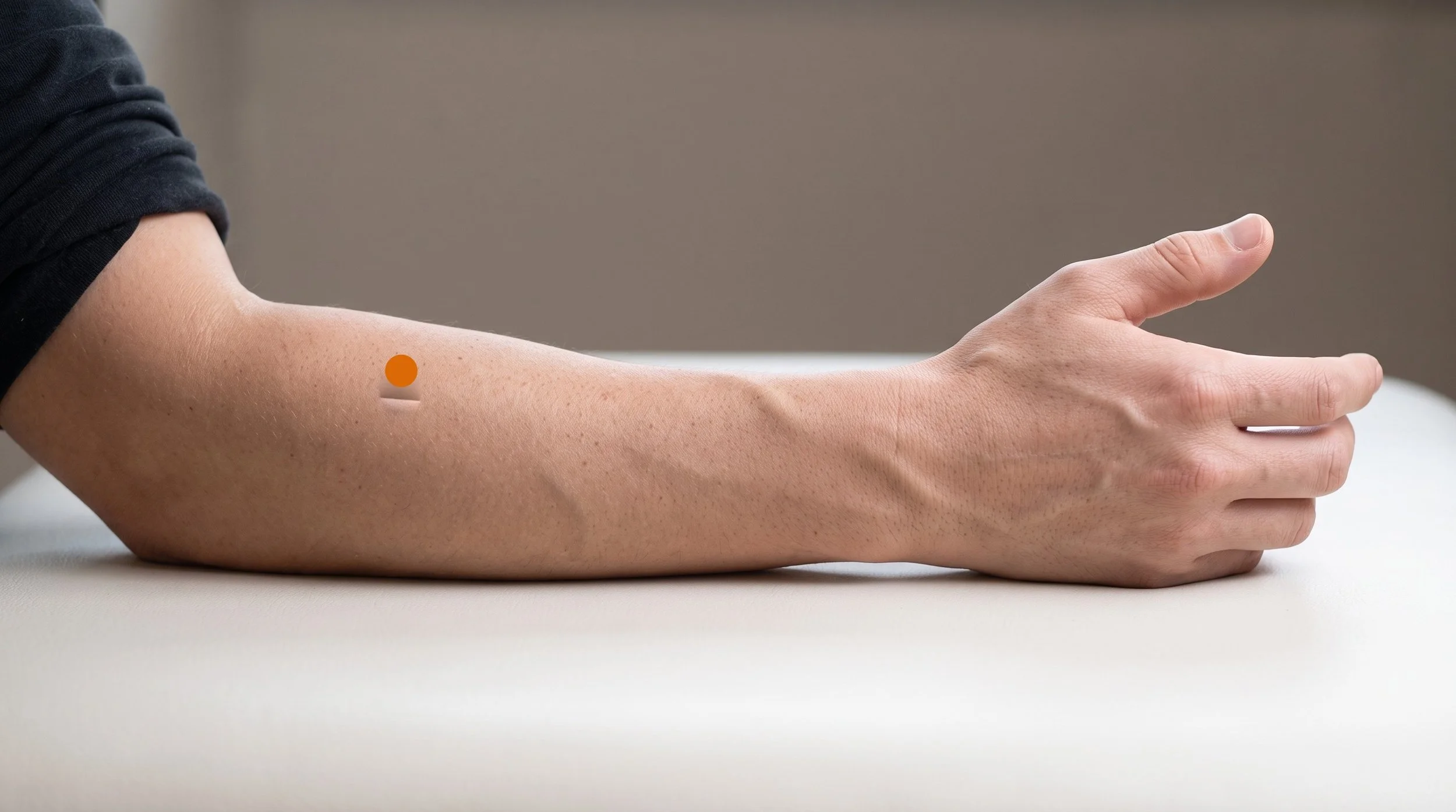
LI9 Acupuncture Point (Shanglian)
The Upper Angle of the Forearm: Anatomy, Mechanism, and Why This Quiet Large Intestine Point Earns Its Place in Elbow, Arm, and Abdominal Treatment
LI9 (Shanglian, often translated as Upper Angle or Upper Edge) sits on the thumb side of the forearm, three cun below the elbow crease on the line that runs from LI11 at the elbow to LI5 at the wrist.
In plain terms, bend your elbow, turn the thumb side of your forearm upward, and slide about four finger widths down from the outer end of the elbow crease into the firm muscular bulk that tightens when you make a fist.
That bulk is the mobile wad of extensor carpi radialis longus and brevis, with supinator underneath and a branch of the radial nerve running through the deeper layer, which is exactly why the li9 acupuncture point matters clinically: it lands in tissue that takes a beating from gripping, typing, racket sports, and repetitive lifting, and it sits on a channel whose classical indications run from the elbow all the way to the gut.
- Shanglian point location is straightforward once you find the endpoints: locate LI11 at the lateral end of the flexed elbow crease and LI5 in the anatomical snuffbox, then measure three cun distal to LI11 along that line, which puts large intestine 9 in the upper third of the radial forearm (Deadman et al., 2001).
- Under the skin, the needle passes through extensor carpi radialis longus and brevis and can reach supinator, a muscle group that Travell and Simons documented as a common source of lateral elbow and dorsal forearm pain in gripping strain presentations (Simons et al., 1999).
- Classically, LI9 is credited with harmonizing the Large Intestine and activating the channel to relieve pain, a pairing that reads neurophysiologically as local extensor tissue effects plus segmental input into the C6 to C7 spinal levels that also serve the arm and shoulder (Deadman et al., 2001).
- The mechanism story is unglamorous but well supported: needling recruits A delta and group III afferents, engages segmental inhibition in the dorsal horn, and activates descending pain control pathways from the midbrain and brainstem (Zhao, 2008).
- For the arm itself, the research picture is cautiously encouraging. A meta-analysis of acupuncture for lateral epicondylitis reported benefit over comparison treatments while flagging low trial quality (Zhou et al., 2020), and dry needling of forearm extensor trigger points has shown meaningful short-term pain and disability changes (Navarro-Santana et al., 2020).
- De qi at li 9 forearm is usually a deep, heavy ache that spreads toward the wrist or up toward the lateral elbow, and in tennis elbow presentations patients often say the sensation reproduces the exact ache they came in with, which is a useful sign the needle is in relevant tissue.
Elbow and Forearm Pain That Flares Every Time You Grip Something?
Lateral elbow pain rarely stays put at the elbow, and the tissue that keeps it going often sits an inch or two down the forearm at LI9. At Morningside Acupuncture, we palpate the whole extensor wad, needle the tender bands we find, and pair that local work with channel points at LI10, LI11, and LI4 so the shoulder and neck contributors get addressed too. Most patients feel a change in grip comfort within a few sessions when treatment is combined with load management and eccentric strengthening. Schedule a visit and let's map where your pain actually lives.
Schedule NowAnatomy of LI9: Why the Mobile Wad of the Upper Forearm Is Such an Important Location
Three cun below the elbow crease on the radial side, the needle enters thin skin and subcutaneous tissue before meeting the mobile wad, the rope of muscle formed by brachioradialis, extensor carpi radialis longus, and extensor carpi radialis brevis. Deeper still lies supinator, wrapping the proximal radius. These are the muscles that stabilize the wrist every time the hand grips, so they load constantly during keyboard work, tool use, weight training, climbing, and racket sports.
Repeated eccentric demand on this group is a classic setup for lateral elbow pain, and the tissue at LI9 is often thickened, ropy, and exquisitely tender to palpation in those presentations (Simons et al., 1999).
The nerve geography here is the reason a forearm point can influence symptoms felt at the elbow and shoulder. Cutaneous supply comes from the lateral antebrachial cutaneous nerve and branches of the radial nerve, while deeper tissue is served by the posterior interosseous branch of the radial nerve as it passes through supinator. All of this converges on the C6 and C7 spinal segments, the same segments that carry input from the lateral elbow and much of the shoulder girdle.
Needling here generates a barrage of small-fiber afferent traffic that modulates dorsal horn transmission at those shared levels and recruits descending inhibitory pathways from the periaqueductal gray and rostral ventromedial medulla (Zhao, 2008). That combination of segmental convergence and top-down modulation, rather than anything moving along a channel, is the plausible explanation for why patients often report the whole arm feeling looser after treatment.
Vascular structures in the neighborhood include branches of the radial recurrent artery and vein running with the radial nerve in the groove between brachioradialis and the extensor carpi radialis muscles. Standard needling at LI9 is perpendicular or oblique, 0.5 to 1.5 cun, which stays well within muscle and avoids anything requiring special caution (Deadman et al., 2001). Practitioners generally angle away from the neurovascular groove rather than into it, and moxibustion is traditionally considered appropriate at this point. It's a low-risk location, which is part of why it gets used so freely in arm pain protocols.
Related Extensor Carpi Radialis Brevis Trigger Points Related Pain Finder Forearm HandLI9 at a Glance: Classification, Location, and Clinical Use
| Category | Detail |
|---|---|
| Traditional Name | Shanglian (Upper Angle, also translated Upper Edge or Upper Integrity) |
| Channel Classification | Large Intestine channel of the hand, yangming; a regular channel point of the upper forearm |
| Point Categories | No five-shu, luo, xi-cleft, or hui-meeting designation and no extraordinary vessel intersection is recorded for this point in the classical texts consulted. It is a plain channel point, traditionally credited with harmonizing the Large Intestine and activating the channel to relieve pain. |
| Precise Location | On the radial side of the forearm, 3 cun distal to LI11, on the line joining LI11 with LI5. Locate with the elbow flexed and the radial side facing up; halve the LI5 to LI11 distance, then halve again between that midpoint and LI11. |
| Tissue Stimulated | Skin and subcutaneous tissue, then extensor carpi radialis longus and extensor carpi radialis brevis, with supinator in the deep layer; branches of the radial nerve including the posterior interosseous nerve run nearby |
| Needle Depth / Direction | Perpendicular or oblique insertion, 0.5 to 1.5 cun, angled into the extensor mass and away from the radial neurovascular groove; moxibustion is traditionally applied |
| De Qi Sensation | Deep, heavy, spreading ache in the forearm, often traveling distally toward the wrist and thumb or proximally toward the lateral elbow; in tennis elbow presentations it frequently reproduces the patient's familiar ache |
| Primary Clinical Uses | Lateral elbow and forearm pain, gripping-related extensor strain, arm numbness and heaviness, shoulder pain referring down the arm, and traditionally abdominal pain with rumbling intestines and post-stroke limb rehabilitation |
| Common Point Combinations |
|
Deadman, Al-Khafaji, and Baker's A Manual of Acupuncture attributes two traditional actions to Shanglian: harmonizing the Large Intestine and activating the channel to relieve pain. The classical indication lists they compile fall into three loose groups. The first is digestive and urinary: rumbling intestines, stagnant Large Intestine qi, abdominal pain, and difficult or dark urination.
The second is a chest and head cluster including chest pain, labored breathing, headache, and the old category of brain wind. The third, and the one most familiar to modern practitioners, covers pain or numbness of the shoulder, elbow, and arm, numbness of the limbs, one-sided weakness after wind-stroke, and a striking classical description of cold felt in the bone marrow. Cunningham's point text adds that LI9 was mentioned classically for flank pain, poor digestion, and periumbilical pain, and suggests palpating the LI8 and LI9 region and needling the most tender spot in abdominal presentations.
What's striking is the pattern itself: a point three inches below the elbow, credited across centuries with settling the gut, in a tradition that had no concept of a spinal reflex arc but repeatedly noticed the connection anyway.
Why LI9 Is Used for Digestive Complaints as Well as Arm Pain
Patients are usually unsurprised that a forearm point helps a forearm problem. The classical use of LI9 for rumbling intestines and abdominal pain takes more explaining. Part of the answer is convergence: sensory input from the forearm enters the spinal cord at the C6 and C7 levels, where it joins a dense network of interneurons that also influence descending autonomic outflow. Somatic stimulation at one body region can shift autonomic tone elsewhere through what researchers call somatoautonomic reflexes, pathways mapped in detail across decades of animal work (Uchida et al., 2017).
Effects on gut motility from limb stimulation appear to be real but modest, and they depend heavily on stimulation site, intensity, and the animal's baseline state.
For pain, the mechanism is better characterized. Needle stimulation activates small-diameter afferents, which triggers segmental inhibition in the dorsal horn and engages descending serotonergic and noradrenergic pathways along with endogenous opioid release (Zhao, 2008). This is why a needle at LI9 can influence symptoms felt above the elbow, and why patients frequently report a general settling or drowsiness during treatment that has nothing to do with the arm.
The largest individual patient data analysis of acupuncture for chronic pain found effects that persisted over months rather than fading immediately after treatment, consistent with a physiological rather than purely expectancy-driven response (Vickers et al., 2018).
In practice we treat LI9 primarily as a musculoskeletal point and view any digestive benefit as a secondary possibility rather than a promise. If a patient's main complaint is abdominal, we'd reach for abdominal points and ST36 first, and use LI9 as an adjunct where the classical grouping suggests it. Being honest about that hierarchy matters more than defending every classical indication.
What the Research Shows for LI9
No trial has isolated LI9 on its own, and it's worth saying so plainly. Acupuncture research almost always tests multi-point protocols, so the fairest way to read the evidence is that LI9 sits inside a family of forearm and elbow points that appear together in lateral epicondylitis and arm pain protocols. What follows summarizes the reviews most relevant to how this point actually gets used, along with the mechanism literature that explains why it might work. Trial quality in this area is generally low to moderate, effect sizes vary, and blinding remains a real problem in needling research.
| Study | Type | Focus | Key Finding |
|---|---|---|---|
| Zhou et al., 2020 | Systematic review and meta-analysis | Acupuncture for lateral epicondylitis (tennis elbow), 10 RCTs, 796 participants | Acupuncture appeared superior to medication, blocking therapy, and sham on pooled outcomes, though the authors emphasized that low trial quality limits confidence in the result. |
| Navarro-Santana et al., 2020 | Systematic review and meta-analysis | Trigger point dry needling for lateral epicondylalgia, 7 RCTs, 320 patients | Dry needling of forearm extensor trigger points was associated with large reductions in pain intensity and related disability, with the caveat of few and heterogeneous trials. |
| Vickers et al., 2018 | Individual patient data meta-analysis | Acupuncture for chronic musculoskeletal, headache, and osteoarthritis pain, roughly 21,000 patients | Acupuncture outperformed both sham and no-acupuncture controls, with effects that persisted over twelve months rather than disappearing quickly. |
| Zhao, 2008 | Narrative mechanism review | Neural pathways underlying acupuncture analgesia | Analgesic effects are attributed to afferent activation, spinal segmental inhibition, and descending control involving opioid and monoaminergic systems. |
| Uchida et al., 2017 | Review of experimental physiology | Somatoautonomic reflexes evoked by acupuncture-like somatic stimulation | Somatic stimulation can modulate visceral function through spinal and supraspinal reflex pathways, though most data come from anesthetized animals and may not transfer directly to conscious patients. |
Numbness, Aching, or Heaviness Running Down the Arm?
Arm symptoms that travel from shoulder to hand often involve several links in the chain at once: irritated cervical segments, tight scapular muscles, and loaded forearm extensors. LI9 gives us a distal handle on that chain, and it is traditionally listed for pain and numbness of the shoulder, elbow, and arm. We combine it with careful assessment so you're not chasing symptoms up and down the limb. Book an evaluation and we'll build a treatment plan around what your exam shows.
Schedule NowLI9 in the Context of Trigger Point Work
LI9 falls squarely in a region that trigger point clinicians treat constantly. Travell and Simons described taut bands in extensor carpi radialis longus and brevis that refer pain to the lateral epicondile region and along the back of the forearm toward the wrist and hand, a referral pattern many patients recognize immediately when the spot is pressed (Simons et al., 1999). Because acupuncture is defined by the use of an acupuncture needle rather than by any single theoretical framework, needling this tissue is the same physical act whether it's described as LI9 or as dry needling of the extensor wad. What changes is the reasoning behind point selection, not the instrument or the target.
At Morningside we typically palpate from the lateral epicondyle down through the extensor mass before deciding where to needle, and the tender band often sits within a centimeter of textbook LI9. From there we may add extensor carpi ulnaris and, in thumb-dominant strain, extensor pollicis longus and brevis, then treat proximally at the shoulder girdle if the arm symptoms travel. Patients usually feel a brief cramping or twitch response in the muscle, followed by a dull soreness that settles within a day. That local work pairs well with channel points at LI10, LI11, and LI4 and with the loading program that ultimately drives tendon recovery.
LI9 Elbow and Arm Pain Treatment at NYC's Highest-Rated Acupuncture Clinic
Morningside Acupuncture is the highest-rated acupuncture and dry needling clinic in New York City with over 500 five-star Google reviews, and forearm and elbow complaints are among the conditions we see most. Our approach blends classical channel point selection with orthopedic assessment and trigger point needling of the extensor group. You'll leave with a clear explanation of what we found and what to do between sessions. Schedule your appointment today.
Schedule NowFrequently Asked Questions
What does LI9 feel like when needled?
Most people describe a deep, heavy, slightly spreading ache rather than a sharp sting. The sensation often travels toward the wrist and thumb or up toward the outer elbow, and in tennis elbow cases it commonly reproduces the ache the patient already knows. If the needle contacts a taut band in the extensor muscles, you may feel a quick involuntary twitch, which is normal and usually brief. Some soreness for a day afterward is common and typically mild.
Why needle the forearm when my pain is at the elbow or shoulder?
Because the tissue that generates lateral elbow pain often sits below the elbow, not at it. The extensor muscles attach near the epicondyle but their taut, tender bands are frequently a few centimeters distal, right around LI9. On top of that, sensory input from the forearm and the shoulder converges on overlapping spinal segments, so needling here can influence how the whole limb's pain is processed through segmental inhibition and descending pain control (Zhao, 2008).
Can I press LI9 myself between sessions?
Yes, and it's an easy one to find. Bend your elbow to about ninety degrees with the thumb side of the forearm facing up, find the outer end of the elbow crease, and slide roughly four finger widths down the forearm into the muscular bulk that firms up when you clench your fist. Press with your opposite thumb using steady, moderate pressure, enough to feel a dull ache but not enough to make you tense up. Hold for thirty to sixty seconds, release, and repeat two or three times per side, up to a few times a day. Gently opening and closing your hand while you hold pressure can help. Stop if you feel sharp pain, tingling, or numbness in the hand.
Is LI9 safe to needle?
It's considered a low-risk point. Standard depth is 0.5 to 1.5 cun, perpendicular or oblique, and there's no cavity or major vessel at risk (Deadman et al., 2001). The main structures to respect are the radial nerve and radial recurrent vessels running in the groove between brachioradialis and the extensor carpi radialis muscles, so practitioners angle into muscle rather than toward that groove. Occasional bruising or short-lived soreness is the most likely side effect. As always, treatment should be performed by a licensed practitioner using sterile single-use needles.
Where exactly is LI9 located?
On the radial (thumb) side of the forearm, three cun below LI11 at the lateral end of the flexed elbow crease, on the straight line connecting LI11 with LI5 at the wrist. A reliable way to measure it: the wrist crease to elbow crease distance is twelve cun, so find the midpoint between LI5 and LI11, then find the midpoint between that spot and LI11. That second midpoint is LI9. Locate with the elbow flexed and the radial forearm turned upward.
References
- Deadman, P., Al-Khafaji, M., & Baker, K. (2009). A manual of acupuncture. Journal of Chinese Medicine Publications.
- Cunningham, P. M. (2000). Acupuncture points: A practical guide to classical and modern usage. Odyssey Press.
- Simons, D. G., Travell, J. G., & Simons, L. S. (1999). Travell & Simons' myofascial pain and dysfunction: The trigger point manual, Vol. 1: Upper half of body (2nd ed.). Williams & Wilkins.
- Zhao, Z. Q. (2008). Neural mechanism underlying acupuncture analgesia. Progress in Neurobiology, 85(4), 355-375. https://doi.org/10.1016/j.pneurobio.2008.05.004
- Vickers, A. J., Vertosick, E. A., Lewith, G., MacPherson, H., Foster, N. E., Sherman, K. J., Irnich, D., Witt, C. M., & Linde, K. (2018). Acupuncture for chronic pain: Update of an individual patient data meta-analysis. Journal of Pain, 19(5), 455-474. https://doi.org/10.1016/j.jpain.2017.11.005
- Zhou, Y., Guo, Y., Zhou, R., Wu, P., Liang, F., & Yang, Z. (2020). Effectiveness of acupuncture for lateral epicondylitis: A systematic review and meta-analysis of randomized controlled trials. Pain Research and Management, 2020, 8506591. https://doi.org/10.1155/2020/8506591
- Navarro-Santana, M. J., Sanchez-Infante, J., Gómez-Chiguano, G. F., Cleland, J. A., López-de-Uralde-Villanueva, I., Fernández-de-las-Peñas, C., & Plaza-Manzano, G. (2020). Effects of trigger point dry needling on lateral epicondylalgia of musculoskeletal origin: A systematic review and meta-analysis. Clinical Rehabilitation, 34(11), 1327-1340. https://doi.org/10.1177/0269215520937468
- Uchida, S., Kagitani, F., & Sato-Suzuki, I. (2017). Somatoautonomic reflexes in acupuncture therapy: A review. Autonomic Neuroscience, 203, 1-8. https://doi.org/10.1016/j.autneu.2016.11.001
Disclaimer: This web site is intended for educational and informational purposes only. Reading this website does not constitute providing medical advice or any professional services. This information should not be used for diagnosing or treating any health issue or disease. Those seeking medical advice should consult with a licensed physician. Seek the advice of a medical doctor or other qualified health professional for any medical condition. If you think you have a medical emergency, call 911 or go to the emergency room. No acupuncturist-patient relationship is created by reading this website or using the information. Morningside Acupuncture PLLC and its employees and contributors do not make any express or implied representations with respect to the information on this site or its use. For any legal interpretation of scope of practice in your state, consult a licensed attorney or regulatory authority.
Read more from our blog



