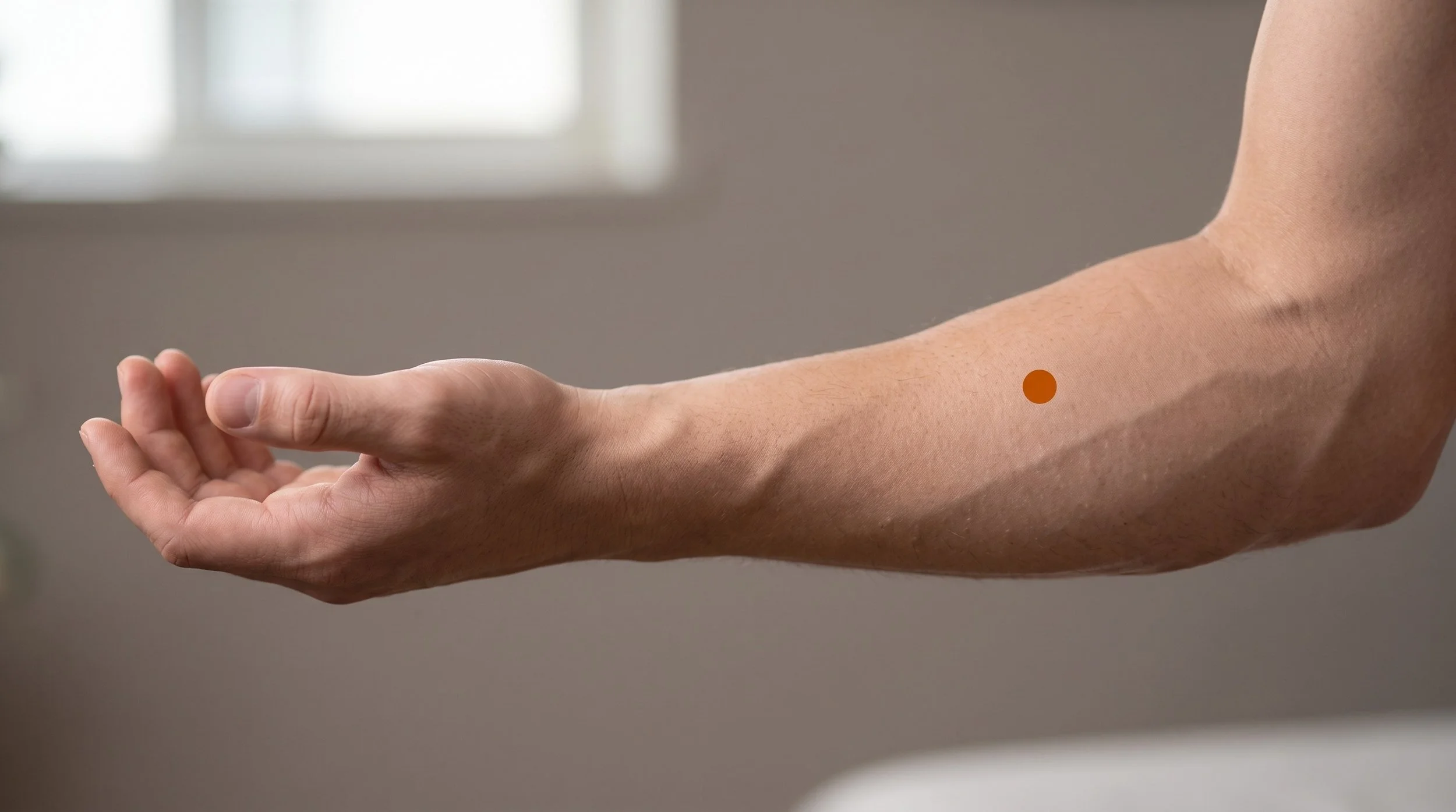
LI8 Acupuncture Point (Xialian)
The Lower Angle of the Forearm: Anatomy, Mechanism, and Why Large Intestine 8 Bridges Elbow Pain and Classical Intestinal Patterns
LI8, known in Chinese as Xialian and usually translated as Lower Angle (some texts render it Lower Integrity or Lower Edge), sits on the thumb side of the forearm, four cun below the elbow crease on the line running from LI11 down to LI5 at the wrist.
In plain terms, bend your elbow, turn the thumb side up, and find the muscular bulge that firms up when you cock your wrist back: the li8 acupuncture point lives in that mass, roughly a third of the way down from the elbow toward the wrist. Clinically it matters for two very different reasons.
Modern practitioners use large intestine 8 mostly as a local and segmental point for lateral elbow pain, forearm extensor tightness, and grip-related overload, while classical texts assign it a more surprising role in intestinal and abdominal patterns, a reflection of how the forearm points were mapped onto the leg's lower he-sea points.
- Location and layers: the lower angle point sits four cun distal to LI11 on the LI11 to LI5 line, in the forearm's mobile wad over extensor carpi radialis longus and brevis, with the supinator and the posterior interosseous nerve deeper still (Deadman et al., 2007).
- Traditional attributions translated: classical sources credit LI8 with harmonizing the Small Intestine, dispersing wind and heat, and easing pain of the elbow and arm, which in modern language maps onto segmental modulation of forearm nociception plus somatoautonomic effects on gut motility (Deadman et al., 2007; Cunningham, 2013; Uchida et al., 2017).
- Mechanism story: needling in the extensor mass recruits A-delta and group III afferents entering the C5 to C8 spinal segments, engaging local dorsal horn inhibition and the descending pain control systems that underpin acupuncture analgesia (Zhao, 2008).
- Research picture: the elbow-specific evidence is thin and dated, while dry needling of the same forearm extensors has better data, with meta-analyses reporting short-term gains in pain, disability, and grip strength in lateral epicondylitis (Green et al., 2002; Navarro-Santana et al., 2020; Ma, X., et al., 2024).
- Clinical framing: even the classical commentary concedes that the leg points influence the intestines more strongly, so in practice li 8 forearm needling earns its place as a musculoskeletal point that may add a mild digestive dimension (Deadman et al., 2007).
- De qi: expect a dull, heavy, spreading ache in the extensor mass, sometimes travelling toward the wrist or thumb, and occasionally a brief twitch if the needle meets a taut band in extensor carpi radialis brevis (Simons et al., 1999).
Is Tennis Elbow Turning Every Grip Into a Wince?
Lateral elbow pain rarely stays in the elbow: it spreads into the forearm, weakens your grip, and makes a coffee cup feel heavier than it should. At Morningside Acupuncture, we treat that pattern along the whole extensor chain, using LI8 and its neighbors on the Large Intestine channel together with precise dry needling of the muscles that actually load the tendon. Treatment is paired with loading advice so the tissue keeps adapting between visits. Schedule a visit and let's get your grip back to work.
Schedule NowAnatomy of LI8: Why the Forearm's Mobile Wad Is Such an Important Location
Under the skin at LI8 sits a thin layer of subcutaneous fat and then the bulk of the radial forearm extensor group: brachioradialis on the surface at the front edge, with extensor carpi radialis longus and brevis making up the mass that a clinician's thumb can roll against the radius. Deeper again lies the supinator wrapping the proximal radius.
These are exactly the tissues loaded by gripping, typing with an extended wrist, carrying bags with the palm down, and the deceleration demands of racquet sports, so it is unsurprising that this stretch of forearm becomes tender, thickened, and reactive in people with lateral elbow pain (Simons et al., 1999). Because the extensor carpi radialis brevis tendon is the usual culprit in tennis elbow, needling into the muscle belly four cun below the joint gives access to the contractile tissue upstream of an irritable tendon rather than into the tendon itself.
The nerve geography here is worth understanding. Skin over the area is supplied by the lateral and posterior antebrachial cutaneous nerves, the muscles are supplied by branches of the radial nerve, and the posterior interosseous nerve, the radial nerve's deep motor branch, runs through the supinator not far beneath the point. All of these afferents feed into the C5 through C8 segments of the cervical spinal cord, the same segments that receive input from the elbow, wrist, and hand.
That shared address is the basis of the segmental convergence model: a needle in the forearm extensors modulates dorsal horn neurons that also process input from the painful tendon and joint, and the stimulation recruits descending inhibitory pathways from the brainstem that damp pain more broadly (Zhao, 2008). Repeated sessions may also normalize local blood flow and reduce mechanical sensitivity in the muscle, which is part of why pressure pain thresholds tend to rise after needling in this region (Navarro-Santana et al., 2020).
There's no major artery directly at LI8: the radial artery runs further toward the palm-side border of the forearm, and the radial recurrent branches sit higher near the elbow. The main deep structure to respect is the posterior interosseous nerve, which is why standard texts keep needling to perpendicular or oblique insertion between 0.5 and 1.5 cun and why practitioners back off if a patient reports a sharp electric sensation shooting into the hand rather than the expected dull ache (Deadman et al., 2007).
Classical texts also list moxibustion as appropriate at this point. Needled with a clean technique, an appropriate depth, and attention to patient feedback, LI8 is a low-risk location.
Related Extensor Carpi Radialis Brevis Trigger Points Related Large Intestine ChannelLI8 at a Glance: Classification, Location, and Clinical Use
| Category | Detail |
|---|---|
| Traditional Name | Xialian (Lower Angle; also translated Lower Integrity or Lower Edge) |
| Channel Classification | Large Intestine channel, hand yangming, upper forearm |
| Point Categories | No five-shu, luo-connecting, xi-cleft, or meeting designations are assigned to this point in the classical literature. It is instead described as the upper limb counterpart of ST39 (Xiajuxu), the lower he-sea point of the Small Intestine, which is why Small Intestine bowel patterns appear among its indications (Deadman et al., 2007). |
| Precise Location | On the radial (thumb) side of the forearm, 4 cun below LI11 on the line connecting LI11 with LI5, at the junction of the upper and middle thirds of that line. Locate with the elbow flexed and the radial side facing up. |
| Tissue Stimulated | Extensor carpi radialis longus and brevis in the mobile wad, with brachioradialis at the anterior border and supinator deeper; see Extensor Carpi Radialis Brevis Trigger Points and Extensor Carpi Ulnaris Trigger Points for the referral patterns that often accompany this area |
| Needle Depth / Direction | Perpendicular or oblique insertion, 0.5 to 1.5 cun, angled into the extensor muscle belly; moxibustion is traditionally permitted |
| De Qi Sensation | A dull, heavy, expanding ache in the forearm extensors that may spread toward the wrist and thumb or up toward the elbow; a brief involuntary twitch can occur if a taut band is engaged |
| Primary Clinical Uses | Lateral elbow pain and tennis elbow, forearm extensor tightness and grip fatigue, arm pain and reduced upper limb mobility, and, in classical use, abdominal and periumbilical pain, diarrhea, headache, and dizziness |
| Common Point Combinations |
|
Peter Deadman's A Manual of Acupuncture frames Xialian as one half of a mirrored pair with Shanglian LI9, the two of them echoing on the arm what Xiajuxu ST39 and Shangjuxu ST37 do on the leg as the lower he-sea points of the Small and Large Intestines. On that logic, traditional sources attributed to LI8 the ability to harmonize the Small Intestine, and its classical indication list reaches well beyond the arm: abdominal fullness and distention, pain around the navel, weak Small Intestine qi, undigested food in the stool, blood in the stool, and dark or difficult urination.
The same tradition adds headache, head wind, dizziness, eye pain, and breathlessness under the heading of dispersing wind and clearing heat, plus a spirit-calming role for agitated, manic presentations that parallels LI5. One unusual detail stands out in the commentary: because the Large Intestine divergent channel is described as descending to the breast, LI8 is the single point on this channel listed for breast abscess.
What makes the classical pattern striking is its honesty, since the same texts acknowledge that the leg points do the heavier work on the intestines, leaving LI8 as a fascinating map marker whose day-to-day value in the clinic remains musculoskeletal.
Why LI8 Is Used for Abdominal Pain and Digestive Complaints Despite Sitting on the Forearm
The first question patients ask is how a needle in the forearm could have anything to do with the belly. The honest answer starts with segmental anatomy: the forearm extensors and the intestines do not share spinal segments, so this is not a simple convergence story like the one that explains why LI8 helps the elbow. What may operate instead is a somatoautonomic reflex, in which stimulation of somatic afferents in a limb feeds into central circuits that adjust sympathetic and parasympathetic output to viscera.
That pathway has been mapped in animal work and reviewed for its clinical implications, with the caveat that responses in conscious patients don't always match those recorded under anesthesia (Uchida et al., 2017). Newer neurobiology adds that these autonomic effects appear somatotopically organized, meaning the body region stimulated influences which autonomic response you get, and that limb points can be relatively effective drivers of certain distant reflexes (Ma, Q., 2022).
The second layer is descending inhibition. Needling that produces genuine de qi activates ascending pathways to the brainstem and midbrain, releasing endogenous opioids and monoamines that reduce pain transmission at the spinal level and can lower general arousal (Zhao, 2008). For a patient whose gut symptoms flare with stress, that autonomic settling may matter as much as any direct intestinal effect. It's also the reason many people describe a heavy, drowsy calm during a session that included forearm points.
Where does that leave the classical claim? In a reasonable but modest place. Clinical evidence for acupuncture in upper gut disorders exists and is improving, with a recent meta-analysis of randomized trials reporting that acupuncture probably improves functional dyspepsia symptoms and quality of life compared with sham, without more adverse events (Li et al., 2026). But those protocols lean on abdominal and leg points rather than the forearm. We'd describe LI8 as a supporting player in a digestive protocol, not the reason it works.
What the Research Shows for LI8
Point-specific research on LI8 essentially doesn't exist, which is true of most non-famous points. Reviews test whole protocols with multiple points chosen by pattern, so the fairest way to read the evidence is to ask what's known about acupuncture and dry needling for the conditions LI8 is used within, then consider how a forearm extensor point contributes to that package. The lateral elbow literature is a good example of split evidence: the classical acupuncture trials are old and few, while the dry needling literature on the same muscles is more recent and more encouraging. Both use an acupuncture needle in the same tissue, which is worth keeping in mind when the studies appear under different labels.
| Study | Type | Focus | Key Finding |
|---|---|---|---|
| Green et al., 2002 | Cochrane systematic review | Acupuncture for lateral elbow pain (tennis elbow) | Reviewers found only short-term pain benefit from needle acupuncture based on two small trials, with no demonstrated benefit beyond 24 hours and a clear call for larger, better-designed studies. |
| Navarro-Santana et al., 2020 | Systematic review and meta-analysis | Trigger point dry needling for lateral epicondylalgia of musculoskeletal origin | Across seven trials in 320 patients, low to moderate certainty evidence suggested short-term improvements in pain, disability, pressure pain sensitivity, and grip strength. |
| Ma, X., et al., 2024 | Updated systematic review and meta-analysis | Dry needling for lateral epicondylitis, comparing needling techniques | Dry needling was associated with improvements in short-term pain, elbow disability, and grip strength, and eliciting a local twitch response appeared important when targeting trigger points. |
| Vickers et al., 2018 | Individual patient data meta-analysis | Acupuncture for chronic musculoskeletal, headache, and osteoarthritis pain | Acupuncture outperformed both sham and no-acupuncture controls, with effects persisting over roughly a year, supporting its use as a reasonable option for persistent pain. |
| Li et al., 2026 | Updated meta-analysis of randomized controlled trials | Acupuncture for functional dyspepsia | Compared with sham, acupuncture probably improved symptom scores and quality of life without an increase in adverse events, though protocols relied on abdominal and leg points rather than forearm points. |
| Uchida et al., 2017 | Narrative mechanistic review | Somatoautonomic reflexes underlying acupuncture effects on visceral function | Somatic needle stimulation can alter autonomic output to organs, though most of the supporting data come from anesthetized animals and translation to conscious patients requires caution. |
Forearm Tight From Typing, Lifting, and Climbing?
Keyboard hours, kettlebells, barbells, and climbing holds all tax the same wrist extensors that sit directly under the li8 acupuncture point. We use LI8 as a working access point into that mobile wad, combining it with LI10, LI11, and trigger point needling when the muscle feels ropey and tender. Many patients notice the forearm softening and the ache easing within the first few sessions. Book an appointment and we'll assess the whole chain from neck to hand.
Schedule NowLI8 in the Context of Trigger Point Work
LI8 lands almost exactly where clinicians hunt for taut bands in extensor carpi radialis longus and brevis, muscles whose referral patterns send pain to the lateral elbow, the back of the forearm, and the web of the hand in ways that closely mimic what patients call tennis elbow (Simons et al., 1999). That overlap is why the classical point and the myofascial target often merge in practice.
At Morningside, a forearm treatment usually begins with palpation: we find the tender, ropey segments in the mobile wad, then decide whether a needle at the Xialian location, a needle in an adjacent band, or both will serve the tissue best. When a taut band is engaged directly, a brief twitch can occur, and the meta-analytic data suggest that eliciting that response matters when the goal is trigger point release (Ma, X., et al., 2024).
We rarely stop at the forearm. Grip-driven elbow pain often involves the wrist flexors as counterparts, the triceps and shoulder as the source of poor deceleration mechanics, and the cervical spine as a contributor to referred forearm symptoms, so treatment can include the flexor group, scapular stabilizers, and neck musculature in the same visit. Combining LI8 with LI10, LI11, and LI4 gives a channel-based framework along the arm, while dry needling addresses the specific bands that reproduce a patient's pain on palpation.
Manual therapy, cupping, and a progressive loading program for the extensor tendon typically round out the plan, since needling reduces sensitivity while loading rebuilds tolerance.
LI8 Forearm and Elbow Pain Treatment at NYC's Highest-Rated Acupuncture Clinic
Morningside Acupuncture is the highest-rated acupuncture and dry needling clinic in New York City with over 500 five-star Google reviews, and forearm, elbow, and hand complaints are among the conditions we see most. Every session is one on one with a licensed acupuncturist who examines your movement and tissue before a needle goes in, so points like Xialian are chosen for your presentation rather than a template. We integrate acupuncture, dry needling, cupping, and rehab guidance in the same visit. Schedule your appointment today.
Schedule NowFrequently Asked Questions
What does LI8 feel like when needled?
Most people feel a brief pinch at the skin, then a dull, heavy, spreading ache in the meat of the forearm that can travel toward the wrist and thumb or back up toward the elbow. That sensation is de qi, and it usually settles within seconds into a warm, full feeling. If the extensor muscle is holding a taut band, you might notice a quick involuntary twitch, which is normal and often followed by the muscle feeling looser. A sharp electric zing shooting into the hand is not the goal: tell your practitioner if that happens, and the needle will be adjusted immediately.
Why needle the forearm for elbow pain instead of the sore spot on the elbow itself?
Because the painful spot on the lateral elbow is usually tendon, and the tissue driving the problem is usually the muscle upstream of it. LI8 gives access to extensor carpi radialis longus and brevis in their contractile portion, where taut bands and heightened sensitivity develop, which is safer and often more comfortable than repeatedly needling an irritable tendon (Simons et al., 1999). There's also a neurological argument: the forearm and elbow share spinal segments, so stimulating the forearm modulates the same dorsal horn circuits that process elbow pain and recruits descending inhibition (Zhao, 2008). In practice we treat both regions across a course of care, but the muscle belly is often the better first target.
Can I press LI8 myself between sessions?
Yes, and it's an easy one to find. Bend your elbow to about 90 degrees with the thumb side facing up, locate the elbow crease and the wrist crease on the thumb side, then move down roughly a third of the way from the elbow toward the wrist. Curl your wrist back a few times and you'll feel the extensor mass firm up under your fingers. Press with your opposite thumb using steady, moderate pressure for 30 to 60 seconds, enough to feel a satisfying ache and never sharp pain, then release and repeat two or three times. You can add small circular or cross-fiber strokes for another minute, and gentle wrist flexion stretching afterward. Twice a day is plenty. Skip it over broken skin, bruising, or an area that's acutely inflamed, and check with your clinician first if you're on blood thinners or have a nerve-related complaint in that arm.
Is LI8 safe to needle?
In trained hands, yes. There's no major artery at the point, and standard depth is 0.5 to 1.5 cun perpendicular or oblique into the extensor muscle (Deadman et al., 2007). The structure that warrants respect is the posterior interosseous nerve running deeper near the supinator, which is why practitioners stay within conventional depths and adjust if a patient reports an electric sensation traveling into the hand. Ordinary side effects are minor and short-lived: a small bruise, brief soreness in the forearm for a day, or temporary tenderness with gripping. Needles are sterile, single use, and disposed of after every treatment.
Where exactly is LI8 located?
On the radial side of the forearm, four cun distal to LI11 at the lateral end of the elbow crease, along the line drawn from LI11 to LI5 at the wrist. Since that whole line measures twelve cun, LI8 sits at the junction of the upper and middle thirds. To find it, flex the elbow, turn the thumb side of the forearm upward, mark the elbow crease and the wrist crease, and divide the distance into three parts: LI8 is at the first division point. It sits one cun below LI9 and two cun below LI10, all within the same extensor muscle group.
References
- Deadman, P., Al-Khafaji, M., & Baker, K. (2009). A manual of acupuncture. Journal of Chinese Medicine Publications.
- Cunningham, P. M. (2000). Acupuncture points: A practical guide to classical and modern usage. Odyssey Press.
- Simons, D. G., Travell, J. G., & Simons, L. S. (1999). Travell & Simons' myofascial pain and dysfunction: The trigger point manual, Vol. 1: Upper half of body (2nd ed.). Williams & Wilkins.
- Green, S., Buchbinder, R., Barnsley, L., Hall, S., White, M., Smidt, N., & Assendelft, W. J. J. (2002). Acupuncture for lateral elbow pain. Cochrane Database of Systematic Reviews, 2002(1), CD003527. https://doi.org/10.1002/14651858.CD003527
- Navarro-Santana, M. J., Sanchez-Infante, J., Gómez-Chiguano, G. F., Cleland, J. A., López-de-Uralde-Villanueva, I., Fernández-de-las-Peñas, C., & Plaza-Manzano, G. (2020). Effects of trigger point dry needling on lateral epicondylalgia of musculoskeletal origin: A systematic review and meta-analysis. Clinical Rehabilitation, 34(11), 1327-1340. https://doi.org/10.1177/0269215520937468
- Ma, X., Qiao, Y., Wang, J., Xu, A., & Rong, J. (2024). Therapeutic effects of dry needling on lateral epicondylitis: An updated systematic review and meta-analysis. Archives of Physical Medicine and Rehabilitation, 105(11), 2184-2197. https://doi.org/10.1016/j.apmr.2024.02.713
- Vickers, A. J., Vertosick, E. A., Lewith, G., MacPherson, H., Foster, N. E., Sherman, K. J., Irnich, D., Witt, C. M., & Linde, K. (2018). Acupuncture for chronic pain: Update of an individual patient data meta-analysis. Journal of Pain, 19(5), 455-474. https://doi.org/10.1016/j.jpain.2017.11.005
- Zhao, Z. Q. (2008). Neural mechanism underlying acupuncture analgesia. Progress in Neurobiology, 85(4), 355-375. https://doi.org/10.1016/j.pneurobio.2008.05.004
- Uchida, S., Kagitani, F., & Sato-Suzuki, I. (2017). Somatoautonomic reflexes in acupuncture therapy: A review. Autonomic Neuroscience, 203, 1-8. https://doi.org/10.1016/j.autneu.2016.11.001
- Ma, Q. (2022). Somatotopic organization of autonomic reflexes by acupuncture. Current Opinion in Neurobiology, 76, 102602. https://doi.org/10.1016/j.conb.2022.102602
- Li, X. X., Hu, Z. Y., Li, Z. C., Tang, J., Liu, Y. Y., Zeng, D. H., Zhou, Q. Q., Ma, W. B., Lan, L., & Wang, L. (2026). Efficacy and safety of acupuncture for functional dyspepsia: An updated meta-analysis of randomized controlled trials. Frontiers in Medicine, 13, 1718632. https://doi.org/10.3389/fmed.2026.1718632
Disclaimer: This web site is intended for educational and informational purposes only. Reading this website does not constitute providing medical advice or any professional services. This information should not be used for diagnosing or treating any health issue or disease. Those seeking medical advice should consult with a licensed physician. Seek the advice of a medical doctor or other qualified health professional for any medical condition. If you think you have a medical emergency, call 911 or go to the emergency room. No acupuncturist-patient relationship is created by reading this website or using the information. Morningside Acupuncture PLLC and its employees and contributors do not make any express or implied representations with respect to the information on this site or its use. For any legal interpretation of scope of practice in your state, consult a licensed attorney or regulatory authority.
Read more from our blog



