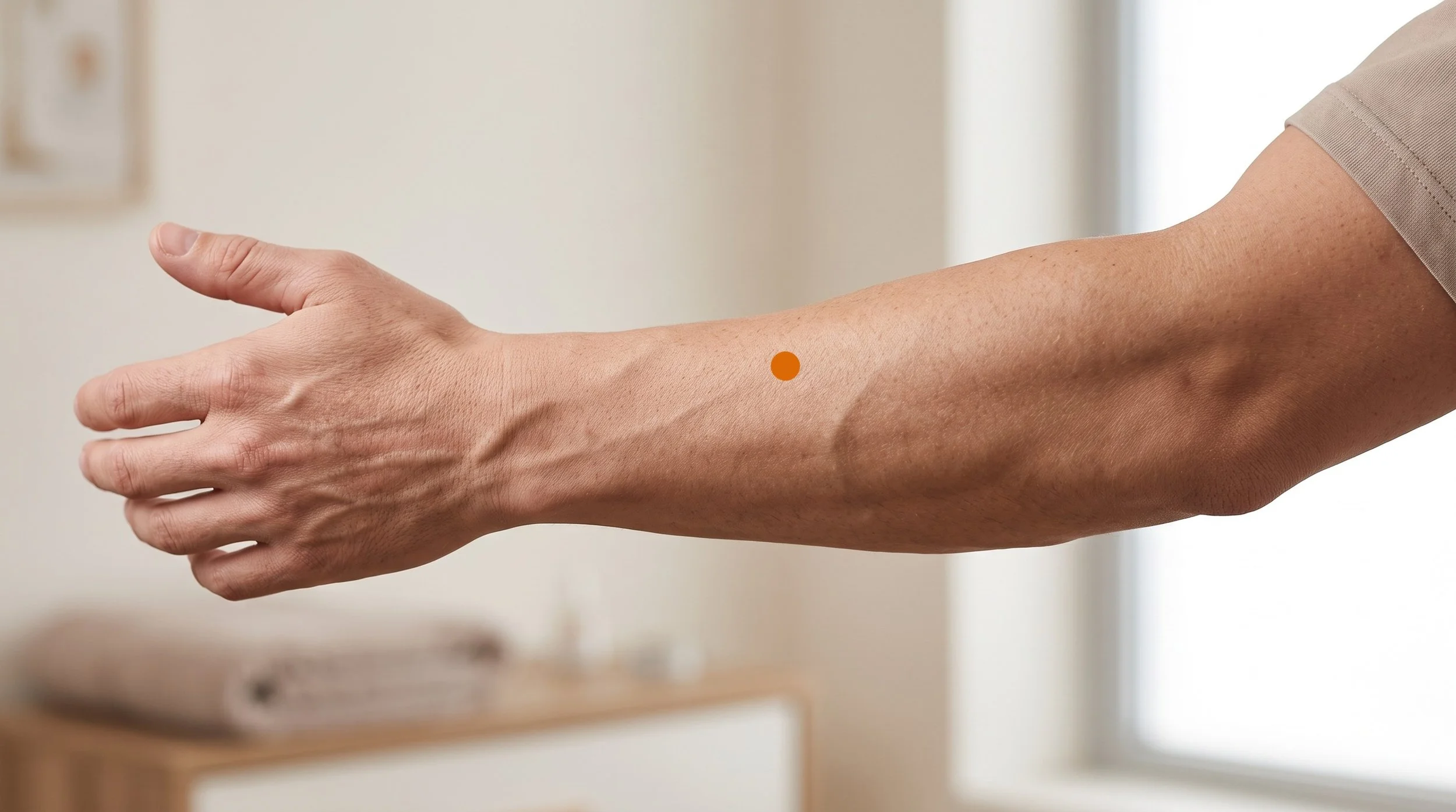
LI7 Acupuncture Point (Wenliu)
The Warm Flow Cleft of the Radial Forearm: Anatomy, Mechanism, and Why the Large Intestine Channel's Acute Point Belongs in Elbow and Arm Treatment
LI7 (Wenliu, often translated as Warm Flow) is the xi-cleft point of the Large Intestine channel, and it sits in the middle of the radial forearm, roughly halfway between the wrist and the elbow on the line that runs from LI5 in the anatomical snuffbox up to LI11 at the elbow crease.
In plain terms, bend your elbow, turn the thumb side of the forearm up, find the midpoint of that line, then drop about a thumb's width toward the wrist: that is the li 7 forearm location. Classically the xi-cleft points were reserved for sudden, sharp, and inflamed presentations, which is exactly how large intestine 7 is still used today, most often for acute pain along the radial forearm, elbow, and shoulder in people who grip, type, lift, or swing a racquet for a living.
Anatomically the point overlies the wrist extensor mass and the radial shaft, which places it squarely in the tissue that fails in lateral elbow pain, and that overlap is why this quiet, rarely discussed point earns a place in a modern needling plan.
- Location and layers: LI7 lies 5 cun proximal to LI5 on the LI5 to LI11 line, over the radial shaft where extensor carpi radialis longus and brevis lie side by side, with the abductor pollicis longus and extensor pollicis brevis crossing nearby (Deadman et al., 2007).
- Traditional categories, translated: classical texts call LI7 the xi-cleft point, the place where channel qi and blood are said to gather and sink more deeply, and they reserved such points for acute, intense, painful presentations (Deadman et al., 2007). In neurophysiological terms this is a densely innervated forearm site that responds well to strong, short-course stimulation.
- Nerve story: needling here recruits A-delta and C fibers in superficial radial and posterior antebrachial cutaneous nerve territory plus muscle afferents from the extensor group, input that feeds C5 to C8 spinal segments shared by the elbow, wrist, and thumb (Zhao, 2008).
- Research picture: acupuncture and dry needling for lateral elbow pain show short-term reductions in pain and disability with generally low quality evidence, so expectations should be modest and treatment should be paired with loading exercise (Green et al., 2002; Navarro-Santana et al., 2020; Ma et al., 2024).
- Clinical framing: individual patient data from chronic pain trials suggest acupuncture effects are more than placebo but modest in size, which fits how we use LI7, as one component of a regional plan rather than a standalone fix (Vickers et al., 2018).
- De qi: patients typically report a deep ache, heaviness, or spreading fullness that may travel toward the wrist or elbow, and de qi level stimulation has been associated with larger increases in local skin and muscle blood flow than light superficial insertion (Sandberg et al., 2003).
Struggling With Tennis Elbow or Forearm Pain That Keeps Coming Back?
At Morningside Acupuncture we treat lateral elbow and forearm pain as a tissue loading problem with a nervous system component, and LI7 is one of our regular radial forearm points for that picture. We combine it with local needling of the wrist extensors, distal points on the same channel, and simple grip loading you can do between visits. Most people notice their first change in grip comfort within a few sessions. Schedule a visit and let's get your forearm working again.
Schedule NowAnatomy of LI7: Why the Mid Radial Forearm Is Such an Important Location
Under the skin at LI7 the superficial fascia is thin, and immediately beneath it sit the fleshy bellies of extensor carpi radialis longus and brevis as they run down the radial side of the forearm toward the radial shaft. This is a working zone. Every time you grip a coffee cup, hold a phone, mouse for hours, or swing a racquet, the wrist extensors fire eccentrically to stabilize the wrist, and the shared tendon of that group anchors at the lateral epicondyle just above.
Slightly distal and deep to the point, the abductor pollicis longus and extensor pollicis brevis emerge obliquely across the radial wrist extensors, which is why thumb-heavy work can load the same neighborhood. When people describe an aching band in the upper forearm that they cannot quite point to, they are often describing tissue within a centimeter or two of the wenliu point location.
Sensory coverage here comes from the superficial branch of the radial nerve and the neighboring lateral and posterior antebrachial cutaneous nerves, with the deep radial nerve running further beneath in the extensor compartment (Deadman et al., 2007). Needling stimulates both cutaneous and intramuscular afferents whose cell bodies project into the C5 through C8 spinal segments, the same segmental pool that receives input from the lateral epicondyle, the wrist, and much of the shoulder girdle.
That shared segmental convergence is the everyday mechanism behind distal point selection: input from the forearm can modulate dorsal horn responsiveness for the whole upper limb region rather than only the skin under the needle. Sustained stimulation also engages descending inhibitory pathways from the midbrain and brainstem that use endogenous opioid, serotonergic, and noradrenergic signaling to damp nociceptive traffic (Zhao, 2008).
Locally, needling with de qi level stimulation has been shown to raise skin and muscle blood flow more than a light superficial insertion, a plausible contributor to the warm, loosened feeling patients report afterward (Sandberg et al., 2003).
The main structures to respect are vascular rather than visceral. Muscular branches of the radial artery run in the deeper plane and the cephalic vein courses superficially along the radial forearm, so practitioners palpate and avoid visible vessels before insertion.
Classical texts describe a transverse-oblique insertion of roughly 0.5 to 1 cun at LI7, while other standard references list a shallow perpendicular insertion in the same depth range, and both are safe in trained hands (Deadman et al., 2007). There are no organs, joint capsules, or pleura anywhere near this point, which makes it one of the more forgiving locations on the arm. Bruising is the most common minor event, and it resolves on its own within a few days.
Related Large Intestine Channel Related Extensor Carpi Radialis Brevis Trigger PointsLI7 at a Glance: Classification, Location, and Clinical Use
| Category | Detail |
|---|---|
| Traditional Name | Wenliu (Warm Flow), Large Intestine 7 |
| Channel Classification | Large Intestine channel (hand yangming), forearm segment |
| Point Categories | Xi-cleft (accumulation) point of the Large Intestine channel, the classical category reserved for acute and painful presentations along the channel |
| Precise Location | Thumb side of the forearm, 5 cun proximal to LI5 on the line joining LI5 and LI11, which is one cun distal to the midpoint of that line; located with the elbow flexed and the radial side of the forearm facing up |
| Tissue Stimulated | Skin and superficial fascia over the radial shaft, the bellies of extensor carpi radialis longus and brevis, and the nearby extensor pollicis longus and brevis as they cross the radial forearm, in superficial radial nerve territory |
| Needle Depth / Direction | Transverse-oblique insertion 0.5 to 1 cun along the channel, or shallow perpendicular insertion in the same depth range; avoid visible superficial veins |
| De Qi Sensation | A deep local ache, heaviness, or spreading fullness that may travel toward the wrist or up toward the elbow; some patients describe warmth through the forearm |
| Primary Clinical Uses | Acute pain along the radial forearm, elbow, and shoulder; lateral elbow pain and grip-related forearm overload; traditionally used for sudden sore throat with loss of voice, headache, facial swelling, toothache, and cramping abdominal pain with rumbling |
| Common Point Combinations |
|
In A Manual of Acupuncture, Deadman and colleagues frame LI7 through its xi-cleft status: the traditional model holds that channel qi and blood, which travel relatively superficially from the fingertip points, collect and dive deeper at these clefts, which is why the whole category was assigned to acute and painful conditions rather than slow, chronic depletion (Deadman et al., 2007). The traditional actions attributed to the point cluster around clearing heat and toxin, moderating sudden conditions, settling the intestines and stomach, and calming an agitated spirit when heat is thought to be the driver.
The recorded indications reflect that: fast-moving inflammatory skin lesions on the face, red and swollen facial tissue, toothache, throat pain with a lost voice, and, more unusually, gurgling abdominal pain with distention and watery vomiting. What makes the classical pattern striking is that LI7 is one of the few hand yang channel points ever credited with treating its paired organ at all, and the commentary is honest that this indication almost never appears in the major classical formulas, which is a useful reminder that classical literature argued with itself long before modern research did.
Why LI7 Is Used for Sore Throat, Facial Swelling, and Toothache When It Sits on the Forearm
Patients are often puzzled that a forearm point was classically indicated for throat, tooth, and facial complaints. The channel logic is straightforward: the Large Intestine pathway runs from the index finger up the radial forearm and arm, across the shoulder, and into the neck, jaw, and face, so points anywhere along it were considered fair game for symptoms at the far end. The modern reading of that observation is convergence.
Afferent input from the forearm enters cervical spinal segments that also receive input from the neck and shoulder girdle, and those segments communicate with the trigeminocervical complex in the upper cervical cord and brainstem, where cervical and facial sensory information mixes. Stimulating a well-innervated distal site can therefore influence how readily that shared pool of neurons responds, which is a more testable claim than energy traveling along a line (Zhao, 2008).
The second half of the story is top down. Needling that produces a genuine de qi sensation recruits descending inhibitory pathways from the periaqueductal gray and rostral ventromedial medulla, which release endogenous opioids and monoamines onto the dorsal horn and reduce nociceptive transmission for a period after the needle is removed (Zhao, 2008).
There are also measurable local effects: de qi level stimulation increased skin and muscle blood flow more than either superficial or unmanipulated insertion in healthy volunteers, which may matter for tissue that has been loaded and irritated (Sandberg et al., 2003). None of this means LI7 treats an infected throat or an abscessed tooth. It means the point can plausibly modulate pain and muscle tone in a shared segmental territory, and that is how we describe it to patients: helpful for symptoms, not a substitute for diagnosis and appropriate medical care.
What the Research Shows for LI7
There is no clinical trial that tests LI7 by itself, and that is true of nearly every individual acupuncture point. Trials study protocols, and LI7 typically appears inside a Large Intestine channel prescription for elbow, forearm, or shoulder pain alongside points such as LI4, LI10, and LI11 plus local needling. The evidence below is therefore about the treatment approach that LI7 belongs to rather than about the point in isolation, and the honest summary is that effects on lateral elbow and chronic musculoskeletal pain are real but modest, often short-term, and drawn from trials with meaningful risk of bias. We share it that way so you can decide whether a short trial of treatment is worth your time.
| Study | Type | Focus | Key Finding |
|---|---|---|---|
| Green et al., 2002 | Cochrane systematic review | Acupuncture for lateral elbow pain (tennis elbow) | The reviewers found only limited evidence, suggesting possible short-term pain relief but no demonstrated benefit lasting beyond the immediate period after treatment. |
| Zhou et al., 2020 | Systematic review and meta-analysis of RCTs | Acupuncture for lateral epicondylitis across 10 trials and 796 participants | Acupuncture compared favorably with medication, injection therapy, and sham on pain and response rates, though the authors cautioned that trial quality was low. |
| Navarro-Santana et al., 2020 | Systematic review and meta-analysis | Trigger point dry needling for lateral epicondylalgia of musculoskeletal origin | Low to moderate quality evidence supported short-term improvements in pain, disability, pressure pain sensitivity, and grip strength. |
| Ma et al., 2024 | Updated systematic review and meta-analysis | Dry needling for lateral epicondylitis, including needling technique comparisons | Dry needling was associated with improved short-term pain, elbow disability, and grip strength, with better pain outcomes when a local twitch response was elicited. |
| Vickers et al., 2018 | Individual patient data meta-analysis | Acupuncture for chronic musculoskeletal, headache, and osteoarthritis pain | Acupuncture outperformed both sham and no-acupuncture controls, with effects that were statistically robust but modest in absolute size and reasonably durable over a year. |
| Sandberg et al., 2003 | Experimental physiological study | Needle stimulation intensity and local skin and muscle blood flow | Stimulation producing a distinct de qi sensation increased local blood flow more than superficial or unmanipulated needling in healthy volunteers. |
Sore Throat, Jaw, or Facial Tension That Flares Fast?
Classical sources reached for LI7 when symptoms along the Large Intestine pathway came on suddenly and hot, including throat pain with a lost voice and swelling of the face. We use the point in that same spirit, as part of a distal plus local plan alongside neck and jaw work rather than as a treatment for infection itself. Our acupuncturists will tell you plainly when a symptom needs a physician instead. Book an evaluation and we'll map out what acupuncture can and cannot do for you.
Schedule NowLI7 in the Context of Trigger Point Work
LI7 sits directly over the extensor carpi radialis longus and brevis bellies, and those two muscles are among the most common sources of referred pain into the lateral elbow, the back of the forearm, and the web of the hand (Simons et al., 1999).
In practice this means the classical point and the myofascial target frequently occupy the same square inch of tissue. When a patient presents with grip weakness and a tender band in the upper radial forearm, we may needle the point as described in the classical texts, then use a slightly different angle and depth to reach a taut band and, where appropriate, elicit a local twitch response. Reviews of dry needling for lateral elbow pain suggest that eliciting that twitch is associated with better short-term pain outcomes, which is one reason we assess the muscle rather than only marking the point (Ma et al., 2024).
A typical Morningside session for radial forearm and elbow pain layers these tools rather than choosing between them. We commonly pair LI7 with trigger point needling of extensor carpi radialis brevis, supinator, and the extensor pollicis longus and brevis, add LI10 and LI11 near the common extensor origin, and use LI4 distally for segmental input. If the neck is contributing, and it often is, we screen the cervical spine and treat the mid and lower cervical segments in the same visit.
Needling is then handed off to loading: isometric grip holds, slow eccentric wrist extension, and workstation or racquet grip adjustments, because the tissue has to be rebuilt, not just quieted.
LI7 Elbow and Forearm Pain Treatment at NYC's Highest-Rated Acupuncture Clinic
Morningside Acupuncture is the highest-rated acupuncture and dry needling clinic in New York City with over 500 five-star Google reviews, and our team blends classical point selection with sports medicine style orthopedic assessment. For elbow, forearm, wrist, and shoulder complaints we combine points like LI7, LI4, LI10, and LI11 with trigger point dry needling of the extensor group and graded strength work. You get a clear plan, honest expectations, and measurable checkpoints. Schedule your session on the Upper West Side today.
Schedule NowFrequently Asked Questions
What does LI7 feel like when needled?
Most people feel a brief pinch at the skin, then a deep, dull ache or heavy fullness that can spread a few inches toward the wrist or up toward the elbow. Because the point sits on working muscle, a twitch or a quick jump of the forearm is common and is not a problem. The ache usually softens within a minute or two and often gives way to a warm, loosened feeling, which is consistent with research showing increased local blood flow after de qi level stimulation (Sandberg et al., 2003). Sharp, electric, or radiating pain is not the goal, and your acupuncturist will adjust the needle if you feel it.
Why needle the forearm for elbow, shoulder, or throat symptoms instead of the painful spot itself?
Two reasons. First, sensory input from the radial forearm enters the same cervical spinal segments that serve the elbow, wrist, and shoulder girdle, so needling here can influence how strongly those shared neurons respond to input from the painful area, and stimulation also recruits descending pain inhibiting pathways from the brainstem (Zhao, 2008). Second, when a region is acutely inflamed and too tender to touch, a distal point like LI7 lets us start treatment on day one instead of waiting. Classical practice arrived at the same conclusion from a different direction, assigning xi-cleft points to sudden and severe presentations along their channel (Deadman et al., 2007).
Can I press LI7 myself between sessions?
Yes, and it is easy to reach. Rest your forearm on a table with the thumb side up and the elbow bent. Find the midpoint between the wrist crease at the base of the thumb and the outer end of the elbow crease, then move about one thumb width back down toward the wrist and press into the muscle on the thumb side of the forearm bone. Use your opposite thumb, press to a firm four to six out of ten pressure, and hold for 30 to 60 seconds while you breathe slowly, or use small circles for one to two minutes. Repeat on both sides two or three times per day, and stop if pressure produces numbness, tingling, or sharp pain into the hand. Acupressure here is a reasonable self-care add-on, not a replacement for treatment.
Is LI7 safe to needle?
It is one of the safer points on the arm when treated by a trained, licensed practitioner. There are no organs, lungs, or joint spaces nearby, and the standard approach is a shallow transverse-oblique or perpendicular insertion of about 0.5 to 1 cun (Deadman et al., 2007). The relevant cautions are vascular: superficial veins along the radial forearm and deeper muscular branches of the radial artery are palpated and avoided, and clean needle technique is standard. Minor bruising or a day of local soreness are the most likely side effects. Tell your acupuncturist if you take anticoagulants, bruise easily, or have any skin infection or open lesion over the area.
Where exactly is LI7 located?
LI7 is on the thumb side of the forearm, 5 cun above the wrist crease at LI5, on the line drawn from LI5 in the anatomical snuffbox to LI11 at the outer end of the elbow crease. The simplest way to find the wenliu point location is to divide that line in half and then move one cun toward the wrist, which places the point over the radial shaft between the two radial wrist extensor muscles (Deadman et al., 2007). Locate it with the elbow flexed and the radial side of the forearm facing upward, since rotating the arm shifts the whole line. Confirm by pressing along the muscle, since the point is usually tender in people with grip-related forearm pain.
References
- Deadman, P., Al-Khafaji, M., & Baker, K. (2009). A manual of acupuncture. Journal of Chinese Medicine Publications.
- Cheng, X. (Ed.). (1999). Chinese acupuncture and moxibustion (Rev. ed.). Foreign Languages Press.
- Cunningham, P. M. (2000). Acupuncture points: A practical guide to classical and modern usage. Odyssey Press.
- Simons, D. G., Travell, J. G., & Simons, L. S. (1999). Travell & Simons' myofascial pain and dysfunction: The trigger point manual, Vol. 1: Upper half of body (2nd ed.). Williams & Wilkins.
- Green, S., Buchbinder, R., Barnsley, L., Hall, S., White, M., Smidt, N., & Assendelft, W. (2002). Acupuncture for lateral elbow pain. Cochrane Database of Systematic Reviews, 2002(1), CD003527. https://doi.org/10.1002/14651858.CD003527
- Zhou, Y., Guo, Y., Zhou, R., Wu, P., Liang, F., & Yang, Z. (2020). Effectiveness of acupuncture for lateral epicondylitis: A systematic review and meta-analysis of randomized controlled trials. Pain Research and Management, 2020, 8506591. https://doi.org/10.1155/2020/8506591
- Navarro-Santana, M. J., Sanchez-Infante, J., Gómez-Chiguano, G. F., Cleland, J. A., López-de-Uralde-Villanueva, I., Fernández-de-las-Peñas, C., & Plaza-Manzano, G. (2020). Effects of trigger point dry needling on lateral epicondylalgia of musculoskeletal origin: A systematic review and meta-analysis. Clinical Rehabilitation, 34(11), 1327-1340. https://doi.org/10.1177/0269215520937468
- Ma, X., Qiao, Y., Wang, J., Xu, A., & Rong, J. (2024). Therapeutic effects of dry needling on lateral epicondylitis: An updated systematic review and meta-analysis. Archives of Physical Medicine and Rehabilitation, 105(11), 2184-2197. https://doi.org/10.1016/j.apmr.2024.02.713
- Vickers, A. J., Vertosick, E. A., Lewith, G., MacPherson, H., Foster, N. E., Sherman, K. J., Irnich, D., Witt, C. M., & Linde, K. (2018). Acupuncture for chronic pain: Update of an individual patient data meta-analysis. Journal of Pain, 19(5), 455-474. https://doi.org/10.1016/j.jpain.2017.11.005
- Zhao, Z. Q. (2008). Neural mechanism underlying acupuncture analgesia. Progress in Neurobiology, 85(4), 355-375. https://doi.org/10.1016/j.pneurobio.2008.05.004
- Sandberg, M., Lundeberg, T., Lindberg, L. G., & Gerdle, B. (2003). Effects of acupuncture on skin and muscle blood flow in healthy subjects. European Journal of Applied Physiology, 90(1-2), 114-119. https://doi.org/10.1007/s00421-003-0825-3
Disclaimer: This web site is intended for educational and informational purposes only. Reading this website does not constitute providing medical advice or any professional services. This information should not be used for diagnosing or treating any health issue or disease. Those seeking medical advice should consult with a licensed physician. Seek the advice of a medical doctor or other qualified health professional for any medical condition. If you think you have a medical emergency, call 911 or go to the emergency room. No acupuncturist-patient relationship is created by reading this website or using the information. Morningside Acupuncture PLLC and its employees and contributors do not make any express or implied representations with respect to the information on this site or its use. For any legal interpretation of scope of practice in your state, consult a licensed attorney or regulatory authority.
Read more from our blog



