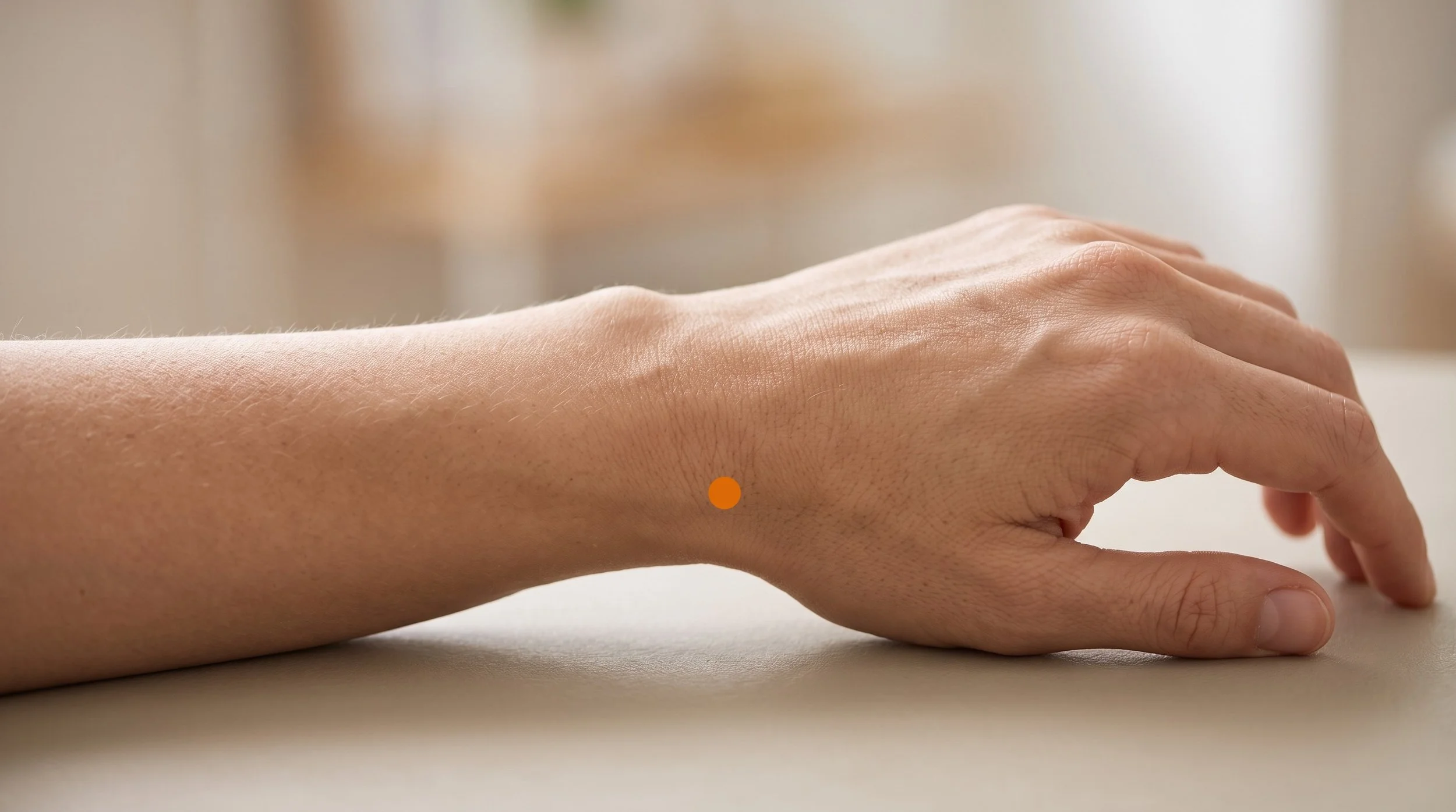
LI5 Acupuncture Point (Yangxi)
The Yang Stream in the Anatomical Snuffbox: Anatomy, Mechanism, and Why This Radial Wrist Point Anchors Thumb and Tendon Pain Treatment
LI5 (Yangxi, or Yang Stream) is the fifth point of the Large Intestine channel, and it sits in one of the most recognizable landmarks in the upper limb: the anatomical snuffbox, the small triangular hollow on the thumb side of the wrist that appears when you lift your thumb away from your hand.
Classical texts class it as the jing-river point and the fire point of the channel, which in traditional terms made it a heat-clearing point for the face, teeth, throat, and eyes, and a local point for a stiff, painful wrist (Deadman et al., 2001). In modern clinical use, the li5 acupuncture point earns most of its value from where it lives: directly over the tendons of the first dorsal compartment, the tissue involved in de Quervain-pattern thumb-side pain, and within reach of the superficial radial nerve branches that carry sensation across the back of the thumb. That combination of a precise tendon-related location and a long classical record is what makes large intestine 5 a point worth knowing well.
- Location and layers: LI5 lies in the center of the anatomical snuffbox, the hollow bounded by the extensor pollicis longus tendon on one side and the extensor pollicis brevis and abductor pollicis longus tendons on the other, with the scaphoid forming the floor (Deadman et al., 2001; Cunningham, 2019). The needle passes through thin skin and retinacular tissue into a space that is loaded every time you pinch, grip, wring, or scroll with the thumb.
- Traditional categories, translated: as the jing-river and fire point of the hand yangming channel, LI5 was traditionally used to clear heat and pain in the head, eyes, teeth, and throat, to settle agitation, and to benefit the wrist joint (Deadman et al., 2001; Kim, 2016). Read neurophysiologically, that list describes a distal upper-limb point used both locally, for the joint it sits on, and heterosegmentally, for pain felt far away in the head and face.
- Nerve story: branches of the superficial radial nerve cross the snuffbox, and stimulation here recruits large-diameter afferents from a C6 and C7 territory, feeding spinal and brainstem circuits that gate nociceptive input rather than acting on any single tendon (Zhao, 2008).
- Research picture: the strongest point-specific evidence comes from a randomized trial in de Quervain's tenosynovitis that needled LI5 with LU7 and LU9 plus tender ahshi points and reported short-term pain and function gains comparable to a corticosteroid injection over six weeks (Hadianfard et al., 2014). Later work supports acupuncture for this presentation while calling for larger and better-controlled trials (Leung et al., 2022; Qin et al., 2024).
- Clinical framing: at Morningside we rarely use LI5 alone. It typically anchors a hand and wrist treatment alongside LI4, forearm motor points, and dry needling of the thumb extensors, an approach consistent with the multi-point protocols tested in chronic pain meta-analyses (Vickers et al., 2018).
- De qi and technique: perpendicular insertion of 0.5 to 1 cun usually produces a deep, dull, slightly heavy ache filling the snuffbox and spreading toward the thumb base, with the cephalic vein and the radial artery in the floor identified and avoided before insertion (Deadman et al., 2001).
Thumb-Side Wrist Pain Every Time You Grip, Lift, or Text?
Pain that sharpens at the base of the thumb when you lift a coffee cup, twist a jar lid, or carry a bag is one of the most common complaints we see on the Upper West Side. Morningside pairs LI5 in the anatomical snuffbox with careful assessment of the first dorsal compartment, the thumb extensors, and the forearm muscles that load them. Treatment may combine acupuncture, dry needling, cupping, and specific loading advice so the tendons calm down and stay calm. Schedule a visit and let's find out what your thumb is actually reacting to.
Schedule NowAnatomy of LI5: Why the Anatomical Snuffbox Is Such an Important Location
Extend your thumb and a small triangular pit appears at the base of it, on the back of the wrist. That pit is the anatomical snuffbox, and LI5 sits in its center. The wall closer to the little finger is the tendon of extensor pollicis longus; the wall closer to the thumb is formed by extensor pollicis brevis and abductor pollicis longus, the two tendons of the first dorsal compartment (Deadman et al., 2001; Cunningham, 2019). Under the needle are thin skin, a slip of retinacular and fascial tissue, and then the scaphoid bone forming the floor.
These tendons work every time the thumb abducts or extends, which in practice means every pinch grip, every phone swipe, every steering wheel adjustment, and every lift of a heavy pan. When that load outpaces tissue tolerance, the first dorsal compartment becomes thickened and irritable, and the snuffbox becomes tender to touch. That is exactly the presentation classical texts described in plainer language as weakness and pain of the wrist (Deadman et al., 2001).
The nerve geography here is what makes LI5 more than a convenient landmark. Branches of the superficial radial nerve fan across the snuffbox on their way to the dorsum of the thumb and index finger, so the skin and subcutaneous tissue at this point are densely innervated by sensory fibers arising from roughly the C6 and C7 spinal segments. Needling recruits A-beta and A-delta afferents from that territory, and those signals converge in the dorsal horn with nociceptive input from the same segments, including the wrist and thumb tendons themselves.
Experimental work suggests acupuncture analgesia depends on this afferent traffic engaging segmental gating and descending inhibitory pathways involving endogenous opioid and monoaminergic systems, rather than on any effect confined to the tissue at the needle tip (Zhao, 2008). In everyday terms, the point may reduce local sensitivity while also turning down how loudly the nervous system is reporting the area.
Two structures dictate technique. The cephalic vein runs through the snuffbox and is often visible or palpable, and the radial artery crosses the floor of the hollow on its way to the palm, which is why a pulse can sometimes be felt in this area (Deadman et al., 2001; Cheng, 1987; Maciocia, 2006). Classical needling conventions call for perpendicular insertion of roughly 0.5 to 1 cun, with shallower depths used by some texts, after visually locating the vein and palpating for arterial pulsation (Deadman et al., 2001; Kim, 2016).
Practitioners angle slightly to stay between the tendons rather than driving into them, avoid heavy periosteal contact on the scaphoid, and stop and redirect if a sharp electric sensation shoots into the thumb, since that suggests direct contact with a superficial radial nerve branch.
Related Extensor Pollicis Longus Brevis Trigger Points Related Large Intestine ChannelLI5 at a Glance: Classification, Location, and Clinical Use
| Category | Detail |
|---|---|
| Traditional Name | Yangxi (Yang Stream), Large Intestine 5 |
| Channel Classification | Fifth point of the Large Intestine channel of Hand Yangming |
| Point Categories | Jing-river point of the Large Intestine channel; Fire point of the Large Intestine channel (five-shu system). No meeting, hui-meeting, or extraordinary vessel designations are attributed to this point in the classical sources. |
| Precise Location | On the radial (thumb) side of the wrist, in the center of the anatomical snuffbox: the hollow between the tendons of extensor pollicis longus and extensor pollicis brevis that becomes obvious when the thumb is extended. |
| Tissue Stimulated | Skin and subcutaneous tissue of the snuffbox, retinacular and fascial tissue between the first and third dorsal compartments, and the tendon borders of extensor pollicis longus and brevis, overlying the scaphoid |
| Needle Depth / Direction | Perpendicular insertion 0.5 to 1 cun between the tendons, angled to stay in the hollow; some texts advise a shallower 0.3 to 0.5 cun. Locate the cephalic vein visually and palpate for the radial pulse before needling. |
| De Qi Sensation | A deep, dull, slightly heavy ache or fullness filling the snuffbox, often spreading toward the base of the thumb or up the radial forearm. A brief electric flick into the dorsal thumb means a superficial radial nerve branch has been contacted and the needle should be withdrawn and redirected. |
| Primary Clinical Uses | Thumb-side wrist pain including tendon-related and de Quervain-pattern presentations, thumb and hand stiffness, wrist weakness with gripping; traditionally also headache, toothache, sore throat, and red irritated eyes |
| Common Point Combinations |
|
In the classical framework preserved by Deadman and colleagues, LI5 is the fire point of a yang channel, and fire points across the twelve channels were traditionally credited with a strong heat-clearing action. Because the Large Intestine channel was described as ascending through the neck to the teeth, nose, and face, its fire point was traditionally attributed with cooling what the texts called yangming fire in exactly those regions: nosebleed and blocked nose, ringing or painful ears, red and watering eyes, toothache, and throat obstruction.
The same commentary explains that its territory overlaps with LI4 while its emphasis differs, with LI5 said to address heat specifically rather than pain generally (Deadman et al., 2001). A second layer of the traditional attribution is stranger to modern ears: because yangming fire was thought to disturb the heart and spirit, LI5 appears in classical lists for fever with agitation, fright, disordered speech, and inappropriate laughter, indications the text further links to the jing-river points and their association with disorders of the voice (Deadman et al., 2001).
What is striking is how a point defined by a two-tendon hollow at the wrist ended up carrying a symptom list that runs from the thumb to the teeth to the mind, a reminder that classical point categories organized clinical experience by channel logic rather than by local anatomy.
Why LI5 Is Used for Toothache and Headache, Not Just the Wrist
Patients are often surprised that a point at the base of the thumb has a classical reputation for teeth, throat, and eyes. Part of the explanation is channel geography: the Large Intestine channel was mapped as running from the index finger up the arm and neck to the face, so points along it were used for problems anywhere on that line. The modern explanation is different but not unrelated. Needling the snuffbox stimulates superficial radial nerve branches from the C6 and C7 segments.
That input does not connect directly to the trigeminal system that serves the teeth and face, so any effect there is not a simple wired shortcut. Instead it appears to work heterosegmentally, meaning the stimulus is delivered far from the painful area and acts through the brain and brainstem rather than through the same spinal level.
The mechanism most often invoked is descending inhibition. Sustained afferent input from a needled point activates midbrain and brainstem structures, including the periaqueductal gray and rostral ventromedial medulla, which then release endogenous opioids, serotonin, and noradrenaline onto dorsal horn and brainstem relay neurons and reduce the transmission of nociceptive signals system-wide (Zhao, 2008).
This is the same broad machinery that supports the modest but consistent benefits reported for acupuncture in chronic pain conditions in individual patient data meta-analysis (Vickers et al., 2018), and it is a plausible reason a distal hand point can influence head pain. Cochrane reviews of headache have found acupuncture protocols to be a reasonable option for prevention, though those protocols use point prescriptions rather than any single point (Linde et al., 2016a).
For the wrist itself the story is more direct and more interesting. Imaging research in carpal tunnel syndrome has shown that wrist and hand pain conditions are associated with measurable changes in how the hand is represented in the primary somatosensory cortex, and that acupuncture at the affected wrist was accompanied by shifts in that cortical representation alongside symptom improvement (Maeda et al., 2017).
That work studied median nerve entrapment rather than radial-sided tendon pain, so it should not be over-extended, but it supports the idea that needling a specific hand region delivers targeted sensory input to the brain map for that region rather than acting only on tissue at the tip of the needle.
What the Research Shows for LI5
It is worth being clear about what the evidence can and cannot say. Almost all acupuncture trials test a full protocol of several points, delivered over multiple sessions, so no study isolates the effect of LI5 by itself. What makes this point unusual is that at least one randomized trial named it explicitly in the treatment prescription, which is rarer than patients assume.
The studies below range from point-specific trials in thumb-side tendon pain to large syntheses of acupuncture for chronic pain, and the honest summary is that results are promising for radial wrist complaints while the trials remain small and often use waitlist rather than sham comparisons.
| Study | Type | Focus | Key Finding |
|---|---|---|---|
| Hadianfard et al., 2014 | Randomized controlled trial | Acupuncture at LI5, LU7, LU9, and ahshi points versus local methylprednisolone injection in de Quervain's tenosynovitis (30 patients) | Both groups improved on pain and disability scores over six weeks without a statistically significant difference between them, suggesting acupuncture may be a reasonable option when injection is declined, though the sample was very small. |
| Leung et al., 2022 | Randomized controlled trial | Five acupuncture sessions over two weeks versus waitlist in 68 patients with de Quervain's tenosynovitis | The acupuncture group showed greater reduction in pain intensity and improvements in grip and pinch strength and Q-DASH scores with effects persisting at follow-up, though a waitlist control cannot separate specific from nonspecific effects. |
| Qin et al., 2024 | Systematic review and meta-analysis | Randomized trials of acupuncture for de Quervain's tenosynovitis | Pooled results favored acupuncture for pain and function, but the authors judged the trial quality limited and called for higher-level evidence before firm conclusions are drawn. |
| Vickers et al., 2018 | Individual patient data meta-analysis | Around 21,000 patients across chronic musculoskeletal, headache, and osteoarthritis pain trials | Acupuncture was more effective than both sham and no-acupuncture control for chronic pain, with effects that persisted over time, supporting its use as a reasonable referral option. |
| Maeda et al., 2017 | Randomized neuroimaging trial | Electroacupuncture and sham in carpal tunnel syndrome with somatosensory cortex mapping | Local acupuncture at the affected wrist was associated with changes in cortical hand representation that tracked with longer-term symptom relief, indicating central as well as local effects. |
| Linde et al., 2016a | Cochrane systematic review | Acupuncture for the prevention of tension-type headache | Acupuncture protocols reduced headache frequency compared with usual care and showed a small additional benefit over sham, relevant to LI5's classical headache indication only as part of multi-point prescriptions. |
| Zhao, 2008 | Mechanistic review | Neural pathways of acupuncture analgesia | Analgesic effects are attributed to afferent stimulation engaging spinal gating and descending opioid and monoaminergic inhibition, which offers a plausible framework for both local and distant effects. |
Repetitive Strain From Keyboards, Phones, and Studio Work?
New York hands work hard: laptops, phones, instruments, cameras, climbing holds, and infant carriers all load the thumb in the same narrow compartment. Our clinicians use the li 5 wrist point as a local anchor and then treat the forearm chain that keeps feeding the problem. We also look upstream at the neck and shoulder, since radial-sided symptoms sometimes travel. Book an evaluation and we'll map the whole pattern, not just the sore spot.
Schedule NowLI5 in the Context of Trigger Point Work
Acupuncture, as we define it, is the use of an acupuncture needle, and that includes the hundreds of styles practiced worldwide as well as dry needling. At Morningside, LI5 frequently sits inside a treatment that also addresses myofascial contributors in the forearm. Referred pain patterns from extensor pollicis longus and brevis and from abductor pollicis longus can project into the radial wrist and thumb web, closely mimicking the tenderness patients localize to the snuffbox, and flexor pollicis longus can contribute pain felt at the thumb itself (Simons et al., 1999). Treating only the point where it hurts, without addressing the muscle bellies pulling on those tendons, tends to give shorter-lived relief.
In practice this means the anatomical snuffbox point is often needled first as a local anchor, followed by dry needling into taut bands in the thumb extensors and the radial wrist extensors, and sometimes extensor carpi radialis brevis when gripping is a major aggravator. Because LI5 sits between two tendons rather than in a muscle belly, we do not chase a twitch response there; the goal at the point itself is a comfortable, moderate de qi rather than aggressive stimulation over the scaphoid.
Adjunct work usually includes gentle cupping over the forearm, isometric loading for the thumb extensors, and a hard look at keyboard, phone, and carrying habits, since sustained thumb abduction is the load most likely to keep the compartment irritated.
LI5 Wrist and Thumb Pain Treatment at NYC's Highest-Rated Acupuncture Clinic
Morningside Acupuncture is the highest-rated acupuncture and dry needling clinic in New York City with over 500 five-star Google reviews, and hand and wrist complaints are a core part of our practice. We combine classical point selection, including the anatomical snuffbox point, with modern orthopedic assessment and trigger point dry needling. Sessions are calm, precise, and built around what you need to be able to do with your hands. Schedule your appointment today.
Schedule NowFrequently Asked Questions
What does LI5 feel like when needled?
Most people feel a brief pinprick at the skin, then a deep, dull, slightly heavy ache that seems to fill the small hollow at the base of the thumb. That ache often spreads a short distance toward the thumb or up the radial forearm, and it usually fades into a warm, released feeling within a minute or two. Because the snuffbox has thin skin and a good sensory nerve supply, LI5 can feel more noticeable than points on the forearm. A sharp electric zap into the thumb is not the goal; it means a superficial radial nerve branch has been contacted, and your clinician should withdraw the needle and reposition it.
Why needle the wrist for a problem that hurts in the thumb?
The tendons that move your thumb do not originate in the thumb. Extensor pollicis brevis and abductor pollicis longus arise in the forearm and pass through a narrow tunnel at the radial wrist before reaching the thumb, and that tunnel is precisely where LI5 lies. Needling here targets the compartment where the load and irritation concentrate, rather than the far end of the tendon where you happen to feel it. This is also the reason we combine LI5 with dry needling of the forearm muscles: the pain is felt distally, but the mechanics are proximal.
Can I press LI5 myself between sessions?
Yes, and it is easy to find. Rest your hand on a table with the thumb side up, lift your thumb away as if hitchhiking, and look for the triangular dip that forms at the base of the thumb near the wrist crease. Place the pad of your opposite thumb in the center of that dip and apply steady, moderate pressure that feels like a firm ache, not a sharp pain. Hold for 30 to 60 seconds, release, and repeat two or three times, up to a few times per day. Small circular pressure for a minute works equally well. Skip it if you feel a pulse strongly under your finger, if pressing produces electric sensations into the thumb, or if the tenderness followed a fall or injury, in which case get the wrist evaluated first.
Is LI5 safe to needle?
In trained hands, yes. It is a shallow, well-tolerated point, and the main cautions are anatomical rather than systemic. The cephalic vein crosses the snuffbox and should be visually identified and avoided, and the radial artery runs across the floor of the hollow, so practitioners palpate for pulsation before inserting (Deadman et al., 2001). Bruising is the most common minor side effect at this location. Superficial radial nerve branches cross the area, so a needle producing electric sensation is repositioned. And any patient with snuffbox tenderness after a fall should be assessed for a scaphoid fracture before local needling is considered.
Where exactly is LI5 located?
LI5 sits on the thumb side of the wrist, in the center of the anatomical snuffbox. To find it, extend or lift your thumb so two tendons stand out at the base of it: the one nearer the index finger side is extensor pollicis longus, and the pair on the outer side are extensor pollicis brevis and abductor pollicis longus. The hollow between them, at about the level of the wrist crease, is the point (Deadman et al., 2001; Cheng, 1987). If you slide your fingertip into that dip and press toward the bone underneath, you are on the scaphoid, which forms the floor of the point.
References
- Deadman, P., Al-Khafaji, M., & Baker, K. (2009). A manual of acupuncture. Journal of Chinese Medicine Publications.
- Cheng, X. (Ed.). (1999). Chinese acupuncture and moxibustion (Rev. ed.). Foreign Languages Press.
- Kim, H. (2008). Handbook of Oriental medicine (3rd ed.). Harmony & Balance Press.
- Cunningham, P. M. (2000). Acupuncture points: A practical guide to classical and modern usage. Odyssey Press.
- Maciocia, G. (2006). The channels of acupuncture: Clinical use of the secondary channels and eight extraordinary vessels. Churchill Livingstone Elsevier.
- Simons, D. G., Travell, J. G., & Simons, L. S. (1999). Travell & Simons' myofascial pain and dysfunction: The trigger point manual, Vol. 1: Upper half of body (2nd ed.). Williams & Wilkins.
- Hadianfard, M., Ashraf, A., Fakheri, M., & Nasiri, A. (2014). Efficacy of acupuncture versus local methylprednisolone acetate injection in De Quervain's tenosynovitis: A randomized controlled trial. Journal of Acupuncture and Meridian Studies, 7(3), 115-121. https://doi.org/10.1016/j.jams.2013.10.003
- Leung, K., Ma, O. C., Qin, Z., Ting, H., Lau, A. H., Lun, K. K., Chan, H. Y., Wen, G. Y., Ng, J. T., Chow, L., Chu, C. Y., Ho, T. S., Tsang, K., Ng, B. F. L., Fok, M. W. M., Fang, C. X. S., Lao, L., & Chen, H. (2022). Acupuncture for de Quervain's tenosynovitis: A randomized controlled trial. Phytomedicine, 104, 154254. https://doi.org/10.1016/j.phymed.2022.154254
- Qin, Y., Luo, D., Qiu, H., Zhang, J., Yong, H., & Yu, S. (2024). A systematic review and meta-analysis of acupuncture for De Quervain's tenosynovitis treatment. Postgraduate Medical Journal, 100(1188), 709-720. https://doi.org/10.1093/postmj/qgae057
- Maeda, Y., Kim, H., Kettner, N., Kim, J., Cina, S., Malatesta, C., Gerber, J., McManus, C., Ong-Sutherland, R., Mezzacappa, P., Libby, A., Mawla, I., Morse, L. R., Kaptchuk, T. J., Audette, J., & Napadow, V. (2017). Rewiring the primary somatosensory cortex in carpal tunnel syndrome with acupuncture. Brain, 140(4), 914-927. https://doi.org/10.1093/brain/awx015
- Linde, K., Allais, G., Brinkhaus, B., Fei, Y., Mehring, M., Shin, B.-C., Vickers, A., & White, A. R. (2016a). Acupuncture for the prevention of tension-type headache. Cochrane Database of Systematic Reviews, 2016(4), CD007587. https://doi.org/10.1002/14651858.CD007587.pub2
- Vickers, A. J., Vertosick, E. A., Lewith, G., MacPherson, H., Foster, N. E., Sherman, K. J., Irnich, D., Witt, C. M., & Linde, K. (2018). Acupuncture for chronic pain: Update of an individual patient data meta-analysis. Journal of Pain, 19(5), 455-474. https://doi.org/10.1016/j.jpain.2017.11.005
- Zhao, Z. Q. (2008). Neural mechanism underlying acupuncture analgesia. Progress in Neurobiology, 85(4), 355-375. https://doi.org/10.1016/j.pneurobio.2008.05.004
Disclaimer: This web site is intended for educational and informational purposes only. Reading this website does not constitute providing medical advice or any professional services. This information should not be used for diagnosing or treating any health issue or disease. Those seeking medical advice should consult with a licensed physician. Seek the advice of a medical doctor or other qualified health professional for any medical condition. If you think you have a medical emergency, call 911 or go to the emergency room. No acupuncturist-patient relationship is created by reading this website or using the information. Morningside Acupuncture PLLC and its employees and contributors do not make any express or implied representations with respect to the information on this site or its use. For any legal interpretation of scope of practice in your state, consult a licensed attorney or regulatory authority.
Read more from our blog



