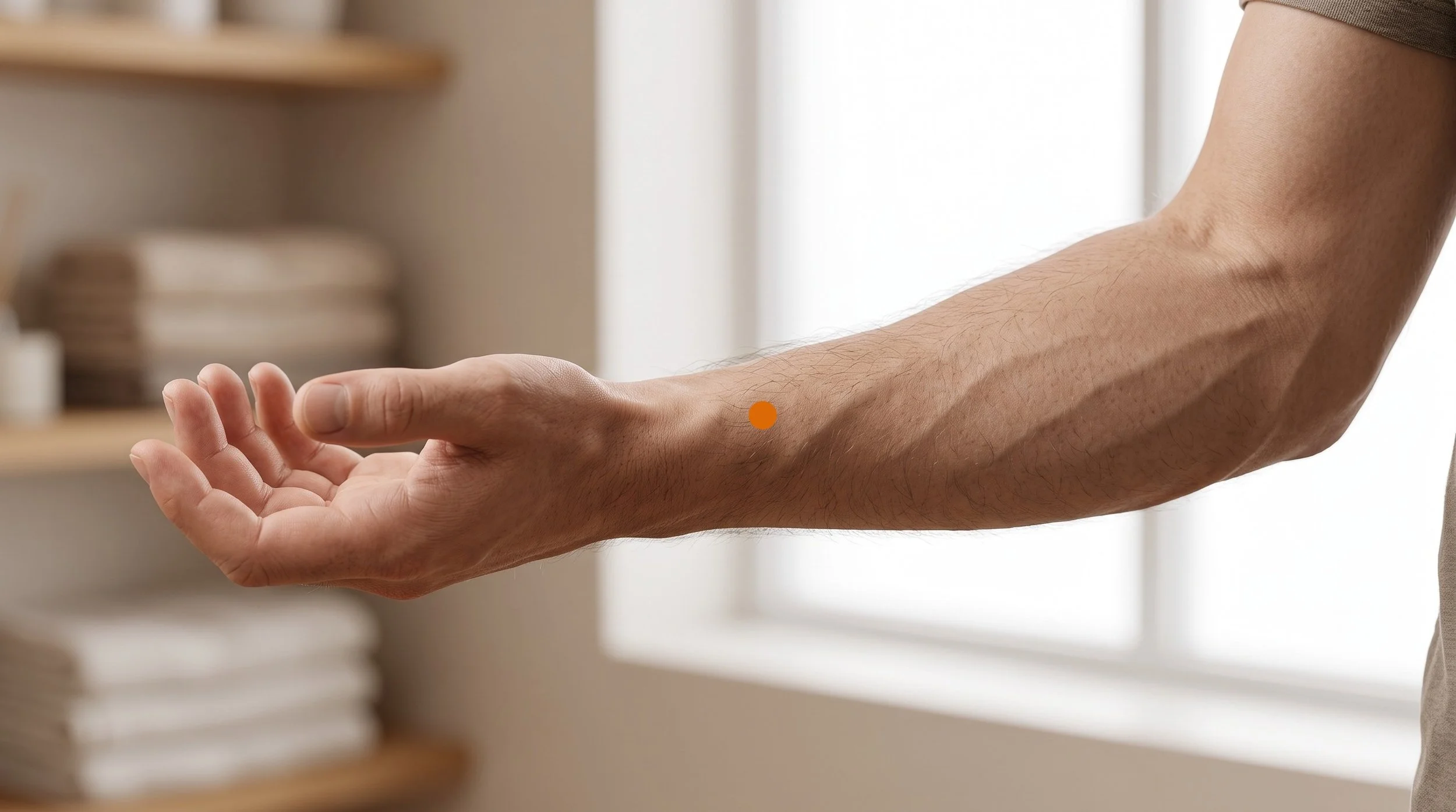
LI6 Acupuncture Point (Pianli)
The Veering Passage of the Radial Forearm: Anatomy, Mechanism, and Why the Large Intestine Luo Point Bridges Wrist Pain, Ear Complaints, and Fluid Regulation
LI6 (Pianli, often translated as Veering Passage or Diverging Passage) is the luo-connecting point of the Large Intestine channel, and it sits on the thumb side of the forearm about 3 cun above the wrist crease at LI5, along the line running up toward LI11 at the elbow.
In plain terms, if you turn your forearm so the thumb side faces the ceiling and bend the elbow, the li6 acupuncture point falls roughly a hand's breadth above the wrist, right where the muscle bellies of the thumb abductors cross over the shaft of the radius.
That crossing is what makes large intestine 6 clinically useful twice over: it's a mechanically loaded spot in people with radial wrist and forearm pain, and it's the classical departure point where the channel's connecting branch was traditionally described as veering off toward the jaw and ear, which is why the older texts list tinnitus, nosebleed, and facial complaints alongside local arm pain.
- Location and layers: the pianli point location is 3 cun proximal to LI5 on the LI5 to LI11 line, over the radius at the border between the radial wrist extensors and abductor pollicis longus. Needling is shallow and angled, typically transverse-oblique to 0.5 to 1 cun, because the tissue plane here is thin and tendinous rather than bulky.
- Category, translated: classically LI6 is the luo-connecting point linking the Large Intestine channel to its paired Lung channel (Deadman et al., 2007). In modern terms, that pairing describes a shared segmental territory (roughly C6 to C7 for the radial forearm) rather than any literal flow of energy.
- Nerve story: the point lies in superficial radial nerve territory, and needling here recruits A-delta and C fibers whose input converges in the dorsal horn with nociceptive traffic from the wrist extensors and first dorsal compartment, one plausible route for local analgesia (Zhao, 2008).
- Research picture: acupuncture reduces chronic musculoskeletal pain with effects that persist beyond the treatment course in individual patient data meta-analysis (Vickers et al., 2018), while trigger point dry needling of the extensor group shows short-term gains in pain, grip strength, and disability in lateral elbow pain (Navarro-Santana et al., 2020).
- Clinical framing: at Morningside we use the li 6 forearm point mostly for thumb-side wrist and forearm pain, de Quervain-type irritation, and repetitive strain from keyboards and phones, and secondarily as a classical distal addition in nasal and ear-related treatments where the evidence remains preliminary (Huang et al., 2021).
- De qi: patients usually report a dull, heavy, slightly spreading ache along the radial forearm toward the thumb. A brief electric zing means the needle has brushed a superficial radial nerve branch, and the needle should be withdrawn slightly and redirected.
Thumb-Side Wrist or Forearm Pain That Won't Settle?
Radial wrist pain rarely comes from the wrist alone, and treating only the sore spot tends to disappoint. At Morningside Acupuncture we pair LI6 with careful needling of the radial extensors and thumb abductors, then add loading advice so the tendons tolerate typing, lifting, and training again. Book an evaluation and we'll map exactly which tissues are driving your pain.
Schedule NowAnatomy of LI6: Why the Radial Border of the Forearm Is Such an Important Location
Slide your thumb up the radial edge of the forearm from the wrist and you'll pass through several layers in quick succession: thin skin and subcutaneous fascia, then the tendinous bellies of extensor carpi radialis longus and brevis, then the oblique crossing of abductor pollicis longus and extensor pollicis brevis as they angle toward the thumb, and finally the periosteum of the radius itself. LI6 sits right at that intersection. It's a busy mechanical junction, and it's loaded every time you grip, type, use a mouse, twist a lid, hold a phone, or carry a bag with the wrist extended.
That's why the classical indication of pain in the wrist, elbow, and upper arm maps so neatly onto what we see in clinic: tennis elbow, first dorsal compartment irritation, and generalized radial forearm aching.
Sensory supply in this region comes largely from the superficial branch of the radial nerve, with segmental input tracking roughly to the C6 and C7 spinal levels. That matters because the same segments carry nociceptive information from the wrist extensor tendons, the lateral elbow, and the radial wrist joint. Needling at LI6 delivers a strong, well-localized afferent barrage into those segments, and experimental work suggests such input engages both spinal inhibitory circuits and supraspinal descending pathways that dampen pain signaling (Zhao, 2008).
Local effects likely add to this, since needle insertion produces small-scale tissue responses and reflex changes in local blood flow. Trigger point research also shows that needling taut bands in the extensor group can reduce referred pain and pressure sensitivity in the forearm and hand (Simons et al., 1999).
There's no major artery directly at LI6: the radial artery runs more toward the palmar side and the radial nerve's deep motor branch has already dived away proximally, so the practical caution here is nerve contact rather than vascular risk. The superficial radial nerve becomes progressively more superficial as it descends, so a sharp, shooting, electric sensation is a signal to reposition rather than push deeper.
Conventional needling is transverse-oblique, 0.5 to 1 cun, usually angled proximally along the channel line or toward a tender tendinous band, which keeps the needle in the soft tissue plane and off the periosteum. Moxibustion is traditionally described as acceptable at this point.
Related Extensor Pollicis Longus Brevis Trigger Points Related Extensor Carpi Radialis Brevis Trigger PointsLI6 at a Glance: Classification, Location, and Clinical Use
| Category | Detail |
|---|---|
| Traditional Name | Pianli, commonly rendered as Veering Passage or Diverging Passage |
| Channel Classification | Large Intestine channel (Hand Yangming), sixth point |
| Point Categories | Luo-connecting point of the Large Intestine channel; the connecting branch is classically described as linking to the paired Lung channel and as sending offshoots to the jaw, teeth, and ear |
| Precise Location | On the thumb side of the forearm, 3 cun proximal to LI5 on the line joining LI5 and LI11. Locate with the elbow flexed and the radial side of the arm facing upward; the LI5 to LI11 distance is 12 cun, so LI6 sits one quarter of the way up. |
| Tissue Stimulated | Subcutaneous fascia over the radius at the junction of the radial wrist extensors and the thumb abductors, in superficial radial nerve territory. Overlaps with myofascial targets covered on our Extensor Carpi Radialis Brevis Trigger Points and Extensor Pollicis Longus Brevis Trigger Points pages. |
| Needle Depth / Direction | Transverse-oblique insertion, 0.5 to 1 cun, angled along the channel or toward a palpable tender band; moxibustion is traditionally permitted |
| De Qi Sensation | Dull, heavy, mildly spreading ache along the radial forearm, sometimes traveling toward the thumb or up toward the elbow; a sharp electric sensation indicates superficial radial nerve contact and calls for redirection |
| Primary Clinical Uses | Thumb-side wrist and forearm pain, lateral elbow pain, repetitive strain from keyboard and phone use; traditionally also used for tinnitus and hearing complaints, nosebleed and rhinitis, and patterns of fluid retention with difficult urination |
| Common Point Combinations |
|
In A Manual of Acupuncture, Deadman and colleagues explain the name by the anatomy of the connecting channel: this is where a branch veers away from the main Large Intestine pathway, joining the paired Lung channel on one hand and ascending toward the jaw, teeth, and ear on the other. Traditional sources therefore credit LI6 with two rather different jobs.
The first is expelling wind and clearing heat from the head, which is the stated rationale for its classical indications in tinnitus, deafness, toothache, red or painful eyes, rhinitis, nosebleed, dry throat, and facial swelling, particularly when those complaints were understood as arising from an external attack.
The second is opening and regulating the water passages, and here LI6 was considered the main Large Intestine channel point for the pattern of upper body puffiness, absent sweating, and scanty urination, a pattern tied to disturbed Lung function in the classical model. The Great Compendium of Acupuncture and Moxibustion even distinguished excess presentations (tooth decay, deafness) from deficiency presentations (cold-feeling teeth, a blocked sensation at the diaphragm) at this single point.
What's striking is how consistent the geography is: every one of those head and face indications sits along the route the connecting branch was said to take, which is a reminder that classical point logic was fundamentally anatomical description, even when its explanatory language was not ours.
Why LI6 Is Used for Ringing in the Ears and Nasal Complaints Far From the Forearm
The honest answer is that a point on the radial forearm has no direct neural connection to the cochlea or the nasal mucosa, so the classical indications can't be explained by local anatomy the way the wrist pain indications can. What we can say is that strong somatic stimulation at a distal limb point produces effects that aren't confined to the segment stimulated. Needling recruits ascending pathways that engage brainstem structures involved in descending pain modulation, including opioidergic and monoaminergic systems, and these effects are measurable well beyond the site of needle insertion (Zhao, 2008). Distal points are also generally more comfortable to needle strongly, which matters when you want a robust afferent signal.
For the head and face indications specifically, the plausible mechanisms are heterosegmental and autonomic rather than direct. Changes in sympathetic tone can influence mucosal blood flow and secretion, which is one proposed route for the effects of acupuncture on nasal symptoms, and reviews of acupuncture for allergic rhinitis have reported symptom and quality-of-life improvements while noting substantial variability across trials (Yin et al., 2020).
Tinnitus is a harder target: a meta-analysis of randomized trials found no significant advantage on visual analog pain-style ratings but did report improvements on tinnitus-specific questionnaires, with the authors emphasizing that the underlying studies were small and methodologically limited (Huang et al., 2021).
So the practical position is a modest one. LI6 earns its place in a treatment plan on anatomical grounds for radial forearm, wrist, and elbow pain, where the segmental logic is clear and the needling evidence for the surrounding musculature is reasonably good (Navarro-Santana et al., 2020). Its classical head and face applications are worth including in a broader protocol when they fit the presentation, but they should be described as traditional indications supported by limited and inconsistent modern evidence, not as established treatments.
What the Research Shows for LI6
Almost no clinical trial isolates a single point, and LI6 is no exception. The studies below tested multi-point protocols in which LI6 may or may not have been included, so they tell us about acupuncture and needling as interventions for the conditions this point is traditionally used for, not about the point itself. Read them as context for why a clinician might reach for this location, and note where the evidence is thin.
| Study | Type | Focus | Key Finding |
|---|---|---|---|
| Vickers et al., 2018 | Individual patient data meta-analysis | Chronic musculoskeletal, headache, and osteoarthritis pain across nearly 21,000 patients | Acupuncture outperformed both sham and no-acupuncture controls for chronic pain, with effects that largely persisted at 12 months. |
| Navarro-Santana et al., 2020 | Systematic review and meta-analysis | Trigger point dry needling for lateral epicondylalgia of musculoskeletal origin | Low to moderate quality evidence suggested short-term improvements in pain, disability, pressure pain sensitivity, and grip strength. |
| Hadianfard et al., 2014 | Randomized controlled trial | Acupuncture compared with corticosteroid injection for de Quervain's tenosynovitis | Both groups improved in the short term, and the authors suggested acupuncture may be a reasonable alternative for patients who decline injection. |
| Challoumas et al., 2023 | Systematic review and network meta-analysis | Comparative management options for de Quervain tenosynovitis | Acupuncture did not separate significantly from placebo on pain scores in this network, a useful counterweight to smaller positive trials. |
| Huang et al., 2021 | Systematic review and meta-analysis | Acupuncture for tinnitus across eight trials and 504 participants | No significant benefit was found on the primary visual analog outcome, though tinnitus-specific questionnaire scores favored acupuncture; the evidence base was judged insufficient for firm conclusions. |
| Yin et al., 2020 | Systematic review and Bayesian network meta-analysis | Acupuncture methods for allergic rhinitis | Several acupuncture approaches were associated with symptom improvement, though heterogeneity across trials limits how confidently the findings can be applied. |
Repetitive Strain From Desk Work, Phones, and Lifting?
Hours of mouse work, thumb scrolling, and grip-heavy training load the same forearm compartment where LI6 sits. Our clinicians combine needling at LI6 and neighboring Large Intestine channel points with dry needling of extensor carpi radialis brevis and abductor pollicis longus, plus practical ergonomic adjustments. Most patients notice a change in grip comfort within a few sessions. Schedule a visit to get started.
Schedule NowLI6 in the Context of Trigger Point Work
LI6 sits in the middle of territory that trigger point clinicians already know well. Extensor carpi radialis longus and brevis run directly beneath and just lateral to the point, and their referred pain patterns travel toward the lateral epicondyle and the back of the wrist and hand, which is why patients with so-called tennis elbow often have tenderness this far down the forearm (Simons et al., 1999). Abductor pollicis longus and extensor pollicis brevis cross the same zone on their way to the thumb, and irritation there contributes to the thumb-side wrist pain that gets labeled de Quervain's.
When we palpate before needling, the most reactive spot in a patient with radial forearm pain frequently lands within a centimeter or two of the classical LI6 location.
At Morningside, that overlap means we rarely treat LI6 in isolation. A typical session for radial wrist or elbow pain includes needling at LI6 and along the Large Intestine channel, dry needling of taut bands in extensor carpi radialis brevis, abductor pollicis longus, extensor pollicis brevis, and supinator when indicated, and screening of the flexor group and the neck, since C6 and C7 segmental referral can masquerade as pure forearm pain.
Acupuncture, in the sense of using an acupuncture needle, covers both the classical point approach and dry needling of myofascial targets, and the two are complementary rather than competing. We finish with grip and loading recommendations, because needling reduces sensitivity while graded loading is what changes tendon tolerance over time.
LI6 Forearm and Wrist Pain Treatment at NYC's Highest-Rated Acupuncture Clinic
Morningside Acupuncture is the highest-rated acupuncture and dry needling clinic in New York City with over 500 five-star Google reviews, and our treatments are built around anatomy, not guesswork. We use LI6 as part of a broader plan for wrist, forearm, and elbow complaints, integrating classical point selection with modern trigger point work. Schedule your appointment and let's build a plan around how your arm actually gets used.
Schedule NowFrequently Asked Questions
What does LI6 feel like when needled?
Most people describe a dull, heavy, slightly spreading ache that may travel toward the thumb or up the forearm toward the elbow. Because the needle is angled shallowly through fascia and tendon, the sensation is usually more of a firm pressure than a sting. If the muscle is genuinely irritable, you may feel a brief twitch or cramping sensation, which typically fades within seconds. A sharp electric zap means the needle has touched a superficial radial nerve branch, and your clinician should adjust it right away.
Why needle the forearm for a problem in the ear, nose, or elbow?
For elbow and wrist pain, the answer is segmental: LI6 shares spinal levels (roughly C6 to C7) with the wrist extensors and lateral epicondyle, so afferent input from the point converges on the same dorsal horn neurons that carry pain from those structures (Zhao, 2008). For ear and nose complaints, the rationale is classical rather than anatomical, since the connecting channel from LI6 was described as ascending to the jaw and ear. Whatever effect exists there is more plausibly explained by widespread descending modulation and autonomic changes than by any local connection, and the clinical evidence for it remains limited (Huang et al., 2021).
Can I press LI6 myself between sessions?
Yes, and it's easy to reach. Rest your forearm on a table with the thumb side facing up, find the wrist crease at the base of the thumb, and move about three finger-widths (roughly 3 cun) up toward the elbow along the radial edge. Press with the opposite thumb and hunt for the most tender spot, which may be slightly off the measured location. Apply firm, steady pressure for 30 to 60 seconds at a level you'd rate 4 or 5 out of 10, release, then repeat two or three times. Doing this two or three times a day is reasonable. Stop if you feel numbness, tingling, or shooting sensations into the thumb, and skip it entirely over broken skin, bruising, or an acutely swollen tendon.
Is LI6 safe to needle?
It's considered a low-risk point in trained hands. There's no major artery immediately beneath it and no organ or lung risk anywhere nearby, so the main consideration is the superficial radial nerve, which is why the standard technique is transverse-oblique insertion of 0.5 to 1 cun rather than deep perpendicular needling. Minor bruising is the most common side effect, slightly more likely in people on blood thinners. Tell your clinician if you have a bleeding disorder, an active local infection, or altered sensation in the hand, and expect a shallower, gentler approach in those cases.
Where exactly is LI6 located?
On the thumb side of the forearm, 3 cun above LI5 at the wrist, on the straight line running from LI5 up to LI11 at the outer elbow crease. A reliable way to find it: the distance from the wrist crease to the elbow crease along this line is treated as 12 cun, so halve it, then halve again toward the wrist, and you're at the level of LI6. Locate it with the elbow bent and the radial side of the forearm facing upward, then palpate for the tender band over the radius between the wrist extensors and the thumb abductors.
References
- Deadman, P., Al-Khafaji, M., & Baker, K. (2009). A manual of acupuncture. Journal of Chinese Medicine Publications.
- Cunningham, P. M. (2000). Acupuncture points: A practical guide to classical and modern usage. Odyssey Press.
- Maciocia, G. (2006). The channels of acupuncture: Clinical use of the secondary channels and eight extraordinary vessels. Churchill Livingstone Elsevier.
- Simons, D. G., Travell, J. G., & Simons, L. S. (1999). Travell & Simons' myofascial pain and dysfunction: The trigger point manual, Vol. 1: Upper half of body (2nd ed.). Williams & Wilkins.
- Zhao, Z. Q. (2008). Neural mechanism underlying acupuncture analgesia. Progress in Neurobiology, 85(4), 355-375. https://doi.org/10.1016/j.pneurobio.2008.05.004
- Vickers, A. J., Vertosick, E. A., Lewith, G., MacPherson, H., Foster, N. E., Sherman, K. J., Irnich, D., Witt, C. M., & Linde, K. (2018). Acupuncture for chronic pain: Update of an individual patient data meta-analysis. Journal of Pain, 19(5), 455-474. https://doi.org/10.1016/j.jpain.2017.11.005
- Navarro-Santana, M. J., Sanchez-Infante, J., Gómez-Chiguano, G. F., Cleland, J. A., López-de-Uralde-Villanueva, I., Fernández-de-las-Peñas, C., & Plaza-Manzano, G. (2020). Effects of trigger point dry needling on lateral epicondylalgia of musculoskeletal origin: A systematic review and meta-analysis. Clinical Rehabilitation, 34(11), 1327-1340. https://doi.org/10.1177/0269215520937468
- Hadianfard, M., Ashraf, A., Fakheri, M., & Nasiri, A. (2014). Efficacy of acupuncture versus local methylprednisolone acetate injection in De Quervain's tenosynovitis: A randomized controlled trial. Journal of Acupuncture and Meridian Studies, 7(3), 115-121. https://doi.org/10.1016/j.jams.2013.10.003
- Challoumas, D., Ramasubbu, R., Rooney, E., Seymour-Jackson, E., Putti, A., & Millar, N. L. (2023). Management of de Quervain tenosynovitis: A systematic review and network meta-analysis. JAMA Network Open, 6(10), e2337001. https://doi.org/10.1001/jamanetworkopen.2023.37001
- Huang, K., Liang, S., Chen, L., & Grellet, A. (2021). Acupuncture for tinnitus: A systematic review and meta-analysis of randomized controlled trials. Acupuncture in Medicine, 39(4), 264-271. https://doi.org/10.1177/0964528420938380
- Yin, Z., Geng, G., Xu, G., Zhao, L., & Liang, F. (2020). Acupuncture methods for allergic rhinitis: A systematic review and Bayesian meta-analysis of randomized controlled trials. Chinese Medicine, 15, 109. https://doi.org/10.1186/s13020-020-00389-9
Disclaimer: This web site is intended for educational and informational purposes only. Reading this website does not constitute providing medical advice or any professional services. This information should not be used for diagnosing or treating any health issue or disease. Those seeking medical advice should consult with a licensed physician. Seek the advice of a medical doctor or other qualified health professional for any medical condition. If you think you have a medical emergency, call 911 or go to the emergency room. No acupuncturist-patient relationship is created by reading this website or using the information. Morningside Acupuncture PLLC and its employees and contributors do not make any express or implied representations with respect to the information on this site or its use. For any legal interpretation of scope of practice in your state, consult a licensed attorney or regulatory authority.
Read more from our blog



