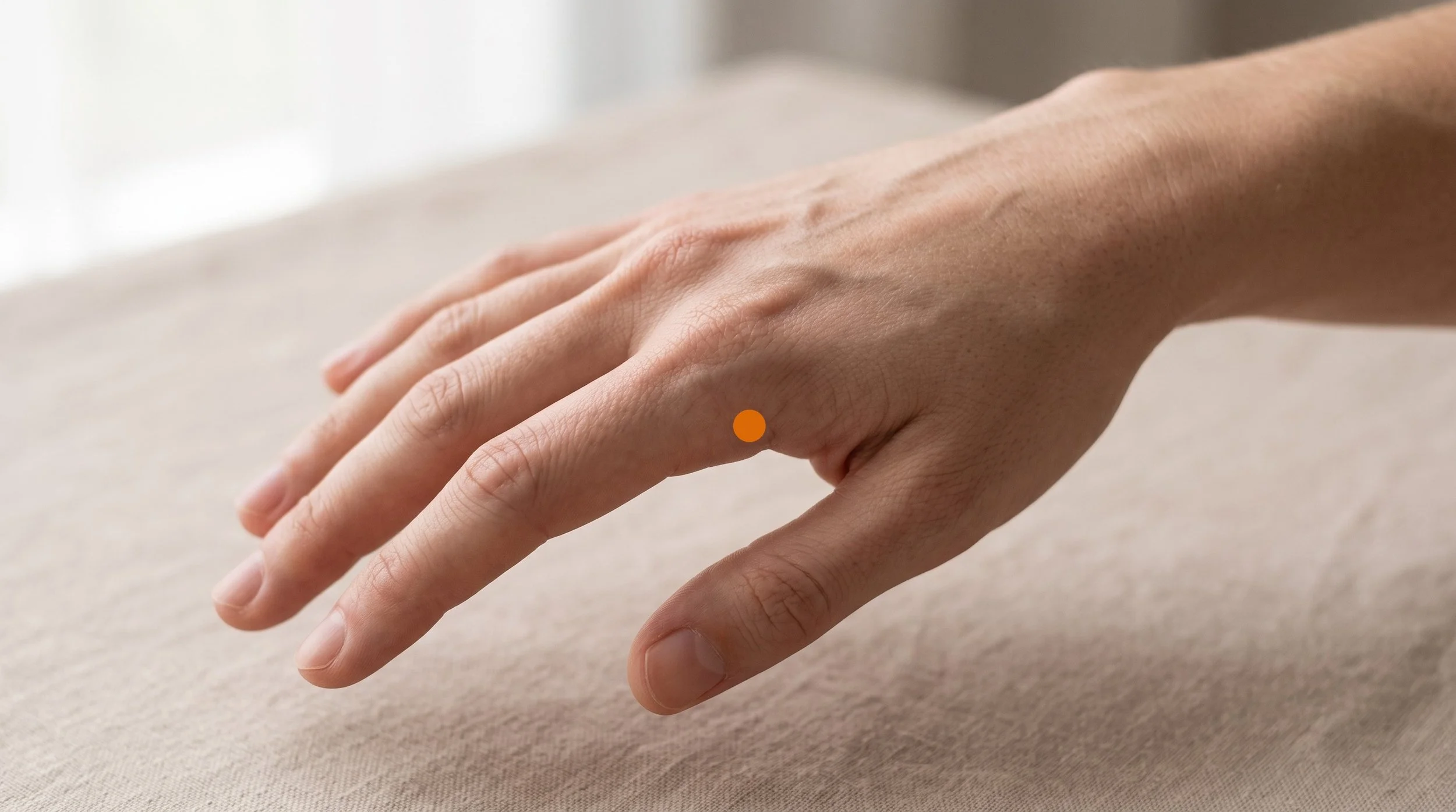
LI2 Acupuncture Point (Erjian)
The Second Space Beside the Index Knuckle: Anatomy, Mechanism, and Why This Small Finger Point Was Classically Reserved for Toothache, Sore Throat, and Facial Heat
LI2, known in pinyin as Erjian and usually translated as Second Space, sits on the thumb side of the index finger in the small hollow just past the big knuckle where the finger meets the hand. It is the second point on the Large Intestine channel and, in five-shu terms, its ying-spring and water point, a category that classical texts linked with heat in the head and face rather than with local finger complaints.
That is what makes the li2 acupuncture point interesting: a needle placed at the base of one finger was traditionally selected for toothache, throat pain, nasal symptoms, and facial inflammation, and modern pain science offers a plausible account of how stimulation that far from the jaw can still change what the brain does with orofacial input.
- Location and layers: LI2 lies in the depression immediately distal to the second metacarpophalangeal joint on the radial side, where thin skin, subcutaneous tissue, the sagittal band of the extensor hood, the radial collateral ligament, and the insertion field of the first dorsal interosseous are all within a few millimeters of the needle tip.
- Traditional category translated: the classical literature files LI2 as the ying-spring and water point of hand yangming and assigns it heat patterns of the teeth, nose, throat, face, and eyes, which in clinical language maps onto acute, inflammatory, hot presentations in the head rather than chronic deficiency states.
- Mechanism: the point sits in radial and median digital nerve territory at roughly the C6 to C7 level, so relief of jaw or tooth pain cannot be segmental; the more defensible model is heterosegmental inhibition of trigeminal convergent neurons plus descending control from the periaqueductal gray and rostral ventromedial medulla, with partial opioid mediation (Bing et al., 1990; Sheng et al., 2000; Zhao, 2008).
- Research picture: reviews of acupuncture for acute dental pain and for temporomandibular disorders report modest benefit with real methodological limits, and larger pain datasets support a genuine but moderate effect of needling overall (Müller et al., 2023; Park et al., 2023; Vickers et al., 2018).
- Clinical framing: LI2 is a supporting distal point rather than a standalone treatment, typically one needle, briefly stimulated, alongside local points at the jaw, sinus, or throat region and alongside LI4 when a stronger yangming distal effect is wanted.
- De qi: because the digits are densely innervated, insertion here can feel briefly sharp before settling into a dull, spreading ache along the index finger toward the wrist, and most patients tolerate it best with shallow angles and short retention.
Dealing With Jaw Pain, Tooth Sensitivity, or Facial Tension That Will Not Settle?
Our acupuncturists use LI2 as part of a broader orofacial treatment that pairs distal hand points with careful needling around the masseter, temporalis, and jaw joint. We assess how you clench, chew, and hold your head at your desk before a single needle goes in, so the treatment addresses the load and not just the symptom. Most patients notice changes in jaw comfort and tension within a few visits. Schedule an appointment and let us build a plan around your presentation.
Schedule NowAnatomy of LI2: Why the Radial Index Knuckle Is Such an Important Location
Slide a fingertip along the thumb side of your index finger toward the hand and you will drop into a small hollow just past the knuckle, right where the pale palm skin meets the darker skin of the back of the hand. That hollow is LI2, and it sits directly over the radial side of the second metacarpophalangeal joint. Under the skin and a thin layer of subcutaneous fat lie the sagittal band of the extensor hood, the radial collateral ligament of the joint, and the insertion field of the first dorsal interosseous onto the base of the proximal phalanx.
These tissues are loaded every time you pinch, grip, type, hold a phone, turn a key, or steady a racquet, which is why the area can become locally tender in people whose hands do repetitive precision work.
The nerve geography matters more than the muscle here. The site is served by digital branches of the radial nerve dorsally and of the median nerve on the palmar side, carrying afferents that enter the cord at roughly the C6 to C7 level. The teeth, jaw, and face are trigeminal territory, so any effect of a hand point on toothache cannot be explained by shared segmental innervation.
The better supported account is heterosegmental: strong noxious or near noxious input from a distal limb site can depress the firing of trigeminal convergent neurons, an effect shown experimentally to be reversible with naloxone and therefore at least partly opioid mediated (Bing et al., 1990). Animal work using a distal yangming point on the foot found reduced activation markers in the trigeminal subnucleus caudalis after tooth pulp stimulation, along with changes in the periaqueductal gray, which is the classic hub for descending inhibition (Sheng et al., 2000).
Broader reviews of acupuncture analgesia describe the same layered picture of spinal gating, brainstem descending control, and endogenous opioid release (Zhao, 2008).
The safety considerations at LI2 are small scale but real. Palmar and dorsal digital arteries and nerves run along the sides of the finger, close to the surface, and the joint capsule sits just deep to the point.
Classical texts describe oblique insertion of about 0.2 to 0.3 cun angled toward the fingertip or toward the wrist, or a perpendicular to oblique angle directed toward the palm to about 0.5 cun, and the manuals note that moxibustion is applicable here.
In practice we keep the angle shallow, avoid driving the needle into the joint capsule, and use a fine gauge because fingers are sensitive. Clean needle technique, extra care in patients on anticoagulants or with swollen or infected finger joints, and short retention times are the sensible defaults.
Related Large Intestine Channel Related LI4 Acupuncture PointLI2 at a Glance: Classification, Location, and Clinical Use
| Category | Detail |
|---|---|
| Traditional Name | Erjian (Second Space, also translated as Second Interval) |
| Channel Classification | Second point of the Large Intestine channel of hand yangming, paired with the Stomach channel in six channel theory and interiorly and exteriorly coupled with the Lung channel |
| Point Categories | Ying-spring point and Water point of the Large Intestine channel in the five-shu system. No meeting, crossing, hui-meeting, or extraordinary vessel designations are attributed to it. Note that the pinyin name Erjian is shared with an unrelated extra point at the apex of the ear, so charts should be read carefully. |
| Precise Location | On the radial border of the index finger, in the depression just distal to the second metacarpophalangeal joint, near the border between palmar and dorsal skin. Easiest to locate with the index finger relaxed in slight flexion. |
| Tissue Stimulated | Skin and subcutaneous tissue over the radial index knuckle, the sagittal band and radial collateral ligament of the joint, and the insertion field of the first dorsal interossei |
| Needle Depth / Direction | Oblique insertion 0.2 to 0.3 cun angled either distally or proximally, or perpendicular to oblique toward the palm to about 0.5 cun. Fine gauge, shallow, avoiding the joint capsule. Moxibustion is described as applicable. |
| De Qi Sensation | Often briefly sharp on insertion given the dense digital innervation, then a dull ache, pressure, or heaviness that can spread along the index finger and occasionally toward the wrist |
| Primary Clinical Uses | Toothache, especially of the lower jaw, sore throat, nasal congestion and nosebleed in classical use, facial pain and swelling, eye discomfort in classical sources, and local pain or stiffness at the index knuckle |
| Common Point Combinations |
|
In A Manual of Acupuncture, Deadman and colleagues present LI2 as the ying-spring and water point of hand yangming, and they follow the Classic of Difficulties in linking ying-spring points with heat in the body. The traditional attribution is that LI2 clears heat and wind from the upper reaches of the channel, so the indication lists cluster around the teeth, lower cheek, nose, throat, mouth, and eyes, along with fever and shivering.
Two relationships are used to explain that reach: the Large Intestine channel is treated as the exterior aspect of the Lung, which accounts for its use in throat pain, rhinitis, and nosebleed, while its yangming pairing with the Stomach accounts for toothache and dry mouth attributed to accumulated heat traveling up the channel. Since the Stomach channel begins at the eye, classical writers extended LI2 to eye complaints even though the Large Intestine channel itself does not reach there.
What stands out is that several classical sources favored LI2 over the far more famous LI4 for toothache, apparently because the more distal point was considered sharper and more urgent in action, and that its stranger indications, including a tendency to fright and sleepiness, sit alongside Kidney channel points in the old formulas, which the commentary reads as a nod to its water point status on a metal channel.
Why LI2 Is Used for Toothache and Sore Throat Rather Than Just Finger Pain
The first question patients ask is fair: how can a needle at the base of the index finger do anything for a tooth? It helps to separate two different jobs the point does. Locally, LI2 sits over tissue that is genuinely loaded by pinch and grip, so for knuckle soreness or first dorsal interosseous irritation the effect is straightforward segmental input at the same spinal levels that serve the hand. For the face and teeth, the story is different, because those structures report to the trigeminal system, not to C6 or C7. There is no shared segment to work with.
What appears to happen instead is remote or heterosegmental modulation. Strong sensory input from a limb can turn down the excitability of convergent neurons in the trigeminal nucleus, and experimental work has shown that this suppression can be reversed by naloxone, pointing to endogenous opioid involvement (Bing et al., 1990). Studies using a distal yangming point on the foot found less activation of the trigeminal subnucleus caudalis after painful tooth pulp stimulation, together with changes in the periaqueductal gray, a key relay for descending pain control (Sheng et al., 2000).
Reviews of acupuncture analgesia describe this as a layered system involving peripheral afferent activation, spinal and brainstem gating, and release of opioid peptides and monoamines (Zhao, 2008).
None of that makes LI2 a substitute for dental care. A tooth that is infected or cracked needs a dentist, and needling may temporarily reduce pain without touching the cause. Where LI2 earns its place is as an adjunct: it can take some edge off orofacial pain, it may make local jaw work more comfortable, and it costs one small needle. That is a reasonable role for a distal point, and it is the way we frame it with patients.
What the Research Shows for LI2
There is no clinical trial that isolates LI2, and it would be unusual to find one. Acupuncture research almost always tests multi-point protocols, so the useful question is whether the treatment categories LI2 belongs to, distal needling for orofacial and dental pain, show benefit, and whether the effect sizes justify including the point. The honest summary is that the evidence for acupuncture in acute dental pain and temporomandibular disorders is promising but limited by small samples and risk of bias, while the general evidence base for acupuncture in chronic pain is stronger and better replicated. Read the table below as context for a supporting point, not as proof that this particular needle location carries the effect.
| Study | Type | Focus | Key Finding |
|---|---|---|---|
| Müller et al., 2023 | Systematic review and meta-analysis | Acupuncture for acute dental pain, intraoperative and postoperative | Pooled data suggested lower postoperative pain scores with acupuncture compared with sham, though the authors emphasized methodological weaknesses across the included trials. |
| Park et al., 2023 | Systematic review and meta-analysis | Acupuncture for temporomandibular disorders | Reported favorable results for acupuncture on TMD pain outcomes while noting variable trial quality and heterogeneous comparators. |
| He et al., 2022 | Systematic review and meta-analysis | Acupuncture for allergic rhinitis | Found improvements in nasal symptom scores and quality of life in adults, which is relevant context for the classical nasal indications of this point. |
| Vickers et al., 2018 | Individual patient data meta-analysis | Acupuncture for chronic pain across conditions | Acupuncture outperformed both sham and no-acupuncture controls, with effects that persisted over time, supporting a real if moderate treatment effect. |
| Sheng et al., 2000 | Animal experimental study | Distal yangming point needling and tooth pulp pain | Needling reduced activation markers in the trigeminal subnucleus caudalis after tooth pulp stimulation, with associated changes in the periaqueductal gray. |
| Bing et al., 1990 | Animal neurophysiology study | Remote noxious stimulation and trigeminal neurons | Depression of trigeminal convergent neuron activity was naloxone reversible, indicating opioid mediated heterosegmental inhibition. |
| Zhao, 2008 | Narrative mechanism review | Neural mechanisms of acupuncture analgesia | Describes acupuncture analgesia as a multi-level process involving afferent activation, spinal gating, descending control, and endogenous opioid release. |
Index Knuckle Pain From Pinching, Typing, and Gripping?
LI2 sits directly over the tissues that get loaded by thumb to index pinch, which makes it useful for irritation at the index metacarpophalangeal joint and the first dorsal interosseous. We combine gentle needling at the point with dry needling of the hand intrinsics and forearm muscles that drive the grip. You also leave with load management and stretching guidance that fits your actual workday. Book a visit to get your hand assessed properly.
Schedule NowLI2 in the Context of Trigger Point Work
Acupuncture, in our definition, is the use of an acupuncture needle, and that includes dry needling. At LI2 the two frameworks overlap neatly, because the point sits at the insertion field of the first dorsal interosseous, a muscle whose trigger points are described as referring pain along the index finger and across the back of the hand (Simons et al., 1999). When a patient with index knuckle pain, pinch related soreness, or a cranky grip comes in, we palpate the interossei and the adductor pollicis before deciding whether the needle belongs at the classical point, in the taut band, or both. The anatomy is small and superficial, so technique here is about precision and restraint rather than depth.
For jaw and facial complaints the roles divide differently. LI2 and LI4 serve as distal modulators, while the local work is dry needling of the masseter, temporalis, and medial pterygoid where indicated, along with treatment of the upper trapezius and suboccipital muscles that so often accompany clenching. Patients frequently report that the distal hand needles make the local jaw needling easier to tolerate, which fits the descending inhibition model rather than any claim about energy moving up the arm. We adjust dosage across sessions based on what your tissue and nervous system tolerate.
LI2 Toothache and Facial Pain Treatment at NYC's Highest-Rated Acupuncture Clinic
Morningside Acupuncture is the highest-rated acupuncture and dry needling clinic in New York City with over 500 five-star Google reviews, and our practitioners integrate classical point selection with current pain neuroscience. For toothache, jaw pain, sinus pressure, and throat discomfort, LI2 is one small part of a treatment designed around your exam findings and your goals. We are transparent about what acupuncture can and cannot do, and we coordinate with your dentist or physician when that is the right call. Schedule your first session and see how the approach feels.
Schedule NowFrequently Asked Questions
What does LI2 feel like when needled?
Expect a brief sharpness on insertion, because the fingers carry a high density of sensory nerve endings, followed by a dull ache, pressure, or fullness that can spread a short distance along the index finger and sometimes toward the wrist. That aching quality is the de qi sensation described in classical texts, and it usually eases within a few seconds. Sharp, electric, or radiating pain that persists is a signal to reposition the needle, and any competent practitioner will do that without hesitation. Needles here are typically fine, shallow, and retained for a shorter time than points on the trunk or limbs.
Why needle a point on the hand for a problem in the mouth or throat?
Because the effect is not local and does not need to be. The teeth and face are supplied by the trigeminal nerve while LI2 sits in radial and median digital territory at roughly the C6 to C7 level, so there is no shared spinal segment to explain the result. What research supports instead is remote inhibition: strong input from a limb site can reduce the excitability of trigeminal convergent neurons and recruit descending pain control pathways through the brainstem, with endogenous opioids playing a part (Bing et al., 1990; Sheng et al., 2000; Zhao, 2008). Classical practitioners noticed the clinical pattern long before the physiology was mapped, and several old sources actually preferred LI2 to LI4 for toothache.
Can I press LI2 myself between sessions?
Yes, and it is one of the easier points for self acupressure because you can reach it with your opposite thumb. Relax the index finger into slight flexion, find the hollow on the thumb side just past the big knuckle, and press with the tip of your thumb at an angle toward the bone, using firm but tolerable pressure. Hold for 30 to 60 seconds, release for 10 seconds, and repeat two or three times per hand, up to a few times per day. You should feel a dull, slightly tender ache, not sharp pain or numbness, and you should stop if the joint is swollen, hot, or recently injured. Acupressure is a reasonable bridge between visits, but it is not a substitute for evaluating an infected tooth, a persistent sore throat, or a joint that keeps flaring.
Is LI2 safe to needle?
In trained hands, yes. The main considerations are that digital nerves and small digital arteries run close to the surface along the sides of the finger, and the metacarpophalangeal joint capsule sits just deep to the point, so shallow oblique angles and fine needles are the norm rather than deep perpendicular insertion. Minor bruising or brief tenderness is the most common side effect. We take extra care in people on blood thinners, and we avoid needling any finger joint that is swollen, infected, or acutely inflamed from trauma. Tell your practitioner about anticoagulants, recent hand injuries, or inflammatory arthritis before treatment.
Where exactly is LI2 located?
Large Intestine 2 lies on the radial, or thumb side, border of the index finger, in the depression just distal to the second metacarpophalangeal joint, close to the border where palmar and dorsal skin meet. To find the li 2 finger location, let the index finger relax into slight flexion, then slide your opposite thumb from the fingertip along the thumb side edge until it drops into the small hollow immediately past the knuckle. LI1 sits at the corner of the index fingernail and LI3 sits proximal to the joint on the same border, so the second space point is the middle of those three landmarks.
References
- Deadman, P., Al-Khafaji, M., & Baker, K. (2009). A manual of acupuncture. Journal of Chinese Medicine Publications.
- Kim, H. (2008). Handbook of Oriental medicine (3rd ed.). Harmony & Balance Press.
- Simons, D. G., Travell, J. G., & Simons, L. S. (1999). Travell & Simons' myofascial pain and dysfunction: The trigger point manual, Vol. 1: Upper half of body (2nd ed.). Williams & Wilkins.
- Bing, Z., Villanueva, L., & Le Bars, D. (1990). Acupuncture and diffuse noxious inhibitory controls: Naloxone-reversible depression of activities of trigeminal convergent neurons. Neuroscience, 37(3), 809-818. https://doi.org/10.1016/0306-4522(90)90110-P
- Sheng, L. L., Nishiyama, K., Honda, T., Sugiura, M., Yaginuma, H., & Sugiura, Y. (2000). Suppressive effects of Neiting acupuncture on toothache: An experimental analysis on Fos expression evoked by tooth pulp stimulation in the trigeminal subnucleus pars caudalis and the periaqueductal gray of rats. Neuroscience Research, 38(4), 331-339. https://doi.org/10.1016/s0168-0102(00)00162-0
- Müller, M., Schmucker, C., Naumann, J., Schlueter, N., Huber, R., & Lederer, A. K. (2023). Acupuncture in management of acute dental pain: A systematic review and meta-analysis. Japanese Dental Science Review, 59, 114-128. https://doi.org/10.1016/j.jdsr.2023.02.005
- Park, E. Y., Cho, J. H., Lee, S. H., Kim, K. W., Ha, I. H., & Lee, Y. J. (2023). Is acupuncture an effective treatment for temporomandibular disorder? A systematic review and meta-analysis of randomized controlled trials. Medicine, 102(38), e34950. https://doi.org/10.1097/MD.0000000000034950
- He, M., Qin, W., Qin, Z., & Zhao, C. (2022). Acupuncture for allergic rhinitis: A systematic review and meta-analysis. European Journal of Medical Research, 27(1), 58. https://doi.org/10.1186/s40001-022-00682-3
- Vickers, A. J., Vertosick, E. A., Lewith, G., MacPherson, H., Foster, N. E., Sherman, K. J., Irnich, D., Witt, C. M., & Linde, K. (2018). Acupuncture for chronic pain: Update of an individual patient data meta-analysis. Journal of Pain, 19(5), 455-474. https://doi.org/10.1016/j.jpain.2017.11.005
- Zhao, Z. Q. (2008). Neural mechanism underlying acupuncture analgesia. Progress in Neurobiology, 85(4), 355-375. https://doi.org/10.1016/j.pneurobio.2008.05.004
Disclaimer: This web site is intended for educational and informational purposes only. Reading this website does not constitute providing medical advice or any professional services. This information should not be used for diagnosing or treating any health issue or disease. Those seeking medical advice should consult with a licensed physician. Seek the advice of a medical doctor or other qualified health professional for any medical condition. If you think you have a medical emergency, call 911 or go to the emergency room. No acupuncturist-patient relationship is created by reading this website or using the information. Morningside Acupuncture PLLC and its employees and contributors do not make any express or implied representations with respect to the information on this site or its use. For any legal interpretation of scope of practice in your state, consult a licensed attorney or regulatory authority.
Read more from our blog



