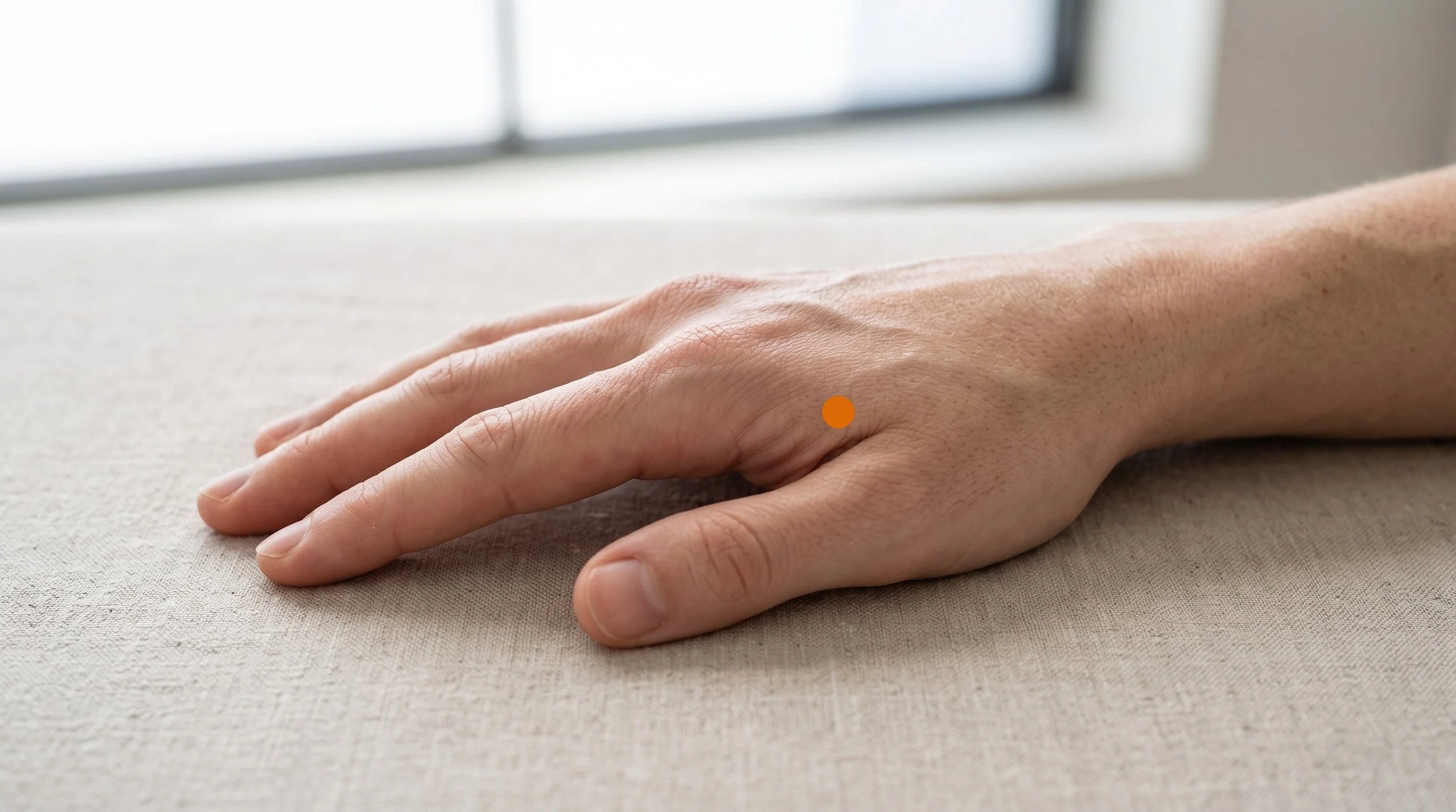
LI3 Acupuncture Point (Sanjian)
The Third Space Beside the Second Metacarpal: Anatomy, Mechanism, and Why This Shu-Stream Point Serves the Throat, Teeth, Neck and Hand
LI3 (Sanjian, often translated as Third Space) is the third point on the Large Intestine channel and its shu-stream and Wood point. You'll find it on the thumb side of the index finger, in the clear hollow just behind the knuckle of the index finger where the second metacarpal head flares out, and it's far easier to locate when the hand rests in a loose fist.
Sitting one point below LI4 in the same densely innervated corner of the hand, the li3 acupuncture point is used two ways in clinic: as a local point for stiff, swollen, painful fingers and for the back of the hand, and as a distal point that classical texts credit with clearing yangming heat from the throat, teeth and face. That double role, hand-local and head-distal, is what makes large intestine 3 a small point with an unusually wide range of use.
- Location and layers: LI3 sits in the depression proximal to the head of the second metacarpal on the radial side of the index finger, and the needle passes through thin dorsal skin and subcutaneous tissue into the radial border of the first dorsal interosseous compartment (Deadman & Al-Khafaji, 2007; Cheng, 2010).
- Traditional categories, read physiologically: as a shu-stream point, LI3 is traditionally used for heaviness and joint pain, and as the Wood point of a yang channel it's traditionally described as expelling wind from the channel (Maciocia, 2015). In modern language, that's a point used for local joint and soft tissue complaints of the hand and for referred, channel-distribution pain.
- Nerve geography: dorsal digital branches of the superficial radial nerve supply the skin here, with deeper input from small intrinsic hand muscles, all carried in roughly C6 to C8 segments, which is the same segmental neighborhood that serves the lower cervical spine and shoulder girdle (Deadman & Al-Khafaji, 2007).
- Mechanism: stimulating a hand point recruits A-delta and C-fiber afferents that engage spinal segmental gating and brainstem descending inhibition through opioid and monoaminergic pathways (Zhao, 2008), and needling the hand has been shown to change primary somatosensory cortex representation in a hand nerve disorder (Maeda et al., 2017).
- Research picture: the strongest evidence supporting acupuncture generally comes from chronic pain meta-analysis (Vickers et al., 2018), while smaller condition-specific reviews on acute dental pain (Müller et al., 2023) and acute throat infection (Zhang et al., 2023) are suggestive but limited by trial quality, and single-point throat trials have been mixed (Fleckenstein et al., 2009).
- De qi and practice framing: patients typically report a deep, heavy ache spreading along the index finger and across the back of the hand. LI3 is rarely used alone; at Morningside it's usually one component of a treatment that also addresses the neck, jaw or forearm depending on the complaint.
Stiff, Aching Hands or a Neck That Won't Turn?
LI3 is one of the points we reach for when the fingers feel tight and swollen, when gripping and typing aggravate the hand, or when an acute stiff neck limits rotation. We combine it with local needling of the neck and forearm and, where appropriate, dry needling of the intrinsic hand muscles. Every plan starts with an exam so the point selection matches your actual pain pattern. Schedule a visit and we'll map it out with you.
Schedule NowAnatomy of LI3: Why the Second Metacarpal Head Is Such an Important Location
Make a loose fist and run your thumb down the index finger toward the wrist. Just past the knuckle you'll drop into a distinct hollow along the thumb side of the bone shaft: that's the sanjian point location. The needle enters thin, mobile dorsal skin and a thin subcutaneous layer, then meets the radial margin of the first dorsal interosseous muscle and the fascia around the second metacarpal shaft. This region is loaded constantly during pinch, grip, typing, phone use, instrument playing and climbing, so the tissue here is often tender in people who use their hands hard, quite apart from any joint disease.
The skin over LI3 is supplied by dorsal digital branches of the superficial radial nerve, with the deeper intrinsic muscle carried by the ulnar nerve's deep branch, and the whole territory maps to roughly the C6 to C8 spinal segments (Deadman & Al-Khafaji, 2007; Cheng, 2010). That segmental address matters. Afferents arriving in the lower cervical dorsal horn from the hand converge on the same second-order neurons that receive input from the lower neck, shoulder girdle and forearm, which gives a mechanical rationale for a hand point influencing pain felt higher up the limb.
Beyond the segment, needle stimulation that produces de qi recruits small-diameter fibers that trigger descending inhibitory control from the periaqueductal gray and rostral ventromedial medulla, mediated by endogenous opioids, serotonin and noradrenaline (Zhao, 2008). The hand also occupies a disproportionately large area of somatosensory cortex, and repeated needling of the hand has been associated with measurable shifts in cortical finger representation in carpal tunnel syndrome (Maeda et al., 2017).
Vascularly, LI3 lies over the dorsal venous network of the hand and near a branch of the first dorsal metacarpal artery (Cheng, 2010), so a small bruise is the most common side effect. Standard needling is perpendicular, 0.5 to 2 cun, angled across the hand toward SI3 on the opposite border. Deep transverse insertion should only be done with the hand held in a loose fist so the metacarpals sit in one plane, which keeps the needle in the intermetacarpal soft tissue and away from bone and joint surfaces (Deadman & Al-Khafaji, 2007).
Most clinical work here uses a shallower 0.3 to 0.8 cun perpendicular insertion (Cheng, 2010; Kim, 2015), with deeper through-needling reserved for stubborn hand stiffness.
Related Large Intestine Channel Related Pain Finder Forearm HandLI3 at a Glance: Classification, Location, and Clinical Use
| Category | Detail |
|---|---|
| Traditional Name | Sanjian (Third Space, also translated Third Interval) |
| Channel Classification | Third point of the Large Intestine channel of Hand Yangming |
| Point Categories | Shu-stream point of the Large Intestine channel; Wood point of the Large Intestine channel within the five-shu system |
| Precise Location | On the radial (thumb) side of the index finger, in the pronounced depression just proximal to the head of the second metacarpal bone. Easiest to locate with the hand in a loose fist. |
| Tissue Stimulated | Dorsal skin and subcutaneous tissue over the radial aspect of the second metacarpal head, the fascia of the metacarpal shaft, and the radial border of the first dorsal interosseous compartment (dorsal interossei trigger points); deeper oblique insertion toward SI3 passes near the deep palmar soft tissue and adductor pollicis |
| Needle Depth / Direction | Perpendicular 0.5 to 0.8 cun for routine use; up to 2 cun directed transversely toward SI3 for stubborn hand stiffness, always with the hand in a loose fist so the metacarpals lie in one plane. Moxibustion is traditionally applied here. |
| De Qi Sensation | A dense, heavy ache or fullness at the base of the index finger that often spreads across the dorsum of the hand and up toward the wrist; deep insertion toward SI3 can produce a strong pressure sensation through the width of the hand |
| Primary Clinical Uses | Sore throat, toothache of the lower jaw, acute stiff neck, and stiffness, swelling or difficulty flexing and extending the fingers |
| Common Point Combinations |
|
In A Manual of Acupuncture, Deadman and Al-Khafaji describe LI3 in traditional terms as a point that expels wind and heat, clears heat from the throat and teeth, and relieves fullness and diarrhea, with a classical indication list that runs from throat obstruction, lower jaw toothache, dry mouth and lips, nosebleed and eye pain through to borborygmus, chest fullness, drowsiness and fright, and finally to acute stiff neck, swelling of the back of the hand and difficulty bending and straightening the fingers.
These are traditional attributions rather than modern diagnoses. The commentary makes two observations worth flagging. First, hand yang channel points are seldom used for their paired bowel, yet LI3 is one of the few Large Intestine points classically indicated for intestinal symptoms, an indication that rarely appears in classical formulas and is little used today.
Second, because the Classic of Difficulties assigns shu-stream points to heaviness of the body and joint pain, LI3 became a workhorse local point for the fingers and dorsum of the hand, frequently paired with SI3, whose position on the opposite border of the hand it mirrors. What's striking is how consistently the classical record ties one small hollow beside a knuckle to symptoms at the far end of the channel, in the throat and jaw.
Why LI3 Is Used for Sore Throat and Toothache When the Needle Goes in the Hand
The first question patients ask is reasonable: how can a needle at the base of the index finger matter to a throat or a molar? Part of the answer is regional and part of it is central. Locally, LI3 sits in a segment (roughly C6 to C8) that overlaps the innervation of the lower cervical spine and shoulder girdle, which is a plausible route for a hand point to influence an acute stiff neck or the shoulder and back pain that the Ode of Xi-hong pairs it with BL23 to treat.
Sensory input from the hand and from the lower neck converges on shared populations of dorsal horn neurons, and turning up competing input at one end of that convergence can change what gets relayed from the other.
The throat and teeth are a different story, because their sensation travels through the trigeminal and glossopharyngeal systems, not the cervical segments that serve the hand. Here the mechanism is heterosegmental rather than segmental: strong, de qi-level stimulation at a distal site engages brainstem-mediated descending inhibition, including endogenous opioid, serotonergic and noradrenergic pathways that damp nociceptive transmission broadly rather than in one dermatome (Zhao, 2008).
This is the same general system implicated in diffuse noxious inhibitory control, and it's why hand and foot points have historically been used for head and face pain. It also explains why the effect tends to be one of turning the volume down on pain rather than treating a cause.
There's also a plasticity argument for the hand specifically. In a randomized trial of patients with carpal tunnel syndrome, real acupuncture at local and distal sites improved median nerve conduction and increased the separation between finger representations in primary somatosensory cortex compared with sham, with cortical changes tracking longer-term clinical outcomes (Maeda et al., 2017).
LI3 wasn't the study's target, but the finding supports a broader principle: needling the hand reaches an unusually large slice of sensory cortex, which is one reason hand points feel so strong and may explain part of their reach.
What the Research Shows for LI3
No trial has tested LI3 in isolation, and that's the honest starting point. Acupuncture research almost always evaluates multi-point protocols, so the fair question isn't whether LI3 works by itself but whether the treatments it belongs to outperform sham and usual care, and whether its specific indications have any supporting data. The picture below is mixed: reasonably strong evidence for acupuncture in chronic pain overall, encouraging but methodologically limited data for dental and throat pain, and mechanistic evidence that needling the hand produces measurable neurophysiological change.
| Study | Type | Focus | Key Finding |
|---|---|---|---|
| Vickers et al., 2018 | Individual patient data meta-analysis (39 trials, about 20,800 patients) | Acupuncture for chronic musculoskeletal, headache and osteoarthritis pain | Acupuncture was modestly better than both sham and no-acupuncture control, with effects persisting over time, supporting the treatments that hand points such as LI3 sit within. |
| Trinh et al., 2016 | Cochrane systematic review (subsequently withdrawn from the library pending update) | Acupuncture for acute, subacute and chronic neck disorders | Moderate quality evidence suggested short-term pain relief for chronic neck pain compared with sham, though the review's withdrawal for updating means the conclusions should be read cautiously. |
| Müller et al., 2023 | Systematic review and meta-analysis (23 publications, 11 RCTs pooled) | Acupuncture for acute dental pain, intraoperative and postoperative | Pooled results favored acupuncture over sham for postoperative dental pain, but the authors emphasized methodological weaknesses and called for higher quality trials. |
| Zhang et al., 2023 | Systematic review and meta-analysis (19 RCTs, 1,701 patients) | Acupuncture for acute pharyngeal infection | Acupuncture showed better response rates and pain scores than antibiotic comparators with fewer adverse events, though most trials were Chinese-language and comparator choice limits interpretation. |
| Fleckenstein et al., 2009 | Randomized controlled trial | A single acupuncture treatment on the Large Intestine channel for acute tonsillitis and pharyngitis | Pain improved clinically, but single-point needling on the Large Intestine channel wasn't superior to sham laser at the same area, suggesting one point alone may not be enough. |
| Maeda et al., 2017 | Randomized, sham-controlled neuroimaging trial | Acupuncture for carpal tunnel syndrome, hand points and brain plasticity | Real acupuncture improved median nerve conduction and somatosensory cortex finger separation versus sham, offering a mechanism by which hand needling may produce more than local effects. |
Sore Throat, Jaw Pain or Toothache That Keeps Flaring?
Classical sources single out LI3 for throat and lower jaw complaints, and we use it alongside points on the face, jaw and neck when patients arrive with recurrent throat irritation or dental and jaw pain that dentistry has already cleared. Acupuncture doesn't replace dental or medical care for infection, and we'll say so plainly if you need a referral. What it may do is reduce pain intensity and muscular guarding while the underlying issue is managed. Book an appointment to see whether it fits your case.
Schedule NowLI3 in the Context of Trigger Point Work
Acupuncture is defined by the tool, an acupuncture needle, and it covers hundreds of styles including dry needling. That framing matters at LI3, because the point sits directly over territory that trigger point clinicians target for their own reasons. The first dorsal interosseous is a common source of hand pain that can refer along the index finger and across the dorsum of the hand, and it's frequently involved in gripping, pinching and repetitive keyboard and device use (Simons et al., 1999).
When we palpate a taut, tender band here in a patient with hand fatigue or index finger pain, needling at or immediately adjacent to LI3 is simultaneously a classical point treatment and a myofascial one.
In practice we treat the whole chain rather than the spot. For hand stiffness and grip pain, LI3 is often combined with dry needling of the first dorsal interosseous, adductor pollicis and the forearm extensor group, plus LI4 and SI3 depending on which side of the hand is symptomatic. For acute stiff neck, we may needle LI3 or SI3 distally, ask the patient to rotate and side-bend gently while the needles are retained, and then treat the cervical paraspinals, levator scapulae and upper trapezius directly. The distal point is used to create a window of easier movement, and the local work is what tends to hold the change.
LI3 Hand and Neck Pain Treatment at NYC's Highest-Rated Acupuncture Clinic
Morningside Acupuncture is the highest-rated acupuncture and dry needling clinic in New York City with over 500 five-star Google reviews, and our approach blends classical point selection with orthopedic assessment and myofascial needling. For hand, wrist and neck complaints, LI3 often sits in a treatment that also targets the first dorsal interosseous, the forearm extensors and the cervical paraspinals. You'll leave with a clear explanation of what we needled and why. Schedule your first session and let's get to work.
Schedule NowFrequently Asked Questions
What does LI3 feel like when needled?
Most people describe a deep, heavy ache or a spreading fullness at the base of the index finger rather than a sharp sting. The sensation often travels across the back of the hand and sometimes toward the wrist. Hand points are sensitive because the hand has a large sensory representation, so the initial insertion can feel brisk for a second or two before settling. If the needle is directed deeply across the hand toward SI3, the feeling is usually a firm band of pressure through the width of the palm. It should be strong but tolerable, and we adjust immediately if it isn't.
Why needle a point on the hand for a sore throat or a toothache?
Two mechanisms are usually invoked. Distal points recruit small-diameter afferents that activate brainstem descending inhibition, an opioid and monoamine mediated system that reduces pain transmission broadly rather than only in the dermatome that was needled (Zhao, 2008). Classical practice also organizes the body into channels, and the Large Intestine channel runs from the index finger up the arm and neck to the face, which is why texts group LI3 indications for the throat, teeth and mouth together. Neither mechanism means acupuncture treats infection or dental disease, so a sore throat that persists or worsens, or a toothache with swelling, needs medical or dental evaluation first.
Can I press LI3 myself between sessions?
Yes, and it's easy to reach. Rest your hand in a loose fist, run the opposite thumb along the thumb side of the index finger and drop into the hollow just behind the knuckle, then angle your pressure slightly toward the bone rather than straight down. Hold steady, moderate pressure for 30 to 60 seconds, ease off, and repeat two or three times per hand. You can also make small circles for a minute, or add gentle finger flexion and extension while holding pressure if hand stiffness is the issue. Two or three rounds a day is plenty. Aim for a satisfying ache, not pain, and stop if the area is bruised, broken, swollen or acutely inflamed.
Is LI3 safe to needle?
It's a low-risk point in trained hands. There's no organ or major vessel beneath it, and the main practical considerations are the dorsal venous network and a small metacarpal artery branch, so a minor bruise is the most likely side effect. Deep insertion across the hand toward SI3 should only be done with the hand in a loose fist so the metacarpals sit in one plane, which keeps the needle in soft tissue. We avoid needling through infected, broken or inflamed skin, take extra care with people on anticoagulants or with bleeding disorders, and use clean-needle technique with single-use sterile needles. Hand points can be strong, so we also watch for lightheadedness in needle-sensitive patients.
Where exactly is LI3 located?
On the radial (thumb) side of the index finger, in the depression just proximal to the head of the second metacarpal bone. To find it, make a loose fist and slide a fingertip down the thumb-side edge of the index finger from the knuckle toward the wrist: you'll fall into a distinct dip right behind the bony prominence. LI2 sits closer to the finger, in front of the same knuckle, and LI4 sits further back, in the web between the thumb and index finger, so LI3 is the middle of the three on the li 3 hand landmarks. Tenderness on palpation is common when the point is relevant.
References
- Deadman, P., Al-Khafaji, M., & Baker, K. (2009). A manual of acupuncture. Journal of Chinese Medicine Publications.
- Cheng, X. (Ed.). (1999). Chinese acupuncture and moxibustion (Rev. ed.). Foreign Languages Press.
- Maciocia, G. (2005). The foundations of Chinese medicine: A comprehensive text for acupuncturists and herbalists (2nd ed.). Elsevier Churchill Livingstone.
- Kim, H. (2008). Handbook of Oriental medicine (3rd ed.). Harmony & Balance Press.
- Cunningham, P. M. (2000). Acupuncture points: A practical guide to classical and modern usage. Odyssey Press.
- Simons, D. G., Travell, J. G., & Simons, L. S. (1999). Travell & Simons' myofascial pain and dysfunction: The trigger point manual, Vol. 1: Upper half of body (2nd ed.). Williams & Wilkins.
- Zhao, Z. Q. (2008). Neural mechanism underlying acupuncture analgesia. Progress in Neurobiology, 85(4), 355-375. https://doi.org/10.1016/j.pneurobio.2008.05.004
- Vickers, A. J., Vertosick, E. A., Lewith, G., MacPherson, H., Foster, N. E., Sherman, K. J., Irnich, D., Witt, C. M., & Linde, K. (2018). Acupuncture for chronic pain: Update of an individual patient data meta-analysis. Journal of Pain, 19(5), 455-474. https://doi.org/10.1016/j.jpain.2017.11.005
- Trinh, K., Graham, N., Irnich, D., Cameron, I. D., & Forget, M. (2016). Acupuncture for neck disorders. Cochrane Database of Systematic Reviews, 2016(5), CD004870. https://doi.org/10.1002/14651858.CD004870.pub4
- Müller, M., Schmucker, C., Naumann, J., Schlueter, N., Huber, R., & Lederer, A. K. (2023). Acupuncture in management of acute dental pain: A systematic review and meta-analysis. Japanese Dental Science Review, 59, 114-128. https://doi.org/10.1016/j.jdsr.2023.02.005
- Zhang, S., Cui, Y., Zhou, X., Wang, D., Yin, J., Meng, X., Cao, Y., Li, Q., & Yin, H. (2023). Efficacy of acupuncture on acute pharynx infections: A systematic review and meta-analysis. Medicine, 102(25), e34124. https://doi.org/10.1097/MD.0000000000034124
- Fleckenstein, J., Lill, C., Lüdtke, R., Gleditsch, J., Rasp, G., & Irnich, D. (2009). A single point acupuncture treatment at large intestine meridian: A randomized controlled trial in acute tonsillitis and pharyngitis. The Clinical Journal of Pain, 25(7), 624-631. https://doi.org/10.1097/AJP.0b013e3181a49e35
- Maeda, Y., Kim, H., Kettner, N., Kim, J., Cina, S., Malatesta, C., Gerber, J., McManus, C., Ong-Sutherland, R., Mezzacappa, P., Libby, A., Mawla, I., Morse, L. R., Kaptchuk, T. J., Audette, J., & Napadow, V. (2017). Rewiring the primary somatosensory cortex in carpal tunnel syndrome with acupuncture. Brain, 140(4), 914-927. https://doi.org/10.1093/brain/awx015
Disclaimer: This web site is intended for educational and informational purposes only. Reading this website does not constitute providing medical advice or any professional services. This information should not be used for diagnosing or treating any health issue or disease. Those seeking medical advice should consult with a licensed physician. Seek the advice of a medical doctor or other qualified health professional for any medical condition. If you think you have a medical emergency, call 911 or go to the emergency room. No acupuncturist-patient relationship is created by reading this website or using the information. Morningside Acupuncture PLLC and its employees and contributors do not make any express or implied representations with respect to the information on this site or its use. For any legal interpretation of scope of practice in your state, consult a licensed attorney or regulatory authority.
Read more from our blog



