BL18 Acupuncture Point (Ganshu)
The Liver Transport Point at T9: Anatomy, Segmental Mechanism, and Why Ganshu Anchors Rib-Side, Mid-Back, and Stress-Pattern Treatment
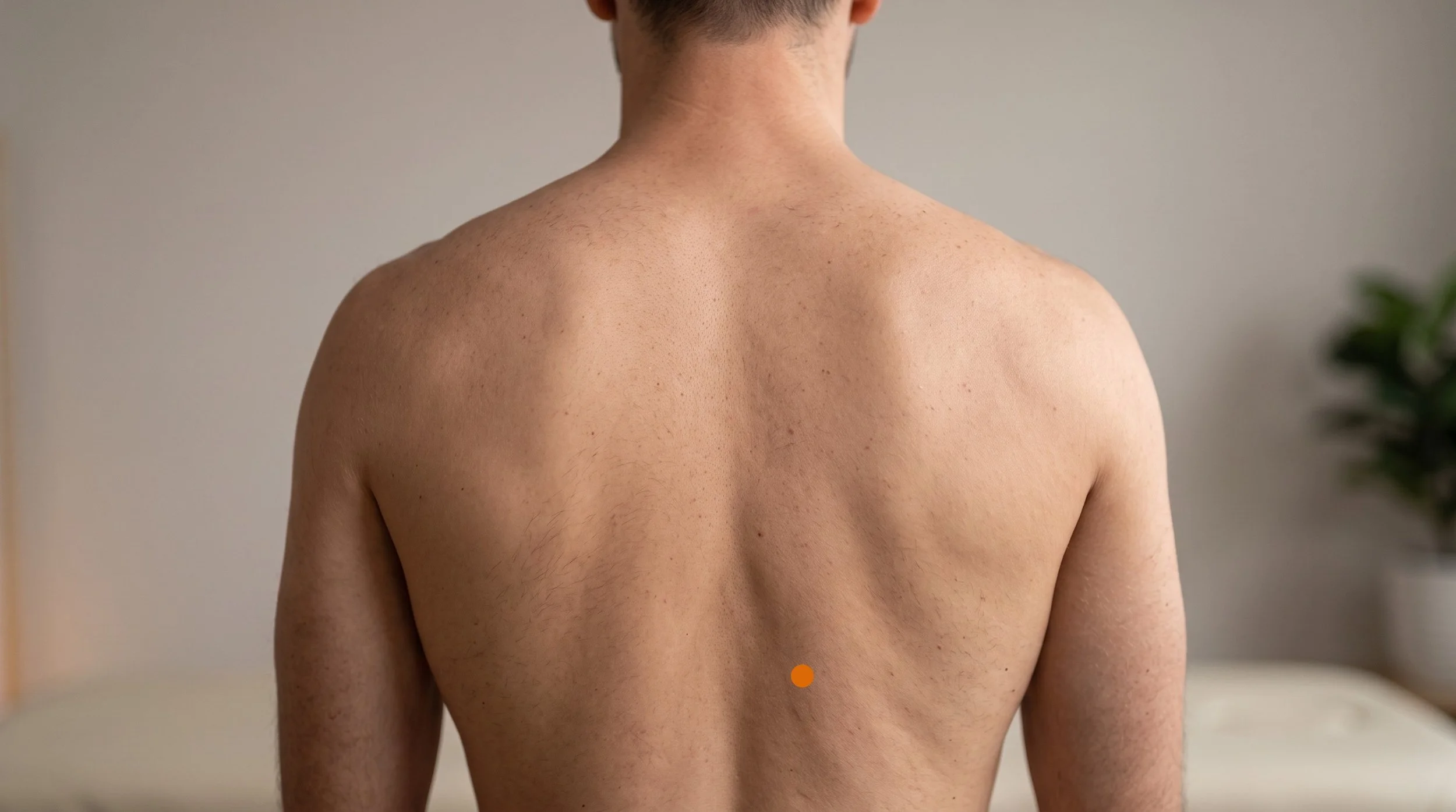
BL18 (Ganshu, often translated as Liver Shu or Liver Transport Point) is the eighteenth point of the Bladder channel and the back-shu point of the Liver. You can find it on the mid back, one and a half cun to either side of the lower edge of the ninth thoracic spinous process, level with GV8, sitting right on the visible ridge of the paraspinal muscles.
Clinically it matters for two overlapping reasons: it is a dense, reliably tender segment of thoracic paraspinal tissue that patients feel as a band of tightness under the lower shoulder blades, and it lies in a spinal segment whose sensory territory overlaps with upper abdominal and hepatobiliary input, which is the modern way of understanding why classical texts assigned this level such broad internal significance.
In our clinic the bl18 acupuncture point shows up most often in treatment plans for rib-side and mid-back tension, stress-pattern holding through the thoracic spine, and eye strain in people who spend long days on screens.
- Location and layers: bladder 18 sits 1.5 cun lateral to the lower border of the T9 spinous process, level with GV8, at the highest point of the paraspinal mass. A needle angled medially passes through skin and thoracolumbar fascia, the aponeurotic sheet of latissimus dorsi and lower trapezius, then into iliocostalis and longissimus, with multifidus and rotatores deeper against the lamina.
- Traditional framing: A Manual of Acupuncture lists BL18 as the back-shu point of the Liver, with traditional actions of spreading Liver qi, regulating and nourishing Liver blood, pacifying wind, clearing heat and damp-heat, and benefiting the eyes and sinews. We present those as historical attributions rather than physiology, and we read the underlying pattern as segmental input at a level whose afferents converge with upper abdominal and hepatobiliary territory (Ma, 2020).
- Mechanism: needling here recruits the medial and lateral branches of the T9 dorsal ramus and the deep muscle and fascial afferents they supply, feeding into a dorsal horn segment that also receives visceral input traveling with the greater splanchnic nerve. Repetitive small-fiber input from acupuncture also engages descending inhibitory control through brainstem serotonergic and noradrenergic pathways and endogenous opioid release (Zhao, 2008), and somatic stimulation can shift autonomic balance measurably (Hamvas et al., 2023).
- Research picture: BL18 rarely gets tested alone. It was the most frequently prescribed point across randomized trials pooled in a meta-analysis of acupuncture for nonalcoholic fatty liver disease (Chen et al., 2021), it appears in dry eye protocols reviewed for optimal point selection (Park et al., 2023), and its analgesic use sits inside the broader chronic pain evidence base (Vickers et al., 2018). Animal work using electroacupuncture at BL18 with GB34 has reported reduced markers of hepatic ischemia-reperfusion injury, which is suggestive but not directly transferable to people (Tan et al., 2020).
- Clinical practice: this is a thoracic point over the pleura, so direction matters more than depth. Oblique insertion toward the spine, or a shallow transverse-oblique angle, is the convention; perpendicular needling and any angle away from the spine carry real pneumothorax risk, and pneumothorax remains the most commonly reported serious adverse event in acupuncture safety reviews (He et al., 2012).
- De qi at BL18 is usually described as a deep, heavy, slightly electric ache that spreads along the paraspinal band and sometimes wraps a short distance around the rib line. Patients often report a sudden softening of the mid back and a slower, deeper breath within a minute or two of the needle settling.
Stuck With Tightness Under Your Shoulder Blades That Stretching Never Fixes?
Mid-back tension at the T9 level is one of the most common complaints we see in people who sit, lift, or carry stress in their upper body. At Morningside Acupuncture we use BL18 with careful oblique needling, often alongside dry needling of the thoracic erector spinae and intercostals, to reduce guarding and restore rotation and rib motion. Treatment is paired with breathing and mobility cues so the change holds between visits. Schedule a session and let us assess your mid back directly.
Schedule NowAnatomy of BL18: Why the T9 Paraspinal Ridge Is Such an Important Location
At the T9 level the back is built in tidy sheets. Under thin skin and subcutaneous fat lies the thoracolumbar fascia, then the aponeurotic edges of the lower trapezius and latissimus dorsi, and beneath those the erector spinae column: iliocostalis laterally, longissimus forming the palpable ridge that the classical texts tell you to locate by eye, and multifidus and rotatores packed against the lamina and transverse processes. This is loaded tissue.
Long hours at a desk with a rounded thoracic spine, overhead lifting, rowing and pressing, carrying a bag on one shoulder, and even sustained bracing during stressful weeks all keep these segmental muscles working isometrically for hours at a time. That is why BL18 is so often tender to palpation before anyone has said a word about the liver, the eyes, or anything else.
The nerve geography is the interesting part. Sensation and motor supply here come from the medial and lateral branches of the T9 dorsal ramus, with the ventral ramus continuing forward as the ninth intercostal nerve toward the rib-side and upper abdominal wall. That same spinal segment receives visceral afferents traveling with the greater splanchnic nerve from the upper abdominal organs, so somatic and visceral inputs share dorsal horn real estate.
Modern reviews of somato-autonomic reflexes describe exactly this kind of segmental organization, where the body region stimulated, and the intensity used, determine which autonomic pathway responds (Ma, 2020). Needling also drives small-diameter afferents that recruit descending inhibition from the periaqueductal gray and rostral ventromedial medulla, along with endogenous opioid and monoamine mechanisms that reduce dorsal horn excitability (Zhao, 2008).
In plain terms, a needle in a tender T9 paraspinal band can turn down the sensitivity of a segment that has been amplifying signals from both muscle and viscera.
Deep to the muscles sit the ninth rib, the intercostal space, and the parietal pleura, along with the dorsal branches of the posterior intercostal arteries and veins. That anatomy dictates technique. The standard approach is oblique insertion angled toward the spine to a depth of about 0.5 to 1 cun, or a transverse-oblique insertion of 1 to 1.5 cun along the muscle plane. A Manual of Acupuncture is explicit that perpendicular needling, or oblique needling angled away from the spine, carries substantial pneumothorax risk.
Safety reviews of the acupuncture literature back that caution up, with pneumothorax repeatedly identified as the most frequent serious adverse event, almost always tied to angle and depth errors over the thorax (He et al., 2012). Practitioners also adjust for body type, since paraspinal thickness varies widely.
Related Back Shu Points Related Bladder ChannelBL18 at a Glance: Classification, Location, and Clinical Use
| Category | Detail |
|---|---|
| Traditional Name | Ganshu (Liver Shu, Liver Transport Point) |
| Channel Classification | Bladder channel, eighteenth point, inner Bladder line of the mid back (BL18, also written UB18; also called the Urinary Bladder channel) |
| Point Categories | Back-shu (Transport) point of the Liver; classically paired with LV14 Qimen as the shu and mu combination for the Liver; listed in the Illustrated Supplement to the Classic of Categories as one of five back-shu points said to drain heat from the five zang (with BL13, BL15, BL20, and BL23) |
| Precise Location | On the mid back, 1.5 cun lateral to the lower border of the T9 spinous process, level with GV8, located at the visible highest point of the paraspinal muscles |
| Tissue Stimulated | Thoracolumbar fascia, aponeuroses of lower trapezius and latissimus dorsi, iliocostalis and longissimus thoracis, multifidus and rotatores; adjacent to the intercostal muscles at the ninth rib level. See also acupuncture for tight muscles and trigger points. |
| Needle Depth / Direction | Oblique insertion angled toward the spine 0.5 to 1 cun, or transverse-oblique along the muscle plane 1 to 1.5 cun. Perpendicular needling, or oblique needling angled away from the spine, carries substantial pneumothorax risk and is avoided. |
| De Qi Sensation | Deep, heavy, spreading ache in the paraspinal band, sometimes with a brief wrap of sensation around the ribs and a noticeable release of holding on exhale |
| Primary Clinical Uses | Rib-side distention and pain, mid-back and lower shoulder-blade tension, stress-pattern tightness and irritability in classical Liver framing, eye strain and blurred vision in classical use, and supportive care in upper abdominal complaints |
| Common Point Combinations |
|
In the classical literature summarized by A Manual of Acupuncture, Ganshu is the back-shu point through which the qi of the Liver is said to surface on the back, and the commentary treats it as the point that regulates every function traditionally assigned to that organ: the free movement of qi, the storage of blood, the health of the sinews, and the clarity of the eyes. The recorded indication lists cluster into a few recognizable groups.
There are distention and pain complaints along the ribs, epigastrium, and lower abdomen; chest and breathing complaints when Liver patterns were thought to disturb the Lung; emotional presentations described as much anger and mania-depression; bleeding upward such as nosebleed and vomiting of blood, understood as heat driving blood in the wrong direction; a long list of eye disorders from blurred vision and night blindness to redness and itching; and stiffness, cramping, and spasm of the neck, spine, and sinews.
Maciocia notes the same organ-to-sense-organ logic in the back-shu series, with BL18 assigned to the eyes. What makes the classical picture striking is not any single indication but the consistency of the through-line: one point at one spinal level was used to account for tension, emotion, bleeding, and vision, a grouping that looks far less arbitrary once you notice how much sensory territory converges at that segment.
Why BL18 Is Used for Eye Strain and Screen Fatigue
Patients are often surprised that a point on the mid back is chosen for tired, blurry, gritty eyes. The classical reasoning is straightforward on its own terms: the Liver was said to open into the eyes and to supply them with blood, so its back-shu point was used for visual complaints. The physiological reasoning is different but not unrelated. Long screen sessions come packaged with a sustained posture, a forward head, a braced thoracic spine, and shallow breathing, which loads exactly the paraspinal and intercostal tissue where BL18 sits.
Reducing that segmental muscle nociception changes the overall input arriving at the spinal cord and brainstem, which is where headache, eye ache, and neck tension often blur together.
Beyond local muscle effects, needling recruits descending inhibitory pathways that reduce how strongly the central nervous system amplifies incoming signals, mediated in part by endogenous opioids and monoamine systems (Zhao, 2008). Somatic stimulation also shifts autonomic balance, and a systematic review of heart rate variability studies found that acupuncture was associated with increased parasympathetic indices compared with sham (Hamvas et al., 2023).
Lacrimal secretion, pupillary tone, and ocular surface comfort are all autonomically influenced, so an autonomic route is plausible, though it has not been demonstrated specifically for BL18 in humans.
The honest summary is that eye complaints are treated with multi-point protocols in which BL18 is a supporting distal or segmental choice, not a stand-alone remedy. A meta-analysis examining which points matter most in dry eye trials found that outcomes improved as protocols included more of a specific set of points, and that treatment frequency and course length mattered too (Park et al., 2023). We use BL18 in eye-strain cases as part of a plan that also addresses the neck, the suboccipitals, and screen habits, and we set expectations accordingly.
What the Research Shows for BL18
Research on BL18 has the same limitation as research on nearly every individual acupuncture point: trials test protocols, not points. What we can say is where BL18 shows up, how often, and what the pooled results of those protocols look like, while being clear that no study has isolated this point's contribution in humans. The evidence below is a mix of pooled clinical reviews, mechanism reviews, and one animal study that stimulated BL18 directly.
| Study | Type | Focus | Key Finding |
|---|---|---|---|
| Chen et al., 2021 | Systematic review and meta-analysis of randomized trials | Acupuncture for nonalcoholic fatty liver disease | Pooled trials reported improvements in clinical efficacy and liver enzyme measures, with BL18 the most frequently selected point across protocols, though the included studies were of variable methodological quality. |
| Park et al., 2023 | Meta-analysis and systematic review | Point selection and protocol design in acupuncture for dry eye syndrome | Improvements in tear film breakup time and Schirmer scores tracked with the number of specific points used and with treatment frequency, suggesting protocol design may matter more than any single point. |
| Hamvas et al., 2023 | Systematic review and meta-analysis | Acupuncture and heart rate variability | Verum acupuncture was associated with significant changes in parasympathetic HRV indices while sham was not, supporting an autonomic effect that is relevant to stress-pattern presentations. |
| Ma, 2020 | Narrative mechanism review | Somato-autonomic reflexes and acupoint location | Reviews evidence that the body region stimulated and the stimulation intensity determine which autonomic pathway is recruited, which offers a segmental rationale for back-shu point selection. |
| Zhao, 2008 | Neurophysiology review | Neural mechanisms of acupuncture analgesia | Summarizes how acupuncture activates small-diameter afferents and engages spinal and supraspinal inhibitory circuits, including opioid and monoamine mediated pathways. |
| Vickers et al., 2018 | Individual patient data meta-analysis | Acupuncture for chronic musculoskeletal, headache, and osteoarthritis pain | Acupuncture was superior to both sham and no-acupuncture controls for chronic pain, with effects that persisted over time, though differences from sham were modest. |
| Tan et al., 2020 | Controlled animal experiment | Electroacupuncture at BL18 with GB34 in a rat model of hepatic ischemia-reperfusion injury | Point-specific stimulation reduced serum transaminases and inflammatory markers compared with non-point stimulation, which is mechanistically interesting but does not establish clinical benefit in people. |
| He et al., 2012 | Systematic review of adverse event reports | Safety of acupuncture in the Chinese literature | Pneumothorax was among the most frequently reported serious adverse events, reinforcing why thoracic points like BL18 are needled obliquely toward the spine rather than perpendicularly. |
Feeling the Stress in Your Ribs, Jaw, and Breathing?
Ganshu is one of the points we return to when patients describe irritability, a tight band across the lower ribs, and shallow breathing that never quite resets. Studies suggest acupuncture may shift autonomic balance toward parasympathetic tone, and clinically we combine BL18 with distal points such as LV3 and ST36 to support that calmer state. Sessions are quiet, unhurried, and built around what your nervous system is actually doing that week. Book an appointment to start.
Schedule NowBL18 in the Context of Trigger Point Work
The ganshu point location overlaps almost perfectly with a region clinicians already treat for myofascial pain. Trigger points in the thoracic portions of iliocostalis and longissimus refer pain up and down the back and sometimes forward around the ribs, and deeper multifidus and rotatores points at a given level tend to produce sharply localized midline soreness plus a band of stiffness (Simons et al., 1999).
Latissimus dorsi and the lower fibers of trapezius add their own contributions to the same neighborhood, and the intercostals just lateral to the point can reproduce a rib-side ache that patients describe as a catch when they breathe deeply. When someone points to BL18 and says the tightness lives right there, the muscular and the classical map are describing the same tissue.
At Morningside we treat that overlap deliberately. A typical session might combine BL18 needled obliquely toward the spine with dry needling of the thoracic erector spinae at neighboring levels, careful flat needling of the intercostals when rib-side pain is part of the picture, and distal points such as LV3 or GB34 when the presentation includes stress-pattern tension rather than pure mechanical loading. Because every one of these targets sits over the ribcage, angle discipline is the priority: flat or medially angled insertions, conservative depth, and constant attention to body type. Manual therapy, thoracic rotation drills, and breathing work usually follow the needles so the segment stays quiet between visits.
BL18 Mid-Back and Stress Tension Treatment at NYC's Highest-Rated Acupuncture Clinic
Morningside Acupuncture is the highest-rated acupuncture and dry needling clinic in New York City with over 500 five-star Google reviews. Our licensed acupuncturists treat the bl18 acupuncture point as part of a full assessment of your thoracic spine, ribs, breathing mechanics, and stress load rather than a fixed recipe. Every treatment is delivered with clean needle technique and conservative thoracic angling for safety. Schedule your visit and see what a focused, evidence-informed session feels like.
Schedule NowFrequently Asked Questions
What does BL18 feel like when needled?
Most people feel a dull, heavy, spreading ache right under the needle, sometimes with a mild electric quality that travels a short distance along the paraspinal band or around toward the ribs. That sensation is called de qi and it usually arrives within a few seconds of gentle manipulation. Because the point is angled toward the spine, the sensation stays fairly local rather than shooting outward. Many patients notice their breathing deepen and their mid back soften once the needle has been in place for a minute or two, and mild residual soreness the next day is common and short lived.
Why treat a back point for rib-side pain or eye strain instead of the area that hurts?
Two reasons. First, the T9 segment supplies both the paraspinal muscles you can palpate and, through the ventral ramus, the ninth intercostal nerve that runs forward toward the rib-side and upper abdominal wall, so reducing sensitivity at the segment can change how the whole band feels. Second, that same spinal level receives visceral afferents traveling with the greater splanchnic nerve, which is the convergence that modern somato-autonomic reviews describe (Ma, 2020). For eye strain, the classical rationale is the Liver opening into the eyes, while the practical rationale is that thoracic posture, breathing, and neck tension typically travel together with screen fatigue.
Can I press BL18 myself between sessions?
You can, though reaching it is awkward. Find the lower shoulder blade level, then trace about two finger widths out from the midline of the spine onto the muscle ridge and hunt for the tender spot. The easiest self-treatment is to lie on the floor with a tennis or lacrosse ball placed under that ridge, never on the bony spine itself, and let your body weight sink in for 30 to 60 seconds per side while breathing slowly. You can repeat two or three rounds, once or twice a day. Pressure should feel like a satisfying ache at roughly 4 to 6 out of 10, not sharp pain. Stop if you feel any radiating pain, numbness, or shortness of breath. Acupressure is a reasonable maintenance tool and is not a substitute for assessment if symptoms are persistent.
Is BL18 safe to needle?
In trained hands, yes, but the technique is not casual. BL18 sits over the ninth rib and the pleura, so the standard is oblique insertion toward the spine to about 0.5 to 1 cun, or a shallow transverse-oblique angle along the muscle. Perpendicular needling and any angle directed away from the spine are avoided because of pneumothorax risk, and safety reviews consistently find pneumothorax to be the most reported serious adverse event in acupuncture, usually the result of angle or depth error over the thorax (He et al., 2012). Practitioners also adjust depth for body composition, use single-use sterile needles, and take extra care with patients who are very lean, who have lung disease, or who are on anticoagulants.
Where exactly is BL18 located?
Locate the T9 spinous process, then move 1.5 cun (about two finger widths) directly lateral to its lower border. The point is level with GV8 (Jinsuo) and sits on the crest of the erector spinae rather than in the groove beside the spine. A practical way to find T9 is to identify the inferior angles of the shoulder blades, which usually sit around T7, then count down two more spinous processes with the arms relaxed at the sides. Confirm by palpation: the correct spot is typically the most prominent and tender part of the paraspinal ridge at that level, and it is needled bilaterally in most treatments.
References
- Deadman, P., Al-Khafaji, M., & Baker, K. (2009). A manual of acupuncture. Journal of Chinese Medicine Publications.
- Maciocia, G. (2005). The foundations of Chinese medicine: A comprehensive text for acupuncturists and herbalists (2nd ed.). Elsevier Churchill Livingstone.
- Simons, D. G., Travell, J. G., & Simons, L. S. (1999). Travell & Simons' myofascial pain and dysfunction: The trigger point manual, Vol. 1: Upper half of body (2nd ed.). Williams & Wilkins.
- Zhao, Z. Q. (2008). Neural mechanism underlying acupuncture analgesia. Progress in Neurobiology, 85(4), 355-375. https://doi.org/10.1016/j.pneurobio.2008.05.004
- Vickers, A. J., Vertosick, E. A., Lewith, G., MacPherson, H., Foster, N. E., Sherman, K. J., Irnich, D., Witt, C. M., & Linde, K. (2018). Acupuncture for chronic pain: Update of an individual patient data meta-analysis. Journal of Pain, 19(5), 455-474. https://doi.org/10.1016/j.jpain.2017.11.005
- Ma, Q. (2020). Somato-autonomic reflexes of acupuncture. Medical Acupuncture, 32(6), 362-366. https://doi.org/10.1089/acu.2020.1488
- Hamvas, S., Hegyi, P., Kiss, S., Lohner, S., McQueen, D., & Havasi, M. (2023). Acupuncture increases parasympathetic tone, modulating HRV: Systematic review and meta-analysis. Complementary Therapies in Medicine, 72, 102905. https://doi.org/10.1016/j.ctim.2022.102905
- Chen, P., Zhong, X., Dai, Y., Tan, M., Zhang, G., Ke, X., Huang, K., & Zhou, Z. (2021). The efficacy and safety of acupuncture in nonalcoholic fatty liver disease: A systematic review and meta-analysis of randomized controlled trials. Medicine (Baltimore), 100(38), e27050. https://doi.org/10.1097/MD.0000000000027050
- Park, J. G., Lee, B. H., Na, J. H., Jung, J. H., & Song, C. H. (2023). Optimal acupuncture protocol improving symptoms of typical dry eye syndrome: Meta-analysis and systematic review. Heliyon, 9(7), e18226. https://doi.org/10.1016/j.heliyon.2023.e18226
- Tan, S. Y., Huang, J., Su, Y. Y., Chen, W. Y., Kong, G. Y., Liu, J. S., & Wei, L. (2020). Electroacupuncture at Ganshu (BL18) and Yanglingquan (GB34) alleviates hepatic ischemia-reperfusion injury by inhibiting translocation and release of high mobility group protein 1 in rats. Zhen Ci Yan Jiu (Acupuncture Research), 45(11), 888-894. https://doi.org/10.13702/j.1000-0607.200374
- He, W., Zhao, X., Li, Y., Xi, Q., & Guo, Y. (2012). Adverse events following acupuncture: A systematic review of the Chinese literature for the years 1956-2010. Journal of Alternative and Complementary Medicine, 18(10), 892-901. https://doi.org/10.1089/acm.2011.0825
Disclaimer: This web site is intended for educational and informational purposes only. Reading this website does not constitute providing medical advice or any professional services. This information should not be used for diagnosing or treating any health issue or disease. Those seeking medical advice should consult with a licensed physician. Seek the advice of a medical doctor or other qualified health professional for any medical condition. If you think you have a medical emergency, call 911 or go to the emergency room. No acupuncturist-patient relationship is created by reading this website or using the information. Morningside Acupuncture PLLC and its employees and contributors do not make any express or implied representations with respect to the information on this site or its use. For any legal interpretation of scope of practice in your state, consult a licensed attorney or regulatory authority.
Read more from our blog