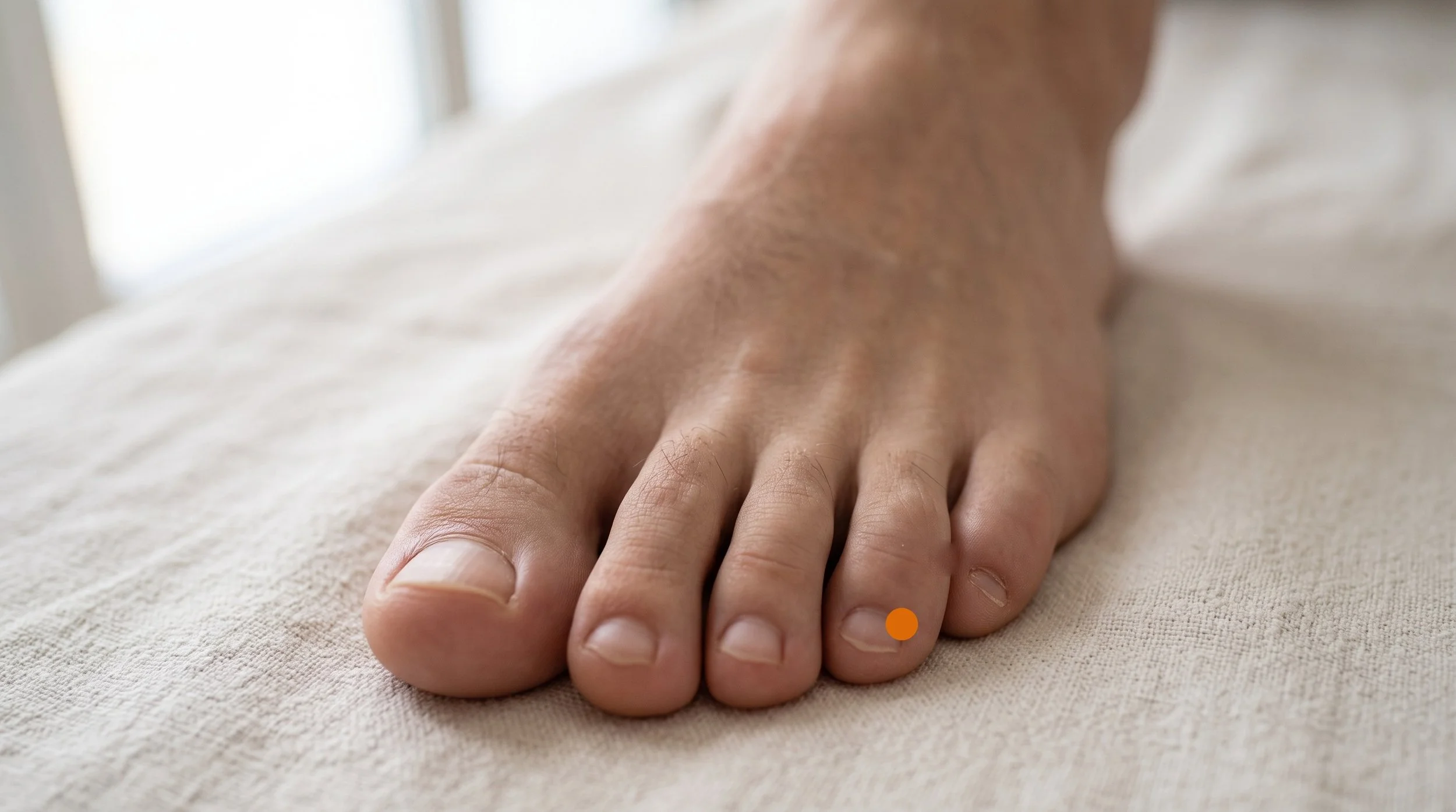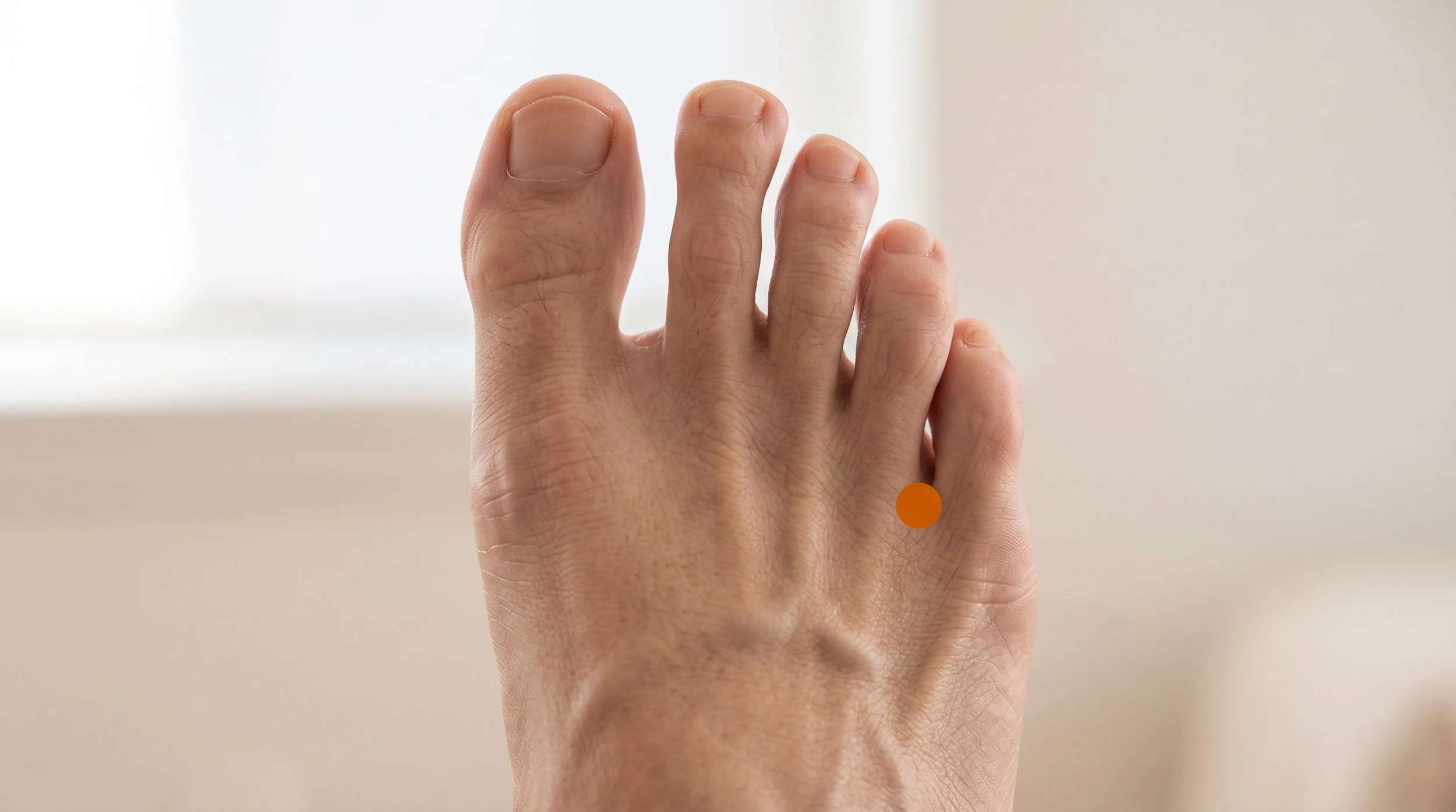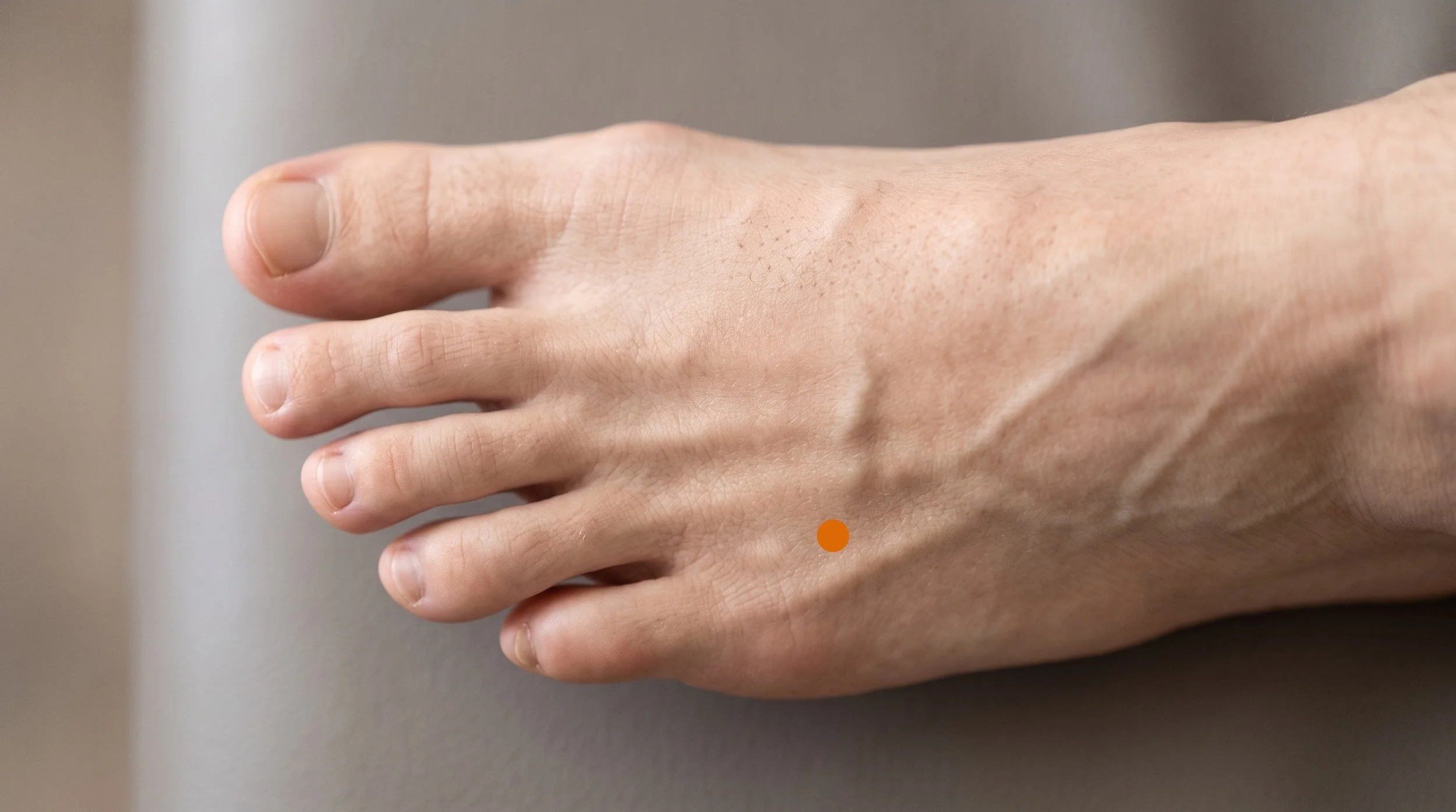
BL19 Acupuncture Point (Danshu)
The Gallbladder Transport Point at T10: Anatomy, Segmental Mechanism, and Why This Mid-Back Point Bridges Rib-Side Pain, Digestion, and Restless Sleep
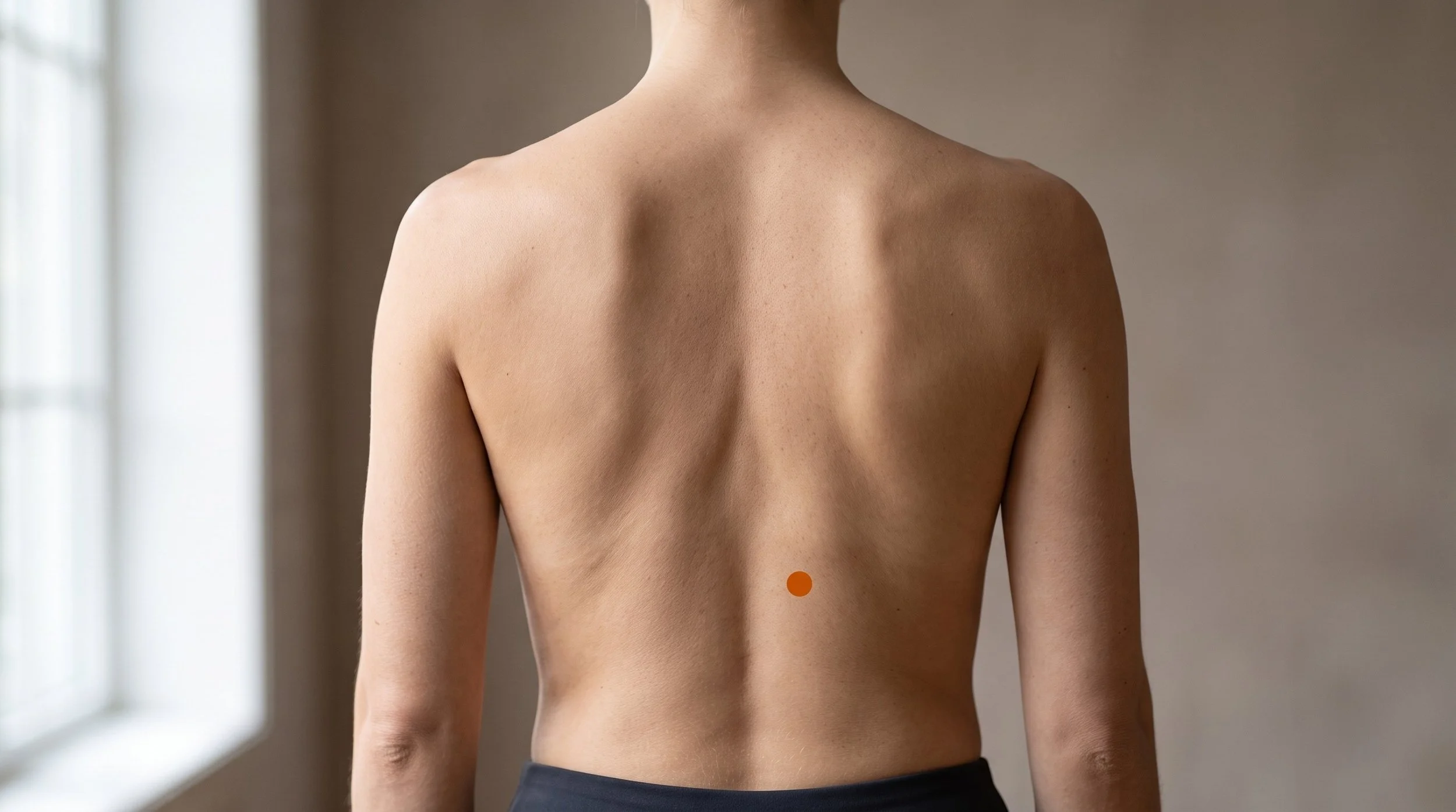
BL19, known as Danshu (Gallbladder Shu), is the back-shu or back transport point of the Gallbladder, and it sits on the mid back 1.5 cun lateral to the lower border of the tenth thoracic spinous process, level with GV7, right over the visible crest of the paraspinal muscles (Deadman et al.).
In plain terms, if you slide your fingers down the ridge of muscle beside the spine to roughly the level where the lower ribs begin to angle forward, you are in the neighborhood of the bl19 acupuncture point. Clinically it matters for two reasons.
First, it is a soft tissue point in a band of thoracic paraspinal muscle that patients commonly load with desk posture, breath-holding, and stress, so it is often tender to palpation. Second, that same T10 segment shares spinal processing with afferent traffic from the upper abdominal and biliary territory, which is the neurophysiological reason a mid-back point has traditionally been used for rib-side distention, a bitter taste in the mouth, nausea, and restless sleep in classical gallbladder-pattern presentations.
- Location and layers: bladder 19 lies 1.5 cun lateral to the T10 spinous process at the highest visible point of the paraspinal muscles, level with GV7, so the needle passes skin and subcutaneous tissue into thoracolumbar fascia and the erector spinae and multifidus layer (Deadman et al.).
- Traditional categories, translated: classical texts describe BL19 as the back-shu point of the Gallbladder, traditionally credited with clearing damp-heat from the Liver and Gallbladder, resolving shaoyang patterns, and regulating Gallbladder qi (Deadman et al.; Kim). Read neurophysiologically, that is a description of a paraspinal point in the segmental band that shares dorsal horn processing with upper abdominal and biliary afferents (Uchida et al., 2017).
- Mechanism: needling here stimulates the T10 dorsal ramus territory and deeper muscle afferents, and somatic input at trunk segments has been shown to modulate visceral function through somatoautonomic reflex pathways (Uchida et al., 2017). Animal work using manual and electroacupuncture at trunk and limb points documented measurable, bidirectional changes in gallbladder pressure and sphincter of Oddi activity, effects the authors attributed to autonomic reflexes and somatovisceral interactions (Zhao et al., 2017).
- Pain modulation: like other segmentally chosen points, BL19 is thought to work partly through local muscle effects and partly through descending inhibitory pathways involving endogenous opioid and monoaminergic systems (Zhao, 2008), the same broad mechanisms invoked in pooled chronic pain data (Vickers et al., 2018).
- Research picture: no high-quality trial isolates BL 19 Gallbladder Shu on its own. It appears inside multi-point protocols, so the honest read is that reviews of acupuncture for chronic pain, functional dyspepsia, and insomnia support the approach rather than the single point (Vickers et al., 2018; Li et al., 2026; Kim et al., 2021).
- De qi and safety: patients usually report a dull, spreading heaviness that can travel toward the lower ribs rather than a sharp sting. Because pleura sits deep to this region, BL19 is needled obliquely toward the spine or transverse-obliquely, never perpendicular or angled away from the midline (Deadman et al.), and large prospective safety data confirm that serious events are rare when trained clinicians observe these conventions (Witt et al., 2009).
Tight Mid Back and Rib-Side Discomfort That Will Not Let Go?
Mid-back tension at the lower shoulder-blade level rarely comes from one muscle, and it often travels with shallow breathing, upper abdominal tightness, and stress. At Morningside Acupuncture we combine safe oblique needling at BL19 with dry needling of the thoracic paraspinals and careful assessment of rib and breathing mechanics. Treatment is tailored to what your tissue actually does under palpation, not to a generic protocol. Schedule a visit and let us map where your mid-back tension is really coming from.
Schedule NowAnatomy of BL19: Why the T10 Paraspinal Band Is Such an Important Location
The danshu point location puts the needle over the thickest visible ridge of the erector spinae at the tenth thoracic level. From the surface down, you pass through skin and subcutaneous fat, then the thoracolumbar fascia, then longissimus and iliocostalis fibers, with the deeper multifidus filling the groove closer to the lamina (Deadman et al.). This band works constantly during sitting, forward reaching, twisting, and loaded breathing, and it commonly develops taut, tender areas in people who spend long hours at a keyboard or who brace the trunk during stress. Palpation at this level often reproduces a familiar, dull ache before a needle ever goes in.
The nerve geography is what makes this location interesting. Cutaneous and muscular tissue here is supplied by the dorsal ramus of the T10 spinal nerve, while visceral afferents from the upper abdominal and biliary territory travel with splanchnic nerves into roughly the same mid to lower thoracic segments. When somatic and visceral inputs converge on shared dorsal horn neurons, stimulation of the body wall can influence autonomic output to those organs, a reflex arrangement documented across decades of experimental work (Uchida et al., 2017).
Studies applying manual and electroacupuncture in the trunk have recorded changes in gallbladder pressure and sphincter of Oddi motility, with the authors describing bidirectional effects mediated by autonomic reflexes rather than by any single organ-specific pathway (Zhao et al., 2017). Layered on top of that segmental story is a broader analgesic response involving descending inhibition and endogenous opioid signaling (Zhao, 2008).
Safety governs technique here. The pleura and lung lie deep to the paraspinal muscles in the thoracic region, so classical guidance is explicit: needle BL19 obliquely toward the spine 0.5 to 1 cun, or transverse-obliquely 1 to 1.5 cun, because perpendicular needling or oblique needling angled away from the spine carries a substantial pneumothorax risk (Deadman et al.).
In practice, that means a shallow, medially directed insertion along the muscle belly, with depth adjusted for body size rather than a fixed number. Large prospective observational data show that serious adverse events from acupuncture are uncommon when trained practitioners work this way, with minor bruising and transient soreness far more typical (Witt et al., 2009).
Related Back Shu Points Related Bladder ChannelBL19 at a Glance: Classification, Location, and Clinical Use
| Category | Detail |
|---|---|
| Traditional Name | Danshu (Gallbladder Shu), Bladder 19, BL-19 |
| Channel Classification | Bladder channel, inner (medial) bladder line of the upper back (BL19, also written UB19; also called the Urinary Bladder channel) |
| Point Categories | Back-shu (back transport) point of the Gallbladder; one of the Four Flowers moxibustion pair together with BL17; classically paired with GB24 as the shu and mu combination for the Gallbladder (Deadman et al.) |
| Precise Location | On the mid back, 1.5 cun lateral to the lower border of the T10 spinous process, at the visible highest point of the paraspinal muscles, level with GV7 |
| Tissue Stimulated | Thoracolumbar fascia and the T10 erector spinae and multifidus, adjacent to targets addressed in intercostal muscles trigger point work and to the mid-back patterns covered in the upper back and shoulder pain finder |
| Needle Depth / Direction | Oblique insertion toward the spine 0.5 to 1 cun, or transverse-oblique 1 to 1.5 cun. Never perpendicular and never angled away from the spine, because of pneumothorax risk (Deadman et al.) |
| De Qi Sensation | A dull, heavy, spreading ache in the paraspinal muscle, sometimes with a band-like sensation toward the lower ribs and a brief muscle twitch if a taut band is engaged |
| Primary Clinical Uses | Rib-side distention and discomfort, mid-back tension at the lower shoulder-blade level, nausea and upper abdominal fullness in gallbladder-pattern framing, bitter taste with dry mouth as traditionally described, and restless sleep with fright palpitations in classical use |
| Common Point Combinations |
|
In A Manual of Acupuncture, Deadman and colleagues present Danshu as the point where the qi of the Gallbladder is traditionally said to surface on the back, and the actions attributed to it follow from that idea: clearing damp-heat from the Liver and Gallbladder, resolving pathogenic factors lodged at the shaoyang level, supporting Gallbladder qi, and treating depletion. The classical indication list is wide, and it groups into three clusters.
The first is a biliary-pattern cluster of jaundice, yellowing of the eyes, a bitter taste with a dry tongue, rib-side distention with difficulty turning, and nausea or dry retching. The second is a spirit cluster of fright palpitations, restless sleep, and insomnia, which the classics tie to the old idea of the Gallbladder as the organ of decisiveness, injured by shock or sustained fear, and only vulnerable when Heart qi is also weak.
The third is a depletion cluster of tidal fever, steaming bone taxation, throat dryness, and chills without sweating, which is where the Four Flowers moxibustion pairing with BL17 belongs. What is striking, from a modern vantage point, is how neatly that first cluster maps onto the mid-thoracic segments that carry biliary and upper abdominal afferent traffic, long before anyone could describe a dorsal horn.
Why BL19 Is Used for Restless Sleep and Stress-Driven Digestive Tension
The first half of the answer is segmental. Sensory nerves supplying the skin and muscle at T10 enter the spinal cord at the same levels that receive afferent traffic from the upper abdominal viscera, including the biliary territory. Because those inputs converge on shared spinal neurons, a tender mid-back band can be part of the picture in upper abdominal complaints, and stimulating that band can influence autonomic outflow back to the region.
Experimental work on somatoautonomic reflexes has mapped these pathways in detail, showing that somatic stimulation reliably changes visceral function through spinal and supraspinal reflex arcs (Uchida et al., 2017). Acupuncture research specific to the biliary system has recorded measurable changes in gallbladder pressure and sphincter of Oddi activity after needling, with direction of effect depending on where the stimulus was applied (Zhao et al., 2017). That is a modest but real physiological signal, and it is animal work, so it should be read as mechanism rather than as proof of clinical benefit.
The second half is about the nervous system as a whole. Needling produces a wider response than a local twitch: it recruits descending inhibitory pathways that dampen pain signaling using endogenous opioids, serotonin, and norepinephrine (Zhao, 2008). Patients often notice this as a settling, heavy-limbed calm during the session, which is one reason points on the mid back get used when tension, disturbed digestion, and poor sleep are tangled together.
Reviews of acupuncture for insomnia report improvements in sleep quality measures compared with control conditions, though the trials vary in quality and use multi-point prescriptions (Kim et al., 2021).
Finally, there is the plainly musculoskeletal explanation, and it should not be dismissed. The paraspinals at T10 can develop taut bands that refer discomfort around the flank and lower ribs, a pattern well described in the trigger point literature (Simons et al., 1999). For some patients, what feels like a deep internal ache is largely a body wall problem, and treating the muscle directly is what changes the symptom.
What the Research Shows for BL19
It is worth being direct about the evidence base. There is no clinical trial that isolates the effect of BL19 by itself, and there almost certainly never will be, because acupuncture is delivered as a combination of points chosen for the individual patient. What the literature offers instead is evidence for the broader approach in conditions where BL19 is commonly part of the prescription, plus mechanistic studies that make the point's traditional use physiologically plausible. Read the table below as context, not as proof that one needle at T10 does any of these things on its own.
| Study | Type | Focus | Key Finding |
|---|---|---|---|
| Vickers et al., 2018 | Individual patient data meta-analysis | Acupuncture for chronic musculoskeletal, headache, and osteoarthritis pain | Acupuncture was associated with modest but statistically significant benefits over both sham and no-acupuncture controls, with effects persisting over time. |
| Zhao et al., 2017 | Controlled animal study (guinea pigs) | Manual and electroacupuncture effects on gallbladder pressure and sphincter of Oddi motility | Needling produced measurable, direction-dependent changes in biliary motility that the authors attributed to autonomic reflex and somatovisceral interactions. |
| Uchida et al., 2017 | Narrative review of experimental physiology | Somatoautonomic reflex pathways underlying acupuncture effects on visceral function | Somatic stimulation can alter visceral and autonomic activity through segmental and supraspinal reflexes, though animal findings do not always translate directly to conscious patients. |
| Li et al., 2026 | Systematic review and meta-analysis of RCTs | Acupuncture for functional dyspepsia | Compared with sham, acupuncture probably improved symptom and quality of life scores without an increase in adverse events, with high to moderate certainty on the main outcomes. |
| Kim et al., 2021 | Systematic review and meta-analysis of RCTs | Acupuncture for insomnia | Pooled results suggested improvements in sleep quality measures, though methodological limitations across the included trials temper confidence. |
| Witt et al., 2009 | Prospective observational safety study (229,230 patients) | Adverse events across routine acupuncture practice | Most reported events were minor, such as bruising or transient pain, and serious events including pneumothorax were rare in trained hands. |
| Zhao, 2008 | Mechanistic review | Neural mechanisms of acupuncture analgesia | Analgesic effects are attributed to peripheral, spinal, and descending inhibitory mechanisms involving opioid and monoaminergic signaling. |
Stress, Digestion, and Sleep That Keep Feeding Each Other?
Many patients describe the same loop: a stressful stretch of work, a churning stomach, a tight rib cage, then broken sleep. Morningside clinicians use BL19 alongside points such as ST36, PC6, and LV3 to address both the muscular tension and the autonomic side of that loop. We explain what the evidence supports and what it does not, so your expectations stay realistic. Book an appointment and we will build a plan around your pattern.
Schedule NowBL19 in the Context of Trigger Point Work
Because BL19 sits directly over the T10 erector spinae, it frequently overlaps with myofascial targets we would treat anyway. Taut bands in longissimus, iliocostalis, and the deeper multifidus at this level can produce a local, poorly localized mid-back ache that patients describe as sitting under or below the shoulder blade, and referral can wrap toward the flank (Simons et al., 1999).
At Morningside, when palpation at the danshu point location reproduces a patient's familiar symptom, we treat it as a myofascial finding first and let the classical designation inform, rather than dictate, the plan.
In practice, that often means combining shallow oblique needling at BL19 with dry needling of the thoracic paraspinals, and, when breathing mechanics or rib-side pain are involved, careful work at the intercostals and the lower trapezius and rhomboid region. The needling technique in the thoracic spine stays medially angled and conservative regardless of whether we are calling the target a point or a muscle, because the anatomy does not change based on terminology. We then pair the session with breathing work and simple thoracic mobility drills so the tissue is not simply reloaded the next day.
BL19 Mid-Back and Digestive Tension Treatment at NYC's Highest-Rated Acupuncture Clinic
Morningside Acupuncture is the highest-rated acupuncture and dry needling clinic in New York City with over 500 five-star Google reviews. Our licensed acupuncturists treat the T10 region with the angled, shallow technique this area requires, and we combine point-based work with trigger point needling, movement advice, and breathing retraining. Every session begins with a clear explanation of what we are doing and why. Schedule your appointment today and start with a proper assessment.
Schedule NowFrequently Asked Questions
What does BL19 feel like when needled?
Most patients feel a dull, heavy, slightly spreading ache in the muscle beside the spine, sometimes with a sense of pressure traveling toward the lower ribs. Because the insertion is oblique and fairly shallow, the sensation is usually mild. If a taut band is engaged, you may feel a brief involuntary twitch followed by a release, and mild soreness for a day afterward is normal.
Why treat the mid back for symptoms that feel like they come from the abdomen?
Sensory nerves from the T10 body wall and from upper abdominal structures feed into overlapping segments of the spinal cord, so somatic stimulation at this level can influence autonomic output to that region through reflex pathways (Uchida et al., 2017). That is the modern explanation for why classical texts placed the Gallbladder's back transport point here. It is also why a genuinely tender mid-back band is worth treating in its own right, since some of the discomfort may be muscular rather than visceral (Simons et al., 1999).
Can I press BL19 myself between sessions?
Acupressure at BL19 is safe and easy, since pressing cannot reach anything a needle could. Find the T10 spinous process by tracing down from the lower tip of the shoulder blade (roughly T7) about three vertebrae, then move about two finger widths out to the side onto the muscle ridge. Use a thumb, a knuckle, or lean against a tennis ball placed on a wall, and apply steady pressure that feels like a firm, tolerable ache rather than sharp pain. Hold for 30 to 60 seconds, breathe slowly, then repeat two or three times per side, once or twice a day. Stop if pressing produces sharp, radiating, or worsening pain, and check in with a clinician instead.
Is BL19 safe to needle?
In trained hands, yes, but it demands respect. The pleura and lung lie deep to the thoracic paraspinals, so BL19 is needled obliquely toward the spine or transverse-obliquely along the muscle, never perpendicularly and never angled away from the midline, because those angles carry a substantial pneumothorax risk (Deadman et al.). Depth is adjusted for body size. Large prospective safety data show that serious adverse events are rare in routine practice, with minor bruising and short-lived soreness being the common experiences (Witt et al., 2009). This is not a point for self-needling.
Where exactly is BL19 located?
BL19 is on the mid back, 1.5 cun (about two finger widths) lateral to the lower border of the T10 spinous process, level with GV7, sitting on the visible highest point of the paraspinal muscle ridge (Deadman et al.). Practically, locate the lower tip of the shoulder blade at approximately T7 with the arms relaxed, count down three spinous processes, then move laterally onto the muscle. BL18 sits one level above at T9 and BL20 one level below at T11, so the three are easy to confuse without careful counting.
References
- Deadman, P., Al-Khafaji, M., & Baker, K. (2009). A manual of acupuncture. Journal of Chinese Medicine Publications.
- Kim, H. (2008). Handbook of Oriental medicine (3rd ed.). Harmony & Balance Press.
- Maciocia, G. (2006). The channels of acupuncture: Clinical use of the secondary channels and eight extraordinary vessels. Churchill Livingstone Elsevier.
- Simons, D. G., Travell, J. G., & Simons, L. S. (1999). Travell & Simons' myofascial pain and dysfunction: The trigger point manual, Vol. 1: Upper half of body (2nd ed.). Williams & Wilkins.
- Zhao, Z. Q. (2008). Neural mechanism underlying acupuncture analgesia. Progress in Neurobiology, 85(4), 355-375. https://doi.org/10.1016/j.pneurobio.2008.05.004
- Vickers, A. J., Vertosick, E. A., Lewith, G., MacPherson, H., Foster, N. E., Sherman, K. J., Irnich, D., Witt, C. M., & Linde, K. (2018). Acupuncture for chronic pain: Update of an individual patient data meta-analysis. Journal of Pain, 19(5), 455-474. https://doi.org/10.1016/j.jpain.2017.11.005
- Zhao, J., Yu, Y., Luo, M., Li, L., & Rong, P. (2017). Bi-directional regulation of acupuncture on extrahepatic biliary system: An approach in guinea pigs. Scientific Reports, 7(1), 14066. https://doi.org/10.1038/s41598-017-14482-x
- Uchida, S., Kagitani, F., & Sato-Suzuki, I. (2017). Somatoautonomic reflexes in acupuncture therapy: A review. Autonomic Neuroscience, 203, 1-8. https://doi.org/10.1016/j.autneu.2016.11.001
- Li, X.-X., Hu, Z.-Y., Li, Z.-C., Tang, J., Liu, Y.-Y., Zeng, D.-H., Zhou, Q.-Q., Ma, W.-B., Lan, L., & Wang, L. (2026). Efficacy and safety of acupuncture for functional dyspepsia: An updated meta-analysis of randomized controlled trials. Frontiers in Medicine, 13, 1718632. https://doi.org/10.3389/fmed.2026.1718632
- Kim, S.-A., Lee, S.-H., Kim, J.-H., van den Noort, M., Bosch, P., Won, T., Yeo, S., & Lim, S. (2021). Efficacy of acupuncture for insomnia: A systematic review and meta-analysis. American Journal of Chinese Medicine, 49(5), 1135-1150. https://doi.org/10.1142/S0192415X21500543
- Witt, C. M., Pach, D., Brinkhaus, B., Wruck, K., Tag, B., Mank, S., & Willich, S. N. (2009). Safety of acupuncture: Results of a prospective observational study with 229,230 patients and introduction of a medical information and consent form. Forschende Komplementärmedizin, 16(2), 91-97. https://doi.org/10.1159/000209315
Disclaimer: This web site is intended for educational and informational purposes only. Reading this website does not constitute providing medical advice or any professional services. This information should not be used for diagnosing or treating any health issue or disease. Those seeking medical advice should consult with a licensed physician. Seek the advice of a medical doctor or other qualified health professional for any medical condition. If you think you have a medical emergency, call 911 or go to the emergency room. No acupuncturist-patient relationship is created by reading this website or using the information. Morningside Acupuncture PLLC and its employees and contributors do not make any express or implied representations with respect to the information on this site or its use. For any legal interpretation of scope of practice in your state, consult a licensed attorney or regulatory authority.
Read more from our blog