BL16 Acupuncture Point (Dushu)
The Governor Shu at the Sixth Thoracic Level: Anatomy, Segmental Mechanism, and Why This Quiet Mid-Back Point Shows Up in Skin and Thoracic Tension Protocols
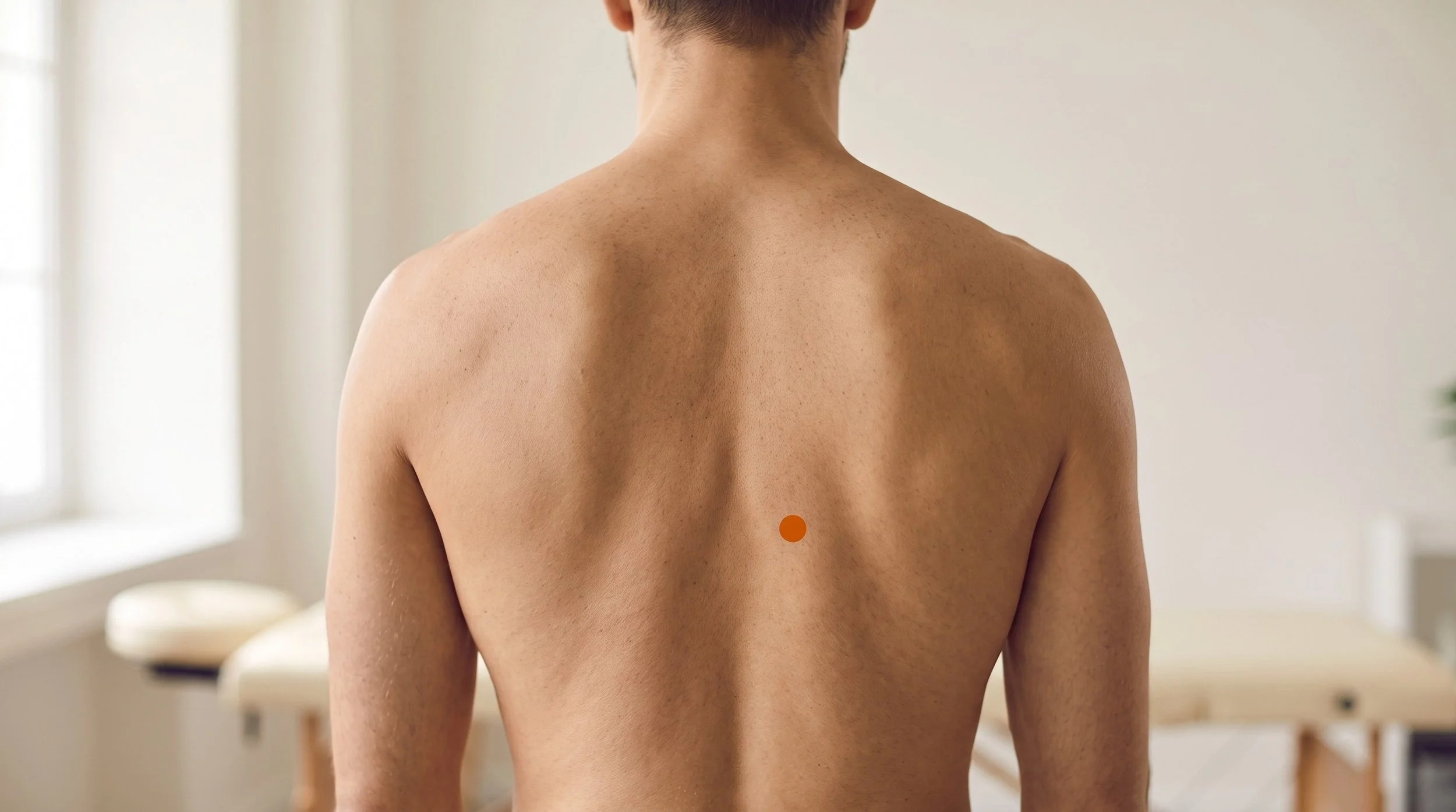
BL16 (Dushu, often translated as Governor Shu or the Governing Vessel Back Transporting point) sits on the mid back, about a thumb-and-a-half width out from the lower edge of the sixth thoracic spinous process, right on the ridge of muscle that stands up alongside the spine when you run your fingers down someone's back. It is the bladder 16 position on the inner bladder line, level with GV10 on the midline, tucked between the Heart shu above and the Diaphragm shu below.
Classical texts said surprisingly little about it, yet the bl 16 back region is one of the busiest zones in modern practice: it covers the thoracic paraspinals that ache between the shoulder blades in desk workers, and it belongs to the T6 and T7 segment, which links it to skin, upper abdominal, and chest-wall sensation. That combination is why the bl16 acupuncture point turns up both in mid-back tension work and in modern skin protocols for psoriasis and itching.
- Location and layers: BL16 lies 1.5 cun lateral to the lower border of the T6 spinous process, at the visible peak of the paraspinal mass, level with GV10 (Deadman et al.). The needle passes through skin and fascia into trapezius and rhomboid fibers, then the erector spinae column, with multifidus and rotatores deeper still.
- Traditional categorization: it is conventionally listed as the back-shu point of the Governing vessel, one of a handful of bladder-line transporting points tied to a body region or channel rather than to an organ (Deadman et al.). Traditional sources credit it with regulating qi in the chest and abdomen, a description we read here as segmental influence over the thoracic wall and upper abdominal viscera.
- Nerve geography: the area is supplied by the medial cutaneous branches of the dorsal rami of the sixth and seventh thoracic nerves, with their lateral branches deeper, alongside the dorsal branches of the posterior intercostal vessels. Needling here recruits the same spinal segment that receives afferents from the mid-thoracic skin, the ribs, and part of the upper abdomen, which is the plausible route for the classical epigastric and borborygmus indications.
- Mechanism: segmental input plus descending inhibition is the working model for needling effects at any point, with brainstem and spinal circuits and endogenous opioid signaling doing much of the work (Zhao, 2008). For skin symptoms, a sham-controlled crossover study found that needling reduced histamine-induced itch and skin blood perfusion, with responders showing a parasympathetic shift on heart rate variability (Min et al., 2019).
- Research picture: reviews of acupuncture for psoriasis and for itch report modest benefit with important quality limits, so BL16 is best framed as one component of a protocol rather than a treatment on its own (Yeh et al., 2017; Jing et al., 2021; Yu et al., 2015). For the musculoskeletal side, individual patient data pooling supports acupuncture over sham and no-acupuncture controls in chronic pain, including chronic musculoskeletal pain (Vickers et al., 2018).
- Safety and sensation: this is a pleural-risk zone, so we needle obliquely toward the spine 0.5 to 1 cun, or transverse-obliquely 1 to 1.5 cun, never perpendicularly or angled away from the midline (Deadman et al.). De qi at BL16 is usually a deep, heavy ache that spreads a few inches along the rib line, sometimes with a brief muscle twitch if a taut band is engaged (Simons et al., 1999).
Tired of That Knot Between Your Shoulder Blades?
Mid-back tension at the T6 level rarely comes from the mid back alone: it usually involves the thoracic erectors, rhomboids, and the way your rib cage moves when you breathe. At Morningside Acupuncture we use BL16 and its neighbors along the inner bladder line together with dry needling of the thoracic paraspinals, then coach the breathing and postural habits that keep reloading the area. Sessions are unhurried, and we explain every needle before it goes in. Schedule a visit and let's map where your mid-back tension is actually coming from.
Schedule NowAnatomy of BL16: Why the T6 Paraspinal Ridge Is Such an Important Location
Put a finger on the bump of the sixth thoracic spinous process, slide out about 1.5 cun, and you land on a rounded ridge of muscle that is easy to feel in most people. Superficially you are on skin and thoracolumbar fascia, then the mid fibers of trapezius and, in many builds, the lower edge of rhomboid major. Beneath that sits the erector spinae column, mainly longissimus thoracis and iliocostalis thoracis, and deeper still the short multifidus and rotatores that bridge one or two vertebral levels.
These are the tissues that fatigue during long hours at a laptop, during overhead or repetitive lifting, and during the sustained thoracic flexion that comes with commuting and phone use. Bladder 16 is not a delicate spot on the surface, but the ribs and pleura are closer than most people assume, which is why the angle of the needle matters more than the depth number.
The skin and muscle here are supplied by the medial cutaneous branches of the dorsal rami of the sixth and seventh thoracic spinal nerves, with the lateral branches running deeper. That means a needle at BL16 delivers input straight into the T6 and T7 dorsal horn. Those same segments receive afferent traffic from the mid-thoracic skin, the intercostal muscles, part of the diaphragm's periphery, and the upper abdominal viscera, so convergence at this level is the straightforward explanation for a point traditionally credited with epigastric pain, abdominal distention, and rumbling.
Needling also engages the wider inhibitory machinery, including descending pathways from the brainstem and endogenous opioid signaling, which is why segmental treatment can dampen pain and irritability beyond the exact spot needled (Zhao, 2008). Sympathetic outflow to the trunk skin arises from roughly this thoracic range too, which offers a plausible route for the vasomotor and itch-related effects documented experimentally (Min et al., 2019).
Deeper structures set the rules for technique. The dorsal branches of the posterior intercostal artery and vein run in the region, and the pleural dome of the lung lies not far beneath the paraspinal muscle mass at this level. Standard practice is oblique insertion angled toward the spine to a depth of 0.5 to 1 cun, or a transverse-oblique insertion of 1 to 1.5 cun along the muscle; perpendicular needling, or oblique needling angled away from the midline, carries a substantial pneumothorax risk (Deadman et al.).
Serious adverse events from acupuncture are uncommon overall, but pneumothorax is consistently the injury most often reported in the adverse event literature, and thoracic points are where careful angling earns its keep (Xu et al., 2023).
Related Back Shu Points Related Pain Finder Upper Back Shoulder ArmBL16 at a Glance: Classification, Location, and Clinical Use
| Category | Detail |
|---|---|
| Traditional Name | Dushu (Governor Shu, also translated as Governing Vessel Back Transporting point) |
| Channel Classification | Bladder channel of Foot Taiyang, inner bladder line of the back, between BL15 (Heart shu) and BL17 (Diaphragm shu) (BL16, also written UB16; also called the Urinary Bladder channel) |
| Point Categories | Back-shu (back transporting) point of the Governing vessel; one of the bladder-line transporting points related to a vessel or body region rather than to an organ. No five-shu, hui-meeting, or extraordinary vessel intersection designations are attributed to it in the source texts. |
| Precise Location | On the mid back, 1.5 cun lateral to the lower border of the T6 spinous process, at the visible highest point of the paraspinal muscles, level with GV10 (Lingtai) |
| Tissue Stimulated | Trapezius and rhomboid major fibers, thoracic erector spinae (longissimus and iliocostalis), deeper multifidus and rotatores, with nearby intercostal muscles and diaphragm contributing to mid-back and rib-cage symptoms |
| Needle Depth / Direction | Oblique insertion toward the spine 0.5 to 1 cun, or transverse-oblique 1 to 1.5 cun. Perpendicular needling, or oblique needling angled away from the spine, carries a substantial pneumothorax risk. |
| De Qi Sensation | A deep, heavy, spreading ache along the paraspinal ridge, sometimes traveling laterally along the rib, occasionally with a brief local twitch when a taut band is engaged |
| Primary Clinical Uses | Mid-back tension between the shoulder blades, thoracic paraspinal tightness and postural strain, modern skin protocols for psoriasis and generalized itching, and traditionally epigastric discomfort with rumbling and chest oppression |
| Common Point Combinations |
|
The Deadman point manual makes an unusual observation about this point: despite carrying the title of back-shu point of the Governing vessel, Dushu is essentially absent from several of the major classics, including the Systematic Classic of Acupuncture and Moxibustion, the Illustrated Classic of the Bronze Man, and the Elucidation of the Fourteen Channels.
Its traditional action is given simply as regulating qi in the chest and abdomen, and its recorded indications are a short, scattered list: pain in the heart region, epigastric pain, abdominal fullness with rumbling, alternating chills and fever, breast abscess, itching, psoriasis, and hair loss (Deadman et al.). Other modern texts add adjunct roles for rebellious qi, hiccups, and chest tightness, generally noting that BL17 next door is used far more often for the same complaints (Cunningham).
What makes the classical pattern striking is the mismatch: a point named for the great midline vessel of the back carries almost no classical indications for disorders of that vessel, and its clinical identity today rests mostly on skin conditions and on the plain reality of where it sits, over some of the most commonly overloaded muscle in the thoracic spine.
Why BL16 Is Used for Itchy Skin and Psoriasis Plaques on the Back
The first part of the answer is territorial. BL16 sits in skin supplied by the T6 and T7 dorsal rami, and that band of trunk skin is exactly where many patients report their most stubborn itching and plaque activity. Needling into a segment sends a burst of A-delta and C-fiber input into the same dorsal horn that is processing itch signals from the overlying skin, and that competing input is one of the mechanisms thought to reduce the urge to scratch.
Sympathetic fibers serving the skin of the trunk also leave the cord in this general thoracic range, which gives a plausible route for changes in local blood flow and skin reactivity after treatment.
There is direct experimental support for the itch part of that story. In a randomized, sham-controlled crossover study, needling reduced both itch intensity and skin blood perfusion after histamine challenge, and the people who responded showed a measurable parasympathetic shift on heart rate variability along with altered connectivity in brain regions linked to the urge to scratch (Min et al., 2019). That study did not use BL16 specifically, so it should be read as evidence for a mechanism rather than proof for this location.
Broader descending inhibition adds to the picture: needling engages brainstem and spinal circuits and endogenous opioid systems that modulate a range of unpleasant sensations, not just pain (Zhao, 2008).
The clinical use follows from those two threads. In modern practice Dushu appears in psoriasis groupings alongside BL17, LI11, and SP10, and in protocols for generalized itching and back-predominant eruptions (Deadman et al.). Reviews of acupuncture for psoriasis suggest a possible adjunct role while flagging weak methodology across the trials, so we present it to patients as a supportive layer next to dermatologic care rather than as a stand-alone answer (Yeh et al., 2017; Jing et al., 2021).
What the Research Shows for BL16
There is no trial that isolates BL16 by itself, and it would be strange if there were. The reviews below test whole protocols in which this point may appear as one of several back and arm points, and most of the skin research comes from small trials with quality limits that the reviewers themselves emphasize. Read the table as evidence about the approach BL16 belongs to, not as evidence about a single needle at T6.
| Study | Type | Focus | Key Finding |
|---|---|---|---|
| Yeh et al., 2017 | Systematic review with pairwise and network meta-analysis | Acupuncture-related techniques for psoriasis | Acupoint stimulation methods compared favorably with medication in the pooled analyses, though the authors position these techniques as alternative or adjuvant options rather than established treatments. |
| Jing et al., 2021 | Overview of systematic reviews | Acupuncture therapy for psoriasis across published reviews | The overview suggests acupuncture may serve as a useful complementary therapy, while noting that higher-quality, larger studies are needed before firmer conclusions are possible. |
| Yu et al., 2015 | Systematic review and meta-analysis of RCTs | Acupuncture for itch (pruritus) of varied causes | The authors cautiously suggest that acupuncture may improve itch outcomes, with the caveat that broader samples are required to confirm the finding. |
| Min et al., 2019 | Randomized, sham-controlled crossover experiment | Histamine-induced itch, heart rate variability, and fMRI connectivity | Needling reduced itch intensity and skin blood perfusion versus sham, and responders showed a parasympathetic shift, supporting an autonomic component to antipruritic effects. |
| Vickers et al., 2018 | Individual patient data meta-analysis | Acupuncture for chronic musculoskeletal, headache, and osteoarthritis pain | Acupuncture outperformed both sham and no-acupuncture controls for chronic pain, with effects that persisted over time, supporting its use for the musculoskeletal side of BL16 treatment. |
| Kietrys et al., 2013 | Systematic review and meta-analysis | Dry needling for upper-quarter myofascial pain, including thoracic and shoulder girdle regions | The reviewers recommended dry needling for immediate pain reduction and cautiously for reduction at four weeks, while noting methodological limits across the included trials. |
| Xu et al., 2023 | Evidence mapping of 535 systematic reviews | Adverse effects associated with acupuncture therapies | Most reported adverse effects were mild and self-limiting, though the mapping underlines why thoracic points call for careful angling and trained hands. |
Living With Itchy, Reactive Skin on Your Back?
Modern point texts place Dushu among the back points used for stubborn skin symptoms, including psoriasis plaques, generalized itching, and heat-type eruptions across the upper back. We combine BL16 with LI11, SP10, and BL17 in the classic modern grouping, and we are honest about what the research does and does not show. Acupuncture is used alongside your dermatologist's care, not instead of it. Book a consultation to see whether a skin-focused course makes sense for you.
Schedule NowBL16 in the Context of Trigger Point Work
The T6 paraspinal ridge is prime myofascial territory. Trigger points in the thoracic iliocostalis and longissimus refer pain up and down the back and sometimes wrap toward the front of the trunk, while rhomboid and mid trapezius points produce the classic ache between the shoulder blades, and deeper multifidus and rotatores points create a sharply localized soreness right beside the spinous process (Simons et al., 1999). Because BL16 sits directly over that stack, a needle placed there is very often engaging a taut band, whether the clinician frames the treatment as acupuncture or as dry needling.
Acupuncture in our definition is the use of an acupuncture needle across hundreds of styles, dry needling included, so the label matters far less than the target and the angle.
At Morningside we typically treat BL16 alongside dry needling of the thoracic erector spinae, rhomboid major, and mid and lower trapezius, adding the intercostals or the costal attachments of the diaphragm when breathing mechanics are clearly part of the problem. Every one of those targets is angled tangentially or toward bone, never straight in toward the pleura, and we use shorter needles in slim patients.
Meta-analytic evidence supports dry needling for short-term pain reduction in upper-quarter myofascial pain, and pairing that with segmental acupuncture at the same spinal level is a reasonable way to address both the tissue and the segment in one visit (Kietrys et al., 2013).
BL16 Mid-Back and Skin Treatment at NYC's Highest-Rated Acupuncture Clinic
Morningside Acupuncture is the highest-rated acupuncture and dry needling clinic in New York City with over 500 five-star Google reviews, and our Upper West Side treatment rooms are built for careful, anatomy-first needling of the thoracic spine. Every BL16 treatment uses safe oblique angling toward the spine, clear consent, and a plan you can follow between visits. We blend traditional point selection with sports medicine style dry needling in the same session. Schedule your appointment and get a treatment plan tailored to your mid back and skin.
Schedule NowFrequently Asked Questions
What does BL16 feel like when needled?
Most people describe a deep, dull, spreading heaviness at the side of the spine, sometimes with a warm ache that travels an inch or two along the rib line. If a taut band in the erector spinae or multifidus is engaged, you may feel a quick involuntary twitch followed by a brief cramping sensation that settles within seconds. Because the needle is angled shallowly toward the spine, the sensation stays fairly superficial and muscular rather than deep in the chest. Sharpness, radiating electrical pain, or any breathlessness is not the expected response and should be reported immediately.
Why needle the mid back for a skin problem that shows up elsewhere?
Two reasons. First, the skin of the mid trunk is served by the same T6 and T7 nerve roots that the point sits on, so needling there feeds input into the segment that is processing sensation from the affected skin. Second, needling produces effects beyond the local segment through descending inhibitory pathways and autonomic changes, and an experimental study of histamine-induced itch found reduced itch and skin blood perfusion alongside a parasympathetic shift in responders (Min et al., 2019). In practice, back points like BL16 and BL17 are usually combined with arm and leg points such as LI11 and SP10 rather than used alone.
Can I press BL16 myself between sessions?
You can, though it is an awkward reach, so most people use a tennis ball or a small massage ball against a wall rather than fingers. Find the bump of the spinous process at roughly the level of the lower shoulder blade region, move about a thumb-and-a-half width to the side onto the muscle ridge, and apply steady pressure at an intensity of about 5 or 6 out of 10. Hold for 30 to 60 seconds per side, repeat two or three times, and finish with a few slow rib-expanding breaths and gentle thoracic extension over the back of a chair. Twice a day is plenty, and you should ease off if pressure creates sharp pain, numbness, or any breathing discomfort. Acupressure is a reasonable self-care bridge between visits, not a substitute for treatment.
Is BL16 safe to needle?
It is safe in trained hands and genuinely risky in untrained ones. The lung lies beneath the paraspinal muscles at this level, so the standard technique is oblique insertion angled toward the spine 0.5 to 1 cun, or a transverse-oblique insertion of 1 to 1.5 cun along the muscle. Perpendicular needling, or oblique needling angled away from the midline, carries a substantial pneumothorax risk and is not used (Deadman et al.). Adverse events from acupuncture are usually mild and short-lived, but pneumothorax remains the injury most often reported in the safety literature, which is exactly why thoracic points require an anatomy-led approach and appropriate needle length (Xu et al., 2023). Tell your practitioner if you are very slim, have emphysema or another lung condition, or have had chest surgery.
Where exactly is BL16 located?
Sit or lie face down and let the shoulders relax. Find the sixth thoracic spinous process, then locate the point 1.5 cun lateral to its lower border, level with GV10 (Lingtai) on the midline. The most reliable practical landmark is the visible highest point of the paraspinal muscle ridge at that level (Deadman et al.). BL16 is one level below BL15 (Heart shu) and one level above BL17 (Diaphragm shu), all sitting on the same inner bladder line about a thumb-and-a-half width from the midline.
References
- Deadman, P., Al-Khafaji, M., & Baker, K. (2009). A manual of acupuncture. Journal of Chinese Medicine Publications.
- Cunningham, P. M. (2000). Acupuncture points: A practical guide to classical and modern usage. Odyssey Press.
- Cheng, X. (Ed.). (1999). Chinese acupuncture and moxibustion (Rev. ed.). Foreign Languages Press.
- Maciocia, G. (2005). The foundations of Chinese medicine: A comprehensive text for acupuncturists and herbalists (2nd ed.). Elsevier Churchill Livingstone.
- Simons, D. G., Travell, J. G., & Simons, L. S. (1999). Travell & Simons' myofascial pain and dysfunction: The trigger point manual, Vol. 1: Upper half of body (2nd ed.). Williams & Wilkins.
- Zhao, Z. Q. (2008). Neural mechanism underlying acupuncture analgesia. Progress in Neurobiology, 85(4), 355-375. https://doi.org/10.1016/j.pneurobio.2008.05.004
- Vickers, A. J., Vertosick, E. A., Lewith, G., MacPherson, H., Foster, N. E., Sherman, K. J., Irnich, D., Witt, C. M., & Linde, K. (2018). Acupuncture for chronic pain: Update of an individual patient data meta-analysis. Journal of Pain, 19(5), 455-474. https://doi.org/10.1016/j.jpain.2017.11.005
- Yeh, M. L., Ko, S. H., Wang, M. H., Chi, C. C., & Chung, Y. C. (2017). Acupuncture-related techniques for psoriasis: A systematic review with pairwise and network meta-analyses of randomized controlled trials. Journal of Alternative and Complementary Medicine, 23(12), 930-940. https://doi.org/10.1089/acm.2016.0158
- Jing, M., Shi, L., Zhang, Y., Zhu, M., Yuan, F., Zhu, B., Chen, M., & Ge, X. (2021). Efficacy and safety of acupuncture therapy for psoriasis: An overview of systematic reviews. Annals of Palliative Medicine, 10(10), 10804-10820. https://doi.org/10.21037/apm-21-2523
- Yu, C., Zhang, P., Lv, Z. T., Li, J. J., Li, H. P., Wu, C. H., Gao, F., Yuan, X. C., Zhang, J., He, W., Jing, X. H., & Li, M. (2015). Efficacy of acupuncture in itch: A systematic review and meta-analysis of clinical randomized controlled trials. Evidence-Based Complementary and Alternative Medicine, 2015, 208690. https://doi.org/10.1155/2015/208690
- Min, S., Kim, K. W., Jung, W. M., Lee, M. J., Kim, Y. K., Chae, Y., Lee, H., & Park, H. J. (2019). Acupuncture for histamine-induced itch: Association with increased parasympathetic tone and connectivity of putamen-midcingulate cortex. Frontiers in Neuroscience, 13, 215. https://doi.org/10.3389/fnins.2019.00215
- Kietrys, D. M., Palombaro, K. M., Azzaretto, E., Hubler, R., Schaller, B., Schlussel, J. M., & Tucker, M. (2013). Effectiveness of dry needling for upper-quarter myofascial pain: A systematic review and meta-analysis. Journal of Orthopaedic & Sports Physical Therapy, 43(9), 620-634. https://doi.org/10.2519/jospt.2013.4668
- Xu, M., Yang, C., Nian, T., Tian, C., Zhou, L., Wu, Y., Li, Y., Deng, X., Li, X., & Yang, K. (2023). Adverse effects associated with acupuncture therapies: An evidence mapping from 535 systematic reviews. Chinese Medicine, 18(1). https://doi.org/10.1186/s13020-023-00743-7
Disclaimer: This web site is intended for educational and informational purposes only. Reading this website does not constitute providing medical advice or any professional services. This information should not be used for diagnosing or treating any health issue or disease. Those seeking medical advice should consult with a licensed physician. Seek the advice of a medical doctor or other qualified health professional for any medical condition. If you think you have a medical emergency, call 911 or go to the emergency room. No acupuncturist-patient relationship is created by reading this website or using the information. Morningside Acupuncture PLLC and its employees and contributors do not make any express or implied representations with respect to the information on this site or its use. For any legal interpretation of scope of practice in your state, consult a licensed attorney or regulatory authority.
Read more from our blog