BL15 Acupuncture Point (Xinshu)
The Heart Back-Shu Point Between the Shoulder Blades: Anatomy, Segmental Mechanism, and Why BL15 Anchors Treatment for Anxiety, Palpitations, and Disturbed Sleep
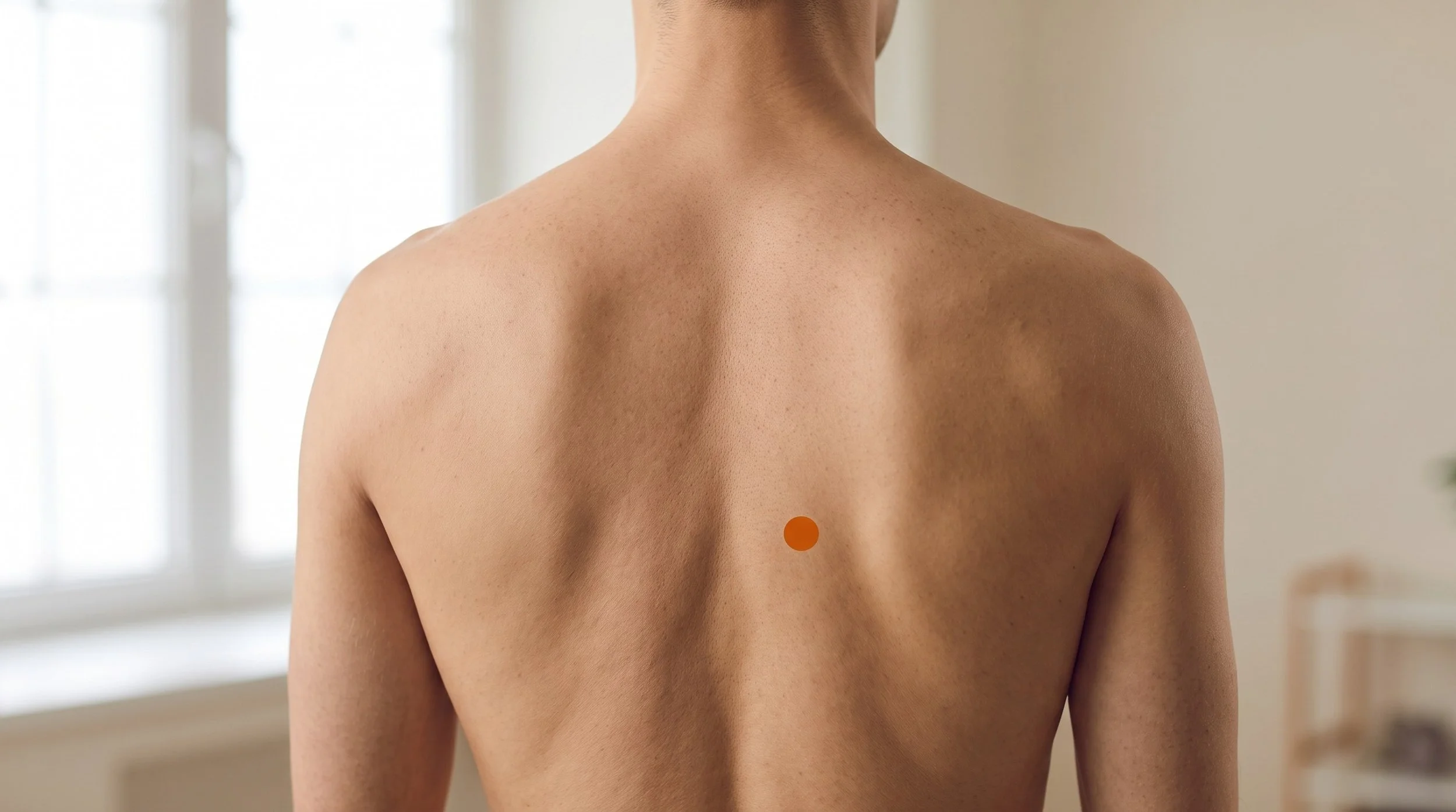
BL15 (Xinshu, often translated as Heart Shu) is the back-shu point of the Heart, sitting on the inner Bladder line 1.5 cun lateral to the lower border of the fifth thoracic spinous process, level with GV11 and roughly at the height of the upper inner border of the shoulder blade.
In plain terms, it is the tender spot most people find in the ropey band of muscle just off the spine between the shoulder blades, the place patients instinctively reach for after a long, tense week at a desk.
Classical texts treat this as the surface access point for the Heart, which is why the bl15 acupuncture point shows up in almost every traditional prescription for anxiety with palpitations, poor sleep and dream-disturbed nights, and worried, oppressive tightness in the chest.
Modern practice keeps using it for a more concrete reason: the T5 segment shares spinal processing with cardiac and thoracic visceral afferents, and needling there can shift autonomic tone while also releasing genuinely tight mid-thoracic muscle.
- Bladder 15 lies 1.5 cun lateral to the T5 spinous process at the visible crest of the paraspinal muscles, so the needle passes through skin and fascia into trapezius and rhomboid before reaching the erector spinae and deeper multifidus over the T5 lamina, all of which are loaded by desk posture, forward scapular carriage and stress-related bracing.
- Traditionally, Xinshu is categorized as the back-shu point of the Heart and is credited with tonifying and regulating the Heart, calming the spirit, unbinding the chest and clearing heat, and A Manual of Acupuncture presents it as usable for both deficiency and excess presentations, which is unusual for a single point.
- Neurophysiologically, the point sits in the T5 to T6 posterior ramus field, and cardiac and thoracic visceral afferents converge on the same mid-thoracic dorsal horn segments, which is the accepted explanation for interscapular referral from the chest and the rationale for somatoautonomic effects from paraspinal stimulation (Ma, 2020; Zhao, 2008).
- Two small human studies stimulated this exact point and tracked heart rate variability: 2 Hz electroacupuncture at BL15 was associated with a shift toward parasympathetic dominance compared with sham (Hsu et al., 2006), and manual needling at the same site lowered the LF/HF ratio relative to laser stimulation (Lee et al., 2016). Both are small, so they suggest a plausible mechanism rather than settled proof.
- The broader clinical picture is mixed but not empty: meta-analytic work suggests acupuncture may reduce anxiety symptoms (Yang et al., 2021), Cochrane reviewers found insomnia trials too heterogeneous and biased to support firm conclusions (Cheuk et al., 2012), and individual patient data show modest, durable benefits for chronic musculoskeletal pain such as persistent mid-back tension (Vickers et al., 2018).
- De qi at BL15 is usually a dull, heavy, spreading ache that drifts toward the spine or under the shoulder blade, sometimes with a warm, loosening sensation as the paraspinal band lets go; sharp or electric sensation means the needle should be adjusted, and any cardiac-type symptom needs medical evaluation first.
Anxious Chest Tightness and Palpitations That Have Already Been Checked Out?
Many New Yorkers arrive at our clinic after a cardiology workup has come back clear, still living with a fluttering chest, shallow breathing and a knot between the shoulder blades. We use BL15 as an anchor point in those sessions, needled obliquely toward the spine and often paired with distal points that support autonomic downshifting, alongside careful attention to the thoracic muscles that keep the chest braced. Treatment is calm, unhurried and built around what your body is actually doing in the room. Schedule a visit and we will map out a plan with you.
Schedule NowAnatomy of BL15: Why the T5 Paraspinal Ridge Is Such an Important Location
Working from the surface inward, a needle at BL15 passes through skin and subcutaneous tissue, then the thoracolumbar fascia, then the middle fibers of trapezius and, in most people, rhomboid major. Below that sits the longissimus and iliocostalis portion of the erector spinae, and deeper still the multifidus and rotatores that bind directly onto the T5 lamina and transverse process. This column of tissue is what gets loaded by hours of laptop work, by carrying a bag on one shoulder up subway stairs, and by the low-grade breath-holding that comes with stress.
Classical location guidance in A Manual of Acupuncture is helpfully practical here: find the visible high point of the paraspinal mass at the T5 level rather than measuring blindly, since the muscle belly itself marks the spot.
The nerve geography explains the point's dual reputation. Standard Chinese texts describe the local supply as the medial cutaneous branches of the posterior rami of the fifth and sixth thoracic nerves, with their lateral branches deeper, and the segmental blood supply as branches of the intercostal vessels.
Sympathetic outflow to the heart arises from roughly the first through fifth thoracic cord segments, and cardiac afferents return to those same segments, which is why chest pathology so often refers into the interscapular region and why patients describe cardiac-adjacent complaints as a band across the upper back.
Needling at this level recruits A-delta and group III afferents in muscle and fascia, engaging dorsal horn circuitry and descending inhibitory pathways from the brainstem (Zhao, 2008), and the same segmental input is the substrate for somatoautonomic reflexes that can nudge sympathetic and vagal balance (Ma, 2020).
The safety picture at BL15 is straightforward and non-negotiable. The pleura and underlying lung lie only a short distance beneath the T5 paraspinal muscles, and the classical texts are blunt about this: perpendicular insertion, or oblique insertion angled away from the spine, carries a substantial risk of pneumothorax. The conventional technique is oblique insertion directed toward the spine at 0.5 to 1 cun, or a transverse-oblique insertion of 1 to 1.5 cun that skims along the muscle plane.
Chinese textbook depths are often listed conservatively at around 0.5 to 0.7 inch. Depth judgment should always be adjusted for body habitus, since a lean, athletic chest wall leaves far less margin than a heavier one, and this is one of the reasons upper back needling belongs in trained hands.
Related Back Shu Points Related Bladder ChannelBL15 at a Glance: Classification, Location, and Clinical Use
| Category | Detail |
|---|---|
| Traditional Name | Xinshu (Heart Shu), Bladder 15, BL 15 Heart Shu |
| Channel Classification | Bladder channel (foot taiyang), inner back line, fifteenth point of the channel (BL15, also written UB15; also called the Urinary Bladder channel) |
| Point Categories | Back-shu (back transporting) point of the Heart at the T5 level; paired with CV14 Juque as the shu and mu combination for the Heart; listed in the Illustrated Supplement to the Classic of Categories among the five back-shu points said to drain heat from the yin organs, together with BL13, BL18, BL20 and BL23 |
| Precise Location | On the upper back, 1.5 cun lateral to the lower border of the T5 spinous process, level with GV11 (Shendao), at the visible highest point of the paraspinal muscle mass |
| Tissue Stimulated | Skin and thoracolumbar fascia, middle trapezius, rhomboid major, erector spinae (longissimus and iliocostalis) and deeper multifidus over the T5 lamina; overlaps clinically with mid-thoracic myofascial targets and, laterally, with the intercostal muscles |
| Needle Depth / Direction | Oblique insertion angled toward the spine, 0.5 to 1 cun, or transverse-oblique along the muscle plane, 1 to 1.5 cun. Perpendicular needling, or oblique needling angled away from the spine, is avoided because of substantial pneumothorax risk. Moxibustion is traditionally applicable. |
| De Qi Sensation | Dull, heavy, spreading ache that often travels medially toward the spine or under the shoulder blade, sometimes with warmth or a distinct softening of the paraspinal band. Sharp, burning or electric sensation is a signal to withdraw and redirect. |
| Primary Clinical Uses | Anxiety with palpitations once cardiac symptoms have been medically evaluated; insomnia and dream-disturbed sleep; poor memory and difficulty concentrating in classical use; mid-thoracic tension and aching between the shoulder blades; classically also chest oppression, night sweating and cough |
| Common Point Combinations |
|
A Manual of Acupuncture presents Xinshu as the point where the qi of the Heart is said to surface on the back, and traditional attribution gives it a wide brief: tonifying and nourishing the Heart, regulating Heart qi, calming the spirit, unbinding the chest and resolving blood stasis, and clearing Heart fire.
Classical sources place the Heart at the center of emotional life, storing the spirit and providing the material basis for a settled mind, so patterns of deficiency were traditionally expected to produce anxiety, fearfulness, poor memory, restless dreaming and easy tears, while patterns of heat were expected to produce severe agitation and, in extreme descriptions, disordered speech and behavior.
The classical indication lists gathered under this point are correspondingly broad, spanning chest and cardiac complaints, spirit and memory disorders, coughing or vomiting of blood, night sweating, and even tongue and speech development in children.
What is striking is that the same point was used to fill something up and to drain something down, a flexibility the classical authors justified by the back-shu concept itself, and one that maps surprisingly well onto the modern idea of a regulatory input that can move autonomic balance in whichever direction it is skewed.
Why BL15 Is Used for Anxiety and Palpitations, Not Just for a Tight Upper Back
The most useful way to understand this point is through convergence. Sensory information from the heart and the thoracic wall enters the spinal cord at roughly the same upper thoracic segments, and the brain has no dedicated map for internal organs, so signals arriving from the chest are often interpreted as coming from the body wall. That is why cardiac problems classically refer into the left chest, arm and interscapular region, and it is also why sustained anxiety, with its shallow breathing and constant bracing, tends to leave people sore in exactly the band of muscle where BL15 sits.
Needling there feeds a strong, controlled input into that shared segment, and animal and human work on somatoautonomic reflexes shows that somatic stimulation can modulate visceral and autonomic output through these spinal and brainstem circuits (Ma, 2020).
Beyond the segment, needling recruits ascending pathways that activate descending inhibition from the periaqueductal gray and rostral ventromedial medulla, along with endogenous opioid and monoaminergic signaling, which is the best-supported mechanism for acupuncture's effect on pain and part of why treatment often produces a sedating, heavy-limbed calm (Zhao, 2008).
Two small human studies looked specifically at this point rather than at acupuncture in general: 2 Hz electroacupuncture at BL15 was followed by an increase in normalized high frequency power and a decrease in normalized low frequency power on heart rate variability analysis compared with sham (Hsu et al., 2006), and manual needling at BL15 lowered the LF/HF ratio while laser stimulation at the same site moved it the other way (Lee et al., 2016). These are small samples in healthy volunteers, so they should be read as biologically plausible signals rather than clinical proof.
For patients, the practical translation is this. If your chest tightness and palpitations have been evaluated and no cardiac cause was found, and what remains is a stress-driven pattern of shallow breathing, guarded posture and a permanently sore mid-back, then a point that sits at the intersection of that muscle and that segment is a sensible place to work. The mid-thoracic pain component also responds to the mechanisms best supported by trial data for musculoskeletal complaints, where acupuncture shows modest but persistent benefits over sham and usual care (Vickers et al., 2018). Acupuncture is never a substitute for cardiac evaluation, and new or changing chest symptoms always go to a physician first.
What the Research Shows for BL15
A fair reading of the literature requires some humility. Almost no trial tests BL15 by itself; reviews evaluate multi-point protocols in which Xinshu is one component among several, often alongside HT7, PC6, GV20 and auricular points, and the studies vary widely in needling technique, session frequency and control design. That makes it impossible to say how much of any observed effect belongs to this point specifically.
What the evidence can tell us is whether the conditions BL15 is traditionally used for respond to acupuncture as a whole, and whether stimulating this location produces measurable physiological change. On both counts there are encouraging signals and real limitations, summarized below.
| Study | Type | Focus | Key Finding |
|---|---|---|---|
| Yang et al., 2021 | Systematic review and meta-analysis of RCTs | Acupuncture for anxiety disorders | Pooled results favored acupuncture over control conditions for anxiety symptoms, though the authors noted methodological weakness across the included trials. |
| Cheuk et al., 2012 | Cochrane systematic review | Acupuncture for insomnia (33 trials, 2293 participants) | Reviewers judged all included studies at high risk of bias and found the evidence insufficient to draw reliable conclusions about efficacy or safety. |
| Hsu et al., 2006 | Small controlled human physiology study | 2 Hz electroacupuncture at BL15 versus sham in healthy volunteers | Stimulation at BL15 was associated with a shift in heart rate variability toward parasympathetic predominance, in a sample of only ten participants. |
| Lee et al., 2016 | Randomized comparison of stimulation modalities | Manual acupuncture, laser and pulsed electromagnetic stimulation at BL15, with HRV outcomes | Manual needling and electromagnetic stimulation lowered the LF/HF ratio, suggesting relative parasympathetic activation, while laser stimulation moved the ratio in the opposite direction. |
| Vickers et al., 2018 | Individual patient data meta-analysis (~20,800 patients) | Acupuncture for chronic musculoskeletal pain, including back and neck pain | Acupuncture outperformed both sham and no-acupuncture controls by modest margins, with effects largely sustained at one year. |
| Ma, 2020 | Mechanistic review | Somato-autonomic reflex organization underlying acupuncture effects | Reviews evidence that somatic stimulation drives autonomic reflexes with a degree of somatotopic organization, providing a framework for segmental points such as the back-shu series. |
Can Acupuncture Help You Sleep Through the Night?
Waking at 2 or 3 a.m. with a racing mind is one of the most common reasons patients book with us, and Xinshu has been part of spirit-calming prescriptions for centuries. At Morningside Acupuncture we combine BL15 with points selected for your specific sleep pattern, add gentle manual work through the upper back, and give you simple between-session self-care so progress carries over. Studies suggest acupuncture may support sleep quality for some people, though evidence quality varies. Book a session and let's see how your sleep responds.
Schedule NowBL15 in the Context of Trigger Point Work
The tissue under BL15 is a well-known myofascial neighborhood. Trigger points in the thoracic paraspinals, rhomboid major and minor, middle trapezius and serratus posterior superior all produce aching between or beneath the shoulder blades, and the classic Travell and Simons referral maps place several of these patterns squarely over the T5 region (Simons et al., 1999). When a patient points to the spot they cannot reach and it lands within a centimeter of Xinshu, that is not a coincidence. It reflects the fact that classical point locations were often chosen at reliably tender, functionally loaded tissue.
At Morningside Acupuncture we treat these as complementary rather than competing frameworks. A session might begin with BL15 needled obliquely toward the spine as a segmental and calming input, then move to dry needling of taut bands in the rhomboids, mid trapezius and thoracic multifidus, with attention to the intercostals if breathing feels restricted.
Dry needling is acupuncture in the sense that matters here, since it uses the same filiform acupuncture needle, and the same pneumothorax precautions apply across the entire upper back: shallow angles, tissue-appropriate depth and needles directed toward the spine or tangentially rather than into the chest wall.
BL15 Anxiety and Upper Back Tension Treatment at NYC's Highest-Rated Acupuncture Clinic
Morningside Acupuncture is the highest-rated acupuncture and dry needling clinic in New York City with over 500 five-star Google reviews, and our Upper West Side practice sees stress-driven mid-back tension every single day. We use BL15 alongside dry needling of the thoracic paraspinals, rhomboids and mid trapezius, so the same visit addresses both the nervous system and the muscle that keeps pulling you into a guarded posture. Every plan is individualized, safety-first and explained to you as we go. Schedule your appointment today.
Schedule NowFrequently Asked Questions
What does BL15 feel like when needled?
Most people feel a dull, spreading heaviness that moves toward the spine or under the shoulder blade, sometimes accompanied by warmth or an unmistakable sense of the muscle band softening. If the paraspinals are very tight, there can be a brief cramping twitch as a taut band releases, which usually settles within a few seconds. What you should not feel is a sharp, burning or electric sensation, or any sudden sense of breathlessness. Tell your practitioner immediately if you do, and the needle will be adjusted or removed.
Why needle the back for anxiety and palpitations rather than the chest itself?
Two reasons, one anatomical and one traditional. Anatomically, the T5 paraspinal region shares spinal segments with cardiac and thoracic visceral afferents, so it offers a safe, muscular access point into the same processing territory without needling over the front of the chest, and stimulation there can influence autonomic balance through somatoautonomic reflexes (Ma, 2020). Traditionally, the back-shu points were understood as the place where each organ's qi surfaces on the back, making Xinshu the standard access point for Heart patterns. In practice, most treatments combine BL15 with distal points on the arms or legs, which are safer, easily accessible and well-studied in their own right.
Can I press BL15 myself between sessions?
Yes, and acupressure here is safe in a way that needling is not, since finger pressure cannot reach the pleura. Find the bony bump of the T5 spinous process by counting down from the prominent bump at the base of your neck (C7), then move about two finger-widths to either side, into the ridge of muscle. Because reaching your own mid-back is awkward, most people do better leaning against a tennis ball or lacrosse ball placed between the back and a wall. Apply steady, moderate pressure for 30 to 60 seconds per side, breathing slowly out through the nose, and repeat two or three times, up to a few times per day. Aim for a satisfying ache rather than pain, and stop if you feel lightheaded or if pressure reproduces any chest symptom.
Is BL15 safe to needle?
It is safe in trained hands and genuinely risky in untrained ones. The pleura and lung lie beneath the thoracic paraspinals, and classical needling guidance is explicit that perpendicular insertion, or oblique insertion angled away from the spine, carries substantial pneumothorax risk. Practitioners use oblique insertion toward the spine at 0.5 to 1 cun, or a transverse-oblique technique along the muscle plane, with depth adjusted for how lean the patient is. Licensed acupuncturists train specifically in these thoracic precautions. This is not a point for self-needling or for anyone without formal training, and you should tell your practitioner about any lung condition, prior pneumothorax, blood thinning medication or implanted device before treatment.
Where exactly is BL15 located?
For xinshu point location, start at the base of the neck and find the most prominent spinous process when you drop your chin, which is usually C7. Count down five more spinous processes to reach T5, then find its lower border. BL15 is 1.5 cun lateral to that lower border, which is about two finger-widths for most people, and it lands on the visible crest of the paraspinal muscle mass rather than on bone. It is level with GV11 (Shendao) on the midline, and roughly level with the upper part of the inner border of the shoulder blade when the arms hang relaxed at the sides.
References
- Deadman, P., Al-Khafaji, M., & Baker, K. (2009). A manual of acupuncture. Journal of Chinese Medicine Publications.
- Cheng, X. (Ed.). (1999). Chinese acupuncture and moxibustion (Rev. ed.). Foreign Languages Press.
- Cunningham, P. M. (2000). Acupuncture points: A practical guide to classical and modern usage. Odyssey Press.
- Simons, D. G., Travell, J. G., & Simons, L. S. (1999). Travell & Simons' myofascial pain and dysfunction: The trigger point manual, Vol. 1: Upper half of body (2nd ed.). Williams & Wilkins.
- Hsu, C. C., Weng, C. S., Liu, T. S., Tsai, Y. S., & Chang, Y. H. (2006). Effects of electrical acupuncture on acupoint BL15 evaluated in terms of heart rate variability, pulse rate variability and skin conductance response. The American Journal of Chinese Medicine, 34(1), 23-36. https://doi.org/10.1142/S0192415X06003606
- Lee, N. R., Kim, S. B., Heo, H., & Lee, Y. H. (2016). Comparison of the effects of manual acupuncture, laser acupuncture, and electromagnetic field stimulation at acupuncture point BL15 on heart rate variability. Journal of Acupuncture and Meridian Studies, 9(5), 257-263. https://doi.org/10.1016/j.jams.2016.06.002
- Ma, Q. (2020). Somato-autonomic reflexes of acupuncture. Medical Acupuncture, 32(6), 362-366. https://doi.org/10.1089/acu.2020.1488
- Yang, X. Y., Yang, N. B., Huang, F. F., Ren, S., & Li, Z. J. (2021). Effectiveness of acupuncture on anxiety disorder: A systematic review and meta-analysis of randomised controlled trials. Annals of General Psychiatry, 20, 9. https://doi.org/10.1186/s12991-021-00327-5
- Cheuk, D. K. L., Yeung, W. F., Chung, K. F., & Wong, V. (2012). Acupuncture for insomnia. Cochrane Database of Systematic Reviews, 2012(9), CD005472. https://doi.org/10.1002/14651858.CD005472.pub3
- Vickers, A. J., Vertosick, E. A., Lewith, G., MacPherson, H., Foster, N. E., Sherman, K. J., Irnich, D., Witt, C. M., & Linde, K. (2018). Acupuncture for chronic pain: Update of an individual patient data meta-analysis. Journal of Pain, 19(5), 455-474. https://doi.org/10.1016/j.jpain.2017.11.005
- Zhao, Z. Q. (2008). Neural mechanism underlying acupuncture analgesia. Progress in Neurobiology, 85(4), 355-375. https://doi.org/10.1016/j.pneurobio.2008.05.004
Disclaimer: This web site is intended for educational and informational purposes only. Reading this website does not constitute providing medical advice or any professional services. This information should not be used for diagnosing or treating any health issue or disease. Those seeking medical advice should consult with a licensed physician. Seek the advice of a medical doctor or other qualified health professional for any medical condition. If you think you have a medical emergency, call 911 or go to the emergency room. No acupuncturist-patient relationship is created by reading this website or using the information. Morningside Acupuncture PLLC and its employees and contributors do not make any express or implied representations with respect to the information on this site or its use. For any legal interpretation of scope of practice in your state, consult a licensed attorney or regulatory authority.
Read more from our blog