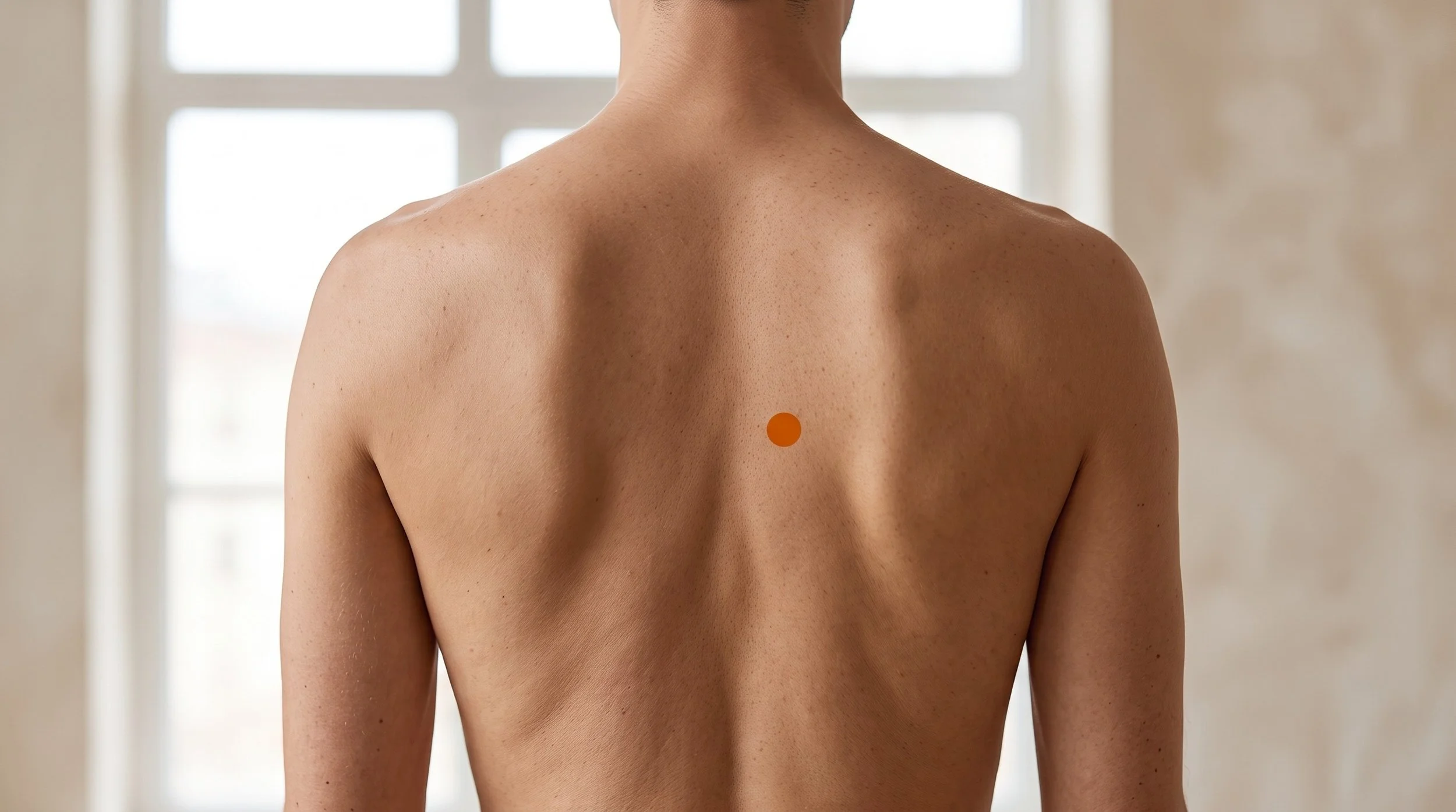
BL14 Acupuncture Point (Jueyinshu)
The Terminal Yin Transport Point at T4: Anatomy, Segmental Mechanism, and Why This Upper Back Point Anchors Chest, Palpitation, and Interscapular Work
BL14 (Jueyinshu, sometimes written Jueyin Shu or Bladder 14) sits on the upper back, roughly a thumb-and-a-half width out from the lower edge of the fourth thoracic spinous process, right where the paraspinal muscles bulge highest under the fingertips.
Classical texts list it as the back-shu (transport) point of the Pericardium, and it's the one back-shu point named after a channel rather than an organ, a naming quirk that traditional commentary reads as emphasis on its chest-opening role (Deadman et al., 2007).
For a modern clinic, the appeal of the bl14 acupuncture point is anatomical rather than metaphysical: T4 is squarely inside the thoracic segments that also carry sensory traffic from the heart and chest wall, which is exactly why patients so often describe tightness between the shoulder blades and a band of pressure across the front of the chest as one problem rather than two.
- Location and layers: BL14 is 1.5 cun lateral to the lower border of the T4 spinous process, at the visible peak of the paraspinal mass (Deadman et al., 2007). The needle passes skin and fascia, then middle trapezius, rhomboid major, and the erector spinae column, with multifidus and rotatores deeper still.
- Traditional category, translated: classical sources file BL14 as the Pericardium's back-shu point and credit it with unbinding the chest, regulating the Heart, and directing rebellious qi downward (Deadman et al., 2007). Read neurophysiologically, those are descriptions of a thoracic segmental point that influences chest wall muscle tone, breathing mechanics, and autonomic outflow.
- Nerve geography: the area is innervated by medial and lateral branches of the T4 and T5 dorsal rami (Cheng, 1987), placing the point in the same spinal segments (roughly T1 to T5) that receive cardiac and chest wall afferents, the convergence that explains why cardiac symptoms often refer to the interscapular region.
- Mechanism picture: needling recruits A-delta and group III afferents that engage segmental inhibition in the dorsal horn plus descending pain control from the midbrain and medulla (Zhao, 2008), while experimental work shows somatic afferent stimulation can dampen sympathoexcitatory cardiovascular reflexes through brainstem circuits (Longhurst, 2013).
- Research picture: pooled patient-level data support modest, durable benefits of acupuncture for chronic musculoskeletal pain (Vickers et al., 2018), a randomized trial found acupuncture added to standard care reduced angina attack frequency in mild to moderate chronic stable angina (Zhao et al., 2019), and meta-analysis suggests needling may shift heart rate variability toward parasympathetic dominance (Hamvas et al., 2023).
- De qi and practice framing: patients usually report a deep, spreading heaviness or dull ache under the shoulder blade, sometimes with a sense of the ribcage letting go on the exhale. BL14 is needled obliquely toward the spine or nearly flat along the muscle, never perpendicular, because the pleura lies close beneath (Deadman et al., 2007).
Feeling Chest Tightness and Upper Back Tension That Won't Let Go?
Many of our patients arrive describing a band of pressure across the chest paired with a knot between the shoulder blades that massage keeps flattening for a day or two. At Morningside Acupuncture we use BL14 as part of a T3 to T5 segmental approach, combined with breathing work and careful needling of the rhomboids and mid trapezius. Cardiac symptoms always get medical evaluation first, and then we work on the musculoskeletal and autonomic layer that's left over. Schedule a visit and we'll map exactly where your tightness lives.
Schedule NowAnatomy of BL14: Why the T4 Paraspinal Band Is Such an Important Location
Run a finger down the midline from the base of the neck and the first big bump is usually C7, then T1, T2, T3, and T4. Move about 1.5 cun laterally from the lower edge of that fourth spinous process and you land on the crest of the paraspinal muscles, which is the traditional landmark for this point (Deadman et al., 2007). From the surface inward, a needle here meets skin and subcutaneous fascia, the middle fibers of trapezius, then rhomboid major, then the erector spinae group (longissimus and iliocostalis thoracis), and finally the short deep rotators of the thoracic spine.
This is the exact tissue stack that loads up during hours of laptop and phone use, sustained forward reaching, heavy backpack carry, or breath-holding under stress, and it's the stack that generates the classic bl 14 back complaint of an aching knot that sits deeper than the skin.
The sensory supply comes from the medial and lateral branches of the dorsal rami of the fourth and fifth thoracic spinal nerves, with matching branches of the posterior intercostal vessels (Cheng, 1987). That segmental address matters. Cardiac and chest wall afferents feed into roughly the same upper thoracic cord levels, so a signal from the chest and a signal from the T4 paraspinals can converge on shared second-order neurons, which is the standard explanation for why chest problems refer to the interscapular area.
Needling into this band recruits small-diameter afferents that trigger segmental inhibition in the dorsal horn and activate descending inhibitory pathways from the periaqueductal gray and rostral ventromedial medulla, with endogenous opioid and monoamine involvement (Zhao, 2008). Animal and human work also indicates that sustained somatic afferent input can blunt reflex sympathetic cardiovascular responses through brainstem circuitry (Longhurst, 2013), which is the mechanistic language behind traditional talk of a point that calms the chest.
Below the deep paraspinals lie the transverse processes, ribs, and, in the intercostal spaces, the parietal pleura and lung. That's the non-negotiable safety fact for this location. The convention is oblique insertion angled toward the spine at about 0.5 to 1 cun, or a transverse-oblique glide of 1 to 1.5 cun along the muscle belly; perpendicular needling, or oblique needling angled away from the spine, carries a substantial risk of pneumothorax (Deadman et al., 2007).
Practically, that means the needle tip should always be heading toward bone or running parallel to the body wall, never toward the lung field. Large prospective safety surveys of trained practitioners report serious events as rare (MacPherson et al., 2001), and thoracic technique discipline is a large part of why.
Related Back Shu Points Related Pericardium ChannelBL14 at a Glance: Classification, Location, and Clinical Use
| Category | Detail |
|---|---|
| Traditional Name | Jueyinshu (Jue Yin Shu), commonly rendered as Terminal Yin Transport Point |
| Channel Classification | Bladder channel (Foot Taiyang), fourteenth point, inner Bladder line of the upper back (BL14, also written UB14; also called the Urinary Bladder channel) |
| Point Categories | Back-shu (transport) point of the Pericardium; the only back-shu point named for a channel (jueyin) rather than for an organ; moxibustion is traditionally applied here. No five-shu, hui-meeting, or extraordinary vessel designation. |
| Precise Location | On the upper back, 1.5 cun lateral to the lower border of the T4 spinous process, at the visible highest point of the paraspinal muscles. |
| Tissue Stimulated | Middle trapezius, rhomboid major, thoracic erector spinae (longissimus and iliocostalis), and deeper multifidus and rotatores, with the chest wall musculature nearby (see Intercostal Muscles Trigger Points and Acupuncture For Tight Muscles And Trigger Points) |
| Needle Depth / Direction | Oblique toward the spine 0.5 to 1 cun, or transverse-oblique along the muscle 1 to 1.5 cun. Perpendicular needling, or oblique needling directed away from the spine, is avoided because of substantial pneumothorax risk. |
| De Qi Sensation | A deep, dull, spreading heaviness under the shoulder blade, sometimes with a warm ache travelling toward the mid-thoracic spine or a sense of the ribcage releasing on exhale |
| Primary Clinical Uses | Chest oppression with restlessness; palpitations (only after medical evaluation of cardiac symptoms); interscapular and paraspinal tension at the T4 level; cough with shortness of breath in classical use; stress-related shallow breathing |
| Common Point Combinations |
|
In the Deadman, Al-Khafaji, and Baker point manual, BL14 is presented as an outlier among the back-shu points: every other one carries the name of a zang or fu, while this one carries the name of the jueyin channel pair (Pericardium and Liver).
Traditional commentary treats that as a signal about function, describing a point that moves stuck qi in the upper burner and loosens a chest bound by emotional strain, with the classical indication list running through Heart pain, chest and diaphragm oppression, palpitations, agitation, restlessness, cough, breathlessness, and rebellious qi rising as vomiting (Deadman et al., 2007). The same source notes that as the Pericardium's transport point it isn't reserved for stagnation patterns alone, and pairs with BL15 across a broad range of Heart-related presentations.
These are traditional attributions rather than physiological claims, but what's striking is how neatly the classical cluster (front-of-chest pressure, upset breathing, agitation, and a queasy stomach) maps onto a single band of upper thoracic segments that modern anatomy would also treat as one functional neighborhood.
Why BL14 Is Used for Chest Tightness That Patients Experience as Upper Back Pain
The most common reason we reach for BL14 isn't dramatic. It's the patient who says their chest feels tight, their breathing feels shallow, and there's a stubborn knot between the shoulder blades that shows up worst during stressful weeks. Those complaints share a spinal address. Sensory fibers from the chest wall, the thoracic paraspinals, and the heart itself converge on the upper thoracic cord, so irritation in one territory can be felt across the whole segment.
Needling into the T4 paraspinals recruits small-diameter afferents that engage inhibitory interneurons at that level and switch on descending control from the brainstem, dampening how readily those shared neurons fire (Zhao, 2008). Patients often notice that as the muscle softening and the breath deepening at the same time.
There's an autonomic layer as well. The sympathetic supply to the heart and upper chest originates in the intermediolateral cell column of roughly the first five thoracic segments, so a point sitting in the T4 band is well placed to interact with that outflow.
Experimental work on acupuncture's cardiovascular actions describes how somatic afferent stimulation can reduce sympathoexcitatory reflex responses through long-loop pathways involving the hypothalamus, midbrain, and medulla (Longhurst, 2013), and meta-analysis of randomized trials suggests real needling may raise parasympathetic indices of heart rate variability compared with placebo needling, though the trial pool is small and heterogeneous (Hamvas et al., 2023).
One thing to be clear about: none of this makes BL14 a treatment for cardiac disease. Chest pain, new or changing palpitations, breathlessness, or exertional symptoms need medical evaluation, full stop. What acupuncture may reasonably offer is help with the musculoskeletal and stress-related components that persist after the cardiac workup, and possibly some adjunctive value in stable, medically managed conditions.
A randomized trial in mild to moderate chronic stable angina reported fewer angina episodes when acupuncture was added to standard antianginal therapy, and it was added to that therapy rather than substituted for it (Zhao et al., 2019).
What the Research Shows for BL14
Almost no clinical trial isolates a single point, and BL14 is no exception. What the literature offers is evidence about multi-point protocols that frequently include upper thoracic back-shu points, plus mechanistic studies that explain what needling in this segment plausibly does. Read the table below as context for how BL14 is used inside a treatment plan, not as proof that any one needle produces a specific outcome.
| Study | Type | Focus | Key Finding |
|---|---|---|---|
| Vickers et al., 2018 | Individual patient data meta-analysis | Chronic musculoskeletal, headache, and osteoarthritis pain (about 21,000 patients) | Acupuncture outperformed both sham and no-acupuncture controls, with modest effect sizes that persisted over roughly a year. |
| Zhao et al., 2019 | Multicenter randomized clinical trial | Chronic stable angina, acupuncture added to standard antianginal therapy | Needling on the disease-affected channel was associated with fewer angina attacks than sham, non-affected channel, and waitlist conditions, as an adjunct rather than a replacement for medical care. |
| Hamvas et al., 2023 | Systematic review and meta-analysis | Heart rate variability after manual acupuncture versus placebo needling | Pooled data from nine trials suggested acupuncture may increase parasympathetic tone, though the evidence base is small and varied. |
| Yang et al., 2021 | Systematic review and meta-analysis | Acupuncture for anxiety disorder across 20 randomized trials | Findings favored acupuncture over controls for anxiety symptoms, with the authors calling for larger, higher-quality trials. |
| Longhurst, 2013 | Mechanistic review | Neural pathways underlying acupuncture's cardiovascular effects | Somatic afferent stimulation engages brainstem and hypothalamic circuits that modulate autonomic outflow and reflex blood pressure responses. |
| Zhao, 2008 | Narrative neurophysiology review | Segmental and descending mechanisms of acupuncture analgesia | Needle stimulation activates dorsal horn inhibition and descending opioid and monoamine pathways that reduce pain transmission. |
| MacPherson et al., 2001 | Prospective safety survey | More than 34,000 treatments by trained acupuncturists | No serious adverse events were reported, supporting the safety of acupuncture when practiced with proper technique and anatomical knowledge. |
Palpitations, Stress, and a Chest That Never Quite Relaxes?
Once your physician has evaluated any heart-related symptoms, the leftover pattern is often a nervous system stuck in a high-alert setting, with shallow breathing and a locked-down upper back. We pair the jueyin shu point with PC6, HT7, and gentle diaphragm-focused work to encourage a calmer autonomic state. Studies suggest acupuncture may nudge heart rate variability toward parasympathetic tone, which fits what patients describe on the table. Book a session and let's see how your body responds.
Schedule NowBL14 in the Context of Trigger Point Work
Acupuncture means treatment with an acupuncture needle, and that single tool covers hundreds of styles, including the segmental and myofascial approach usually labeled dry needling. At the T4 level, the classical point and the myofascial targets sit almost on top of each other. Trigger points in rhomboid major, middle and lower trapezius, and the thoracic iliocostalis all produce aching between or beneath the shoulder blade, and scalene and infraspinatus referral can layer more pain into the same region (Simons et al., 1999). When a patient points to BL14 as their sore spot, we palpate for taut bands in those muscles before deciding on an angle and depth.
In practice we treat the area as one segment. That might mean a shallow oblique needle at BL14 directed medially, flat needling along the paraspinal band, and separate trigger point needling of rhomboid and trapezius bands with the same rib-safe angles, always tangential or toward bone. Distal points such as PC6, HT7, or LV3 are often added to address the autonomic and stress side, and we finish with breathing retraining and thoracic mobility work so the release holds. Over the ribcage, technique discipline matters more than needle count: fewer needles, better angles, clearer landmarks.
BL14 Chest and Upper Back Treatment at NYC's Highest-Rated Acupuncture Clinic
Morningside Acupuncture is the highest-rated acupuncture and dry needling clinic in New York City with over 500 five-star Google reviews, and thoracic work is one of the things we do most carefully. Points like bladder 14 sit over the lungs, so our licensed acupuncturists use shallow, spine-directed angles and clear communication about every needle. You'll get a specific plan rather than a generic protocol, including what to do between sessions. Schedule your first appointment at our Upper West Side office.
Schedule NowFrequently Asked Questions
What does BL14 feel like when needled?
Most people feel a brief pinch at the skin, then a deep, dull heaviness or spreading ache under the shoulder blade. If a taut band in the rhomboid or trapezius is involved, there can be a quick twitch and a moment of familiar soreness that fades within seconds. Because the needle is angled shallowly and toward the spine, the sensation stays fairly superficial in feel even when it's described as deep. Many patients notice their breathing drop lower into the ribcage while the needles are retained, and mild next-day soreness in the muscle is normal.
Why treat my back when the tightness is in my front chest?
Because the two share a spinal segment. Sensory fibers from the chest wall and from the T4 paraspinals converge on the same upper thoracic cord levels, which is why chest-related discomfort so often shows up as an interscapular ache. Needling into that band engages segmental inhibition and descending pain control (Zhao, 2008), and somatic input at these levels can also influence autonomic outflow to the chest (Longhurst, 2013). Traditional texts made a similar clinical link long before this anatomy was described, listing chest oppression and Heart-related complaints under a point located on the back (Deadman et al., 2007).
Can I press BL14 myself between sessions?
Yes, with the caveat that acupressure here is easier with help or a tool since it's hard to reach. Find the T4 spinous process, move about two finger widths to the side onto the muscle ridge, and apply steady, moderate pressure for 30 to 60 seconds per side, breathing slowly and letting the exhale be longer than the inhale. Repeat two or three times, once or twice daily. A lacrosse or massage ball against a wall works well: lean in, hold 60 to 90 seconds until the ache eases, then shift a half inch and repeat. Pressure should feel like a satisfying ache, never sharp. Stop if you feel chest pain, breathlessness, or lightheadedness, and get those symptoms evaluated medically.
Is BL14 safe to needle?
It's safe in trained hands, and it demands respect. The lung lies below this region, so perpendicular needling or oblique needling angled away from the spine carries a substantial pneumothorax risk; the accepted technique is oblique toward the spine at 0.5 to 1 cun or transverse-oblique along the muscle at 1 to 1.5 cun (Deadman et al., 2007). Extra caution applies in thin patients, in people with emphysema or prior chest surgery, and with any patient who can't hold still. Large prospective surveys of qualified practitioners found serious adverse events to be rare (MacPherson et al., 2001). Cardiac-sounding symptoms should always be evaluated by a physician before being treated as a musculoskeletal or stress problem.
Where exactly is BL14 located?
On the upper back, 1.5 cun (about two finger widths) lateral to the lower border of the fourth thoracic spinous process, sitting on the visible high point of the paraspinal muscle ridge (Deadman et al., 2007). To count down, start at the prominent bump of C7 at the base of the neck, then step down T1, T2, T3, and T4; the level roughly corresponds to the medial spine of the scapula in many people, though scapular position varies. BL13 (Lung shu) sits one level above at T3 and BL15 (Heart shu) one level below at T5, which is why these three are so often used together in chest-focused treatment.
References
- Deadman, P., Al-Khafaji, M., & Baker, K. (2009). A manual of acupuncture. Journal of Chinese Medicine Publications.
- Cheng, X. (Ed.). (1999). Chinese acupuncture and moxibustion (Rev. ed.). Foreign Languages Press.
- Maciocia, G. (2005). The foundations of Chinese medicine: A comprehensive text for acupuncturists and herbalists (2nd ed.). Elsevier Churchill Livingstone.
- Simons, D. G., Travell, J. G., & Simons, L. S. (1999). Travell & Simons' myofascial pain and dysfunction: The trigger point manual, Vol. 1: Upper half of body (2nd ed.). Williams & Wilkins.
- Zhao, Z. Q. (2008). Neural mechanism underlying acupuncture analgesia. Progress in Neurobiology, 85(4), 355-375. https://doi.org/10.1016/j.pneurobio.2008.05.004
- Vickers, A. J., Vertosick, E. A., Lewith, G., MacPherson, H., Foster, N. E., Sherman, K. J., Irnich, D., Witt, C. M., & Linde, K. (2018). Acupuncture for chronic pain: Update of an individual patient data meta-analysis. Journal of Pain, 19(5), 455-474. https://doi.org/10.1016/j.jpain.2017.11.005
- Zhao, L., Li, D., Zheng, H., Chang, X., Cui, J., Wang, R., Shi, J., Fan, H., Li, Y., Sun, X., Zhang, F., Wu, X., & Liang, F. (2019). Acupuncture as adjunctive therapy for chronic stable angina: A randomized clinical trial. JAMA Internal Medicine, 179(10), 1388-1397. https://doi.org/10.1001/jamainternmed.2019.2407
- Hamvas, S., Hegyi, P., Kiss, S., Lohner, S., McQueen, D., & Havasi, M. (2023). Acupuncture increases parasympathetic tone, modulating HRV: Systematic review and meta-analysis. Complementary Therapies in Medicine, 72, 102905. https://doi.org/10.1016/j.ctim.2022.102905
- Yang, X. Y., Yang, N. B., Huang, F. F., Ren, S., & Li, Z. J. (2021). Effectiveness of acupuncture on anxiety disorder: A systematic review and meta-analysis of randomised controlled trials. Annals of General Psychiatry, 20, 9. https://doi.org/10.1186/s12991-021-00327-5
- Longhurst, J. (2013). Acupuncture's cardiovascular actions: A mechanistic perspective. Medical Acupuncture, 25(2), 101-113. https://doi.org/10.1089/acu.2013.0960
- MacPherson, H., Thomas, K., Walters, S., & Fitter, M. (2001). The York acupuncture safety study: Prospective survey of 34,000 treatments by traditional acupuncturists. BMJ, 323(7311), 486-487. https://doi.org/10.1136/bmj.323.7311.486
Disclaimer: This web site is intended for educational and informational purposes only. Reading this website does not constitute providing medical advice or any professional services. This information should not be used for diagnosing or treating any health issue or disease. Those seeking medical advice should consult with a licensed physician. Seek the advice of a medical doctor or other qualified health professional for any medical condition. If you think you have a medical emergency, call 911 or go to the emergency room. No acupuncturist-patient relationship is created by reading this website or using the information. Morningside Acupuncture PLLC and its employees and contributors do not make any express or implied representations with respect to the information on this site or its use. For any legal interpretation of scope of practice in your state, consult a licensed attorney or regulatory authority.
Read more from our blog



