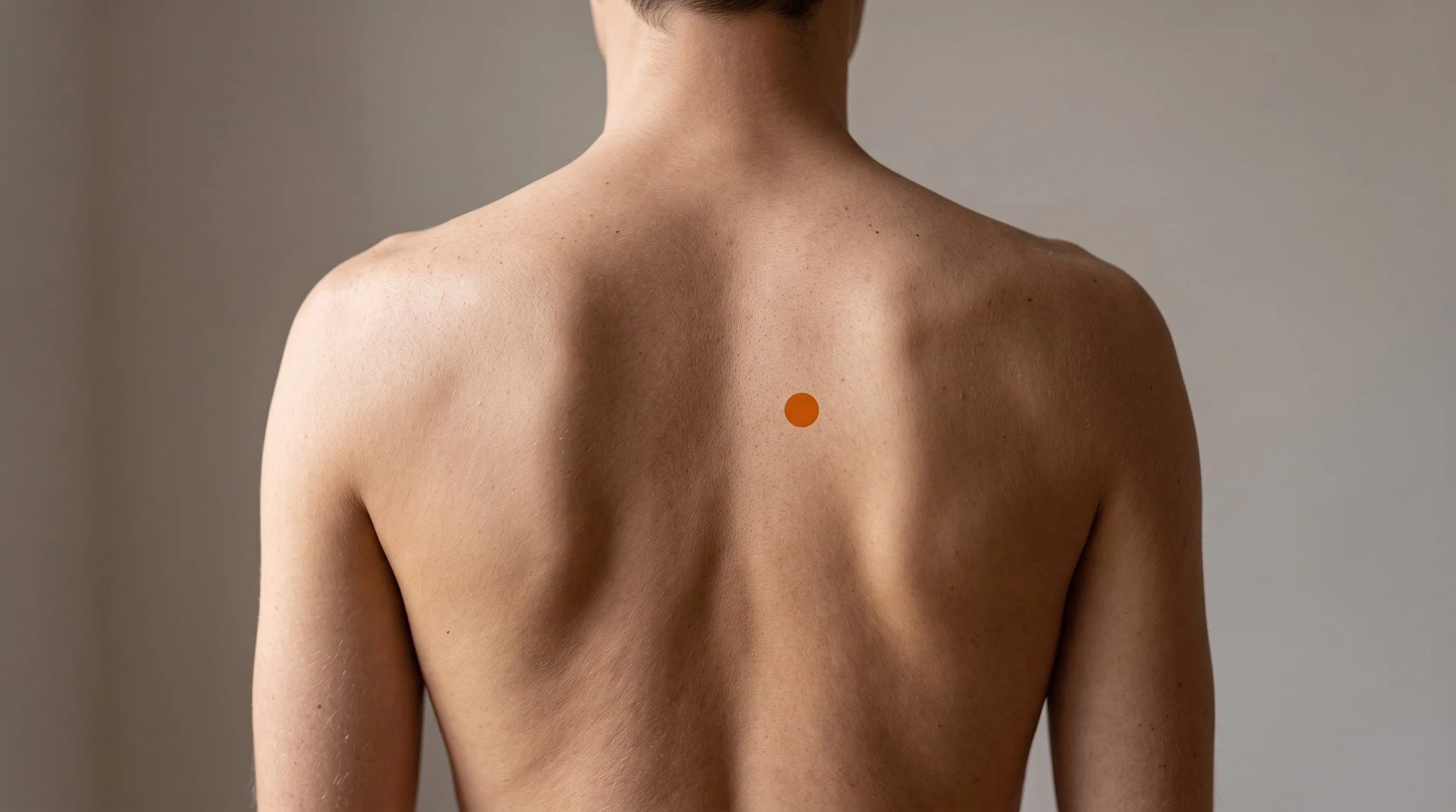
BL13 Acupuncture Point (Feishu)
The Lung Back-Shu Point at T3: Anatomy, Segmental Airway Reflexes, and Why This Upper Back Location Anchors Respiratory Treatment
BL13 (Feishu, often translated as Lung Shu or Lung Back Transporting Point) sits on the upper back, roughly a thumb-and-a-half width (1.5 cun) out from the lower edge of the third thoracic spinous process, at the visible crest of the paraspinal muscles and level with GV12. In classical texts it's the back-shu point of the Lung, the place on the back surface where Lung function was said to be reachable, and it's the point most consistently reached for in traditional respiratory prescriptions (Deadman et al., 2007).
In modern terms, the bl13 acupuncture point is a T3 segmental site: it sits in the same spinal neighborhood that supplies sympathetic outflow to the airways, which is why bladder 13 shows up in study protocols for asthma and COPD and why it doubles as a practical target for the stiff, guarded upper back that makes a full breath feel short.
- Location and layers: bl 13 lung shu is 1.5 cun lateral to the lower border of the T3 spinous process, level with GV12, over the highest visible point of the paraspinal mass (Deadman et al., 2007). The needle passes through skin, trapezius and rhomboid, then thoracic erector spinae, with the pleura and lung lying deep to the adjacent rib interspaces.
- Traditional category: classical sources classify Feishu as the back-shu (back transporting) point of the Lung and attribute to it actions of supporting and regulating Lung function, descending and spreading Lung qi, clearing heat and releasing the exterior (Deadman et al., 2007; Kim, 2008). Those are traditional attributions, not physiological measurements.
- Mechanism: T3 is a segmental match for the airways, and stimulation here recruits dorsal ramus afferents that converge with visceral input in the upper thoracic cord. In an animal model, electroacupuncture at BL13 reduced airway inflammation through a somatosensory to sympathetic pathway involving the intermediolateral cell column and beta-2 adrenergic signaling (Ma et al., 2025).
- Research picture: Cochrane's review of acupuncture for chronic asthma found the trial evidence too limited and inconsistent to support firm recommendations (McCarney et al., 2004), while a placebo-controlled COPD trial that included BL13 in its protocol reported improved dyspnea on exertion alongside standard medication (Suzuki et al., 2012). An overview of systematic reviews found BL13 to be the most frequently used point in COPD trials, with generally low-certainty evidence (Zeng et al., 2024).
- Clinical framing: at Morningside we use BL13 as an adjunct alongside inhalers, medications and pulmonary care, never as a replacement, and often as much for the mechanical side of breathing (rigid thoracic paraspinals, guarded rib motion) as for the classical respiratory indications (Vickers et al., 2018).
- De qi and safety: patients usually report a dull, spreading heaviness across the upper back rather than a sharp sensation. Needling angle matters more here than almost anywhere else, since perpendicular or laterally angled insertion at this level carries real pneumothorax risk, and pneumothorax remains among the most reported serious adverse events in the acupuncture literature (Deadman et al., 2007; He et al., 2012).
Does Your Chest Feel Tight Every Time You Try to Take a Full Breath?
Many of our patients describe a band of tension across the upper back that makes deep breathing feel like work, especially after long desk hours or a lingering respiratory illness. At Morningside Acupuncture we treat BL13 with shallow, spine-directed angles and pair it with dry needling of the rhomboids, mid trapezius and thoracic paraspinals to reduce guarding around the rib cage. Treatment is always positioned alongside your medical care, not instead of it. Schedule a visit and we'll assess how your upper back is limiting your breath.
Schedule NowAnatomy of BL13: Why the T3 Paraspinal Ridge Is Such an Important Location
Put your fingers on the ridge of muscle that runs alongside the spine between the shoulder blades and you're on BL13. From the surface down, the needle meets skin and subcutaneous tissue, then the lower trapezius fibers, then rhomboid major, and then the thoracic erector spinae column (mainly longissimus and iliocostalis) heaped up over the T3 transverse process. This is the tissue that works overtime in anyone who sits with a rounded upper back, holds a phone at chest height, or braces through the shoulders during stressful days. Chronic coughing loads it too, since forceful expiration recruits the thoracic paraspinals and intercostals repeatedly.
The nerve geography is the interesting part. Skin and muscle here are supplied by the medial and lateral branches of the T3 dorsal ramus, and those afferents enter the same upper thoracic cord segments (roughly T1 to T5) that receive visceral input from the trachea, bronchi and lungs, and that send sympathetic fibers out toward the airways. Convergence of somatic and visceral input in shared segments is the standard neurophysiological reading of why a back point at a specific vertebral level was historically tied to a specific organ (Deadman et al., 2007).
Experimental work at this point supports a somato-autonomic route rather than anything mystical: electroacupuncture at BL13 in asthmatic rats activated intermediolateral neurons and sympathetic outflow to lung tissue, with downstream beta-2 adrenergic effects on inflammatory signaling (Ma et al., 2025), and acupuncture at BL13 with ST36 reduced inflammatory cell counts and airway remodeling markers in a chronic asthma model (Nurwati et al., 2019).
Needling also drives A-delta and C-fiber input that engages descending inhibitory pathways from the brainstem, the same system implicated in acupuncture analgesia generally (Zhao, 2008).
Deep to the paraspinal column lie the T3 transverse process, the rib angles, the intercostal spaces and, immediately beneath them, the parietal pleura and lung. The posterior intercostal arteries and their dorsal branches supply the region. This anatomy dictates technique: classical guidance is oblique insertion angled toward the spine at 0.5 to 1 cun, or a shallow transverse-oblique insertion of 1 to 1.5 cun along the muscle, and it warns explicitly that perpendicular needling or needling angled away from the spine carries substantial pneumothorax risk (Deadman et al., 2007).
Other texts give a conservative 0.5 to 0.7 cun oblique depth and note that moxibustion is appropriate here (Kim, 2008). Pneumothorax is consistently reported as one of the most common serious acupuncture complications in review literature, which is a strong argument for treating this point only with a trained, licensed practitioner (He et al., 2012).
Related Back Shu Points Related Bladder ChannelBL13 at a Glance: Classification, Location, and Clinical Use
| Category | Detail |
|---|---|
| Traditional Name | Feishu (Lung Shu, Lung Back Transporting Point) |
| Channel Classification | Bladder channel, inner (medial) back line of the upper thoracic spine (BL13, also written UB13; also called the Urinary Bladder channel) |
| Point Categories | Back-shu (back transporting) point of the Lung; one of the five zang back-shu points that the Illustrated Appendices to the Classic of Categories grouped as draining heat from the five zang (with BL15, BL18, BL20 and BL23); classically paired with the Lung front-mu point LU1 |
| Precise Location | On the upper back, 1.5 cun lateral to the lower border of the T3 spinous process, at the visible highest point of the paraspinal muscle mass, level with GV12 (Shenzhu) |
| Tissue Stimulated | Trapezius and rhomboid major overlying the thoracic erector spinae at T3, with the adjacent rib and intercostal muscles deeper and lateral; commonly needled alongside other tight muscles and trigger points of the upper back |
| Needle Depth / Direction | Oblique toward the spine 0.5 to 1 cun, or transverse-oblique along the muscle 1 to 1.5 cun; perpendicular needling, or oblique needling angled away from the spine, is avoided because of pneumothorax risk; moxibustion is traditionally applied here |
| De Qi Sensation | A dull, heavy, spreading ache across the upper back, sometimes with a warm sensation traveling toward the shoulder blade or around the rib; sharp or electric sensations mean the needle should be adjusted |
| Primary Clinical Uses | Cough, wheezing and asthma patterns alongside standard medical care; breathlessness with a weak voice in classical deficiency presentations; night sweating in classical use; upper back tightness and rib-cage guarding that restrict a full breath |
| Common Point Combinations |
|
Deadman, Al-Khafaji and Baker present Feishu as the pre-eminent point for disorders of the Lung, the surface access point where the back-shu of a yin organ was thought to allow the deepest regulation of that organ. The traditional indication list is unusually broad: cough, wheezing, chest fullness, breathlessness with no desire to speak, coughing phlegm, difficulty breathing when lying flat, fevers with or without sweating, night sweating, tidal fever and spitting of blood, along with wasting conditions the classics called Lung atrophy and consumption.
Because the Lung was held to govern the voice and to dominate the qi of the whole body, a weak, easily tired voice was read as a sign that this point was indicated. The commentary also stretches beyond breathing: nausea and vomiting (through the close descending relationship of Lung and Stomach), skin itching and hives, upper back and shoulder pain, curvature of the upper back in children, and even disturbances of the spirit, since Lung heat was said to reach the Heart readily.
What's striking is how consistently the pattern maps onto one spinal level: a single upper thoracic site collecting breathing, voice, chest, upper back posture and heat symptoms into one prescription, centuries before anyone described segmental innervation.
Why BL13 Is Used for Upper Back Tightness That Makes Deep Breaths Feel Short
Patients often arrive describing something that doesn't fit neatly into either a lung problem or a back problem: the sense that the upper back is a rigid plate and the breath cannot get past it. That description makes anatomical sense. The thoracic paraspinals, rhomboids and intercostals all participate in rib motion, and when they're persistently shortened from posture, stress, coughing or old injury, chest expansion drops and breathing shifts upward into the neck and shoulders.
Needling at BL13 addresses the muscular side directly, and because the T3 segment shares spinal territory with airway afferents and airway-bound sympathetic fibers, the same input has a plausible route to the autonomic side of breathing as well.
Two mechanisms are usually invoked. The first is segmental: needling recruits small-diameter afferents in the T3 dorsal ramus, which converge in the dorsal horn with visceral input, modulating both local muscle tone and reflex activity in the shared segment. The animal work at this specific point supports that reading, showing airway effects mediated through sympathetic outflow rather than any local action on the lung itself (Ma et al., 2025; Nurwati et al., 2019).
The second is systemic: needling engages descending inhibitory control from the periaqueductal grey and rostral ventromedial medulla, along with endogenous opioid signaling, which is the best-supported explanation for acupuncture's effects on pain and muscle guarding (Zhao, 2008).
For the musculoskeletal side of the complaint, the evidence base is stronger than it is for the respiratory side. Individual patient data pooled from high-quality trials found acupuncture superior to both sham and no-acupuncture controls for chronic musculoskeletal pain, with effects persisting over time (Vickers et al., 2018). That's the honest framing we give patients: BL13 may reduce upper back tension and improve how the rib cage moves, and it may add something modest to respiratory care, but the two claims sit on different amounts of evidence.
What the Research Shows for BL13
A caution before the table: almost no trial isolates a single point. Studies of acupuncture for asthma and COPD test multi-point protocols delivered over weeks, and BL13 is typically one of eight to twelve points in the prescription. What the literature can tell us is that this point appears in most respiratory protocols that have been formally studied, that some trials report symptom improvements when acupuncture is added to standard medication, and that overall certainty remains low because of small samples, variable sham controls and inconsistent reporting. None of this supports acupuncture as a substitute for inhalers, bronchodilators or medical management of a respiratory condition.
| Study | Type | Focus | Key Finding |
|---|---|---|---|
| McCarney et al., 2004 | Cochrane systematic review | Acupuncture for chronic asthma | Trials were small, variable in quality and inconsistent in result, so the reviewers concluded there was insufficient evidence to make recommendations. |
| Suzuki et al., 2012 | Randomized placebo-controlled trial | Dyspnea on exertion in COPD, with BL13 among the points used | Patients receiving real acupuncture alongside standard medication reported better post-walk breathlessness scores than the placebo needling group after 12 weeks. |
| Zeng et al., 2024 | Overview of systematic reviews | Acupuncture and related acupoint therapies as adjuncts in COPD | Pooled reviews suggested benefits for lung function and exercise measures, though most reviews were rated low in methodological quality, and BL13 was among the most frequently used points. |
| Ma et al., 2025 | Controlled animal mechanistic study | Electroacupuncture at BL13 in allergic asthmatic rats | Airway inflammation and mucus secretion improved via a somatosensory to sympathetic pathway involving spinal intermediolateral neurons and beta-2 adrenergic signaling. |
| Nurwati et al., 2019 | Controlled animal study | Acupuncture at BL13 and ST36 in a mouse model of chronic asthma | Treated animals showed reduced inflammatory cell infiltration and less airway remodeling than untreated model animals. |
| Vickers et al., 2018 | Individual patient data meta-analysis | Acupuncture for chronic musculoskeletal pain, including back and neck pain | Acupuncture outperformed both sham and no-acupuncture controls, with modest but durable effect sizes, which is relevant to the upper back component of BL13 treatment. |
| He et al., 2012 | Systematic review of adverse events | Safety reporting in the Chinese acupuncture literature | Pneumothorax was among the most frequently reported serious adverse events, underscoring why angle and depth at thoracic points like BL13 matter. |
Cough, Wheeze or Post-Illness Fatigue That Won't Settle?
Feishu has been the anchor point for respiratory patterns in Chinese medicine for centuries, and it appears in most modern acupuncture protocols studied for asthma and COPD. We use it in combination with points like LU9, LU1, ST40 and ST36 depending on your presentation, plus moxibustion when warmth is appropriate. Our licensed acupuncturists will be candid with you about what acupuncture may and may not add to your existing treatment plan. Book a consultation to talk it through.
Schedule NowBL13 in the Context of Trigger Point Work
The feishu point location sits squarely in territory that myofascial pain literature has mapped in detail. Trigger points in rhomboid major, the middle and lower trapezius, the thoracic iliocostalis and serratus posterior superior all refer pain into the region between the spine and the shoulder blade, and serratus posterior superior in particular can produce a deep ache under the scapula that patients sometimes interpret as coming from the lung itself (Simons et al., 1999).
When we palpate BL13 and find a taut, tender band rather than a diffusely tight muscle, that band is usually the practical target, and treating it is the same act whether you call it acupuncture at a back-shu point or dry needling of the thoracic paraspinals.
In a typical Morningside session for someone with a rigid upper back and shallow breathing, we might needle BL13 obliquely toward the spine, then address rhomboids, mid trapezius, the thoracic erector spinae and, when indicated and with extra care, the intercostals, before finishing with breathing work and mobility drills. Angle discipline is non-negotiable in this region: needles stay shallow and directed medially or tangentially, never perpendicular into an interspace, because the pleura lies just beneath (Deadman et al., 2007; He et al., 2012). Patients with thin body types, prior lung surgery or emphysema get an even more conservative approach.
BL13 Breathing and Upper Back Treatment at NYC's Highest-Rated Acupuncture Clinic
Morningside Acupuncture is the highest-rated acupuncture and dry needling clinic in New York City with over 500 five-star Google reviews, and our practitioners treat the thoracic spine and rib cage every single day. We combine classical point selection at BL13 with modern trigger point needling, breathing retraining and manual work to help the upper back move again. Every treatment is delivered with clean-needle technique and careful angling in this sensitive region. Schedule your appointment with us on the Upper West Side.
Schedule NowFrequently Asked Questions
What does BL13 feel like when needled?
Most people feel a dull, heavy, spreading ache across the upper back, sometimes with warmth or a sense of the muscle releasing under the needle. If a taut band is present, you may feel a brief twitch or cramp-like grab that settles within seconds. Because the needle is angled shallowly, the sensation stays fairly superficial. Sharp, burning or electric sensations, or any sudden shortness of breath, should be reported right away so the practitioner can adjust or remove the needle.
Why treat a breathing problem from the back instead of the chest?
Two reasons. Traditionally, the back-shu points were considered the surface access route to the organs, and Feishu was the pre-eminent point for Lung patterns (Deadman et al., 2007). Physiologically, T3 sits in the spinal segments that receive sensory input from the airways and send sympathetic fibers toward them, so stimulation here has a plausible reflex route to airway smooth muscle and airway inflammation, which is what animal work at this point has explored (Ma et al., 2025). There's also a purely mechanical reason: the muscles at this level move the rib cage, and freeing them can make a full breath easier.
Can I press BL13 myself between sessions?
You can, though you'll likely need help or a tool since the spot is hard to reach. Find the bony bump at the base of the neck (C7), count down three vertebrae, then move about two finger widths to the side onto the muscle ridge. Press with a thumb, knuckle or a tennis ball against a wall using firm but comfortable pressure, hold for 30 to 60 seconds per side, and breathe slowly into the area. Two or three rounds, once or twice a day, is plenty. Acupressure is safe here since nothing is penetrating the skin, but stop if pressure provokes pain, numbness or breathlessness, and never attempt self-needling.
Is BL13 safe to needle?
In trained hands, yes, but it's a point that demands respect. The lung lies directly deep to the rib interspaces at this level, and classical guidance is explicit that perpendicular needling, or oblique needling angled away from the spine, carries substantial pneumothorax risk (Deadman et al., 2007). Review literature confirms pneumothorax as one of the most commonly reported serious complications of acupuncture overall (He et al., 2012). Safe practice means shallow oblique or transverse angles directed toward the spine, appropriate needle length, and extra caution in thin patients or anyone with underlying lung disease. This is not a point for untrained hands.
Where exactly is BL13 located?
BL13 is on the upper back, 1.5 cun (about two finger widths for most people) lateral to the lower border of the third thoracic spinous process, level with GV12. A reliable way to find it: locate the prominent C7 vertebra at the neck base, count down three spinous processes to T3, drop to its lower edge, then slide laterally onto the highest visible ridge of the paraspinal muscles. It's found bilaterally and is usually treated on both sides.
References
- Deadman, P., Al-Khafaji, M., & Baker, K. (2009). A manual of acupuncture. Journal of Chinese Medicine Publications.
- Kim, H. (2008). Handbook of Oriental medicine (3rd ed.). Harmony & Balance Press.
- Maciocia, G. (2006). The channels of acupuncture: Clinical use of the secondary channels and eight extraordinary vessels. Churchill Livingstone Elsevier.
- Simons, D. G., Travell, J. G., & Simons, L. S. (1999). Travell & Simons' myofascial pain and dysfunction: The trigger point manual, Vol. 1: Upper half of body (2nd ed.). Williams & Wilkins.
- McCarney, R. W., Brinkhaus, B., Lasserson, T. J., & Linde, K. (2004). Acupuncture for chronic asthma. Cochrane Database of Systematic Reviews, 2004(1), CD000008. https://doi.org/10.1002/14651858.CD000008.pub2
- Suzuki, M., Muro, S., Ando, Y., Omori, T., Shiota, T., Endo, K., Sato, S., Aihara, K., Matsumoto, M., Suzuki, S., Itotani, R., Ishitoko, M., Hara, Y., Takemura, M., Ueda, T., Kagioka, H., Hirabayashi, M., Fukui, M., & Mishima, M. (2012). A randomized, placebo-controlled trial of acupuncture in patients with chronic obstructive pulmonary disease (COPD): The COPD-acupuncture trial (CAT). Archives of Internal Medicine, 172(11), 878-886. https://doi.org/10.1001/archinternmed.2012.1233
- Zeng, Q., Liu, L., Chen, Y., Chen, D., Zhou, Z., Hu, W., Gong, S., He, B., Qi, W., Wang, C., Yang, Z., Yu, S., & Zhao, L. (2024). Efficacy and safety of acupuncture in managing COPD: An overview of systematic reviews. International Journal of Chronic Obstructive Pulmonary Disease, 19, 1721-1739. https://doi.org/10.2147/COPD.S464546
- Ma, H., Liu, X., Cai, H., Yan, Y., Li, W., & Zhao, J. (2025). Electroacupuncture reduced airway inflammation by activating somatosensory-sympathetic pathways in allergic asthmatic rats. Chinese Medical Journal, 138(6), 702-712. https://doi.org/10.1097/CM9.0000000000003074
- Nurwati, I., Purwanto, B., Mudigdo, A., Saputra, K., Prasetyo, D. H., & Muthmainah, M. (2019). Improvement in inflammation and airway remodelling after acupuncture at BL13 and ST36 in a mouse model of chronic asthma. Acupuncture in Medicine, 37(4). https://doi.org/10.1177/0964528418818705
- He, W., Zhao, X., Li, Y., Xi, Q., & Guo, Y. (2012). Adverse events following acupuncture: A systematic review of the Chinese literature for the years 1956-2010. Journal of Alternative and Complementary Medicine, 18(10), 892-901. https://doi.org/10.1089/acm.2011.0825
- Zhao, Z. Q. (2008). Neural mechanism underlying acupuncture analgesia. Progress in Neurobiology, 85(4), 355-375. https://doi.org/10.1016/j.pneurobio.2008.05.004
- Vickers, A. J., Vertosick, E. A., Lewith, G., MacPherson, H., Foster, N. E., Sherman, K. J., Irnich, D., Witt, C. M., & Linde, K. (2018). Acupuncture for chronic pain: Update of an individual patient data meta-analysis. Journal of Pain, 19(5), 455-474. https://doi.org/10.1016/j.jpain.2017.11.005
Disclaimer: This web site is intended for educational and informational purposes only. Reading this website does not constitute providing medical advice or any professional services. This information should not be used for diagnosing or treating any health issue or disease. Those seeking medical advice should consult with a licensed physician. Seek the advice of a medical doctor or other qualified health professional for any medical condition. If you think you have a medical emergency, call 911 or go to the emergency room. No acupuncturist-patient relationship is created by reading this website or using the information. Morningside Acupuncture PLLC and its employees and contributors do not make any express or implied representations with respect to the information on this site or its use. For any legal interpretation of scope of practice in your state, consult a licensed attorney or regulatory authority.
Read more from our blog



