BL23 Acupuncture Point (Shenshu)
The Kidney Shu at the Second Lumbar Level: Anatomy, Segmental Mechanism, and Why This Point Anchors Low Back Pain and Fatigue Treatment
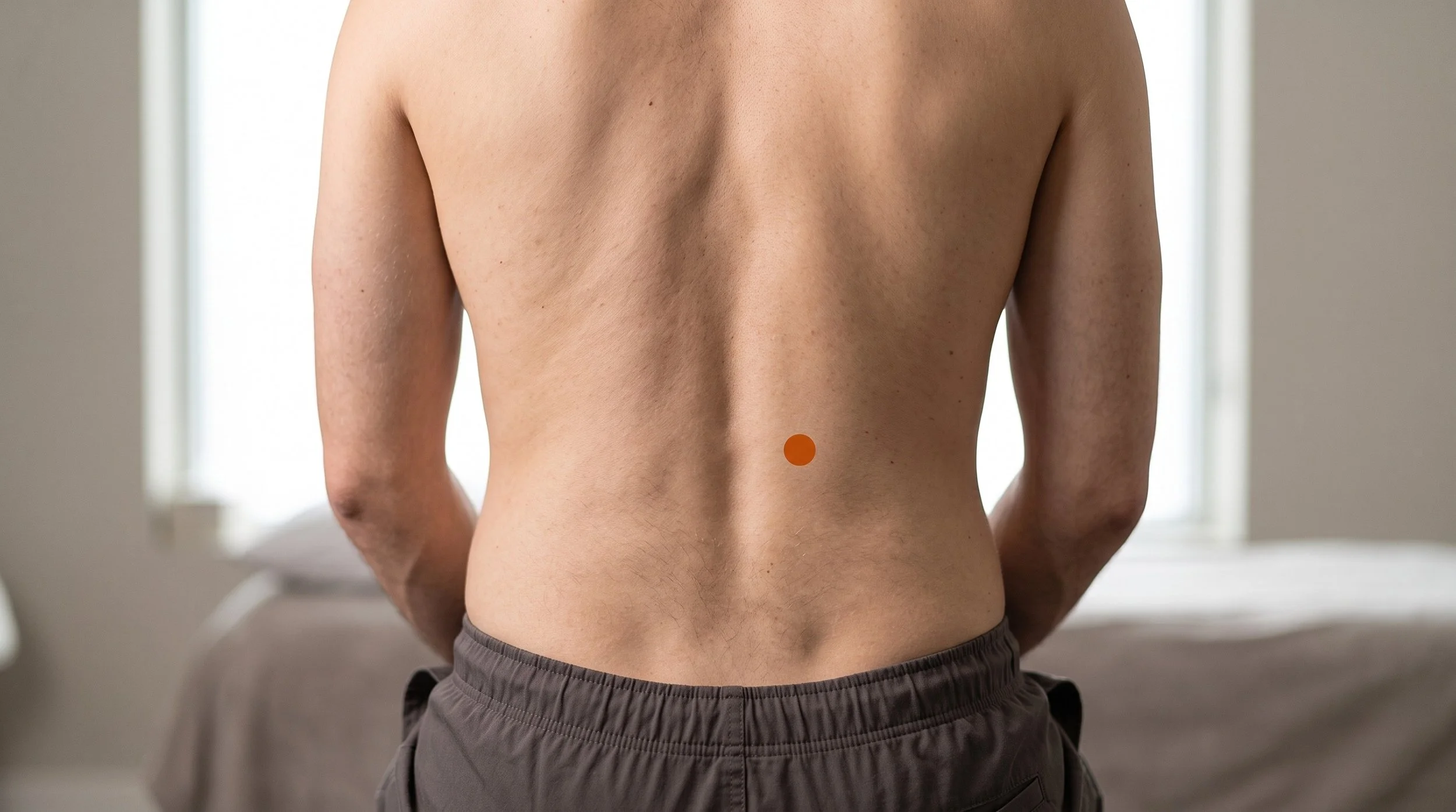
BL23 (Shenshu, translated as Kidney Shu) is the twenty-third point of the Bladder channel and the back-shu (back-transporting) point of the Kidney. In plain terms, the bl 23 point location is on the thick band of low back muscle about 1.5 cun (roughly two finger-widths) lateral to the midline, level with the lower edge of the second lumbar vertebra, at the same height as GV4 on the spine itself. Anyone who has pressed into their own low back after a long day has probably found it: the tender ridge of paraspinal muscle just above the waistline.
Clinically, bladder 23 matters because it sits exactly where mechanical lumbar strain, segmental nerve input from the upper lumbar spine, and the traditional indications for deep constitutional depletion all converge, which is why it appears in treatment plans for low back pain, lumbar stiffness, and persistent fatigue more often than almost any other point on the back.
- BL23 (Shenshu, also written UB23) lies 1.5 cun lateral to the lower border of the L2 spinous process, level with GV4, over the visible bulk of the erector spinae. The needle passes through skin, subcutaneous tissue, and thoracolumbar fascia into longissimus, with quadratus lumborum deeper and more lateral (Deadman et al., 2001).
- Traditionally, BL23 is classified as the back-shu point of the Kidney and is described as strengthening the lumbar region, firming Kidney qi, benefiting essence, warming yang, regulating the water passages, and benefiting the ears and eyes (Deadman et al., 2001; Kim, 2015). These are traditional attributions, not physiological claims.
- Anatomically, the point sits over the posterior rami of the upper lumbar spinal nerves. Neural tracing work at BL23 in animals has shown overlapping sensory and sympathetic innervation shared between this body wall region and the kidney, offering a plausible segmental basis for the historic back-shu to organ pairing (Zhang et al., 2021).
- Needling likely works through several mechanisms at once: local nociceptor and mechanoreceptor input, segmental inhibition in the dorsal horn, and activation of descending pain-modulating pathways using endogenous opioid and monoamine signaling (Zhao, 2008). A small crossover study using BL23 also reported blunted sympathetic and plasma renin responses to standing compared with a sham point, though this is preliminary (Umemoto et al., 2022).
- For the condition most patients bring to us, the evidence base is for whole protocols rather than single points: a Cochrane review of chronic nonspecific low back pain found acupuncture better than no treatment for pain with moderate-certainty evidence, and small, less certain differences against sham and usual care (Mu et al., 2020), while a 2025 Cochrane overview placed acupuncture among the better-supported non-drug options (Rizzo et al., 2025).
- De qi at BL23 usually feels like a deep, dull heaviness or a spreading ache around the flank and belt line, sometimes with a brief muscle twitch if a taut band is engaged. It should not feel electric or shooting, and depth is kept conservative because the kidney lies deep and lateral to this point (Deadman et al., 2001).
Is Your Low Back Pain Not Responding to Stretching and Rest?
Persistent lumbar pain rarely comes from one tissue, which is why we assess the whole region before needling. At Morningside Acupuncture, BL23 is often part of a lumbar treatment that also addresses quadratus lumborum, the erector spinae, and the gluteal muscles with dry needling. We pair that hands-on work with practical loading advice so the relief holds between visits. Schedule an appointment and let's map out what is actually driving your back pain.
Schedule NowAnatomy of BL23: Why the Second Lumbar Level Is Such an Important Location
From the surface inward, a needle at BL23 passes through skin and subcutaneous fat, then the posterior layer of the thoracolumbar fascia, then into the longissimus portion of the erector spinae, with iliocostalis lumborum sitting slightly more lateral. Deeper and further from the midline lies quadratus lumborum, which bridges the twelfth rib, the lumbar transverse processes, and the iliac crest.
This is the region loaded by nearly everything we ask of the low back: standing and walking, lifting and carrying, prolonged sitting with a rounded spine, and the constant low-grade postural work of holding the torso upright. Chronic overload here often produces taut, tender bands that reproduce familiar belt-line aching when pressed, which is one reason the point is so reliably sore in patients with lumbar complaints.
The nerve geography is straightforward and clinically useful. The tissues at BL23 are supplied by the posterior rami of the upper lumbar spinal nerves, whose medial branches serve the paraspinal muscles and overlying skin. Because segmental afferents from deep somatic tissue and from visceral structures can converge on shared dorsal horn neurons, input at a given spinal level may influence how pain and autonomic reflexes are processed at that level.
Neuroanatomical tracing work at BL23 has documented sensory and sympathetic neurons shared between this body wall site and the kidney, which gives a concrete anatomical reading of the classical back-shu relationship (Zhang et al., 2021).
Beyond the segment, needling also recruits supraspinal pain control: descending inhibitory pathways using endogenous opioids, serotonin, and norepinephrine are among the best-characterized mechanisms of acupuncture analgesia (Zhao, 2008). In patients whose lumbar tissue has become sensitized, both effects may matter, since local muscular findings and central sensitivity commonly coexist (Simons et al., 1999).
The important deep structure here is the kidney itself, which sits retroperitoneally with its lower pole in the neighborhood of the L2 level, along with the lumbar arteries and veins running close to the vertebral bodies.
Classical texts flag this directly: deep perpendicular needling at BL23 carries a risk of injuring the kidney (Deadman et al., 2001). Practical conventions follow from that. Insertion is typically perpendicular or angled slightly toward the spine to about 1 to 1.5 cun, with shallower depth in lean patients, the patient positioned prone and breathing normally, and needle depth judged by tissue resistance rather than a fixed number (Deadman et al., 2001; Kim, 2015). Moxibustion and gentle heat are traditionally applied here as well, which is one reason the point is popular in cold, stiff, chronic presentations.
Related Best Acupuncture Points For Back Pain Related Quadratus Lumborum Trigger PointsBL23 at a Glance: Classification, Location, and Clinical Use
| Category | Detail |
|---|---|
| Traditional Name | Shenshu (Kidney Shu), BL23, also written UB23 or Bladder 23 |
| Channel Classification | Bladder channel (foot taiyang), lumbar segment of the inner Bladder line (BL23, also written UB23; also called the Urinary Bladder channel) |
| Point Categories | Back-shu (back-transporting) point of the Kidney, the point traditionally used to regulate and tonify the Kidney zang directly (Deadman et al., 2001; Kim, 2015) |
| Precise Location | 1.5 cun lateral to the lower border of the spinous process of the second lumbar vertebra (L2), level with GV4 on the midline; palpate for the highest point of the paraspinal muscle mass |
| Tissue Stimulated | Thoracolumbar fascia and the longissimus portion of erector spinae, with iliocostalis lumborum lateral and quadratus lumborum deeper and more lateral; posterior rami of the upper lumbar spinal nerves |
| Needle Depth / Direction | Perpendicular, or angled slightly toward the spine, 1 to 1.5 cun depending on body type; deep lateral perpendicular needling is avoided because of the kidney |
| De Qi Sensation | Deep, dull heaviness or a spreading ache around the low back and flank, sometimes with warmth or a brief local twitch; never sharp, electric, or radiating |
| Primary Clinical Uses | Low back pain and lumbar stiffness, fatigue and poor recovery, traditional Kidney support including urinary, reproductive, and ear-related indications |
| Common Point Combinations |
|
In the classical literature summarized by Deadman, Al-Khafaji, and Baker, BL23 is presented as the surface site where the qi of the Kidney zang emerges, and therefore as one of the primary points for reaching that organ at depth. Traditional attributions cluster into recognizable themes: strengthening and warming the lumbar region and knees, firming the holding function associated with urination and reproduction, moving fluid and reducing swelling, warming the uterus and regulating menstruation, supporting inhalation in long-standing cough and wheezing, and benefiting the ears and eyes in deficiency presentations.
Older sources also frame this point as suitable for exhaustion states described as taxation, including emaciation, chronic cold, and depletion after illness or overwork. What is striking about the classical pattern is its logic rather than its breadth: because the Kidney was understood to be the root of constitutional reserve, it was thought to fail only through depletion, never excess, so a single point at the second lumbar level became the standard address for whatever a person had run out of.
Why BL23 Is Used for Fatigue and Deep Lumbar Aching, Not Just Localized Muscle Pain
The first part of the answer is segmental. BL23 sits in tissue supplied by the upper lumbar spinal nerves, and afferents from deep muscle, fascia, joints, and nearby viscera converge onto shared neurons in the dorsal horn at those levels. That convergence explains a common clinical experience: pain in this belt of the low back is often diffuse, hard to point to, and accompanied by a sense of heaviness rather than a sharp local pinch. Needling the same segment gives the nervous system a strong, well-localized input that can compete with and dampen ongoing nociceptive traffic from that region.
Tracing studies at BL23 have shown that sensory and sympathetic neurons serving this body wall site overlap with those serving the kidney, which suggests why back-shu points were historically matched to specific organs (Zhang et al., 2021).
The second part is systemic. Acupuncture analgesia involves descending pathways from the brainstem that use endogenous opioid, serotonergic, and noradrenergic signaling to reduce spinal transmission, along with changes in autonomic tone (Zhao, 2008). This is why patients frequently report a shift in overall state during a session, a settling, drowsy calm, rather than only a change at the needle site.
A small crossover study in healthy volunteers found that needling BL23 blunted the expected rise in sympathetic activity and plasma renin concentration on standing, an effect not seen at a sham point (Umemoto et al., 2022). That work is preliminary and needs replication, but it lines up with what clinicians observe: lumbar back-shu needling often produces a distinctly relaxing, autonomic response.
Put together, this is a reasonable way to understand why BL23 appears in treatments for fatigue, poor recovery, and that vague sense of a weak low back, without appealing to energy flowing through channels. The point gives dense segmental input to a heavily loaded region while also engaging the body's own pain and stress modulation systems.
For patients, the useful expectation is gradual: less lumbar guarding, better tolerance for sitting and lifting, and often improved sleep, built over a course of treatments rather than one visit.
What the Research Shows for BL23
It is worth being clear about what the research does and does not test. Trials almost never study BL23 by itself; they study multi-point protocols for a condition, and BL23 is one of the most frequently included local points in lumbar formulas. So the honest reading is that the evidence supports acupuncture treatment for low back pain, with BL23 as a standard component, rather than proving anything unique about this single site. Point-specific physiological studies exist and are interesting, but they are small and mechanistic rather than clinical.
| Study | Type | Focus | Key Finding |
|---|---|---|---|
| Mu et al., 2020 | Cochrane systematic review (33 trials, 8270 participants) | Acupuncture for chronic nonspecific low back pain | Compared with no treatment, moderate-certainty evidence suggested acupuncture improved pain to a clinically relevant degree, while differences against sham and usual care were smaller and of lower certainty. |
| Rizzo et al., 2025 | Cochrane overview of reviews | Non-drug, non-surgical treatments for low back pain in adults | Acupuncture emerged as one of the better-supported conservative options for chronic low back pain, though effect sizes across non-drug therapies were generally modest. |
| Vickers et al., 2018 | Individual patient data meta-analysis (about 20,800 patients) | Acupuncture for chronic pain including back and neck pain | Acupuncture was associated with greater pain reduction than sham and no-acupuncture controls, with effects that appeared to persist over about 12 months. |
| Hu et al., 2018 | Systematic review and meta-analysis | Dry needling of lumbar musculature for low back pain | Dry needling reduced pain and disability immediately after treatment compared with several controls, though study quality was limited and follow-up effects were less clear. |
| Zhang et al., 2021 | Animal neuroanatomical tracing study | Sensory and sympathetic innervation shared by BL23 and the kidney | Overlapping neurons were identified in dorsal root ganglia and the sympathetic chain, suggesting peripheral pathways by which back-shu point stimulation may influence its paired organ. |
| Umemoto et al., 2022 | Randomized crossover study in healthy volunteers | BL23 needling, heart rate variability, and plasma renin concentration during standing | Needling BL23 was associated with a blunted sympathetic and renin response to standing that was not seen with sham needling, a small preliminary finding requiring replication. |
Tired, Achy, and Feeling Depleted After Months of Stress?
Traditionally, BL23 was chosen for exactly this picture: a low back that feels weak and cold, low stamina, and poor recovery. We use it alongside points like KI3 and ST36 in treatments designed to calm sympathetic arousal and improve sleep and energy, while still respecting what the research can and cannot show. Many New Yorkers notice they simply recover better between workouts and workweeks. Book a session and we'll build a plan around your pattern.
Schedule NowBL23 in the Context of Trigger Point Work
Acupuncture, defined simply as treatment with an acupuncture needle, covers hundreds of styles, and dry needling is one of them. At BL23 the two approaches overlap almost perfectly, because the classical location sits directly over tissue that commonly harbors taut, tender bands: the longissimus and iliocostalis portions of the lumbar erector spinae, with quadratus lumborum deeper and lateral.
Trigger points in these muscles are well described as referring pain across the low back, into the iliac crest, and sometimes toward the buttock or groin, which mirrors the diffuse belt-line ache patients describe when they push on this spot (Simons et al., 1999).
In practice at Morningside, we palpate before we needle. If the tissue at and around BL23 feels ropey and reproduces the patient's familiar pain, we treat it as a myofascial target and may use a slight change in angle or depth to engage the band, sometimes eliciting a local twitch response, while keeping the needle away from the deep lateral region near the kidney. That work is then combined with dry needling of gluteus medius, the deeper lumbar paraspinals, and psoas or quadratus lumborum when the exam points there, plus classical distal points such as BL40 to broaden the treatment.
The goal is not to choose between traditional point selection and trigger point needling but to let the anatomy and the exam decide which one the needle is serving on that day.
BL23 Low Back Pain Treatment at NYC's Highest-Rated Acupuncture Clinic
Morningside Acupuncture is the highest-rated acupuncture and dry needling clinic in New York City with over 500 five-star Google reviews. Our licensed acupuncturists combine classical point selection, including back-shu points like BL23, with myofascial trigger point needling and movement guidance. Every treatment is tailored to your exam findings rather than a fixed protocol. Schedule your visit at our Upper West Side clinic today.
Schedule NowFrequently Asked Questions
What does BL23 feel like when needled?
Most people feel a deep, dull heaviness or a spreading ache that fans out across the low back and toward the flank, sometimes with a sensation of warmth. If a taut muscular band is engaged, there can be a brief twitch or a cramp-like grab that eases within seconds. What you should not feel is a sharp, electric, or shooting sensation down the leg. Tell your acupuncturist right away if you do, and the needle will be adjusted or removed.
Why needle the low back for fatigue rather than only for pain?
The tissue at BL23 shares spinal segments with structures of the upper lumbar region, and needling there provides dense sensory input to a heavily loaded area while also engaging descending pain and stress modulation systems that involve endogenous opioid and monoamine signaling (Zhao, 2008). A small crossover study found that BL23 needling blunted the sympathetic and renin response to standing compared with a sham point, which fits the calm, settled feeling many patients report (Umemoto et al., 2022). Traditionally, this point was the standard address for depletion and exhaustion states, and that classical use is presented here as a historical attribution rather than a proven physiological claim.
Can I press BL23 myself between sessions?
Yes, and it is one of the easier points to self-treat. Stand or sit upright, place your thumbs on either side of your spine about two finger-widths out, roughly level with the bottom of your ribcage waistline where your low back curves in most. Press firmly inward and slightly toward the spine until you feel a satisfying ache at about 4 to 6 out of 10 intensity, hold for 30 to 60 seconds while breathing slowly, then release. Repeat two or three times per side, once or twice a day, and consider a heating pad over the area for 10 to 15 minutes afterward. Stop if pressure produces sharp pain, numbness, or leg symptoms, and skip self-pressure over bruised, inflamed, or recently injured tissue.
Is BL23 safe to needle?
In trained hands, yes. The main consideration is depth: the kidney lies deep and lateral to this point, and classical texts specifically caution against deep perpendicular needling here (Deadman et al., 2001). Licensed practitioners manage this by using conservative depths of roughly 1 to 1.5 cun, angling slightly toward the spine, adjusting for body size, and using single-use sterile needles. Expected side effects are minor, such as brief soreness or a small bruise. Let your practitioner know if you are on blood thinners, are pregnant, have a single functioning kidney, or have had lumbar surgery or hardware placed, since technique will be modified accordingly.
Where exactly is BL23 located?
BL23 is 1.5 cun lateral to the lower border of the spinous process of the second lumbar vertebra, level with GV4 on the midline. A practical way to find it is to locate the highest ridge of the paraspinal muscle in the low back, roughly two finger-widths from the spine, just above the waistline and below the level of the twelfth rib. On most people it is noticeably tender to firm pressure, especially if the low back has been overloaded, which is often how bladder 23 is confirmed by palpation.
References
- Deadman, P., Al-Khafaji, M., & Baker, K. (2009). A manual of acupuncture. Journal of Chinese Medicine Publications.
- Kim, H. (2008). Handbook of Oriental medicine (3rd ed.). Harmony & Balance Press.
- Maciocia, G. (2005). The foundations of Chinese medicine: A comprehensive text for acupuncturists and herbalists (2nd ed.). Elsevier Churchill Livingstone.
- Simons, D. G., Travell, J. G., & Simons, L. S. (1999). Travell & Simons' myofascial pain and dysfunction: The trigger point manual, Vol. 1: Upper half of body (2nd ed.). Williams & Wilkins.
- Mu, J., Furlan, A. D., Lam, W. Y., Hsu, M. Y., Ning, Z., & Lao, L. (2020). Acupuncture for chronic nonspecific low back pain. Cochrane Database of Systematic Reviews, 12(12), CD013814. https://doi.org/10.1002/14651858.CD013814
- Rizzo, R. R. N., Cashin, A. G., Wand, B. M., Ferraro, M. C., Sharma, S., Lee, H., O'Hagan, E., Maher, C. G., Furlan, A. D., van Tulder, M. W., & McAuley, J. H. (2025). Non-pharmacological and non-surgical treatments for low back pain in adults: An overview of Cochrane reviews. Cochrane Database of Systematic Reviews, 3(3), CD014691. https://doi.org/10.1002/14651858.CD014691.pub2
- Vickers, A. J., Vertosick, E. A., Lewith, G., MacPherson, H., Foster, N. E., Sherman, K. J., Irnich, D., Witt, C. M., & Linde, K. (2018). Acupuncture for chronic pain: Update of an individual patient data meta-analysis. Journal of Pain, 19(5), 455-474. https://doi.org/10.1016/j.jpain.2017.11.005
- Zhao, Z. Q. (2008). Neural mechanism underlying acupuncture analgesia. Progress in Neurobiology, 85(4), 355-375. https://doi.org/10.1016/j.pneurobio.2008.05.004
- Zhang, Z., Xu, D., Wang, J., Cui, J., Wu, S., Zou, L., Shen, Y., Jing, X., & Bai, W. (2021). Correlated sensory and sympathetic innervation between the acupoint BL23 and kidney in the rat. Frontiers in Integrative Neuroscience, 14, 616778. https://doi.org/10.3389/fnint.2020.616778
- Umemoto, K., Hayashi, T., Fukushige, K., Hirai, S., Terayama, H., Sakabe, K., & Naito, M. (2022). Specific acupuncture stimulation of Shenshu (BL23) affects sympathetic nervous activity-associated plasma renin concentration changes. Journal of Traditional Chinese Medicine, 42(2), 250-255. https://doi.org/10.19852/j.cnki.jtcm.2022.02.005
- Hu, H. T., Gao, H., Ma, R. J., Zhao, X. F., Tian, H. F., & Li, L. (2018). Is dry needling effective for low back pain? A systematic review and PRISMA-compliant meta-analysis. Medicine (Baltimore), 97(26), e11225. https://doi.org/10.1097/MD.0000000000011225
Disclaimer: This web site is intended for educational and informational purposes only. Reading this website does not constitute providing medical advice or any professional services. This information should not be used for diagnosing or treating any health issue or disease. Those seeking medical advice should consult with a licensed physician. Seek the advice of a medical doctor or other qualified health professional for any medical condition. If you think you have a medical emergency, call 911 or go to the emergency room. No acupuncturist-patient relationship is created by reading this website or using the information. Morningside Acupuncture PLLC and its employees and contributors do not make any express or implied representations with respect to the information on this site or its use. For any legal interpretation of scope of practice in your state, consult a licensed attorney or regulatory authority.
Read more from our blog