BL20 Acupuncture Point (Pishu)
The Spleen Back-Shu Point at T11: Anatomy, Segmental Reflexes, and Why Bladder 20 Anchors Treatment for Weak Digestion and Mid Back Tension
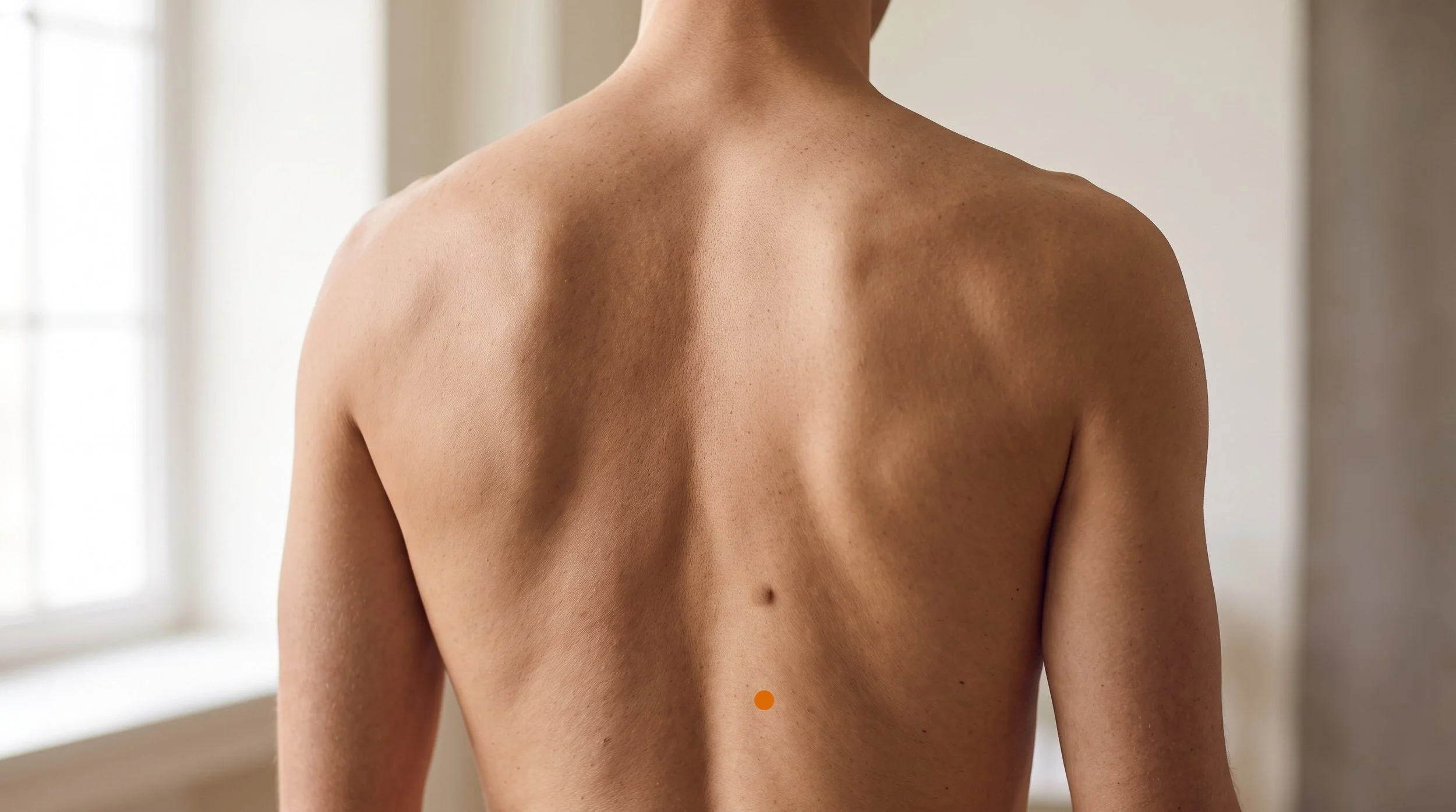
BL20, known as Pishu (often translated as Spleen Shu or the Spleen Back-Transporting point), sits on the mid back, roughly a thumb-and-a-half width out from the lower edge of the eleventh thoracic spinous process, right where the paraspinal muscles bulge highest under your fingers. In classical texts it's the surface access point for the Spleen, the organ system traditionally held responsible for turning food into usable energy, which is why the bl20 acupuncture point shows up in almost every historical formula for poor appetite, bloating after meals, loose stools and the heavy, foggy fatigue that goes with them.
Read through a modern lens, bladder 20 is a lower thoracic segmental point: the tissue there shares spinal levels with the autonomic supply to the upper digestive tract, and it also happens to be a common site of stubborn thoracolumbar muscle tension. That double identity, visceral and musculoskeletal, is what makes it so useful in clinic.
- Location and layers: BL20 lies 1.5 cun lateral to the lower border of the T11 spinous process, level with GV6, and is best found at the visible peak of the paraspinal mass; the needle passes skin and thoracolumbar fascia before reaching longissimus, iliocostalis and multifidus (Deadman et al., 2007).
- Traditional categories, translated: classical sources list BL20 as the back-shu point of the Spleen and credit it with strengthening digestion, resolving dampness, raising qi and holding blood in the vessels (Deadman et al., 2007). These are traditional attributions describing recognizable clinical patterns (poor appetite with fatigue, heaviness, loose stools), not claims about a literal substance moving through channels.
- Mechanism: the point sits in the T11 to T12 dorsal ramus territory, a segmental field that overlaps with the splanchnic autonomic supply to the stomach and proximal gut, so needling here can plausibly influence gastric tone and sensation through somato-autonomic reflexes rather than any local effect on the abdomen itself (Ma, 2020; Guo et al., 2020).
- The research picture: meta-analyses of acupuncture for functional dyspepsia report symptom and quality-of-life improvements against sham and usual care with moderate to high certainty in the most recent update, though protocols always use point groups rather than BL20 alone (Li et al., 2026; Pang et al., 2016). Cochrane's IBS review is more restrained, finding no clear benefit over sham (Manheimer et al., 2012).
- Clinical framing: BL20 is a supporting anchor, not a solo act. It's typically paired with BL21 and with distal points such as ST36, and the same needle often addresses genuine paraspinal tenderness at the thoracolumbar junction (Vickers et al., 2018; Simons et al., 1999).
- De qi at BL20 is usually a deep, dull, slightly heavy ache with a sense of the muscle gripping the needle, sometimes spreading a few inches sideways toward the lower ribs. Sharp, electric or radiating sensations aren't the goal and mean the angle should change.
Bloated After Every Meal and Tired by Mid-Afternoon?
Digestive complaints that don't show up on a scope can still be miserable, and they often travel with mid back tightness and low energy. At Morningside Acupuncture we use BL20 alongside points like BL21, CV12 and ST36, with gentle oblique needling into the T11 paraspinals and, where appropriate, warming techniques that patients find calming. Sessions are quiet, unhurried and built around what your symptoms actually do across a week. Schedule a visit and let's map your pattern.
Schedule NowAnatomy of BL20: Why the T11 Paraspinal Level Is Such an Important Location
Run your fingers down the spine until you reach the lowest ribs, then move about an inch and a half to either side and you'll feel the paraspinal muscles rise into a firm ridge. That ridge, level with the lower edge of the T11 spinous process and with GV6 on the midline, is where BL20 is located (Deadman et al., 2007). Under the skin sits a surprisingly thick sheet of thoracolumbar fascia, and beneath that the longissimus and iliocostalis columns, with multifidus tucked closer to the lamina.
This is a working zone: it stabilizes the transition between the mobile thoracic cage and the lumbar spine, absorbs load during lifting and rotation, and stiffens up during long hours of desk posture. Palpable tenderness here is extremely common, which is part of why pishu point location is easy to teach and easy to confirm.
The nerve supply comes from the posterior rami of the lower thoracic nerves, with medial cutaneous branches superficially and lateral branches deeper. What makes this level clinically interesting is what else uses those spinal segments. Sympathetic outflow to the stomach, duodenum and upper small intestine leaves the cord through the lower thoracic levels and travels via the splanchnic nerves, so somatic input from the T11 region and visceral input from the upper gut arrive in overlapping territory in the dorsal horn.
Experimental work on somato-autonomic reflexes shows that stimulating body wall tissue can shift gastric motility and autonomic tone through exactly these pathways, with the direction of the effect depending on where and how strongly you stimulate (Ma, 2020). Alongside that segmental story, needling recruits the descending pain-modulating systems that dampen dorsal horn transmission more broadly (Zhao, 2008), which may be one reason a back point can ease both muscular soreness and diffuse abdominal discomfort in the same visit.
Deep to the muscle at this level lies the vertebral lamina medially and, moving laterally, the lower ribs and the pleural reflection. Classical needling instructions are unusually emphatic here for good reason: BL20 should be angled obliquely toward the spine at 0.5 to 1 cun, or threaded transversely 1 to 1.5 cun, because perpendicular needling or oblique needling angled away from the spine carries a real risk of pneumothorax (Deadman et al., 2007). The kidney also lies deep and lateral in this general region, another reason directional discipline matters.
In practice, a trained clinician tents the tissue, aims medially, and works within the muscle belly rather than driving toward the chest wall, which keeps the technique both safe and comfortable.
Related Back Shu Points Related Bladder ChannelBL20 at a Glance: Classification, Location, and Clinical Use
| Category | Detail |
|---|---|
| Traditional Name | Pishu (Spleen Shu), the Spleen Back-Transporting point |
| Channel Classification | Bladder channel, inner (medial) back line, lower thoracic region (BL20, also written UB20; also called the Urinary Bladder channel) |
| Point Categories | Back-shu point of the Spleen; listed in the Illustrated Supplement to the Classic of Categories among five back-shu points (with BL13, BL15, BL18 and BL23) traditionally said to drain heat from the five zang; no five-shu, hui-meeting or extraordinary vessel designations |
| Precise Location | On the mid back, 1.5 cun lateral to the lower border of the T11 spinous process, level with GV6, at the visible highest point of the paraspinal muscles |
| Tissue Stimulated | Skin, thoracolumbar fascia, then longissimus, iliocostalis thoracis and multifidus at T11; the intercostal muscles and lower rib attachments lie just lateral, and the region is a frequent target in trigger point and tight muscle work |
| Needle Depth / Direction | Oblique toward the spine, 0.5 to 1 cun, or transverse-oblique 1 to 1.5 cun. Perpendicular insertion, or oblique insertion angled away from the spine, carries a substantial pneumothorax risk and is avoided |
| De Qi Sensation | Deep dull ache with a heavy, grabbing quality in the paraspinal muscle, sometimes spreading laterally toward the lower ribs; occasionally a warm, settling sensation through the mid back |
| Primary Clinical Uses | Weak digestion with bloating and poor appetite, loose stools and undigested food patterns in classical use, fatigue and heaviness accompanying digestive weakness, thoracolumbar back tension |
| Common Point Combinations |
|
Deadman's Manual of Acupuncture presents BL20 as the point where the Spleen system reaches the body surface, and the indication list is one of the most coherent in the back-shu series: abdominal distention and pain, poor appetite, undigested food in the stools, diarrhea, jaundice, swelling, and a striking cluster of fatigue terms including sleepiness, bodily heaviness and no inclination to move the limbs.
Alongside these, classical sources attribute to it a role in chronic bleeding of many kinds and in prolapse, on the traditional logic that the Spleen both holds blood within the vessels and lifts structures upward. There's also the odd and memorable entry about staying thin despite eating a great deal, which Li Dong-yuan's Treatise on the Spleen and Stomach explained as heat in the Stomach driving appetite while a depleted Spleen fails to build flesh (Deadman et al., 2007).
These are traditional attributions rather than physiological claims, but what's striking is the pattern recognition underneath: centuries before anyone described gut-brain signaling, clinicians were grouping poor appetite, altered stools, bloating, heaviness and low energy into a single treatable picture, and locating its access point on the back at the level that shares nerve segments with the upper digestive tract.
Why BL20 Is Used for Bloating and Fatigue That Show Up as Mid Back Tightness
Patients are often puzzled that a point on the back gets used for symptoms in the belly. The explanation is segmental. Sensory nerves from the skin and muscle around T11 and sensory nerves from the stomach and upper intestines feed into the same neighborhood of the spinal cord, and the sympathetic nerves that regulate those organs leave the cord at nearby levels. When two inputs converge, stimulating one can change how the nervous system processes the other.
This is the basis of somato-autonomic reflexes, which have been documented in detail: body wall stimulation can measurably alter gastric motility and autonomic balance, with the response depending on the region stimulated and the intensity used (Ma, 2020; Guo et al., 2020). It also explains the reverse experience many people report, where a stretch of persistent digestive trouble leaves the mid back feeling tight and tender.
Animal research gives some direct support for back points specifically. Studies stimulating the gastric back-shu point BL21, the immediate neighbor of BL20 one vertebra below, found changes in gastric motility that appear to run through brainstem vagal circuitry, with combined back and abdominal point stimulation producing a larger effect than either alone (Wang et al., 2015). That's laboratory work in rats, and it shouldn't be read as proof of what happens in a person with bloating, but it does show a plausible route from a needle in the lower thoracic paraspinals to a change in how the stomach behaves.
On top of the segmental story, needling recruits descending inhibitory pathways from the brainstem that reduce transmission of nociceptive signals across many segments, along with endogenous opioid mechanisms (Zhao, 2008). For a patient whose complaint is a mix of visceral discomfort, referred soreness and genuinely irritable paraspinal muscle, that broader modulation may matter as much as the local effect. It's also why treatment at BL20 frequently leaves people feeling settled and slightly sleepy, a shift in autonomic tone rather than anything specific to digestion.
What the Research Shows for BL20
A word of caution before the evidence table. No good clinical trial has ever tested BL20 by itself, and none realistically will. Acupuncture research studies whole protocols, and BL20 typically appears inside a group of points chosen for digestive complaints, most often with BL21, CV12, ST36 and PC6. So the studies below tell us something about the treatment approach BL20 belongs to, not about the point in isolation. The picture is genuinely mixed: functional dyspepsia research has become moderately encouraging, while the Cochrane review of acupuncture for IBS did not find benefit over sham.
Read alongside that, mechanistic and animal studies suggest the back-shu region has plausible access to gastric regulation, which is a reason to keep using these points thoughtfully rather than a reason to promise outcomes.
| Study | Type | Focus | Key Finding |
|---|---|---|---|
| Li et al., 2026 | Systematic review and meta-analysis (23 RCTs, 2,454 participants) | Acupuncture for functional dyspepsia | Reported that acupuncture probably improves dyspepsia symptoms and quality of life compared with sham, with moderate to high certainty evidence and no signal of increased adverse events. |
| Pang et al., 2016 | Systematic review and meta-analysis (16 RCTs, 1,436 participants) | Manual acupuncture and electroacupuncture for functional dyspepsia | Found improvements in dyspepsia indices and in postprandial fullness and early satiation, while noting that most included trials were of low methodological quality. |
| Manheimer et al., 2012 | Cochrane systematic review (17 RCTs, 1,806 participants) | Acupuncture for irritable bowel syndrome | Did not find acupuncture superior to sham for IBS symptom severity, though benefit over no specific treatment was seen, which the authors attributed partly to nonspecific effects. |
| Guo et al., 2020 | Systematic review of clinical and mechanistic studies | Effects and mechanisms of acupuncture and electroacupuncture in functional dyspepsia | Summarized evidence that stimulation can influence gastric accommodation, motility and autonomic balance, while noting substantial heterogeneity across studies. |
| Wang et al., 2015 | Controlled animal study (rats) | Electroacupuncture at the gastric back-shu point BL21 with CV12 | Observed changes in gastric motility associated with brainstem vagal circuitry, with back and abdominal point stimulation together producing a greater effect than either alone. |
| Ma, 2020 | Narrative review of neurophysiology | Somato-autonomic reflexes underlying acupuncture effects | Describes how stimulation at different body regions and intensities drives distinct sympathetic or vagal reflexes affecting gastrointestinal function. |
| Vickers et al., 2018 | Individual patient data meta-analysis (about 20,800 patients) | Acupuncture for chronic pain including chronic back pain | Found modest but persistent benefits over sham and usual care, relevant to the musculoskeletal component often treated at BL20. |
Is Your Mid Back Tension Tied to Your Gut?
Patients often arrive describing a band of tightness at the thoracolumbar junction that flares when digestion is off, or after long weeks hunched over a laptop. Because BL20 sits directly over that segment, one needle can address both the tender paraspinal tissue and the segmental input that feeds visceral discomfort. We combine point-based acupuncture with dry needling of the erector spinae and multifidus when the exam calls for it. Book an appointment and we'll assess both layers.
Schedule NowBL20 in the Context of Trigger Point Work
The T11 paraspinal level is a busy myofascial zone. Longissimus and iliocostalis thoracis run directly beneath BL20, with multifidus deeper and closer to the lamina, and taut bands in these muscles refer pain in patterns that patients often describe as a belt of soreness across the mid back or a nagging ache that drifts toward the flank and lower back (Simons et al., 1999). Because the point and the muscle occupy the same real estate, a needle placed at BL20 with oblique medial angulation frequently engages exactly the tissue that's tender on exam.
When that happens, patients feel a distinct twitch or grabbing sensation, and the treatment is doing two jobs at once: addressing the local muscular contribution and providing segmental input at a level tied to upper digestive territory.
At Morningside Acupuncture we treat this region with the same directional caution regardless of framework, since dry needling and point-based acupuncture both use an acupuncture needle and both face the same rib cage below. Depending on findings, we may combine BL20 with dry needling of the thoracolumbar erector spinae, quadratus lumborum and the lower intercostals, add BL21 and BL23 along the same line, and use distal points such as ST36 to round out a digestive-focused plan.
For patients whose main complaint is back pain rather than digestion, BL20 usually functions as one node in a broader thoracolumbar treatment rather than the centerpiece.
BL20 Digestive and Mid Back Treatment at NYC's Highest-Rated Acupuncture Clinic
Morningside Acupuncture is the highest-rated acupuncture and dry needling clinic in New York City with over 500 five-star Google reviews, and our Upper West Side practice sees a steady stream of patients with functional digestive complaints, IBS-type symptoms and thoracolumbar tension. Treatment plans are conservative, evidence-informed and explained in plain language, so you always know why a given point is being used. Whether BL20 is a small part of your plan or a central one, you'll leave understanding the reasoning. Schedule your first session today.
Schedule NowFrequently Asked Questions
What does BL20 feel like when needled?
Most people describe a deep, dull, heavy ache in the muscle beside the spine, sometimes with a sense of the tissue gripping the needle. If the paraspinals are ropy or tender, you may feel a brief twitch and then a noticeable softening. Some patients feel the sensation spread sideways toward the lower ribs, and many feel calm or a little drowsy within a few minutes, which reflects a shift in autonomic tone. Sharp, burning or electric sensations are not the goal and should prompt your clinician to adjust the angle or depth immediately.
Why treat a point on my back for bloating and appetite problems?
Because the nervous system doesn't organize itself the way our symptom maps do. Sensory nerves from the skin and muscle at the T11 level and sensory nerves from the stomach and upper intestines converge in overlapping territory in the spinal cord, and the autonomic nerves that regulate those organs exit at nearby levels. Stimulating the body wall in that segment can therefore influence gastric activity and autonomic balance through somato-autonomic reflexes (Ma, 2020; Guo et al., 2020). Classical medicine reached the same practical conclusion by observation, calling BL20 the back access point for the Spleen system and using it for exactly these complaints (Deadman et al., 2007).
Can I press BL20 myself between sessions?
Yes, though reaching it takes a little creativity. Find your lowest ribs at the back, then move about an inch and a half out from the spine and slightly upward until you feel the firmest ridge of muscle. You can press with your thumbs, lean a tennis or lacrosse ball against a wall at that spot, or ask a partner to apply steady pressure. Use firm, tolerable pressure (roughly a 4 to 6 out of 10) for 30 to 60 seconds per side, breathing slowly, and repeat two or three times, once or twice daily. A warm pack over the same area for 10 to 15 minutes after meals is another option patients find comfortable. Stop if pressure causes sharp pain, and don't use ball pressure directly over the spine itself.
Is BL20 safe to needle?
It's safe in trained hands and genuinely risky in untrained ones, which is why technique matters more here than at most points. Classical instruction is explicit: needle obliquely toward the spine at 0.5 to 1 cun, or thread transversely 1 to 1.5 cun, and avoid perpendicular insertion or oblique insertion angled away from the spine, both of which carry substantial pneumothorax risk (Deadman et al., 2007). The kidney also sits deep and lateral in this region. Licensed practitioners work within the muscle belly with medial angulation, use appropriate needle lengths, and screen for factors such as anticoagulant use, low body mass, prior thoracic surgery and pregnancy. This is not a point for self-needling under any circumstances.
Where exactly is BL20 located?
Sit or lie face down and trace down the spine until you reach the level of the lowest ribs. The eleventh thoracic spinous process sits just above that, and BL20 is 1.5 cun (about a thumb-and-a-half width, using your own hand as the ruler) lateral to its lower border, level with GV6 on the midline. The most reliable confirmation is tactile: the point sits at the visible highest point of the paraspinal muscle ridge, and in most people it's slightly tender to firm pressure. BL21 lies one vertebra below at T12, and BL19 one above at T10, so counting ribs is the simplest way to keep the bl 20 Spleen Shu level straight.
References
- Deadman, P., Al-Khafaji, M., & Baker, K. (2009). A manual of acupuncture. Journal of Chinese Medicine Publications.
- Cheng, X. (Ed.). (1999). Chinese acupuncture and moxibustion (Rev. ed.). Foreign Languages Press.
- Simons, D. G., Travell, J. G., & Simons, L. S. (1999). Travell & Simons' myofascial pain and dysfunction: The trigger point manual, Vol. 1: Upper half of body (2nd ed.). Williams & Wilkins.
- Li, X. X., Hu, Z. Y., Li, Z. C., Tang, J., Liu, Y. Y., Zeng, D. H., Zhou, Q. Q., Ma, W. B., Lan, L., & Wang, L. (2026). Efficacy and safety of acupuncture for functional dyspepsia: An updated meta-analysis of randomized controlled trials. Frontiers in Medicine, 13, 1718632. https://doi.org/10.3389/fmed.2026.1718632
- Pang, B., Jiang, T., Du, Y. H., Li, J., Li, B., Hu, Y. C., & Cai, Q. H. (2016). Acupuncture for functional dyspepsia: What strength does it have? A systematic review and meta-analysis of randomized controlled trials. Evidence-Based Complementary and Alternative Medicine, 2016, 3862916. https://doi.org/10.1155/2016/3862916
- Manheimer, E., Cheng, K., Wieland, L. S., Min, L. S., Shen, X., Berman, B. M., & Lao, L. (2012). Acupuncture for treatment of irritable bowel syndrome. Cochrane Database of Systematic Reviews, 2012(5), CD005111. https://doi.org/10.1002/14651858.CD005111.pub3
- Guo, Y., Wei, W., & Chen, J. D. Z. (2020). Effects and mechanisms of acupuncture and electroacupuncture for functional dyspepsia: A systematic review. World Journal of Gastroenterology, 26(19), 2440-2457. https://doi.org/10.3748/wjg.v26.i19.2440
- Wang, H., Liu, W. J., Shen, G. M., Zhang, M. T., Huang, S., & He, Y. (2015). Neural mechanism of gastric motility regulation by electroacupuncture at RN12 and BL21: A paraventricular hypothalamic nucleus-dorsal vagal complex-vagus nerve-gastric channel pathway. World Journal of Gastroenterology, 21(48), 13480-13489. https://doi.org/10.3748/wjg.v21.i48.13480
- Ma, Q. (2020). Somato-autonomic reflexes of acupuncture. Medical Acupuncture, 32(6), 362-366. https://doi.org/10.1089/acu.2020.1488
- Zhao, Z. Q. (2008). Neural mechanism underlying acupuncture analgesia. Progress in Neurobiology, 85(4), 355-375. https://doi.org/10.1016/j.pneurobio.2008.05.004
- Vickers, A. J., Vertosick, E. A., Lewith, G., MacPherson, H., Foster, N. E., Sherman, K. J., Irnich, D., Witt, C. M., & Linde, K. (2018). Acupuncture for chronic pain: Update of an individual patient data meta-analysis. Journal of Pain, 19(5), 455-474. https://doi.org/10.1016/j.jpain.2017.11.005
Disclaimer: This web site is intended for educational and informational purposes only. Reading this website does not constitute providing medical advice or any professional services. This information should not be used for diagnosing or treating any health issue or disease. Those seeking medical advice should consult with a licensed physician. Seek the advice of a medical doctor or other qualified health professional for any medical condition. If you think you have a medical emergency, call 911 or go to the emergency room. No acupuncturist-patient relationship is created by reading this website or using the information. Morningside Acupuncture PLLC and its employees and contributors do not make any express or implied representations with respect to the information on this site or its use. For any legal interpretation of scope of practice in your state, consult a licensed attorney or regulatory authority.
Read more from our blog