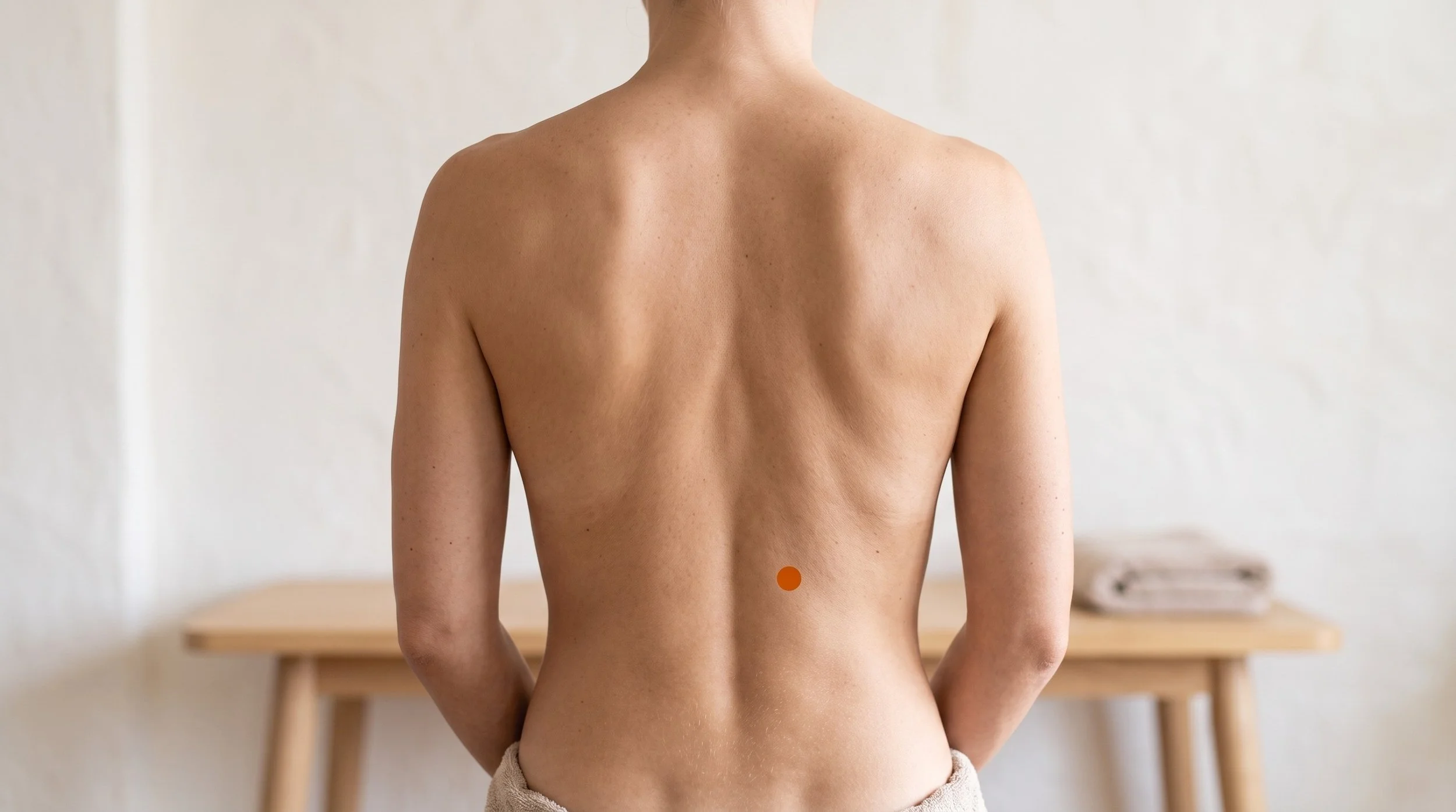
BL21 Acupuncture Point (Weishu)
The Stomach Shu at the Thoracolumbar Junction: Anatomy, Segmental Mechanism, and Why BL21 Sits at the Center of Acupuncture for Epigastric Pain, Nausea, and Mid Back Tension
BL21 (Weishu, often translated as Stomach Shu) is the back-shu point of the Stomach, and it's one of the most consistently used points on the inner Bladder line for digestive complaints. You'll find it on the mid back, about 1.5 cun (roughly two finger widths) to either side of the lower edge of the twelfth thoracic spinous process, right where the paraspinal muscles bulge highest at the thoracolumbar junction (Deadman et al., 2007).
Classical texts place it at the center of Stomach treatment, and modern clinicians keep using it for two overlapping reasons: it sits in a spinal segment with rich autonomic connections to the upper abdomen, and it sits directly over a band of deep back muscle that gets stiff, tender, and reactive in people who carry tension through the lower ribs. That combination makes the bl21 acupuncture point useful for epigastric fullness and nausea patterns as well as for the stubborn band of mid back tightness that often travels with them.
- Weishu point location is straightforward once you find T12: measure 1.5 cun lateral to the lower border of the T12 spinous process, at the visible peak of the paraspinal muscle mass (Deadman et al., 2007). The needle passes through skin and thoracolumbar fascia into the erector spinae, with deeper fibers of multifidus and rotatores just beneath.
- Traditionally, bladder 21 is categorized as the back-shu (back transporting) point of the Stomach, and classical sources credit it with regulating the Stomach, directing rebellious qi downward, and harmonizing the middle burner (Deadman et al., 2007). We translate those attributions into segmental language rather than treating them as literal energy movement.
- Needling here stimulates the medial branches of the lower thoracic dorsal rami, which feed into dorsal horn segments that also receive visceral afferent traffic from the upper abdomen. That convergence, plus descending inhibitory control from the brainstem, is the standard neurophysiological account of why segmental back points change how abdominal and back symptoms are perceived (Zhao, 2008).
- Animal electrophysiology using the Stomach back-shu and front-mu points together reported changes in dorsal vagal complex neuron activity alongside changes in gastric motility, which is one of the few point-specific mechanistic datasets that names BL21 directly (Wang et al., 2013). It's preclinical work, so it explains a plausible pathway rather than proving a clinical result.
- The clinical research picture is cautiously positive for the conditions BL21 is used in: meta-analyses of acupuncture for functional dyspepsia suggest symptom and quality-of-life improvements over sham with acceptable safety (Li et al., 2026), while the Cochrane review in irritable bowel syndrome found no advantage over credible sham (Manheimer et al., 2012). Protocols test point combinations, not BL21 in isolation.
- De qi at BL21 usually feels like a deep, dull, spreading heaviness in the mid back, sometimes with a warm band tracking toward the lower ribs or a quiet settling sensation under the ribcage. Sharp, electric, or radiating sensation isn't the goal and should be reported to your acupuncturist right away.
Dealing With Post-Meal Fullness, Reflux, or Nausea That Won't Settle?
At Morningside Acupuncture, BL21 is one of the points we return to when digestive symptoms cluster around meals: fullness, upper abdominal pressure, queasiness, and appetite that comes and goes. We typically pair it with CV12 and ST36 in a prone-then-supine sequence, and we palpate the T12 paraspinals first because tenderness there often tells us how reactive that segment is. Treatment is gentle, and we track your symptoms week to week rather than promising a fixed number of sessions. Schedule a visit and we'll build a plan around what your exam actually shows.
Schedule NowAnatomy of BL21: Why the T12 Paraspinals Are Such an Important Location
BL21 lies in the thick paraspinal column at the thoracolumbar junction, the transition zone where the relatively rotation-friendly thoracic spine meets the relatively rotation-resistant lumbar spine. From the surface inward, a needle at this point encounters skin and subcutaneous tissue, the posterior layer of the thoracolumbar fascia, the longissimus and iliocostalis portions of the erector spinae, and then the deeper multifidus and rotatores fibers that bridge individual segments.
This is high-demand tissue. It resists trunk flexion during sitting, stabilizes rotation during lifting and twisting, and takes a beating in desk workers, runners, and anyone who spends long hours in sustained forward posture. Palpating BL21 in a symptomatic patient often reveals a firm, ropey band and reproducible tenderness at the T12 level.
The sensory supply here comes from the medial branches of the lower thoracic dorsal rami, which carry input from skin, fascia, muscle, and the small facet joints of the region. Those fibers enter the dorsal horn at spinal levels that also receive visceral afferent traffic ascending from the upper abdominal organs through the splanchnic nerves, so a needle in the back muscle and a signal from the stomach can end up sharing processing space in the same neural neighborhood.
That's the segmental convergence story, and it's why back-shu points are described as reflecting the state of their associated organ on palpation (Maciocia, 2015). Needle stimulation also recruits descending inhibitory pathways from the brainstem that dampen dorsal horn transmission more broadly, which helps explain effects that outlast the treatment itself (Zhao, 2008).
Preclinical work using the Stomach shu and mu points together has also reported convergence at the dorsal vagal complex with parallel shifts in gastric motility, suggesting an autonomic route in addition to the local segmental one (Wang et al., 2013).
Depth discipline matters at BL21 more than at most back points. The pleural recess dips low behind the lower ribs, and the kidney sits deep to the thoracolumbar paraspinals, so this is not a location for casual perpendicular needling. Standard technique is oblique insertion angled toward the spine to a depth of 0.5 to 1 cun, or a transverse-oblique insertion of 1 to 1.5 cun along the muscle. Perpendicular needling, and oblique needling angled away from the spine, carry a substantial risk of pneumothorax (Deadman et al., 2007). In practice that means a trained clinician, a controlled angle, and no deep freehand needling in this region.
Related Back Shu Points Related Bladder ChannelBL21 at a Glance: Classification, Location, and Clinical Use
| Category | Detail |
|---|---|
| Traditional Name | Weishu (Stomach Shu), BL21, also written as bladder 21 or BL-21 |
| Channel Classification | Bladder channel, inner (medial) branch of the back line (BL21, also written UB21; also called the Urinary Bladder channel) |
| Point Categories | Back-shu (back transporting) point of the Stomach, one of the paired organ shu points along the inner Bladder line, located at the T12 level |
| Precise Location | On the mid back, 1.5 cun lateral to the lower border of the T12 spinous process, at the visible highest point of the paraspinal muscles |
| Tissue Stimulated | Thoracolumbar fascia, erector spinae (longissimus and iliocostalis) and deeper multifidus and rotatores at T12; adjacent territory overlaps with lower intercostal muscle referral and with the paraspinal groups covered in muscles that cause low back pain |
| Needle Depth / Direction | Oblique insertion toward the spine 0.5 to 1 cun, or transverse-oblique 1 to 1.5 cun. Perpendicular needling, or oblique needling angled away from the spine, carries a substantial pneumothorax risk |
| De Qi Sensation | Deep, dull, spreading heaviness in the mid back, sometimes with warmth tracking toward the lower ribs or a settling sensation beneath the ribcage; sharp or radiating sensation is not the target |
| Primary Clinical Uses | Epigastric pain and fullness, nausea and vomiting patterns in classical use, poor appetite with cold-pattern digestion in classical use, and thoracolumbar junction back tension |
| Common Point Combinations |
|
In Deadman's manual, BL21 is presented as the back-shu point of the Stomach, the surface location where the classical tradition understood Stomach function to be accessible from the back, and it's described as a primary point for essentially the whole range of Stomach disorders as well as for harmonizing the middle burner as a whole (Deadman et al., 2007). The traditional actions attributed to it are regulating the Stomach, descending rebellion, and harmonizing the middle jiao.
The classical indication lists cluster into a few recognizable groups: upper abdominal pain, distention, and fullness; upward-moving symptoms such as vomiting, reflux, and regurgitation; appetite disturbances of several kinds, including poor appetite, difficulty digesting, hunger without the ability to eat, and eating well without gaining weight; bowel symptoms such as loose stools, borborygmus, and undigested food; and a scattering of broader complaints including chest and back pain, jaundice, and abdominal masses.
The traditional logic tying them together is that the Stomach's job was understood as receiving and downward-moving food, so almost any Stomach pathology was framed as a failure of that descending function, whether from deficiency, cold, heat, dampness, food stagnation, or pressure from the Liver.
What's striking about the classical pattern is how tightly the appetite indications are reasoned: the same point was recommended for the patient who can't finish a meal and for the patient who eats constantly and stays thin, because the tradition read both as different failures of one process rather than as opposite problems.
Why BL21 Is Used for Digestive Symptoms and Mid Back Tightness at the Same Time
Patients are often surprised that a point on the back gets used for symptoms felt in the front of the abdomen. The explanation is segmental. Sensory information from the upper abdominal organs travels through splanchnic nerves into the lower thoracic spinal cord, where it converges with input from the skin, fascia, and deep muscle of the corresponding back segments.
When two streams of information share dorsal horn neurons, the nervous system can misattribute the source, which is why organ irritation can present as a tender band in the mid back, and why needling that tender band can change how the abdominal symptoms are experienced (Zhao, 2008). This is also the mechanism behind the traditional habit of palpating back-shu points for diagnostic information, since tenderness at BL21 was read as a reflection of the state of the Stomach (Maciocia, 2015).
There's a second, autonomic layer. Needling the thoracolumbar region can influence sympathetic outflow to the abdomen, while the broader literature on acupuncture and gastrointestinal function describes changes in gastric motility, accommodation, gut hormone levels, and autonomic balance in patients with functional dyspepsia (Guo et al., 2020).
Animal work stimulating the Stomach back-shu and front-mu points together reported convergent activity at the dorsal vagal complex with corresponding shifts in gastric motility, which supports the idea that the shu and mu pairing does something more than double the local stimulation (Wang et al., 2013). Those findings come from rodent models, so they describe a plausible pathway rather than a guaranteed clinical outcome.
Then there's the plainly musculoskeletal part. The tissue under BL21 is dense, hardworking, and frequently loaded, and needling it addresses local tension, tenderness, and restricted extension at the thoracolumbar junction directly. Acupuncture for chronic musculoskeletal pain shows modest but consistent benefits over both sham and no-acupuncture controls in individual patient data meta-analysis, with effects that persist over time (Vickers et al., 2018). For many patients the value of BL21 is that one needle placement can address the local muscular complaint and the segmental input at once.
What the Research Shows for BL21
A fair caveat before the table: no trial has isolated BL21 and measured what it does on its own in humans. Clinical research tests multi-point protocols, and BL21 appears inside protocols for functional dyspepsia, gastric motility disorders, and digestive complaints alongside points like CV12, ST36, and BL20. The mechanistic work that names BL21 directly is preclinical. So the honest reading is that BL21 is a well-supported component of protocols with reasonable evidence, not an independently proven intervention. The strength of the evidence also varies sharply by condition, with functional dyspepsia looking more favorable than irritable bowel syndrome.
| Study | Type | Focus | Key Finding |
|---|---|---|---|
| Li et al., 2026 | Systematic review and meta-analysis of RCTs | Acupuncture versus sham and versus usual care for functional dyspepsia | Across 23 trials, acupuncture probably improved dyspeptic symptoms and quality of life compared with sham without an increase in adverse events. |
| Ho et al., 2017 | Overview of systematic reviews with network meta-analysis | Acupuncture and related therapies as add-on or alternative to prokinetics for functional dyspepsia | Comparative effectiveness data suggested potential benefit as an add-on, though the authors flagged limitations in the underlying review quality. |
| Yang et al., 2020 | Randomized clinical trial | Acupuncture for postprandial distress syndrome | Participants receiving acupuncture reported greater improvement in postprandial symptoms than those receiving sham acupuncture over the treatment period. |
| Guo et al., 2020 | Systematic review of mechanistic studies | Physiological effects of acupuncture and electroacupuncture in functional dyspepsia | Reported effects on gastric motility, accommodation, gut hormones, and autonomic function, with the authors calling for better-designed studies. |
| Manheimer et al., 2012 | Cochrane systematic review | Acupuncture for irritable bowel syndrome | Sham-controlled trials found no benefit for IBS symptom severity or quality of life, while comparisons against certain antispasmodic drugs favored acupuncture. |
| Wang et al., 2013 | Preclinical electrophysiology and immunochemistry study | Electroacupuncture at the Stomach back-shu and front-mu points in rats | Stimulation was associated with dorsal vagal complex activity changes and altered gastric motility, suggesting a vagally mediated pathway. |
| Vickers et al., 2018 | Individual patient data meta-analysis | Acupuncture for chronic musculoskeletal pain, including back pain | Acupuncture produced modest benefits over sham and larger benefits over no-acupuncture controls, with effects largely sustained at one year. |
Mid Back Tightness That Flares Alongside Your Stomach?
Plenty of patients arrive describing a stubborn band of tension right at the bottom of the ribcage that seems to get worse when digestion is off. BL21 sits directly over that territory, so we can treat the local paraspinal tissue and the segmental input in the same needle placement, then add dry needling of multifidus and iliocostalis when the muscular component dominates. Our practitioners angle toward the spine at this level for safety, and we explain each step before we needle. Book an appointment and we'll assess both the muscular and the segmental picture.
Schedule NowBL21 in the Context of Trigger Point Work
Acupuncture, as we define it, means the use of an acupuncture needle, and that encompasses hundreds of styles including dry needling. At BL21 those approaches overlap almost completely, because the point sits in the same tissue a dry needling practitioner would target for thoracolumbar paraspinal dysfunction.
Trigger points in the deeper multifidus and rotatores at the T11 to L1 levels refer pain locally and toward the adjacent segments, while the more superficial longissimus and iliocostalis fibers can refer downward toward the buttock and upward along the back, patterns documented in the standard myofascial reference (Simons et al., 1999). Lower intercostal and abdominal wall trigger points can also produce referral that patients describe as stomach discomfort, which is one reason we palpate the whole region before committing to a treatment plan.
At Morningside, we generally use BL21 in one of two modes. When digestive symptoms lead, we needle BL21 with a shallow oblique angle toward the spine as part of a shu and mu protocol with CV12 and distal points, keeping stimulation modest so the segmental input is comfortable and repeatable. When the mid back complaint leads, we add dry needling of the local multifidus and iliocostalis, often with BL20 above and BL23 below, and we assess thoracolumbar extension and rotation before and after.
The two modes aren't mutually exclusive, and for many patients the most useful outcome is the one they notice in both places: less local stiffness and less reactivity in the upper abdomen.
BL21 Digestive and Mid Back Treatment at NYC's Highest-Rated Acupuncture Clinic
Morningside Acupuncture is the highest-rated acupuncture and dry needling clinic in New York City with over 500 five-star Google reviews, and we treat digestive complaints and thoracolumbar tension with the same evidence-informed approach we bring to pain. Every session starts with palpation of the back-shu region and a clear explanation of what we're targeting and why. We combine classical point selection with modern anatomy, and we'll tell you honestly if acupuncture isn't the right tool for your presentation. Schedule your visit with our Upper West Side team today.
Schedule NowFrequently Asked Questions
What does BL21 feel like when needled?
Most people feel a deep, dull heaviness or a spreading ache in the mid back that builds over a few seconds and then eases into a warm, weighted sensation. Some patients notice the feeling travel toward the lower ribs, and a smaller number describe a quiet loosening under the ribcage. Because the needle is angled obliquely and inserted shallowly here, the sensation is usually mild compared with thicker limb points. Sharp, burning, or radiating sensation isn't expected and should be mentioned immediately so the practitioner can adjust or remove the needle.
Why treat a back point for stomach symptoms felt in the front of the body?
Because the nervous system doesn't organize itself by front and back. Sensory information from upper abdominal organs travels into the lower thoracic spinal cord, where it converges with input from skin, fascia, and deep muscle of the corresponding back segments, so treating the back segment can change how abdominal symptoms are processed (Zhao, 2008). That's also why the same segment can produce back tenderness when the organ is irritated, and why palpating back-shu points has long been used as a diagnostic step (Maciocia, 2015). Traditionally, the explanation was framed as the Stomach's qi surfacing at its back-shu point, and we treat that as a historical attribution rather than a physiological claim.
Can I press BL21 myself between sessions?
Yes, with the caveat that it's an awkward point to reach on yourself. The easiest approach is a tennis ball or lacrosse ball against a wall: place the ball just to one side of your spine at the level of the lowest ribs, lean back until you find the tender band, and hold steady pressure for 30 to 60 seconds while breathing slowly. Repeat two or three rounds per side, once or twice a day. You can also have a partner apply firm thumb pressure at the same spot for a similar duration. Pressure should feel like a satisfying ache, never sharp, and you should avoid it entirely over bruised, inflamed, or numb skin. Acupressure at BL21 is a reasonable self-care adjunct, but it isn't a substitute for evaluation of persistent digestive symptoms.
Is BL21 safe to needle?
It's safe in trained hands and genuinely risky in untrained ones. The pleural recess extends low behind the lower ribs and the kidney sits deep to the paraspinal muscles at this level, so perpendicular needling, or oblique needling angled away from the spine, carries a substantial risk of causing a pneumothorax (Deadman et al., 2007). Licensed practitioners use an oblique angle directed toward the spine at 0.5 to 1 cun, or a transverse-oblique insertion of 1 to 1.5 cun along the muscle. This isn't a point for self-needling or for anyone without formal training. Tell your practitioner about any lung condition, bleeding disorder, blood-thinning medication, or recent abdominal or spinal surgery before treatment.
Where exactly is BL21 located?
Find the twelfth thoracic vertebra, the last one bearing a rib, and locate the lower border of its spinous process. From there, measure 1.5 cun laterally to either side, which for most people lands at roughly two finger widths and falls right on the visible high point of the paraspinal muscle mass (Deadman et al., 2007). It's a bilateral point, so it exists on both sides of the spine. BL20 (Pishu) sits one vertebral level above at T11 and BL23 (Shenshu) sits two levels below at L2, which is a useful way to double-check your count if the T12 landmark is hard to identify.
References
- Deadman, P., Al-Khafaji, M., & Baker, K. (2009). A manual of acupuncture. Journal of Chinese Medicine Publications.
- Maciocia, G. (2005). The foundations of Chinese medicine: A comprehensive text for acupuncturists and herbalists (2nd ed.). Elsevier Churchill Livingstone.
- Simons, D. G., Travell, J. G., & Simons, L. S. (1999). Travell & Simons' myofascial pain and dysfunction: The trigger point manual, Vol. 1: Upper half of body (2nd ed.). Williams & Wilkins.
- Zhao, Z. Q. (2008). Neural mechanism underlying acupuncture analgesia. Progress in Neurobiology, 85(4), 355-375. https://doi.org/10.1016/j.pneurobio.2008.05.004
- Vickers, A. J., Vertosick, E. A., Lewith, G., MacPherson, H., Foster, N. E., Sherman, K. J., Irnich, D., Witt, C. M., & Linde, K. (2018). Acupuncture for chronic pain: Update of an individual patient data meta-analysis. Journal of Pain, 19(5), 455-474. https://doi.org/10.1016/j.jpain.2017.11.005
- Li, X. X., Hu, Z. Y., Li, Z. C., Tang, J., Liu, Y. Y., Zeng, D. H., Zhou, Q. Q., Ma, W. B., Lan, L., & Wang, L. (2026). Efficacy and safety of acupuncture for functional dyspepsia: An updated meta-analysis of randomized controlled trials. Frontiers in Medicine, 13, 1718632. https://doi.org/10.3389/fmed.2026.1718632
- Ho, R. S. T., Chung, V. C. H., Wong, C. H. L., Wu, J. C. Y., Wong, S. Y. S., & Wu, I. X. Y. (2017). Acupuncture and related therapies used as add-on or alternative to prokinetics for functional dyspepsia: Overview of systematic reviews and network meta-analysis. Scientific Reports, 7, 10320. https://doi.org/10.1038/s41598-017-09856-0
- Guo, Y., Wei, W., & Chen, J. D. Z. (2020). Effects and mechanisms of acupuncture and electroacupuncture for functional dyspepsia: A systematic review. World Journal of Gastroenterology, 26(19), 2440-2457. https://doi.org/10.3748/wjg.v26.i19.2440
- Yang, J. W., Wang, L. Q., Zou, X., Yan, S. Y., Wang, Y., Zhao, J. J., et al. (2020). Effect of acupuncture for postprandial distress syndrome: A randomized clinical trial. Annals of Internal Medicine, 172(12), 777-785. https://doi.org/10.7326/M19-2880
- Manheimer, E., Cheng, K., Wieland, L. S., Min, L. S., Shen, X., Berman, B. M., & Lao, L. (2012). Acupuncture for treatment of irritable bowel syndrome. Cochrane Database of Systematic Reviews, 2012(5), CD005111. https://doi.org/10.1002/14651858.CD005111.pub3
- Wang, H., Shen, G. M., Liu, W. J., Huang, S., & Zhang, M. T. (2013). The neural mechanism by which the dorsal vagal complex mediates the regulation of the gastric motility by Weishu (RN12) and Zhongwan (BL21) stimulation. Evidence-Based Complementary and Alternative Medicine, 2013, 291764. https://doi.org/10.1155/2013/291764
Disclaimer: This web site is intended for educational and informational purposes only. Reading this website does not constitute providing medical advice or any professional services. This information should not be used for diagnosing or treating any health issue or disease. Those seeking medical advice should consult with a licensed physician. Seek the advice of a medical doctor or other qualified health professional for any medical condition. If you think you have a medical emergency, call 911 or go to the emergency room. No acupuncturist-patient relationship is created by reading this website or using the information. Morningside Acupuncture PLLC and its employees and contributors do not make any express or implied representations with respect to the information on this site or its use. For any legal interpretation of scope of practice in your state, consult a licensed attorney or regulatory authority.
Read more from our blog



