BL25 Acupuncture Point (Dachangshu)
The Large Intestine Shu at the Lumbar Hinge: Anatomy, Segmental Mechanism, and Why BL25 Serves Both the Low Back and the Bowel
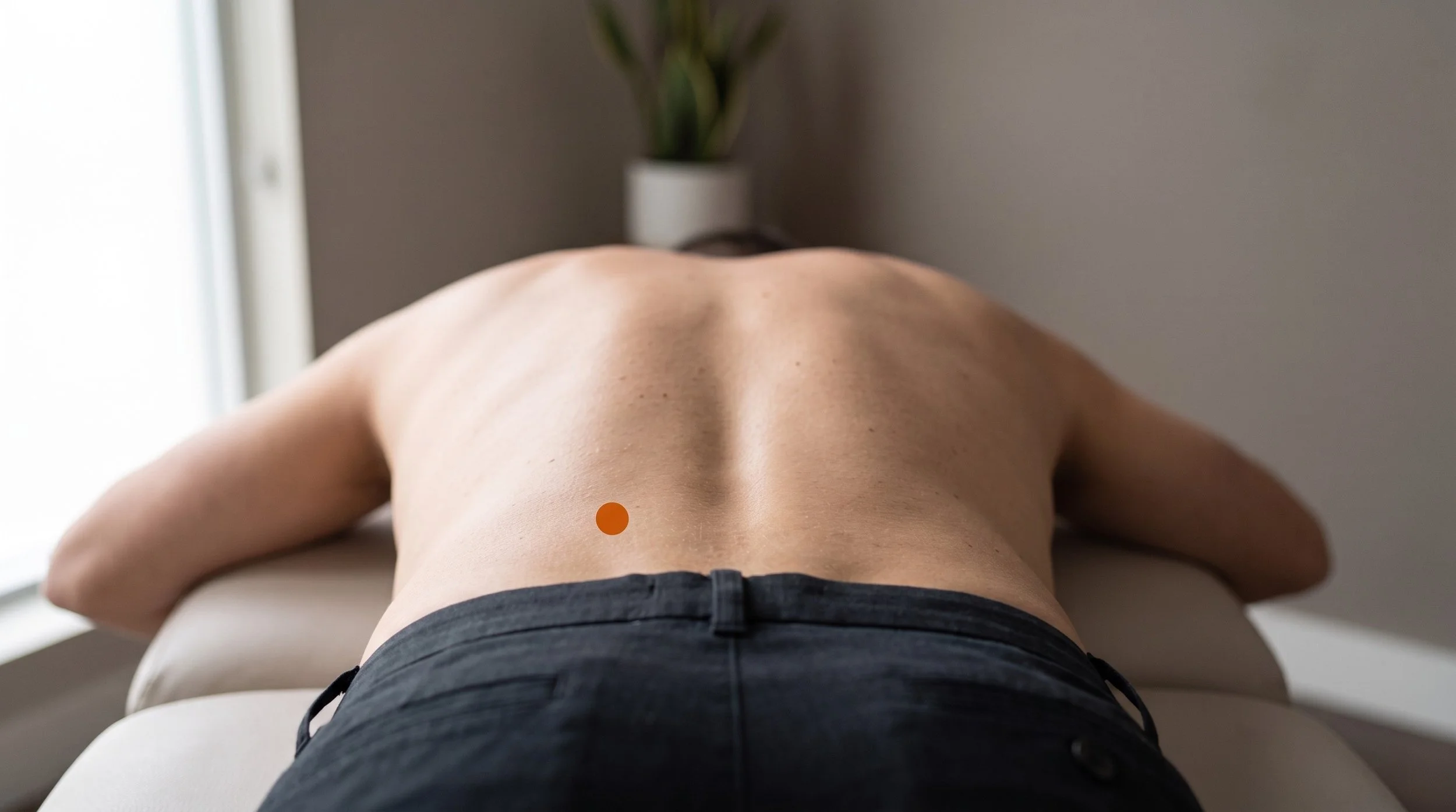
BL25, called Dachangshu in pinyin and translated as Large Intestine Shu, is the back-shu (associated) point of the Large Intestine on the Bladder channel. You'll find it on the low back, roughly a thumb-and-a-half width out from the lower edge of the L4 spinous process, level with GV3 and usually level with the top of the iliac crests. That places the bl25 acupuncture point right at the lumbar hinge, the segment that absorbs most of the load when you bend, lift, twist, or sit badly for hours, which is why bladder 25 is one of the most frequently needled local points in low back care.
Its second identity is visceral: classical texts group it with the bowel-regulating points, and modern gastrointestinal acupuncture protocols still pair it with ST25 as a shu and mu combination. Few points on the body carry that dual clinical workload as convincingly.
- Location and layers: BL25 sits 1.5 cun lateral to the lower border of the L4 spinous process, level with GV3, and a needle passes through skin and thoracolumbar fascia into the lumbar erector spinae, with multifidus medially and quadratus lumborum deeper and more lateral.
- Traditional attributions: the Manual of Acupuncture lists BL25 as the Large Intestine back-shu point and credits it with regulating the intestines, transforming stagnation, easing pain, and strengthening the lumbar region and legs, a set of classical functions we treat as historical description rather than physiology.
- Mechanism: needling here engages the dorsal rami of the lower lumbar nerves, including the medial branches that supply multifidus and the facet joints, and segmental input of this kind is one of the better-described routes by which acupuncture may modulate dorsal horn processing (Zhao, 2008).
- Research picture: a Cochrane review of acupuncture for chronic nonspecific low back pain found effects on pain and function that varied by comparator and by certainty of evidence (Mu et al., 2020), while individual patient data from chronic pain trials suggest modest but persisting benefits over sham and no-acupuncture controls (Vickers et al., 2018).
- Bowel side: BL25 appears in gastrointestinal trials and mechanistic work, including a large randomized comparison in which a shu and mu pairing of BL25 with ST25 performed comparably to loperamide for diarrhea-predominant IBS and functional diarrhea (Zheng et al., 2016), and an animal study reporting acupoint-dependent differences in visceral hypersensitivity responses (Wang et al., 2015).
- De qi at BL25 is typically a deep, heavy, spreading ache in the low back that can broaden toward the iliac crest or buttock, sometimes with a warm or loosening feeling across the lumbar region, and occasionally a vague sensation of movement in the abdomen.
Struggling With Low Back Pain That Flares Every Time You Bend or Lift?
BL25 sits exactly where most mechanical low back pain concentrates, at the L4 hinge between the stiff lumbar spine and the pelvis. At Morningside Acupuncture we combine bl 25 low back needling with dry needling of the erector spinae and quadratus lumborum, plus distal points chosen for your movement pattern. Treatment is paced over a short series so we can measure change in pain, bending, and sitting tolerance. Schedule a visit and we'll map exactly which tissues are driving your back.
Schedule NowAnatomy of BL25: Why the L4 Lumbar Hinge Is Such an Important Location
From the surface inward, a needle at BL25 passes through skin and subcutaneous tissue, then the posterior layer of the thoracolumbar fascia, then into the bulk of the lumbar erector spinae (longissimus and iliocostalis fibers) at the L4 level. Medially lies multifidus, the deep segmental stabilizer that hugs the lamina and facet joints; laterally and deeper lies quadratus lumborum, running between the iliac crest, the lumbar transverse processes, and the twelfth rib.
This is the tissue that resists side bending, decelerates trunk flexion, and stiffens when you sit for long stretches, so it's routinely tender at L4. The Manual of Acupuncture suggests locating the point at the visible high point of the paraspinal muscle mass, which in most people falls close to the level of the iliac crests.
The nerve geography is what makes this location clinically interesting. The dorsal rami of the lower lumbar spinal nerves divide into medial branches, which innervate multifidus and the zygapophysial (facet) joints, and lateral branches, which supply the more superficial paraspinal muscles and overlying skin. Needling at BL25 therefore delivers input into the same spinal segments that receive nociceptive traffic from lumbar facets, discs, and paraspinal muscle.
Segmental convergence of this kind, along with recruitment of descending inhibitory pathways from the brainstem, is the mechanism most often invoked to explain acupuncture analgesia in experimental work (Zhao, 2008).
In plain terms, stimulating the L4 paraspinal region gives the nervous system a strong, well-localized signal at the exact level where the pain is being processed.
Deep to the muscle at this level sit the L4 transverse process and lamina, and further anterior lies the retroperitoneal space. The kidneys sit considerably higher (roughly T12 to L2), so kidney risk at L4 is low compared with points such as BL23, but deep, laterally angled insertion in a thin patient could still reach abdominal contents, and steep medial angulation could approach the interlaminar space. Standard texts describe perpendicular insertion of about 1 to 1.5 cun, with a shallower 0.8 to 1.2 cun range given in some modern manuals. We choose depth by body habitus, keep the angle perpendicular or very slightly medial toward the lamina, and never chase depth for its own sake.
Related Acupuncture For Low Back Pain Related Muscles That Cause Low Back PainBL25 at a Glance: Classification, Location, and Clinical Use
| Category | Detail |
|---|---|
| Traditional Name | Dachangshu (Large Intestine Shu) |
| Channel Classification | Bladder channel of Foot Taiyang, inner bladder line, lumbar region at L4 (BL25, also written UB25; also called the Urinary Bladder channel) |
| Point Categories | Back-shu (associated) point of the Large Intestine |
| Precise Location | On the low back, 1.5 cun lateral to the lower border of the L4 spinous process, level with GV3 and generally level with the top of the iliac crests |
| Tissue Stimulated | Skin and thoracolumbar fascia over the lumbar erector spinae (longissimus and iliocostalis) at L4, with multifidus medially and quadratus lumborum deeper and more lateral; iliocostalis lumborum is a frequent myofascial target in the same region |
| Needle Depth / Direction | Perpendicular insertion 1 to 1.5 cun (some modern texts advise 0.8 to 1.2 cun); depth scaled to body habitus, avoiding deep lateral angulation in slender patients |
| De Qi Sensation | Deep, heavy, spreading ache in the lumbar paraspinals, often broadening toward the iliac crest or buttock, sometimes with warmth or a sense of the low back loosening |
| Primary Clinical Uses | Low back pain and lumbar stiffness, leg pain and sciatica-type symptoms accompanying lumbar problems, constipation and sluggish bowels, diarrhea and borborygmus, abdominal distention and pain, dysmenorrhea with low back cramping |
| Common Point Combinations |
|
In the classical framing preserved by Deadman's Manual of Acupuncture, BL25 is where the qi of the Large Intestine surfaces on the back, and its traditional actions are given as regulating the intestines, transforming stagnation while easing pain, and strengthening the low back and legs. The historical indication list runs in two directions at once.
On the digestive side it covers rumbling, watery or cold diarrhea, undigested food in the stool, dysenteric disorders, blood in the stool, difficulty passing stool or urine, constipation, intestinal abscess, and rectal prolapse, along with abdominal distention, twisting or cutting pain around the navel, and the memorable observation of someone who stays thin no matter how much they eat. On the musculoskeletal side it covers lumbar pain, stiffness and rigidity of the lumbar spine, painful obstruction and atrophy of the legs, and menstrual pain.
Later commentaries add that the point was used to firm the intestines when patterns of deficiency or dampness were suspected, and to move things along when stagnation was blamed instead. What's striking is that a single spot on the lower back was expected to answer both a loose bowel and a locked lumbar spine, an intuition that maps surprisingly well onto what we now describe as shared spinal segments serving skin, muscle, and viscera.
Why BL25 Is Used for Constipation and Diarrhea, Not Just Low Back Pain
The bridge between a low back point and the bowel is segmental. Sensory nerves from the skin and muscle of the lower lumbar region, and autonomic nerves serving the colon, converge on overlapping levels of the spinal cord. Once you accept that convergence, a needle placed in the L4 paraspinals is not really speaking to the intestine directly; it's feeding input into a shared processing region that also handles visceral signaling, and the output of that region includes autonomic adjustments to gut motility and to how strongly visceral sensations register.
Experimental work comparing several acupoints in a model of colorectal hypersensitivity found that the size of the effect differed by point, with abdominal and lower leg points producing larger changes than BL25 and LI11 in that particular model, and the authors linked the differences to segmental innervation (Wang et al., 2015). That's a useful caution against treating any single point as a switch.
The pain side of the story is better characterized. Needling engages A-delta and group III muscle afferents, which recruit descending inhibitory pathways involving the periaqueductal gray and rostral ventromedial medulla, along with endogenous opioid and monoaminergic signaling (Zhao, 2008). Local effects matter too: needling into a taut, tender lumbar paraspinal band can change local blood flow and reduce the muscle's resting irritability, which patients usually report as the back feeling less braced. When we needle bl 25 low back for someone who can't bend to tie their shoes, we're aiming at both levels, the segmental and the local.
In practice this dual action shapes how we sequence a treatment. If the presenting problem is mechanical back pain, BL25 is a workhorse local point supported by regional and distal choices. If the presenting problem is digestive, BL25 tends to be one member of a group that includes abdominal and lower leg points, since the trials that show the clearest bowel effects use multi-point protocols rather than isolated needling (Liu et al., 2016; Zheng et al., 2016).
What the Research Shows for BL25
A fair reading of the evidence starts with a caveat: almost no clinical trial tests BL25 by itself. Reviews evaluate whole protocols, and BL25 is usually one point among six to twelve, so what follows tells you how the protocols containing this point have performed rather than what this point does in isolation. The low back pain literature is the largest, and its conclusions depend heavily on the comparator used, with sham comparisons producing smaller differences than no-treatment or usual-care comparisons.
The gastrointestinal literature is smaller and more mixed, though a few large trials have been run. Read these as reasons for measured optimism, not as promises.
| Study | Type | Focus | Key Finding |
|---|---|---|---|
| Mu et al., 2020 | Cochrane systematic review | Acupuncture for chronic nonspecific low back pain, 33 studies and 8270 participants | Moderate-certainty evidence suggested acupuncture may relieve pain and improve back function compared with no treatment immediately after a course, with lower certainty and smaller differences against sham and usual care. |
| Vickers et al., 2018 | Individual patient data meta-analysis | Chronic pain conditions including chronic low back pain, roughly 20,000 patients | Acupuncture was associated with modest but statistically significant benefits over both sham and no-acupuncture controls, with effects that persisted over about a year. |
| Manheimer et al., 2012 | Cochrane systematic review | Acupuncture for irritable bowel syndrome | Acupuncture did not outperform sham on symptom severity, though it compared favorably with pharmacologic controls in trials with weaker designs, so the authors urged caution. |
| Liu et al., 2016 | Multicenter randomized sham-controlled trial | Electroacupuncture at abdominal and lower leg points for chronic severe functional constipation, 1075 patients | Eight weeks of electroacupuncture increased mean weekly complete spontaneous bowel movements more than sham, with effects maintained through the follow-up period. |
| Zheng et al., 2016 | Randomized controlled trial | Electroacupuncture groups including a shu and mu pairing of BL25 with ST25 for diarrhea-predominant IBS and functional diarrhea, 448 participants | No significant difference emerged between the electroacupuncture groups and loperamide on the primary outcome, with both approaches improving stool consistency measures. |
| Wang et al., 2015 | Animal mechanistic study | Acupoint specificity in colorectal hypersensitivity and c-fos expression along the brain-gut axis | Effects on visceral hypersensitivity varied by point, and the authors attributed the pattern to segmental innervation, which supports a neural rather than metaphorical account of point selection. |
Constipation, Loose Stools, or IBS Flares That Track With Stress?
Dachangshu is the Large Intestine back-shu point, and it's used with ST25, ST36, and abdominal points in bowel-focused acupuncture protocols. We use gentle, well-tolerated stimulation aimed at autonomic regulation rather than aggressive needling, alongside practical guidance on meal timing, fiber, and stress load. Results with digestive complaints usually build over a course of sessions rather than a single visit. Book an evaluation and we'll build a plan around your specific pattern.
Schedule NowBL25 in the Context of Trigger Point Work
Because acupuncture is defined by the use of an acupuncture needle rather than by any single tradition, the same filiform needle we place at BL25 can be redirected a centimeter or two into a taut band and used as dry needling. At the L4 level that matters, since the point overlies iliocostalis lumborum and longissimus fibers, with quadratus lumborum sitting deeper and more lateral.
Trigger points in the lumbar erector spinae and in quadratus lumborum are classically described as referring pain toward the iliac crest, the sacroiliac region, and the lower buttock, which is exactly the territory patients point to when they describe their back pain (Simons et al., 1999). When a patient's tenderness at BL25 reproduces their familiar pain and it spreads, we take that as a signal to treat the muscle rather than only the point.
In a typical Morningside session for lumbar pain, BL25 anchors the local treatment while we add dry needling to the specific muscles that reproduce symptoms on palpation and movement testing: quadratus lumborum for side-bending and crest pain, iliocostalis lumborum for pain that runs down toward the buttock, gluteus medius and piriformis when hip mechanics are contributing. Depth and angle change with the target, and we work more conservatively in slender patients given the retroperitoneal space anterior to the lumbar musculature.
The point and the muscle are not competing frameworks here; needling at BL25 gives strong segmental input at L4, and needling the myofascial target addresses the tissue that keeps re-loading that segment.
BL25 Low Back and Digestive Treatment at NYC's Highest-Rated Acupuncture Clinic
Morningside Acupuncture is the highest-rated acupuncture and dry needling clinic in New York City with over 500 five-star Google reviews, and BL25 is part of our daily toolkit for lumbar pain and bowel complaints alike. Every session blends orthopedic assessment, precise needling, and clear explanations of what we're doing and why. You'll leave knowing your working diagnosis, the plan, and what to do between visits. Schedule your appointment and let's get your back and your gut working better together.
Schedule NowFrequently Asked Questions
What does BL25 feel like when needled?
Most people describe a deep, heavy, dull ache that spreads across the lower back rather than a sharp poke. The sensation may broaden toward the iliac crest or upper buttock, and some patients feel warmth or a sense of the muscles releasing over the following minute. A brief muscle twitch is common if the needle enters a taut band, which usually feels like a quick jump followed by a softening. Sharp, electric, or radiating pain down the leg is not the goal, and you should say so immediately if it happens so the needle can be adjusted.
Why needle my low back for a digestive complaint?
The short answer is shared wiring. Nerves serving lumbar skin and muscle and nerves serving the colon converge on overlapping spinal segments, so input from the L4 paraspinal region enters a processing zone that also handles visceral signaling and autonomic output to the gut (Zhao, 2008). Classically, BL25 was named the Large Intestine Shu for exactly this reason, long before anyone described the anatomy in those terms. In practice we rarely use it alone for digestive complaints, since the trials with the clearest bowel outcomes combine back, abdominal, and lower leg points (Liu et al., 2016; Zheng et al., 2016).
Can I press BL25 myself between sessions?
Yes, and it's easy to reach. Stand or sit upright, run your thumbs along your sides until they rest on the top of your iliac crests, then slide them back toward your spine until they sit on the thick paraspinal muscle bands about a thumb-and-a-half width out from the midline. Press inward and slightly toward the spine with steady, firm pressure at an intensity you'd rate around 4 to 6 out of 10, hold for 30 to 60 seconds, release, and repeat two or three times per side. Small circular pressure or a lacrosse ball against a wall works too, for two to three minutes total per side. Do this once or twice a day, ease off if pressure sharpens the pain or sends symptoms down the leg, and combine it with gentle movement rather than using it as a substitute for moving.
Is BL25 safe to needle?
In trained hands, yes. BL25 is needled perpendicularly into a thick muscular region, and the kidneys sit well above this level, so it carries less organ risk than higher points on the inner bladder line. The main considerations are depth and angle: steep lateral angulation in a very slender person could reach retroperitoneal structures, and aggressive medial angulation could approach the interlaminar space, so competent practitioners keep the insertion perpendicular and scale depth to body size. Tell your clinician about anticoagulant use, spinal hardware, recent lumbar surgery, pregnancy, or any implanted device before the low back is needled. Transient soreness for a day is the most common side effect.
Where exactly is BL25 located?
For dachangshu point location, find the L4 spinous process, most easily identified by drawing an imaginary line between the tops of the iliac crests, which usually crosses at or near the L4 level. Drop to the lower border of that spinous process, which is where GV3 sits on the midline, then move 1.5 cun laterally onto the belly of the lumbar erector spinae. In most adults that lands on the visible high point of the paraspinal muscle mass. The point is bilateral, and clinicians typically confirm it by palpating for the tender, ropey band rather than relying on measurement alone.
References
- Deadman, P., Al-Khafaji, M., & Baker, K. (2009). A manual of acupuncture. Journal of Chinese Medicine Publications.
- Cunningham, P. M. (2000). Acupuncture points: A practical guide to classical and modern usage. Odyssey Press.
- Kim, H. (2008). Handbook of Oriental medicine (3rd ed.). Harmony & Balance Press.
- O'Connor, J., & Bensky, D. (Eds. & Trans.). (1981). Acupuncture: A comprehensive text. Shanghai College of Traditional Medicine. Eastland Press.
- Simons, D. G., Travell, J. G., & Simons, L. S. (1999). Travell & Simons' myofascial pain and dysfunction: The trigger point manual, Vol. 1: Upper half of body (2nd ed.). Williams & Wilkins.
- Zhao, Z. Q. (2008). Neural mechanism underlying acupuncture analgesia. Progress in Neurobiology, 85(4), 355-375. https://doi.org/10.1016/j.pneurobio.2008.05.004
- Vickers, A. J., Vertosick, E. A., Lewith, G., MacPherson, H., Foster, N. E., Sherman, K. J., Irnich, D., Witt, C. M., & Linde, K. (2018). Acupuncture for chronic pain: Update of an individual patient data meta-analysis. Journal of Pain, 19(5), 455-474. https://doi.org/10.1016/j.jpain.2017.11.005
- Mu, J., Furlan, A. D., Lam, W. Y., Hsu, M. Y., Ning, Z., & Lao, L. (2020). Acupuncture for chronic nonspecific low back pain. Cochrane Database of Systematic Reviews, 12(12), CD013814. https://doi.org/10.1002/14651858.CD013814
- Manheimer, E., Cheng, K., Wieland, L. S., Min, L. S., Shen, X., Berman, B. M., & Lao, L. (2012). Acupuncture for treatment of irritable bowel syndrome. Cochrane Database of Systematic Reviews, 2012(5), CD005111. https://doi.org/10.1002/14651858.CD005111.pub3
- Liu, Z., Yan, S., Wu, J., He, L., Li, N., Dong, G., ... & Liu, B. (2016). Acupuncture for chronic severe functional constipation: A randomized trial. Annals of Internal Medicine, 165(11), 761-769. https://doi.org/10.7326/M15-3118
- Zheng, H., Li, Y., Zhang, W., Zeng, F., Zhou, S. Y., Zheng, H. B., ... & Zhu, B. (2016). Electroacupuncture for patients with diarrhea-predominant irritable bowel syndrome or functional diarrhea: A randomized controlled trial. Medicine, 95(24), e3884. https://doi.org/10.1097/MD.0000000000003884
- Wang, S. J., Yang, H. Y., Wang, F., & Li, S. T. (2015). Acupoint specificity on colorectal hypersensitivity alleviated by acupuncture and the correlation with the brain-gut axis. Neurochemical Research, 40(6), 1274-1282. https://doi.org/10.1007/s11064-015-1587-0
Disclaimer: This web site is intended for educational and informational purposes only. Reading this website does not constitute providing medical advice or any professional services. This information should not be used for diagnosing or treating any health issue or disease. Those seeking medical advice should consult with a licensed physician. Seek the advice of a medical doctor or other qualified health professional for any medical condition. If you think you have a medical emergency, call 911 or go to the emergency room. No acupuncturist-patient relationship is created by reading this website or using the information. Morningside Acupuncture PLLC and its employees and contributors do not make any express or implied representations with respect to the information on this site or its use. For any legal interpretation of scope of practice in your state, consult a licensed attorney or regulatory authority.
Read more from our blog