BL24 Acupuncture Point (Qihaishu)
The Sea of Qi Point at the Third Lumbar Vertebra: Anatomy, Mechanism, and Why This Mid Lumbar Bladder Channel Point Anchors Low Back Pain Treatment
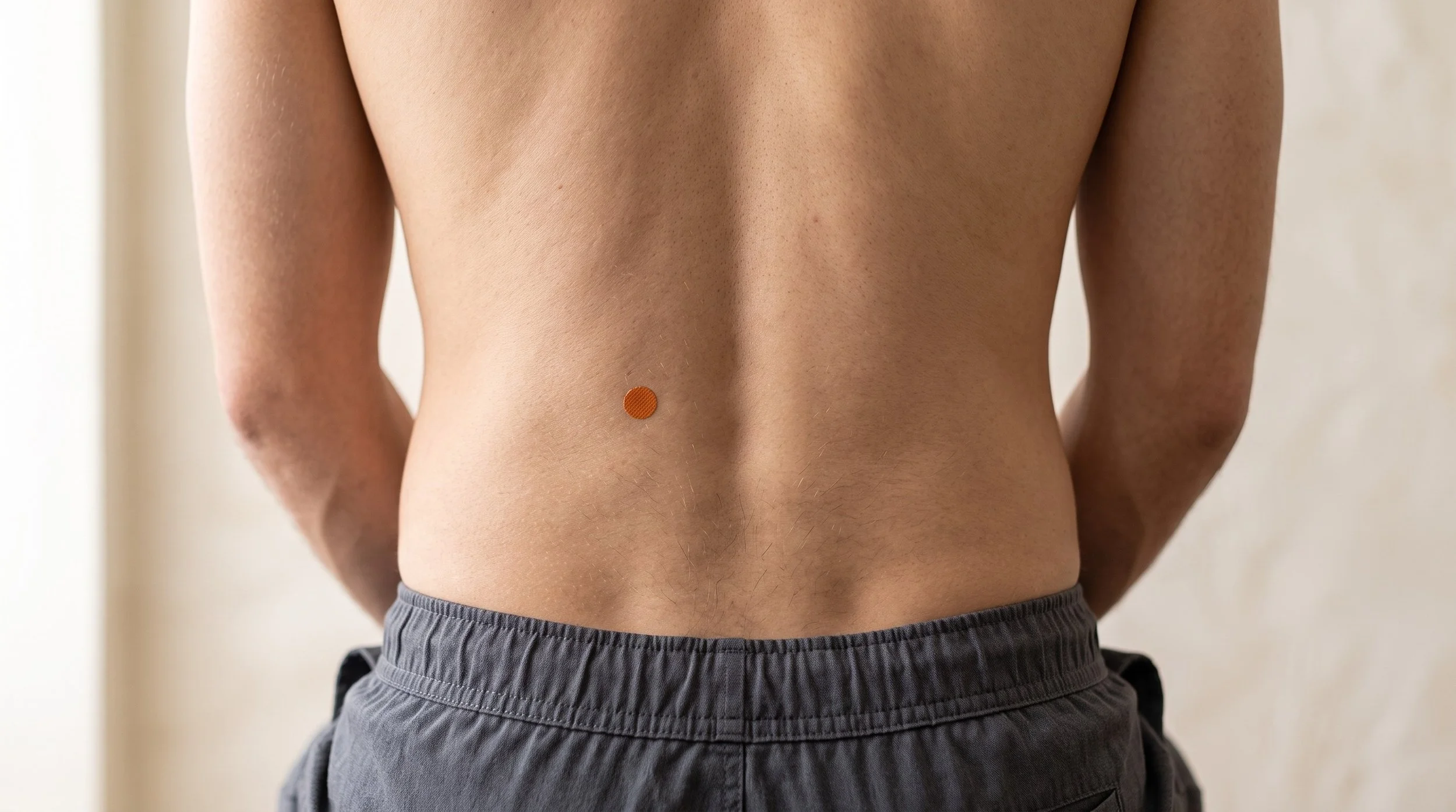
BL24 (Qihaishu, often translated as Sea of Qi Shu) is the Bladder channel point that sits 1.5 cun lateral to the lower border of the L3 spinous process, right on the visible crest of the lumbar paraspinal muscles. It falls between BL23 above and BL25 below, which places it squarely in the middle of the low back region that patients point to when they describe a deep band of ache across the belt line.
The name is grand, but the clinical identity of the bl24 acupuncture point is refreshingly plain: it is one of the most reliably tender levels in lumbar pain, and it is used, in both classical practice and modern dry needling, mostly as a local point for the low back and for leg pain that travels with it.
- Location and layers: bladder 24 sits 1.5 cun lateral to the L3 spinous process, over skin, thoracolumbar fascia, the lumbar erector spinae (iliocostalis and longissimus) and, with deeper insertion, the multifidus that spans the segment. These are the tissues loaded by prolonged sitting, repeated bending and asymmetric lifting.
- Traditional attribution: classical sources credit Qihaishu with strengthening the lumbar region and legs and regulating the lower jiao, and list lumbar pain and stiffness, lower limb pain and weakness, painful periods, and haemorrhoids among its indications (A Manual of Acupuncture).
- Category note: some authors group BL24 with the back transporting points, but as a point named for a region (the Sea of Qi) rather than an organ, and Deadman is explicit that it carries no tonifying or qi regulating reputation in practice (A Manual of Acupuncture; Maciocia).
- Mechanism: needling here stimulates the medial and lateral branches of the lumbar dorsal rami, feeding segmental input into dorsal horn levels that also receive input from discs, facet joints and paraspinal muscle, and recruiting descending inhibitory pathways involving endogenous opioid and monoaminergic systems (Zhao, 2008).
- Research picture: the Cochrane review of acupuncture for chronic nonspecific low back pain found small improvements in pain and function over sham and larger effects over no treatment, with low to moderate certainty (Mu et al., 2020), and individual patient data pooling supports modest, durable benefit for chronic musculoskeletal pain (Vickers et al., 2018).
- De qi and practice framing: patients usually report a dull, heavy, spreading ache at bl 24 low back level rather than a sharp sensation, sometimes with a brief twitch of the paraspinal muscle when a taut band is engaged (Simons et al., 1999). It is rarely used alone and is typically paired with adjacent levels, gluteal points or a distal point.
Stiff, Aching Low Back That Never Fully Settles?
At Morningside Acupuncture we palpate the L3 paraspinal level first, because BL24 is so often the tender spot patients have been pressing with their own thumbs for months. We combine gentle needling there with adjacent lumbar levels, gluteal work and movement advice, so the segment gets treated rather than just soothed. Most people notice looser rotation and easier standing within the first few visits. Schedule an evaluation and we'll map exactly where your low back is loading.
Schedule NowAnatomy of BL24: Why the L3 Paraspinal Level Is Such an Important Location
Find the L3 spinous process, drop to its lower border, then move about 1.5 cun laterally and you land on the highest visible ridge of the paraspinal muscles. Under the needle there is skin and subcutaneous fat, then the posterior layer of the thoracolumbar fascia, then the lumbar erector spinae group (iliocostalis lumborum and longissimus), and deeper still the multifidus filling the trough between the spinous and transverse processes. This is the tissue that resists trunk flexion all day, so it accumulates load from desk work, driving, gardening, deadlifting and carrying a bag on one shoulder. Fascial layers here are richly innervated and can be a pain source in their own right, which is part of why the area is so consistently tender.
The nerve geography is straightforward and clinically useful. Needling at this level engages branches of the lumbar dorsal rami, and standard Chinese texts describe the segmental supply here as coming from posterior rami of the upper lumbar nerves, with the posterior branch of the third lumbar artery and vein supplying the region (Chinese Acupuncture and Moxibustion). Those same spinal segments also receive input from the intervertebral disc, the facet joint capsule and deep paraspinal muscle, so signals from very different structures converge on shared dorsal horn neurons.
That convergence explains both why lumbar pain feels diffuse and hard to localize and why a needle placed in muscle can influence the whole segment. Beyond the segment, needling recruits descending inhibitory control involving endogenous opioid and monoaminergic pathways, which is one of the better characterized mechanisms of acupuncture analgesia (Zhao, 2008).
Depth matters. Standard needling is perpendicular, roughly 1 to 1.5 cun in Deadman's manual and 0.8 to 1.2 cun in Chinese Acupuncture and Moxibustion, kept within the muscle mass. The kidney lies deep and lateral at the upper lumbar levels, and classical Chinese texts warn against excessively deep insertion at the lumbar shu points for exactly that reason (Shanghai College of Traditional Chinese Medicine). Angling slightly medially keeps the needle in muscle and away from the space lateral to the paraspinals (Cunningham).
In practice, body composition dictates depth: a lean athlete needs far less than the textbook maximum, and there is no clinical reason to chase depth for its own sake.
Related Acupuncture For Low Back Pain Related Muscles That Cause Low Back PainBL24 at a Glance: Classification, Location, and Clinical Use
| Category | Detail |
|---|---|
| Traditional Name | Qihaishu, commonly translated as Sea of Qi Shu or Sea of Qi Back Transporting Point |
| Channel Classification | Bladder channel of Foot Taiyang, inner (medial) line of the back, at the L3 level between BL23 Shenshu and BL25 Dachangshu (BL24, also written UB24; also called the Urinary Bladder channel) |
| Point Categories | No five-shu, hui-meeting, luo, xi-cleft or extraordinary vessel designations. Some authors group it loosely with the back transporting points, though it is named for a region (the Sea of Qi) rather than an organ (Maciocia), and Deadman's manual notes that it is credited with no tonifying or qi regulating properties in clinical use. |
| Precise Location | On the low back, 1.5 cun lateral to the lower border of the L3 spinous process, at the visible highest point of the paraspinal muscle mass |
| Tissue Stimulated | Thoracolumbar fascia, lumbar iliocostalis and longissimus, and with deeper insertion the multifidus at the L3 segment. See Muscles That Cause Low Back Pain and Acupuncture For Tight Muscles And Trigger Points |
| Needle Depth / Direction | Perpendicular, 1 to 1.5 cun per Deadman and 0.8 to 1.2 cun per Chinese Acupuncture and Moxibustion, often angled slightly medially to stay within muscle; depth is scaled to build. Moxibustion is traditionally permitted. |
| De Qi Sensation | A dull, heavy, spreading ache across the low back, sometimes with a sense of pressure toward the buttock or flank; a brief involuntary twitch can occur when a taut paraspinal band is engaged |
| Primary Clinical Uses | Low back pain and stiffness (especially when tender on palpation at L3), leg pain and heaviness accompanying lumbar problems, and, in classical use, painful periods and haemorrhoids |
| Common Point Combinations |
|
Deadman, Al-Khafaji and Baker's A Manual of Acupuncture presents Qihaishu with unusual candor. Traditionally the point is said to strengthen the lumbar region and legs and to regulate the lower jiao, and its classical indication list runs across three territories: lumbar pain and stiffness with painful obstruction, pain or wasting of the lower limb; irregular or painful menstruation and vaginal discharge; and disorders of the lower digestive tract including haemorrhoids, bleeding haemorrhoids, diarrhoea and abdominal pain.
The manual also records the Supplementing Life pairing of BL24 with BL23 and BL29 for lumbar pain. What is striking is the commentary attached to the name: despite being called Sea of Qi Shu, the point is not credited with tonifying or regulating qi, and its real working life in clinic is as a local lumbar point, chosen above all when it is tender. Older Western texts add that it sits at roughly the same level as CV6 Qihai on the front of the body and shares some of its indications (Cunningham), which likely explains the borrowed name more than any shared function.
Why BL24 Is Used for Leg Pain and Period Cramps, Not Just the Low Back
The leg connection is the easier one to explain. Sensory input from the L3 paraspinal region enters the spinal cord at segments that also receive input from the disc, facet joints, deep lumbar muscle and, through overlapping neighbours, from tissues in the buttock and thigh. When those neurons become sensitized, pain spreads beyond its source and patients report a band of ache that runs from the belt line into the hip or down the back of the leg. Needling into the muscle at this level delivers strong, well-localized input into the same segment, which can dampen that sensitized processing. This is the same logic behind treating adjacent levels together rather than hunting for one perfect spot.
The gynecological indications work through a different route. The sympathetic supply to the pelvic organs arises from lower thoracic and upper lumbar cord levels, so somatic stimulation in the lower back is anatomically positioned to influence pelvic autonomic tone and local blood flow. That is a plausible mechanism rather than a proven one for this specific point, and it should be read cautiously.
What is better established is the general picture: acupuncture analgesia involves segmental gating plus descending inhibition mediated by endogenous opioids, serotonin and noradrenaline, along with local changes in blood flow and inflammatory signaling at the needling site (Zhao, 2008).
Clinically, the practical value of the sea of qi shu point is that it is easy to find, easy to needle safely, and usually already tender. Pooled patient-level data across chronic pain conditions show acupuncture outperforming both sham and usual care by modest but persistent margins (Vickers et al., 2018), and low back pain is the condition where that evidence base is deepest. BL24 is one component of the protocols that produced those numbers, not the reason they worked.
What the Research Shows for BL24
No trial has isolated BL24 on its own, and none realistically could. Low back pain studies test whole protocols, usually a handful of lumbar and gluteal points with one or two distal additions, so what the literature tells us is how the region performs, not how any single needle performs. Read the evidence below as context for a point that appears in most lumbar prescriptions rather than as proof about the point itself, and keep expectations proportionate: the effect sizes are real but moderate, and the certainty of the evidence is often limited by trial quality.
| Study | Type | Focus | Key Finding |
|---|---|---|---|
| Mu et al., 2020 | Cochrane systematic review | Acupuncture for chronic nonspecific low back pain compared with sham, no treatment and usual care | Acupuncture produced small improvements in pain and function versus sham and larger improvements versus no treatment, with certainty of evidence rated low to moderate. |
| Vickers et al., 2018 | Individual patient data meta-analysis | Chronic musculoskeletal pain including back and neck pain, roughly 20,000 patients | Acupuncture was superior to both sham and no-acupuncture controls, with benefits persisting at 12 months rather than fading immediately after treatment. |
| Liu et al., 2018 | Systematic review and meta-analysis | Dry needling of myofascial trigger points in low back pain, 11 randomized trials | Dry needling of lumbar trigger points reduced pain compared with other treatments immediately after intervention, though follow-up data were limited and trial quality varied. |
| Smith et al., 2016 | Cochrane systematic review | Acupuncture and acupressure for primary dysmenorrhoea | Evidence was insufficient to determine whether acupuncture or acupressure reduce period pain, with all comparisons rated low or very low certainty. |
| Zhao, 2008 | Narrative review of mechanism research | Neural pathways underlying acupuncture analgesia | Analgesic effects are attributed to segmental spinal inhibition plus descending control involving endogenous opioid and monoaminergic systems. |
Low Back Pain With Ache Running Into the Hip or Leg?
When lumbar pain refers into the buttock or down the thigh, we treat the L3 and L4 levels together and add distal points along the leg, an approach that follows the classical local plus distal logic. Dry needling of the lumbar multifidus, iliocostalis and quadratus lumborum often sits alongside BL24 in the same session. Our licensed acupuncturists explain each step and adjust depth to your comfort. Book a visit and we'll build the plan around your actual pain map.
Schedule NowBL24 in the Context of Trigger Point Work
The location of BL24 overlaps almost perfectly with territory that trigger point clinicians target every day. Taut bands in the lumbar iliocostalis and longissimus, and in the deeper multifidus at the L3 segment, refer pain across the low back, into the sacroiliac region and sometimes into the buttock, and these muscles are among the usual suspects in mechanical low back pain (Simons et al., 1999). When a patient's most tender spot at L3 turns out to be a palpable band rather than a diffuse ache, needling that band is effectively the same intervention as needling the point, described in a different vocabulary. Acupuncture, as we define it, is the use of an acupuncture needle, and dry needling is one of the many styles that falls inside that definition.
At Morningside Acupuncture, we usually treat BL24 as one node in a lumbopelvic map rather than a standalone target. A typical session might combine needling at the L3 and L4 paraspinal levels with dry needling of quadratus lumborum, gluteus medius and, when the pain pattern warrants it, piriformis, followed by cupping over the thoracolumbar fascia and specific loading advice. Evidence for lumbar trigger point dry needling shows short-term pain reduction with limited long-term follow-up (Liu et al., 2018), which is exactly why we pair the needling with movement rather than treating it as the whole plan.
BL24 Low Back Pain Treatment at NYC's Highest-Rated Acupuncture Clinic
Morningside Acupuncture is the highest-rated acupuncture and dry needling clinic in New York City with over 500 five-star Google reviews, and low back pain is the single most common reason people walk through our door. We use the sea of qi shu point as part of a broader lumbar strategy that blends acupuncture, dry needling, cupping and clear self-care guidance. Sessions are unhurried, evidence-informed and tailored to how your back actually behaves during the week. Schedule your appointment and start with a proper assessment.
Schedule NowFrequently Asked Questions
What does BL24 feel like when needled?
Most people describe a deep, dull, heavy ache that spreads outward from the needle across the low back, sometimes with a sense of pressure toward the flank or buttock. That spreading heaviness is de qi, and it is the sensation practitioners aim for at this point. If a taut muscle band is engaged, you may feel a brief involuntary twitch followed by a few seconds of cramping ache, then a noticeable release. Sharp, electric or radiating pain is not the goal, and you should say so immediately if you feel it so the needle can be adjusted.
Why needle at L3 when my pain feels lower, near my belt line or sacrum?
Lumbar pain is notoriously bad at telling you where it comes from. Sensory input from discs, facet joints, deep muscle and fascia converges on shared spinal cord neurons, so a problem at one segment is often felt a level or two away, or spread across a whole band (Zhao, 2008). Palpation usually settles it: if the L3 level at BL24 is the tender spot, that segment is contributing, whatever the pain map looks like. In practice we treat the tender level plus its neighbours, which is why BL24 and BL25 are so often needled in the same session.
Can I press BL24 myself between sessions?
Yes, and it is one of the easier points to reach. Stand or sit upright, find the ridge of muscle running alongside your spine at about waist level (roughly two finger widths out from the midline of the low back), and press with your thumb or a knuckle into the firm muscle, not onto the bony spine itself. Use steady, moderate pressure for 30 to 60 seconds per side, breathing slowly, then release and repeat two or three times. A tennis ball or massage ball against a wall works well if your thumbs tire, and two to three minutes per side, once or twice daily, is plenty. Stop if pressure produces sharp or radiating leg pain, and always pair the pressure with gentle movement such as walking or hip hinging, since sustained stillness is usually what irritated the area in the first place.
Is BL24 safe to needle?
In trained hands, yes. It sits over a thick mass of paraspinal muscle at a level where there is no lung risk, and standard depth is 0.8 to 1.5 cun perpendicular, kept within the muscle. The relevant caution is depth and angle: the kidney lies deep and lateral in the upper lumbar region, and classical Chinese texts specifically warn against excessively deep needling at the lumbar shu points, so practitioners keep the angle perpendicular or slightly medial and scale depth to body size. Ordinary side effects are minor, mostly brief soreness or a small bruise. Tell your acupuncturist if you take blood thinners, have had spinal surgery or hardware placed, or have a known kidney condition.
Where exactly is BL24 located?
On the low back, level with the lower border of the third lumbar spinous process, 1.5 cun lateral to the midline. A practical way to find it: locate the highest point of the iliac crests, which sits near the L4 spinous process, count up one vertebra to L3, drop to the bottom edge of that spinous process, then move laterally to the highest visible bulge of the paraspinal muscle. In most adults that is roughly two finger widths from the midline. BL23 lies one level above at L2 and BL25 one level below at L4, so the three sit in a vertical line along the inner Bladder channel.
References
- Deadman, P., Al-Khafaji, M., & Baker, K. (2009). A manual of acupuncture. Journal of Chinese Medicine Publications.
- Cheng, X. (Ed.). (1999). Chinese acupuncture and moxibustion (Rev. ed.). Foreign Languages Press.
- Maciocia, G. (2005). The foundations of Chinese medicine: A comprehensive text for acupuncturists and herbalists (2nd ed.). Elsevier Churchill Livingstone.
- O'Connor, J., & Bensky, D. (Eds. & Trans.). (1981). Acupuncture: A comprehensive text. Shanghai College of Traditional Medicine. Eastland Press.
- Cunningham, P. M. (2000). Acupuncture points: A practical guide to classical and modern usage. Odyssey Press.
- Simons, D. G., Travell, J. G., & Simons, L. S. (1999). Travell & Simons' myofascial pain and dysfunction: The trigger point manual, Vol. 1: Upper half of body (2nd ed.). Williams & Wilkins.
- Mu, J., Furlan, A. D., Lam, W. Y., Hsu, M. Y., Ning, Z., & Lao, L. (2020). Acupuncture for chronic nonspecific low back pain. Cochrane Database of Systematic Reviews, 2020(12), CD013814. https://doi.org/10.1002/14651858.CD013814
- Vickers, A. J., Vertosick, E. A., Lewith, G., MacPherson, H., Foster, N. E., Sherman, K. J., Irnich, D., Witt, C. M., & Linde, K. (2018). Acupuncture for chronic pain: Update of an individual patient data meta-analysis. Journal of Pain, 19(5), 455-474. https://doi.org/10.1016/j.jpain.2017.11.005
- Liu, L., Huang, Q. M., Liu, Q. G., Thitham, N., Li, L. H., Ma, Y. T., & Zhao, J. M. (2018). Evidence for dry needling in the management of myofascial trigger points associated with low back pain: A systematic review and meta-analysis. Archives of Physical Medicine and Rehabilitation, 99(1), 144-152. https://doi.org/10.1016/j.apmr.2017.06.008
- Smith, C. A., Armour, M., Zhu, X., Li, X., Lu, Z. Y., & Song, J. (2016). Acupuncture for dysmenorrhoea. Cochrane Database of Systematic Reviews, 2016(4), CD007854. https://doi.org/10.1002/14651858.CD007854.pub3
- Zhao, Z. Q. (2008). Neural mechanism underlying acupuncture analgesia. Progress in Neurobiology, 85(4), 355-375. https://doi.org/10.1016/j.pneurobio.2008.05.004
Disclaimer: This web site is intended for educational and informational purposes only. Reading this website does not constitute providing medical advice or any professional services. This information should not be used for diagnosing or treating any health issue or disease. Those seeking medical advice should consult with a licensed physician. Seek the advice of a medical doctor or other qualified health professional for any medical condition. If you think you have a medical emergency, call 911 or go to the emergency room. No acupuncturist-patient relationship is created by reading this website or using the information. Morningside Acupuncture PLLC and its employees and contributors do not make any express or implied representations with respect to the information on this site or its use. For any legal interpretation of scope of practice in your state, consult a licensed attorney or regulatory authority.
Read more from our blog