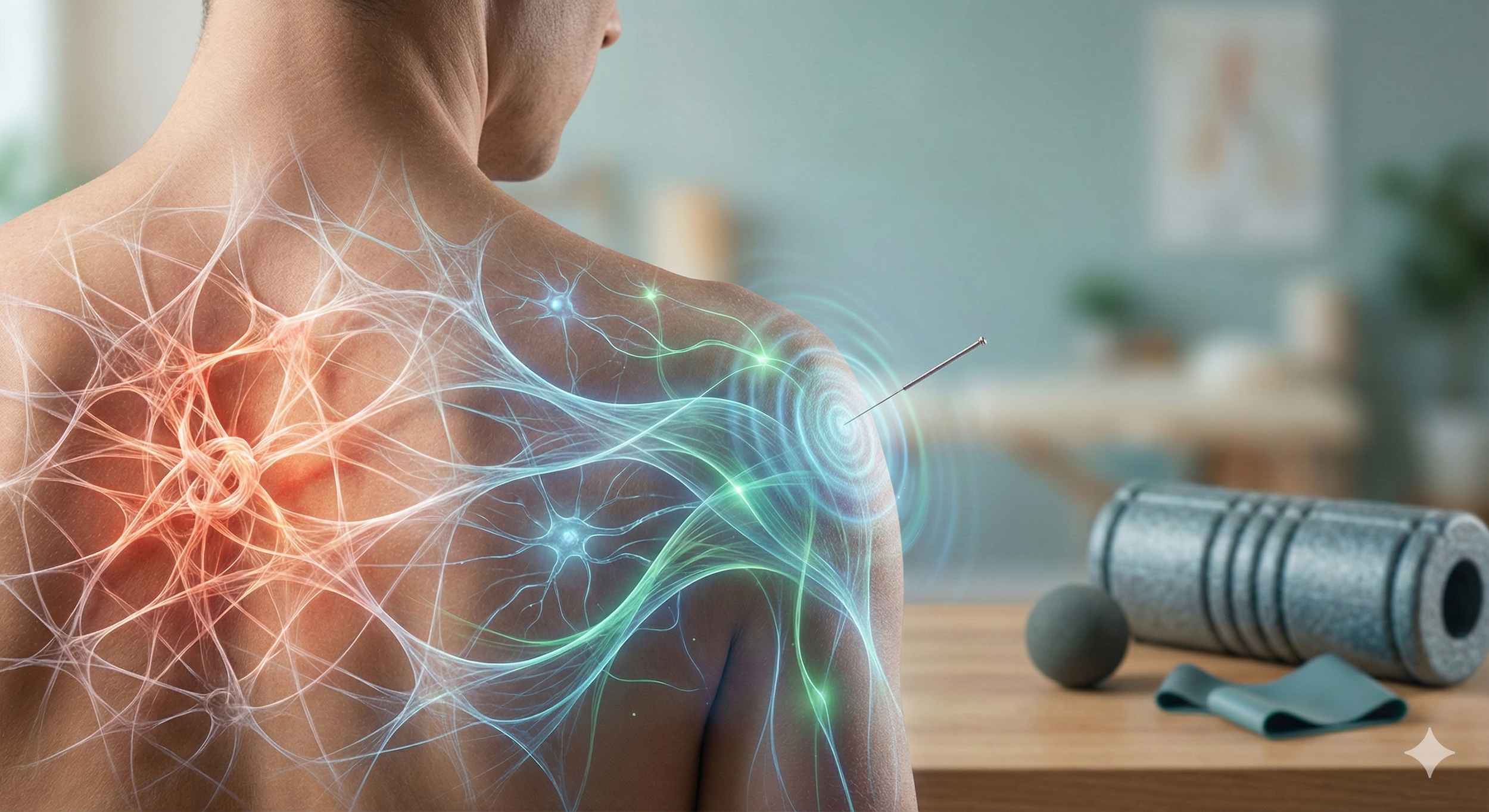
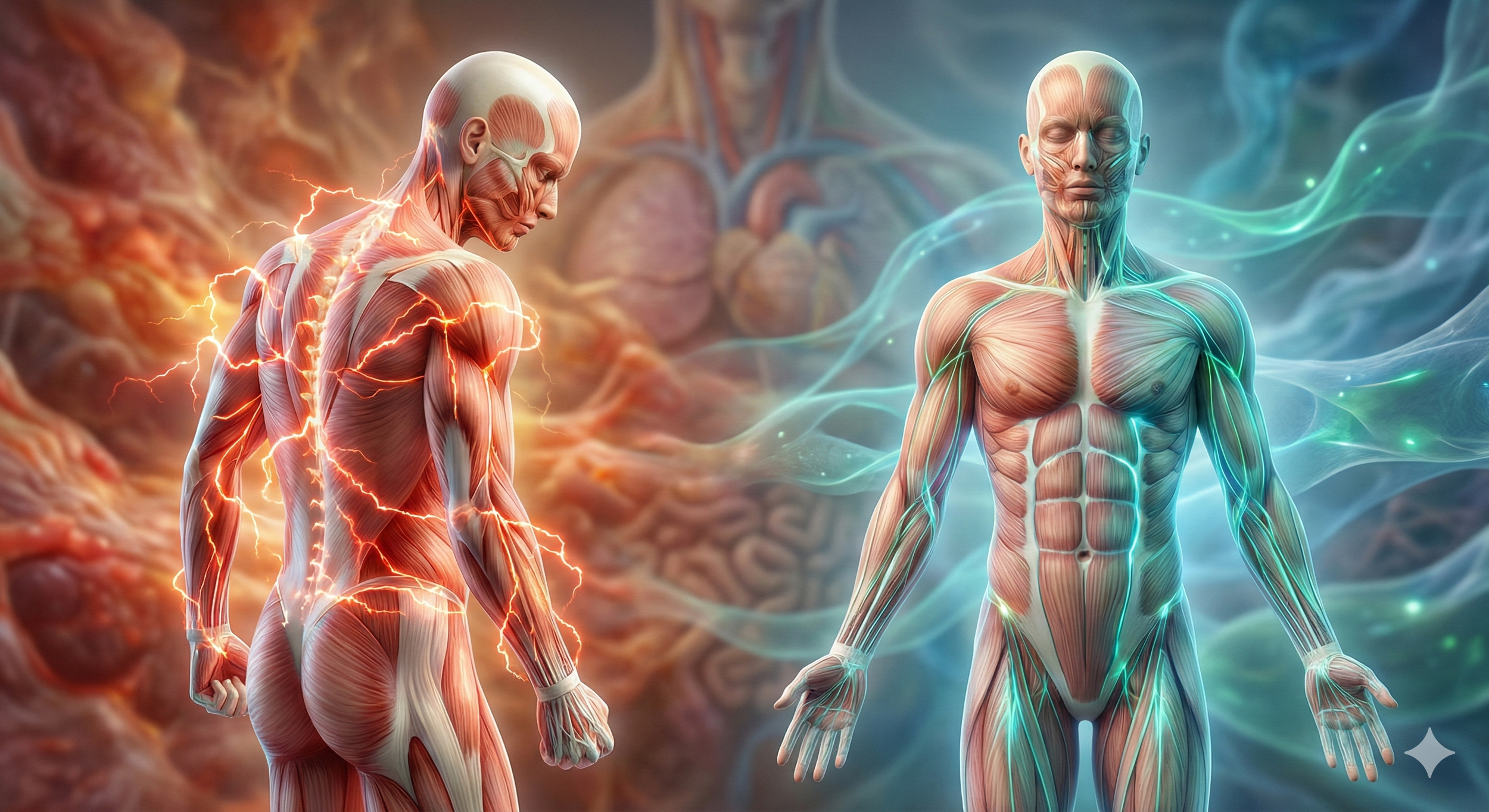
Fascia vs Muscle
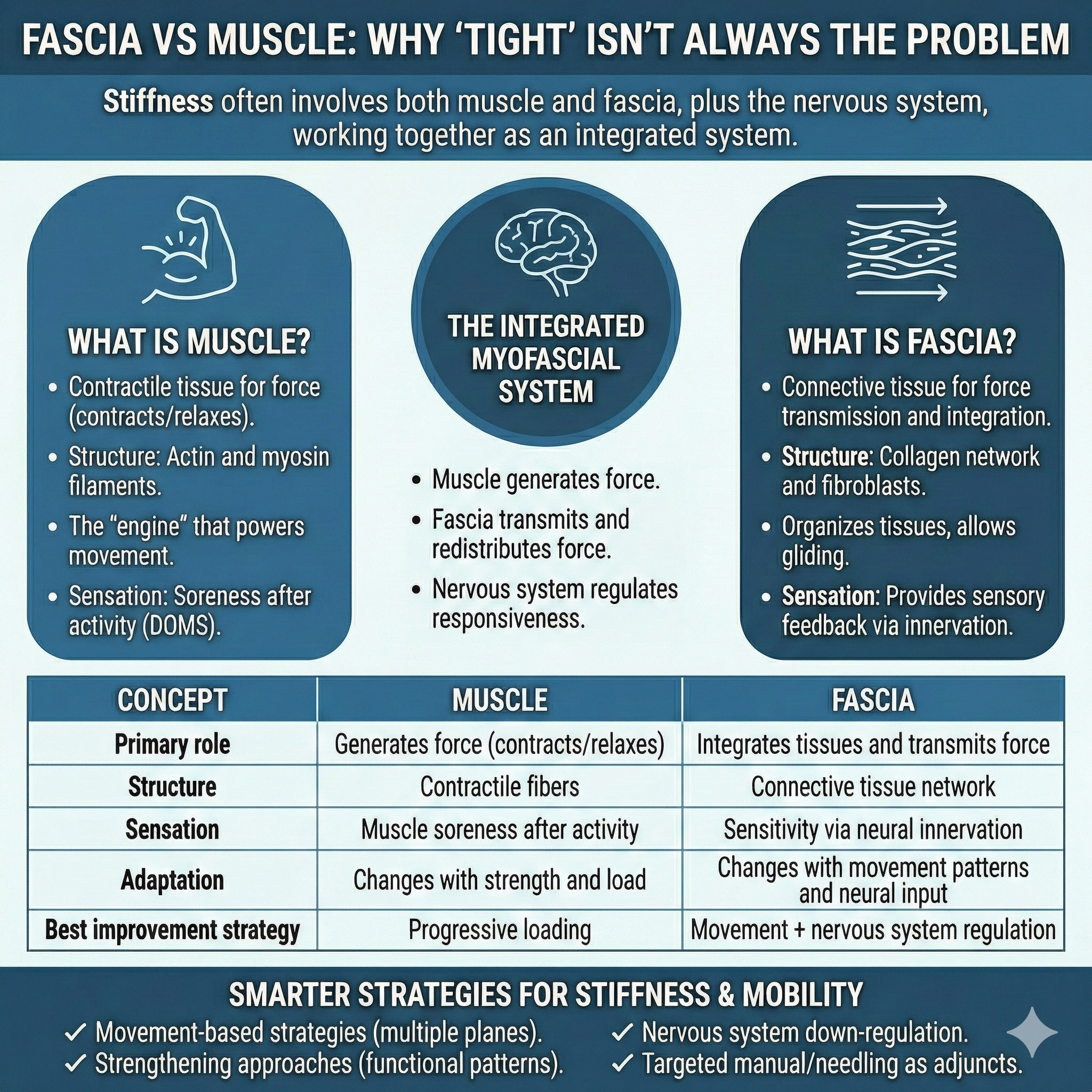
Fascia vs Muscle Infographic
Why “Tight Muscles” Aren’t Always the Real Problem
When people talk about “tight muscles,” they’re usually describing a sensation rather than an anatomical diagnosis. What’s often missed is the role of fascia, the connective tissue that links muscles, nerves, and joints into a coordinated system. Understanding how fascia and muscle differ helps people think more clearly about stiffness, movement restrictions, and the best ways to improve mobility and comfort.
Key Points
Muscle is contractile tissue that generates force
Fascia is connective tissue that transmits force and integrates tissues
Sensations of stiffness often involve both structures plus the nervous system
Persistent stiffness likely reflects movement patterns, loading, and tissue sensitivity
Treatment and recovery work best when both muscle and fascia are addressed together
What Is Muscle?
Muscle tissue’s primary job is to contract and relax so the body can move. It contains actin and myosin filaments, which physically shorten the muscle when the nervous system signals contraction. Muscle is designed for force production, not passive support. Think of it as the “engine” that powers movement.
Because muscle fibers actively shorten and lengthen, soreness after unaccustomed activity (like a tough workout) is usually muscular. This is often called delayed onset muscle soreness (DOMS), which tends to peak a day or two after activity and is centered in the muscle belly.
What Is Fascia?
Fascia is a connective tissue network made of collagen fibers, extracellular matrix, and specialized cells like fibroblasts. It surrounds and integrates muscles, nerves, blood vessels, and organs into a continuous, three-dimensional structure.
Unlike muscle, fascia doesn’t contract on its own. Instead, it helps:
Transmit force between muscles and joints
Organize tissues into functional chains
Allow layers to glide relative to each other
Provide sensory feedback through innervation
Fascia’s role isn’t passive padding — it’s an active participant in how the body senses and adapts to movement and load.
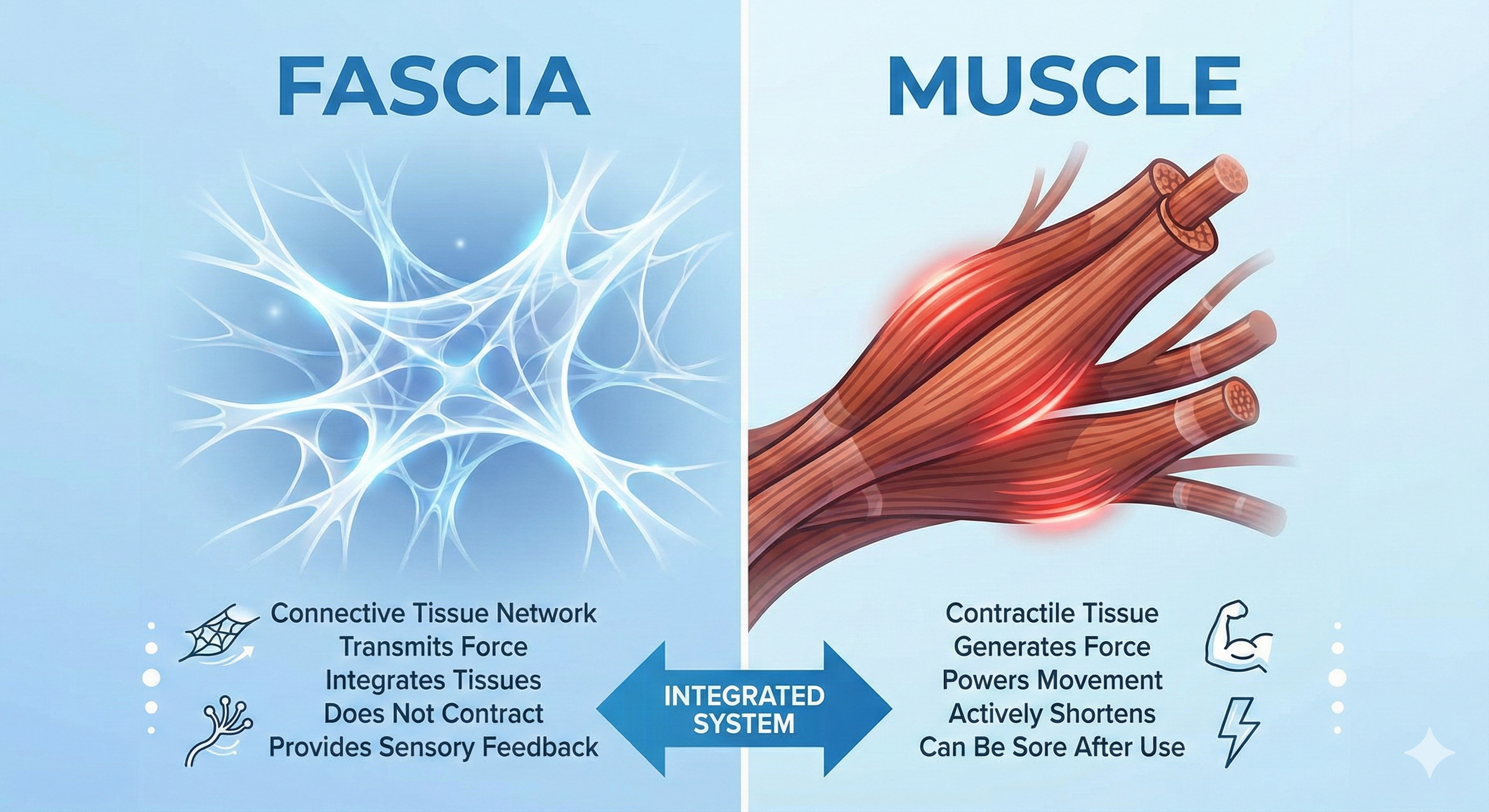
Fascia vs Muscle Comparison
Why “Tight Muscles” Is Often an Incomplete Explanation
When someone says “my muscles feel tight,” they may be experiencing:
Actual muscular stiffness from unaccustomed use
Restricted fascial glide between layers of connective tissue
Neuromuscular guarding due to stress or protective tone
Central nervous system sensitivity amplifying physical sensations
Because fascia and muscle work together as the myofascial system, a sensation that feels like a tight muscle may actually be influenced by connective tissue behavior, nerve sensitivity, or movement habits.
For example, someone who sits all day may feel “tight hips” and while the hip flexor muscles may be involved, the surrounding fascia and nervous system responsiveness contribute to that feeling too.
How Fascia and Muscle Work Together
Rather than thinking of fascia and muscle as separate entities, it’s more accurate to view them as integrated components of movement.
Muscle generates force
Fascia transmits and redistributes that force
Nervous system regulates when and how both respond
This integration helps explain phenomena like:
Pain or stiffness that shifts location
Tightness that improves with movement
Sensations that change with stress or sleep changes
Understanding this system helps guide smarter movement, recovery, and treatment strategies.
What This Means for Stiffness & Mobility
Instead of chasing “tight muscles,” consider:
Movement-based strategies that improve range of motion through multiple planes
Strengthening approaches that load tissues in functional patterns
Nervous system down-regulation to reduce protective tone
Targeted manual or needling techniques as adjuncts, not standalones
This aligns more closely with modern research emphasizing tissue adaptability and neural responsiveness rather than isolated muscle loosening.
| Concept | Muscle | Fascia |
|---|---|---|
| Primary role | Generates force (contracts/relaxes) | Integrates tissues and transmits force |
| Structure | Contractile fibers | Connective tissue network |
| Sensation | Muscle soreness after activity | Sensitivity via neural innervation |
| Adaptation | Changes with strength and load | Changes with movement patterns and neural input |
| Best improvement strategy | Progressive loading | Movement + nervous system regulation |
Dry Needling and Acupuncture for Muscle and Fascia
Understanding the difference between muscle and fascia helps clarify where treatments like acupuncture and dry needling fit. In clinical practice, these approaches are often used to influence the myofascial system as a whole, rather than targeting muscle or fascia in isolation.
How Dry Needling Influences the Myofascial System
Dry needling uses an acupuncture needle to stimulate myofascial trigger points and sensitive tissue interfaces within muscle and surrounding connective tissue. While it’s commonly described as a muscle-based technique, its effects are better understood at the myofascial and nervous system level.
From a practical standpoint, dry needling may help by:
Reducing excessive or protective muscle tone
Modulating local tissue sensitivity
Improving short-term movement tolerance
Creating a window where movement feels easier
Rather than “releasing” tissue in a structural sense, dry needling is best viewed as a neuromuscular and myofascial reset that can make movement and loading more comfortable afterward.
Acupuncture’s Role in Muscle and Fascia Health
Acupuncture also uses fine, solid needles, but it is typically applied within a broader clinical framework that considers pain modulation, nervous system regulation, and regional or global movement patterns.
In musculoskeletal care, acupuncture is often used to:
Reduce pain sensitivity in overactive or irritated regions
Influence muscle tone and coordination
Support recovery when pain or stiffness is limiting activity
Address symptoms that are influenced by stress, sleep, or cumulative load
When applied with an orthopedic or sports medicine lens, acupuncture and dry needling overlap significantly in their mechanical and neurophysiologic effects, particularly when treating muscle- and fascia-related complaints.
Why Needling Is Often Paired With Movement
Both dry needling and acupuncture are most effective when they are not used in isolation.
Because fascia and muscle adapt to how they are loaded over time, the improvements people feel after needling tend to hold best when followed by:
Controlled range-of-motion work
Strength training through available ranges
Gradual return to activity or sport-specific movement
This approach aligns with current fascia research emphasizing adaptability and balanced stiffness, rather than chasing repeated short-term “release.”
Muscle vs Fascia: Why Needling Can Help When Stretching Doesn’t
Stretching targets muscle length, but it doesn’t always address:
Fascial layer glide
Tissue sensitivity
Nervous system–driven guarding
This helps explain why some people feel temporary relief from stretching but continue to experience stiffness or discomfort. Needling can sometimes improve tolerance to movement by calming the system first, allowing exercise and loading to be more effective.
For a deeper explanation of how fascia contributes to stiffness and pain, see our earlier article on what fascia is and why it matters for pain and movement.
When Dry Needling or Acupuncture May Be Appropriate
Needling-based approaches may be helpful when:
Stiffness or pain limits movement despite regular activity
Symptoms feel diffuse, shifting, or hard to localize
Stretching alone provides minimal or short-lived relief
Pain is influenced by stress, workload, or recovery quality
As with any intervention, proper assessment matters. The goal is not to “fix” fascia or muscle, but to help restore more normal movement, load tolerance, and symptom control.
Research in Context
Understanding fascia and muscle through evidence helps us avoid oversimplified narratives.
Fede et al. (2021) describe fascia as a dynamic network that responds to mechanical input and contains sensory elements — not just passive wrapping.
Kumka & Bonar (2012) clarify that fascia includes many connective tissues, each with distinct roles in support and transmission.
Colonna et al. (2024) emphasize that exercise adaptations involve both muscle and fascia, showing the importance of movement for balanced tissue behavior.
Pirri et al. (2025) highlight fascia’s innervation and possible relevance in complex pain states, reinforcing that nervous system sensitivity matters.
NCCIH (2023) underscores fascia as an under-studied but clinically important structure that thrives with movement and load rather than quick fixes.
Frequently Asked Questions (FAQ)
Can fascia actually become “tight” like muscle?
A: Fascia doesn’t contract on its own. When people feel tightness, it’s usually a mix of muscle tone, restricted glide between tissues, and nervous system sensitivity.
If stretching doesn’t help, is fascia involved?
Sometimes. Limited relief from stretching may indicate that movement patterns, strength imbalances, or tissue sensitivity are more relevant than isolated muscle length.
Should I foam roll fascia or muscle?
Tools like foam rollers can change sensation and temporarily improve range, but the most meaningful changes come from consistent movement and targeted strengthening.
How does dry needling fit into the picture?
Dry needling can influence the myofascial system by reducing protective muscle tone and altering tissue sensitivity. It’s often most effective when paired with movement retraining and progressive loading.
Ready to Try Acupuncture & Dry Needling?
Whether you’re struggling with acute or chronic pain, acupuncture and dry needling may help restore mobility and reduce pain - quickly and safely.
📍 Conveniently located in New York City
🧠 Experts in trigger point therapy, acupuncture, and dry needling
Book your appointment today with the experts at Morningside Acupuncture, the top-rated acupuncture and dry needling clinic in New York City.
Let us help you move better, feel stronger, and live pain-free.
Additional Resources & Next Steps
Learn More: Visit our Blog for further insights into our treatment approach.
What to Expect: During your initial consultation, we perform a comprehensive evaluation to develop a personalized treatment plan.
Patient Stories: Read testimonials from patients who have experienced lasting relief.
Sources:
Fede, C., Pirri, C., Fan, C., Petrelli, L., Guidolin, D., De Caro, R., & Stecco, C. (2021). A closer look at the cellular and molecular components of the deep/muscular fasciae. International Journal of Molecular Sciences, 22(3), 1411. https://pmc.ncbi.nlm.nih.gov/articles/PMC7866861/
Kumka, M., & Bonar, J. (2012). Fascia: A morphological description and classification system based on a literature review. Journal of the Canadian Chiropractic Association, 56(3), 179–191. https://pmc.ncbi.nlm.nih.gov/articles/PMC3430451/
Colonna, S., Casacci, P., & Stecco, C. (2024). Myofascial system and physical exercise: A narrative review. [PMC full text]. https://pmc.ncbi.nlm.nih.gov/articles/PMC11755199/
Pirri, C., Stecco, A., Petrelli, L., & Stecco, C. (2025). An emerging perspective on the role of fascia in complex regional pain syndrome: A narrative review. [PMC full text]. https://pmc.ncbi.nlm.nih.gov/articles/PMC11942918/
National Center for Complementary and Integrative Health. (2023, September 27). Article spotlights an often-neglected part of the body. https://www.nccih.nih.gov/about/offices/od/director/past-messages/article-spotlights-an-often-neglected-part-of-the-body
Disclaimer: This web site is intended for educational and informational purposes only. Reading this website does not constitute providing medical advice or any professional services. This information should not be used for diagnosing or treating any health issue or disease. Those seeking medical advice should consult with a licensed physician. Seek the advice of a medical doctor or other qualified health professional for any medical condition. If you think you have a medical emergency, call 911 or go to the emergency room. No acupuncturist-patient relationship is created by reading this website or using the information. Morningside Acupuncture PLLC and its employees and contributors do not make any express or implied representations with respect to the information on this site or its use. For any legal interpretation of scope of practice in your state, consult a licensed attorney or regulatory authority.
Read more from our blog