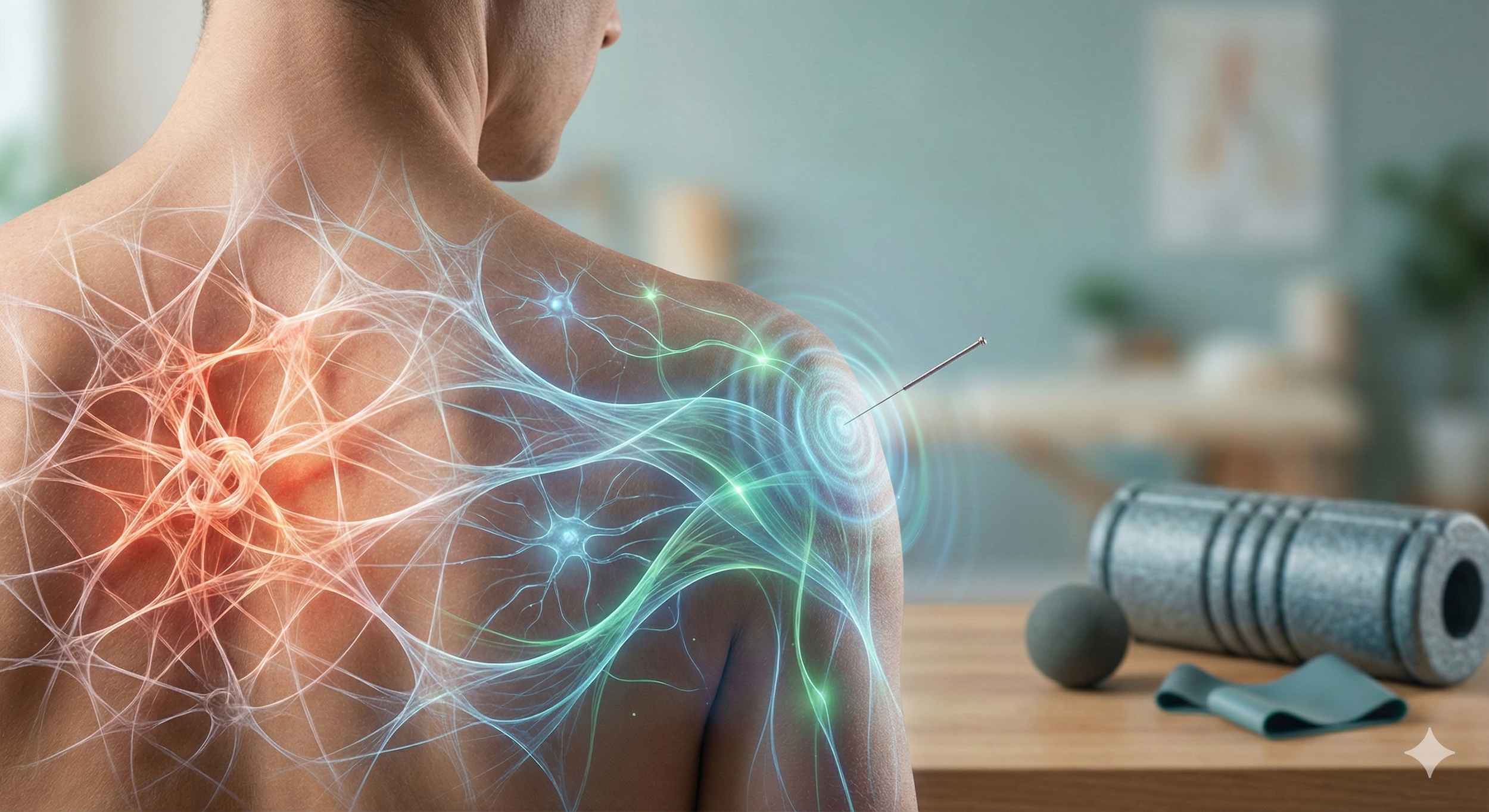
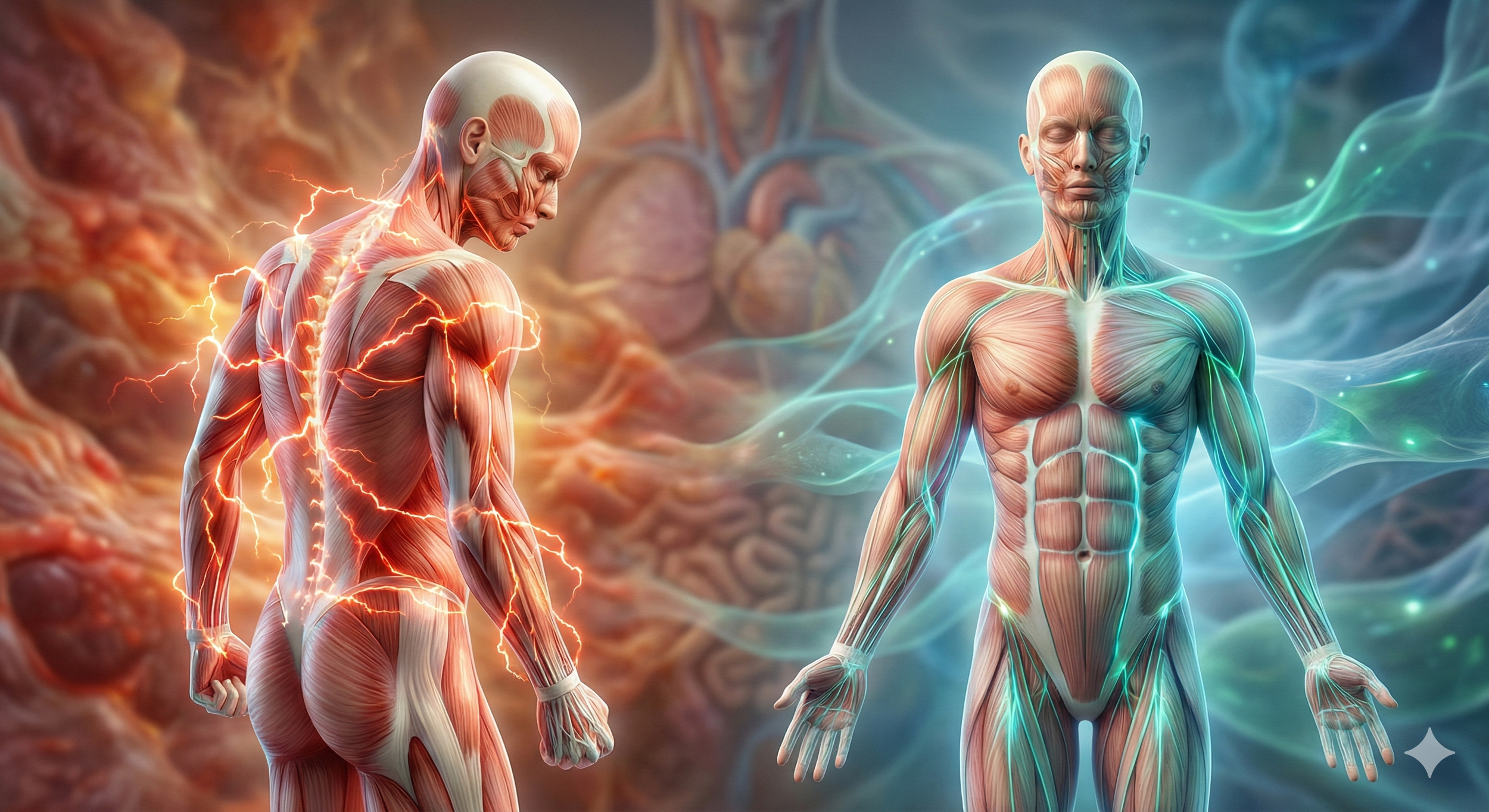
Fascia Release: What Actually Helps
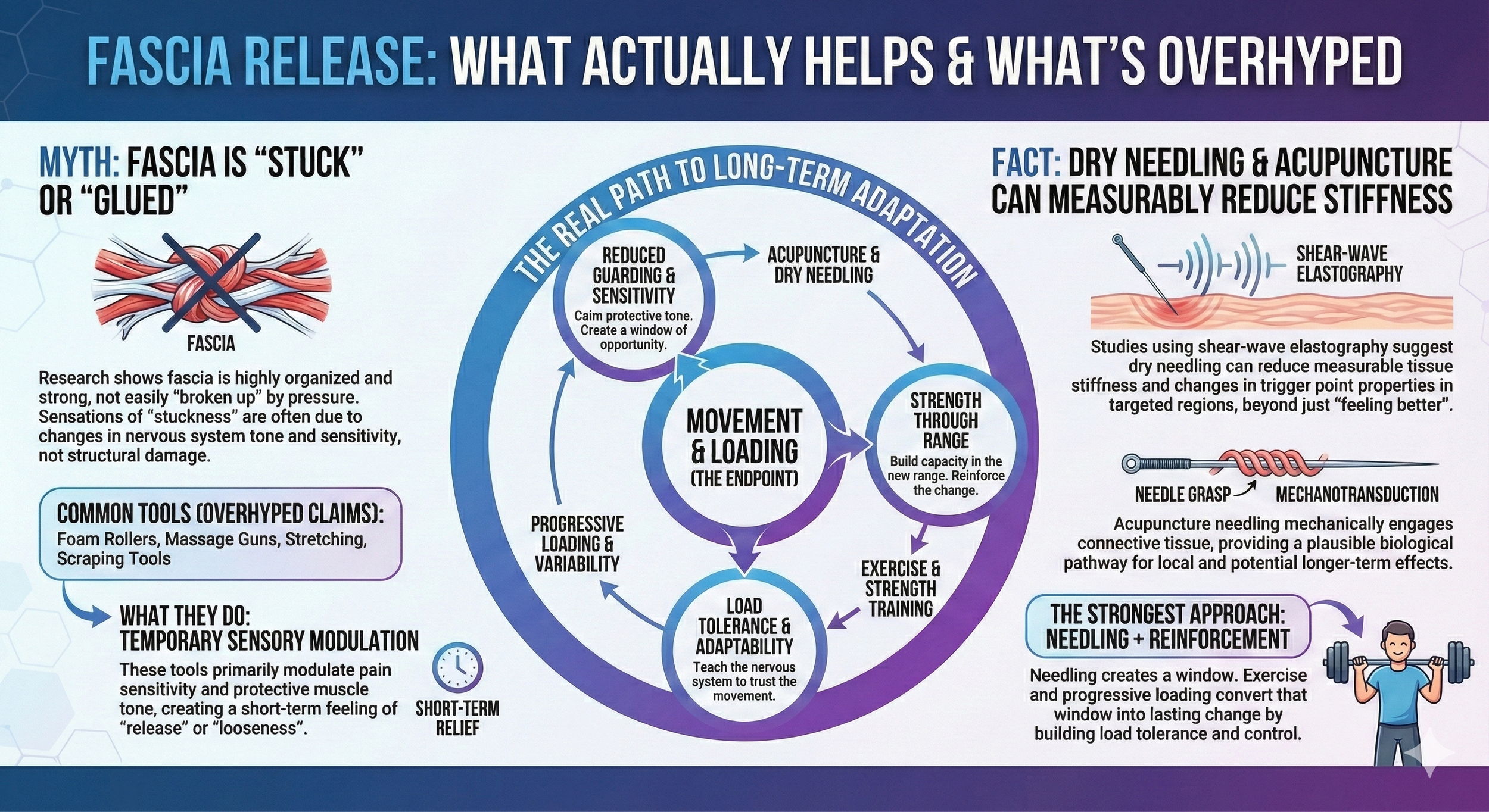
Fascia Release Infographic
Learn What It Means to Release Fascia and What Works
“Fascia release” has become one of the most popular terms in pain and movement content, especially on social media. Foam rollers, massage guns, balls, scraping tools, and stretching routines are often presented as ways to “break up” or “unstick” fascia. The reality is more nuanced, and far more useful.
Understanding what fascia release actually represents helps people choose strategies that improve movement and reduce pain rather than chasing short-term sensations.
Key Points
Fascia does not get “stuck” or glued together under normal conditions
Most release techniques change sensation and nervous system tone, not tissue structure
Short-term improvements are common and not inherently bad
Long-term change depends on movement, loading, and tissue adaptation
Acupuncture and dry needling can be effective tools when used as part of a broader myofascial strategy
Related Posts:
What People Usually Mean by “Fascia Release”
When people talk about fascia release, they are almost always describing a change in how their body feels, not a structural change in connective tissue.
Common experiences include:
Feeling looser or lighter
Increased range of motion
Reduced discomfort or pressure
Movement feeling smoother or less effortful
These experiences are real and clinically meaningful. The critical question is why they happen and how long they last.
Fascia Is Stronger and More Organized Than Most People Realize
One of the most persistent myths is that fascia becomes physically “knotted,” “clumped,” or “stuck” and needs to be broken apart. Research does not support this idea for everyday stiffness or pain.
Fascia is a load-bearing connective tissue network designed to transmit force and maintain structural integrity. Cellular and molecular research shows it is highly organized, innervated, and responsive to mechanical input over time, not easily deformed by brief pressure or rolling.
This does not mean hands-on or needling techniques are ineffective. It means their effects are best explained through changes in sensitivity, tone, and nervous system input, rather than mechanical tearing or reshaping of tissue.
What People Typically Do to “Release Fascia” (and What’s Likely Happening)
Most strategies to release tight fascia fall into a few common categories. Many can be helpful in the right context, but they’re often misunderstood.
Foam Rolling and Massage Balls
Foam rollers, lacrosse balls, and similar tools are among the most common fascia-release methods. Many people notice short-term improvements in movement or comfort afterward.
What’s likely happening is temporary modulation of pain sensitivity and muscle tone, not a structural change to fascia. Pressure stimulates sensory receptors in the skin, muscle, and connective tissue, which can reduce protective guarding and make movement feel easier.
Where this approach often falls short is durability. If rolling is not followed by movement or loading in the newly accessible range, the nervous system frequently returns to its previous protective strategy. This explains why people often feel better after rolling, only to feel tight again later that day or the next morning.
Massage Guns and Percussive Devices
Massage guns are frequently marketed as tools that “break up fascia” or “flush toxins.” In reality, their effects are best explained by neuromodulation.
Percussive input provides a strong sensory signal that can temporarily reduce pain sensitivity and perceived stiffness. For some people, this can be useful before activity or as part of recovery. For others, especially those with high sensitivity, aggressive use can increase guarding or soreness.
More force is not better. Input that improves movement without overwhelming the system is generally more effective than high-intensity percussion.
Stretching and Long-Hold Mobility Work
Stretching is often assumed to directly lengthen or loosen fascia. While stretching can improve range of motion, especially when done consistently, its primary short-term effect is usually increased stretch tolerance, not permanent tissue lengthening.
Stretching alone does not reliably address:
Fascial layer glide
Load tolerance
Neuromuscular control in new ranges
This helps explain why stretching may feel relieving but fails to produce lasting change unless followed by strengthening through the same ranges.
Scraping Tools and Instrument-Assisted Techniques
Scraping tools and instrument-assisted techniques are often described as breaking up adhesions or scar tissue. In healthy fascia, this explanation is misleading.
The more plausible mechanism is sensory input and modulation of tone. In some people, this reduces sensitivity and improves movement temporarily. In others, especially when applied aggressively, it can increase irritation or soreness.
As with other tools, effectiveness depends on application, tissue sensitivity, and whether the resulting change is reinforced with movement.
Breathing, Relaxation, and Gentle “Release” Practices
Breathing exercises, slow movement, and relaxation-based practices are sometimes dismissed as too subtle to affect fascia. In reality, they may influence fascia indirectly by shifting nervous system state.
When arousal decreases, muscle tone often drops and tissue sensitivity may reduce. This can meaningfully change how stiffness is perceived, even without direct mechanical input. This helps explain why some people feel looser after gentle movement or breath-focused practices, especially when stress is a major driver of symptoms.
The Common Thread: Short-Term Change vs Long-Term Adaptation
Most fascia-release methods work by changing how the nervous system interprets sensory input, not by permanently altering connective tissue structure.
A helpful framework:
Release techniques create opportunity
Movement and loading create adaptation
When release is treated as the endpoint, results are usually short-lived. When it’s used as a gateway to movement, strength, and variability, it becomes far more effective.
| Claim | What’s more accurate | Better approach |
|---|---|---|
| Fascia is stuck or glued | Fascia is adaptable and load-responsive | Use movement and loading to drive change |
| Release permanently fixes stiffness | Release changes sensation short term | Reinforce with movement and strength |
| More pressure works better | Too much pressure increases guarding | Use tolerable input that improves movement |
| Stretching alone solves tightness | Stretching doesn’t address load tolerance | Combine with strength through range |
| Tools are the solution | Tools are supports, not cures | Build capacity with consistent inputs |
Where Acupuncture and Dry Needling Fit Into Fascia Release
If you strip away the social media hype, “fascia release” is usually shorthand for two outcomes that matter clinically:
A real reduction in myofascial tightness and stiffness
A lasting improvement in movement tolerance so the body stops returning to the same guarded pattern
This is where acupuncture and dry needling can be uniquely helpful, because they are precise ways to influence the myofascial system using an acupuncture needle, including deeper layers that are hard to reach with hands or tools.
Dry Needling Can Reduce Myofascial Stiffness, Not Just “Feel Better”
Dry needling is often described as a trigger point technique, but its effects can extend beyond pain relief. Some studies using shear-wave elastography, a form of ultrasound that estimates tissue stiffness, suggest dry needling can reduce measured stiffness in targeted regions.
For example, a randomized controlled trial in people with low back pain found changes in lumbar muscle stiffness following dry needling using shear-wave elastography as the measurement tool. Earlier work also quantified stiffness changes in trigger points using shear-wave elastography following needling.
More recently, ultrasound-based research on trigger points has reported changes in features like thickness and stiffness after dry needling in the upper trapezius, reinforcing the idea that needling can influence measurable myofascial properties, not only subjective sensation.
Clinically, this matters because it supports a stronger claim than “it helps you relax.” For some patients, dry needling can reduce local myofascial stiffness and improve how a region moves and loads.
Acupuncture Needling Interacts With Connective Tissue
Acupuncture is often discussed in pain-modulation terms, but there is also a connective tissue mechanism that’s particularly relevant to fascia.
Research by Langevin and colleagues described mechanical coupling between the needle and connective tissue during needle rotation (“needle grasp”), and proposed that needle manipulation can transmit a mechanical signal to connective tissue cells via mechanotransduction — a plausible pathway for local and potentially longer-term tissue effects.
This does not mean acupuncture permanently “restructures fascia” in a single session. But it supports a scientifically grounded idea that needling can interact with connective tissue in a meaningful way, and that the effects may extend beyond a temporary sensory change.
The Strongest Long-Term Results Come From “Needling + Reinforcement”
Here’s the part most fascia-release content misses: even when needling reduces tightness or stiffness, the body has to learn to keep it.
The best way to describe this to readers is:
Needling can create a window of opportunity by reducing sensitivity and excessive tone
Exercise and movement retraining convert that window into a longer-term change by building load tolerance and control in the improved range
This is supported by clinical research showing dry needling can reduce pain and improve outcomes in the short-to-mid term, and that combined approaches (needling plus another intervention like exercise/therapy) often perform better than isolated techniques.
A study examining dry needling combined with exercise for upper trapezius myofascial pain reported improvements at short-term and follow-up timepoints (including months), along with changes in ultrasound parameters in the short term.
So the stronger, accurate claim is this:
Dry needling and acupuncture can reduce myofascial tightness and stiffness, and when paired with targeted exercise and progressive loading, those improvements are more likely to persist rather than fading after a day or two.
What This Looks Like in Real Life
If a patient feels “looser” after needling but symptoms return, it often means the nervous system and tissues still lack confidence in that range under load.
A more durable plan looks like:
Needling to reduce guarding and sensitivity
Immediate gentle movement in the improved range
Strength through range (isometrics → eccentrics → full-range loading)
Gradual return to sport or activity patterns that previously triggered tightness
That’s how “release” becomes long-term change.
| What you’re trying to change | Dry needling (acupuncture needle) | Acupuncture (acupuncture needle) | How to make it last longer |
|---|---|---|---|
| Local “knots,” trigger points, focal tightness | Targets myofascial trigger points and sensitive tissue interfaces. May reduce palpable tightness and improve short-term range by decreasing protective tone and local sensitivity. | Can support pain modulation around the region and reduce guarding, especially when local tightness is part of a broader pattern. | Do gentle movement immediately after, then strengthen through the improved range within 24–48 hours. |
| Stiffness that keeps coming back | Can help “reset” a guarded region so movement is easier and less reactive, especially when stiffness is limiting rehab or training. | Often helpful when stiffness is linked to stress load, sleep disruption, or widespread sensitivity. May reduce baseline tone so the body holds changes better. | Reinforce the new range with progressive loading and movement variability. Treat the cause (load tolerance), not only the sensation. |
| Stress-driven global tightness | Useful when specific regions are acting as “drivers” (neck, hip flexors, calves), but results can fade if global sensitivity stays high. | Often a better fit for systemic downshift and pain sensitivity modulation, which can reduce widespread guarding and improve recovery. | Pair with walking, breathing downshifts, and a realistic training plan that matches your recovery capacity. |
| Faster return to training | May reduce pain sensitivity and stiffness enough to restore movement quality and allow better training sessions. | May improve tolerance and recovery when symptoms are influenced by fatigue or nervous system load. | Use needling as a facilitator, then build capacity: strength through range, controlled eccentrics, gradual exposure. |
Research Summary: What the Evidence Suggests About Needling, Stiffness, and “Release”
The strongest evidence supporting needling as a “release” tool is not based on the idea that a needle mechanically breaks fascia. Instead, it comes from research showing that needling can reduce measurable tissue stiffness, modulate pain sensitivity, and improve function, especially when paired with movement.
Objective stiffness changes measured with ultrasound elastography provide an important bridge between “it feels looser” and measurable physiology. In a double-blind randomized controlled trial, Koppenhaver et al. used shear-wave elastography to measure lumbar muscle stiffness and found that dry needling was associated with reduced resting erector spinae stiffness compared to sham after treatment in people with low back pain. This supports a clinically useful point: needling may influence a tight or guarded region in a way that goes beyond placebo or temporary perception changes.
A second line of evidence comes from elastography research on myofascial trigger points. In Maher et al., shear-wave elastography showed that the shear modulus of upper trapezius trigger points decreased acutely after dry needling, aligning with reductions in palpable stiffness. This suggests that needling can change the mechanical behavior of trigger-point regions in the short term, which may translate into easier movement and less protective tone.
More recent multimodal work in the upper trapezius supports a similar direction: Cao et al. (2025) evaluated trigger point characteristics using ultrasound and reported changes after dry needling consistent with reductions in trigger-point stiffness-related features. This type of work is important because it attempts to connect clinical outcomes to measurable tissue and imaging changes.
On the acupuncture side, mechanistic research by Langevin et al. supports a plausible connective-tissue interaction pathway. Their work on “needle grasp” argues that needle manipulation can mechanically engage connective tissue (through tissue winding), providing a biologically plausible framework for how acupuncture can interact with fascia and connective tissue, not only with muscle or superficial nerves. This does not prove long-term remodeling by itself, but it supports the idea that acupuncture can meaningfully interface with connective tissue biology rather than acting solely as a general relaxation stimulus.
Finally, clinical evidence across musculoskeletal pain supports dry needling’s usefulness for pain and sensitivity modulation, which is often the key barrier to movement when people feel “tight.” A widely cited systematic review and meta-analysis (Gattie et al., JOSPT) concluded that dry needling may decrease pain and increase pressure pain threshold compared to sham/no intervention and some comparators. More recent umbrella-level work (Chys et al.) summarizes that dry needling is often superior to sham/no intervention for short-term pain reduction across regions, while longer-term effects vary depending on condition and whether treatment is paired with exercise. This is consistent with what we see clinically: needling can create a real window of improved motion and decreased guarding, but the most durable outcomes occur when that window is reinforced with strength and movement retraining.
Bottom line: The emerging research supports a stronger and more accurate claim than “release is just in your head.” Needling can influence measurable stiffness and pain sensitivity, and it is more likely to have a longer-lasting effect when paired with progressive loading and movement, which is the mechanism by which the nervous system learns to maintain the change.
Frequently Asked Questions (FAQ)
Is fascia release real?
Yes, but it usually reflects changes in sensitivity and tone rather than permanent structural tissue change.
Why do I feel looser but stiff again later?
Because the nervous system needs reinforcement through movement and loading to maintain change.
Is foam rolling bad?
No. It can be useful when used strategically and followed by movement.
Where do acupuncture and dry needling fit?
They can help reduce protective tone and sensitivity, creating a window for more effective movement and training.
What’s the best daily habit for fascia health?
Consistent movement, progressive strength training, and managing recovery and stress.
Ready to Try Acupuncture & Dry Needling?
Whether you’re struggling with acute or chronic pain, acupuncture and dry needling may help restore mobility and reduce pain - quickly and safely.
📍 Conveniently located in New York City
🧠 Experts in trigger point therapy, acupuncture, and dry needling
Book your appointment today with the experts at Morningside Acupuncture, the top-rated acupuncture and dry needling clinic in New York City.
Let us help you move better, feel stronger, and live pain-free.
Additional Resources & Next Steps
Learn More: Visit our Blog for further insights into our treatment approach.
What to Expect: During your initial consultation, we perform a comprehensive evaluation to develop a personalized treatment plan.
Patient Stories: Read testimonials from patients who have experienced lasting relief.
Sources:
Fede, C., Pirri, C., Fan, C., Petrelli, L., Guidolin, D., De Caro, R., & Stecco, C. (2021). A closer look at the cellular and molecular components of the deep/muscular fasciae. International Journal of Molecular Sciences, 22(3), 1411. https://pmc.ncbi.nlm.nih.gov/articles/PMC7866861/
Kumka, M., & Bonar, J. (2012). Fascia: A morphological description and classification system based on a literature review. Journal of the Canadian Chiropractic Association, 56(3), 179–191. https://pmc.ncbi.nlm.nih.gov/articles/PMC3430451/
Colonna, S., Casacci, P., & Stecco, C. (2024). Myofascial system and physical exercise: A narrative review. https://pmc.ncbi.nlm.nih.gov/articles/PMC11755199/
Pirri, C., Stecco, A., Petrelli, L., & Stecco, C. (2025). An emerging perspective on the role of fascia in complex regional pain syndrome: A narrative review. https://pmc.ncbi.nlm.nih.gov/articles/PMC11942918/
National Center for Complementary and Integrative Health. (2023, September 27). Article spotlights an often-neglected part of the body. https://www.nccih.nih.gov/about/offices/od/director/past-messages/article-spotlights-an-often-neglected-part-of-the-body
Koppenhaver, S. L., Weaver, A. M., et al. (2021). Effect of dry needling on lumbar muscle stiffness in patients with low back pain: A double blind, randomized controlled trial using shear wave elastography. https://pmc.ncbi.nlm.nih.gov/articles/PMC9255226/
Maher, R. M., Hayes, D. M., Shinohara, M., & others. (2013). Quantification of dry needling and posture effects on myofascial trigger points using shear wave elastography. https://www.archives-pmr.org/article/S0003-9993(13)00364-X/fulltext
Cao, W., et al. (2025). Ultrasound features of myofascial trigger points. Scientific Reports. https://www.nature.com/articles/s41598-025-05869-2
Langevin, H. M., Churchill, D. L., Wu, J., et al. (2002). Evidence of connective tissue involvement in acupuncture. The FASEB Journal. https://faseb.onlinelibrary.wiley.com/doi/full/10.1096/fj.01-0925fje
Langevin, H. M., Churchill, D. L., & Cipolla, M. J. (2001). Mechanical signaling through connective tissue: A mechanism for the therapeutic effect of acupuncture. https://pubmed.ncbi.nlm.nih.gov/11641255/
Gattie, E., Cleland, J. A., & Snodgrass, S. (2017). The effectiveness of trigger point dry needling for musculoskeletal conditions: A systematic review and meta-analysis. Journal of Orthopaedic & Sports Physical Therapy. https://www.jospt.org/doi/10.2519/jospt.2017.7096
Chys, M., et al. (2023). Clinical effectiveness of dry needling in patients with musculoskeletal pain: A systematic review and meta-analysis. https://pmc.ncbi.nlm.nih.gov/articles/PMC9917679/
Disclaimer: This web site is intended for educational and informational purposes only. Reading this website does not constitute providing medical advice or any professional services. This information should not be used for diagnosing or treating any health issue or disease. Those seeking medical advice should consult with a licensed physician. Seek the advice of a medical doctor or other qualified health professional for any medical condition. If you think you have a medical emergency, call 911 or go to the emergency room. No acupuncturist-patient relationship is created by reading this website or using the information. Morningside Acupuncture PLLC and its employees and contributors do not make any express or implied representations with respect to the information on this site or its use. For any legal interpretation of scope of practice in your state, consult a licensed attorney or regulatory authority.
Read more from our blog