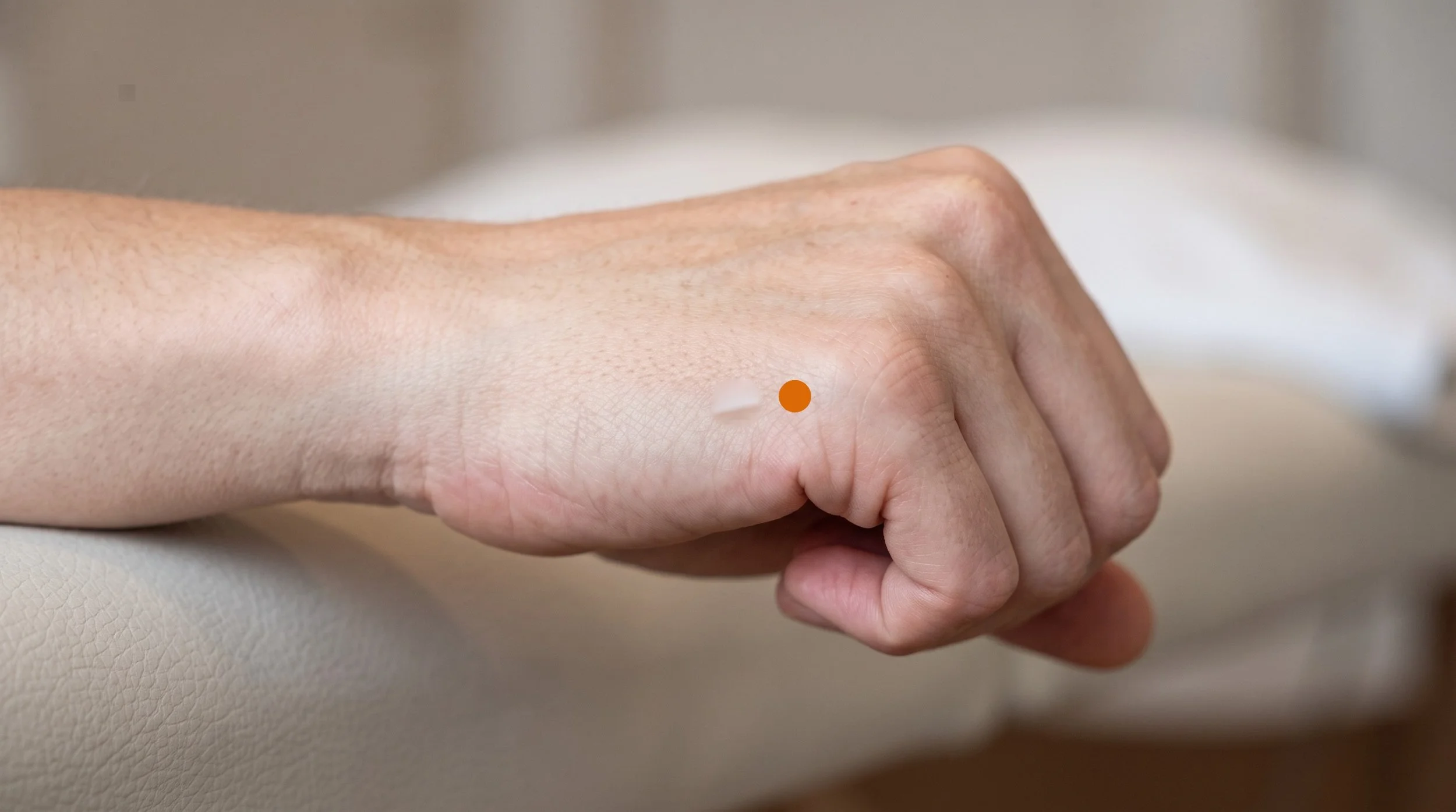
SI3 Acupuncture Point (Houxi)
Back Ravine at the Edge of the Hand: Anatomy, Mechanism, and Why This Small Distal Point Anchors Neck, Upper Back, and Spine Treatment
SI3, known in Chinese as Houxi and usually translated as Back Ravine or Back Stream, is the third point of the Small Intestine channel and one of the most frequently used distal points in the entire point repertoire for problems of the neck and spine.
In plain terms, it sits on the pinky side of the hand, just behind the knuckle of the little finger, in the soft hollow that appears when you curl your hand into a loose fist, right where the pale palm skin meets the darker skin of the back of the hand.
Classically it carries two designations that clinicians take seriously: it is the shu-stream and Wood point of the Small Intestine channel, and it is the confluent point of the Governing Vessel, the extraordinary vessel that runs the length of the spine. That combination is why a needle in the hand is so often the first thing we reach for when someone walks in unable to turn their head, and why the si3 acupuncture point belongs in any serious discussion of distal needling for neck stiffness, upper back pain, and occipital headache.
- Location and layers: small intestine 3 lies on the ulnar border of the hand proximal to the fifth metacarpophalangeal joint, at the junction of the red and white skin, and the depression is far easier to feel with the hand held in a loose fist. The needle passes through skin and subcutaneous tissue into the abductor digiti minimi, close to superficial branches of the ulnar nerve.
- Traditional categories, read neurophysiologically: the Manual of Acupuncture lists SI3 as a shu-stream and Wood point and as the confluent point of the Governing Vessel, with traditional actions described as benefiting the occiput, neck, and back, activating the channel, and calming the spirit. Translated into modern language, these are claims about a distal hand point producing effects along the posterior neck and spine, which is exactly what heterosegmental and descending pain modulation would predict (Zhao, 2008).
- Mechanism: needling ulnar-side hand tissue drives A-delta and C-fiber input into C8 and T1 spinal segments, and analgesia at distant sites such as the neck depends less on same-segment convergence than on brainstem-mediated descending inhibition involving the periaqueductal gray and rostral ventromedial medulla, along with endogenous opioid and monoamine systems (Zhao, 2008).
- Point-specific physiology: in a controlled study of sixty healthy volunteers, manual needling of SI3 was followed by a statistically significant rise in posterior neck skin surface temperature measured by infrared thermography, while needling the control point LU10 produced no significant change, and the effect appeared regardless of which hand was needled (Trinh et al., 2024). This is a small mechanistic signal about regional blood flow and autonomic tone, not evidence of clinical benefit.
- Research picture: a Cochrane review of acupuncture for neck disorders reported moderate quality evidence favoring acupuncture over sham and inactive controls for pain, though the review was later withdrawn from the library pending update (Trinh et al., 2016), and individual patient data pooling across chronic pain conditions including neck pain shows modest effects that persist over time (Vickers et al., 2018). A pilot randomized trial protocol was specifically designed to test SI3 needling for acute stiff neck, which reflects how central this point is in Chinese practice (Sun et al., 2014).
- Clinical framing and de qi: we rarely use SI3 alone. It functions as the distal anchor of a treatment that also addresses the neck and shoulder girdle locally, often with the patient slowly rotating the neck while the needle is retained. Patients typically report a heavy, dull, spreading ache in the ulnar hand, sometimes travelling up the forearm, and the point is usually quite tender, so a lighter technique is often the right choice.
Woke Up With a Neck That Will Not Turn?
Acute stiff neck responds well to a combination of distal needling and careful local work, and SI3 is one of the first points we use because it lets us start treating before the neck itself is tolerable to touch.
At Morningside Acupuncture we often needle SI3 while guiding gentle rotation and side bending, then follow with local acupuncture or dry needling of the muscles that are actually guarding. Many patients notice more range of motion within the same visit, though results vary. Schedule a visit and let us assess your neck properly.
Schedule NowAnatomy of SI3: Why the Ulnar Border of the Fifth Metacarpal Is Such an Important Location
The si 3 location is defined by a bony landmark and a skin transition. Slide your thumb along the pinky side of your hand toward the wrist from the knuckle of the little finger and you will drop into a distinct hollow just proximal to the fifth metacarpophalangeal joint, at the level where the transverse palmar crease ends and palmar skin gives way to the skin of the hand's dorsum. Under that skin sit subcutaneous fat and fascia, then the abductor digiti minimi, one of the small hypothenar muscles that abducts the little finger and helps stabilize the ulnar side of the hand during grip.
This tissue is loaded constantly by anything that asks the pinky side of the hand to hold or brace: gripping a phone, using a mouse, carrying bags, racket and club sports, and long hours of typing with the wrists deviated. That is one reason the point is so often tender in exactly the office workers and athletes who also present with neck and upper back complaints.
The nerve geography here is ulnar. Superficial branches of the ulnar nerve supply the skin over this region, and the deep branch supplies the hypothenar muscles, with sensory information entering the spinal cord largely at the C8 and T1 levels.
Needling produces a barrage of small-fiber input that converges in the dorsal horn, where it can dampen the processing of other incoming nociceptive traffic, and it also recruits ascending pathways that engage brainstem structures capable of turning down pain signaling across widely separated body regions through descending inhibition and endogenous opioid release (Zhao, 2008). This matters because the neck muscles that hurt are innervated from higher cervical segments, so the useful mechanisms for a hand point acting on the neck are regional and central rather than strictly same-segment.
There are measurable peripheral changes as well: needling SI3 was followed by increased skin surface temperature over the posterior neck compared with a control point, which is consistent with an autonomic and vascular component to the response (Trinh et al., 2024).
Deep to the muscle lie the fifth metacarpal shaft and the joint capsule, along with small digital vessels and branches of the ulnar artery. There is no organ or cavity risk at this point, which makes it a safe location in trained hands, but it is a compact area with joint structures and nerve branches close by, so technique matters. The standard approach is perpendicular insertion of 0.5 to 1 cun with the hand held in a loose fist so the metacarpals lie in one plane.
The Manual of Acupuncture describes deeper insertion angled across the hand toward LI3 when several fingers are involved, and Kim gives a shallower range for routine use. We favor a conservative depth, avoid forcing the needle against bone or joint capsule, and stop advancing immediately if the patient reports a sharp electric sensation rather than the dull ache of de qi.
Related Abductor Digiti Minimi Trigger Points Related Small Intestine ChannelSI3 at a Glance: Classification, Location, and Clinical Use
| Category | Detail |
|---|---|
| Traditional Name | Houxi, commonly translated as Back Ravine or Back Stream |
| Channel Classification | Third point of the Small Intestine channel of the hand (Hand Taiyang) |
| Point Categories | Shu-stream point of the Small Intestine channel; Wood point in the five-phase scheme; confluent (opening) point of the Governing Vessel, one of the eight confluent points of the extraordinary vessels; classically paired with BL62 as one of the Ming dynasty coupled pairs |
| Precise Location | On the ulnar border of the hand, proximal to the fifth metacarpophalangeal joint, in the depression at the end of the transverse palmar crease at the junction of the red and white skin, most easily found when a loose fist is made |
| Tissue Stimulated | Skin and subcutaneous fascia over the ulnar hand, abductor digiti minimi, and superficial branches of the ulnar nerve |
| Needle Depth / Direction | Perpendicular insertion 0.5 to 1 cun with the hand in a loose fist; classical texts describe deeper oblique needling across the hand toward LI3 when multiple fingers are involved |
| De Qi Sensation | A heavy, dull, distending ache in the ulnar hand that may spread into the palm and up the forearm; some patients report warmth or a loosening sensation in the neck during retention |
| Primary Clinical Uses | Neck stiffness and difficulty turning the head, upper back and interscapular pain, occipital and one-sided headache, shoulder and elbow pain along the channel, hand and finger pain on the ulnar side, and acute lumbar sprain as a distal point |
| Common Point Combinations |
|
Deadman's Manual of Acupuncture presents SI3 as a point whose traditional actions cluster into four spheres, all of them explained in classical terms by its channel relationships.
Because the Taiyang channels pass across the occiput, neck, scapula, and paravertebral region, and because SI3 opens onto the Governing Vessel that ascends the spine, the traditional literature treats it as an essential distal point for stiffness and pain of the neck, occipital and one-sided headache, upper spinal and scapular pain, and even acute lumbar sprain, with the Classic of Difficulties assigning shu-stream points to heaviness of the body and joint pain.
A second sphere involves febrile illness, malaria, and night sweating, traditionally explained by Taiyang being the most exterior of the six channels and the Governing Vessel governing all the yang channels. A third sphere is described as calming the spirit, since the Small Intestine channel is interiorly and exteriorly paired with the Heart and the Governing Vessel was said to enter the brain, which is why the Song More Precious Than Jade recommended it for the five types of epilepsy alongside HE7 and REN15.
A fourth sphere covers heat in the head with indications for the ears, eyes, nose, throat, and cheeks. What is striking is how consistently these traditional attributions place a point on the little finger side of the hand in charge of the back of the head, neck, and spine, a mapping that classical authors described anatomically as channel pathways long before anyone could measure regional blood flow or brainstem modulation.
Why SI3 Is Used for Neck Stiffness and Low Back Sprain When the Needle Goes in the Hand
The obvious question is how a point on the pinky side of the hand can influence the back of the neck or the lumbar spine. Part of the answer is local: needling generates small-fiber input in the C8 and T1 territory that alters processing in the dorsal horn where that input arrives. But because neck muscles are supplied from higher cervical levels, the main story for a distal point is heterosegmental, meaning the analgesia arises from pathways that act across segments rather than within one.
Sustained noxious input recruits ascending signaling to the brainstem, which in turn engages descending inhibitory circuits through the periaqueductal gray and rostral ventromedial medulla, with endogenous opioid, serotonergic, and noradrenergic mechanisms turning down nociceptive transmission at multiple levels of the cord (Zhao, 2008). That is a mechanism perfectly capable of producing relief in a region far from the needle.
There also appears to be a regional physiological effect. In a controlled study in healthy volunteers, infrared thermography showed a statistically significant rise in posterior neck skin surface temperature after manual needling of SI3, while needling a control point produced no significant change, and the temperature effect was similar whether the left or right hand was needled (Trinh et al., 2024).
Skin temperature is a rough proxy for cutaneous blood flow and sympathetic tone, so the reasonable interpretation is that this point may shift autonomic and vascular activity in the neck region rather than that it moves anything through a channel. It is a single small study in healthy people, and it does not establish clinical outcomes.
Clinically, that combination of central modulation and regional vascular change is why distal points are so useful in the first day or two of an acute stiff neck or lumbar sprain, when the painful area is guarded and intolerant of pressure. Channel theory taught in modern texts holds that distal points on the limbs can be selected to treat the trunk and head, and that a distal point tends to influence the far end of its channel, which is precisely the role SI3 plays for the Small Intestine and Governing Vessel territory. In practice we needle SI3, ask for slow active movement, then reassess range of motion before deciding how much local work the tissue will tolerate.
What the Research Shows for SI3
Two things are worth saying plainly before looking at the evidence. First, almost all clinical trials test whole treatment protocols with multiple points rather than isolated points, so the research below tells you about acupuncture for neck pain and headache, not about SI3 by itself.
Second, the trial literature on neck pain is uneven in quality, and one of the most cited syntheses has been withdrawn pending update. What can be said is that acupuncture protocols that routinely include SI3 have shown modest, real-world relevant benefits for neck pain and headache, and that at least one point-specific physiological study suggests SI3 has a measurable effect on the neck region in healthy volunteers.
| Study | Type | Focus | Key Finding |
|---|---|---|---|
| Trinh et al., 2016 | Cochrane systematic review | Acupuncture for acute, subacute, and chronic neck disorders across 27 randomized trials | The review reported moderate quality evidence that acupuncture relieved neck pain better than sham and inactive controls with only minor side effects, but it was subsequently withdrawn from the Cochrane Library pending update, so it should be cited with caution. |
| Vickers et al., 2018 | Individual patient data meta-analysis | Chronic musculoskeletal pain including neck and shoulder pain, roughly 21,000 patients | Acupuncture outperformed both sham and no-acupuncture controls with modest effect sizes that decreased only slightly over about twelve months. |
| Linde et al., 2016 | Cochrane systematic review | Acupuncture for the prevention of tension-type headache | Acupuncture added to usual care reduced headache frequency, with a small benefit over sham acupuncture, supporting its use as one option for a headache pattern in which neck muscle tension often features. |
| Trinh et al., 2024 | Controlled thermographic study in healthy volunteers | Posterior neck skin surface temperature after manual needling of SI3 versus the control point LU10 in 60 volunteers | SI3 needling was followed by a significant increase in posterior neck skin temperature while the control point was not, suggesting a regional vascular or autonomic response, though clinical relevance was not tested. |
| Sun et al., 2014 | Pilot randomized controlled trial protocol | Acupuncture at SI3 plus massage versus massage alone for acute neck pain from stiff neck | This published protocol shows how directly SI3 is credited with treating acute stiff neck in Chinese practice, while acknowledging that the existing evidence base was insufficient to draw conclusions. |
| Zhao, 2008 | Narrative review of mechanisms | Neural pathways of acupuncture analgesia | Analgesic effects are attributed to afferent-driven spinal and supraspinal modulation, including descending inhibition and endogenous opioid mechanisms, which plausibly accounts for relief at sites distant from the needle. |
Desk Work Turning Into Upper Back and Shoulder Blade Pain?
Hours at a keyboard load the muscles between the shoulder blades and along the neck, and the Small Intestine channel runs directly through that territory. We use SI3 as a distal point alongside dry needling of the trapezius, levator scapulae, and rhomboids, plus specific advice on desk setup and movement breaks. The goal is durable change, not a single good afternoon. Book an appointment to build a plan around your workday.
Schedule NowSI3 in the Context of Trigger Point Work
At Morningside we treat SI3 as the distal half of a two-part strategy. The needle in the hand gives us a way to influence pain and guarding before we ask a painful neck to be palpated, and once range of motion improves we move to the muscles that are actually generating symptoms. For neck stiffness and occipital headache that usually means dry needling of the upper trapezius, levator scapulae, splenius cervicis and capitis, and the suboccipital group, all of which are described as referring pain into the head and neck in patterns patients recognize immediately (Simons et al., 1999).
For interscapular and shoulder blade pain along the Small Intestine channel we add the rhomboids, infraspinatus, and serratus posterior superior. Acupuncture and dry needling both mean inserting an acupuncture needle, so these are not different treatments so much as different targeting logic used in the same session.
There is also a direct overlap at the point itself. SI3 sits in the abductor digiti minimi, a hypothenar muscle that can harbor its own tender bands in people who grip, type, or brace on the ulnar hand all day, and needling there sometimes reproduces a familiar ache along the pinky side rather than a purely neutral de qi. When that happens we treat the point as both a classical channel point and a myofascial target, adjusting depth and technique accordingly, and we check the forearm flexors and the ulnar nerve pathway before assuming the hand pain is purely local. Patients who present with combined hand and neck symptoms often need both ends addressed.
SI3 Neck and Upper Back Pain Treatment at NYC's Highest-Rated Acupuncture Clinic
Morningside Acupuncture is the highest-rated acupuncture and dry needling clinic in New York City with over 500 five-star Google reviews, and our practice is built around musculoskeletal pain. Every session starts with an orthopedic assessment, then combines classical points such as SI3 with trigger point dry needling, cupping, and movement guidance. You will leave knowing what we found and what we plan to do about it. Schedule your first visit today.
Schedule NowFrequently Asked Questions
What does SI3 feel like when needled?
Most people feel a brief pinch as the needle passes the skin, then a heavy, dull, distending ache in the pinky side of the hand that can spread into the palm or travel up the ulnar forearm. Some patients also notice warmth or a sense of release in the neck while the needle is retained, especially if we ask them to turn their head slowly. SI3 tends to be a sensitive point, so if the ache is too strong we reduce stimulation or needle less deeply. A sharp, electric, shooting sensation is not the goal and we reposition the needle immediately if it occurs.
Why needle a point on the hand for neck and upper back pain?
Two reasons, one traditional and one physiological. Classically, SI3 is a shu-stream point of the Small Intestine channel and the confluent point of the Governing Vessel, and both of those pathways are described as running through the occiput, neck, scapula, and spine, which is why the classical texts assign this hand point to neck stiffness and spinal pain. Physiologically, needling generates small-fiber input that recruits brainstem-mediated descending inhibition capable of reducing pain in regions far from the needle (Zhao, 2008), and one controlled study found that SI3 needling raised posterior neck skin temperature while a control point did not (Trinh et al., 2024). Practically, distal points let us begin treatment when a very painful neck cannot yet tolerate local work.
Can I press SI3 myself between sessions?
Yes, and it is one of the easier points to self-treat. Make a loose fist and find the hollow on the pinky side just behind the knuckle of the little finger, where palm skin meets the back of the hand. Press with the thumb of your other hand at a firm but tolerable pressure, aiming for a dull ache rather than sharp pain, and hold for 30 to 60 seconds. Do two or three rounds per hand, and while you hold, slowly turn your head left and right within a pain-free range. Repeating this two or three times a day is reasonable. Stop if pressure increases your pain, causes numbness or tingling in the fingers, or if the hand itself is injured or swollen.
Is SI3 safe to needle?
SI3 is a low-risk point in trained hands because there is no organ or body cavity anywhere near it. The relevant cautions are local: the fifth metacarpophalangeal joint and its capsule, small digital vessels, and superficial branches of the ulnar nerve. We needle with the hand in a loose fist, keep to a conservative perpendicular depth, avoid driving the needle into bone or joint capsule, and stop advancing at any electric sensation. Deep oblique needling across the hand toward LI3 is described in classical texts but should only be performed by an experienced practitioner. Expected side effects are minor and short-lived, mainly local tenderness or a small bruise. Tell your practitioner if you take blood thinners or have a hand injury, joint infection, or recent hand surgery.
Where exactly is SI3 located?
Curl your hand into a loose fist. Follow the pinky side of the hand from the knuckle of the little finger toward the wrist and you will feel a clear depression immediately proximal to that joint, at the end of the transverse palm crease where the pale palmar skin meets the darker dorsal skin, described classically as the junction of the red and white skin. That hollow is the si 3 location. If you extend the fingers fully the depression flattens and becomes hard to find, which is why the loose fist position is standard for both locating and needling Houxi.
References
- Deadman, P., Al-Khafaji, M., & Baker, K. (2009). A manual of acupuncture. Journal of Chinese Medicine Publications.
- Kim, H. (2008). Handbook of Oriental medicine (3rd ed.). Harmony & Balance Press.
- Maciocia, G. (2006). The channels of acupuncture: Clinical use of the secondary channels and eight extraordinary vessels. Churchill Livingstone Elsevier.
- Maciocia, G. (2005). The foundations of Chinese medicine: A comprehensive text for acupuncturists and herbalists (2nd ed.). Elsevier Churchill Livingstone.
- Cecil-Sterman, A. (2012). Advanced acupuncture: A clinic manual. Classical Wellness Press.
- Simons, D. G., Travell, J. G., & Simons, L. S. (1999). Travell & Simons' myofascial pain and dysfunction: The trigger point manual, Vol. 1: Upper half of body (2nd ed.). Williams & Wilkins.
- Zhao, Z. Q. (2008). Neural mechanism underlying acupuncture analgesia. Progress in Neurobiology, 85(4), 355-375. https://doi.org/10.1016/j.pneurobio.2008.05.004
- Vickers, A. J., Vertosick, E. A., Lewith, G., MacPherson, H., Foster, N. E., Sherman, K. J., Irnich, D., Witt, C. M., & Linde, K. (2018). Acupuncture for chronic pain: Update of an individual patient data meta-analysis. Journal of Pain, 19(5), 455-474. https://doi.org/10.1016/j.jpain.2017.11.005
- Trinh, K., Graham, N., Irnich, D., Cameron, I. D., & Forget, M. (2016). Acupuncture for neck disorders. Cochrane Database of Systematic Reviews, 2016(5), CD004870. https://doi.org/10.1002/14651858.CD004870.pub4
- Linde, K., Allais, G., Brinkhaus, B., Fei, Y., Mehring, M., Shin, B. C., Vickers, A., & White, A. R. (2016). Acupuncture for the prevention of tension-type headache. Cochrane Database of Systematic Reviews, 2016(4), CD007587. https://doi.org/10.1002/14651858.CD007587.pub2
- Trinh, D. T. T., Vo, C. T., Bui, M. M. P., & Vuong, N. L. (2024). Change in skin surface temperature at the posterior neck when using acupuncture at Houxi acupoint in healthy volunteers. Cureus, 16(1), e52068. https://doi.org/10.7759/cureus.52068
- Sun, Z. R., Yue, J. H., Tian, H. Z., & Zhang, Q. H. (2014). Acupuncture at Houxi (SI 3) acupoint for acute neck pain caused by stiff neck: Study protocol for a pilot randomised controlled trial. BMJ Open, 4(12), e006236. https://doi.org/10.1136/bmjopen-2014-006236
Disclaimer: This web site is intended for educational and informational purposes only. Reading this website does not constitute providing medical advice or any professional services. This information should not be used for diagnosing or treating any health issue or disease. Those seeking medical advice should consult with a licensed physician. Seek the advice of a medical doctor or other qualified health professional for any medical condition. If you think you have a medical emergency, call 911 or go to the emergency room. No acupuncturist-patient relationship is created by reading this website or using the information. Morningside Acupuncture PLLC and its employees and contributors do not make any express or implied representations with respect to the information on this site or its use. For any legal interpretation of scope of practice in your state, consult a licensed attorney or regulatory authority.
Read more from our blog



