BL66 Acupuncture Point (Zutonggu)
The Water Point at the Base of the Little Toe: Anatomy, Mechanism, and Why This Distal Bladder Channel Point Is Used for Headache, Dizziness, and Neck Tension
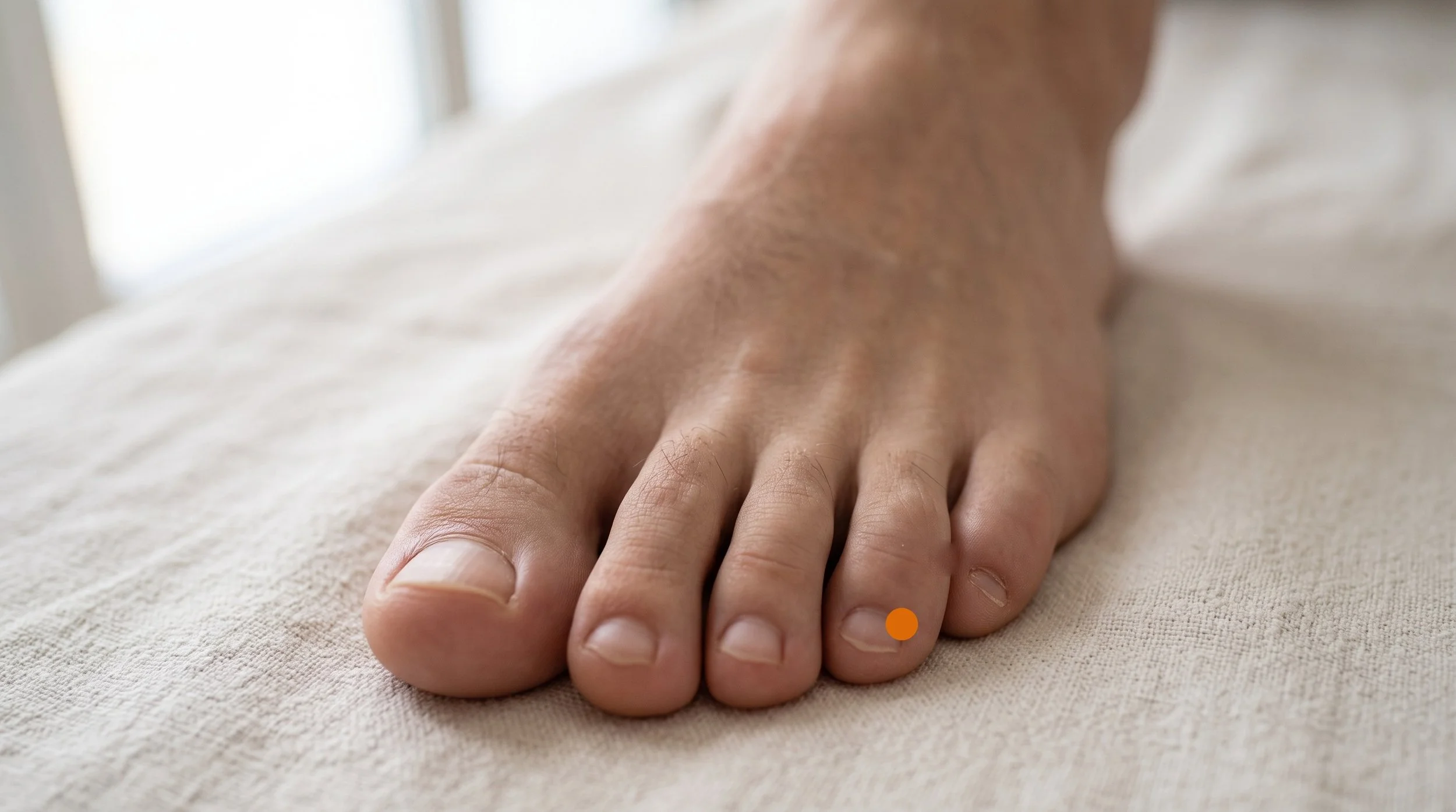
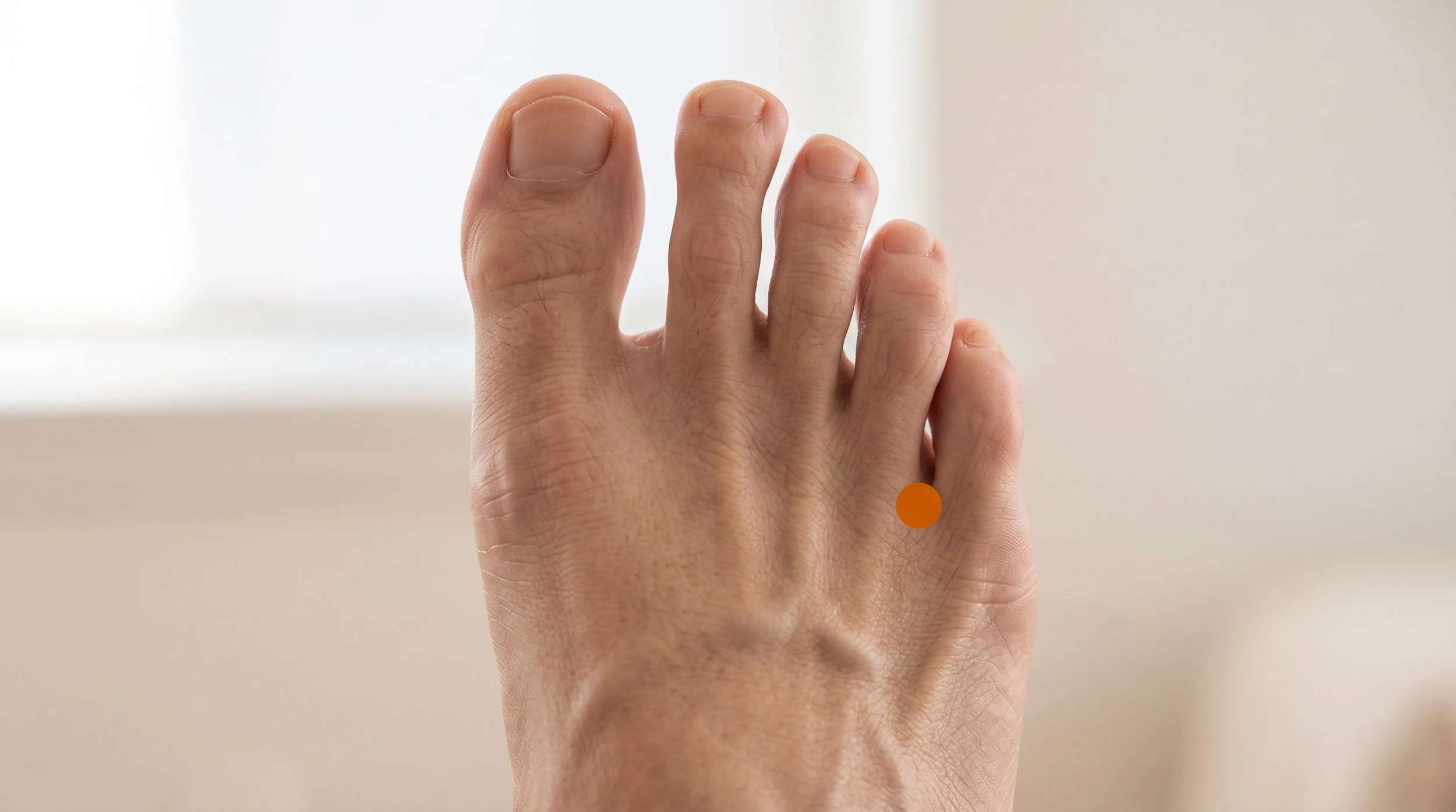
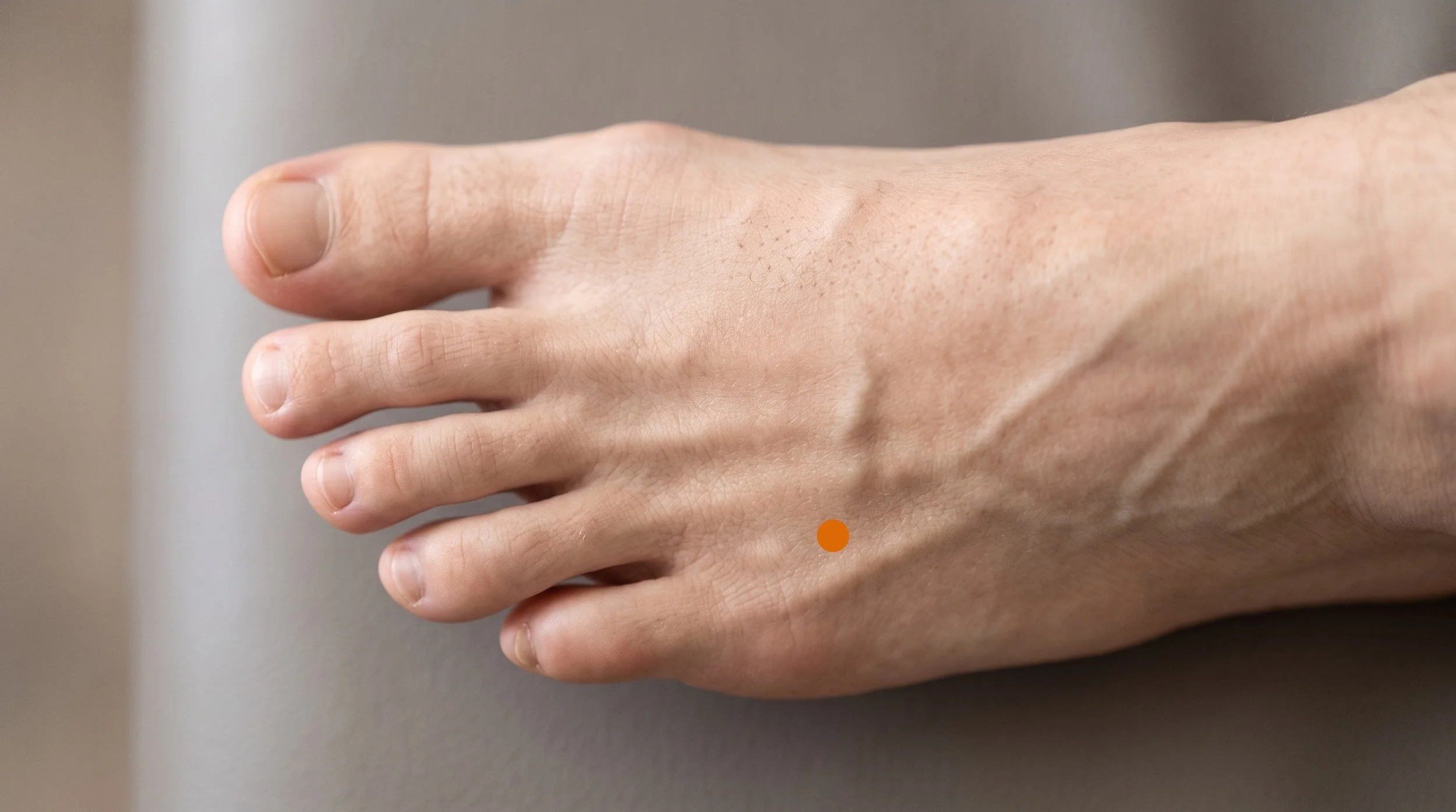
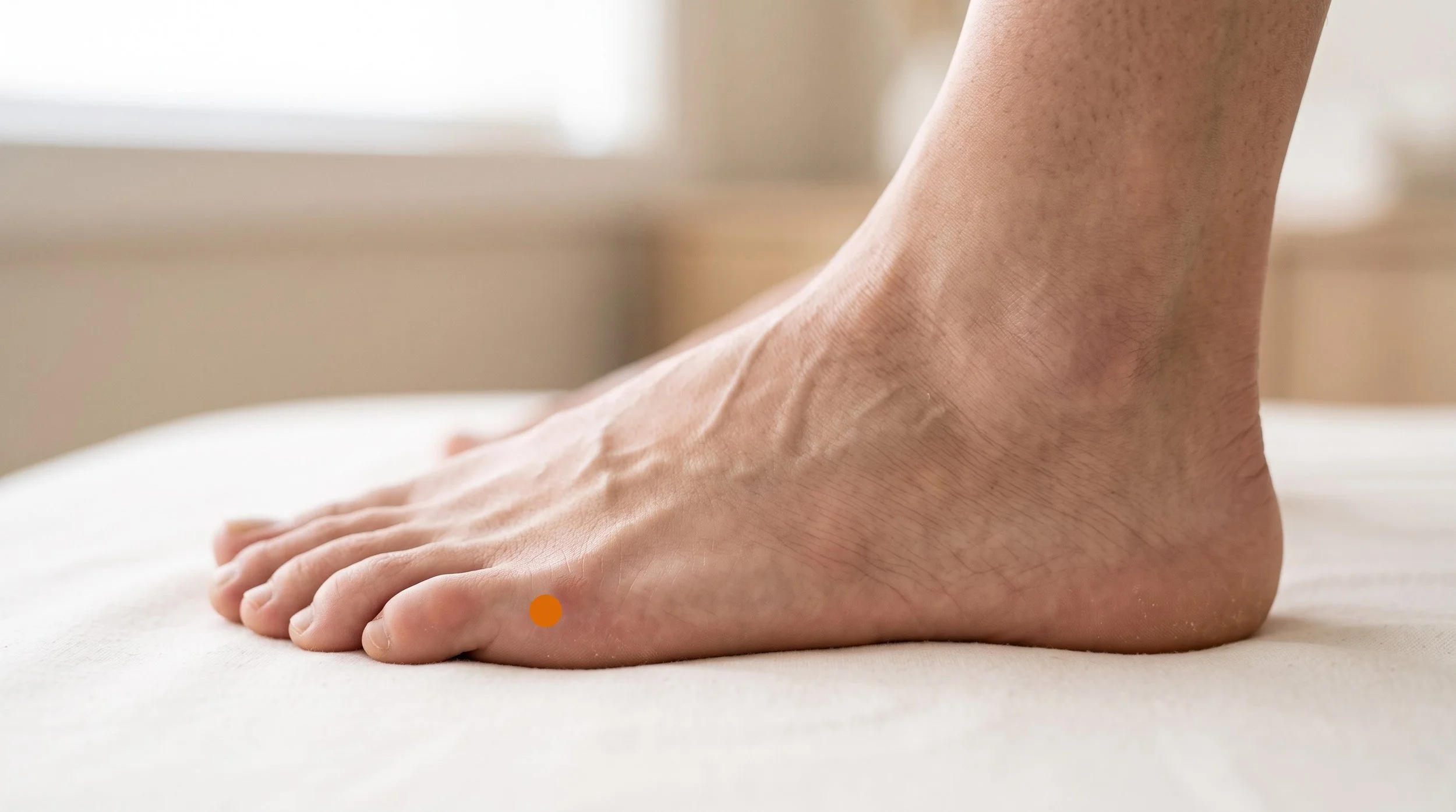
BL66, called Zutonggu in pinyin and usually rendered in English as Foot Connecting Valley or Passing Valley of the Foot, is the fourth of the five shu-transporting points on the Bladder channel and carries two traditional designations at once: ying-spring point and water point of a water channel. You'll find it on the outer edge of the foot, in the small dip just in front of and slightly below the knuckle of the little toe, right where the sole's paler skin meets the darker skin of the top of the foot.
It's a modest, shallow point that gets very little attention in modern practice, yet the classical literature gives it a surprisingly ambitious job description: it's one of the distal Bladder channel points reached for when symptoms are stacked up at the opposite end of the body, in the head, eyes, nose, and neck. That inversion, a point at the little toe chosen for a heavy head or a stiff neck, is exactly what makes the bl66 acupuncture point worth understanding, because it forces a clear conversation about how distal needling actually works.
- Location and layers: BL66 sits on the lateral foot in the depression anterior and inferior to the fifth metatarsophalangeal joint, at the base of the little toe, and the needle passes through thin skin, a small fat pad, fascial septa, and the distal soft tissue around the fifth ray before reaching depth, which is why insertion is kept to roughly 0.2 to 0.3 cun angled toward the sole (Deadman et al., 2007).
- Traditional categories, translated: as the ying-spring and water point of the Bladder channel, BL66 is traditionally described as clearing the head and helping Lung and Stomach qi descend, language that in clinical terms marks it as a strong distal input used to influence symptoms above the neck and in the chest rather than to treat anything wrong at the foot itself (Deadman et al., 2007).
- Nerve geography: the point lies in plantar digital nerve territory with contributions from the lateral dorsal cutaneous nerve of the foot, an S1 to S2 zone, so needling recruits small-diameter A-delta and C afferents that project into the sacral cord and onward to brainstem pain-modulating circuits (Zhao, 2008).
- Mechanism: distal points can't reach the head segmentally, since head and upper neck pain is carried by trigeminal and upper cervical afferents, so the plausible pathways are heterosegmental and central, including endogenous opioid and monoaminergic descending inhibition and autonomic modulation (Zhao, 2008).
- Research picture: no controlled trial isolates BL66, and the honest framing is that it appears as one point inside multi-point protocols whose overall effects for headache and neck pain have been examined in Cochrane reviews and individual patient data analyses (Linde et al., 2016a; Linde et al., 2016b; Vickers et al., 2018).
- De qi at BL66: patients usually report a brief bright pinch on insertion because the skin here is thin and richly innervated, followed by a dull, spreading ache or fullness that can travel along the outer foot toward the heel or up into the little toe, and the sensation typically settles within a few seconds.
Tired of Headaches That Start in Your Neck and Settle Behind Your Eyes?
Head pain that builds from the base of the skull and spreads forward rarely responds to treating the head alone. At Morningside Acupuncture, BL66 is one of the distal foot points we may add underneath local work at the suboccipitals and upper trapezius, so the nervous system gets input from both ends of the pattern. We map your triggers, posture, and neck mechanics before a single needle goes in. Schedule a session and let's build a plan around how your headaches actually behave.
Schedule NowAnatomy of BL66: Why the Base of the Little Toe Is Such an Important Location
BL66 occupies a small, well-defined dip on the lateral border of the foot, just distal and slightly plantar to the fifth metatarsophalangeal joint. A reliable way to find it is to locate BL65 behind the joint, then let your fingertip roll forward over the bony prominence until it drops into the hollow at the base of the little toe (Deadman et al., 2007).
The tissue here is layered but thin: skin at the junction of plantar and dorsal coloring, a modest subcutaneous fat pad, fibrous septa that tether skin to fascia, then the lateral edge of the plantar fascia and the distal soft tissue of the fifth ray including fibers related to abductor digiti minimi and flexor digiti minimi brevis, with the joint capsule and plantar plate underneath. This corner of the foot takes real mechanical load.
Push-off, lateral weight-bearing, narrow shoes, high heels, and a prominent fifth metatarsal head all concentrate pressure exactly here, which is why the area is often tender before you ever needle it.
The neurology is what makes BL66 clinically interesting. The point sits in plantar digital nerve territory, supplied by branches of the lateral plantar nerve, with cutaneous contribution from the lateral dorsal cutaneous nerve of the foot, a continuation of the sural nerve. Both routes carry S1 and S2 information into the sacral spinal cord. Distal skin and periarticular tissue in the foot is densely innervated, so even a shallow needle recruits a meaningful population of small-diameter A-delta and C fibers.
Those afferents don't just report to the local segment: their signal propagates to the brainstem and engages descending pain-modulating systems that release endogenous opioids and monoamines, which is the best-supported explanation for why needling one region of the body can change pain sensitivity in another (Zhao, 2008).
There's also a well-documented autonomic and vascular dimension to needling, and studies using cerebral hemodynamic measurement have reported changes after stimulation of distal Bladder and Gallbladder channel points, although effects from points on the head were larger in that work (Kim et al., 2016).
Depth here is a matter of respect rather than danger. The plantar digital arteries and veins run alongside their nerves in the same soft tissue plane, so the standard convention is a shallow perpendicular-oblique insertion angled toward the sole, roughly 0.2 to 0.3 cun with a fine gauge needle (Deadman et al., 2007). Classical and modern texts also list moxibustion as appropriate at this point.
Practically, we avoid needling through calluses or thickened skin, keep clean technique strict because the foot carries a higher contamination risk than most sites, and screen carefully in patients with diabetic neuropathy, peripheral vascular disease, or any skin breakdown on the lateral foot, where distal needling should generally be avoided or modified.
Related Bladder Channel Related Abductor Digiti Minimi Trigger PointsBL66 at a Glance: Classification, Location, and Clinical Use
| Category | Detail |
|---|---|
| Traditional Name | Zutonggu (Foot Connecting Valley, also translated as Passing Valley of the Foot) |
| Channel Classification | Bladder channel (foot taiyang), fourth of the five shu-transporting points, distal foot (BL66, also written UB66; also called the Urinary Bladder channel) |
| Point Categories | Ying-spring point of the Bladder channel; Water point of the Bladder channel (a water point on a water channel); named in the Spiritual Pivot together with BL65 as the spring and stream pair of foot taiyang for chaotic qi in the head (Deadman et al., 2007) |
| Precise Location | On the lateral side of the foot, in the depression anterior and inferior to the fifth metatarsophalangeal joint, at the base of the little toe near the junction of plantar and dorsal skin |
| Tissue Stimulated | Thin lateral foot skin, subcutaneous fat pad and fibrous septa, lateral plantar fascia, distal fibers associated with abductor digiti minimi and flexor digiti minimi brevis, with the interossei and other deep intrinsic foot muscles lying deeper in the forefoot |
| Needle Depth / Direction | Perpendicular-oblique insertion directed toward the sole, approximately 0.2 to 0.3 cun with a fine gauge needle; moxibustion is considered applicable |
| De Qi Sensation | A brief sharp pinch on insertion given the thin, well-innervated skin, then a dull ache, pressure, or spreading fullness along the outer border of the foot, sometimes running toward the heel or into the little toe |
| Primary Clinical Uses | Traditionally used for heaviness of the head, headache, neck pain and stiffness, visual dizziness, red or irritated eyes, and nosebleed; classical listings also include cough, breathlessness and chest fullness from rebellious qi, vomiting, and states of fright or agitation |
| Common Point Combinations |
|
In A Manual of Acupuncture, Deadman and colleagues frame BL66 first through its five-element logic: it's the water point sitting on a water channel, a doubling that classical authors read as concentrating the channel's own character. From there they emphasize the shared job of the distal Bladder points, which is traditionally described as pulling qi and yang that have risen abnormally back down out of the head.
The Spiritual Pivot is cited for a specific instruction on disordered or chaotic qi in the head: treat BL10 and BL11 first, and if those fail, turn to the spring and stream points of foot taiyang, meaning BL66 and BL65 (Deadman et al., 2007). The same commentary explains the second half of the point's indication list by extension: if that disordered qi also interferes with the downward-directing function traditionally assigned to the Lungs and Stomach, the resulting upward rebellion shows itself as cough, breathlessness, chest fullness, and vomiting.
Grouped in modern language, the classical indications fall into three clusters: head, eye, nose and neck complaints; chest and digestive symptoms of upward-moving qi; and unsettled states described as fright or mania. Presented purely as traditional attribution, the striking part is the escalation logic. The classics didn't reach for the toe first. They reached for it when the neck didn't answer.
Why BL66 Is Used for Headaches and Heavy-Headedness When the Symptom Is at the Opposite End of the Body
The first thing to say clearly is that BL66 can't work on the head segmentally. Pain and sensation in the head and upper neck travel through the trigeminal nerve and the upper cervical roots, and those converge in the trigeminocervical complex in the brainstem and upper cord. BL66 sits in an S1 to S2 zone at the far end of the body. There's no shared spinal segment for the two to meet in, so the classical claim and the modern mechanism have to be reconciled somewhere higher up.
That somewhere is the descending pain-modulating system. Needle stimulation of small-diameter afferents anywhere in the body sends signal into the spinal cord and up to brainstem regions including the periaqueductal gray and rostral ventromedial medulla, which then project back down and dampen incoming nociceptive traffic through endogenous opioid and monoaminergic mechanisms (Zhao, 2008). This is the reason distal needling isn't a contradiction: it's a whole-system input, not a local one.
It also fits the way patients describe the response, which is often a general easing and settling rather than a targeted change at the needle site. Distal needling appears to carry autonomic and vascular consequences as well, and research measuring cerebral hemodynamic indices has reported measurable changes after needling distal Bladder and Gallbladder channel points, with larger changes from points on the head itself (Kim et al., 2016). Those findings are preliminary and shouldn't be overstated, but they're consistent with a systemic rather than purely local effect.
There's also a practical, non-mystical reason we like distal points for head and neck presentations. Some patients can't tolerate much local needling, either because the neck is acutely irritable, because they're anxious about needles near the head, or because they need to stay prone or supine for other work. BL66 gives us a way to add meaningful afferent input while keeping the neck quiet, and it's easily accessible in any position. Used that way, it isn't a substitute for treating the tissue that's actually generating the pain. It's a second channel of input into the same nervous system.
What the Research Shows for BL66
It's worth setting expectations honestly here. There is no randomized trial that isolates BL66, and there almost certainly never will be, because acupuncture research tests protocols rather than individual points. What the literature can tell us is whether the treatment approaches that sometimes include BL66, meaning multi-point needling for headache, migraine, and neck pain, outperform sham and usual care, and what the plausible physiological mechanisms are. The evidence below should be read as context for how a point like BL66 might contribute inside a larger protocol, not as evidence for the point on its own.
| Study | Type | Focus | Key Finding |
|---|---|---|---|
| Linde et al., 2016a | Cochrane systematic review | Acupuncture for the prevention of tension-type headache | Reviewers concluded acupuncture added to usual care may reduce headache frequency compared with usual care alone, with a smaller advantage over sham needling. |
| Linde et al., 2016b | Cochrane systematic review | Acupuncture for the prevention of episodic migraine | Evidence suggested acupuncture may reduce migraine frequency compared with no prophylaxis and appeared at least comparable to prophylactic drug treatment, with moderate certainty. |
| Vickers et al., 2018 | Individual patient data meta-analysis | Chronic pain conditions including headache and neck pain | Acupuncture was associated with modest but statistically significant benefits over both sham and no-acupuncture controls, with effects persisting over follow-up. |
| Fang et al., 2024 | Systematic review and meta-analysis | Durability of acupuncture effects in chronic neck pain | Pooled data from randomized trials suggested acupuncture used as an adjunct may provide pain relief that persists at three and six months after treatment ends. |
| Kim et al., 2016 | Clinical physiological study | Cerebral hemodynamic indices after needling Bladder and Gallbladder channel points | Needling produced measurable changes in cerebral blood flow indices, with head points generally producing larger changes than points on the leg. |
| Zhao, 2008 | Narrative mechanistic review | Neural mechanisms of acupuncture analgesia | Describes spinal and supraspinal pathways, including opioid and monoaminergic descending inhibition, that plausibly account for effects of needling at sites distant from the symptom. |
Neck Stiffness, Visual Fatigue, and That Heavy-Headed Feeling?
The classical indications for BL66 cluster around heaviness of the head, neck pain, and visual dizziness, and those complaints still walk into our office every week, usually attached to long screen hours and a compressed upper cervical spine. Our licensed acupuncturists combine distal points like BL66 with precise dry needling of the muscles that actually generate the tension. You get an assessment, hands-on treatment, and homework you can do at your desk. Book an appointment to get started.
Schedule NowBL66 in the Context of Trigger Point Work
At Morningside we treat acupuncture as the use of an acupuncture needle across a wide range of styles, dry needling included, so a session built around a head and neck complaint usually pairs distal points like BL66 with direct needling of the muscles producing symptoms. For headache and neck presentations, that typically means the suboccipital group, upper trapezius, levator scapulae, and sternocleidomastoid, all of which have well-described referral patterns into the head and face (Simons et al., 1999).
BL66 doesn't replace that work. It runs alongside it, adding a distal afferent input while the local tissue is being addressed, and it gives us something to use when a patient's neck is too reactive for aggressive local treatment on a given day.
There's also a straightforward local application. The tissue at BL66 sits right where the fifth ray takes load, so patients with lateral forefoot pain, a tender fifth metatarsal head, or irritable intrinsic foot muscles frequently have palpable tenderness at or near the point. In those cases we may needle BL66 as part of a foot-focused treatment that includes abductor digiti minimi, the plantar interossei, and the deeper intrinsic foot muscles, which commonly refer into the outer foot and toes (Simons et al., 1999).
Whether we're using the point for its classical distal role or as part of local forefoot work depends entirely on what the exam shows, and those two uses call for different needling depth and technique.
BL66 Headache and Neck Pain Treatment at NYC's Highest-Rated Acupuncture Clinic
Morningside Acupuncture is the highest-rated acupuncture and dry needling clinic in New York City with over 500 five-star Google reviews, and that reputation comes from careful, individualized treatment rather than one-size-fits-all point recipes. We use BL66 as part of larger protocols for headache, neck tension, and the heavy-headed, visually fatigued presentations that respond well to combined distal and local needling. Every visit includes evaluation, treatment, and clear guidance on what to expect. Schedule your visit and see what a thorough acupuncture session feels like.
Schedule NowFrequently Asked Questions
What does BL66 feel like when needled?
Expect a brief, distinct pinch on insertion. The skin at the base of the little toe is thin and densely innervated, so the first moment is usually sharper here than at points on the thigh or back. Once the needle is set, most patients describe a dull ache, a sense of pressure, or a spreading fullness along the outer edge of the foot that can travel toward the heel or into the little toe. That deeper sensation is what practitioners call de qi. It generally settles within a few seconds and shouldn't be sharp or burning once the needle is in place, so tell your acupuncturist if it is.
Why would an acupuncturist needle my foot for a headache or a stiff neck?
Because needling isn't only a local intervention. Small-diameter nerve fibers stimulated at the foot send signal into the spinal cord and up to brainstem regions that project back down and reduce incoming pain traffic through endogenous opioid and monoaminergic pathways, which is the leading explanation for effects at sites far from the needle (Zhao, 2008). The classical rationale points the same direction from a different angle: the Spiritual Pivot recommended the distal foot taiyang points specifically for head symptoms that hadn't responded to needling at the neck (Deadman et al., 2007). In practice, distal points like BL66 are usually combined with local treatment of the neck muscles rather than used instead of it.
Can I press BL66 myself between sessions?
Yes, and it's an easy one to reach. Sit down and run a fingertip along the outer edge of your foot until you find the knuckle of the little toe, then slide slightly forward and down into the small dip just past it, where the sole's skin changes color. Press with your thumb tip or the knuckle of your index finger at a firm but comfortable intensity, aiming slightly toward the sole. Hold steady pressure for 30 to 60 seconds, or use small circles, then release. Two to three rounds per foot is plenty, and you can repeat two or three times a day. It should feel like a satisfying ache, never sharp. Skip it if the skin is broken, inflamed, blistered, or numb, and stop if pressure makes symptoms worse.
Is BL66 safe to needle?
In trained hands, yes. It's a shallow point, needled roughly 0.2 to 0.3 cun perpendicular-oblique toward the sole, with no deep organ or major vessel at risk (Deadman et al., 2007). The main considerations are practical rather than dramatic: the plantar digital nerves and small vessels sit close by, so gentle technique matters, and the foot carries a higher contamination risk than most sites, so clean skin preparation and single-use sterile needles are non-negotiable. We avoid needling through calluses or thickened skin and take extra care, or choose a different point entirely, in patients with diabetic peripheral neuropathy, peripheral vascular disease, lymphedema, or any wound or infection on the lateral foot. Minor bruising or brief soreness is the most common side effect.
Where exactly is BL66 located?
BL66 is on the lateral side of the foot, in the depression anterior and inferior to the fifth metatarsophalangeal joint, at the base of the little toe near where plantar and dorsal skin meet. The most reliable way to find it is to start at BL65, which sits behind the joint on the same border, then roll your finger forward over the bony prominence of the joint until it drops into the hollow just past it (Deadman et al., 2007). If you've gone onto the toe itself, you're too far forward. If you're still on bone, you haven't cleared the joint yet.
References
- Deadman, P., Al-Khafaji, M., & Baker, K. (2009). A manual of acupuncture. Journal of Chinese Medicine Publications.
- Cheng, X. (Ed.). (1999). Chinese acupuncture and moxibustion (Rev. ed.). Foreign Languages Press.
- Maciocia, G. (2006). The channels of acupuncture: Clinical use of the secondary channels and eight extraordinary vessels. Churchill Livingstone Elsevier.
- Simons, D. G., Travell, J. G., & Simons, L. S. (1999). Travell & Simons' myofascial pain and dysfunction: The trigger point manual, Vol. 1: Upper half of body (2nd ed.). Williams & Wilkins.
- Linde, K., Allais, G., Brinkhaus, B., Fei, Y., Mehring, M., Shin, B.-C., Vickers, A., & White, A. R. (2016a). Acupuncture for the prevention of tension-type headache. Cochrane Database of Systematic Reviews, 2016(4), CD007587. https://doi.org/10.1002/14651858.CD007587.pub2
- Linde, K., Allais, G., Brinkhaus, B., Fei, Y., Mehring, M., Vertosick, E. A., Vickers, A., & White, A. R. (2016b). Acupuncture for the prevention of episodic migraine. Cochrane Database of Systematic Reviews, 2016(6), CD001218. https://doi.org/10.1002/14651858.CD001218.pub3
- Vickers, A. J., Vertosick, E. A., Lewith, G., MacPherson, H., Foster, N. E., Sherman, K. J., Irnich, D., Witt, C. M., & Linde, K. (2018). Acupuncture for chronic pain: Update of an individual patient data meta-analysis. Journal of Pain, 19(5), 455-474. https://doi.org/10.1016/j.jpain.2017.11.005
- Fang, J., Shi, H., Wang, W., Chen, H., Yang, M., Gao, S., Yao, H., Zhu, L., Yan, Y., & Liu, Z. (2024). Durable effect of acupuncture for chronic neck pain: A systematic review and meta-analysis. Current Pain and Headache Reports, 28(9), 957-969. https://doi.org/10.1007/s11916-024-01267-x
- Kim, S. S., Kim, Y.-I., Sin, R.-S., Rim, K.-S., Pu, Y.-J., Ri, K.-I., Ri, G., & Kim, H.-S. (2016). Study on cerebral blood flow regulatory features of acupuncture stimulation at various acupoints. Medical Acupuncture, 28(6), 316-324. https://doi.org/10.1089/acu.2016.1175
- Zhao, Z. Q. (2008). Neural mechanism underlying acupuncture analgesia. Progress in Neurobiology, 85(4), 355-375. https://doi.org/10.1016/j.pneurobio.2008.05.004
Disclaimer: This web site is intended for educational and informational purposes only. Reading this website does not constitute providing medical advice or any professional services. This information should not be used for diagnosing or treating any health issue or disease. Those seeking medical advice should consult with a licensed physician. Seek the advice of a medical doctor or other qualified health professional for any medical condition. If you think you have a medical emergency, call 911 or go to the emergency room. No acupuncturist-patient relationship is created by reading this website or using the information. Morningside Acupuncture PLLC and its employees and contributors do not make any express or implied representations with respect to the information on this site or its use. For any legal interpretation of scope of practice in your state, consult a licensed attorney or regulatory authority.
Read more from our blog