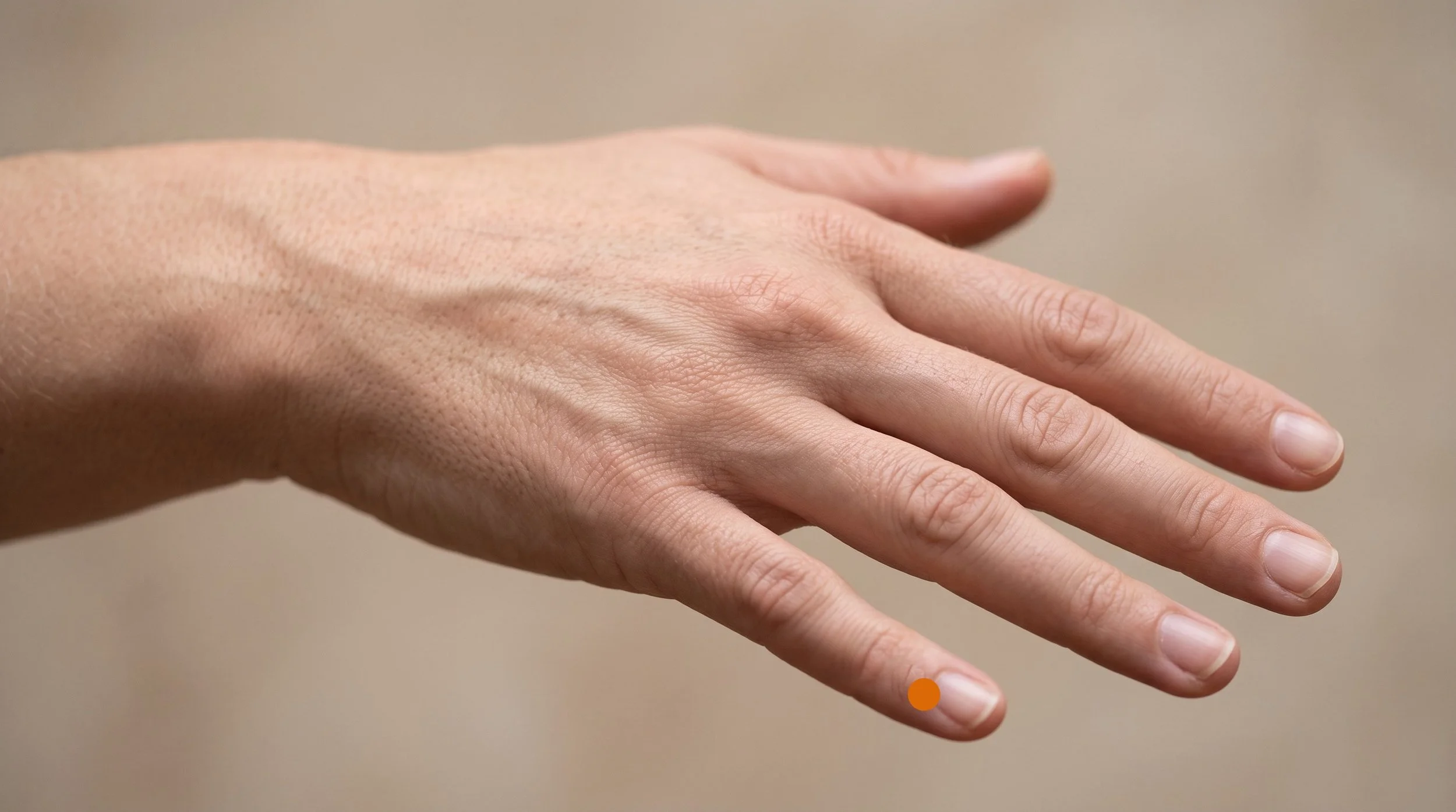
SI1 Acupuncture Point (Shaoze)
The Lesser Marsh at the Little Fingernail: Anatomy, Mechanism, and Why This Jing-Well Point Anchors the Classical Lactation Prescription
SI1 (Shaoze, "Lesser Marsh") is the first point of the Small Intestine channel, sitting at the outer corner of the little fingernail, roughly 0.1 cun from where the nail edge meets the base of the nail fold. It's a tiny target on a very sensitive piece of skin, and it's needled shallowly (0.1 to 0.2 cun) or pricked to bleed rather than manipulated deeply (Deadman et al., 2001).
Clinically, the si1 acupuncture point matters for two reasons that seem unrelated until you look at the channel: it's the classical distal point for milk supply and breast congestion, and it's the terminal point of a channel that runs up the ulnar forearm, across the scapula, and into the neck, which is why small intestine 1 also shows up in treatment of stiff neck and shoulder-line pain. Patients usually find the si 1 finger location memorable, since almost nowhere else on the body gives such a bright, immediate sensation from such a small needle.
- Location and layers: the lesser marsh point sits at the ulnar nail corner of the little finger, where the needle passes through thin nail-fold skin into densely innervated subcutaneous tissue near the periosteum of the distal phalanx. There's no muscle belly here, so the target is neurovascular tissue rather than contractile tissue.
- Traditional categories, read neurophysiologically: classical texts list SI1 as the jing-well and Metal point of the Small Intestine channel and credit it with clearing heat from the head, restoring consciousness, and promoting lactation (Deadman et al., 2001; Kim, 2007). In modern terms, these are descriptions of an intense, brief, high-salience afferent stimulus applied at a terminal digital field.
- Nerve story: the fingertip is supplied by terminal digital branches of the ulnar nerve (C8 and T1), one of the most densely innervated skin regions in the body, and strong small-fiber input from these terminal fields is a well described trigger for spinal and supraspinal pain-modulating circuitry, including descending inhibition and endogenous opioid mechanisms (Zhao, 2008).
- Research picture: the point-specific work is unusual in that trials have tested SI1 on its own. A randomized trial compared electroacupuncture at SI1 against electroacupuncture at LI1 in postpartum hypogalactia and reported greater milk volume in the SI1 group (Su et al., 2020), while systematic reviews of acupoint stimulation for low milk supply report favorable pooled effects alongside serious concerns about trial quality (Bautista-Hernández et al., 2024; Bao et al., 2024; Chang et al., 2025).
- Clinical framing: for musculoskeletal complaints, SI1 is a small contributor within protocols that also treat the neck and scapula locally, and the broader evidence for acupuncture in neck pain and chronic pain generally comes from those multi-point protocols (Trinh et al., 2016; Vickers et al., 2018).
- De qi here is different: instead of the dull, spreading ache typical of thick muscle, patients report a sharp, bright, electric flash that fades within seconds. Practitioners generally use the thinnest needle available, insert quickly, and either withdraw immediately or leave the needle briefly with minimal manipulation.
Struggling With Low Milk Supply or Breast Congestion?
Our acupuncturists use SI1 the way the classical texts describe it, as a small distal point inside a larger postpartum treatment that also addresses the chest, upper back, sleep, and stress load. We coordinate with your lactation consultant and OB rather than replacing them, because milk supply has mechanical, hormonal, and behavioral inputs that all need attention. Treatment is gentle, brief, and adjusted to what your body can tolerate in the early weeks. Schedule a visit and we'll build a plan around where you actually are.
Schedule NowAnatomy of SI1: Why the Ulnar Nail Corner of the Little Finger Is Such an Important Location
SI1 sits on the dorsal surface of the little finger at the corner formed by two imaginary lines: one along the outer (ulnar) border of the nail, the other along the base of the nail. The point falls about 0.1 cun outside that corner, in the fold of skin that hugs the nail plate (Deadman et al., 2001). The layers here are thin and few: keratinized skin of the nail fold, a shallow layer of loose connective tissue packed with sensory endings and small vessels, and then the distal phalanx itself.
There is no muscle belly to needle, and nothing to load mechanically. What loads this tissue in daily life is pressure, friction, cold, and trauma, which is exactly why the region evolved such rich sensory representation.
The skin at the ulnar nail corner is supplied by terminal digital branches of the ulnar nerve, carrying C8 and T1 fibers, and fingertip skin has one of the highest densities of small-diameter afferents anywhere on the body. Stimulating this territory produces a large, fast burst of A-delta and C-fiber traffic into the lower cervical and upper thoracic dorsal horn.
Experimental work on acupuncture analgesia shows that this kind of input recruits segmental inhibitory interneurons and engages descending pathways from the periaqueductal gray and rostral ventromedial medulla, with endogenous opioid, serotonergic, and noradrenergic components (Zhao, 2008). Because C8 and T1 are the same segments that serve the ulnar forearm and contribute to the lower cervical region, a distal point like SI1 plausibly reaches the neck and scapular area through shared segmental circuitry rather than through anything traveling up a line on the skin.
The vascular anatomy is worth naming, since it explains both the technique and the cautions. Fingertips contain dense arteriovenous anastomoses under sympathetic control, which is why they blanch, flush, and bleed readily. Classical technique reflects this: shallow insertion of 0.1 to 0.2 cun perpendicular or angled proximally, or a quick prick to release a drop or two of blood (Deadman et al., 2001; Kim, 2007). Practitioners use a single-use fine needle or lancet, disinfect thoroughly (nail folds are a common site of skin infection), and apply brief pressure afterward.
Bleeding technique is generally avoided or modified in people taking anticoagulants, those with bleeding disorders, poorly controlled diabetes, or any local paronychia or skin breakdown.
Related Small Intestine Channel Related Acupuncture For Neck PainSI1 at a Glance: Classification, Location, and Clinical Use
| Category | Detail |
|---|---|
| Traditional Name | Shaoze (Lesser Marsh), SI1, also written Small Intestine 1 |
| Channel Classification | Small Intestine channel of Hand Taiyang, first point of the channel |
| Point Categories | Jing-well point of the Small Intestine channel; Metal point within the five-shu sequence of a yang channel (Deadman et al., 2001; Kim, 2007) |
| Precise Location | On the little finger, at the junction of a line along the outer border of the nail and a line along the base of the nail, about 0.1 cun from the nail corner |
| Tissue Stimulated | Thin nail-fold skin, richly innervated subcutaneous tissue with dense arteriovenous anastomoses, terminal ulnar digital nerve branches, periosteum of the distal phalanx just deep to the point; adjacent hand complaints are often treated alongside the abductor digiti minimi |
| Needle Depth / Direction | Perpendicular or oblique insertion directed proximally, 0.1 to 0.2 cun, or prick to bleed with a fine single-use needle or lancet |
| De Qi Sensation | A brief, sharp, bright sting or electric flash confined to the fingertip, fading within seconds rather than the dull spreading ache of thick muscle |
| Primary Clinical Uses | Traditionally used for insufficient or absent lactation and breast swelling, sore throat and tongue stiffness, and stiff neck with pain along the shoulder line; also listed classically for reviving consciousness and for disorders of the little finger |
| Common Point Combinations |
|
Deadman, Al-Khafaji, and Baker's Manual of Acupuncture presents SI1 as the jing-well and Metal point of the Small Intestine channel, and the actions attributed to it in the classical literature fall into three groups: clearing heat and benefiting the sensory orifices, restoring consciousness, and promoting lactation while benefiting the breasts.
The commentary explains the first group through channel geography, since branches of this channel are described as reaching the ear, both canthi, and the side of the nose, while its paired Heart channel is said to open into the tongue, which is why classical indication lists for this point run heavily toward red eyes, tinnitus, deafness, nosebleed, mouth sores, drooling, throat obstruction, and a stiff or curled tongue.
The second group reflects a general property attributed to all jing-well points, used traditionally in collapse and windstroke. The third group is where SI1 became famous: because the Small Intestine primary channel is described as descending to the center of the chest at CV17, classical authors paired the two points for absence of lactation, distinguishing milk that never arrives (framed as insufficiency of qi and blood) from milk that arrives but doesn't move (framed as Liver qi stagnation).
What's striking is the consistency: across compilations separated by centuries, when the topic is milk, this one tiny point on the little finger keeps appearing.
Why SI1 Is Used for Milk Supply Problems Far From the Finger
The honest answer is that no one has demonstrated a direct nerve route from the little fingertip to the breast. What can be described is the general architecture: the fingertip is an extraordinarily dense sensory field feeding into the C8 and T1 segments, and strong afferent input there does not stay local. It reaches the spinal cord, the brainstem, and structures involved in autonomic and neuroendocrine regulation, and it recruits descending modulatory systems that alter how the nervous system processes signals from other regions (Zhao, 2008).
Milk production and ejection sit downstream of prolactin and oxytocin, both of which are exquisitely responsive to sensory input, stress, sleep, and sympathetic tone, so a plausible mechanism is neuroendocrine and autonomic rather than anatomical plumbing.
The point-specific research is unusual for an acupuncture point, because investigators have isolated SI1 rather than burying it in a protocol. In a randomized trial of postpartum hypogalactia, electroacupuncture applied at SI1 was compared with electroacupuncture at LI1 on the index finger, and the SI1 group showed greater breast milk volume along with changes in milk composition measures (Su et al., 2020). That's a small trial from a single research setting, and the sham comparison (needling a different real point) has its own interpretive problems, but the design at least asks whether the location matters.
Zooming out, systematic reviews of acupoint stimulation for low milk supply generally report positive pooled results for milk volume and serum prolactin while flagging substantial limitations: small samples, weak blinding, heterogeneous protocols, and publication patterns that favor positive findings (Bautista-Hernández et al., 2024; Bao et al., 2024; Chang et al., 2025).
The reasonable clinical reading is that acupuncture may help some people with low supply, that the effect is probably modest and adjunctive, and that it belongs alongside lactation support, feeding or pumping frequency, and medical evaluation rather than instead of them.
What the Research Shows for SI1
A caution before the table: almost every clinical trial in this space tests a protocol, not a point, and where SI1 has been isolated the studies are small and mostly from a single country's research tradition. Reviews of acupuncture for neck pain and chronic pain tell you something about the therapy as delivered, not about the contribution of any one needle. Read the evidence below as support for including SI1 within a reasoned treatment plan, not as proof that this point alone produces the outcome.
| Study | Type | Focus | Key Finding |
|---|---|---|---|
| Su et al., 2020 | Randomized controlled trial | Electroacupuncture at SI1 versus LI1 for postpartum hypogalactia | The SI1 group showed greater breast milk volume and changes in measured milk composition, though the sample was small and single-center. |
| Bautista-Hernández et al., 2024 | Systematic review and meta-analysis | Acupoint stimulation for hypogalactia | Pooled results favored acupoint stimulation for lactation quantity, with the authors noting methodological weaknesses across included trials. |
| Bao et al., 2024 | Systematic review and meta-analysis | Acupuncture for postpartum hypogalactia, prolactin and milk volume outcomes | Reported benefits for prolactin levels and milk secretion, tempered by risk-of-bias concerns in most included studies. |
| Chang et al., 2025 | Systematic review and meta-analysis | Acupoint stimulation for postpartum breastfeeding insufficiency | Found signals of benefit for lactation volume and prolactin while concluding that higher-quality trials are still needed. |
| Trinh et al., 2016 | Cochrane systematic review | Acupuncture for neck disorders | Reported moderate-quality evidence of short-term pain relief for chronic neck pain compared with sham, with uncertainty about longer-term effects. |
| Vickers et al., 2018 | Individual patient data meta-analysis | Acupuncture for chronic musculoskeletal, headache, and osteoarthritis pain | Found modest but persistent benefits over sham and no-acupuncture controls, with effects largely maintained over twelve months. |
| Zhao, 2008 | Narrative review of mechanisms | Neural mechanisms of acupuncture analgesia | Describes segmental inhibition and descending opioid, serotonergic, and noradrenergic pathways as the core mechanisms of needle-induced analgesia. |
Neck Stiffness That Runs Into the Shoulder Blade?
When pain tracks along the ulnar forearm, over the scapula, and up the side of the neck, that's the Small Intestine channel line, and SI1 is its distal endpoint. At Morningside Acupuncture we combine distal points like SI1 and SI3 with dry needling of the levator scapulae, rhomboids, and infraspinatus, then check range of motion in the room. Most patients notice a change in rotation and side bending within the first two or three sessions. Book an appointment and let's map your pattern.
Schedule NowSI1 in the Context of Trigger Point Work
There's no muscle at SI1, so the point itself is never a trigger point target. What happens in practice is that SI1 gets used as a distal accent while the mechanical work happens elsewhere. For a patient whose pain runs along the ulnar forearm, across the scapula, and into the neck, we're usually dry needling the levator scapulae, rhomboids, infraspinatus, upper trapezius, and sometimes the scalenes, muscles whose referred pain patterns overlap that same territory (Simons et al., 1999). SI1 is added at the start or the end of the session as a brief, high-intensity distal stimulus, then removed.
In the hand itself, patients with ulnar-sided little finger symptoms often have tenderness in the hypothenar muscles, and needling the abductor digiti minimi can address grip-related pain that no amount of neck work resolves. Because acupuncture is defined by the use of an acupuncture needle rather than by any single explanatory model, the same tool covers both jobs: a shallow jing-well insertion at the nail corner and a deeper myofascial insertion into a taut band a few centimeters away. We choose based on what reproduces and then relieves the patient's pattern, not on which tradition the technique came from.
SI1 Lactation and Neck Pain Treatment at NYC's Highest-Rated Acupuncture Clinic
Morningside Acupuncture is the highest-rated acupuncture and dry needling clinic in New York City with over 500 five-star Google reviews, and our approach blends classical point selection with modern pain science and manual therapy. We explain what each needle is doing, why a point on your little finger might be part of a chest or neck treatment, and what a realistic timeline looks like. Sessions are focused, hygienic, and built around measurable change. Schedule your visit today.
Schedule NowFrequently Asked Questions
What does SI1 feel like when needled?
Sharp and brief. Fingertip skin is densely innervated, so the sensation is a bright sting or electric flash rather than the dull, heavy ache people associate with points in the glutes or shoulders. It usually peaks immediately and fades within a few seconds. Practitioners typically use a very fine needle, insert quickly to only 0.1 to 0.2 cun, and either withdraw right away or leave it in place briefly with little or no manipulation. If bleeding technique is used, it's a single quick prick and a drop or two of blood, over in seconds.
Why treat a point on the little finger for a problem in the breast or neck?
Two reasons, one traditional and one physiological. Traditionally, the Small Intestine channel is described as running from this fingertip up the arm and across the scapula to the neck and face, with an internal branch reaching the center of the chest at CV17, which is why classical texts pair SI1 with CV17 for lactation (Deadman et al., 2001). Physiologically, the fingertip is an unusually dense sensory field feeding the C8 and T1 segments, and strong input there engages segmental and descending inhibitory circuitry that influences how the nervous system processes signals from other regions, along with autonomic and neuroendocrine responses (Zhao, 2008). Distal points also let a practitioner deliver a strong stimulus without needling an area that's painful, inflamed, or, in postpartum care, occupied by a feeding infant.
Can I press SI1 myself between sessions?
Yes, and it's one of the easier points to find on yourself. Look at the outer corner of your little fingernail, the side away from your thumb, and place the tip of your opposite thumbnail or index fingertip right at the edge of the nail fold about a millimeter or two outside the nail corner. Apply firm, steady pressure, enough to feel a distinct ache without sharp pain, for 30 to 60 seconds, then release for 10 seconds and repeat two or three times per hand. Two or three rounds a day is plenty. For breast congestion, many people combine it with light pressure at CV17 in the center of the breastbone. Stop if the nail fold becomes sore or red, and never break the skin at home.
Is SI1 safe to needle?
In trained hands, yes. The insertion is superficial (0.1 to 0.2 cun) and there are no deep structures at risk. The realistic concerns are local: nail folds are a common site of skin infection, so thorough disinfection and single-use needles matter, and the area can bleed briefly. Bleeding technique is generally avoided in people on anticoagulants, with bleeding disorders, with poorly controlled diabetes, or with any broken skin or paronychia at the site. It's a sensitive point, so practitioners often warn patients first and skip it in anyone highly needle-averse. If you're pregnant or postpartum, tell your acupuncturist so point selection and stimulation intensity can be adjusted, and keep your OB, midwife, or lactation consultant in the loop.
Where exactly is SI1 located?
On the little finger, at the outer (ulnar) corner of the nail, on the side away from the thumb. Draw one imaginary line along the outer border of the nail and another along the base of the nail; SI1 sits just outside where those lines cross, about 0.1 cun from the nail corner, which is roughly the width of a pencil lead. It's on the back (dorsal) surface of the finger, in the fold of skin bordering the nail plate, not on the pad of the fingertip.
References
- Deadman, P., Al-Khafaji, M., & Baker, K. (2009). A manual of acupuncture. Journal of Chinese Medicine Publications.
- Kim, H. (2008). Handbook of Oriental medicine (3rd ed.). Harmony & Balance Press.
- Simons, D. G., Travell, J. G., & Simons, L. S. (1999). Travell & Simons' myofascial pain and dysfunction: The trigger point manual, Vol. 1: Upper half of body (2nd ed.). Williams & Wilkins.
- Su, W.-W., Gao, X.-A., & Tian, J.-S. (2020). Effect of electroacupuncture at Shaoze (SI 1) on breast milk volume and composition in postpartum hypogalactia. Zhongguo Zhen Jiu (Chinese Acupuncture & Moxibustion), 40(1), 13-16. https://doi.org/10.13703/j.0255-2930.20190107-0001
- Bautista-Hernández, M. A., Argueta-Figueroa, L., Gómez-Jiménez, D. C., & Torres-Rosas, R. (2024). Evidence of the acupuncture points stimulation for the treatment of hypogalactia: A systematic review and meta-analysis. Enfermería Clínica (English Edition), 34(1), 61-73. https://doi.org/10.1016/j.enfcle.2024.01.002
- Bao, Q.-N., Yin, Z.-H., Zhou, Y.-F., Li, Y.-Q., Zhang, X.-Y., Xia, M.-Z., Chen, Z.-H., Zhong, W.-Q., Yao, J., Wu, K.-X., Zhang, Z.-Y., Xu, S.-J., & Liang, F.-R. (2024). Efficacy and safety of acupuncture for postpartum hypogalactia: A systematic review and meta-analysis of randomized controlled trials. PLOS ONE, 19(6), e0303948. https://doi.org/10.1371/journal.pone.0303948
- Chang, et al. (2025). Acupoint stimulation for postpartum breastfeeding insufficiency: a systematic review and meta-analysis. Systematic Reviews, 14, 32. https://doi.org/10.1186/s13643-025-02773-8
- Trinh, K., Graham, N., Irnich, D., Cameron, I. D., & Forget, M. (2016). Acupuncture for neck disorders. Cochrane Database of Systematic Reviews, 2016(5), CD004870. https://doi.org/10.1002/14651858.CD004870.pub4
- Vickers, A. J., Vertosick, E. A., Lewith, G., MacPherson, H., Foster, N. E., Sherman, K. J., Irnich, D., Witt, C. M., & Linde, K. (2018). Acupuncture for chronic pain: Update of an individual patient data meta-analysis. Journal of Pain, 19(5), 455-474. https://doi.org/10.1016/j.jpain.2017.11.005
- Zhao, Z. Q. (2008). Neural mechanism underlying acupuncture analgesia. Progress in Neurobiology, 85(4), 355-375. https://doi.org/10.1016/j.pneurobio.2008.05.004
Disclaimer: This web site is intended for educational and informational purposes only. Reading this website does not constitute providing medical advice or any professional services. This information should not be used for diagnosing or treating any health issue or disease. Those seeking medical advice should consult with a licensed physician. Seek the advice of a medical doctor or other qualified health professional for any medical condition. If you think you have a medical emergency, call 911 or go to the emergency room. No acupuncturist-patient relationship is created by reading this website or using the information. Morningside Acupuncture PLLC and its employees and contributors do not make any express or implied representations with respect to the information on this site or its use. For any legal interpretation of scope of practice in your state, consult a licensed attorney or regulatory authority.
Read more from our blog



