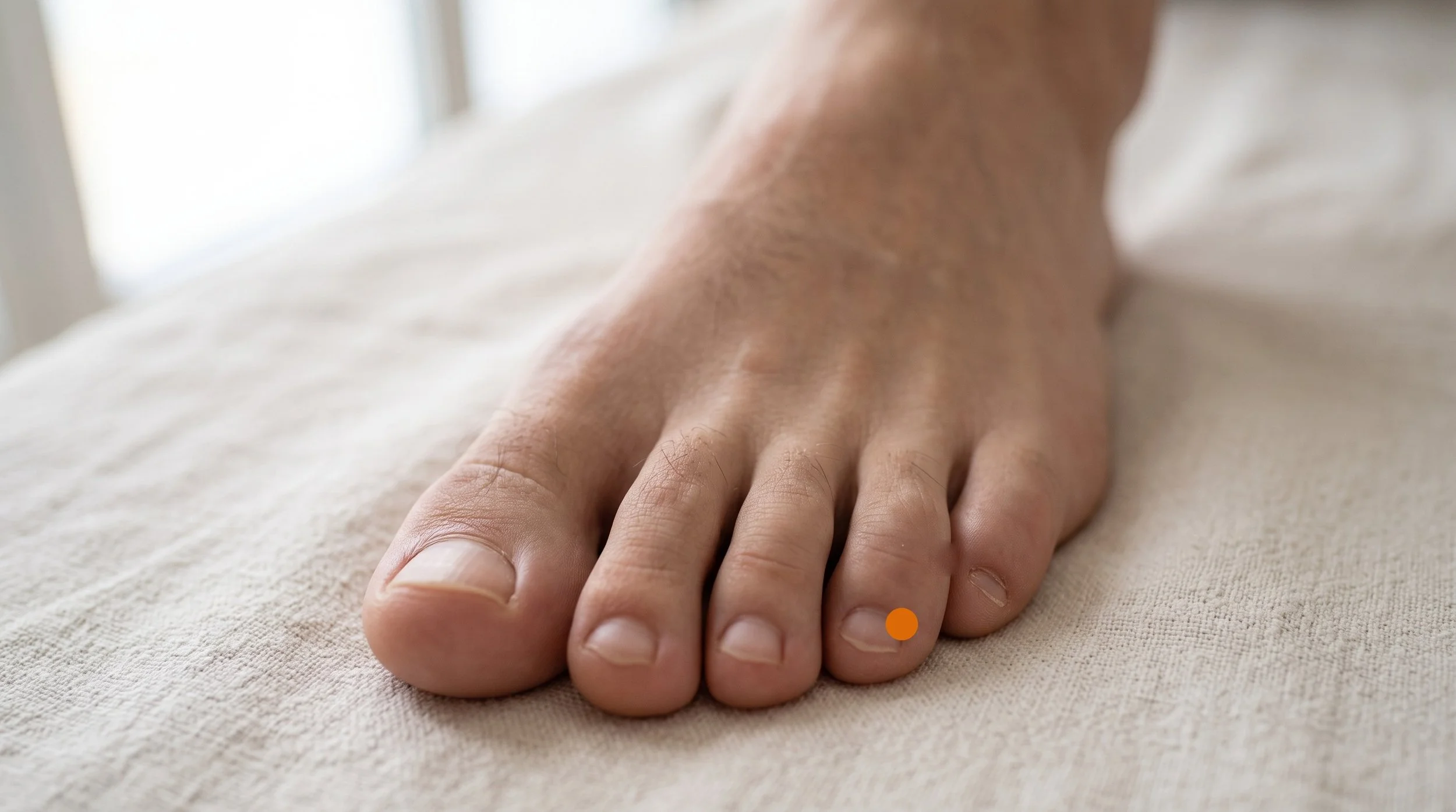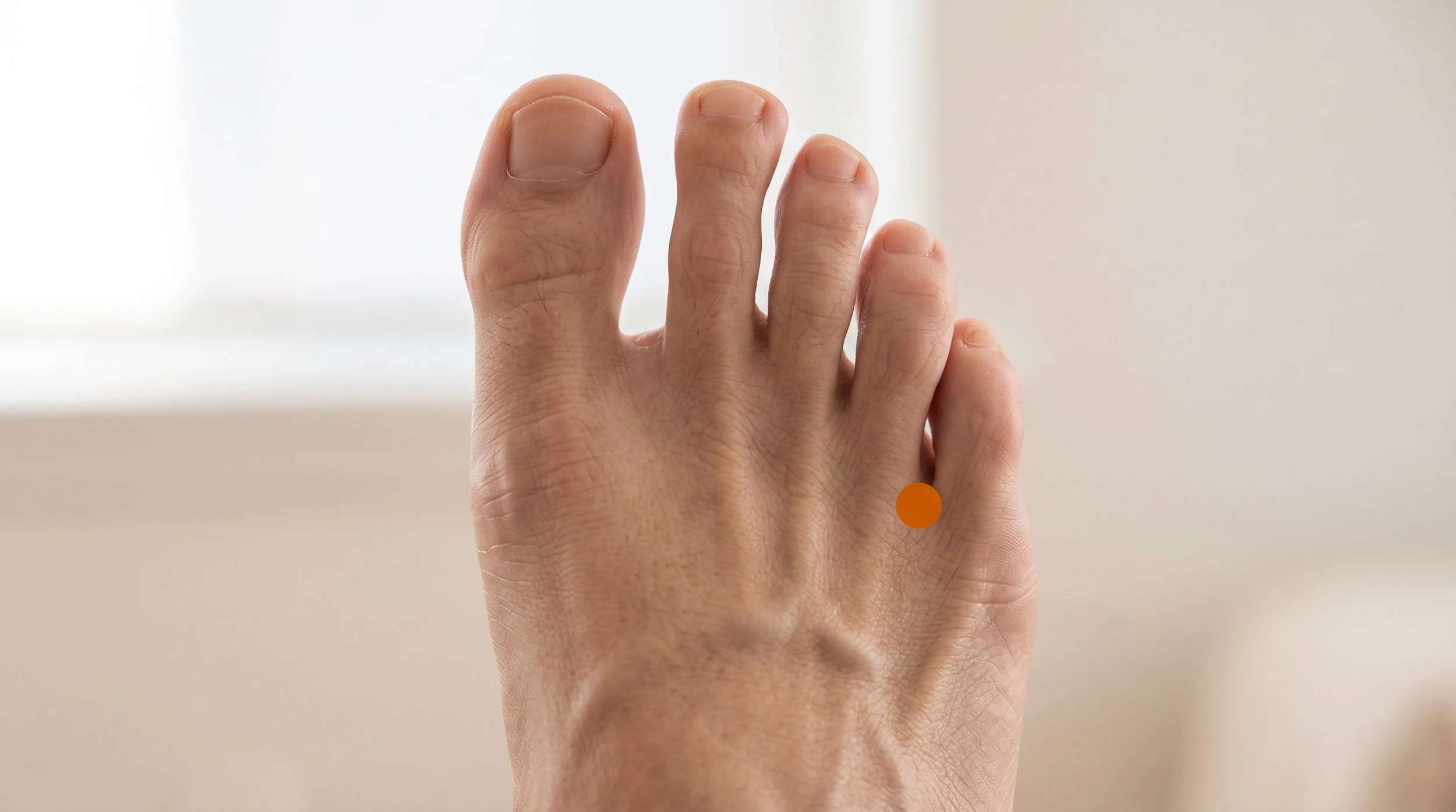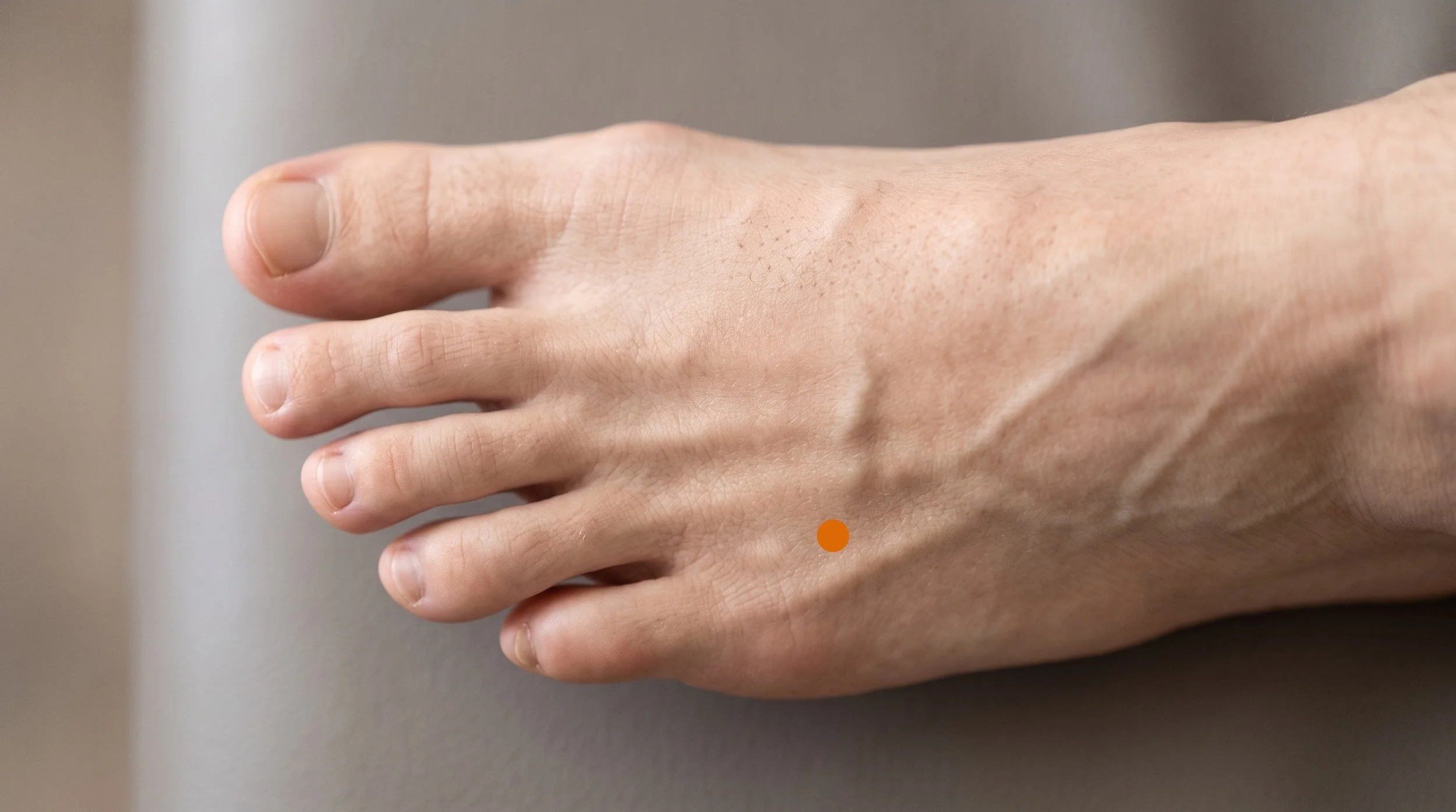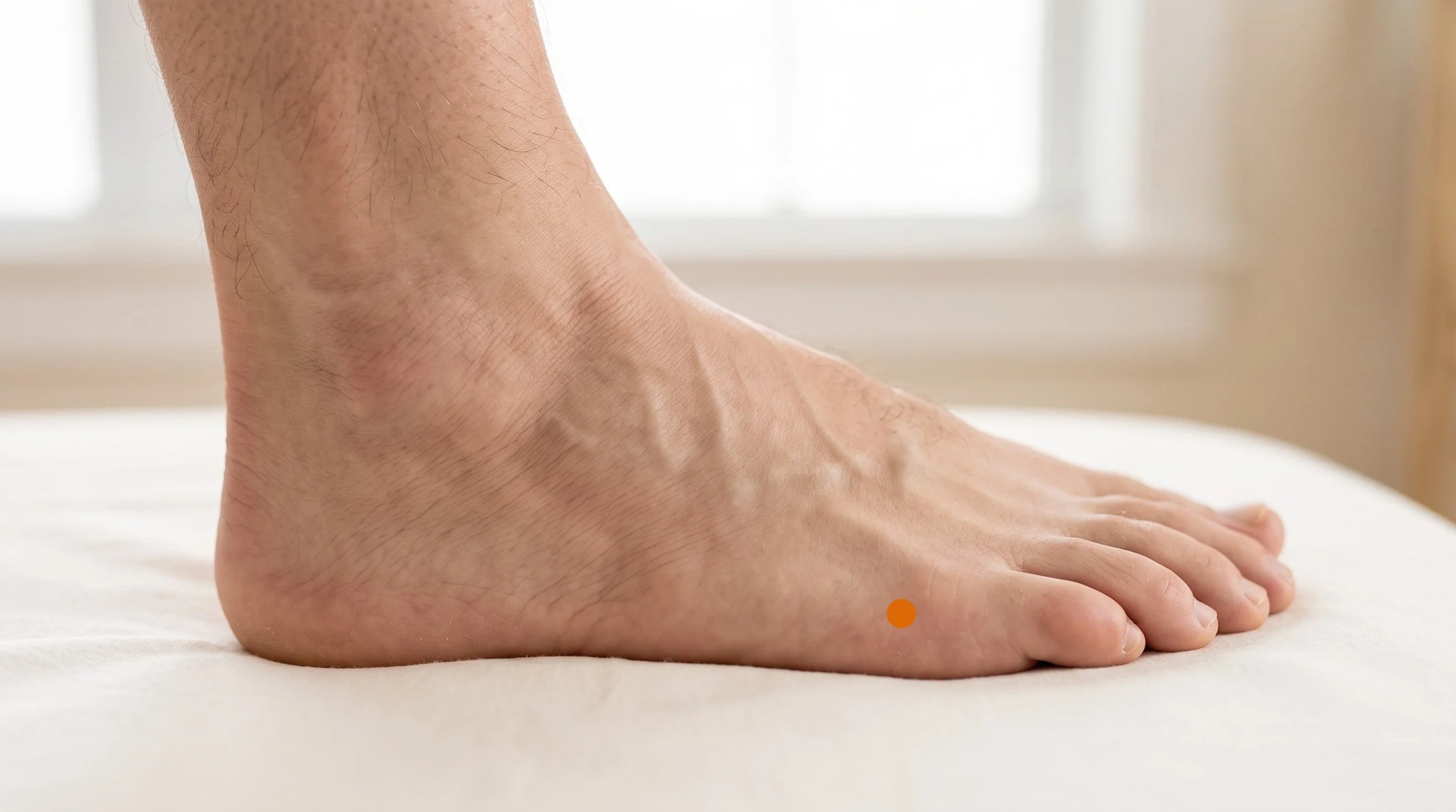
BL65 Acupuncture Point (Shugu)
The Restraining Bone on the Little Toe Side of the Foot: Anatomy, Mechanism, and Why a Point Below the Ankle Is Used for Occipital Headache, Stiff Neck, and Lateral Foot Pain
BL65, known as Shugu (often translated as Restraining Bone or Binding Bone), sits on the outer edge of the foot in the small hollow just behind and below the knuckle of the fifth metatarsal, the bony bump you can feel at the base of the little toe. It is the shu-stream point and the wood point of the Bladder channel, and in classical five-phase practice it is the channel's draining or child point, which is why older texts reached for it when symptoms clustered at the far end of the channel in the head, the occiput, and the eyes.
For a modern clinic the bl65 acupuncture point earns its place twice over: as a distal point paired with neck and head treatment, and as a straightforward local point for pain along the outer border of the foot near the little toe joint.
- Location and layers: bladder 65 lies at the light and dark skin border on the lateral foot, posterior and inferior to the head of the fifth metatarsal, over thin skin, subcutaneous fat, and the abductor digiti minimi muscle, with the metatarsal shaft immediately deep to it (Deadman et al., 2007).
- Traditional categories, read neurophysiologically: as shu-stream and wood point the classical texts treat Shugu as the place to drain excess from the far end of the Bladder channel, which in practice describes a strongly innervated distal site used to influence symptoms in the occiput, neck, and eyes (Deadman et al., 2007).
- Nerve story: needle sensation here recruits branches of the lateral plantar nerve and the lateral dorsal cutaneous branch of the sural nerve, entering the cord at roughly S1 to S2, well below the C2 to C3 segments that carry occipital pain, so the head effect is best explained by descending inhibition rather than same-segment convergence (Zhao, 2008).
- Research picture: no trial isolates this point, but Cochrane reviews of acupuncture for tension-type headache and for neck disorders report modest benefits from multi-point protocols that routinely mix local and distal points (Linde et al., 2016; Trinh et al., 2016), and pooled individual patient data support persisting effects in chronic pain (Vickers et al., 2018).
- Clinical framing: we generally use BL65 as a supporting distal point while the neck and occiput are being treated or mobilized, and as a local point when the outer foot itself is the complaint, rather than as a stand-alone prescription.
- De qi here is usually a brief sharp pinch at the skin, then a dull, spreading ache or pressure that may travel toward the little toe or back along the outer arch; the area is sensitive, so shallow insertion and gentle technique matter more than depth.
Stuck With Headaches at the Base of Your Skull?
Occipital headaches usually involve more than one layer of the problem: irritable suboccipital and upper trapezius muscles, a stiff upper cervical spine, and a nervous system that has become efficient at producing pain.
At Morningside Acupuncture we treat the neck directly with acupuncture and dry needling, then add distal points such as BL65 so you can keep moving your head while the needles are retained. Most patients notice changes in tightness and headache frequency across a short series rather than after one visit. Schedule a visit and we will map out a plan for your specific headache pattern.
Schedule NowAnatomy of BL65: Why the Fifth Metatarsal Head Is Such an Important Location
Run a finger forward along the outer edge of the foot from BL64 and it will drop into a hollow just behind the knob of the fifth metatarsal head; that hollow is BL65, sitting at the border between the paler sole skin and the darker skin of the foot's outer surface (Deadman et al., 2007). The tissue here is shallow and layered simply: mobile skin, a thin cushion of subcutaneous fat, the fleshy edge of abductor digiti minimi, and then bone. This corner of the foot takes real mechanical load.
It absorbs the lateral push-off in running and cutting sports, it is where the foot lands first in a supinated gait pattern, and it is compressed all day by narrow toe boxes and stiff dress shoes. Bunion-like changes at the fifth ray (tailor's bunion), old fifth metatarsal stress reactions, and post-sprain guarding all leave this area tender.
The sensory supply is a shared border zone: branches of the lateral plantar nerve serve the deeper muscular tissue while the lateral dorsal cutaneous branch of the sural nerve covers the skin, and small plantar digital branches run toward the little toe. These afferents reach the spinal cord at approximately S1 to S2. That matters for how we explain the point's classical head indications honestly. Occipital and upper neck pain is carried by the C2 and C3 roots into the trigeminocervical complex, so needling the outer foot cannot work through same-segment convergence with the head.
What it can do is generate a robust, sustained afferent barrage from a densely innervated distal site, which engages brainstem and spinal mechanisms of pain modulation, including endogenous opioid signaling and descending inhibitory pathways from the periaqueductal gray and rostral ventromedial medulla (Zhao, 2008). Local effects are more direct: needling into the taut edge of abductor digiti minimi can reduce mechanical sensitivity in a muscle that commonly harbors trigger points referring along the outer foot (Simons et al., 1999).
Deep to the point are the fourth common plantar digital vessels and small branches of the lateral plantar artery, all of them tiny and of no serious consequence, though bruising is possible in a thin-skinned area. The standard convention is perpendicular insertion of about 0.3 to 0.5 cun, which is intentionally shallow because bone lies close beneath (Deadman et al., 2007). Practically, we angle slightly away from the periosteum, use a fine gauge needle, and warn patients that foot points sting for a second at insertion.
Clean technique matters here, since foot skin is easily colonized, and we avoid needling through calluses, blisters, broken skin, or any area with compromised circulation.
Related Bladder Channel Related Pain Finder Leg Ankle FootBL65 at a Glance: Classification, Location, and Clinical Use
| Category | Detail |
|---|---|
| Traditional Name | Shugu (Restraining Bone, also translated as Binding Bone) |
| Channel Classification | Bladder channel (foot taiyang), point 65 of 67, on the lateral foot (BL65, also written UB65; also called the Urinary Bladder channel) |
| Point Categories | Shu-stream point of the Bladder channel; wood point in the five-phase scheme; the channel's draining or child point, used classically to reduce excess according to mother-child theory (Deadman et al., 2007) |
| Precise Location | On the outer side of the foot, in the depression posterior and inferior to the head of the fifth metatarsal, at the border of the lighter and darker skin; slide a finger distally from BL64 until it falls into the hollow |
| Tissue Stimulated | Skin and subcutaneous tissue over the lateral fifth ray, the lateral border of abductor digiti minimi, and fascia adjacent to the deep intrinsic foot muscles and interossei |
| Needle Depth / Direction | Perpendicular insertion 0.3 to 0.5 cun, angled slightly off the bone; moxibustion is traditionally permitted |
| De Qi Sensation | A quick sting at the skin, then a dull ache, heaviness, or pressure that can spread toward the little toe or back along the outer arch |
| Primary Clinical Uses | Occipital headache and stiff neck as a distal supporting point; eye redness and irritation in classical use; lateral foot pain near the fifth metatarsophalangeal joint; low back, hip, and posterior leg pain along the Bladder channel |
| Common Point Combinations |
|
In A Manual of Acupuncture, Deadman and colleagues place Shugu in the five-phase framework as the wood point of a water channel, which makes it the child of the Bladder in the mother-child scheme; following the classical rule that excess is treated by draining the child, the point was traditionally reduced to pull fullness and heat away from the head.
The rationale offered is anatomical in a channel sense: the Bladder pathway begins at the inner corner of the eye, climbs over the vertex, meets points of the Governing vessel and Gall Bladder channel, then comes down through the occiput and neck, so the classical indication list runs from red painful eyes and irritation of the inner canthus to occipital headache and neck stiffness. The same heat-clearing attribution was extended outward to fevers attributed to wind invasion, to hemorrhoids as heat in the lower body, and to sores and abscesses on the back, an application it shares with BL40.
What is striking is the consistency of the reasoning: one small point at the little toe side of the foot was assigned to problems at the opposite end of a long channel, and that same distal-to-proximal logic is exactly what modern practitioners exploit when they needle the foot and then ask a patient to turn their head.
Why BL65 Is Used for Headaches at the Back of the Head
The first question patients ask is reasonable: how can a needle at the little toe side of the foot matter to a headache behind the skull? It is not a segmental relationship. Sensation from BL65 travels through sural and lateral plantar branches into the S1 and S2 spinal segments, while pain at the occiput and upper neck arrives through the C2 and C3 roots into the trigeminocervical complex. The two do not converge at the same spinal level, so we do not claim they do.
What distal points can do is drive a strong, sustained sensory input that recruits pain-modulating systems operating above the spinal cord. Experimental work on acupuncture analgesia describes activation of ascending pathways to the periaqueductal gray and rostral ventromedial medulla, release of endogenous opioids and other neuropeptides, and descending inhibition that reduces the responsiveness of dorsal horn neurons at distant segments (Zhao, 2008).
This general, non-segmental effect is the honest explanation for why a foot point is included in a headache or neck treatment, and it is also why distal points tend to be used alongside local ones rather than instead of them.
There is a practical reason too. When the useful needles are in the foot and hand rather than the neck, we can ask a patient to rotate, side-bend, and retract their head during retention, pairing sensory input with active movement. Clinically that combination often produces a quicker change in perceived stiffness than passive lying still, and it fits the broader picture from pooled patient data showing that acupuncture effects on chronic pain are modest, real, and reasonably durable over months rather than instantaneous (Vickers et al., 2018).
What the Research Shows for BL65
It is worth being clear about what the literature can and cannot say. There are no randomized trials that isolate BL65, and there probably never will be, since acupuncture is almost always delivered as a prescription of several points chosen for the individual. What the evidence base tests is whole protocols for conditions this point is traditionally part of treating: tension-type headache, cervicogenic headache, mechanical neck pain, and chronic musculoskeletal pain in general. Read the table below as context for how BL65 is used, not as proof that this single point does something on its own.
| Study | Type | Focus | Key Finding |
|---|---|---|---|
| Linde et al., 2016 | Cochrane systematic review | Acupuncture for the prevention of tension-type headache (12 trials, 2349 adults) | Adding acupuncture to usual care was associated with fewer headache days, with a smaller advantage over sham that the authors judged to be of low to moderate certainty. |
| Trinh et al., 2016 | Cochrane systematic review | Acupuncture for acute, subacute, and chronic neck disorders | Moderate quality evidence suggested pain relief greater than sham at the end of treatment and at short-term follow-up, with mostly minor adverse effects. |
| Liu et al., 2024 | Meta-analysis of randomized trials | Acupuncture for cervicogenic headache, the pattern most overlapping with the classical occipital headache indication | Pooled results favored acupuncture over comparison therapies, though most included trials were small and of limited methodological quality. |
| Vickers et al., 2018 | Individual patient data meta-analysis | Chronic musculoskeletal pain, headache, and osteoarthritis across roughly 20,000 patients | Acupuncture outperformed both sham and no-acupuncture controls by modest margins, with roughly 85 percent of the benefit sustained at one year. |
| Pourahmadi et al., 2021 | Systematic review and meta-analysis | Dry needling for tension-type, cervicogenic, and migraine headache | Dry needling reduced headache intensity and related disability in the short term, with evidence certainty rated low to very low. |
| Zhao, 2008 | Narrative review of experimental studies | Neural mechanisms of acupuncture analgesia | Describes segmental and supraspinal pathways, including endogenous opioid mediated descending inhibition, that plausibly underlie effects from distal points. |
Outer Foot Pain Near the Little Toe That Will Not Settle?
Pain along the fifth metatarsal often builds from running on cambered roads, long days on city pavement, narrow shoes, or an ankle sprain that never fully rehabbed. BL65 sits right in that zone, so we can needle it locally, treat the abductor digiti minimi and the small foot muscles with dry needling, and address the calf and peroneals that load the outer foot. We also look upstream at hip and gait mechanics, because a foot that keeps getting irritated is usually being asked to do a job that belongs to something else. Book an evaluation and let us look at the whole chain.
Schedule NowBL65 in the Context of Trigger Point Work
BL65 sits directly over the lateral edge of abductor digiti minimi, a small muscle that frequently develops taut bands and refers pain along the outer border of the foot, which is the same territory patients point to when they describe soreness near the little toe joint (Simons et al., 1999). When someone presents with lateral forefoot pain, we often treat the point and the muscle in the same pass: a shallow needle at the classical location, then careful dry needling of the abductor digiti minimi belly, the adjacent interossei, and abductor hallucis if the medial arch is also involved. Calf work usually follows, because soleus and the peroneals influence how much load the fifth ray absorbs at push-off.
For headache and neck presentations, BL65 plays the opposite role: it is the distal anchor while the real myofascial work happens above. A typical session might include dry needling of the suboccipitals, upper trapezius, splenius capitis, semispinalis, and levator scapulae, all common contributors to occipital and referred head pain (Simons et al., 1999), with BL65 and other distal points retained so the patient can move their neck through range during treatment.
Reviews of dry needling for headache report short-term reductions in pain intensity and disability, with the caveat that evidence certainty remains low (Pourahmadi et al., 2021), which is why we treat needling as one component alongside loading, posture variation, and sleep and stress management rather than the entire plan.
BL65 Headache and Foot Pain Treatment at NYC's Highest-Rated Acupuncture Clinic
Morningside Acupuncture is the highest-rated acupuncture and dry needling clinic in New York City with over 500 five-star Google reviews, and our approach blends classical point selection with modern pain science. Points like BL65 are used inside a plan that includes trigger point dry needling, cupping when appropriate, and simple movement homework you can keep up between visits. You will always know why a given point was chosen and what we expect it to change. Schedule your appointment at our Upper West Side office and get started.
Schedule NowFrequently Asked Questions
What does BL65 feel like when needled?
Expect a brief sting as the needle passes the skin, since the outer foot is thin skinned and well supplied with nerve endings. That fades within a few seconds and is usually replaced by a dull, heavy ache or a sense of pressure that can spread toward the little toe or back along the outer arch. Some people feel a faint tingle following the sural nerve territory. It should not be sharp or electric once the needle is set, and it should not hurt more when you walk afterward. Tell your acupuncturist if the sensation is intense; the needle can be withdrawn slightly or repositioned.
Why would an acupuncturist needle my foot for a headache in the back of my head?
Because distal points give us a way to influence pain processing without adding more input to an already irritated area, and because they leave the neck free to move during treatment. BL65 is at the far end of the Bladder channel, which classical texts trace from the inner eye over the top of the head and down through the occiput and neck, so it has been used for occipital headache and stiff neck for centuries (Deadman et al., 2007). In modern terms, the effect is not segmental; needling the foot recruits brainstem and spinal pain-modulating systems that can reduce sensitivity at distant sites (Zhao, 2008). It is a supporting point, not a substitute for treating the neck itself.
Can I press BL65 myself between sessions?
Yes, and it is easy to reach. Sit with your foot crossed over the opposite knee, find the bony knob at the base of your little toe on the outer edge of the foot, then slide your thumb backward until it drops into the small hollow just behind and below it. Press with your thumb tip at a firmness that feels like a strong, tolerable ache, around a five or six out of ten, and hold steady for 30 to 60 seconds, or use small circles for the same duration. Repeat two or three rounds per foot, once or twice a day, and combine it with slow neck rotations if you are using it for headache or stiffness. Stop if the area is bruised, numb, swollen, or sharply painful, and skip it entirely over broken skin.
Is BL65 safe to needle?
It is a low-risk point when treated with standard precautions. There is no cavity, no major vessel, and no significant nerve trunk beneath it, only small digital vessels and bone, so the main considerations are shallow insertion (0.3 to 0.5 cun), avoidance of the periosteum, and clean technique (Deadman et al., 2007). Minor bruising and brief post-needle tenderness are the most common effects. Extra caution applies if you have diabetes with peripheral neuropathy, poor circulation in the feet, active infection, an unhealed wound, or lymphedema, since foot skin heals more slowly in those situations. Always have this point needled by a licensed provider who knows your medical history.
Where exactly is BL65 located?
On the lateral side of the foot, in the depression just behind and below the head of the fifth metatarsal, right at the color change between the paler skin of the sole and the darker skin of the foot's outer surface. The simplest way to find the Shugu point location is to place a finger on BL64 at the base of the fifth metatarsal and slide forward along the outer edge until it falls into a hollow behind the knuckle of the little toe joint; that hollow is bl 65 foot territory (Deadman et al., 2007). If you press and feel a firm bony prominence, you have gone too far forward onto the metatarsal head itself; back up a few millimeters into the soft dip.
References
- Deadman, P., Al-Khafaji, M., & Baker, K. (2009). A manual of acupuncture. Journal of Chinese Medicine Publications.
- Simons, D. G., Travell, J. G., & Simons, L. S. (1999). Travell & Simons' myofascial pain and dysfunction: The trigger point manual, Vol. 1: Upper half of body (2nd ed.). Williams & Wilkins.
- Linde, K., Allais, G., Brinkhaus, B., Fei, Y., Mehring, M., Shin, B.-C., Vickers, A., & White, A. R. (2016). Acupuncture for the prevention of tension-type headache. Cochrane Database of Systematic Reviews, 2016(4), CD007587. https://doi.org/10.1002/14651858.CD007587.pub2
- Trinh, K., Graham, N., Irnich, D., Cameron, I. D., & Forget, M. (2016). Acupuncture for neck disorders. Cochrane Database of Systematic Reviews, 2016(5), CD004870. https://doi.org/10.1002/14651858.CD004870.pub4
- Liu, Z., Gao, X., Zhang, X., & Qu, Y. (2024). Meta-analysis of acupuncture treatment for cervicogenic headache. World Neurosurgery, 189, 166-173. https://doi.org/10.1016/j.wneu.2024.05.084
- Pourahmadi, M., Dommerholt, J., Fernández-de-Las-Peñas, C., Koes, B. W., Mohseni-Bandpei, M. A., Mansournia, M. A., Delavari, S., Keshtkar, A., & Bahramian, M. (2021). Dry needling for the treatment of tension-type, cervicogenic, or migraine headaches: A systematic review and meta-analysis. Physical Therapy, 101(5), pzab068. https://doi.org/10.1093/ptj/pzab068
- Vickers, A. J., Vertosick, E. A., Lewith, G., MacPherson, H., Foster, N. E., Sherman, K. J., Irnich, D., Witt, C. M., & Linde, K. (2018). Acupuncture for chronic pain: Update of an individual patient data meta-analysis. Journal of Pain, 19(5), 455-474. https://doi.org/10.1016/j.jpain.2017.11.005
- Zhao, Z. Q. (2008). Neural mechanism underlying acupuncture analgesia. Progress in Neurobiology, 85(4), 355-375. https://doi.org/10.1016/j.pneurobio.2008.05.004
Disclaimer: This web site is intended for educational and informational purposes only. Reading this website does not constitute providing medical advice or any professional services. This information should not be used for diagnosing or treating any health issue or disease. Those seeking medical advice should consult with a licensed physician. Seek the advice of a medical doctor or other qualified health professional for any medical condition. If you think you have a medical emergency, call 911 or go to the emergency room. No acupuncturist-patient relationship is created by reading this website or using the information. Morningside Acupuncture PLLC and its employees and contributors do not make any express or implied representations with respect to the information on this site or its use. For any legal interpretation of scope of practice in your state, consult a licensed attorney or regulatory authority.
Read more from our blog