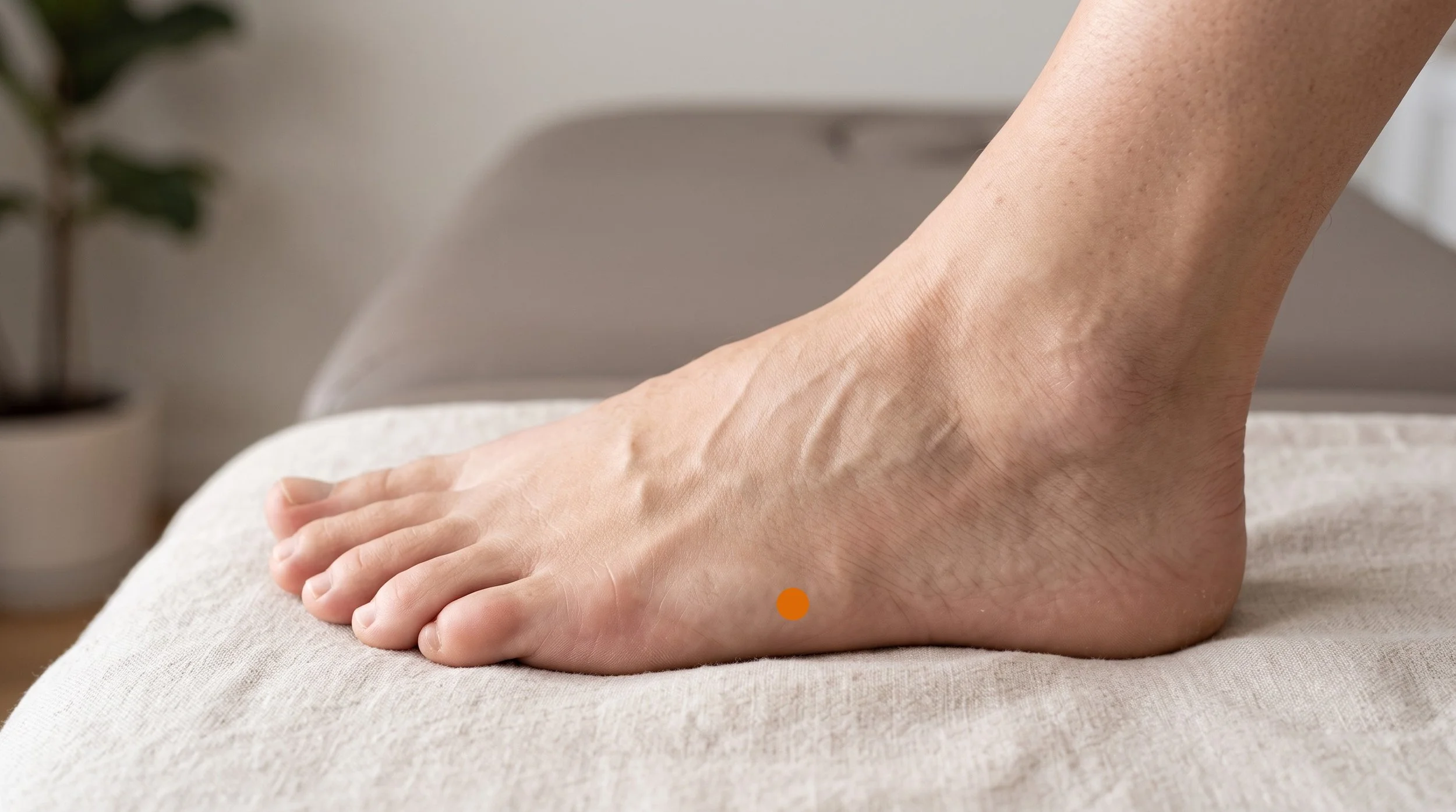
BL64 Acupuncture Point (Jinggu)
The Capital Bone on the Outer Edge of the Foot: Anatomy, Mechanism, and Why the Bladder Channel's Source Point Was Traditionally Used to Clear the Head
BL64, known in Chinese as Jinggu and usually translated as Capital Bone, is the yuan-source point of the Bladder channel and sits on the outer border of the foot, in the small hollow just in front of and below the bony bump at the base of the fifth metatarsal. That bump (the fifth metatarsal tuberosity) is the most obvious landmark on the lateral foot, which makes the bl64 acupuncture point one of the easier foot points to find reliably.
Clinically it earns its place twice over: it's a local point for pain along the outer foot, peroneal tendon insertion and lateral arch, and it's a classical distal point used within treatments for headache, stiff neck and back pain running along the Bladder channel. That double role, local tissue plus distal channel, is exactly why it still shows up in modern treatment plans.
- Location and layers: Jinggu point location is the depression anterior and inferior to the fifth metatarsal tuberosity, at the color change between the paler sole skin and the darker dorsal skin. A needle here passes thin skin and subcutaneous tissue into the abductor digiti minimi, immediately adjacent to the peroneus brevis tendon insertion on the tuberosity.
- Traditional categories, translated: classical texts assign BL64 the yuan-source role for the Bladder channel and credit it with clearing the head and eyes, settling the spirit and relaxing the sinews. In modern terms, those descriptions map onto a well innervated distal site that provides strong afferent input into segmentally shared and supraspinal pain circuits (Zhao, 2008).
- Nerve geography: the point lies in sural nerve territory (its lateral dorsal cutaneous branch), with lateral plantar nerve branches deeper, drawing on S1 and S2 spinal levels shared with the calf, hamstrings and lower lumbar region. Needling recruits small diameter afferents that engage spinal segmental inhibition and brainstem descending modulation (Zhao, 2008).
- Research picture: no trial has isolated bladder 64 on its own, so its evidence is indirect. Multi-point acupuncture protocols show modest but real benefit for chronic musculoskeletal pain (Vickers et al., 2018), episodic migraine (Linde et al., 2016b), tension-type headache (Linde et al., 2016a) and chronic low back pain compared with sham or no treatment (Mu et al., 2020).
- Clinical framing: at Morningside we treat BL64 mainly as a local point for lateral foot loading problems and as a distal addition inside Bladder channel treatments for neck, back and headache patterns, often alongside dry needling of the peroneus brevis and abductor digiti minimi (Simons et al., 1999). Trigger point dry needling around the foot has moderate to low quality support for plantar heel pain (Llurda-Almuzara et al., 2021).
- De qi at bl 64 foot: patients usually feel a brief surface pinch, then a dull, heavy, slightly spreading ache along the outer border of the foot, sometimes drifting toward the little toe or up toward the outer ankle. That heavy, achy quality is the sensation clinicians are looking for, not sharp or electric pain.
Outer Foot Pain That Flares Every Time You Walk?
Pain at the base of the fifth metatarsal often involves the peroneus brevis insertion, the lateral band of the plantar fascia and the small muscles along the outer foot. At Morningside Acupuncture we use BL64 as a precise local point in that hollow, then combine it with dry needling of the peroneal and intrinsic foot muscles and with gait and footwear coaching. Most patients notice changes in how the foot loads within a few sessions. Schedule a visit and let's map where your outer foot pain is actually coming from.
Schedule NowAnatomy of BL64: Why the Fifth Metatarsal Tuberosity Is Such an Important Location
Run your finger along the outer border of your foot and you'll bump into a prominent knob roughly halfway between the heel and the little toe. That's the tuberosity of the fifth metatarsal, and BL64 sits in the soft hollow just forward and slightly below it. The tissue stack here is thin: skin, a shallow layer of fat and fascia, then the abductor digiti minimi running lengthwise along the outer sole. The tuberosity itself is a busy attachment site where the peroneus brevis tendon anchors and the lateral band of the plantar fascia blends in.
Anything that loads the outer foot repeatedly can irritate this zone, including running on cambered roads, court sports with hard cutting, a history of ankle inversion sprains, rigid high-arched feet that supinate, and shoes worn down along the outer heel.
Sensation over this area comes largely from the sural nerve by way of its lateral dorsal cutaneous branch, with lateral plantar nerve branches supplying deeper muscle. Those fibers carry S1 and S2 information, the same spinal levels that serve the calf, hamstrings, gluteal region and lower lumbar segments. Because afferents from these territories converge on shared dorsal horn neurons, a strong stimulus at the foot can influence processing for a region far from the needle.
Needling also recruits A-delta and C fibers that activate brainstem structures involved in descending pain inhibition, releasing endogenous opioids, serotonin and noradrenaline at the spinal level (Zhao, 2008). That's the plausible mechanism behind a foot point being used for complaints higher up the back line, and it doesn't require any appeal to energy moving through channels.
There's no major artery or nerve trunk at risk at BL64, though small superficial veins and the cutaneous nerve branches deserve respect, so most texts describe a perpendicular insertion of roughly 0.3 to 0.5 cun and note that moxibustion is applicable here. Because the tissue layer is shallow, technique matters more than depth: slow insertion, modest stimulation and attention to patient feedback.
Clinicians should avoid needling over broken or infected skin, take extra care in people with peripheral neuropathy or reduced circulation, and refer rather than needle when acute trauma raises suspicion of a fifth metatarsal avulsion or stress fracture, since bone pain at this landmark is not a needling problem.
Related Bladder Channel Related Peroneus Brevis Trigger PointsBL64 at a Glance: Classification, Location, and Clinical Use
| Category | Detail |
|---|---|
| Traditional Name | Jinggu (Capital Bone), BL-64 |
| Channel Classification | Bladder channel of the foot (taiyang), distal foot point on the lateral border (BL64, also written UB64; also called the Urinary Bladder channel) |
| Point Categories | Yuan-source point of the Bladder channel; moxibustion is described as applicable in standard point texts |
| Precise Location | On the lateral side of the foot, in the depression anterior and inferior to the tuberosity of the fifth metatarsal, at the junction of the lighter and darker skin |
| Tissue Stimulated | Skin and subcutaneous fascia, abductor digiti minimi, and the fascial envelope around the peroneus brevis insertion at the fifth metatarsal tuberosity, in sural nerve (lateral dorsal cutaneous) territory |
| Needle Depth / Direction | Perpendicular insertion, roughly 0.3 to 0.5 cun; shallow angling toward the tuberosity is sometimes used for insertional tenderness |
| De Qi Sensation | Brief surface pinch followed by a dull, heavy, spreading ache along the outer foot, occasionally traveling toward the fifth toe or up toward the lateral ankle |
| Primary Clinical Uses | Lateral foot pain including tenderness at the fifth metatarsal base, peroneal tendon irritation and lateral arch strain; traditionally used for heavy or splitting headache, stiff neck and back pain along the channel, eye complaints at the inner corner, and palpitations with a startled quality |
| Common Point Combinations |
|
Deadman's point manual presents BL64 as the yuan-source point of the Bladder channel and, like other distal points on that channel, as a treatment for what classical writers called fullness of the head. Traditional attribution frames that fullness as arising from several sources: an external wind or wind-heat invasion, internally stirring wind, yang surging upward when Kidney function is weak, or simple disharmony between the upper and lower body. The picture drawn is a top-heavy one, with heat, heaviness, splitting head pain, head shaking and stubborn nosebleed above while the feet stay cold below.
Because the channel is described as ending at the inner corner of the eye, the same texts list eye complaints such as visual dizziness, redness of the inner canthus and clouded vision; because the primary channel is said to enter the brain and the divergent channel to reach the Heart, palpitations, chest pain, a startled or fearful quality, epilepsy and mania-depression also appear.
Finally, the point is listed for stiffness, contraction and pain anywhere along the channel from the neck to the foot. What makes the pattern striking is its architecture: a point at the far end of the body's longest channel, credited with settling what's happening at the other end.
Why BL64 Is Used for Headaches and Stiff Necks Even Though It Sits on the Foot
The first part of the answer is segmental. Sensory information from the outer foot enters the spinal cord at the S1 and S2 levels, which also receive input from the calf, hamstrings, gluteal muscles and the lower part of the back. Those inputs converge on shared second-order neurons in the dorsal horn, so a clear stimulus at the foot lands in the same processing neighborhood as complaints from the lower back and posterior leg. For lumbar and posterior leg pain, that convergence gives a straightforward account of why a distal point can change what a patient feels proximally, without invoking anything mystical.
The neck and head connection works differently, and it's mostly a top-down story. Needling that produces de qi activates A-delta and C fiber afferents which drive brainstem circuits, including the periaqueductal gray and rostral ventromedial medulla, that send inhibitory signals back down to the spinal cord and release endogenous opioids, serotonin and noradrenaline (Zhao, 2008). This system isn't organized segment by segment, so input from the foot can influence pain sensitivity in regions well outside its own spinal level.
Add the autonomic shifts that often accompany needling, including changes in local blood flow and a general drop in sympathetic arousal, and you have a reasonable mechanism for why distal foot points are still standard in headache and neck treatments.
None of this makes BL64 a headache point in isolation. In practice it functions as a distal contributor inside a broader treatment that usually includes local work at the neck, occiput or upper back, and it's often chosen when the patient's presentation also involves the posterior line: tight calves, sore heels, stiffness on forward bending. When the outer foot itself is the problem, the reasoning is much simpler, because then the needle is going into the exact tissue that's irritated.
What the Research Shows for BL64
Setting expectations honestly matters here. There are no clinical trials that test BL64 by itself, and there almost certainly never will be, because acupuncture research studies whole protocols rather than single points. What the literature can tell us is whether the protocols that commonly include distal Bladder channel points on the foot outperform sham needling, usual care or medication for the conditions BL64 is traditionally used within. Those findings are modest, generally favorable, and specific to the condition rather than to this point. The dry needling evidence around the foot is a separate and smaller literature that speaks to the local, myofascial side of the work.
| Study | Type | Focus | Key Finding |
|---|---|---|---|
| Vickers et al., 2018 | Individual patient data meta-analysis | Chronic musculoskeletal pain, including back, neck and shoulder pain and headache | Acupuncture outperformed both sham and no-acupuncture controls for chronic pain, with effects that persisted over time, though differences from sham were modest. |
| Linde et al., 2016a | Cochrane systematic review | Acupuncture for prevention of tension-type headache | A course of at least six sessions may be a worthwhile option for people with frequent tension-type headache, based on trials of variable quality. |
| Linde et al., 2016b | Cochrane systematic review | Acupuncture for prevention of episodic migraine | Acupuncture reduced migraine frequency and appeared at least as good as prophylactic drug treatment, with fewer dropouts from adverse effects (moderate quality evidence). |
| Mu et al., 2020 | Cochrane systematic review | Acupuncture for chronic nonspecific low back pain | Acupuncture showed benefit over sham, no treatment and usual care for pain and function in the short term, with evidence certainty generally low to moderate. |
| Llurda-Almuzara et al., 2021 | Systematic review and meta-analysis | Trigger point dry needling for plantar heel pain | Moderate to low quality evidence suggested improvements in pain intensity and related disability, with the authors urging caution given the small number of trials. |
| Zhao, 2008 | Narrative review of mechanism research | Neural mechanisms of acupuncture analgesia | Needle stimulation appears to act through small fiber afferent input, spinal segmental inhibition and descending modulatory pathways involving endogenous opioids and monoamines. |
Headaches, Neck Tension, or Back Pain That Runs Down the Back Line?
The Bladder channel travels from the head and neck down the back and calf to the outer foot, which is why distal points like Jinggu are added to treatments aimed at the other end of that line. Morningside clinicians pair BL64 with local needling at the neck, suboccipital region and paraspinals so both ends of the pattern get addressed in the same session. Treatment plans are built around your exam findings, not a fixed recipe. Book an appointment and we'll put together a plan that fits your headache or back pain pattern.
Schedule NowBL64 in the Context of Trigger Point Work
BL64 sits in territory that dry needling practitioners already know well. The peroneus brevis attaches directly to the tuberosity just behind the point, and taut bands in that muscle can refer pain to the lateral ankle and along the outer border of the foot, a pattern that overlaps almost exactly with where patients point when they complain of pain at the fifth metatarsal base (Simons et al., 1999). The abductor digiti minimi lies right under the point and contributes its own lateral sole and heel border pain.
When a patient's presentation is clearly myofascial rather than bony, needling BL64 and needling the abductor digiti minimi are effectively the same act described in two vocabularies.
At Morningside, a typical session for lateral foot pain uses BL64 as the anchor point at the tuberosity, then adds dry needling to the peroneus brevis and longus along the lateral leg, the abductor digiti minimi and deeper intrinsic foot muscles, and often the gastrocnemius and soleus, since calf stiffness changes how the outer foot loads at push off.
Trigger point dry needling around the foot has moderate to low quality support for plantar heel pain, with benefits that may take several weeks to appear (Llurda-Almuzara et al., 2021; Yang et al., 2024), so we pair needling with loading exercises, footwear review and calf mobility work rather than relying on needles alone. Acupuncture, in the sense of using an acupuncture needle, covers both approaches; the difference is the reasoning that selects the target, not the tool.
BL64 Foot and Headache Treatment at NYC's Highest-Rated Acupuncture Clinic
Morningside Acupuncture is the highest-rated acupuncture and dry needling clinic in New York City with over 500 five-star Google reviews, and our practitioners combine classical point knowledge with orthopedic assessment and myofascial trigger point work. BL64 is one of many tools we use for lateral foot pain, stiff necks and headache patterns that follow the Bladder channel. Every session includes hands-on evaluation, needling tailored to your findings, and home care you can actually keep up with. Schedule your appointment today and get started.
Schedule NowFrequently Asked Questions
What does BL64 feel like when needled?
Most people feel a quick pinch as the needle passes the skin, since the outer foot is thin-skinned and sensitive, followed by a dull, heavy, slightly spreading ache in the hollow beside the bony bump. That heavy ache is de qi, and it may drift toward the little toe or up toward the outer ankle. If the point is genuinely irritated, patients often report that the sensation feels like the pain they came in with, which is usually a good sign. Sharp, burning or electric sensations aren't the goal, and your practitioner should adjust the needle if you feel them.
Why needle a point on the outer foot for a headache or a stiff neck?
Two reasons, one traditional and one physiological. Traditionally, BL64 is the source point of the Bladder channel, which is described as running from the inner corner of the eye over the head and down the back to the foot, so distal points were used to influence complaints at the far end of that line. Physiologically, needling that produces de qi drives small fiber afferent input into brainstem circuits that inhibit pain processing throughout the body, not just at the same spinal level (Zhao, 2008). That said, BL64 is a supporting player for head and neck complaints; local treatment at the neck and upper back is usually doing most of the work.
Can I press BL64 myself between sessions?
Yes, and it's easy to find. Slide a finger along the outer edge of your foot until you hit the prominent bump roughly midway between heel and little toe, then move forward and slightly down into the soft depression just in front of it. Press with your thumb tip at an intensity of about five to seven out of ten, hold for 30 to 60 seconds, then release, and repeat for three to five rounds per foot. You can alternate steady pressure with small slow circles. Doing this two or three times a day, especially after long periods of standing or walking, is reasonable. Stop if you get numbness, tingling, sharp pain or increasing soreness that lasts more than a day, and don't press over bruised or broken skin.
Is BL64 safe to needle?
In trained hands it's a low-risk point, with no major artery or nerve trunk at the site and a conventional depth of only about 0.3 to 0.5 cun. The usual cautions apply: clean technique, single-use sterile needles, avoiding broken or infected skin, and extra care in people with peripheral neuropathy, poor circulation or bleeding tendencies. Because the tissue is thin, mild bruising or lingering tenderness is the most common side effect. One important exception is acute trauma: sudden pain at the fifth metatarsal base after an inversion injury can indicate an avulsion or stress fracture, and that needs imaging and medical assessment rather than needling.
Where exactly is BL64 located?
Sit with your foot resting on its inner edge so the outer border faces you. Trace from the little toe backward along that border and you'll meet a distinct bony prominence, the tuberosity at the base of the fifth metatarsal, which is the most palpable landmark on the lateral foot. BL64 lies in the depression immediately in front of and below that prominence, on the line where the paler skin of the sole meets the darker skin of the top of the foot. Press gently around the hollow; on an irritated foot the point will often be noticeably tender compared with the surrounding tissue.
References
- Deadman, P., Al-Khafaji, M., & Baker, K. (2009). A manual of acupuncture. Journal of Chinese Medicine Publications.
- Cheng, X. (Ed.). (1999). Chinese acupuncture and moxibustion (Rev. ed.). Foreign Languages Press.
- Kim, H. (2008). Handbook of Oriental medicine (3rd ed.). Harmony & Balance Press.
- Cunningham, P. M. (2000). Acupuncture points: A practical guide to classical and modern usage. Odyssey Press.
- Maciocia, G. (2006). The channels of acupuncture: Clinical use of the secondary channels and eight extraordinary vessels. Churchill Livingstone Elsevier.
- Simons, D. G., Travell, J. G., & Simons, L. S. (1999). Travell & Simons' myofascial pain and dysfunction: The trigger point manual, Vol. 1: Upper half of body (2nd ed.). Williams & Wilkins.
- Zhao, Z. Q. (2008). Neural mechanism underlying acupuncture analgesia. Progress in Neurobiology, 85(4), 355-375. https://doi.org/10.1016/j.pneurobio.2008.05.004
- Vickers, A. J., Vertosick, E. A., Lewith, G., MacPherson, H., Foster, N. E., Sherman, K. J., Irnich, D., Witt, C. M., & Linde, K. (2018). Acupuncture for chronic pain: Update of an individual patient data meta-analysis. Journal of Pain, 19(5), 455-474. https://doi.org/10.1016/j.jpain.2017.11.005
- Linde, K., Allais, G., Brinkhaus, B., Fei, Y., Mehring, M., Shin, B. C., Vickers, A., & White, A. R. (2016a). Acupuncture for the prevention of tension-type headache. Cochrane Database of Systematic Reviews, 2016(4), CD007587. https://doi.org/10.1002/14651858.CD007587.pub2
- Linde, K., Allais, G., Brinkhaus, B., Fei, Y., Mehring, M., Vertosick, E. A., Vickers, A., & White, A. R. (2016b). Acupuncture for the prevention of episodic migraine. Cochrane Database of Systematic Reviews, 2016(6), CD001218. https://doi.org/10.1002/14651858.CD001218.pub3
- Mu, J., Furlan, A. D., Lam, W. Y., Hsu, M. Y., Ning, Z., & Lao, L. (2020). Acupuncture for chronic nonspecific low back pain. Cochrane Database of Systematic Reviews, 2020(12), CD013814. https://doi.org/10.1002/14651858.CD013814
- Llurda-Almuzara, L., Labata-Lezaun, N., Meca-Rivera, T., Navarro-Santana, M. J., Cleland, J. A., Fernandez-de-las-Penas, C., & Perez-Bellmunt, A. (2021). Is dry needling effective for the management of plantar heel pain or plantar fasciitis? An updated systematic review and meta-analysis. Pain Medicine, 22(7), 1630-1641. https://doi.org/10.1093/pm/pnab114
- Yang, A., Lin, R., Xia, M., Su, H., & He, Y. (2024). The effectiveness of dry needling for plantar fasciitis: A systematic review and meta-analysis. Frontiers in Neurology, 15, 1520585. https://doi.org/10.3389/fneur.2024.1520585
Disclaimer: This web site is intended for educational and informational purposes only. Reading this website does not constitute providing medical advice or any professional services. This information should not be used for diagnosing or treating any health issue or disease. Those seeking medical advice should consult with a licensed physician. Seek the advice of a medical doctor or other qualified health professional for any medical condition. If you think you have a medical emergency, call 911 or go to the emergency room. No acupuncturist-patient relationship is created by reading this website or using the information. Morningside Acupuncture PLLC and its employees and contributors do not make any express or implied representations with respect to the information on this site or its use. For any legal interpretation of scope of practice in your state, consult a licensed attorney or regulatory authority.
Read more from our blog



