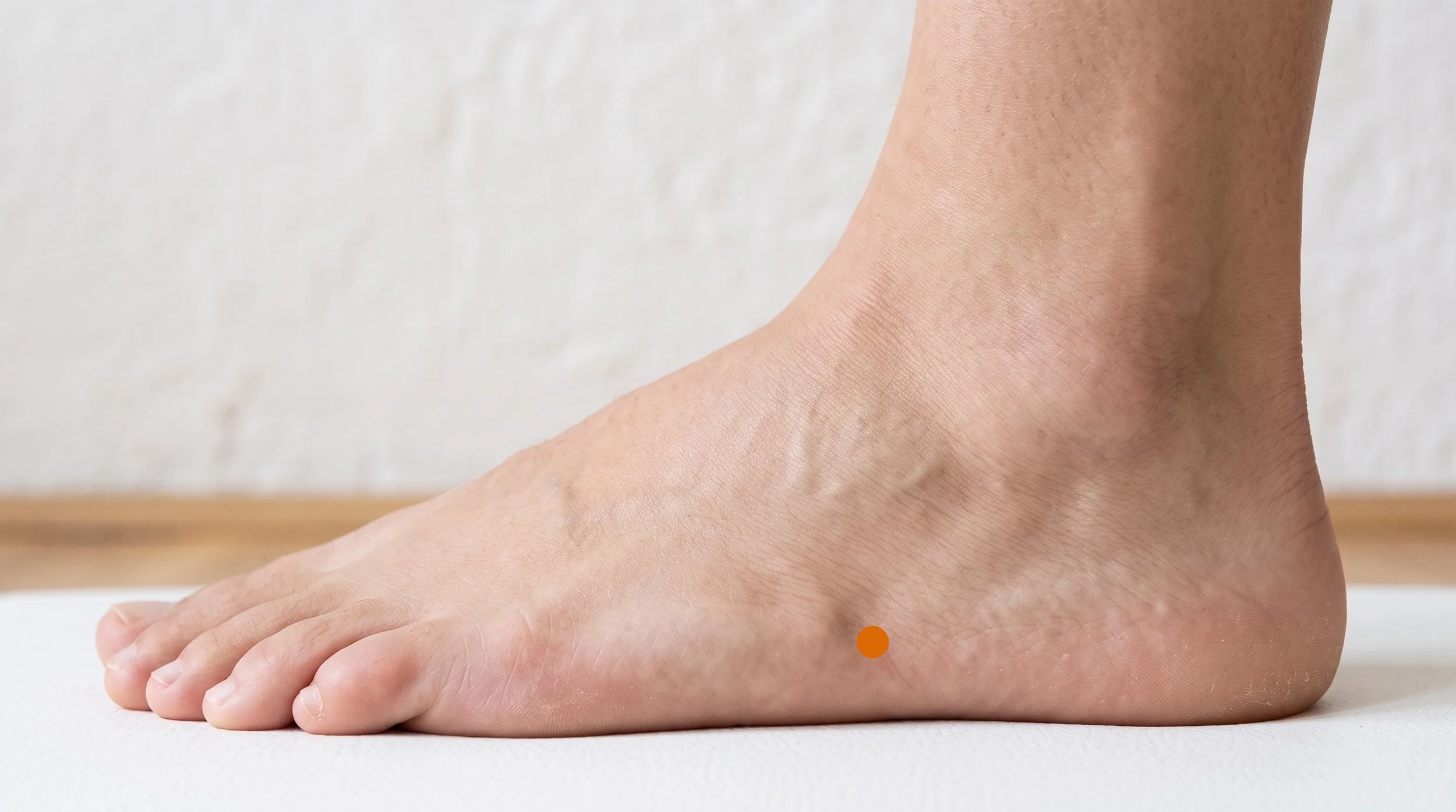
BL63 Acupuncture Point (Jinmen)
The Golden Gate on the Outer Foot: Anatomy, Mechanism, and Why the Bladder Channel's Xi-Cleft Point Belongs in Acute Pain Treatment
BL63, known in Chinese as Jinmen and usually translated as Golden Gate or Golden Door, sits on the outer edge of the foot in the small hollow just behind the bony bump you can feel halfway along the lateral border, the tuberosity of the fifth metatarsal. Bladder 63 is the xi-cleft point of the Bladder channel and the point where classical texts place the start of the Yang Linking vessel, two designations that in traditional theory mark it as a point for sudden, sharp, severe problems rather than slow-burning ones.
For a modern clinician, the bl63 acupuncture point is interesting for a simpler reason: it lies in sural and lateral plantar nerve territory over the abductor digiti minimi, in the S1 and S2 segmental neighborhood that also serves the low back, buttock, and posterior leg, which makes this small point on the bl 63 foot location a plausible distal choice when acute lumbar or lateral ankle pain is the presenting complaint.
- Location and layers: BL63 sits in the depression behind the fifth metatarsal tuberosity, where the needle passes through thin skin and lateral foot fascia into the abductor digiti minimi, close to the peroneus brevis insertion, the peroneus longus tendon as it turns under the cuboid, and the calcaneocuboid joint line.
- Traditional categories translated: classical sources class BL63 as the xi-cleft point of the Bladder channel (a point reserved for acute conditions and severe pain) and as the origin of the Yang Linking vessel, which described a route up the whole lateral side of the body. Read neurophysiologically, both designations point at a distal site used to influence pain experienced far from the foot.
- Mechanism: needling here recruits sural and lateral plantar nerve afferents that enter the cord at roughly S1 to S2, the same segments serving the lumbosacral tissues, so segmental convergence plus descending inhibition from the midbrain and brainstem offers a reasonable account of distal analgesia (Zhao, 2008).
- Research picture: no trial isolates BL63 on its own. The broader evidence comes from multi-point protocols, where individual patient data meta-analysis supports modest but real effects of acupuncture over sham and no-acupuncture control for chronic musculoskeletal pain (Vickers et al., 2018), while reviews of acute ankle sprain remain limited by trial quality (Kim et al., 2014; Liu et al., 2020).
- Clinical framing: at Morningside we treat Bladder 63 as a supporting distal point, added to local segmental needling for acute low back pain, lateral ankle pain, and calf or foot cramping, often with movement or loading of the painful area while the needle is retained.
- De qi at BL63 is usually a dull, spreading ache or pressure hugging the outer foot, sometimes with a brief tingle toward the little toe because of the nerve territory involved; it should never be a lasting sharp or electric pain.
Dealing With Sudden Low Back Pain or a Rolled Ankle?
Acute pain responds best when it's addressed early, before guarding patterns settle in. Our acupuncturists combine local needling of the lumbar paraspinals, glutes, or peroneal group with distal points like BL63 on the lateral foot, then check your movement in the room to see what changed. Treatment plans are built around your activity goals, not a generic protocol. Schedule a visit and let's get you moving normally again.
Schedule NowAnatomy of BL63: Why the Fifth Metatarsal Tuberosity Is Such an Important Location
Run your thumb along the outer border of your foot and you'll find a prominent bump roughly at the midpoint: that's the tuberosity at the base of the fifth metatarsal, the most reliable landmark on this side of the foot. BL63 occupies the soft depression immediately behind it, just forward and below BL62. The needle enters thin, mobile skin and a layer of lateral foot fascia, then reaches the muscle belly of abductor digiti minimi, which runs along this border toward the little toe.
Nearby structures include the peroneus brevis tendon attaching onto the tuberosity itself, the peroneus longus tendon curving beneath the cuboid on its way across the sole, and the calcaneocuboid joint capsule just behind. This is loaded tissue: it takes strain during lateral push-off, on uneven ground, in cutting sports, and in anyone who supinates or walks the outer edge of the foot, which is exactly the population that shows up with tenderness here.
The sensory geography matters more than the muscle. The skin over this region is supplied largely by the sural nerve and its lateral dorsal cutaneous branch, while the deeper tissue falls in lateral plantar nerve territory from the tibial nerve. Both trace back to the S1 and S2 spinal segments, the same segmental pool that serves the gluteals, hamstrings, calf, and lower lumbar structures.
Needling BL63 therefore feeds a barrage of A-delta and C-fiber input into dorsal horn segments already receiving nociceptive traffic from an irritated low back or lateral ankle, and that convergence, combined with activation of descending inhibitory pathways involving endogenous opioids, serotonin, and noradrenaline, is the standard neurophysiological explanation for why a foot point can change how the back or the ankle feels (Zhao, 2008).
Local effects add to this: needling reliably produces small-vessel vasodilation and a short-lived inflammatory-repair response in the tissue around the needle, alongside reduced tone in nearby taut muscle bands (Simons et al., 1999).
Deeper structures here are modest but worth respecting. Branches of the lateral plantar artery and vein and the small saphenous venous drainage run near the lateral foot, and the fifth metatarsal base is a common fracture site (including the slow-healing Jones fracture zone), so an exquisitely tender bony point after an inversion injury deserves imaging rather than needling.
Classical texts including A Manual of Acupuncture give a perpendicular insertion of about 0.3 to 0.5 cun, which is all the depth this location needs. In practice we angle slightly into the soft depression rather than toward bone, use a fine gauge because the area is sensitive, and avoid aggressive manipulation over a fresh sprain.
Related Bladder Channel Related Abductor Digiti Minimi Trigger PointsBL63 at a Glance: Classification, Location, and Clinical Use
| Category | Detail |
|---|---|
| Traditional Name | Jinmen (Golden Gate, also translated Golden Door) |
| Channel Classification | Bladder channel of the foot taiyang, point 63 of 67 (BL63, also written UB63; also called the Urinary Bladder channel) |
| Point Categories | Xi-cleft (accumulation) point of the Bladder channel; meeting point of the Bladder channel with the Yang Linking vessel, described in classical sources as the vessel's starting point |
| Precise Location | Lateral side of the foot, in the depression just posterior to the tuberosity of the fifth metatarsal bone, anterior and inferior to BL62 |
| Tissue Stimulated | Lateral foot fascia and abductor digiti minimi; adjacent to the peroneus brevis insertion, the peroneus longus tendon under the cuboid, and the deep intrinsic foot muscles; sural and lateral plantar nerve territory |
| Needle Depth / Direction | Perpendicular insertion, 0.3 to 0.5 cun, into the depression rather than toward the metatarsal base |
| De Qi Sensation | Dull ache, pressure, or spreading fullness along the outer foot, occasionally with a light tingle toward the little toe; sharp or electric sensations mean the needle should be adjusted |
| Primary Clinical Uses | Acute pain along the Bladder channel including sudden lumbar and leg pain; pain around the lateral malleolus and knee; cramping and severe joint pain; traditionally listed for epilepsy and childhood fright wind |
| Common Point Combinations |
|
In the classical framework described in A Manual of Acupuncture, xi-cleft points are places where the channel's qi and blood are said to gather and sink more deeply, and that image gave them a specific job: acute presentations and pain.
Jinmen inherits that role for the Bladder channel, and its traditional indication list reflects it, running through sudden severe abdominal and genital pain patterns, sudden turmoil disorder with cramping, malaria-type shivering, epilepsy, childhood convulsions, loss of consciousness, and toothache, alongside the musculoskeletal cluster of lumbar pain, knee pain, painful obstruction of the lower limb, and pain at the outer ankle. One entry stands out: white tiger joint wind, a classical name for joint pain so severe it was compared to a tiger's bite.
The Deadman text also notes something counterintuitive for a Bladder channel point, that Jinmen and most other distal points of this channel were traditionally credited with almost no effect on urination, even though Maciocia's writing does include BL63 in a formula aimed at acute painful urination. What's striking is the coherence of the pattern despite that inconsistency: a point on the outer foot repeatedly assigned to whatever arrives suddenly, violently, and with spasm.
Why BL63 Is Used for Sudden Low Back Pain and Cramping Far From the Foot
The first part of the answer is segmental. Sensory information from the skin and deep tissue around BL63 travels in the sural and lateral plantar nerves and arrives at the S1 and S2 levels of the spinal cord, which are also handling input from the lumbosacral joints, the gluteal muscles, and the posterior leg. When several inputs converge on the same dorsal horn neurons, stimulating one of them changes how the others are processed, which is why a needle in the foot can shift the experience of a back that seized up yesterday.
This is also part of why the brain can be imprecise about where deep pain is coming from, and why patients are often surprised that a distal point feels relevant at all.
The second part is systemic. Needle stimulation strong enough to produce de qi activates descending pain-modulating pathways running from the periaqueductal gray and rostral ventromedial medulla back down to the spinal cord, with endogenous opioid, serotonergic, and noradrenergic signaling all implicated in the analgesic effect (Zhao, 2008). Those effects aren't confined to the segment treated, so BL63 can contribute to a general lowering of pain sensitivity during a session, not only a local change.
Locally, needling the tissue around the fifth metatarsal base increases blood flow in the immediate area and may reduce the tone of overactive lateral foot muscles, which matters when someone has been walking on the outside of the foot for a week to protect a sprained ankle (Simons et al., 1999).
A practical point about acute care: distal points like Jinmen are easy to use while the painful area is moving. We often needle BL63 and then ask a patient with acute lumbar pain to bend, rotate, or stand up and sit down, using the movement itself as feedback. Whether or not the classical framing of a xi-cleft point holds up as theory, it does describe a real clinical habit of reaching for a distal, off-the-injury site when the target area is too irritable to needle directly.
What the Research Shows for BL63
There's no clinical trial testing Bladder 63 in isolation, and it would be surprising if there were: acupuncture research almost always evaluates multi-point protocols, so the honest framing is that BL63 is one component within treatments that have been studied as a whole. The most relevant literature covers the conditions this point is traditionally used for, namely acute and chronic low back pain and acute ankle sprain, and it's a mixed picture: reasonably strong for chronic musculoskeletal pain, encouraging but methodologically weak for acute sprains, and still developing for acute back pain. The table below summarizes what's currently available, and none of it should be read as evidence that any single point does the work.
| Study | Type | Focus | Key Finding |
|---|---|---|---|
| Kim et al., 2014 | Cochrane systematic review | Acupuncture for acute ankle sprains in adults | The authors concluded that the available trials were too flawed and too few to support firm conclusions about effectiveness. |
| Liu et al., 2020 | Systematic review and meta-analysis | Acupuncture therapy for acute ankle sprain | Pooled results favored acupuncture on ankle function and pain outcomes, though the authors cautioned that study quality limits confidence. |
| Lee et al., 2013 | Systematic review | Acupuncture for acute and subacute nonspecific low back pain | Findings were described as encouraging, with acupuncture possibly outperforming medication for symptom improvement, but the evidence base was limited. |
| Mu et al., 2020 | Cochrane systematic review | Acupuncture for chronic nonspecific low back pain | Acupuncture appeared to reduce pain and improve function compared with no treatment or usual care, with certainty of evidence downgraded for risk of bias. |
| Rizzo et al., 2025 | Cochrane overview of reviews | Non-drug, non-surgical treatments for low back pain | Acupuncture was among the interventions with the more favorable evidence profile for chronic low back pain across the reviews examined. |
| Vickers et al., 2018 | Individual patient data meta-analysis | Acupuncture for chronic musculoskeletal, headache, and osteoarthritis pain | Acupuncture produced modest benefits over both sham and no-acupuncture controls, with effects persisting over twelve months. |
| Zhao, 2008 | Narrative review of mechanisms | Neural mechanisms of acupuncture analgesia | Analgesic effects are attributed to segmental spinal modulation plus descending inhibitory control involving opioid and monoamine signaling. |
Lateral Ankle and Foot Pain That Keeps Coming Back?
Repeated ankle sprains often leave behind stiff peroneal tendons, irritable intrinsic foot muscles, and a foot that no longer trusts uneven ground. We use acupuncture and dry needling around the fifth metatarsal region, the peroneus longus and brevis, and the calf, with BL63 as a channel point on the outer foot itself. Rehab guidance is included so gains hold between sessions. Book an evaluation to start.
Schedule NowBL63 in the Context of Trigger Point Work
Dry needling is one style within acupuncture, using the same filiform needles with a myofascial target in mind, and the tissue at BL63 happens to be a legitimate myofascial target in its own right. The abductor digiti minimi runs directly under this point, and taut bands in the lateral intrinsic foot muscles can produce nagging pain along the outer border of the foot that patients describe as bruised or burning, a pattern well documented in the Travell and Simons trigger point literature (Simons et al., 1999).
When we needle here for a myofascial reason, we're often working the same tissue a classical acupuncturist would call Jinmen, just with different reasoning attached.
In a typical lateral foot or ankle case we'll pair BL63 with dry needling of the peroneus longus and brevis along the lateral lower leg, the tibialis posterior when the medial arch is also involved, and the interossei or deep intrinsic muscles when forefoot symptoms dominate. For acute low back presentations, BL63 more often serves as a distal channel point while the primary needling addresses the quadratus lumborum, lumbar multifidus, and gluteal group.
Combining a distal point with segmental local work is our default because it gives two different routes to the same goal: reducing local muscle tone and turning down the sensitivity of the segments involved.
BL63 Acute Pain Treatment at NYC's Highest-Rated Acupuncture Clinic
Morningside Acupuncture is the highest-rated acupuncture and dry needling clinic in New York City with over 500 five-star Google reviews. Our practitioners integrate classical point selection, including xi-cleft points like Jinmen, with orthopedic assessment and trigger point needling of the foot, calf, and low back. Every visit includes hands-on evaluation and a clear plan for what happens next. Schedule your appointment today.
Schedule NowFrequently Asked Questions
What does BL63 feel like when needled?
Most people feel a brief pinch as the needle passes the skin, then a dull, heavy ache or spreading pressure across the outer foot. Because the point sits in sural and lateral plantar nerve territory, some patients notice a light tingle traveling toward the little toe or up the outside of the ankle, which is normal and usually brief. The lateral foot is a sensitive area, so we use fine needles and gentle technique here. Sharp, burning, or lasting electric pain isn't the goal, and your acupuncturist should adjust the needle if that happens.
Why needle a point on my foot when my back is what hurts?
Distal points work through the nervous system rather than the injured tissue itself. Sensory nerves at BL63 enter the spinal cord at roughly the S1 and S2 levels, the same segments processing input from your lower back, buttock, and posterior leg, so stimulating the foot changes how that shared pool of neurons handles pain signals (Zhao, 2008). Needling also recruits descending inhibitory pathways from the brainstem that lower pain sensitivity more broadly. There's a practical advantage too: with the needle in your foot, we can have you move your back and see what changes, which is difficult when needles are sitting in the painful area.
Can I press BL63 myself between sessions?
Yes, and it's an easy point to find on yourself. Sit with your ankle crossed over the opposite knee, slide your thumb along the outer edge of the foot until you meet the bony bump at the base of the fifth metatarsal, then drop just behind it into the soft depression. Press with your thumb at a firmness that feels like a strong but tolerable ache, around a 4 to 6 out of 10, and hold steady pressure for 30 to 60 seconds, or use small circles for the same duration. Repeat two or three rounds per foot, once or twice daily, and combine it with gentle ankle circles or a slow calf stretch. Stop if the area is sharply tender, swollen, or bruised, especially after an inversion injury, since bony tenderness at the fifth metatarsal base needs to be assessed before you press on it.
Is BL63 safe to needle?
In trained hands it's a low-risk point. The standard depth is 0.3 to 0.5 cun perpendicular, which keeps the needle in superficial fascia and the abductor digiti minimi with no organs or major vessels at risk. The main considerations are local: the skin here is thin and sensitive, small branches of the lateral plantar vessels run nearby, and diabetic or neuropathic feet warrant extra care with sensation checks and skin integrity. Anyone with acute, focal bone tenderness at the fifth metatarsal base after an ankle roll should be evaluated for fracture before needling. Licensed acupuncturists use sterile single-use needles and clean technique, and transient soreness or a small bruise is the most common side effect.
Where exactly is BL63 located?
On the lateral side of the foot, in the depression directly posterior to the tuberosity of the fifth metatarsal bone. To find it, trace the outer border of your foot from the little toe backward until you hit the prominent bony bump roughly midway along that edge; BL63 is in the soft hollow just behind it, slightly forward and below BL62, which sits under the outer ankle bone. The fifth metatarsal tuberosity is the most obvious landmark on this side of the foot, which makes the jinmen xi cleft point one of the easier distal Bladder channel points to locate accurately.
References
- Deadman, P., Al-Khafaji, M., & Baker, K. (2009). A manual of acupuncture. Journal of Chinese Medicine Publications.
- Maciocia, G. (2005). The foundations of Chinese medicine: A comprehensive text for acupuncturists and herbalists (2nd ed.). Elsevier Churchill Livingstone.
- Maciocia, G. (2006). The channels of acupuncture: Clinical use of the secondary channels and eight extraordinary vessels. Churchill Livingstone Elsevier.
- Kim, H. (2008). Handbook of Oriental medicine (3rd ed.). Harmony & Balance Press.
- Simons, D. G., Travell, J. G., & Simons, L. S. (1999). Travell & Simons' myofascial pain and dysfunction: The trigger point manual, Vol. 1: Upper half of body (2nd ed.). Williams & Wilkins.
- Zhao, Z. Q. (2008). Neural mechanism underlying acupuncture analgesia. Progress in Neurobiology, 85(4), 355-375. https://doi.org/10.1016/j.pneurobio.2008.05.004
- Vickers, A. J., Vertosick, E. A., Lewith, G., MacPherson, H., Foster, N. E., Sherman, K. J., Irnich, D., Witt, C. M., & Linde, K. (2018). Acupuncture for chronic pain: Update of an individual patient data meta-analysis. Journal of Pain, 19(5), 455-474. https://doi.org/10.1016/j.jpain.2017.11.005
- Kim, T. H., Lee, M. S., Kim, K. H., Kang, J. W., Choi, T. Y., & Ernst, E. (2014). Acupuncture for treating acute ankle sprains in adults. Cochrane Database of Systematic Reviews, 2014(6), CD009065. https://doi.org/10.1002/14651858.CD009065.pub2
- Liu, A. F., Gong, S. W., Chen, J. X., & Zhai, J. B. (2020). Efficacy and safety of acupuncture therapy for patients with acute ankle sprain: A systematic review and meta-analysis of randomized controlled trials. Evidence-Based Complementary and Alternative Medicine, 2020, 9109531. https://doi.org/10.1155/2020/9109531
- Park, J., Hahn, S., Park, J. Y., Park, H. J., & Lee, H. (2013). Acupuncture for ankle sprain: Systematic review and meta-analysis. BMC Complementary and Alternative Medicine, 13, 55. https://doi.org/10.1186/1472-6882-13-55
- Lee, J. H., Choi, T. Y., Lee, M. S., Lee, H., Shin, B. C., & Lee, H. (2013). Acupuncture for acute low back pain: A systematic review. Clinical Journal of Pain, 29(2), 172-185. https://doi.org/10.1097/AJP.0b013e31824909f9
- Mu, J., Furlan, A. D., Lam, W. Y., Hsu, M. Y., Ning, Z., & Lao, L. (2020). Acupuncture for chronic nonspecific low back pain. Cochrane Database of Systematic Reviews, 2020(12), CD013814. https://doi.org/10.1002/14651858.CD013814
- Rizzo, R. R. N., Cashin, A. G., Wand, B. M., Ferraro, M. C., Sharma, S., Lee, H., O'Hagan, E., Maher, C. G., Furlan, A. D., van Tulder, M. W., & McAuley, J. H. (2025). Non-pharmacological and non-surgical treatments for low back pain in adults: An overview of Cochrane reviews. Cochrane Database of Systematic Reviews, 2025(3), CD014691. https://doi.org/10.1002/14651858.CD014691.pub2
Disclaimer: This web site is intended for educational and informational purposes only. Reading this website does not constitute providing medical advice or any professional services. This information should not be used for diagnosing or treating any health issue or disease. Those seeking medical advice should consult with a licensed physician. Seek the advice of a medical doctor or other qualified health professional for any medical condition. If you think you have a medical emergency, call 911 or go to the emergency room. No acupuncturist-patient relationship is created by reading this website or using the information. Morningside Acupuncture PLLC and its employees and contributors do not make any express or implied representations with respect to the information on this site or its use. For any legal interpretation of scope of practice in your state, consult a licensed attorney or regulatory authority.
Read more from our blog



