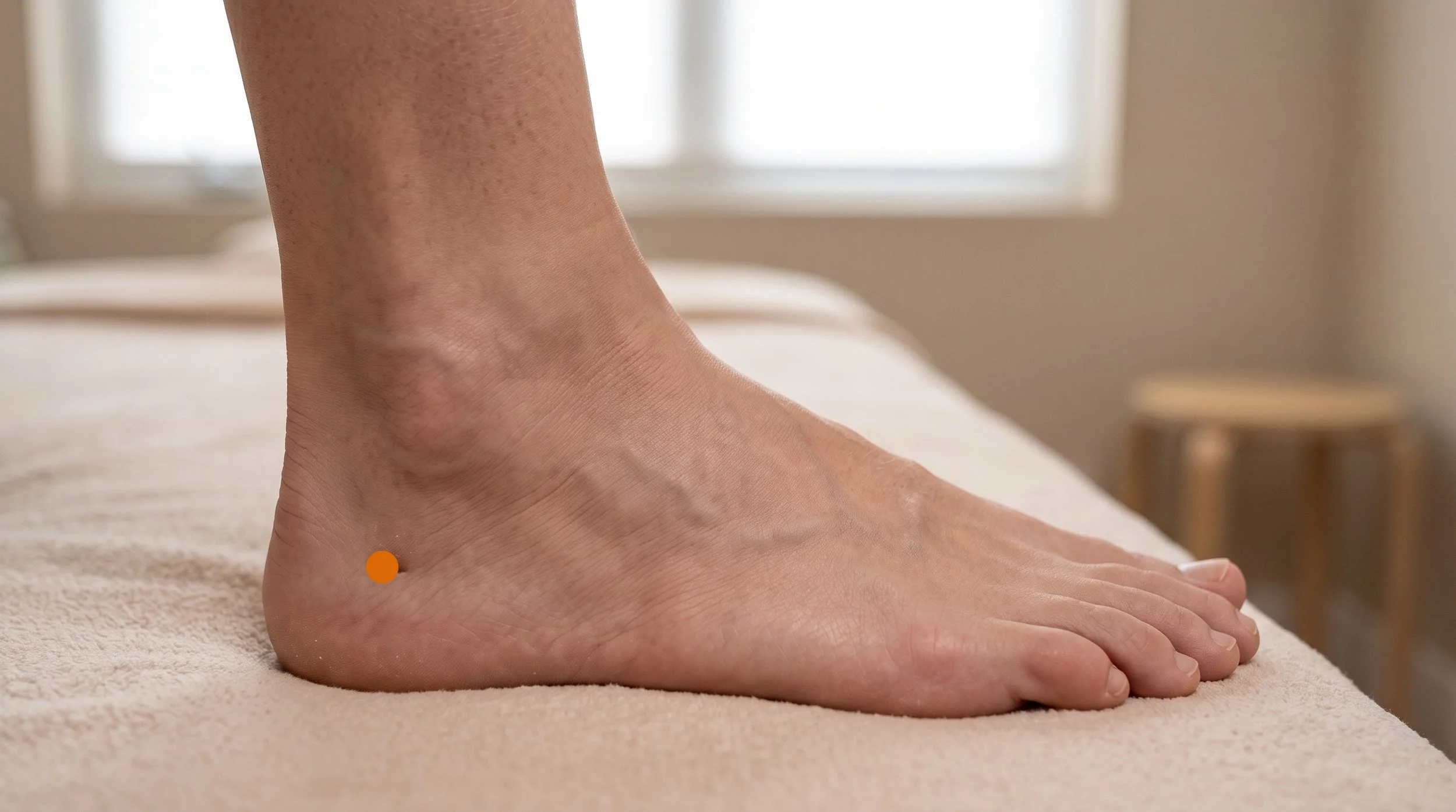
BL61 Acupuncture Point (Pucan)
The Servant's Respect Point on the Heel Bone: Anatomy, Mechanism, and Why BL61 Earns Its Place in Heel Pain and Lateral Foot Protocols
BL61, known in Chinese as Pucan and usually rendered in English as Servant's Respect, sits low on the outside of the heel, roughly halfway between the tip of the outer ankle bone and the sole, in a tender hollow you can feel directly on the calcaneus. It belongs to the Bladder channel and is described in the classical literature as a meeting point of that channel with the Yang Motility vessel, the extraordinary vessel that classical writers traced from the lateral heel up the outside of the body to the head.
What makes the bl61 acupuncture point clinically interesting is not its lineage but its address: very few points sit squarely on the heel bone itself, and that is exactly where patients with plantar heel pain, insertional Achilles irritation, and lateral rearfoot tenderness point when you ask them to show you the problem. For clinicians who treat runners, dancers, restaurant workers, and anyone who logs miles on New York City sidewalks, bladder 61 is a small, easily overlooked point that often turns out to be the most reactive spot in the region.
- Location and layers: BL61 lies about 1.5 cun below BL60 on the lateral calcaneus, in a palpable depression at the border where the thicker heel skin meets the thinner lateral skin. The needle passes through skin and subcutaneous tissue toward calcaneal periosteum, just below the fibularis (peroneal) tendons, which is why insertion is kept shallow and oblique or transverse.
- Traditional framing, modern translation: classical sources credit BL61 with relaxing the sinews, freeing the channel, and easing pain. Read neurophysiologically, that language maps onto reduced protective muscle guarding, altered local nociceptive input, and improved regional blood flow rather than any literal movement of energy.
- Nerve story: the area is supplied by lateral calcaneal branches of the sural nerve, with S1 and S2 segmental representation shared by the calf, Achilles, plantar fascia, and low back. Segmental convergence at those cord levels is one plausible reason a heel point shows up in classical lists for lumbar pain and leg weakness (Zhao, 2008).
- Research picture: reviews of acupuncture and of trigger point dry needling for plantar heel pain report short-term pain reductions with modest effect sizes and limited trial quality (Clark & Tighe, 2012; Llurda-Almuzara et al., 2021), while individual patient data across chronic musculoskeletal pain show effects that persist beyond the treatment course (Vickers et al., 2018).
- Clinical framing: BL61 is rarely used alone. It works best as the local anchor in a foot and calf protocol that also addresses gastrocnemius, soleus, and the intrinsic foot muscles, with load management and calf loading exercise running alongside the needling (Simons et al., 1999).
- De qi at BL61: patients typically report a firm, slightly bruise-like ache or a spreading heaviness across the heel rather than the sharp travelling sensation common at fleshier points, because the tissue here is thin and close to bone.
Stuck With First-Step Heel Pain Every Morning?
That first painful step out of bed is one of the most common complaints we see, and it rarely resolves with stretching alone. At Morningside Acupuncture we use BL61 alongside calf and intrinsic foot needling to reduce local sensitivity and lower the protective guarding that keeps the heel irritable. Treatment is paired with practical loading advice so the gains hold between visits. Book a session and let's map out where your heel pain is actually coming from.
Schedule NowAnatomy of BL61: Why the Lateral Calcaneus Is Such an Important Location
BL61 sits on the outer surface of the heel bone, a region with unusually little tissue between skin and bone. Under the needle there is skin, a thin subcutaneous layer with the fibrous fat pad septa that anchor heel skin to bone, and then the periosteum of the calcaneus itself. Immediately above the point run the fibularis longus and brevis tendons as they curve around the outer ankle toward the foot, and just distal and plantar to it lies the origin of abductor digiti minimi.
This is loaded tissue: every heel strike transmits force through the calcaneus, the fibularis tendons stabilize against ankle inversion, and the plantar fascia and intrinsic foot muscles tug on the same bone from the underside. Patients with plantar heel pain, fat pad irritation, or a history of lateral ankle sprain frequently have marked tenderness right at this spot.
The sensory supply here comes mainly from lateral calcaneal branches of the sural nerve, which carries fibers from the S1 and S2 spinal levels. That matters because the plantar fascia, the Achilles tendon, the calf muscles, the hamstrings, and much of the lower lumbar and sacral region share the same segmental neighborhood.
Needling at BL61 delivers a discrete, well-localized afferent barrage into dorsal horn segments that also receive input from these deeper, more diffusely painful structures, and this kind of segmental convergence is one recognized route by which acupuncture input can modulate pain perception in a region (Zhao, 2008). Sustained stimulation also engages descending inhibitory pathways from the brainstem, which helps explain why analgesia is not confined strictly to the needled spot.
Local effects likely include changes in microcirculation and in the sensitivity of nociceptors embedded in periosteum and the tight fibrous septa of the heel pad.
There are no large vessels or nerves at risk at BL61, but the point sits close to bone and to the fibularis tendon sheaths, which is why the standard convention is a shallow transverse or oblique insertion of roughly 0.3 to 0.5 cun rather than a deep perpendicular thrust. Some texts describe a shallow perpendicular approach of similar depth. Heel skin is thick and richly innervated, so slow insertion and a fine gauge needle make a substantial difference in comfort.
Practitioners avoid repeatedly grinding the needle tip against periosteum, and standard clean needle technique applies as it does anywhere on the foot, where skin flora and footwear friction warrant ordinary care.
Related Pain Finder Leg Ankle Foot Related Bladder ChannelBL61 at a Glance: Classification, Location, and Clinical Use
| Category | Detail |
|---|---|
| Traditional Name | Pucan (Servant's Respect), also transliterated Pushen or Pushe in some texts |
| Channel Classification | Bladder channel of the foot, taiyang; distal lower limb, lateral heel region (BL61, also written UB61; also called the Urinary Bladder channel) |
| Point Categories | Meeting (intersecting) point of the Bladder channel with the Yang Motility vessel (Yang Qiao mai); listed among the trajectory points of that extraordinary vessel alongside BL62 and BL59. Not a five-shu point and not a hui-meeting point. |
| Precise Location | On the lateral foot, roughly 1.5 cun inferior to BL60, in a tender depression on the calcaneus midway between BL60 and the sole, at the junction of lighter and darker skin. Since the distance from the tip of the lateral malleolus to the sole is measured as 3 cun, BL61 sits at the midpoint of that span, directly below BL60. |
| Tissue Stimulated | Heel skin and fibro-fatty septa, periosteum of the lateral calcaneus, the fibularis (peroneal) tendon region just superior, and the nearby origin of abductor digiti minimi and the deep intrinsic foot muscles |
| Needle Depth / Direction | Transverse or oblique insertion 0.3 to 0.5 cun along the surface of the calcaneus; some texts allow shallow perpendicular needling to a similar depth. Moxibustion is traditionally described as applicable. |
| De Qi Sensation | A firm, dull, bruise-like ache or pressure spreading across the heel; occasionally a brief sharpness on entry given the thick, well-innervated skin. Radiation is usually limited compared with fleshier points. |
| Primary Clinical Uses | Heel pain and plantar heel pain syndrome, lateral rearfoot and ankle pain, calf and foot cramping, lower limb weakness and atrophy patterns, and lumbar pain in classical listings |
| Common Point Combinations |
|
The entry in Deadman, Al-Khafaji and Baker's A Manual of Acupuncture presents BL61 in traditional terms as a point that relaxes the sinews, activates the channel, and alleviates pain, and it groups the classical indications into three clusters that sit oddly together at first glance. The first is local and regional: heel pain, knee swelling, leg qi, atrophy disorder of the leg, cramping, and lumbar pain.
The second is cranial: headache and a distinctive complaint of the head feeling heavy, described in the old sources as heavy as a stone. The third is mental and neurological, including mania, disordered speech, loss of consciousness, and childhood seizure disorders, alongside scattered references to vomiting and painful urination. These are traditional attributions rather than clinical claims we would make today.
Cunningham's commentary similarly places BL61 as a local point for pain, swelling, numbness, and weakness of the ankle, heel, and foot while noting its classical association with spirit disorders and with cramping arising from fluid loss, an association the Systematic Classic linked to episodes of sudden turmoil disorder.
What makes the classical pattern striking is that a point sitting on the outside of the heel bone was consistently credited with reaching the head, and the explanation the tradition offered was the Yang Motility vessel, whose described pathway runs from the lateral heel all the way up the body to the eye and the occiput.
Why BL61 Is Used for Low Back and Head Complaints as Well as Heel Pain
Patients are often surprised that a point on the heel appears in classical lists for lumbar pain, leg weakness, and even heaviness of the head. The most straightforward modern account is segmental. The skin and periosteum at BL61 are supplied by calcaneal branches of the sural nerve, carrying S1 and S2 fibers, and those same cord segments receive input from the plantar fascia, Achilles tendon, calf, posterior thigh, and lower lumbosacral tissues.
When several structures feed the same dorsal horn territory, stimulating one of them changes the processing of input from the others, which is a well-described feature of acupuncture analgesia (Zhao, 2008). That is a very different claim from saying a heel point cures back pain, but it does explain why distal lower limb points recur in back and leg protocols across many traditions.
The second layer is systemic rather than segmental. Needle stimulation that produces genuine de qi recruits descending inhibitory pathways involving the periaqueductal grey and rostral ventromedial medulla, along with endogenous opioid and monoaminergic signaling, and these effects are not restricted to the segment needled (Zhao, 2008).
This is the mechanism that likely underpins the finding, from individual patient data pooled across nearly 21,000 patients with chronic musculoskeletal pain, that acupuncture effects exceed sham controls and persist meaningfully at one year rather than fading immediately after the last needle (Vickers et al., 2018).
There is also a practical reason BL61 keeps showing up in foot work. Heel pain is rarely purely local. Reduced ankle dorsiflexion, a stiff or overloaded calf, and myofascial trigger points in gastrocnemius, soleus, and the plantar intrinsics all contribute to the picture, and trigger points in these muscles can refer pain into the heel in patterns that mimic plantar fasciitis (Simons et al., 1999). Treating the heel point alone would miss most of that. Treating the calf alone often misses the exquisitely tender spot the patient actually feels. Using both is the reason the bl 61 heel point tends to appear in combination rather than in isolation.
What the Research Shows for BL61
No trial has isolated BL61 on its own, and it would be unusual if one had. Acupuncture research for heel pain tests multi-point protocols that typically include local rearfoot and plantar points along with ankle and calf points, so BL61's contribution can only be inferred from its place inside those protocols and from the anatomy of the region. The honest summary is that the evidence for needling in plantar heel pain is positive in direction but modest in magnitude, with heterogeneous protocols, small samples, and short follow-up in many trials. What follows should be read as support for including needling in a broader plan, not as proof that any single point does the work.
| Study | Type | Focus | Key Finding |
|---|---|---|---|
| Clark & Tighe, 2012 | Systematic review | Acupuncture for plantar heel pain | The authors concluded that acupuncture appeared effective and broadly comparable to other commonly used interventions, while noting the limited quality and quantity of available trials. |
| Llurda-Almuzara et al., 2021 | Systematic review and meta-analysis | Trigger point dry needling for plantar heel pain and plantar fasciitis | Moderate to low quality evidence suggested a positive effect on pain intensity in the short term and on pain-related disability in the longer term, with the authors urging caution because of the small number of trials. |
| Cotchett et al., 2014 | Participant-blinded randomized controlled trial | Real versus sham trigger point dry needling in 84 patients with plantar heel pain | Real needling produced statistically significant reductions in first-step pain and foot pain at six weeks, though the between-group difference fell below the authors' threshold for minimal important difference and minor transient adverse events were more frequent. |
| Wang et al., 2021 | Randomized controlled trial | Electroacupuncture versus manual acupuncture for plantar heel pain syndrome over 12 sessions with 24-week follow-up | Both modalities were associated with improvement in morning first-step pain, with the trial designed to test whether electrical stimulation offers additional benefit over manual needling. |
| Yang et al., 2024 | Systematic review and meta-analysis | Dry needling for plantar fasciitis across 12 randomized trials and 781 patients | Adding dry needling to routine care was associated with lower pain scores and improved Foot Function Index values, although the authors highlighted variability in control conditions across studies. |
| Vickers et al., 2018 | Individual patient data meta-analysis | Acupuncture for chronic musculoskeletal, headache, and osteoarthritis pain | Acupuncture was superior to both sham and no-acupuncture controls, and treatment effects were largely maintained at 12 months, supporting effects beyond expectation alone. |
| Zhao, 2008 | Narrative review of mechanisms | Neural pathways underlying acupuncture analgesia | Needle stimulation activates peripheral afferents that engage segmental spinal inhibition and descending control systems involving endogenous opioid and monoaminergic signaling. |
Lateral Heel and Ankle Pain That Keeps Coming Back?
Recurrent lateral rearfoot pain often involves the fibularis tendons, old ankle sprain history, and a calf that never fully recovered its capacity. BL61 sits right in that neighborhood and gives us a precise local target next to BL60 and BL62. We combine it with dry needling of the calf and foot musculature plus graded strengthening. Schedule an evaluation and we will build a plan around your specific pattern.
Schedule NowBL61 in the Context of Trigger Point Work
Acupuncture is defined by the use of an acupuncture needle, and that includes the hundreds of styles practiced worldwide, dry needling among them. At Morningside we treat BL61 as a landmark on the lateral heel and then ask what myofascial structures around it are contributing. Soleus is the usual suspect: its trigger points refer pain strongly into the posterior heel and can reproduce the exact complaint a patient describes as plantar fasciitis (Simons et al., 1999).
Gastrocnemius, quadratus plantae, abductor hallucis, and abductor digiti minimi round out the map, with the abductors flanking the plantar fascia origin on either side of the calcaneus. A session might combine shallow needling at BL61 and BL60 with deeper needling into taut bands in the calf and, when tolerated, into the intrinsic foot muscles.
The overlap between point and muscle is partial here rather than complete. BL61 sits on bone, not in a muscle belly, so it is not itself a trigger point target in the classical Travell and Simons sense; it is closer to a periosteal and tendon-adjacent stimulation site. That is useful in its own right, since the fibularis tendon region and the calcaneal periosteum are frequently tender in chronic rearfoot pain, but it means the point functions as a complement to muscular work rather than a substitute for it.
Needling is then paired with graded calf loading, footwear review, and load management, since the needle reduces sensitivity while the exercise changes the tissue's tolerance.
BL61 Heel Pain Treatment at NYC's Highest-Rated Acupuncture Clinic
Morningside Acupuncture is the highest-rated acupuncture and dry needling clinic in New York City with over 500 five-star Google reviews, and heel and foot pain is one of the conditions we treat most often. Our licensed acupuncturists use the pucan heel point as part of a full lower limb assessment rather than as a standalone trick. You get orthopedic testing, needling, and a home plan in the same visit. Schedule your appointment today and get moving comfortably again.
Schedule NowFrequently Asked Questions
What does BL61 feel like when needled?
Most patients describe a firm, dull, slightly bruise-like ache spreading across the outer heel, sometimes with a sense of pressure or warmth. Because heel skin is thick and densely innervated, there can be a brief sharp sensation as the needle passes the surface, which settles quickly. The needling is shallow and angled along the bone, so the sensation stays fairly local rather than travelling far up the leg. If the heel is already highly irritable, we use a finer needle and less stimulation.
Why needle a point on the outside of the heel when my pain is underneath?
Plantar heel pain is rarely confined to the spot that hurts. The calcaneus is a shared attachment site for the plantar fascia, the Achilles tendon, and several intrinsic foot muscles, and the whole rearfoot shares S1 and S2 innervation through the sural and tibial nerve territories. Stimulating BL61 feeds input into the same segmental levels that process pain from the plantar surface, and it is often far better tolerated than needling directly into the most inflamed, weight-bearing part of the sole (Zhao, 2008). In practice we usually treat both regions across a course of care.
Can I press BL61 myself between sessions?
Yes, and it is one of the easier points to self-treat. Sit with the ankle crossed over the opposite knee so the outer heel faces you, find the tip of the outer ankle bone, then slide down toward the sole and stop about halfway, feeling for a tender hollow on the heel bone. Press with your thumb tip at moderate pressure, around a five or six out of ten, and hold for 30 to 60 seconds, then release. Repeat two or three times per session, once or twice daily, and try adding slow ankle circles while holding pressure. Stop if the area becomes more inflamed or if you have any skin breakdown, numbness, or unexplained swelling in the foot.
Is BL61 safe to needle?
It is considered a low-risk point when needled by a trained practitioner. There are no major vessels or nerves at the site, and the standard shallow transverse or oblique insertion of 0.3 to 0.5 cun keeps the needle well away from the fibularis tendon sheaths and away from repeated periosteal contact. Expected reactions include brief post-needle soreness or a small bruise, which is common on the foot. People with diabetes, peripheral neuropathy, poor circulation, or any active skin infection of the foot need extra caution and should tell their practitioner before treatment. Some texts advise conservative point selection during pregnancy, so let your clinician know if you are pregnant.
Where exactly is BL61 located?
BL61 lies on the lateral side of the foot, on the calcaneus, about 1.5 cun below BL60. The classical measuring convention treats the distance from the prominence of the outer ankle bone down to the sole as 3 cun, so BL61 sits at the midpoint of that line, directly beneath BL60, in a depression at the junction of the lighter and darker skin. Palpation matters more than measurement here: look for the tender hollow rather than a fixed number of finger-widths, since heel size varies considerably.
References
- Deadman, P., Al-Khafaji, M., & Baker, K. (2009). A manual of acupuncture. Journal of Chinese Medicine Publications.
- Cunningham, P. M. (2000). Acupuncture points: A practical guide to classical and modern usage. Odyssey Press.
- Kim, H. (2008). Handbook of Oriental medicine (3rd ed.). Harmony & Balance Press.
- Maciocia, G. (2005). The foundations of Chinese medicine: A comprehensive text for acupuncturists and herbalists (2nd ed.). Elsevier Churchill Livingstone.
- Simons, D. G., Travell, J. G., & Simons, L. S. (1999). Travell & Simons' myofascial pain and dysfunction: The trigger point manual, Vol. 1: Upper half of body (2nd ed.). Williams & Wilkins.
- Clark, R. J., & Tighe, M. (2012). The effectiveness of acupuncture for plantar heel pain: A systematic review. Acupuncture in Medicine, 30(4), 298-306. https://doi.org/10.1136/acupmed-2012-010183
- Llurda-Almuzara, L., Labata-Lezaun, N., Meca-Rivera, T., Navarro-Santana, M. J., Cleland, J. A., Fernández-de-las-Peñas, C., & Pérez-Bellmunt, A. (2021). Is dry needling effective for the management of plantar heel pain or plantar fasciitis? An updated systematic review and meta-analysis. Pain Medicine, 22(7), 1630-1641. https://doi.org/10.1093/pm/pnab114
- Cotchett, M. P., Munteanu, S. E., & Landorf, K. B. (2014). Effectiveness of trigger point dry needling for plantar heel pain: A randomized controlled trial. Physical Therapy, 94(8), 1083-1094. https://doi.org/10.2522/ptj.20130255
- Wang, W., Liu, Y., Jiao, R., Liu, S., Zhao, J., & Liu, Z. (2021). Comparison of electroacupuncture and manual acupuncture for patients with plantar heel pain syndrome: A randomized controlled trial. Acupuncture in Medicine, 39(4), 272-282. https://doi.org/10.1177/0964528420947739
- Yang, A., Lin, R., Xia, M., Su, H., & He, Y. (2024). The effectiveness of dry needling for plantar fasciitis: A systematic review and meta-analysis. Frontiers in Neurology, 15, 1520585. https://doi.org/10.3389/fneur.2024.1520585
- Vickers, A. J., Vertosick, E. A., Lewith, G., MacPherson, H., Foster, N. E., Sherman, K. J., Irnich, D., Witt, C. M., & Linde, K. (2018). Acupuncture for chronic pain: Update of an individual patient data meta-analysis. Journal of Pain, 19(5), 455-474. https://doi.org/10.1016/j.jpain.2017.11.005
- Zhao, Z. Q. (2008). Neural mechanism underlying acupuncture analgesia. Progress in Neurobiology, 85(4), 355-375. https://doi.org/10.1016/j.pneurobio.2008.05.004
Disclaimer: This web site is intended for educational and informational purposes only. Reading this website does not constitute providing medical advice or any professional services. This information should not be used for diagnosing or treating any health issue or disease. Those seeking medical advice should consult with a licensed physician. Seek the advice of a medical doctor or other qualified health professional for any medical condition. If you think you have a medical emergency, call 911 or go to the emergency room. No acupuncturist-patient relationship is created by reading this website or using the information. Morningside Acupuncture PLLC and its employees and contributors do not make any express or implied representations with respect to the information on this site or its use. For any legal interpretation of scope of practice in your state, consult a licensed attorney or regulatory authority.
Read more from our blog



