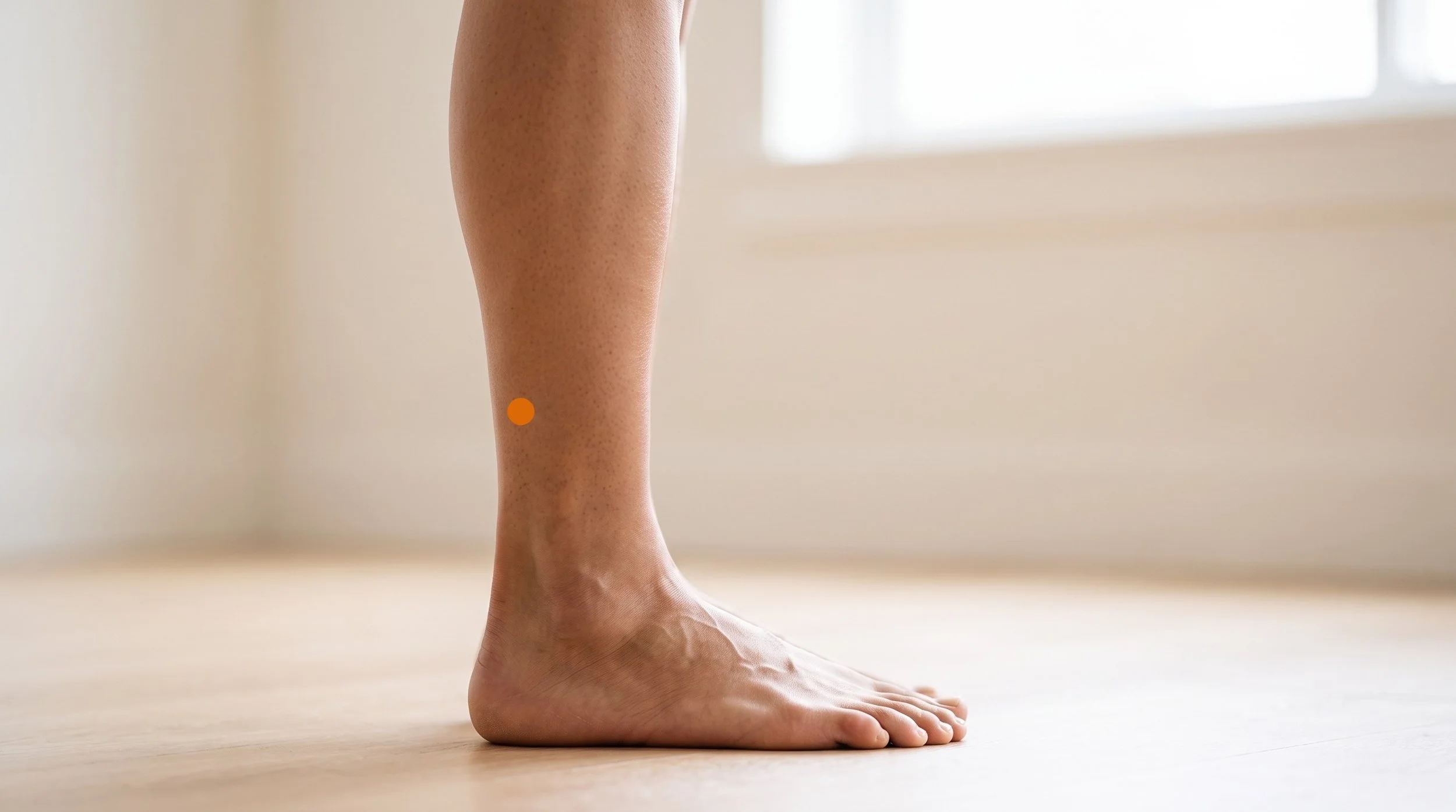
BL59 Acupuncture Point (Fuyang)
The Xi-Cleft Above the Lateral Ankle: Anatomy, Mechanism, and Why BL59 Earns a Place in Acute Low Back, Sciatica, and Ankle Treatment
BL59, called Fuyang or Instep Yang, sits on the back of the lower leg roughly one handbreadth above the ankle bone on the outer side, in the soft gap between the Achilles tendon behind and the peroneal tendons in front. In classical terms it is the xi-cleft (accumulation) point of the Yang Motility vessel, also called the Yang Qiao or Yang Stepping vessel, a designation traditionally reserved for acute, sharp, stubborn problems along that pathway.
What makes the bl59 acupuncture point interesting to a modern clinician is the mismatch between where it sits and what it is used for: a point just above the outer ankle that has been used for centuries for low back pain, radiating leg pain, and heaviness of the head. That gap between location and target is exactly the sort of distal relationship that segmental neuroanatomy and descending pain modulation help explain.
- Location and layers: bladder 59 lies 3 cun directly above BL60, level-wise following the line of the Achilles tendon, in the depression between that tendon and the tendons of peroneus longus and brevis (Deadman et al., 2007). The needle passes through skin and subcutaneous tissue into the intertendinous space and toward the deep posterior compartment.
- Traditional category, translated: as the xi-cleft point of the Yang Motility vessel, BL59 is classically indexed for acute pain and spasm along the lateral leg and back, and accumulation points in general are described as the places where a vessel's activity concentrates, making them useful for sudden, intense presentations (Maciocia, 2015).
- Nerve geography: the point sits in sural nerve territory (largely S1 and S2), and those same segments serve the lower lumbar spine, gluteal region, posterior thigh, and calf. Needling here feeds afferent input into spinal levels that also process low back and posterior leg pain, a convergence effect that is central to how distal points are understood (Zhao, 2008).
- The research picture: no trial isolates fuyang acupuncture on its own, but BL59 appears within lateral leg and lumbosacral protocols. A Cochrane review found acupuncture may modestly improve pain and function in chronic nonspecific low back pain compared with sham or no treatment, with mostly low-certainty evidence (Mu et al., 2020), and a large sham-controlled trial reported meaningful leg pain and disability improvement in chronic sciatica from disk herniation (Tu et al., 2024).
- Clinical framing: this is a working point, not a headline point. It earns its place when the lateral leg line is involved, when the low back hurts most on standing or on rising from sitting, or when the outer ankle is swollen and too tender to needle directly (Cunningham, 2015).
- De qi at BL 59 ankle level is usually a deep, heavy, slightly achy fullness between the two tendons that can spread up the calf or down toward the heel. Because the sural nerve is superficial here, a brief electric flick toward the outer border of the foot can occur, and a skilled practitioner will redirect the needle rather than push through it.
Low Back Pain That Flares When You Stand Up?
Patients often tell us the pain is worst in the first few steps after sitting, or after standing on a subway platform for ten minutes. That specific pattern is one we treat with a combination of local lumbar and gluteal needling plus distal points like BL59 and BL60 on the lower leg. Our acupuncturists use both traditional channel reasoning and dry needling of the muscles that drive the pattern, then send you out with movement and loading strategies. Schedule a visit and we will map where your pain actually starts.
Schedule NowAnatomy of BL59: Why the Gap Between the Achilles and the Peroneal Tendons Is Such an Important Location
Find the tip of the outer ankle bone, slide back to the hollow in front of the Achilles tendon where BL60 sits, then measure roughly one handbreadth (3 cun) straight up (Deadman et al., 2007). At that height the leg has narrowed into tendon: the Achilles is a firm cord behind, the peroneus longus and brevis tendons run just in front of it against the fibula, and BL59 occupies the soft corridor between them.
Under the skin and superficial fascia the needle enters that intertendinous space, and with deeper insertion it approaches the muscle bulk of the deep posterior compartment, including flexor hallucis longus, the muscle that powers push-off at the end of a stride (Cunningham, 2015). This is a high-load neighborhood in a walking city: every stair, curb, and long block loads the peroneals for lateral stability and the Achilles-soleus complex for propulsion, which is one reason the area accumulates tenderness in runners, dancers, and people recovering from ankle sprains.
The most important nerve here is the sural nerve, which runs down the back of the calf near the small saphenous vein and passes just behind the outer ankle to supply the lateral heel and outer border of the foot. Its fibers arise from the S1 and S2 spinal segments, and those segments also receive input from the lower lumbar and sacroiliac region, the gluteals, hamstrings, and calf.
When a needle stimulates afferents at BL59, that input arrives at dorsal horn levels shared with structures that are often the actual source of a patient's back or buttock pain, which is the convergence mechanism used to explain why distal points influence proximal symptoms (Zhao, 2008). Needle stimulation also recruits descending inhibitory pathways from the brainstem and drives local changes in blood flow and tissue signaling, effects that operate whether the needling is framed as channel-based acupuncture or as dry needling (Zhao, 2008).
Deep to the point, the peroneal (fibular) artery and its accompanying veins travel within the deep posterior compartment, and the small saphenous vein lies superficially near the sural nerve, so BL59 is needled with attention rather than force. Standard practice is perpendicular or oblique insertion angled proximally or distally, 1 to 1.5 cun, with shallower depths often sufficient in lean lower legs (Deadman et al., 2007; Kim, 2018).
Practitioners avoid tenting or piercing visible superficial veins, avoid driving the needle through the Achilles tendon itself, and withdraw and redirect if a sharp nerve sensation shoots into the foot. The point is well tolerated, and moxibustion has traditionally been applied here as well (Kim, 2018).
Related Best Acupuncture Points For Sciatica Related Pain Finder Leg Ankle FootBL59 at a Glance: Classification, Location, and Clinical Use
| Category | Detail |
|---|---|
| Traditional Name | Fuyang (Instep Yang), Bladder 59 |
| Channel Classification | Bladder channel of the foot, point 59 of 67, on the lower leg above the lateral malleolus (BL59, also written UB59; also called the Urinary Bladder channel) |
| Point Categories | Xi-cleft (accumulation) point of the Yang Motility (Yang Qiao) vessel; an intersection point of the Bladder channel with the Yang Motility vessel, listed among that vessel's coalescent points alongside BL62, BL61, and BL1 |
| Precise Location | On the posterolateral lower leg, 3 cun (about one handbreadth) directly above BL60, in the depression between the Achilles tendon and the tendons of peroneus longus and brevis |
| Tissue Stimulated | Skin and subcutaneous tissue in sural nerve territory, the intertendinous space between the Achilles tendon and the peroneus longus and peroneus brevis tendons, and with deeper insertion the deep posterior compartment including flexor hallucis longus |
| Needle Depth / Direction | Perpendicular or oblique insertion angled proximally or distally, 1 to 1.5 cun; shallower depths of about 0.5 to 1 cun are commonly used, and moxibustion is traditionally applied |
| De Qi Sensation | Deep heavy ache or fullness between the tendons, often spreading up the calf or down toward the heel and outer ankle; a brief tingle along the outer foot border can occur from sural nerve proximity and should prompt redirection |
| Primary Clinical Uses | Low back pain with difficulty standing for long or rising from sitting, sciatica and lateral thigh or leg pain, heaviness, soreness and weakness of the leg and knee, redness and swelling around the outer ankle, and traditionally heaviness of the head |
| Common Point Combinations |
|
In the classical literature summarized by Deadman and colleagues, BL59 is credited with benefiting the lumbar region and legs, activating the channel, and relieving pain, and the indication list clusters into three recognizable groups.
The first is axial and radiating pain: low back pain in which a person cannot stand for long or struggles to rise after sitting, thigh pain, and sciatica. The second is a heaviness, weakness, and wasting group covering aching and heavy legs and knees, numbness described as wind painful obstruction, atrophy patterns of the lower limb, damp-cold leg conditions, and inability to lift the limbs, along with local redness and swelling at the outer ankle.
The third group is the surprising one: heaviness of the head, alternating chills and fever, brow pain, cramping with sudden digestive turmoil, and convulsive spasm, all traditionally attributed to the point's role on the Yang Motility vessel, which the classics describe as running from the outer ankle all the way to the eye and the back of the skull (Deadman et al., 2007; Maciocia, 2006).
What is striking is the coherence of that spread: a single point above the ankle indexed for the entire posterior and lateral line of the body, from the heel to the head, long before anyone described fascial continuity or shared spinal segments.
Why BL59 Is Used for Low Back Pain and Sciatica From a Point Just Above the Ankle
The short version is that your low back and your outer ankle share wiring. The sural nerve territory around BL59 is supplied largely by the S1 and S2 spinal segments, and the same segments carry sensory information from the lower lumbar joints, the sacroiliac region, the gluteals, the hamstrings, and the calf. Sensory neurons from all of these converge on overlapping populations of dorsal horn cells, so a strong, well-localized input from a distal point can change how those cells respond to input coming from the painful back or buttock (Zhao, 2008).
This is the same logic that underlies distal needling generally, and it is why patients sometimes feel their back loosen while the needle is sitting in the calf.
Needling also engages systems that operate well beyond the segment. Experimental work describes activation of descending inhibitory pathways from the periaqueductal gray and rostral ventromedial medulla, along with release of endogenous opioids and other neurochemicals that reduce the responsiveness of pain-processing neurons (Zhao, 2008). Locally, needle insertion produces small changes in blood flow and tissue signaling around the tendon interval, which may matter in a region that gets stiff and poorly perfused after an ankle injury.
Individual patient data from a large pooled analysis suggest that acupuncture for chronic musculoskeletal pain produces effects modestly greater than sham needling and clearly greater than no acupuncture, with benefit that persists over time (Vickers et al., 2018).
There is a practical reason clinicians reach for BL59 in ankle work specifically. When a lateral sprain is acutely swollen and every direct touch hurts, needling proximal to the injury along the same lines gives you a way to treat without provoking the injured tissue, an approach described explicitly in the point literature (Cunningham, 2015). As swelling settles, the same point becomes part of a broader plan that includes local ankle points, peroneal muscle work, and graded balance and strength loading.
What the Research Shows for BL59
It is worth being clear about what the research can and cannot say. No published trial tests BL59 by itself, and no study compares a protocol with BL59 against the identical protocol without it. What exists are trials and reviews of multi-point acupuncture for conditions this point is traditionally used within, notably chronic low back pain, sciatica, and ankle sprain, where BL59 is one of several possible lower leg selections.
Read the evidence below as support for the treatment approach rather than proof about a single location, and note that much of it comes with meaningful caveats about study quality, blinding, and heterogeneity.
| Study | Type | Focus | Key Finding |
|---|---|---|---|
| Mu et al., 2020 | Cochrane systematic review | Acupuncture for chronic nonspecific low back pain | Acupuncture may produce small improvements in pain and function compared with sham, no treatment, or usual care, though the certainty of the evidence was mostly low to moderate. |
| Vickers et al., 2018 | Individual patient data meta-analysis | Acupuncture for chronic musculoskeletal, headache, and osteoarthritis pain | Acupuncture was associated with effects modestly superior to sham and clearly superior to no acupuncture, with benefit largely sustained at one year. |
| Tu et al., 2024 | Multicenter randomized sham-controlled trial | Chronic sciatica from herniated lumbar disk, 216 patients, 10 sessions over 4 weeks | Leg pain and disability improved significantly more with real acupuncture than with sham at week 4, with differences reported through 52 weeks. |
| Qin et al., 2015 | Systematic review and meta-analysis | Acupuncture for sciatica, 11 randomized trials | Acupuncture may be more effective than medication and may add to drug treatment, but the authors judged the evidence limited by the small number of rigorous studies. |
| Park et al., 2013 | Systematic review and meta-analysis | Acupuncture for ankle sprain, 17 trials and 1820 participants | Pooled results favored acupuncture on symptom improvement, but trial quality was generally poor and the authors considered the findings inconclusive. |
| Liu et al., 2020 | Systematic review and meta-analysis | Acupuncture for acute ankle sprain | Acupuncture appeared to improve ankle scores and pain outcomes with few adverse events, though methodological limitations across trials temper confidence. |
| Zhao, 2008 | Narrative review of mechanisms | Neural mechanisms of acupuncture analgesia | Describes segmental dorsal horn modulation, descending inhibitory control, and endogenous opioid involvement as core mechanisms of needling analgesia. |
Sciatica or Lateral Leg Pain That Will Not Settle?
Pain that travels from the low back into the buttock, outer thigh, and calf usually needs both proximal and distal attention. At Morningside Acupuncture we often pair gluteal and paraspinal needling with the bl59 acupuncture point and its Yang Motility partner BL62, especially when stiffness and guarded walking are prominent. Sessions are quiet, focused, and built around your exam findings rather than a fixed template. Book an appointment and let us assess your leg pain properly.
Schedule NowBL59 in the Context of Trigger Point Work
At Morningside Acupuncture, BL59 rarely gets used alone. When a patient presents with outer ankle pain, a history of repeated sprains, or calf tightness that limits dorsiflexion, we palpate the peroneus longus and brevis along the fibula and the soleus deep to the gastrocnemius. Taut bands in the peroneals are described as referring pain over and just below the lateral malleolus and along the outer foot, and soleus bands are described as referring to the heel and, in some cases, to the sacroiliac region (Simons et al., 1999).
That last referral pattern is worth noting for anyone treating low back pain, because it is a myofascial parallel to the same calf-to-back relationship the classical literature attributes to this point.
Practically, the needling looks like this: BL59 is used as a channel point in the tendon interval with gentle proximal or distal angling, while dry needling targets the muscle bellies themselves, which sit higher up the leg than the point does. Because BL59 is positioned in a tendon corridor rather than in muscle, it usually feels different from trigger point needling, with a slow spreading ache instead of a twitch response.
We combine the two when the picture is mixed, add hip and gluteal work when the pain travels from the back, and then load the ankle with balance and calf strength work so the improvement holds between sessions.
BL59 Sciatica and Ankle Pain Treatment at NYC's Highest-Rated Acupuncture Clinic
Morningside Acupuncture is the highest-rated acupuncture and dry needling clinic in New York City with over 500 five-star Google reviews, and our practice is built around orthopedic and sports-related pain. We use points like BL59 alongside dry needling of the peroneals, soleus, and gluteal muscles for sciatica, chronic ankle instability, and recurring low back pain. Every plan is explained in plain language, with clear expectations about how many sessions a given pattern usually needs. Schedule your first visit and start with a full assessment.
Schedule NowFrequently Asked Questions
What does BL59 feel like when needled?
Most people describe a deep, heavy, slightly achy fullness in the gap between the Achilles tendon and the peroneal tendons, sometimes spreading up the calf toward the knee or down into the heel. That sensation is de qi, and it usually fades into a warm, dull awareness within a minute or two. Because the sural nerve runs close to the surface here, some patients feel a brief tingle along the outer edge of the foot; a good practitioner adjusts the needle rather than leaving a sharp nerve sensation in place.
Why treat a point above the ankle for low back pain?
Two reasons, one traditional and one physiological. Traditionally, BL59 belongs to the Bladder channel and the Yang Motility vessel, both of which are described as running the length of the back and lateral body, and the classics list it for lumbar pain and difficulty standing (Deadman et al., 2007). Physiologically, the skin and tissue at this point are supplied by nerves from the S1 and S2 spinal segments, the same segments that carry input from the lower back, buttock, and posterior leg, so needling here reaches spinal levels involved in processing those symptoms (Zhao, 2008). Distal points also let us treat when the painful area is too acute or too swollen to work on directly.
Can I press BL59 myself between sessions?
Yes, acupressure at this point is straightforward and low risk. Sit with the ankle relaxed, find the tip of the outer ankle bone, slide back to the hollow just in front of the Achilles tendon, then move about one handbreadth straight up the leg. Feel for the soft groove between the Achilles cord and the firmer tendons in front of it. Press with your thumb at a moderate, tolerable pressure and hold for 30 to 60 seconds, or use small circles for one to two minutes per side, repeating two or three times a day. Stop if you feel a sharp electric sensation shooting into the foot, since that means you are on the nerve rather than the tissue interval. Acupressure is a useful adjunct between visits, not a substitute for treating the underlying cause.
Is BL59 safe to needle?
In trained hands it is a safe point. There is no body cavity or organ nearby, and the main considerations are the superficial sural nerve and small saphenous vein and the deeper peroneal vessels within the calf compartment. Standard practice is perpendicular or oblique insertion of 1 to 1.5 cun with proximal or distal angling, using clean needle technique and avoiding visible veins (Deadman et al., 2007). Practitioners take extra care with patients on anticoagulants, with active skin infection or open wounds over the area, or after recent Achilles or peroneal tendon surgery. Temporary soreness or a small bruise is the most common side effect.
Where exactly is BL59 located?
On the back and outer side of the lower leg, 3 cun (roughly one handbreadth, the width of your four fingers) directly above BL60, which sits in the depression between the tip of the outer ankle bone and the Achilles tendon. At that level the point falls in the depression between the Achilles tendon behind and the peroneus longus and brevis tendons in front (Deadman et al., 2007). A quick check: run your thumb up the front edge of the Achilles tendon from the ankle until you reach four finger widths, then let the thumb settle into the soft groove just in front of the tendon.
References
- Deadman, P., Al-Khafaji, M., & Baker, K. (2009). A manual of acupuncture. Journal of Chinese Medicine Publications.
- Maciocia, G. (2005). The foundations of Chinese medicine: A comprehensive text for acupuncturists and herbalists (2nd ed.). Elsevier Churchill Livingstone.
- Maciocia, G. (2006). The channels of acupuncture: Clinical use of the secondary channels and eight extraordinary vessels. Churchill Livingstone Elsevier.
- Cunningham, P. M. (2000). Acupuncture points: A practical guide to classical and modern usage. Odyssey Press.
- Kim, H. (2008). Handbook of Oriental medicine (3rd ed.). Harmony & Balance Press.
- Simons, D. G., Travell, J. G., & Simons, L. S. (1999). Travell & Simons' myofascial pain and dysfunction: The trigger point manual, Vol. 1: Upper half of body (2nd ed.). Williams & Wilkins.
- Mu, J., Furlan, A. D., Lam, W. Y., Hsu, M. Y., Ning, Z., & Lao, L. (2020). Acupuncture for chronic nonspecific low back pain. Cochrane Database of Systematic Reviews, 12, CD013814. https://doi.org/10.1002/14651858.CD013814
- Vickers, A. J., Vertosick, E. A., Lewith, G., MacPherson, H., Foster, N. E., Sherman, K. J., Irnich, D., Witt, C. M., & Linde, K. (2018). Acupuncture for chronic pain: Update of an individual patient data meta-analysis. Journal of Pain, 19(5), 455-474. https://doi.org/10.1016/j.jpain.2017.11.005
- Tu, J. F., Shi, G. X., Yan, S. Y., Ni, G. X., Yu, F. T., Cai, G. W., Liu, Z. S., Ma, C. Y., Wang, L. Q., Yang, J. W., Zhou, X. Q., Meng, X. L., Fu, H. Y., Li, J., Wan, W. J., Sun, T. H., Wang, X. Z., & Liu, C. Z. (2024). Acupuncture vs sham acupuncture for chronic sciatica from herniated disk: A randomized clinical trial. JAMA Internal Medicine, 184(12), 1417-1424. https://doi.org/10.1001/jamainternmed.2024.5463
- Qin, Z., Liu, X., Wu, J., Zhai, Y., & Liu, Z. (2015). Effectiveness of acupuncture for treating sciatica: A systematic review and meta-analysis. Evidence-Based Complementary and Alternative Medicine, 2015, 425108. https://doi.org/10.1155/2015/425108
- Park, J., Hahn, S., Park, J. Y., Park, H. J., & Lee, H. (2013). Acupuncture for ankle sprain: Systematic review and meta-analysis. BMC Complementary and Alternative Medicine, 13, 55. https://doi.org/10.1186/1472-6882-13-55
- Liu, A. F., Gong, S. W., Chen, J. X., & Zhai, J. B. (2020). Efficacy and safety of acupuncture therapy for patients with acute ankle sprain: A systematic review and meta-analysis of randomized controlled trials. Evidence-Based Complementary and Alternative Medicine, 2020, 9109531. https://doi.org/10.1155/2020/9109531
- Zhao, Z. Q. (2008). Neural mechanism underlying acupuncture analgesia. Progress in Neurobiology, 85(4), 355-375. https://doi.org/10.1016/j.pneurobio.2008.05.004
Disclaimer: This web site is intended for educational and informational purposes only. Reading this website does not constitute providing medical advice or any professional services. This information should not be used for diagnosing or treating any health issue or disease. Those seeking medical advice should consult with a licensed physician. Seek the advice of a medical doctor or other qualified health professional for any medical condition. If you think you have a medical emergency, call 911 or go to the emergency room. No acupuncturist-patient relationship is created by reading this website or using the information. Morningside Acupuncture PLLC and its employees and contributors do not make any express or implied representations with respect to the information on this site or its use. For any legal interpretation of scope of practice in your state, consult a licensed attorney or regulatory authority.
Read more from our blog



