BL58 Acupuncture Point (Feiyang)
The Luo-Connecting Point on the Outer Calf: Anatomy, Mechanism, and Why BL58 Anchors Treatment for Sciatica That Runs Between the Back and Side of the Leg
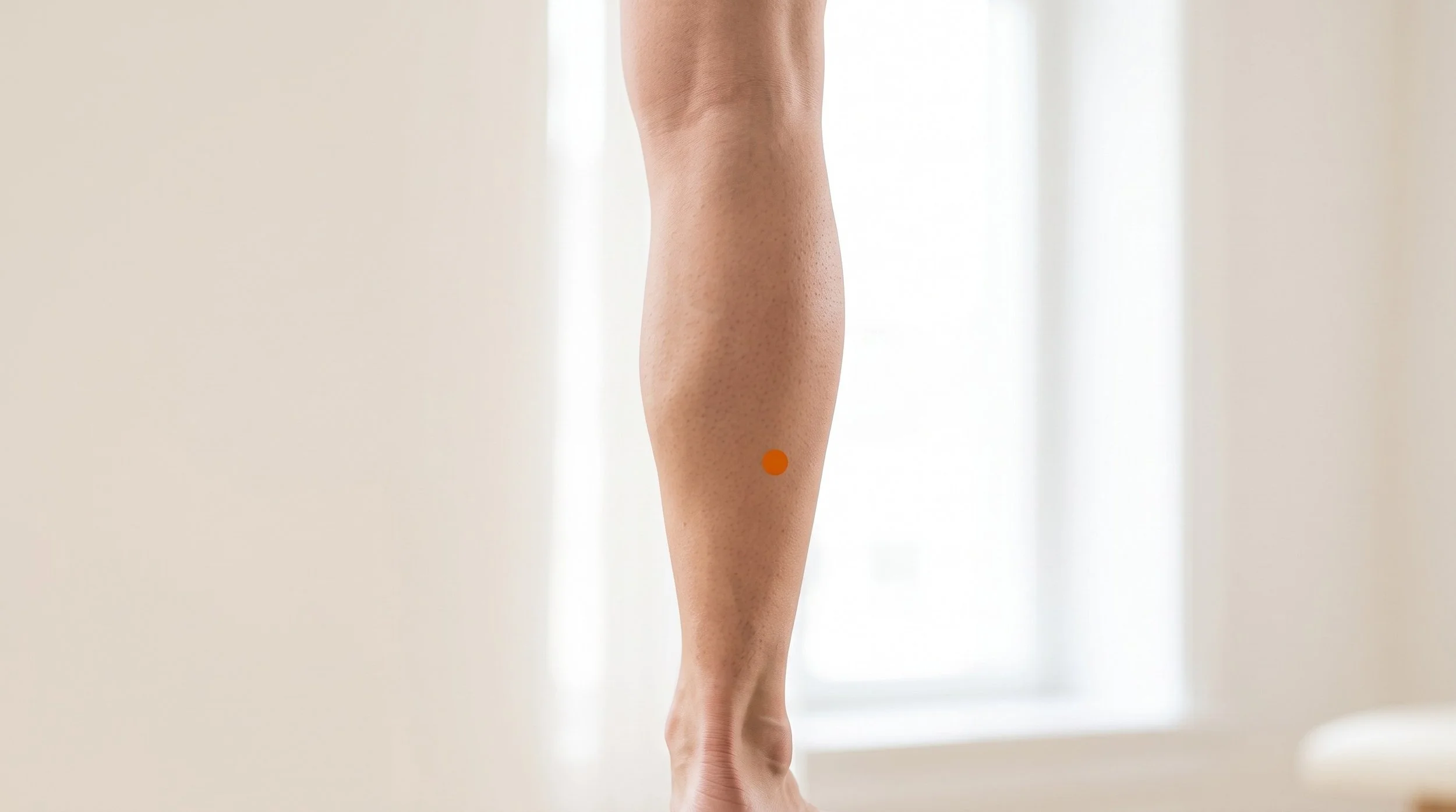
BL58 (Feiyang, often translated as Soaring Upwards or Flying Up) is the luo-connecting point of the Bladder channel, and it sits low on the outer calf where the bulk of the gastrocnemius tapers into the Achilles complex.
In plain terms, you find it about a hand's width and change above the outer ankle bone, roughly 7 cun above BL60 and about 1 cun below and to the outside of BL57. That position matters clinically: this is where the Bladder channel drifts laterally toward the Gallbladder line, which is exactly the strip of leg patients point to when their sciatic-type pain runs neither purely down the back of the calf nor purely down the side, but somewhere in between.
The bl58 acupuncture point is also one of the more interesting points in the classical literature, because its traditional indication list reaches far above the leg, up into the head, neck, and nose.
- Location and layers: bladder 58 lies about 7 cun above BL60 and roughly 1 cun inferior and lateral to BL57, near the posterior border of the fibula, where the lateral head of gastrocnemius thins into aponeurosis over soleus. A needle here passes skin, subcutaneous fascia, and the calf aponeurosis into muscle that loads heavily during push-off, running, and long days standing on hard city floors.
- Traditional categories, translated: classical texts class BL58 as the luo-connecting point of the foot taiyang channel, the place where a branch crosses to the Kidney channel, and credit it with harmonizing above and below, dispelling wind from the taiyang channel, treating hemorrhoids, and moving the channel to ease pain. Read neurophysiologically, that is a description of a distal lower-leg point whose effects were observed along a long body-surface territory rather than only under the needle.
- Nerve geography: the area is supplied by branches of the sural nerve complex in the S1 to S2 range, the same neurological neighborhood as the lower lumbar and sacral roots that generate most sciatic-type leg pain, which gives the point a plausible segmental relationship with the symptoms it is chosen for (Zhao, 2008).
- Mechanism: needling appears to recruit A-delta and group III afferents that engage spinal segmental inhibition and brainstem descending pain control, along with local blood flow and axon reflex changes in the needled tissue (Zhao, 2008).
- The research picture: no trial isolates BL58 by itself, but large pooled analyses of acupuncture for chronic musculoskeletal pain report modest, durable benefits over sham and usual care (Vickers et al., 2018), Cochrane found small short-term pain reduction in chronic nonspecific low back pain with low to moderate certainty (Mu et al., 2020), and sciatica reviews report favorable but methodologically limited results (Zhang et al., 2023).
- What it feels like: most people report a dull, spreading heaviness or a deep ache at the point that may travel toward the outer ankle, the heel, or up the calf, and occasionally a brief electric flick if the needle brushes a sural branch, which is a cue to adjust rather than push deeper.
Sciatic Pain That Runs Down the Outside of Your Calf?
Leg pain that tracks between the back and side of the calf is one of the clearest reasons to reach for BL58. At Morningside Acupuncture, we combine this point with local and lumbar needling, plus dry needling of gastrocnemius, soleus, and the gluteal muscles when the exam points there. Treatment is paired with movement and load advice so the calf tolerates walking, stairs, and subway platforms again. Schedule a visit and we'll map exactly where your pain travels.
Schedule NowAnatomy of BL58: Why the Outer Calf Where Gastrocnemius Meets the Achilles Complex Is Such an Important Location
Feiyang point location puts the needle on the lateral aspect of the lower leg, near the posterior border of the fibula, in the transition zone where the lateral head of gastrocnemius stops being thick muscle belly and becomes tendinous sheet blending into the Achilles complex, with soleus sitting deeper. Under the fingertip there is often a subtle dip or crevice rather than a bulge, and classical luo-point teaching emphasizes exactly that palpable depression when locating this point.
Mechanically, this tissue absorbs enormous repetitive load: every push-off in walking and running, every calf raise, and every hour of standing tensions the muscle-tendon junction here, which is one reason the area becomes tender in runners, dancers, and people who commute on foot all day.
The skin and subcutaneous tissue over BL58 fall in sural nerve territory, with the lateral sural cutaneous branch nearby, and the underlying muscle is supplied by tibial nerve branches in the S1 to S2 range. That shared segmental level is the practical link between a calf point and lumbosacral symptoms: afferents from this region converge in the same dorsal horn neighborhood as inputs from lower lumbar and sacral structures, so stimulating the calf can modulate processing of signals arriving from the low back and posterior thigh.
Needling of this type recruits small-diameter afferents that trigger spinal inhibitory circuits and activate descending pathways from the periaqueductal gray and rostral ventromedial medulla, mediated by endogenous opioid and monoamine systems (Zhao, 2008). Trigger points in the calf musculature can also refer pain in patterns that mimic or overlap sciatic distributions, which is why palpation of gastrocnemius and soleus is part of the exam here (Simons et al., 1999).
The main structures to respect are the small saphenous vein running in the posterior calf and the sural nerve complex itself. Standard technique is perpendicular or oblique insertion, 1 to 1.5 cun, angled either proximally or distally along the leg, using clean needle technique and avoiding visible veins. If the patient reports a sharp, radiating electric sensation rather than a dull spread, the needle is withdrawn slightly and redirected. Depth is adjusted for body size, and in leaner patients the aponeurotic layer is reached quickly, so heavy manipulation is unnecessary to produce a strong sensation.
Related Muscles That Cause Sciatica Like Symptoms Related Calf Pain Treatment NYCBL58 at a Glance: Classification, Location, and Clinical Use
| Category | Detail |
|---|---|
| Traditional Name | Feiyang (Soaring Upwards, also translated Flying Up), Bladder 58 |
| Channel Classification | Bladder channel (foot taiyang), lower leg (BL58, also written UB58; also called the Urinary Bladder channel) |
| Point Categories | Luo-connecting point of the Bladder channel, the point from which the connecting channel crosses to the Kidney channel. The reference texts list no five-shu, hui-meeting, or extraordinary vessel designations for this point. |
| Precise Location | On the lower leg, approximately 7 cun directly above BL60 at the outer ankle, near the posterior border of the fibula, about 1 cun inferior and lateral to BL57. |
| Tissue Stimulated | Skin and subcutaneous fascia in sural nerve territory, the lateral gastrocnemius aponeurosis as it merges into the Achilles complex, and underlying soleus; frequently palpated alongside gastrocnemius and tibialis posterior findings. |
| Needle Depth / Direction | Perpendicular or oblique insertion directed proximally or distally along the leg, 1 to 1.5 cun, adjusted for build. |
| De Qi Sensation | Dull, heavy, spreading ache at the point, often traveling toward the outer ankle and heel or upward through the calf; sharp electrical sensation means redirect. |
| Primary Clinical Uses | Sciatic-type pain running between the Bladder and Gallbladder lines of the leg, calf pain and cramping, leg weakness and heaviness, low back pain with a heavy quality, and classical use as a distal point for head, neck, and nasal symptoms. |
| Common Point Combinations |
|
In A Manual of Acupuncture, Deadman and colleagues describe BL58 as the luo-connecting point of the Bladder channel and note something unusual about it: what practitioners use it for today and what the classical sources list barely overlap.
Modern practice reaches for it almost entirely for lumbar pain and lower limb complaints, especially sciatic pain along or between the Bladder and Gallbladder pathways, which fits the point's position where the channel angles laterally on the lower leg. The older indications, presented as traditional attributions rather than physiological claims, describe a pattern of fullness above with emptiness below: heat in the head, dizziness, headache, occipital and neck pain, nasal congestion and nosebleed appearing alongside lumbar pain, cold in the lower body, weak legs, and difficulty standing.
The classical framework explains this through the connecting channel's crossing to the Kidney channel, so that depletion below and rising yang above are treated at a single point, and the same texts add hemorrhoids and, notably, disorders such as mania and epilepsy, which are attributed to the Bladder channel's links with the Governing vessel and the brain. What makes the pattern striking is that a point on the outer calf was named Soaring Upwards precisely because its recorded effects were observed at the opposite end of the body.
Why BL58 Is Used for Headaches, Dizziness, and Neck Pain Far From the Calf
Patients are often surprised when a point on the outer calf is chosen for a complaint in the head or neck. Part of the answer is anatomical bookkeeping: the Bladder channel runs from the head and occiput all the way down the back of the body to the foot, so classical practitioners treated the whole strip as one functional territory and used points at the far end to influence the near end. Part of the answer is modern pain science. Needling produces a strong, well-localized afferent barrage that does not stay local.
Signals from the calf enter the spinal cord at lumbosacral levels, but the downstream response includes brainstem and hypothalamic structures that project widely, dampening transmission at many spinal segments rather than only the one that was stimulated (Zhao, 2008).
That descending inhibitory system is the most credible explanation for distal point effects. Small-diameter afferent input drives the periaqueductal gray and rostral ventromedial medulla, releasing endogenous opioids, serotonin, and noradrenaline at the dorsal horn, which raises pain thresholds in regions the needle never touched (Zhao, 2008). Autonomic shifts add another layer, since many patients report a settled, drowsy state during treatment that tends to accompany reduced muscle guarding in the neck and jaw.
None of this validates the classical explanation in its own terms, but it does give a physiological account of why a lower leg point could reasonably be part of a plan for tension-type headache or occipital neck pain.
For the leg itself, the case is more direct. Segmental convergence between calf afferents and lumbosacral inputs means the needle is working in the same neural neighborhood as the symptoms, and pooled clinical data support acupuncture producing modest but real reductions in chronic musculoskeletal pain that persist beyond the treatment course (Vickers et al., 2018). BL58 is a reasonable component of a sciatica or low back protocol, not a standalone answer.
What the Research Shows for BL58
It's worth being clear about what the evidence can and can't say. Clinical trials test whole protocols, usually eight to twenty points delivered over multiple sessions, so no study has isolated BL58 and measured what it contributes on its own. What we can say is that BL58 appears regularly in the point sets used in trials and in data-mining analyses of prescriptions for lumbar disc herniation and sciatica, and that the protocols containing it have been evaluated for the conditions this point is chosen for.
The reviews below assess acupuncture as a whole intervention, and the certainty of evidence in this literature is often limited by small samples, inconsistent sham controls, and heterogeneity between trials.
| Study | Type | Focus | Key Finding |
|---|---|---|---|
| Vickers et al., 2018 | Individual patient data meta-analysis | Chronic pain including back, neck, and musculoskeletal pain (about 21,000 patients) | Acupuncture produced modest reductions in pain compared with sham and usual care, with effects that persisted over about a year. |
| Mu et al., 2020 | Cochrane systematic review | Chronic nonspecific low back pain | Acupuncture may relieve pain slightly more than sham in the short term and improve function versus no treatment, though certainty of evidence was low to moderate. |
| Zhang et al., 2023 | Systematic review and meta-analysis (30 RCTs, 2,662 participants) | Acupuncture for sciatica | Acupuncture was associated with better reported outcomes than medication treatment, but the authors graded the evidence cautiously due to trial quality. |
| Qin et al., 2015 | Systematic review and meta-analysis (11 RCTs) | Acupuncture for sciatica | Acupuncture may be more effective than drug therapy and may add to it, though the authors described the evidence base as limited. |
| Gattie et al., 2017 | Systematic review and meta-analysis | Trigger point dry needling for musculoskeletal conditions | Dry needling by physical therapists showed small to moderate short-term reductions in pain compared with sham or no treatment. |
| Zhao, 2008 | Mechanistic review | Neural mechanisms of acupuncture analgesia | Analgesic effects are attributed to afferent stimulation engaging spinal segmental inhibition and descending opioid and monoamine pathways. |
Calf Tightness, Cramping, and Heavy Legs After Long Days on Your Feet?
Chronic calf tightness rarely comes from the calf alone, so we assess the ankle, hip, and lumbar spine before deciding where the bl 58 calf point fits in. We frequently pair BL58 with BL57 and targeted needling of the triceps surae to reduce local tenderness and improve how the lower leg loads. Sessions include practical self-care, from heel raise dosing to simple pressure work between visits. Book an appointment to get a plan built around your leg, not a generic protocol.
Schedule NowBL58 in the Context of Trigger Point Work
Acupuncture, defined by the use of an acupuncture needle, covers hundreds of styles, and dry needling is one of them. At Morningside, the BL58 region is often needled twice over in a single session: once as a channel point, and once as a myofascial target if palpation finds taut bands nearby. The lateral gastrocnemius and the soleus beneath it are common culprits in calf pain, cramping, and a heavy, fatigued feeling in the legs, and their referral patterns can reach the posterior ankle and heel in ways patients often describe as sciatica (Simons et al., 1999).
Because the point sits at the muscle-tendon transition, the practitioner chooses insertion angle deliberately: shallow and oblique for channel work, or angled into the muscle belly slightly proximal to the point when a band is the target.
In a typical sciatica session, BL58 sits inside a larger plan. We may needle the lumbar segmental levels and gluteal muscles, add GB34 or lateral leg points when the pain tracks along the outer line, and finish with calf work if the exam reproduces symptoms there. Dry needling of the calf has been shown in controlled studies to change local muscle stiffness and pressure sensitivity in the short term, and pooled data suggest small to moderate short-term pain reductions across musculoskeletal conditions (Gattie et al., 2017). We treat those as useful windows for loading and movement work, not as endpoints in themselves.
BL58 Sciatica and Calf Pain Treatment at NYC's Highest-Rated Acupuncture Clinic
Morningside Acupuncture is the highest-rated acupuncture and dry needling clinic in New York City with over 500 five-star Google reviews, and points like BL58 are part of a broader, exam-driven approach rather than a fixed recipe. Our licensed acupuncturists integrate classical channel theory with modern pain science and orthopedic assessment for sciatica, low back pain, and calf complaints. You'll leave each session knowing what we treated and why. Schedule your visit today.
Schedule NowFrequently Asked Questions
What does BL58 feel like when needled?
Most patients describe a dull, heavy, slightly achy spreading sensation at the point, sometimes traveling down toward the outer ankle and heel or up through the calf. That spreading quality is the de qi sensation practitioners look for. Because the sural nerve runs nearby, a brief electric or zinging sensation is possible; it isn't harmful, but your acupuncturist should adjust the needle so the feeling settles into a dull ache. Soreness for a day afterward is common in tight calves, especially if the area was also dry needled.
Why needle a point on the calf for low back pain or headaches?
Two reasons, one traditional and one physiological. Classically, BL58 is the luo-connecting point of the Bladder channel, a pathway that runs from the head and occiput down the back of the body to the foot, so distal points were used to treat the far end of that territory. Physiologically, needling recruits small-diameter afferents that engage spinal inhibition and brainstem descending pain control systems, which reduce pain transmission at multiple segments rather than only where the needle sits (Zhao, 2008). For low back and leg pain, there's also a direct segmental link, since the calf shares lumbosacral innervation with the structures generating the symptoms.
Can I press BL58 myself between sessions?
Yes, and it's an easy one to reach. Sit with your knee bent and slide your thumb up from the outer ankle bone about a hand's width and a half, staying just behind the fibula on the outer calf, then hunt for a tender dip below and to the outside of the thickest part of the calf. Press with your thumb at a firmness you'd rate about 5 or 6 out of 10, hold for 30 to 60 seconds, release, and repeat two or three times per leg. Small circles or slow ankle pumping while you hold can help. Once or twice a day is plenty. Skip it over varicose veins, broken skin, or any area of numbness, and stop if pressing produces sharp shooting pain into the foot.
Is BL58 safe to needle?
In trained hands, yes. The main considerations are the small saphenous vein in the posterior calf and branches of the sural nerve, so practitioners avoid visible veins, use clean single-use needles, and redirect if the patient reports sharp radiating sensations. Standard insertion is 1 to 1.5 cun, perpendicular or oblique along the leg. Extra caution applies with anticoagulant use, a history of deep vein thrombosis, lymphedema, or acute calf swelling and tenderness, since sudden unilateral calf pain needs medical evaluation before any needling. Mild bruising or temporary soreness are the most common side effects.
Where exactly is BL58 located?
BL58 is on the lower leg, roughly 7 cun above BL60 at the outer ankle, near the posterior border of the fibula, and about 1 cun below and lateral to BL57. A practical way to find it: locate BL57 in the V-shaped notch where the two heads of the calf muscle meet, then move about a thumb's width down and a thumb's width toward the outside of the leg. You're usually looking for a slight depression or crevice rather than muscle bulk, and in most people the spot is tender to firm pressure when calf or leg pain is present.
References
- Deadman, P., Al-Khafaji, M., & Baker, K. (2009). A manual of acupuncture. Journal of Chinese Medicine Publications.
- Maciocia, G. (2006). The channels of acupuncture: Clinical use of the secondary channels and eight extraordinary vessels. Churchill Livingstone Elsevier.
- Kim, H. (2008). Handbook of Oriental medicine (3rd ed.). Harmony & Balance Press.
- Cecil-Sterman, A. (2012). Advanced acupuncture: A clinic manual. Classical Wellness Press.
- Simons, D. G., Travell, J. G., & Simons, L. S. (1999). Travell & Simons' myofascial pain and dysfunction: The trigger point manual, Vol. 1: Upper half of body (2nd ed.). Williams & Wilkins.
- Zhao, Z. Q. (2008). Neural mechanism underlying acupuncture analgesia. Progress in Neurobiology, 85(4), 355-375. https://doi.org/10.1016/j.pneurobio.2008.05.004
- Vickers, A. J., Vertosick, E. A., Lewith, G., MacPherson, H., Foster, N. E., Sherman, K. J., Irnich, D., Witt, C. M., & Linde, K. (2018). Acupuncture for chronic pain: Update of an individual patient data meta-analysis. Journal of Pain, 19(5), 455-474. https://doi.org/10.1016/j.jpain.2017.11.005
- Mu, J., Furlan, A. D., Lam, W. Y., Hsu, M. Y., Ning, Z., & Lao, L. (2020). Acupuncture for chronic nonspecific low back pain. Cochrane Database of Systematic Reviews, 12(12), CD013814. https://doi.org/10.1002/14651858.CD013814
- Zhang, Z., Hu, T., Huang, P., Yang, M., Huang, Z., Xia, Y., Zhang, X., Zhang, X., & Ni, G. (2023). The efficacy and safety of acupuncture therapy for sciatica: A systematic review and meta-analysis of randomized controlled trials. Frontiers in Neuroscience, 17, 1097830. https://doi.org/10.3389/fnins.2023.1097830
- Qin, Z., Liu, X., Wu, J., Zhai, Y., & Liu, Z. (2015). Effectiveness of acupuncture for treating sciatica: A systematic review and meta-analysis. Evidence-Based Complementary and Alternative Medicine, 2015, 425108. https://doi.org/10.1155/2015/425108
- Ji, M., Wang, X., Chen, M., Shen, Y., Zhang, X., & Yang, J. (2015). The efficacy of acupuncture for the treatment of sciatica: A systematic review and meta-analysis. Evidence-Based Complementary and Alternative Medicine, 2015, 192808. https://doi.org/10.1155/2015/192808
- Gattie, E., Cleland, J. A., & Snodgrass, S. (2017). The effectiveness of trigger point dry needling for musculoskeletal conditions by physical therapists: A systematic review and meta-analysis. Journal of Orthopaedic & Sports Physical Therapy, 47(3), 133-149. https://doi.org/10.2519/jospt.2017.7096
Disclaimer: This web site is intended for educational and informational purposes only. Reading this website does not constitute providing medical advice or any professional services. This information should not be used for diagnosing or treating any health issue or disease. Those seeking medical advice should consult with a licensed physician. Seek the advice of a medical doctor or other qualified health professional for any medical condition. If you think you have a medical emergency, call 911 or go to the emergency room. No acupuncturist-patient relationship is created by reading this website or using the information. Morningside Acupuncture PLLC and its employees and contributors do not make any express or implied representations with respect to the information on this site or its use. For any legal interpretation of scope of practice in your state, consult a licensed attorney or regulatory authority.
Read more from our blog