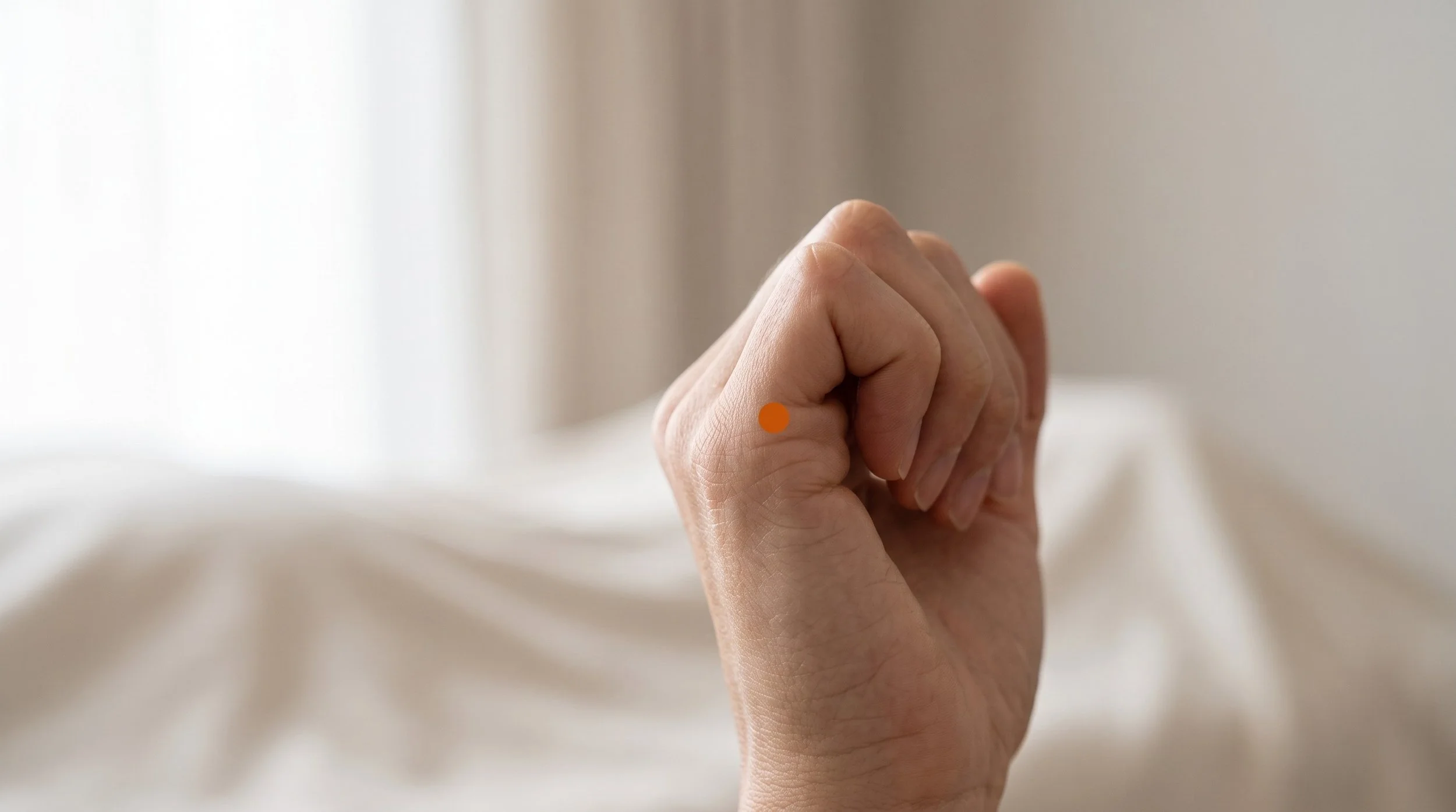
SI2 Acupuncture Point (Qiangu)
The Front Valley on the Edge of the Little Finger: Anatomy, Mechanism, and Why This Small Intestine Ying-Spring Point Is Used for Throat, Ear, and Hand Complaints
SI2, known in Chinese as Qiangu and usually translated as Front Valley, sits on the outer (little finger) edge of the hand, in the small hollow just past the knuckle of the fifth finger, right where the pale palm skin meets the darker skin of the back of the hand. Make a loose fist and the depression appears under your thumb tip. In the classical system it is the ying-spring and water point of the Small Intestine channel, a category traditionally reserved for clearing heat, and the older texts direct it upward along the hand taiyang line toward the throat, ears, eyes and neck (Deadman et al., 2007).
In a modern clinic the si2 acupuncture point earns its place for two practical reasons: it is a well tolerated distal point on the ulnar side of the hand for people with little-finger, hand-edge and taiyang-line neck complaints, and it gives a strong, easily graded sensory input in a region richly supplied by branches of the ulnar nerve.
- Location and layers: small intestine 2 lies on the ulnar border of the fifth finger just distal to the metacarpophalangeal joint, at the junction of palmar and dorsal skin, and is easiest to find with the hand in a loose fist (Deadman et al., 2007; Kim, 2010). The needle passes through thin skin and sparse subcutaneous tissue close to the joint capsule and the small intrinsic muscles of the hypothenar border.
- Traditional categories, read neurophysiologically: as the ying-spring and water point on a fire channel, SI2 was classically grouped with points said to subdue heat in the upper body (Deadman et al., 2007). Translated into modern language, this is a strong, discrete sensory input at a densely innervated acral site, the kind of stimulus most reliably associated with measurable changes in pain processing (Zhao, 2008).
- Nerve geography: the site is supplied by dorsal and palmar proper digital branches of the ulnar nerve, which carry information back to the C8 and T1 spinal segments (Cheng, 2010). Those same lower cervical segments receive input from the lower neck, shoulder girdle and medial arm, which offers a plausible segmental route for the classical si 2 finger to neck relationship.
- Distal needling has direct support: in a double-blind crossover trial, needling at points away from the painful area reduced motion-related neck pain more than local dry needling or sham in the same patients (Irnich et al., 2002), and large individual patient data analyses show modest but persistent benefits of acupuncture over sham for chronic musculoskeletal pain (Vickers et al., 2018).
- The classical throat and ear uses are less settled: a single-point protocol on the hand for acute tonsillitis and pharyngitis improved pain but did not beat sham (Fleckenstein et al., 2009), and tinnitus reviews report mixed results with low-quality trials (Huang et al., 2021). We use the front valley point as one element of a broader plan, not as a stand-alone answer.
- De qi here is bright and fast: most people feel a brief sting at insertion, then a concentrated ache or fullness that can spread a short distance along the outer edge of the hand toward the wrist. Because finger points are sensitive, we use fine needles, shallow depth and gentle stimulation, and we check comfort before adding any manipulation.
Neck Pain That Runs Into the Shoulder Blade and Down the Arm?
Pain along the back of the neck, the top border of the shoulder blade and the little-finger side of the arm follows the hand taiyang line, and it is one of the patterns we see most often at Morningside Acupuncture. We may pair distal needling at SI2 and SI3 with careful local work in the cervical and scapular muscles, so the nervous system gets input from both ends of the problem. Treatment is graded to what you can tolerate, and we reassess range of motion in the same visit. Schedule an evaluation and we will map your pain pattern before a single needle goes in.
Schedule NowAnatomy of SI2: Why the Ulnar Border of the Little Finger Is Such an Important Location
SI2 sits in the small dip just beyond the knuckle of the little finger, on the outer edge of the hand where palm skin transitions to the skin of the hand's back surface (Deadman et al., 2007; Kim, 2010). The tissue here is thin: skin, a shallow layer of fat and fascia, then the capsule of the fifth metacarpophalangeal joint and the tendinous edges of the small hypothenar muscles that abduct and flex the little finger. This border of the hand takes a surprising amount of mechanical load.
It is the part that rests on a desk while typing, absorbs the impact of a mouse or a phone held for hours, and braces during push-ups, kettlebell work and racket sports. Repetitive pressure and gripping can leave the region tender well before any imaging finding appears.
Sensation at the point travels in dorsal and palmar proper digital branches of the ulnar nerve, which feed back to the C8 and T1 spinal cord segments (Cheng, 2010). This matters clinically because those segments also receive input from the lower cervical spine, the medial arm and parts of the shoulder girdle. When several tissues converge on the same dorsal horn neurons, a needle stimulus at the hand can influence how signals from the neck and arm are processed, a mechanism usually described as segmental modulation.
Beyond the segment, needling with de qi recruits descending inhibitory pathways from the brainstem and triggers release of endogenous opioids and other neuromodulators, which is the best supported explanation for why distal points can change pain in distant regions (Zhao, 2008). Trial data are consistent with this: distal needling outperformed local dry needling for immediate motion-related neck pain in a controlled crossover study (Irnich et al., 2002).
Vascular structures here are the small dorsal and palmar digital arteries and veins arising from the ulnar artery (Cheng, 2010). They are superficial and easily nicked, so a small bruise is the most common side effect at this point. Standard needling is oblique and directed distally 0.2 to 0.3 cun, or angled toward the palm to roughly 0.5 cun (Deadman et al., 2007), while other texts describe perpendicular insertion of 0.3 to 0.5 cun (Cheng, 2010; Kim, 2010). Fine gauge needles, clean technique and shallow depth are the norm, and pressure after withdrawal reduces bruising. Because the joint capsule is close, we angle away from the joint line rather than into it.
Related Small Intestine Channel Related Pain Finder Forearm HandSI2 at a Glance: Classification, Location, and Clinical Use
| Category | Detail |
|---|---|
| Traditional Name | Qiangu (Front Valley), SI2, also written Small Intestine 2 or SI-2 |
| Channel Classification | Small Intestine channel of the hand taiyang |
| Point Categories | Ying-spring point of the Small Intestine channel; water point within the five-shu (five transport) sequence on a fire channel; no meeting, hui-meeting or extraordinary vessel designations are attributed to this point in the standard texts |
| Precise Location | On the ulnar border of the little finger, in the depression just distal to the fifth metacarpophalangeal joint, at the border between palmar and dorsal skin; located most easily with the hand held in a loose fist |
| Tissue Stimulated | Skin and thin subcutaneous fascia over the ulnar side of the fifth metacarpophalangeal joint, adjacent to the tendinous border of the hypothenar muscles (abductor digiti minimi), with ulnar digital nerve and small digital vessels in the immediate field |
| Needle Depth / Direction | Oblique insertion directed distally 0.2 to 0.3 cun, or perpendicular to oblique toward the palm about 0.5 cun; other standard texts describe perpendicular insertion 0.3 to 0.5 cun. Moxibustion is traditionally considered applicable |
| De Qi Sensation | A brief sharp sting on insertion, then a concentrated ache, fullness or pressure that may spread a short distance along the outer edge of the hand toward the wrist; sensation is usually strong because acral points are densely innervated |
| Primary Clinical Uses | Pain along the ulnar border of the hand and little finger; taiyang-line neck, scapular and arm pain as a distal point; traditionally used for sore throat with painful swallowing, eye pain with tearing, tinnitus, and swelling of the cheek or neck |
| Common Point Combinations |
|
Deadman, Al-Khafaji and Baker summarize a consistent traditional picture for Qiangu. As a ying-spring point it belonged to the category the Classic of Difficulties associated with heat in the body, and because the Small Intestine is a fire channel, its water point was traditionally credited with an unusually strong cooling action. Being part of taiyang, the most superficial of the six channels in that system, it was said to act on the outer layers of the head region: bursting or reddened eyes, eye pain with tearing, blocked nose, nosebleed and ringing in the ears.
When heat was described as intense enough to produce swelling, the same point appears for mumps, a swollen cheek that spreads toward the ear, and a painful, swollen throat that makes swallowing difficult. A third strand of indications is purely local and channel-based: stiffness and pain running from the hand up through the wrist, arm, shoulder blade and neck, along with heat, numbness or itching of the fingers and palms.
What is striking is the pairing of these two very different roles in one small point on the edge of the little finger, an upper-body heat action and a long-line musculoskeletal action, both organized around the same channel map (Deadman et al., 2007).
Why SI2 Is Used for Throat, Ear and Neck Symptoms Far From the Hand
The first part of the explanation is segmental. Sensation from the ulnar side of the little finger travels back through ulnar nerve branches into the C8 and T1 spinal segments (Cheng, 2010), and those segments also process input from the lower neck, the medial arm and parts of the shoulder girdle. Dorsal horn neurons in that region receive convergent input from skin, muscle, joint and deeper tissues, so a strong, well localized needle stimulus at the hand can alter how signals arriving from the neck and arm are amplified or dampened.
This is the most direct account of why a point on the si 2 finger position may help pain that a patient feels in the shoulder blade or the side of the neck.
The second part is non-segmental. Needling that produces de qi engages descending inhibitory systems running from the midbrain and brainstem down to the spinal cord, along with release of endogenous opioids, serotonin and norepinephrine, and it also shifts autonomic balance and local blood flow (Zhao, 2008). These pathways do not respect segmental boundaries, which is why a hand point can influence symptoms in the face, throat or ear region even though those areas are supplied by entirely different nerves.
Clinically, the crossover trial by Irnich and colleagues is the cleanest demonstration of the principle: needling away from the painful neck produced a larger immediate drop in motion-related pain than needling the local trigger points in the same patients (Irnich et al., 2002).
Where the classical throat, eye and ear indications are concerned, we stay deliberately measured. A randomized trial of single-point needling on the hand for acute tonsillitis and pharyngitis found real improvement in pain but no advantage over sham stimulation of the same area (Fleckenstein et al., 2009), and reviews of acupuncture for tinnitus report inconsistent results across small, low-quality trials (Huang et al., 2021). We use SI2 as one component of a treatment plan rather than a targeted intervention for these conditions, and we are clear with patients about which uses have stronger support.
What the Research Shows for SI2
There is no clinical trial testing SI2 on its own, which is true of nearly every individual acupuncture point. Research in this field almost always evaluates multi-point protocols, so the reasonable question is not whether Qiangu works in isolation but whether the strategies it belongs to (distal needling for musculoskeletal pain, and channel-based protocols for head and neck complaints) hold up under scrutiny. The picture is mixed by condition: reasonably supported for chronic musculoskeletal pain, uncertain for throat and ear symptoms. The table below summarizes the studies most relevant to how we actually use this point.
| Study | Type | Focus | Key Finding |
|---|---|---|---|
| Irnich et al., 2002 | Randomized, double-blind, sham-controlled crossover trial | Immediate effects of distal-point acupuncture versus local dry needling in chronic neck pain | Needling at points distant from the painful area reduced motion-related neck pain more than local dry needling or sham in the same patients, supporting the distal strategy that SI2 belongs to. |
| Vickers et al., 2018 | Individual patient data meta-analysis | Acupuncture for chronic musculoskeletal, headache and osteoarthritis pain | Acupuncture was modestly superior to sham and to no-acupuncture control, with effects that persisted over roughly a year, suggesting benefits are not explained by placebo alone. |
| Fleckenstein et al., 2009 | Randomized placebo-controlled trial | Single-point needling on a hand channel for acute tonsillitis and pharyngitis | Pain on swallowing improved clinically, but real needling was not superior to sham laser at the same area, so classical throat indications for distal hand points remain unproven. |
| Huang et al., 2021 | Systematic review and meta-analysis | Acupuncture for tinnitus across eight randomized trials | No significant difference on the primary visual analogue outcome, with improvements on tinnitus handicap and severity indices, though the authors judged the overall evidence too weak for firm conclusions. |
| Moss et al., 2015 | Pragmatic randomized controlled trial | Auricular acupuncture added to usual care for acute sore throat | Added needling was associated with lower pain scores and less analgesic use over 24 to 48 hours, though the technique differs substantially from body points such as SI2. |
| Zhao, 2008 | Mechanistic review | Neural mechanisms of acupuncture analgesia | Analgesic effects are attributed to segmental spinal modulation plus descending inhibition and endogenous opioid, serotonergic and noradrenergic signaling. |
Sore Throat, Ear Fullness, or Jaw and Cheek Tension?
Classical texts sent Qiangu upward toward the throat, ear and cheek, and modern practice keeps that idea while staying honest about the evidence. At Morningside Acupuncture we combine distal hand points with cervical, jaw and suboccipital work, plus breathing and self-care guidance you can use at home. We will tell you plainly when acupuncture is a reasonable adjunct and when you should be seen by your physician first. Book a visit to talk through your symptoms with a licensed acupuncturist.
Schedule NowSI2 in the Context of Trigger Point Work
Acupuncture, defined by the use of an acupuncture needle, includes hundreds of styles, and dry needling is one of them. At Morningside we frequently treat SI2 in the same session as myofascial targets on the ulnar side of the hand and forearm. The abductor digiti minimi and the other hypothenar muscles sit immediately deep and proximal to the point, and taut bands there can refer pain along the little finger and the outer edge of the hand, a pattern documented in the trigger point literature (Simons et al., 1999).
Because SI2 lies over the tendinous border of this group, needling the point and needling the muscle belly can feel like variations on the same intervention, with the distinction being depth, angle and whether we are chasing a local twitch response.
For patients whose hand symptoms sit inside a larger neck and shoulder picture, we widen the field. Distal needling at SI2 and SI3 often accompanies dry needling of the levator scapulae, upper trapezius, scalenes and infraspinatus, muscles with referral patterns that overlap the taiyang line and can reproduce arm and scapular complaints (Simons et al., 1999). Sequencing matters in practice: using the distal point first can reduce guarding and make local needling more comfortable, which fits the finding that distant needling produces measurable immediate change in motion-related neck pain (Irnich et al., 2002). We then reassess grip, cervical rotation and provocative positions before deciding what to add.
SI2 Hand and Neck Pain Treatment at NYC's Highest-Rated Acupuncture Clinic
Morningside Acupuncture is the highest-rated acupuncture and dry needling clinic in New York City with over 500 five-star Google reviews, and our approach blends classical point selection with sports medicine style assessment. For ulnar-sided hand pain, grip complaints and taiyang-pattern neck pain, SI2 is one of several distal options we may use alongside dry needling of the hypothenar and cervical muscles. Every plan includes movement and loading advice so gains hold between visits. Schedule your first session and start with a full evaluation.
Schedule NowFrequently Asked Questions
What does SI2 feel like when needled?
Expect a brief sharp sting as the needle passes the skin, since the edge of the little finger is densely innervated, followed by a concentrated ache, heaviness or fullness at the knuckle. Some people feel that sensation travel a short way along the outer border of the hand toward the wrist. The initial sting fades within seconds, and the residual ache is usually mild. We use very fine needles and shallow depth here, and we ask for feedback before adding any manipulation.
Why treat a point on the little finger for neck or shoulder blade pain?
Two reasons. Anatomically, the skin at SI2 is supplied by ulnar nerve branches feeding the C8 and T1 spinal segments, which also receive input from the lower neck and shoulder girdle, so needling at the hand can influence how those signals are processed (Cheng, 2010). Physiologically, needling with de qi also recruits descending pain-inhibiting pathways that act well beyond a single segment (Zhao, 2008). Clinically, a controlled crossover trial found distal needling reduced motion-related neck pain more than local dry needling in the same patients (Irnich et al., 2002).
Can I press SI2 myself between sessions?
Yes, acupressure at this point is simple and low risk. Make a loose fist and slide the pad of your opposite thumb along the outer edge of the little finger until you drop into the small hollow just past the knuckle. Press with firm, steady pressure at an intensity you would rate about 4 to 6 out of 10, hold for 30 to 60 seconds, then release. Repeat two or three times per hand, up to a few times a day, and stop if you feel numbness, tingling or sharp pain. Small circular pressure while slowly opening and closing the hand can help if stiffness is the main complaint. Acupressure is a reasonable self-care adjunct, not a substitute for evaluation of persistent hand or neck symptoms.
Is SI2 safe to needle?
In trained hands it is a low-risk point. There are no organs or major vessels nearby, and the main considerations are the small digital arteries and veins (which can produce a minor bruise) and the joint capsule of the fifth knuckle, which we angle away from rather than into. Standard depth is shallow, roughly 0.2 to 0.5 cun depending on the direction chosen (Deadman et al., 2007; Cheng, 2010). Tell your practitioner if you take anticoagulants, have a bleeding disorder, or have local infection, an open wound or an inflamed joint at the site, since these change our approach.
Where exactly is SI2 located?
Rest your hand in a loose fist with the palm facing down. Trace the outer border of the little finger toward the knuckle: SI2 lies in the depression just beyond that knuckle joint, on the line where the paler palm skin meets the skin of the back of the hand, described in classical texts as the junction of light and dark skin (Kim, 2010; Cheng, 2010). It is directly distal to SI3, which sits on the other side of the same knuckle at the end of the palm crease. When you have the right spot, firm pressure usually feels distinctly more tender than the tissue on either side.
References
- Deadman, P., Al-Khafaji, M., & Baker, K. (2009). A manual of acupuncture. Journal of Chinese Medicine Publications.
- Cheng, X. (Ed.). (1999). Chinese acupuncture and moxibustion (Rev. ed.). Foreign Languages Press.
- Kim, H. (2008). Handbook of Oriental medicine (3rd ed.). Harmony & Balance Press.
- Maciocia, G. (2006). The channels of acupuncture: Clinical use of the secondary channels and eight extraordinary vessels. Churchill Livingstone Elsevier.
- O'Connor, J., & Bensky, D. (Eds. & Trans.). (1981). Acupuncture: A comprehensive text. Shanghai College of Traditional Medicine. Eastland Press.
- Simons, D. G., Travell, J. G., & Simons, L. S. (1999). Travell & Simons' myofascial pain and dysfunction: The trigger point manual, Vol. 1: Upper half of body (2nd ed.). Williams & Wilkins.
- Zhao, Z. Q. (2008). Neural mechanism underlying acupuncture analgesia. Progress in Neurobiology, 85(4), 355-375. https://doi.org/10.1016/j.pneurobio.2008.05.004
- Vickers, A. J., Vertosick, E. A., Lewith, G., MacPherson, H., Foster, N. E., Sherman, K. J., Irnich, D., Witt, C. M., & Linde, K. (2018). Acupuncture for chronic pain: Update of an individual patient data meta-analysis. Journal of Pain, 19(5), 455-474. https://doi.org/10.1016/j.jpain.2017.11.005
- Irnich, D., Behrens, N., Gleditsch, J. M., Stör, W., Schreiber, M. A., Schöps, P., Vickers, A. J., & Beyer, A. (2002). Immediate effects of dry needling and acupuncture at distant points in chronic neck pain: Results of a randomized, double-blind, sham-controlled crossover trial. Pain, 99(1-2), 83-89. https://doi.org/10.1016/S0304-3959(02)00062-3
- Fleckenstein, J., Lill, C., Lüdtke, R., Gleditsch, J., Rasp, G., & Irnich, D. (2009). A single point acupuncture treatment at large intestine meridian: A randomized controlled trial in acute tonsillitis and pharyngitis. The Clinical Journal of Pain, 25(7), 624-631. https://doi.org/10.1097/AJP.0b013e3181a49e35
- Huang, K., Liang, S., Chen, L., & Grellet, A. (2021). Acupuncture for tinnitus: A systematic review and meta-analysis of randomized controlled trials. Acupuncture in Medicine, 39(4), 264-271. https://doi.org/10.1177/0964528420938380
- Moss, D. A., et al. (2015). Ear acupuncture for acute sore throat: A randomized controlled trial. Journal of the American Board of Family Medicine, 28(6), 697-705. https://doi.org/10.3122/jabfm.2015.06.150014
Disclaimer: This web site is intended for educational and informational purposes only. Reading this website does not constitute providing medical advice or any professional services. This information should not be used for diagnosing or treating any health issue or disease. Those seeking medical advice should consult with a licensed physician. Seek the advice of a medical doctor or other qualified health professional for any medical condition. If you think you have a medical emergency, call 911 or go to the emergency room. No acupuncturist-patient relationship is created by reading this website or using the information. Morningside Acupuncture PLLC and its employees and contributors do not make any express or implied representations with respect to the information on this site or its use. For any legal interpretation of scope of practice in your state, consult a licensed attorney or regulatory authority.
Read more from our blog



