BL43 Acupuncture Point (Gaohuangshu)
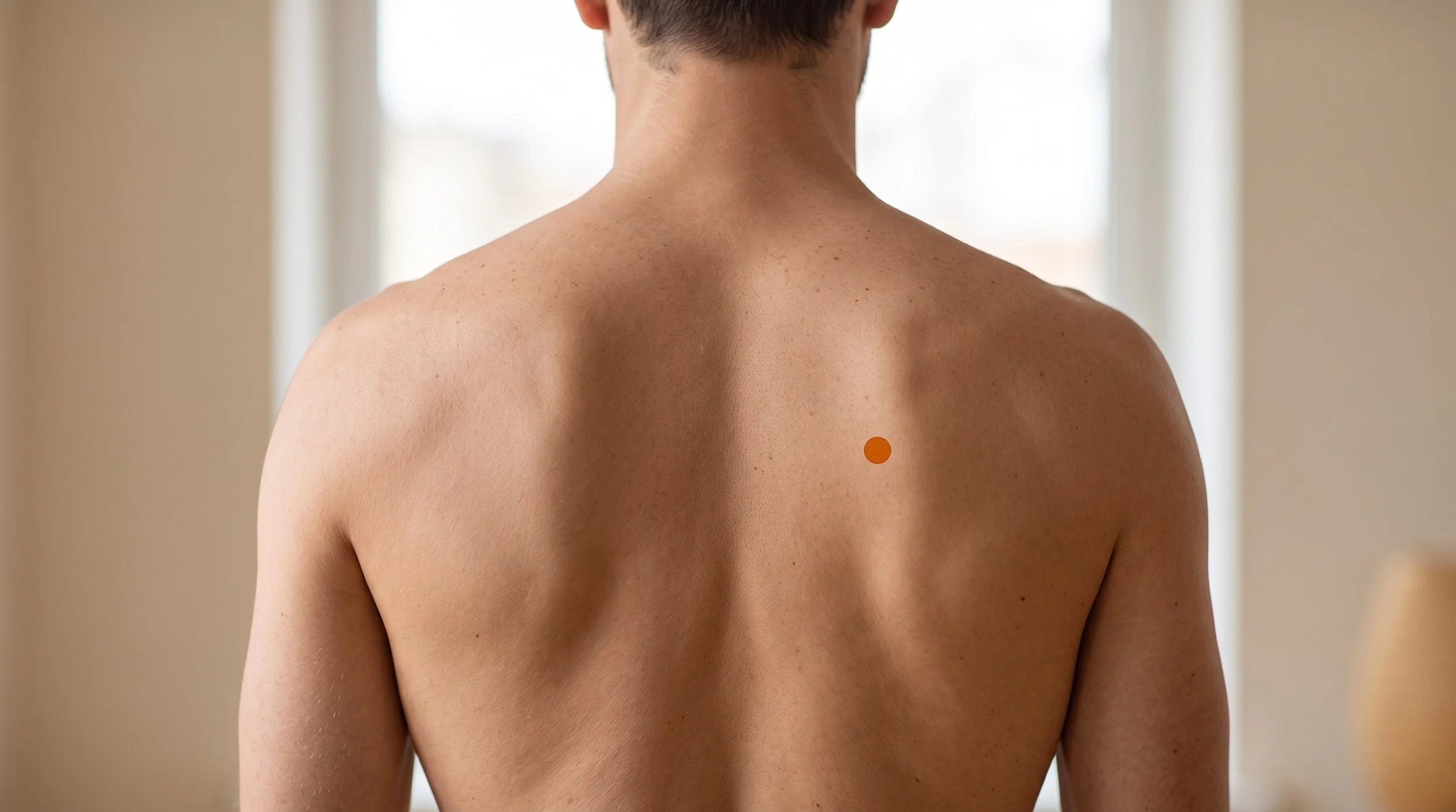
BL43 Acupuncture Point (Gaohuangshu)
The Vital Region Point Beside the Shoulder Blade: Anatomy, Mechanism, and Why BL43 Became the Classical Address for Exhaustion, Breathlessness, and Interscapular Pain
BL43, called Gaohuangshu (sometimes written gao huang shu, and translated as Vital Region Shu), sits on the outer Bladder line of the upper back, three cun to either side of the spine at the level of the lower edge of the fourth thoracic spinous process, right along the inner border of the shoulder blade when the shoulders are relaxed. Bladder 43 is level with BL14 on the inner line, and it lands squarely in the interscapular zone where desk workers, cyclists, and new parents carry a familiar deep ache between the shoulder blades.
Classically it was one of the most celebrated moxibustion points in the entire literature, reserved for people who were profoundly depleted, and modern practice keeps that reputation while adding a much more practical use: BL43 is a reliable access point to the rhomboid and mid trapezius region, an area that refers pain up the neck and around the chest wall. Understanding the bl43 acupuncture point means holding both stories at once, the classical one about deep deficiency and the anatomical one about a thin muscular shelf lying directly over the lung.
- Location and layers: BL43 lies 3 cun lateral to the midline at the lower border of T4, over the medial scapular border, with skin and fascia, mid trapezius, and rhomboid major stacked superficially and the pleural dome of the lung not far beneath the intercostal spaces (Deadman et al., 2007).
- Traditional identity: classical texts assign BL43 the job of supplementing severe depletion across the Lung, Heart, Kidney, Spleen, and Stomach systems, calming the spirit, and resolving phlegm, all presented here as traditional attributions rather than physiology (Deadman et al., 2007; Maciocia, 2015).
- Mechanism: needling at T4 stimulates the medial branch of the thoracic dorsal ramus and muscle spindle rich tissue in a segment that shares spinal input with cardiopulmonary afferents, and repeated stimulation may recruit descending inhibitory pathways that dampen pain signaling more broadly (Zhao, 2008).
- Research picture: no trial isolates BL43 by itself, but individual patient data pooling shows modest, durable effects of acupuncture for chronic musculoskeletal pain (Vickers et al., 2018), and reviews of moxibustion for chronic fatigue syndrome report benefit from low to moderate quality evidence (You et al., 2021).
- Clinical framing: at Morningside we treat BL43 as a regional workhorse for interscapular pain and postural strain, often paired with distal points, and we use moxibustion here for fatigue and cold, depleted presentations rather than promising anything about energy reserves.
- De qi: patients usually describe a deep, heavy, slightly spreading ache under the shoulder blade, sometimes with a soft twitch when a taut band in the rhomboids is engaged, and a warm loosening sensation afterward (Simons et al., 1999).
Tired of That Deep Ache Between Your Shoulder Blades?
Interscapular pain rarely comes from one muscle, and it rarely resolves with stretching alone. At Morningside Acupuncture we use BL43 alongside dry needling of the rhomboids and mid trapezius, plus distal points, to reduce muscle tone and calm sensitized tissue in the upper back. We pair the treatment with simple posture and breathing changes that keep the region from reloading between visits. Schedule a session and let's map where your pain actually starts.
Schedule NowAnatomy of BL43: Why the Medial Scapular Border at T4 Is Such an Important Location
At BL43 the needle passes through skin and superficial fascia into the middle fibers of trapezius, then into rhomboid major, which anchors the medial border of the scapula to the thoracic spine. This is a working shelf of tissue: it decelerates the shoulder blade every time you reach forward, holds the scapula back when you sit upright, and fatigues quickly when a keyboard, a phone, or a steering wheel keeps the arms in front of the body for hours. Because the scapula slides over these muscles, the region also has to tolerate shear as well as tension, which is one reason taut bands and tender spots cluster here.
When the shoulders are relaxed, the three cun line effectively runs along the inner edge of the shoulder blade, which makes the point easy to find and easy to confuse with the scapula itself (Deadman et al., 2007).
The segmental story is what makes BL43 interesting beyond local muscle. Sensory innervation here comes from the medial branches of the T3 to T5 dorsal rami, and those same spinal segments receive visceral afferent traffic from the heart, great vessels, and lungs by way of sympathetic pathways. Convergence of somatic and visceral input at shared dorsal horn neurons is the standard explanation for why chest and lung problems can produce interscapular tenderness, and it offers a plausible, non-mystical reading of why a point over the rhomboids was historically linked with cough, breathlessness, and palpitations.
Needling in this segment also activates ascending pathways that engage midbrain and brainstem structures involved in descending pain modulation, including opioid and monoaminergic mechanisms (Zhao, 2008). Repeated sessions in chronic musculoskeletal pain are associated with effects that persist beyond the treatment course, which suggests something more than momentary distraction is happening (Vickers et al., 2018).
The deep structure that dictates technique is the lung. Between the ribs at this level, the pleura sits close to the surface, particularly in thin patients and in anyone with a flattened or hypermobile scapula. Standard teaching is oblique insertion of roughly 0.3 to 0.5 cun, angled away from the midline or along the muscle plane, and deep perpendicular or medially directed needling is specifically cautioned against because of substantial pneumothorax risk (Deadman et al., 2007).
Pneumothorax remains the most frequently reported serious adverse event in acupuncture, yet large prospective safety data show it is rare in trained hands, with serious events uncommon across hundreds of thousands of treatments (Witt et al., 2009). Practically, that means angle, depth control, and patient positioning matter far more at BL43 than needle count.
Related Back Shu Points Related Pain Finder Upper Back Shoulder ArmBL43 at a Glance: Classification, Location, and Clinical Use
| Category | Detail |
|---|---|
| Traditional Name | Gaohuangshu (Vital Region Shu), also written Gaohuang or gao huang shu; Bladder 43 |
| Channel Classification | Bladder channel, outer (second) line of the back, level with BL14 Jueyinshu on the inner line |
| Point Categories | Transporting point of the gaohuang (the vital region between heart and diaphragm); one of the 'huang' points along with KI16, BL51, and BL53; originally a miscellaneous or extra point that was later incorporated into the channel points in the Song dynasty Illustrated Classic on the Bronze Man; classically emphasized as a moxibustion point rather than a five-shu, meeting, or hui-meeting point |
| Precise Location | On the upper back, 3 cun lateral to the posterior midline at the level of the lower border of the T4 spinous process, along the medial border of the scapula when the shoulder is relaxed |
| Tissue Stimulated | Middle trapezius fibers and rhomboid major over the T4 costotransverse region, with thoracic dorsal ramus branches and a common interscapular myofascial trigger point zone |
| Needle Depth / Direction | Oblique insertion 0.3 to 0.5 cun, angled laterally or along the muscle plane; deep perpendicular or medially angled needling is avoided because of pneumothorax risk; classically treated with moxibustion, sometimes in very large numbers of cones |
| De Qi Sensation | Deep, heavy, dull ache beneath the shoulder blade that may spread toward the spine or shoulder, sometimes with a brief local twitch and a warm, released feeling afterward |
| Primary Clinical Uses | Interscapular and upper back pain, postural shoulder strain, chronic cough and weak breathing, fatigue and depletion states, poor sleep, palpitations, and poor memory (traditional indications) |
| Common Point Combinations |
|
In the classical literature, summarized in Deadman, Al-Khafaji and Baker's A Manual of Acupuncture, Gaohuangshu carries a reputation out of proportion to its modest anatomical footprint. The name refers to a region deep in the chest, between heart and diaphragm, that an ancient case narrative described as beyond the reach of needles, herbs, or purging, which is precisely why later physicians treated BL43 as the doorway into it.
Sun Si-miao praised its scope in the Thousand Ducat Formulas, and a twelfth century monograph was devoted entirely to moxibustion technique at this one point, written by an author who credited a very large course of cones with his own recovery. Many texts listed BL43 as a moxibustion point rather than a needling point, recommending dozens to hundreds of cones for what the tradition called the five taxations and seven injuries, along with cough, coughing blood, night sweats, wasting, poor memory, palpitations, insomnia, seminal emission, weak digestion, and phlegm conditions.
Early sources also insisted that moxibustion here be followed by moxibustion at points below the navel, such as CV6 and CV4, so the accumulated heat would be conducted downward. What is striking is not any single claim but the pattern: a point on the back of the chest, in a segment that shares nerve supply with heart and lung, became the tradition's default address for the kind of whole-body exhaustion that no single organ diagnosis explains.
Why BL43 Is Used for Fatigue and Breathlessness, Not Just Upper Back Pain
The most useful modern explanation for BL43's broad classical reach is segmental convergence. The upper thoracic segments that supply the skin and muscles around T4 also carry sympathetic outflow toward the heart and lungs, and visceral and somatic afferents from these segments meet on shared neurons in the dorsal horn. That overlap is why irritation in the chest can register as interscapular tenderness, and why stimulating tissue in the same segment can influence how the nervous system weights signals from that region.
It does not mean a needle in the rhomboid changes lung tissue. It means the input arrives in a spinal neighborhood that also processes cardiopulmonary information, which is a modest but real basis for the traditional grouping of cough, breath, and palpitation symptoms at this point.
Beyond the segment, needle stimulation engages brainstem and midbrain circuits that release endogenous opioids, serotonin, and noradrenaline into the spinal cord, damping nociceptive transmission in a way that outlasts the session itself (Zhao, 2008). The same circuitry overlaps with autonomic control, and clinically many patients notice slower breathing and a distinct drop in guarding within a few minutes of needle retention.
That combination, less muscular bracing across the upper back plus a calmer autonomic tone, is the most defensible reason a point traditionally used for exhaustion still earns a place in treatments for fatigue and poor sleep.
The evidence directly relevant to those uses is suggestive rather than settled. A meta-analysis of moxibustion for chronic fatigue syndrome found favorable results on fatigue scales but rated the underlying evidence as moderate to very low quality (You et al., 2021). A large pragmatic trial in breast cancer survivors reported meaningful improvements in general fatigue with a six week acupuncture course added to usual care (Molassiotis et al., 2012).
In respiratory work, a placebo-controlled trial in COPD found improvements in exertional breathlessness with a protocol that included upper back points (Suzuki et al., 2012). None of this isolates Gaohuangshu, and we say so plainly to patients.
What the Research Shows for BL43
Almost every acupuncture trial tests a protocol, not a point, so the honest framing for BL43 is that it appears inside multi-point prescriptions for upper back pain, fatigue, breathlessness, and sleep, and its individual contribution has not been measured. Reviews also vary widely in quality, particularly for moxibustion, where blinding is difficult and much of the literature comes from single regions. What follows is a snapshot of the research that bears on the conditions BL43 is typically used for, with the caveat that effect sizes are generally modest and heterogeneity is high.
| Study | Type | Focus | Key Finding |
|---|---|---|---|
| Vickers et al., 2018 | Individual patient data meta-analysis | Chronic musculoskeletal, neck, and back pain across 39 trials | Acupuncture outperformed both sham and no-acupuncture controls with modest effect sizes that persisted at twelve months, supporting its use for persistent upper back and neck complaints. |
| You et al., 2021 | Systematic review and meta-analysis | Moxibustion for chronic fatigue syndrome, 15 trials and 1,030 participants | Moxibustion was associated with reduced fatigue scores and few adverse events, though the authors graded the evidence as moderate to very low quality. |
| Molassiotis et al., 2012 | Pragmatic randomized controlled trial | Acupuncture added to usual care for cancer-related fatigue in 302 breast cancer patients | A six week course produced greater improvement in general fatigue than enhanced usual care, though the open design leaves expectation effects unresolved. |
| Suzuki et al., 2012 | Randomized placebo-controlled trial | Acupuncture for dyspnea on exertion in COPD | Real acupuncture was associated with greater improvement in exertional breathlessness than placebo needling in patients already on standard medication. |
| Zhang et al., 2020 | Systematic review and meta-analysis | Acupuncture versus sham or placebo needling for insomnia, 15 trials | Acupuncture was superior to sham on sleep quality indices, though heterogeneity across sham techniques limits confidence. |
| Zhao, 2008 | Narrative review of mechanism research | Neural mechanisms of acupuncture analgesia | Needle stimulation recruits spinal and supraspinal pathways using endogenous opioids and monoamines, a plausible mechanism for segmental points such as BL43. |
| Witt et al., 2009 | Prospective observational safety study | Adverse events across 229,230 patients | Serious adverse events were rare and most reactions were minor, while pneumothorax risk remains the specific concern that dictates shallow oblique technique over the thorax. |
Running on Empty With Poor Sleep and Low Energy?
Gaohuangshu has been used for exhaustion states for close to a thousand years, and moxibustion at BL43 remains one of the gentler ways to work with people who feel depleted, cold, and wired at night. We combine it with points that support digestion and downregulate a busy nervous system, and we set realistic expectations about pace of change. Studies suggest acupuncture and moxibustion may help fatigue and sleep quality within multi-point protocols, not as a stand-alone fix. Book a consultation and we'll build a plan around your history, not a template.
Schedule NowBL43 in the Context of Trigger Point Work
BL43 sits inside one of the most commonly treated myofascial regions in the body. Rhomboid major and the middle fibers of trapezius develop taut bands right along the medial scapular border, and the classic referral pattern is a superficial, aching pain along the vertebral edge of the shoulder blade that patients almost always describe by reaching over the shoulder with one thumb. Levator scapulae and the scalenes frequently contribute from above, and infraspinatus can send pain into the same territory from the other side of the scapula (Simons et al., 1999).
When we needle BL43 at Morningside, we are often engaging exactly the tissue a dry needling assessment would identify anyway, which is a good example of how acupuncture and dry needling converge on the same anatomy from different traditions.
In practice the sequence matters more than the label. We palpate the interscapular region for taut bands and reproduce the patient's familiar pain before needling, then use shallow oblique technique at BL43 and adjacent bands, keeping the needle in the muscle plane and away from the intercostal spaces. From there we usually address the upstream drivers, which commonly include upper trapezius, levator scapulae, and pectoralis minor pulling the scapula forward, before adding distal points and a short mobility plan.
Acupuncture here is defined by the tool, an acupuncture needle used within one of hundreds of styles, so whether a given insertion is called BL43 or a rhomboid trigger point release is largely a question of vocabulary rather than technique.
BL43 Fatigue and Upper Back Pain Treatment at NYC's Highest-Rated Acupuncture Clinic
Morningside Acupuncture is the highest-rated acupuncture and dry needling clinic in New York City with over 500 five-star Google reviews, and our Upper West Side team blends classical point selection with modern orthopedic assessment. BL43 shows up in our upper back, breathing, and fatigue protocols because it reaches tissue that matters and carries centuries of clinical use behind it. Every session includes a safety-first needling approach in the thoracic region, with shallow oblique technique only. Schedule your visit and see what careful, evidence-informed acupuncture feels like.
Schedule NowFrequently Asked Questions
What does BL43 feel like when needled?
Most people feel a deep, dull, heavy ache underneath or just inside the shoulder blade, sometimes with a sense of spreading toward the spine or out toward the shoulder. If a taut band in the rhomboids is engaged, there may be a brief involuntary twitch that feels like a small internal jump, followed by a distinct softening. Because the needle stays shallow and angled here, the sensation is usually more muscular than sharp, and it tends to fade within a minute or two into warmth and looseness.
Why would a point on the upper back be used for fatigue or breathing rather than just muscle pain?
The traditional answer is that Gaohuangshu reaches the gaohuang, a deep region between heart and diaphragm associated with stubborn, chronic illness. The neurophysiological answer is that BL43 lies in the T3 to T5 segments, where sensory input from the skin and muscles converges with visceral afferent traffic from the heart and lungs on shared spinal neurons. That convergence explains why chest conditions can produce interscapular tenderness and why stimulating this segment can influence breathing effort and autonomic tone (Zhao, 2008). We present the classical framing as tradition and the segmental framing as mechanism, and we do not claim a needle here changes lung tissue.
Can I press BL43 myself between sessions?
Yes, acupressure is safe here because you are not penetrating anything. Reach across your chest with the opposite hand, find the inner edge of your shoulder blade at about the level of your armpit crease, and press about a thumb width in from that bony edge until you find the tender spot. Hold steady pressure for 30 to 60 seconds while breathing slowly, then release, and repeat two or three times per side, once or twice daily. A lacrosse or massage ball against a wall works better than a hand for most people: lean into the ball, hold for 60 to 90 seconds, and stop if you feel numbness, tingling, or sharp pain. Warmth from a heat pack for 10 to 15 minutes afterward often extends the effect. If pressing the area reproduces chest pain, breathlessness, or arm symptoms, skip the self-treatment and get evaluated.
Is BL43 safe to needle?
It is safe when needled correctly and genuinely risky when it is not. The lung lies deep to the interspaces at this level, so standard technique is oblique insertion of about 0.3 to 0.5 cun angled laterally or along the muscle plane, never deep perpendicular or angled toward the midline (Deadman et al., 2007). Pneumothorax is the most frequently reported serious complication in acupuncture, but prospective safety data from more than 229,000 patients show serious events are rare with trained practitioners (Witt et al., 2009). Extra caution applies in thin patients, in people with emphysema or a history of pneumothorax, and with moxibustion in anyone with reduced skin sensation or a bleeding disorder. Always tell your practitioner about lung conditions or recent chest procedures.
Where exactly is BL43 located?
Find the T4 spinous process, most easily located by tracing down from the prominent C7 bump or by working across from the spine of the scapula, and drop to its lower border. From that point, measure 3 cun laterally, which for most people with relaxed shoulders lands right along the inner border of the shoulder blade. BL43 is level with BL14 on the inner Bladder line and sits in the fleshy band of mid trapezius and rhomboid, not on the bone of the scapula itself. If you slide onto hard bone, you have gone too far laterally.
References
- Deadman, P., Al-Khafaji, M., & Baker, K. (2009). A manual of acupuncture. Journal of Chinese Medicine Publications.
- Maciocia, G. (2006). The channels of acupuncture: Clinical use of the secondary channels and eight extraordinary vessels. Churchill Livingstone Elsevier.
- Maciocia, G. (2005). The foundations of Chinese medicine: A comprehensive text for acupuncturists and herbalists (2nd ed.). Elsevier Churchill Livingstone.
- Simons, D. G., Travell, J. G., & Simons, L. S. (1999). Travell & Simons' myofascial pain and dysfunction: The trigger point manual, Vol. 1: Upper half of body (2nd ed.). Williams & Wilkins.
- Vickers, A. J., Vertosick, E. A., Lewith, G., MacPherson, H., Foster, N. E., Sherman, K. J., Irnich, D., Witt, C. M., & Linde, K. (2018). Acupuncture for chronic pain: Update of an individual patient data meta-analysis. Journal of Pain, 19(5), 455-474. https://doi.org/10.1016/j.jpain.2017.11.005
- Zhao, Z. Q. (2008). Neural mechanism underlying acupuncture analgesia. Progress in Neurobiology, 85(4), 355-375. https://doi.org/10.1016/j.pneurobio.2008.05.004
- You, J., Ye, J., Li, H., Ye, W., & Hong, E. (2021). Moxibustion for chronic fatigue syndrome: A systematic review and meta-analysis. Evidence-Based Complementary and Alternative Medicine, 2021, 6418217. https://doi.org/10.1155/2021/6418217
- Molassiotis, A., Bardy, J., Finnegan-John, J., Mackereth, P., Ryder, D. W., Filshie, J., Ream, E., & Richardson, A. (2012). Acupuncture for cancer-related fatigue in patients with breast cancer: A pragmatic randomized controlled trial. Journal of Clinical Oncology, 30(36), 4470-4476. https://doi.org/10.1200/JCO.2012.41.6222
- Suzuki, M., Muro, S., Ando, Y., Omori, T., Shiota, T., Endo, K., Sato, S., Aihara, K., Matsumoto, M., Suzuki, S., Itotani, R., Ishitoko, M., Hara, Y., Takemura, M., Ueda, T., Kagioka, H., Hirabayashi, M., Fukui, M., & Mishima, M. (2012). A randomized, placebo-controlled trial of acupuncture in patients with chronic obstructive pulmonary disease (COPD): The COPD-acupuncture trial (CAT). Archives of Internal Medicine, 172(11), 878-886. https://doi.org/10.1001/archinternmed.2012.1233
- Zhang, J., He, Y., Huang, X., Liu, Y., & Yu, H. (2020). The effects of acupuncture versus sham/placebo acupuncture for insomnia: A systematic review and meta-analysis of randomized controlled trials. Complementary Therapies in Clinical Practice, 41, 101253. https://doi.org/10.1016/j.ctcp.2020.101253
- Witt, C. M., Pach, D., Brinkhaus, B., Wruck, K., Tag, B., Mank, S., & Willich, S. N. (2009). Safety of acupuncture: Results of a prospective observational study with 229,230 patients and introduction of a medical information and consent form. Forschende Komplementarmedizin, 16(2), 91-97. https://doi.org/10.1159/000209315
Disclaimer: This web site is intended for educational and informational purposes only. Reading this website does not constitute providing medical advice or any professional services. This information should not be used for diagnosing or treating any health issue or disease. Those seeking medical advice should consult with a licensed physician. Seek the advice of a medical doctor or other qualified health professional for any medical condition. If you think you have a medical emergency, call 911 or go to the emergency room. No acupuncturist-patient relationship is created by reading this website or using the information. Morningside Acupuncture PLLC and its employees and contributors do not make any express or implied representations with respect to the information on this site or its use. For any legal interpretation of scope of practice in your state, consult a licensed attorney or regulatory authority.
Read more from our blog