KI1 Acupuncture Point (Yongquan)
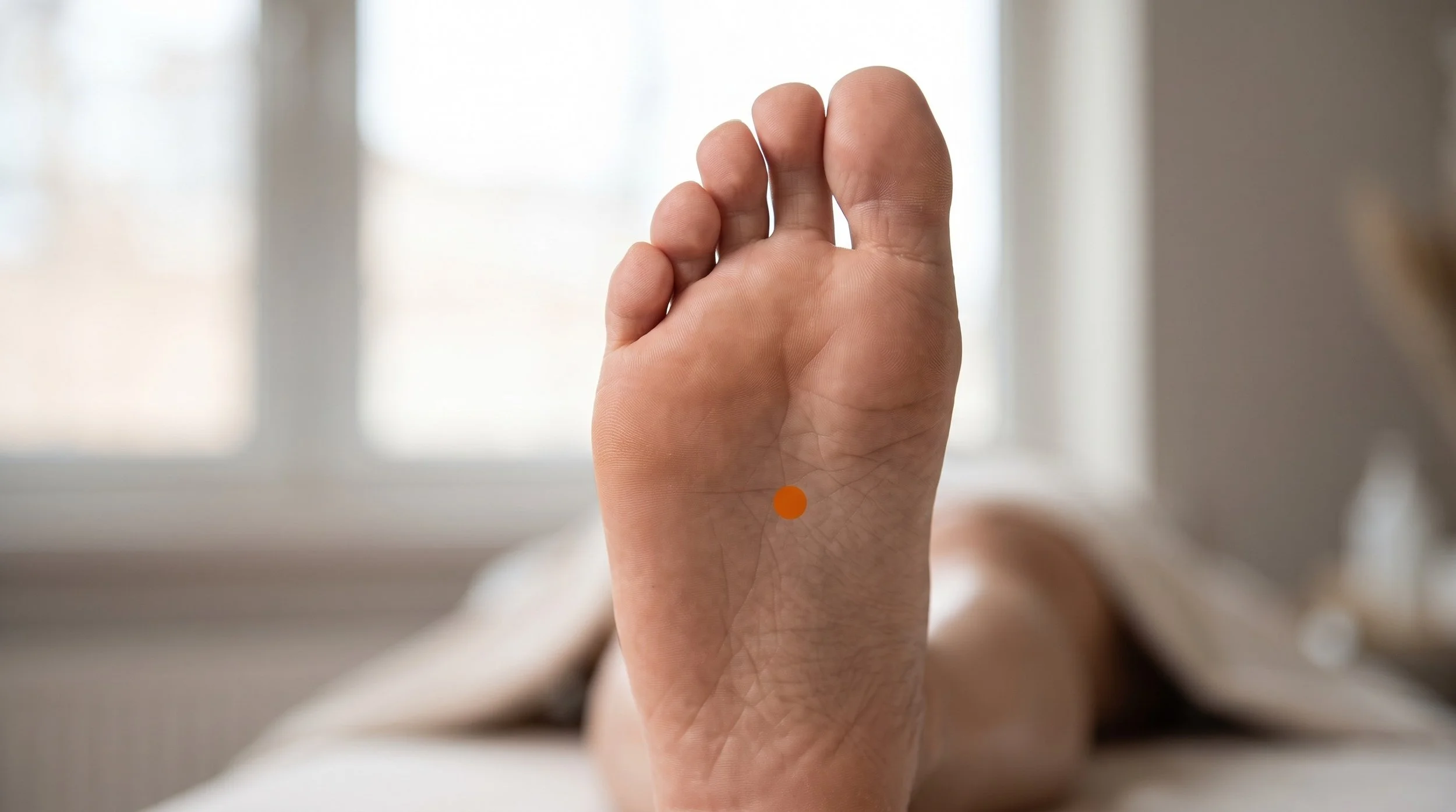
KI1 Acupuncture Point (Yongquan)
The Gushing Spring on the Sole of the Foot: Anatomy, Mechanism, and Why the Lowest Point on the Body Anchors Sleep, Headache, and Foot Pain Treatment
KI1 (Yongquan, often written yong quan and translated as Gushing Spring or Bubbling Spring) is the first point of the Kidney channel and the only channel point on the sole of the foot. You'll find the ki 1 point location in the hollow that appears when the toes curl down, at the junction of the front third and back two thirds of the sole, between the second and third metatarsal bones.
Because it sits at the very bottom of the body in a patch of skin that is among the most densely innervated tissue we have, kidney 1 has an outsized clinical reputation: classically it was the point reached for when symptoms felt stuck at the top (headache, dizziness, agitation, a mind that won't settle), and in modern practice it doubles as a local point for plantar foot pain. The ki1 acupuncture point is also one of the most intensely sensitive points on the body, which shapes how carefully it gets used.
- KI1 sits on the sole between the second and third metatarsals, passing through thick glabrous skin and the fibrofatty heel-to-forefoot padding, then the central band of the plantar aponeurosis, flexor digitorum brevis, and deeper layers including quadratus plantae and the oblique head of adductor hallucis. A cadaveric dissection study mapping the point through the four plantar layers found it lies adjacent to both the medial and lateral plantar nerves, with small differences in position between male and female feet (Kim et al., 2024).
- Traditionally KI1 is classified as the jing-well point and the wood point of the Kidney channel, and its classical actions are described as descending excess from the head, calming the spirit, and reviving consciousness (Deadman et al., 2007). Read neurophysiologically, those categories describe a very strong distal afferent input used to modulate symptoms felt far from the foot.
- The nerve story is straightforward: the tibial nerve divides into the medial and lateral plantar nerves, which carry sole afferents into the S1 and S2 spinal segments. Needling here produces a large, salient volley into the dorsal horn, and experimental work links that kind of input to activation of descending pain-modulating pathways from the midbrain and brainstem (Zhao, 2008).
- Research on KI1 specifically is limited but interesting. A small positron emission tomography study in patients with disorders of consciousness reported greater neuronal activation with needling at Yongquan than at sham locations, involving subcortical and cortical regions (Zhang et al., 2014), while the anatomical work suggests stimulation reaches muscle spindles and nerve fibers relevant to balance and upright stance (Kim et al., 2024).
- For sleep, the honest evidence picture is mixed: a Cochrane review concluded the trial evidence was not rigorous enough to support or refute acupuncture for insomnia (Cheuk et al., 2012), while later meta-analyses of acupressure report modest improvements in sleep quality scores (Waits et al., 2018). Reviews test whole protocols, not KI1 alone.
- De qi at KI1 is distinctive and usually strong: a sharp initial sensation followed by a deep, spreading ache through the arch, sometimes with a brief electric quality traveling toward the toes or up the leg. Most clinicians use gentle technique, fewer needles, or acupressure and moxibustion here precisely because the point is so responsive.
Wired, Tired, and Unable to Switch Off at Night?
Many of our NYC patients describe the same pattern: exhausted body, overactive head, and a brain that starts negotiating with the ceiling at 2am. Morningside Acupuncture uses KI1 as a grounding anchor in calming treatments, usually paired with points at the wrist, lower leg, and scalp so the input is distributed rather than concentrated. Treatment plans also address the daytime drivers of poor sleep, from stress load to unresolved pain. Schedule a visit and let's build a protocol around your sleep pattern, not a generic one.
Schedule NowAnatomy of KI1: Why the Sole of the Foot Is Such an Important Location
The sole is built for load, and KI1 sits in the middle of that load path. From the surface down, a needle at this point passes through thick glabrous skin, a fibrofatty cushioning layer, the central band of the plantar aponeurosis, and then flexor digitorum brevis, the broad second-layer muscle that flexes the lesser toes. Deeper still lie quadratus plantae, the lumbricals, and in the third layer the oblique head of adductor hallucis, along with the interossei sitting between the second and third metatarsal shafts (Kim et al., 2024).
Every step you take tensions this stack: the plantar fascia stiffens as the toes extend at push-off, the intrinsic muscles stabilize the arch, and long hours of standing, running on hard surfaces, or wearing unsupportive shoes concentrate stress exactly where this point is located.
The nerve geography explains most of what KI1 does. The tibial nerve splits behind the medial malleolus into the medial and lateral plantar nerves, and a cadaveric study that dissected the point layer by layer found KI1 positioned adjacent to branches of both, with the lateral plantar nerve entering the oblique head of adductor hallucis nearby (Kim et al., 2024). Those afferents enter the cord at roughly the S1 and S2 segments, converging with input from the calf, posterior thigh, and pelvic floor region.
Sole skin is also exceptionally rich in mechanoreceptors and nociceptors because it serves balance and protective reflexes, so needling here generates a large, unmistakable afferent signal. That signal is thought to engage descending inhibitory pathways running from the midbrain periaqueductal gray and rostral ventromedial medulla back down to the dorsal horn, which is one plausible route by which a foot point may influence pain reported elsewhere in the body (Zhao, 2008).
Deep to the muscular layers run the deep plantar arch and the plantar metatarsal arteries, which is the main reason needling conventions here favor control over depth. Standard texts describe perpendicular insertion of 0.5 to 1 cun (Deadman et al., 2007), while other references list a shallower 0.3 to 0.5 cun (Kim, 2004), and in practice depth is usually dictated by patient tolerance long before it is dictated by anatomy. Clean technique matters on the foot, and we avoid needling this point in anyone with impaired plantar sensation, active infection, open lesions, or significant peripheral vascular disease. Because the sensation can be intense enough to trigger a vasovagal response, KI1 is best needled with the patient lying down.
Related Flexor Digitorum Brevis Trigger Points Related Deep Intrinsic Foot Muscles Trigger PointsKI1 at a Glance: Classification, Location, and Clinical Use
| Category | Detail |
|---|---|
| Traditional Name | Yongquan (Gushing Spring, also translated Bubbling Spring); yong quan |
| Channel Classification | Kidney channel of the foot shaoyin, point 1 of 27; the lowest channel point on the body and the only one on the sole |
| Point Categories | Jing-well point of the Kidney channel; wood point in the five-shu (five transport) system, and therefore the child point of the water channel; entry point of the Kidney channel and its classical Origin, paired in the classical literature with an End at REN-23 on the throat |
| Precise Location | On the sole of the foot, in the depression that appears when the foot is plantar-flexed, at the junction of the anterior third and posterior two thirds of the sole, between the second and third metatarsal bones |
| Tissue Stimulated | Plantar skin and fibrofatty pad, central plantar aponeurosis, flexor digitorum brevis, quadratus plantae and lumbricals, oblique head of adductor hallucis and the deep intrinsic foot muscles; branches of the medial and lateral plantar nerves |
| Needle Depth / Direction | Perpendicular insertion 0.5 to 1 cun, often needled more shallowly for comfort; patient supine or prone with the foot supported |
| De Qi Sensation | Sharp on entry, then a deep spreading ache through the arch, sometimes with a brief electric sensation toward the toes or up the leg; one of the most strongly felt points on the body |
| Primary Clinical Uses | Grounding and calming, insomnia and restless sleep, headache (especially vertex and tension-type), dizziness, plantar foot and arch pain, agitation and anxiety states |
| Common Point Combinations |
|
In the classical literature summarized by Deadman, Al-Khafaji and Baker in A Manual of Acupuncture, Yongquan is the jing-well and wood point of the Kidney channel and, as the lowest point on the body, the archetypal choice for drawing symptoms downward. Traditional sources attribute to it three main actions: descending excess from the head, calming the spirit, and reviving consciousness.
Its classical indication lists are unusually broad and cluster into recognizable groups: head and sensory complaints (vertex headache, dizziness, blurred vision, nosebleed), spirit and emotional disorders (agitation, insomnia, poor memory, fearfulness, and at the extreme, mania), throat and voice problems (painful swallowing, dryness, loss of voice), breathing and cough, urinary and bowel difficulty, and local foot symptoms such as heat in the soles, cold feet, chronic foot pain, and toe pain that makes standing difficult.
Classical commentary frames all of this through a single logic: when the base is depleted, symptoms surge upward, and the remedy is to treat from below. What is striking is how consistently a point on the sole of the foot was chosen to address complaints at the very top of the body, a principle of distal treatment that arrived centuries before anyone could describe a dorsal horn.
Why KI1 Is Used for Insomnia, Headaches, and a Mind That Will Not Settle
The obvious objection to needling the sole of the foot for a headache is that the foot is nowhere near the head. The segmental answer is that KI1's afferents enter the spinal cord at the S1 and S2 levels, sharing dorsal horn territory with input from the calf, posterior thigh, and pelvic region, so its most direct local effects are on the foot and lower limb. What lets a distal point influence symptoms above the neck is not a segmental relay but a systemic one: strong afferent input recruits descending modulatory circuits that adjust how readily the whole nervous system amplifies incoming signals (Zhao, 2008). This is the same mechanism that explains why hand and foot points appear in headache protocols across many needling styles.
There is also a plausible autonomic and sensory story specific to the sole. Plantar afferents feed postural, balance, and arousal-related networks, and the cadaveric mapping study concluded that needling KI1 reaches muscle spindles and nerve fibers involved in balance and bipedal stance, suggesting the stimulation may enhance sensory feedback from the foot (Kim et al., 2024).
Imaging work has looked at the point directly: a small positron emission tomography study in patients with disorders of consciousness reported stronger activation at Yongquan than at sham locations in regions including the putamen, cingulate cortex, frontal areas, and cerebellum (Zhang et al., 2014). That study is small and its population highly specific, so it should be read as a hypothesis about central responsiveness rather than proof of a clinical effect.
Clinically, we use KI1 the way the classics suggest, as a counterweight. When someone arrives with tension pressing at the top of the head, a buzzing mind, cold hands, and shallow breathing, treatment that clusters needles around the head and shoulders can sometimes leave them feeling more keyed up. Adding a distal, strongly felt point at the sole gives the nervous system somewhere else to go, and patients frequently report a heavy, settled feeling within a few minutes. That subjective shift is not a substitute for evidence, but it is consistent, reproducible, and clinically useful.
What the Research Shows for KI1
Research relevant to KI1 comes in three flavors, and none of them isolates the point. Clinical reviews test multi-point protocols in which KI1 may or may not appear, so their findings speak to acupuncture as a treatment package rather than to this point's individual contribution. Anatomical and imaging studies do examine the point directly, but they describe structures and brain responses rather than patient outcomes. And for foot pain, the most relevant literature evaluates needling of the plantar region broadly, including dry needling of local muscles, which overlaps with KI1's territory without naming it. With those limits in mind, here is the current picture.
| Study | Type | Focus | Key Finding |
|---|---|---|---|
| Cheuk et al., 2012 | Cochrane systematic review | Acupuncture for insomnia | The review concluded that the available trial evidence was not rigorous enough to either support or refute acupuncture for insomnia, and called for larger high-quality trials. |
| Waits et al., 2018 | Systematic review and meta-analysis | Acupressure and sleep quality | Pooled results from randomized trials suggested acupressure may improve sleep quality scores compared with standard and sham treatment, though heterogeneity between studies was substantial. |
| Lai et al., 2017 | Randomized controlled trial | Acupressure including Yongquan in institutionalized older adults | Participants receiving acupressure at a point set that included Yongquan showed better sleep quality and quality of life scores than a sham-location control group. |
| Kim et al., 2024 | Cadaveric anatomical study | Structures underlying the KI1 acupoint | Dissection through the four plantar layers placed KI1 adjacent to medial and lateral plantar nerve branches and suggested needling reaches muscle spindles relevant to balance. |
| Zhang et al., 2014 | Positron emission tomography study | Neuronal activation with needling at KI1 versus sham points | In a small sample of patients with disorders of consciousness, needling at Yongquan produced greater activation in several cortical and subcortical regions than sham needling. |
| Clark & Tighe, 2012 | Systematic review | Acupuncture for plantar heel pain | The review found tentative support for acupuncture in plantar heel pain but flagged wide variation in protocols and reporting quality across the included trials. |
| Llurda-Almuzara et al., 2021 | Systematic review and meta-analysis | Dry needling for plantar heel pain | Pooled data suggested dry needling may reduce pain and improve function in plantar heel pain, with the authors noting a limited number of trials and variable methodology. |
| Vickers et al., 2018 | Individual patient data meta-analysis | Acupuncture for chronic pain across conditions | Acupuncture was associated with modest but statistically significant benefits over both sham and no-acupuncture controls, with effects persisting over twelve months. |
The Kidney 1 Pressure Point for Sleep and Grounding: How Yongquan Became a Bedtime Ritual
Of all the ways this point gets used, the most widely practiced is not needling at all. The kidney 1 pressure point is a staple of self-care: firm thumb pressure or slow circular massage into the hollow of each sole before bed, often after a warm foot soak. Classical sources recommended exactly this for restless sleep, framing it as drawing overactive energy back down to the base.
In plain terms, you're applying sustained pressure to one of the most richly innervated skin regions on the body while lying still in a dim room, which is a reasonable way to shift attention out of your head and into your body.
The research on the yongquan point for sleep is encouraging but not definitive. A meta-analysis of acupressure trials found improvements in sleep quality scores relative to standard and sham treatment, with considerable variability between studies (Waits et al., 2018), and a randomized trial in institutionalized older adults using a point set that included Yongquan reported better sleep and quality of life outcomes than sham-location massage (Lai et al., 2017).
At the needling level, the Cochrane review of acupuncture for insomnia stopped short of a verdict, concluding the evidence base was not strong enough to draw firm conclusions (Cheuk et al., 2012). Our reading is that self-applied pressure at kidney 1 is low-risk, occasionally quite helpful, and best treated as one piece of a broader sleep strategy.
In clinic, we tend to combine the point with a sleep history rather than substituting for one. If a patient's insomnia is driven by pain, reflux, sleep apnea, a stimulant habit, or an anxiety pattern that needs proper attention, no amount of pressing on the sole will fix it. What KI1 does well is give the wind-down routine a physical anchor, and it pairs naturally with acupuncture sessions aimed at the same goal.
Heel and Arch Pain That Bites on the First Steps of the Morning?
Plantar foot pain rarely lives in one tissue, which is why we assess the plantar fascia, the intrinsic foot muscles, and the deep calf muscles that refer pain into the sole. KI1 sits right in that territory, and we combine careful needling of the point with dry needling of flexor digitorum brevis, quadratus plantae, and tibialis posterior when the exam points there. Loading strategy, footwear, and calf mobility get addressed in the same visit. Book an evaluation and start working on the actual driver of your heel pain.
Schedule NowKI1 in the Context of Trigger Point Work
KI1 sits directly over territory that myofascial pain literature treats as clinically important. The point overlies the central plantar aponeurosis and flexor digitorum brevis, with quadratus plantae and the oblique head of adductor hallucis in the deeper layers (Kim et al., 2024). Trigger points in these intrinsic foot muscles refer pain into the sole and toes, and referral from the deeper calf compartment can land in the same region, which is why a patient's arch pain is not always an arch problem (Simons et al., 1999).
At Morningside we sort this out on the table: palpation of the plantar surface, the medial calcaneal region, and the posterior compartment usually clarifies whether the pain generator is local fascia, intrinsic muscle, or a referral from above.
When needling is indicated, we treat the point and the muscles as a coordinated set rather than choosing one framework over the other. That might mean gentle needling at KI1 with KI3 at the medial ankle for the channel-based part of the treatment, plus dry needling of flexor digitorum brevis, the deep intrinsic foot muscles, flexor digitorum longus, or tibialis posterior depending on what reproduces the pain.
Systematic review data suggest dry needling may help plantar heel pain, with the caveat that the trial base is small (Llurda-Almuzara et al., 2021), and reviews of acupuncture for the same condition reach similarly cautious conclusions (Clark & Tighe, 2012). Because the sole tolerates needling less comfortably than most areas, we frequently use fewer needles here and add manual therapy, loading exercises, and footwear changes to carry the rest of the work.
KI1 Insomnia and Foot Pain Treatment at NYC's Highest-Rated Acupuncture Clinic
Morningside Acupuncture is the highest-rated acupuncture and dry needling clinic in New York City with over 500 five-star Google reviews, and our approach blends classical point selection with modern pain science. We use KI1 thoughtfully, matching needle depth and stimulation to how sensitive your feet are, and we always explain what we're doing and why. Whether your concern is sleep, tension headaches, anxiety, or stubborn arch pain, you'll get a plan with clear milestones. Schedule your appointment and see what a precise, well-reasoned treatment feels like.
Schedule NowFrequently Asked Questions
What does KI1 feel like when needled?
Intense, and there's no getting around it. The sole has thick, densely innervated skin, so insertion is usually sharp for a moment, followed by a deep ache that spreads through the arch and sometimes a brief electric sensation traveling toward the toes or up the back of the leg. Most patients describe a heavy, grounded feeling afterward, and many say the sensation was strong but oddly satisfying. Because the point is so responsive, we use shallow insertion and minimal manipulation, and we always tell you before we needle it.
Why would a point on the sole of the foot help a headache or insomnia?
Two reasons, one traditional and one physiological. Classically, KI1 is the lowest point on the body and was selected precisely to treat symptoms felt at the top, following the principle of needling below to influence above (Deadman et al., 2007). Physiologically, a distal point with very dense innervation produces a strong afferent input that appears to engage descending pain-modulating pathways from the midbrain and brainstem, which can influence how the nervous system processes signals from anywhere in the body (Zhao, 2008). Neither explanation guarantees an effect for a given person, but together they explain why foot points show up in headache and sleep protocols across many needling styles.
Can I press KI1 myself between sessions?
Yes, and it's one of the more practical self-care points. Sit down, cross one ankle over the opposite knee, and find the depression that appears in the front third of the sole when you curl your toes down, roughly between the second and third toe lines. Press with your thumb, knuckle, or a small massage ball using steady, firm pressure for 1 to 3 minutes per foot, or use slow circles at the same intensity. Doing this after a warm foot soak, at the start of your bedtime routine, suits the point's traditional use for restless sleep. Keep the pressure firm but not painful, and skip it if you have reduced sensation in your feet, open skin, active infection, or known circulation problems.
Is KI1 safe to needle?
In trained hands, yes, with a few sensible precautions. Standard texts describe perpendicular insertion of 0.5 to 1 cun (Deadman et al., 2007), with other references using a shallower range (Kim, 2004), and depth here is generally limited by comfort well before it is limited by anatomy. The deep plantar vascular arch sits below the muscular layers, so controlled depth and clean technique matter. We avoid the point in anyone with impaired plantar sensation, peripheral neuropathy with skin compromise, significant peripheral vascular disease, or a local infection or wound, and we needle it with the patient lying down because the intensity can occasionally provoke lightheadedness. If you're pregnant, mention it at intake so your practitioner can adjust point selection and stimulation accordingly.
Where exactly is KI1 located?
On the sole of the foot, at the junction of the anterior third and posterior two thirds, between the second and third metatarsal bones. The easiest way to find the ki 1 point location is to curl your toes downward: a distinct hollow appears just behind the ball of the foot, and Yongquan sits in that depression. Measured another way, it's roughly one third of the distance from the web between the second and third toes back toward the heel. It's the only channel point on the sole, which makes it hard to confuse with anything else.
How long should I press the kidney 1 pressure point for sleep?
Try 1 to 3 minutes per foot, using thumb pressure or a small massage ball at an intensity that feels firm and satisfying rather than sharp. Do it sitting on the edge of the bed with the lights low, ideally after a warm foot soak, and finish with a minute of slow breathing. It's a nightly practice, not a one-off fix, so give it two to three weeks before judging whether it helps. Stop if you have numbness, tingling, or reduced sensation in your feet and check with your clinician first, since diminished plantar sensation needs evaluation rather than pressure.
References
- Deadman, P., Al-Khafaji, M., & Baker, K. (2009). A manual of acupuncture. Journal of Chinese Medicine Publications.
- Kim, H. (2008). Handbook of Oriental medicine (3rd ed.). Harmony & Balance Press.
- Cunningham, P. M. (2000). Acupuncture points: A practical guide to classical and modern usage. Odyssey Press.
- Simons, D. G., Travell, J. G., & Simons, L. S. (1999). Travell & Simons' myofascial pain and dysfunction: The trigger point manual, Vol. 1: Upper half of body (2nd ed.). Williams & Wilkins.
- Kim, S. H., Joung, J. Y., Lee, Y. H., & Son, C. G. (2024). Anatomical exploration of the KI1 acupoint: Implications for medial and lateral plantar nerve stimulation. Medicina, 60(4), 535. https://doi.org/10.3390/medicina60040535
- Zhang, H., Sun, X., Liu, S., Chen, Y., & Ling, F. (2014). Neuronal activation by acupuncture at Yongquan (KI1) and sham acupoints in patients with disorder of consciousness: A positron emission tomography study. Neural Regeneration Research, 9(5), 500-501. https://doi.org/10.4103/1673-5374.130070
- Cheuk, D. K. L., Yeung, W. F., Chung, K. F., & Wong, V. (2012). Acupuncture for insomnia. Cochrane Database of Systematic Reviews, 2012(9), CD005472. https://doi.org/10.1002/14651858.CD005472.pub3
- Waits, A., Tang, Y. R., Cheng, H. M., Tai, C. J., & Chien, L. Y. (2018). Acupressure effect on sleep quality: A systematic review and meta-analysis. Sleep Medicine Reviews, 37, 24-34. https://doi.org/10.1016/j.smrv.2016.12.004
- Lai, F. C., Chen, I. H., Chen, P. J., Chen, I. J., Chien, H. W., & Yuan, C. F. (2017). Acupressure, sleep, and quality of life in institutionalized older adults: A randomized controlled trial. Journal of the American Geriatrics Society, 65(5), e103-e108. https://doi.org/10.1111/jgs.14729
- Clark, R. J., & Tighe, M. (2012). The effectiveness of acupuncture for plantar heel pain: A systematic review. Acupuncture in Medicine, 30(4), 298-306. https://doi.org/10.1136/acupmed-2012-010183
- Llurda-Almuzara, L., Labata-Lezaun, N., Meca-Rivera, T., Navarro-Santana, M. J., Cleland, J. A., Fernández-de-las-Peñas, C., & Pérez-Bellmunt, A. (2021). Is dry needling effective for the management of plantar heel pain or plantar fasciitis? An updated systematic review and meta-analysis. Pain Medicine, 22(7), 1630-1641. https://doi.org/10.1093/pm/pnab114
- Zhao, Z. Q. (2008). Neural mechanism underlying acupuncture analgesia. Progress in Neurobiology, 85(4), 355-375. https://doi.org/10.1016/j.pneurobio.2008.05.004
- Vickers, A. J., Vertosick, E. A., Lewith, G., MacPherson, H., Foster, N. E., Sherman, K. J., Irnich, D., Witt, C. M., & Linde, K. (2018). Acupuncture for chronic pain: Update of an individual patient data meta-analysis. Journal of Pain, 19(5), 455-474. https://doi.org/10.1016/j.jpain.2017.11.005
Disclaimer: This web site is intended for educational and informational purposes only. Reading this website does not constitute providing medical advice or any professional services. This information should not be used for diagnosing or treating any health issue or disease. Those seeking medical advice should consult with a licensed physician. Seek the advice of a medical doctor or other qualified health professional for any medical condition. If you think you have a medical emergency, call 911 or go to the emergency room. No acupuncturist-patient relationship is created by reading this website or using the information. Morningside Acupuncture PLLC and its employees and contributors do not make any express or implied representations with respect to the information on this site or its use. For any legal interpretation of scope of practice in your state, consult a licensed attorney or regulatory authority.
Read more from our blog



