BL32 Acupuncture Point (Ciliao)
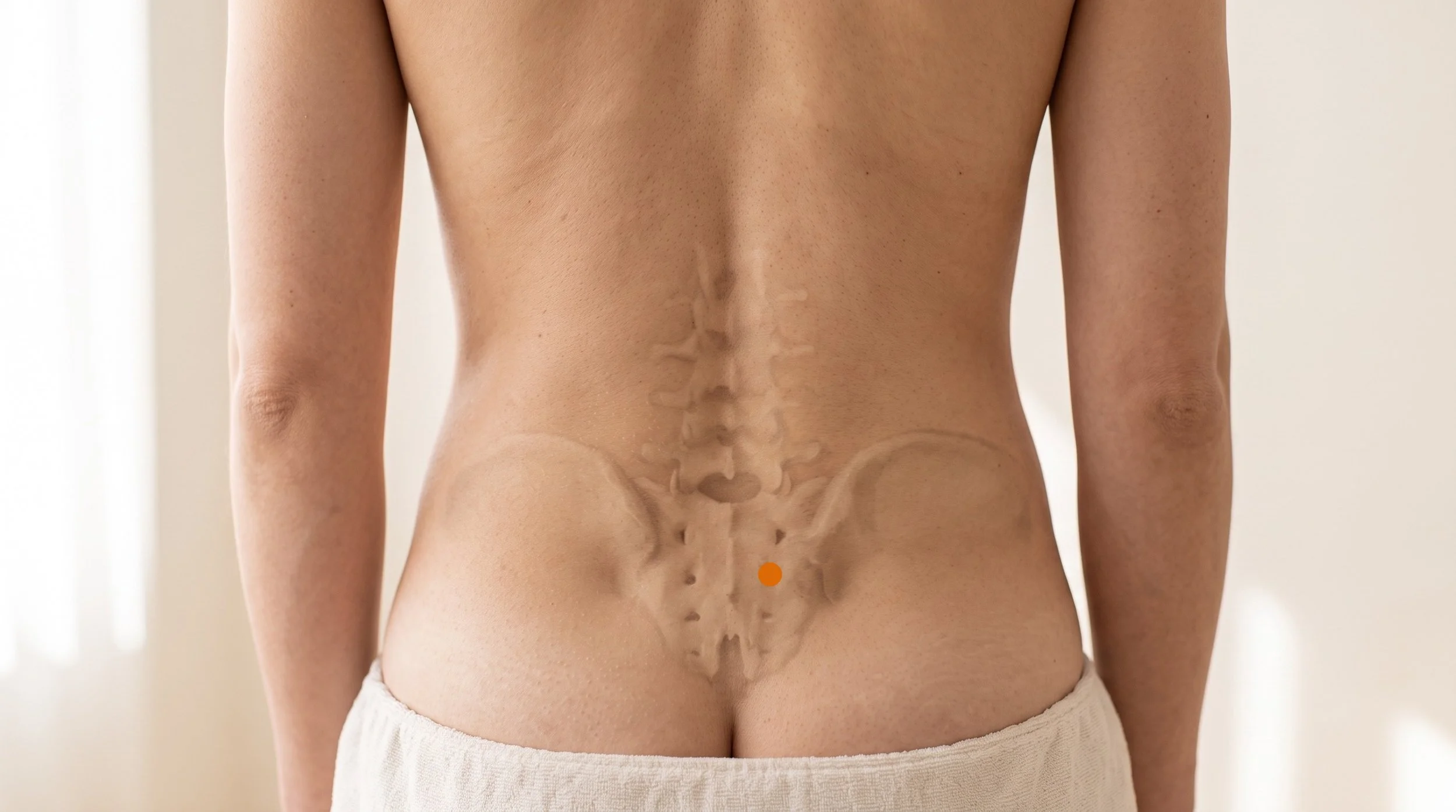
BL32 Acupuncture Point (Ciliao)
The Second Crevice on the Sacrum: Anatomy, Mechanism, and Why This Foraminal Point Anchors Modern Pelvic and Low Back Protocols
BL32, known in Chinese as Ciliao and usually translated as Second Crevice, sits directly over the second posterior sacral foramen, roughly midway between the bony bump you can feel at the top of the buttock (the posterior superior iliac spine) and the midline of the sacrum. It is the second of the four paired sacral foramen points collectively called the eight liao, and in modern practice it is the most heavily used of them.
The reason is anatomical rather than mystical: a needle placed here sits over an opening that transmits the second sacral nerve, part of the S2 to S4 outflow that supplies the bladder, the lower bowel, the uterus and the pelvic floor. That is why the bl32 acupuncture point shows up so consistently in treatment plans for menstrual cramps, urinary urgency, sacral and low back pain, and pelvic floor complaints.
- Location and layers: BL32 lies over the second posterior sacral foramen, with skin, the aponeurotic sheet of the erector spinae and the sacral multifidus above the foraminal opening. Shallow needling engages muscle and fascia, while deeper foraminal needling reaches the S2 nerve root territory (Deadman et al., 2007).
- Traditional attributions, translated: classical texts describe BL32 as regulating the lower jiao, easing urination and defecation, regulating menstruation and benefiting the lumbar region and legs (Deadman et al., 2007). In modern language, that maps onto a sacral segmental point that influences pelvic viscera, pelvic floor tone and lumbosacral pain.
- Mechanism: sacral afferents from BL32 enter the same cord segments that receive visceral input from the bladder and uterus, and needling engages spinal and supraspinal pain modulation including descending inhibitory pathways (Zhao, 2008). Animal work shows that somatic stimulation in matched segments can reflexively alter uterine blood flow, which is one plausible route for its pelvic effects (Uchida & Hotta, 2008).
- Research picture: reviews of acupuncture for period pain remain cautious about certainty of evidence (Smith et al., 2016), while meta-analysis of electroacupuncture trials suggests possible benefit for primary dysmenorrhea (Yu et al., 2017), and a small comparative trial focused specifically on Ciliao reported outcomes similar to a multi-point protocol (Zhang et al., 2016).
- Clinical framing: sacral foramen points anchor modern electroacupuncture protocols for urinary symptoms, and a large randomized trial of electroacupuncture at neighboring sacral points reported reduced urine leakage in women with stress urinary incontinence (Liu et al., 2017). BL32 is used in the same family of protocols, usually alongside abdominal, lumbar and leg points.
- De qi at BL32 is distinctive: a deep, heavy, spreading ache across the sacrum, sometimes with a warm or electrical sensation that travels toward the tailbone, the pubic area or down the back of the leg. Sensation that shoots sharply down the limb is a signal to withdraw slightly and adjust angle rather than push deeper.
Do Period Cramps Take Over Several Days Every Month?
At Morningside Acupuncture we treat menstrual pain with sacral needling at BL32 paired with points on the lower abdomen and medial leg, often with gentle electroacupuncture across the sacrum. Treatment is usually timed to begin several days before your period rather than only during the worst hours, because that pattern mirrors how the research protocols were run. We combine this with practical guidance on heat, movement and sleep so the effect carries between visits. Schedule a visit and let's build a cycle-based plan.
Schedule NowAnatomy of BL32: Why the Second Sacral Foramen Is Such an Important Location
The sacrum is a fused triangle of bone with four pairs of openings on its back surface, and BL32 sits over the second pair. From the surface inward, a needle passes through skin and subcutaneous tissue, then the tough aponeurotic sheet that the erector spinae forms as it anchors to the sacrum, then the sacral fibers of multifidus, before arriving at the mouth of the foramen itself.
This tissue stack takes a great deal of load: it stabilizes the sacroiliac joints during walking and single-leg stance, it works hard in prolonged sitting, and it is commonly tender in people with low back pain, postpartum pelvic pain, or long hours at a desk. That is why palpating for BL32 often turns up a firm, ropey, tender spot rather than an abstract point on a chart.
The nerve geography is what makes this second sacral foramen point clinically special. Superficially, the area is supplied by the dorsal ramus of the second sacral nerve. Deeper, the foramen is the gateway to the S2 nerve root, and the S2 to S4 roots carry the parasympathetic supply to the bladder, the lower bowel, the uterus and the pelvic floor musculature.
Because visceral afferents from these organs converge with somatic afferents on the same sacral segments of the spinal cord, stimulation at the body wall can influence how that segment processes both muscular and visceral input, and needling more broadly recruits spinal and brainstem pain-modulating systems including descending inhibition (Zhao, 2008). Experimental work in animals also shows that somatic stimulation delivered in matched segments can reflexively change uterine blood flow, a segmental autonomic response rather than a general one (Uchida & Hotta, 2008).
Depth conventions follow that anatomy. Standard perpendicular insertion of about 0.5 to 1 cun stays in muscle and fascia and is appropriate for most musculoskeletal complaints. Deeper needling of roughly 1.5 to 2 cun through the foramen, using a slightly medial and inferior angle to find the opening, is the technique used in pelvic and electroacupuncture protocols and belongs in trained hands only (Deadman et al., 2007). Practitioners locate the foramen by palpation first, and if the needle meets bone they withdraw slightly and re-angle rather than forcing depth.
Deep foraminal needling is avoided or modified during pregnancy unless it is part of supervised care with the referring clinician's agreement, and strong electrical stimulation over the sacrum is used cautiously in anyone with an implanted stimulator or pacemaker.
Related Acupuncture For Low Back Pain Related Multifidus Trigger PointsBL32 at a Glance: Classification, Location, and Clinical Use
| Category | Detail |
|---|---|
| Traditional Name | Ciliao (Second Crevice), the second of the four paired sacral foramen points known collectively as the eight liao or Baliao |
| Channel Classification | Bladder channel, sacral segment; part of the Baliao group (BL31 through BL34) |
| Point Categories | Meeting point of the Bladder and Gall Bladder channels (listed for the eight liao group in several sources); foraminal point over the second posterior sacral foramen; a classical moxibustion group point for the lower jiao |
| Precise Location | On the sacrum, directly over the second posterior sacral foramen, roughly midway between the posterior superior iliac spine and the midline |
| Tissue Stimulated | Skin and subcutaneous tissue, the erector spinae aponeurosis, and the sacral multifidus; with deeper foraminal insertion, the S2 nerve root territory that also relates to pelvic floor function |
| Needle Depth / Direction | Perpendicular 0.5 to 1 cun for musculoskeletal work; 1.5 to 2 cun into the foramen with a slightly medial and inferior angle for pelvic and electroacupuncture protocols, trained practitioners only |
| De Qi Sensation | Deep, heavy, spreading soreness across the sacrum, sometimes warm or mildly electrical, occasionally radiating toward the tailbone, pubic region or the back of the thigh |
| Primary Clinical Uses | Menstrual cramps and pelvic pain, urinary urgency and retention-pattern symptoms, low back and sacral pain, sciatic-type leg pain, pelvic floor dysfunction in modern practice |
| Common Point Combinations |
|
Deadman's A Manual of Acupuncture presents BL32 as part of the eight liao, four pairs of points over the sacral foramina that share a common territory: disorders of the lower body cavity. Within that group, the traditional attributions place BL32 and its neighbor BL33 as the strongest for urinary complaints, while BL34 carries the widest bowel and genital indications, and BL32 and BL33 are also credited with the greatest effect on sacral pain, leg pain and numbness.
The classical indication lists for BL32 fall into three recognizable clusters: urinary and bowel difficulty, gynecological complaints including painful and irregular periods, vaginal discharge, difficulty conceiving and back pain during labor, and lumbosacral and leg pain including cold, numb or heavy sensations reaching the feet. The commentary also notes Sun Si-miao's recommendation in the Thousand Ducat Formulas to moxa all eight liao for difficult urination and defecation, and observes that BL32 is the most commonly used of the four in clinical practice, frequently with electroacupuncture.
What is striking is how tightly that traditional pattern tracks the S2 to S4 nerve supply, a correspondence the classical authors described without any way of seeing it.
Why BL32 Is Used for Bladder Symptoms and Pelvic Floor Complaints, Not Just Back Pain
Most people expect a point on the sacrum to be a back pain point, and it is. What surprises them is that the same location is a first-choice option for urinary urgency, incomplete emptying, period pain and pelvic floor tightness. The explanation is segmental. The bladder, the lower bowel, the uterus and the pelvic floor muscles all share nerve supply with the S2 to S4 spinal segments, and the second posterior sacral foramen is essentially a doorway to that neighborhood.
Sensory input from the body wall and from the pelvic organs converges on the same pool of spinal neurons, so a needle at BL32 is talking to a circuit that is already listening to the pelvis. This is also why sacral pain and pelvic symptoms so often show up together in the same patient.
Beyond the segment, needling recruits broader pain control machinery. Stimulation activates spinal and supraspinal pathways that release endogenous opioids, serotonin and noradrenaline and dampen incoming nociceptive signaling, which is the best-supported explanation for acupuncture analgesia (Zhao, 2008).
There is also an autonomic and vascular story: experimental studies show that somatic stimulation in segments matched to the pelvic organs can reflexively alter uterine blood flow, whereas stimulation in unmatched segments does not produce the same response (Uchida & Hotta, 2008). That segment-specific pattern fits how BL32 is used clinically, and it is a more useful model than any notion of energy being pushed along a line.
Clinically, this shows up as combined effects. A patient treated at BL32 for deep sacral pain may notice that cramping eases, that urgency settles, or that the pelvic floor relaxes enough for stretching and breathing work to take hold. None of that is guaranteed, and BL32 is not a stand-alone answer for any of these conditions, but it explains why one point earns a place in protocols that look, on the surface, unrelated to each other.
What the Research Shows for BL32
A note on what the evidence can and cannot tell us. Almost every trial and review below tested a multi-point protocol, not BL32 alone, so the honest claim is that BL32 is a consistent component of protocols that have been studied, not that this single point has been isolated and proven. Certainty of evidence in this area is often low, sham comparisons in pelvic and sacral studies are difficult to design, and results vary with dose, timing and whether electroacupuncture was used. With that framing, the studies below give a reasonable picture of where BL32 sits.
| Study | Type | Focus | Key Finding |
|---|---|---|---|
| Smith et al., 2016 | Cochrane systematic review | Acupuncture and acupressure for primary dysmenorrhea | The review concluded there was insufficient evidence to determine whether acupuncture or acupressure are effective for primary period pain, with limited adverse event reporting. |
| Yu et al., 2017 | Systematic review and meta-analysis | Electroacupuncture for primary dysmenorrhea across randomized trials | Pooled results suggested possible benefit from electroacupuncture for menstrual pain, though the authors noted the underlying trials varied in quality. |
| Zhang et al., 2016 | Comparative clinical trial | Acupuncture and moxibustion at Ciliao (BL32) alone versus a routine multi-point protocol for cold-damp pattern period pain | Treating BL32 alone produced results broadly comparable to the larger protocol in this small study, using fewer points. |
| Liu et al., 2017 | Multicenter randomized clinical trial (JAMA) | Electroacupuncture at sacral points for women with stress urinary incontinence | Electroacupuncture at sacral foramen-region points reduced urine leakage compared with sham over six weeks, supporting the sacral approach that BL32 belongs to. |
| Rizzo et al., 2025 | Cochrane overview of systematic reviews | Non-pharmacological and non-surgical treatments for low back pain | Acupuncture is among the non-drug options with supportive evidence for chronic low back pain, though effect sizes are modest and certainty varies. |
| Smith et al., 2020 | Cochrane systematic review | Acupuncture or acupressure for pain management during labour | Acupuncture may increase satisfaction with pain management and reduce use of pharmacological analgesia compared with sham, with low certainty evidence overall. |
| Uchida & Hotta, 2008 | Review of experimental physiology studies | Somato-autonomic reflex effects of acupuncture-like stimulation on regional blood flow | Uterine blood flow responses behaved as segmental reflexes, which offers a plausible physiological route for sacral points such as BL32. |
| Zhao, 2008 | Narrative review of neurophysiology | Neural mechanisms of acupuncture analgesia | Analgesic effects are attributed to spinal and supraspinal modulation involving endogenous opioids and monoamine pathways rather than to any tissue-specific channel. |
Sacral Pain, Urinary Urgency, or Pelvic Floor Tension?
BL32 is one of our most-used points when low back pain sits low and central, when the sacroiliac area feels deep and achy, or when bladder urgency and pelvic floor tightness travel together. We combine careful foraminal needling with dry needling of the sacral multifidus and gluteal muscles, plus breathing and loading strategies that pelvic floor patients often have never been shown. Our practitioners explain every step before the needle goes in. Book an appointment to get a clear plan for your pelvis and low back.
Schedule NowBL32 in the Context of Trigger Point Work
The tissue sitting over the second sacral foramen is the same tissue that dry needling targets in patients with deep, hard-to-localize low back pain. The sacral fibers of multifidus, the erector spinae attachment onto the sacrum, and the upper fibers of gluteus maximus all overlap the BL32 region, and taut bands in these muscles can refer pain into the sacroiliac area, the buttock and occasionally the back of the thigh in patterns documented in the myofascial literature (Simons et al., 1999).
Because acupuncture is defined by the use of an acupuncture needle rather than by the tradition guiding it, needling at BL32 and dry needling the sacral multifidus are the same tool applied with two different reasoning systems, and they frequently land in the same square inch of tissue.
At Morningside we usually treat the region layered. Shallow needling at BL32 and adjacent eight liao points addresses the local muscular and fascial layer, dry needling of the sacral multifidus and gluteal trigger points addresses referred pain and guarding, and where indicated deeper foraminal technique or electroacupuncture across the sacral pair addresses the segmental pelvic component.
For patients with pelvic floor symptoms, this external work is often paired with internal or external pelvic floor strategies from their physical therapist, since sacral needling may reduce protective tone and make loading and breathing work easier to progress.
BL32 Pelvic and Low Back Pain Treatment at NYC's Highest-Rated Acupuncture Clinic
Morningside Acupuncture is the highest-rated acupuncture and dry needling clinic in New York City with over 500 five-star Google reviews, and our practitioners are licensed acupuncturists who are also certified in myofascial trigger point work. We use BL32 as part of a whole-plan approach that includes sacral and lumbar needling, targeted dry needling, and home strategies you can actually repeat. Sessions are unhurried, hands-on and built around your symptoms rather than a template. Schedule your appointment and start treatment this week.
Schedule NowFrequently Asked Questions
What does BL32 feel like when needled?
Most people describe a deep, heavy, spreading ache across the sacrum, sometimes with a sense of warmth or a mild electrical quality. With deeper foraminal technique, the sensation can travel toward the tailbone, the pubic area, the perineum or down the back of the leg, and many patients find it oddly satisfying rather than sharp. Sensation that shoots hard down the limb or feels like a jolt is a cue for the practitioner to withdraw slightly and change angle. A dull soreness in the sacral area for a day afterward is common and settles quickly.
Why treat the sacrum for period pain instead of the lower abdomen?
Both are used, and they are often combined as a front-and-back pairing. The sacral approach works because the uterus, bladder and pelvic floor share nerve supply with the S2 to S4 spinal segments, and BL32 sits directly over that territory, so input there reaches the same spinal circuits that process pelvic sensation (Uchida & Hotta, 2008). Traditional texts arrived at the same conclusion from a different direction, listing BL32 among the strongest points for painful periods that radiate into the sacrum (Deadman et al., 2007). In practice, needling the sacrum also lets us treat the low back pain that so often accompanies cramping.
Can I press BL32 myself between sessions?
Yes, and it is one of the easier points to self-treat because you can reach it lying down or sitting. Find the bony bump at the top of each buttock (the posterior superior iliac spine), then move about halfway toward the midline and slightly downward until you feel a small depression or a tender, firm spot. Press with your thumbs, knuckles or a small ball against a wall, using firm but tolerable pressure for 30 to 60 seconds per side, then release and repeat two or three times. You can do this once or twice a day, and lying on two tennis balls placed either side of the midline works well for tight sacral muscles. A heating pad over the same area for 15 to 20 minutes is a reasonable addition for cramping or cold, achy low back pain. Stop if pressure produces sharp pain, numbness or leg symptoms, and check with your clinician first if you are pregnant.
Is BL32 safe to needle?
In trained hands it has a good safety profile. Shallow needling stays in muscle and fascia over solid bone, which makes it a low-risk location, and the main practical cautions are ordinary ones: clean technique, avoiding needling over broken or infected skin, and care in people on anticoagulants or with bleeding disorders. Deep foraminal insertion of 1.5 to 2 cun is a technique for experienced practitioners because it passes through the sacral opening toward the S2 nerve root region, and it should never be forced against bone. Deep sacral needling and strong electroacupuncture are avoided or modified in pregnancy unless the treatment is part of supervised care coordinated with your obstetric provider, and electrical stimulation over the sacrum is used cautiously in anyone with an implanted device.
Where exactly is BL32 located?
BL32, or Bladder 32, is on the sacrum over the second posterior sacral foramen, approximately midway between the posterior superior iliac spine and the midline of the sacrum, one on each side. A practical way to find the bl 32 sacral area is to locate the two bony bumps at the top of the buttocks, slide inward and slightly down, and feel for a small dip where the tissue gives slightly under the fingertip. It usually feels tender or dense compared with the surrounding bone. Practitioners palpate for the foramen before inserting, since sacral shape and foramen position vary noticeably between individuals.
References
- Deadman, P., Al-Khafaji, M., & Baker, K. (2009). A manual of acupuncture. Journal of Chinese Medicine Publications.
- Cunningham, P. M. (2000). Acupuncture points: A practical guide to classical and modern usage. Odyssey Press.
- Simons, D. G., Travell, J. G., & Simons, L. S. (1999). Travell & Simons' myofascial pain and dysfunction: The trigger point manual, Vol. 1: Upper half of body (2nd ed.). Williams & Wilkins.
- Smith, C. A., Armour, M., Zhu, X., Li, X., Lu, Z. Y., & Song, J. (2016). Acupuncture for dysmenorrhoea. Cochrane Database of Systematic Reviews, 2016(4), CD007854. https://doi.org/10.1002/14651858.CD007854.pub3 [VERIFY BEFORE PUBLISHING]
- Yu, S. Y., Lv, Z. T., Zhang, Q., Yang, S., Wu, X., Hu, Y. P., Zeng, F., Liang, F. R., & Yang, J. (2017). Electroacupuncture is beneficial for primary dysmenorrhea: The evidence from meta-analysis of randomized controlled trials. Evidence-Based Complementary and Alternative Medicine, 2017, 1791258. https://doi.org/10.1155/2017/1791258
- Zhang, M., Guang, X. L., & Liu, J. C. (2016). Efficacy observation on acupuncture-moxibustion at Ciliao (BL 32) for primary dysmenorrhea due to cold-dampness. Journal of Acupuncture and Tuina Science, 14(2), 122-125. https://doi.org/10.1007/s11726-016-0911-9
- Liu, Z., Liu, Y., Xu, H., He, L., Chen, Y., Fu, L., Li, N., Lu, Y., Su, T., Sun, J., Wang, J., Yue, Z., Zhang, W., Zhao, J., Zhou, Z., Wu, J., Zhou, K., Ai, Y., Zhou, J., ... Liu, B. (2017). Effect of electroacupuncture on urinary leakage among women with stress urinary incontinence: A randomized clinical trial. JAMA, 317(24), 2493-2501. https://doi.org/10.1001/jama.2017.7220
- Rizzo, R. R. N., Cashin, A. G., Wand, B. M., Ferraro, M. C., Sharma, S., Lee, H., O'Hagan, E., Maher, C. G., Furlan, A. D., van Tulder, M. W., & McAuley, J. H. (2025). Non-pharmacological and non-surgical treatments for low back pain in adults: An overview of Cochrane reviews. Cochrane Database of Systematic Reviews, 2025(3), CD014691. https://doi.org/10.1002/14651858.CD014691.pub2
- Smith, C. A., Collins, C. T., Levett, K. M., Armour, M., Dahlen, H. G., Tan, A. L., & Mesgarpour, B. (2020). Acupuncture or acupressure for pain management during labour. Cochrane Database of Systematic Reviews, 2020(2), CD009232. https://doi.org/10.1002/14651858.CD009232.pub2
- Uchida, S., & Hotta, H. (2008). Acupuncture affects regional blood flow in various organs. Evidence-Based Complementary and Alternative Medicine, 5(2), 145-151. https://doi.org/10.1093/ecam/nem051 [VERIFY BEFORE PUBLISHING]
- Zhao, Z. Q. (2008). Neural mechanism underlying acupuncture analgesia. Progress in Neurobiology, 85(4), 355-375. https://doi.org/10.1016/j.pneurobio.2008.05.004
Disclaimer: This web site is intended for educational and informational purposes only. Reading this website does not constitute providing medical advice or any professional services. This information should not be used for diagnosing or treating any health issue or disease. Those seeking medical advice should consult with a licensed physician. Seek the advice of a medical doctor or other qualified health professional for any medical condition. If you think you have a medical emergency, call 911 or go to the emergency room. No acupuncturist-patient relationship is created by reading this website or using the information. Morningside Acupuncture PLLC and its employees and contributors do not make any express or implied representations with respect to the information on this site or its use. For any legal interpretation of scope of practice in your state, consult a licensed attorney or regulatory authority.
Read more from our blog