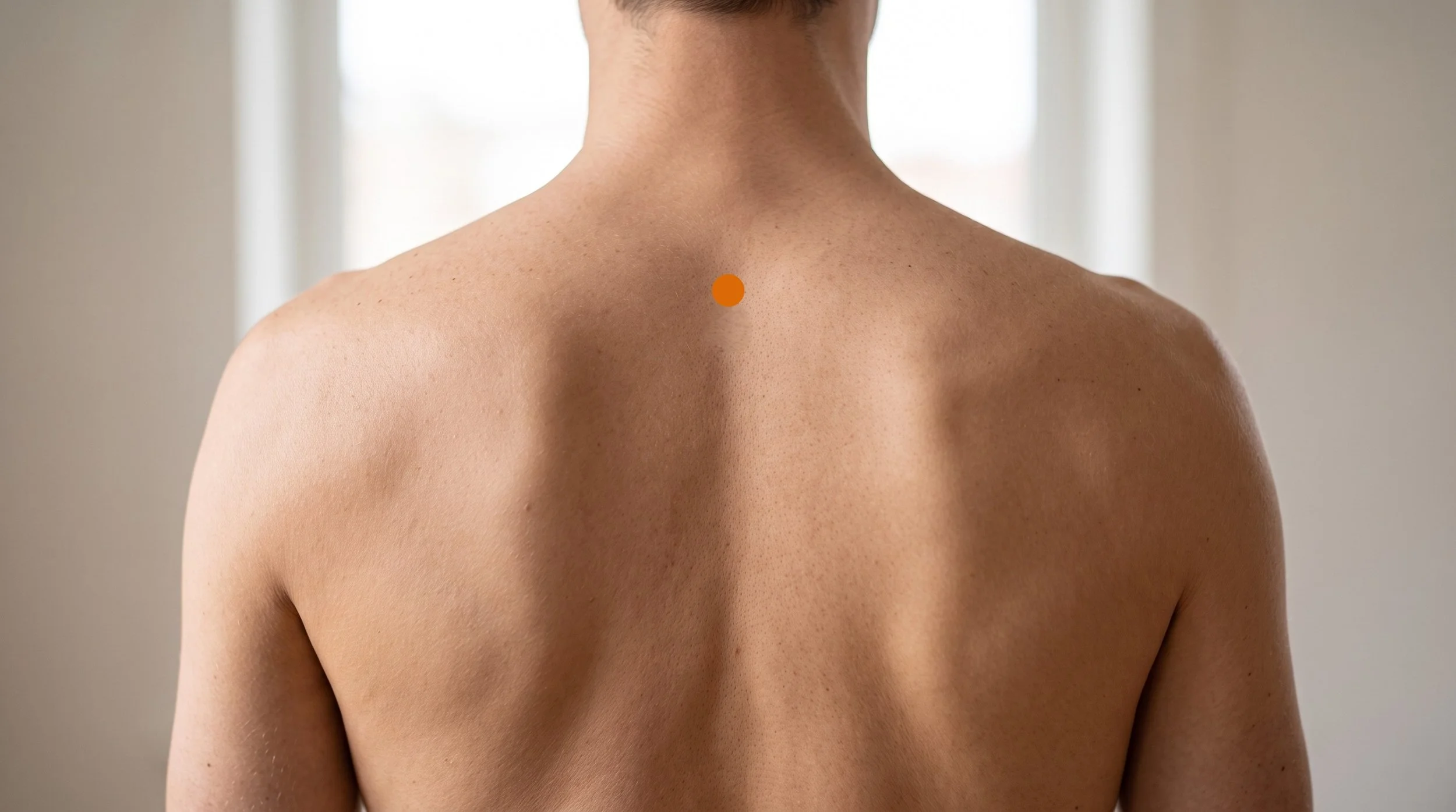
DU13 Acupuncture Point (Taodao)
The Way of Happiness Below the First Thoracic Vertebra: Anatomy, Mechanism, and Why This Cervicothoracic Point Supports Upper Back and Headache Treatment
DU13 (Taodao), also written GV13, often translated as Way of Happiness and rendered in other texts as Kiln Path, is the Governing Vessel point that sits on the midline of the upper back in the small depression just below the spinous process of the first thoracic vertebra, one intervertebral space below C7 and one space below its better known neighbor DU14. In classical sources it is listed as a meeting point of the Governing vessel with the Bladder channel, and it was traditionally used for stiffness of the spine, heaviness of the head, feverish patterns including malaria, and states of restlessness or low mood.
For modern patients the appeal is more practical: the GV13 acupuncture point sits directly over the cervicothoracic junction, the hinge where a mobile neck meets a stiff thoracic cage, and that is precisely where desk posture, laptop work, and long commutes concentrate load.
- Taodao point location is straightforward once C7 is identified: find the most prominent spinous process at the base of the neck, drop one interspace, and needle the depression below the T1 spinous process, level with BL11 on either side. The layers under the needle are skin, superficial fascia, the supraspinous and interspinous ligaments, and the medial attachments of trapezius.
- Traditional sources categorize governing vessel 13 as a crossing point of the Governing vessel and the Bladder channel with actions described as clearing heat and regulating the Governing vessel (Deadman et al., 2009). Read neurophysiologically, those descriptions map onto a segmental point that influences paraspinal muscle tone, upper thoracic autonomic outflow, and pain processing at the T1 and T2 levels.
- Needling here recruits A delta and group III afferents in skin, ligament, and muscle whose input converges in the upper thoracic dorsal horn and engages descending inhibitory pathways involving the periaqueductal gray, rostral ventromedial medulla, and endogenous opioid systems (Zhao, 2008). That is the plausible reason a midline point can influence sensations felt across the shoulders and up into the head.
- Research does not test DU13 in isolation. Cochrane reviews of acupuncture for neck disorders and for tension type headache prevention report modest benefits with low to moderate certainty (Trinh et al., 2016; Linde et al., 2016), and individual patient data from chronic pain trials suggest effects that are real but moderate and that persist reasonably well over time (Vickers et al., 2018).
- Depth discipline matters more than needle count at this location. The spinal canal lies roughly 1.25 to 1.75 cun from the skin depending on build, so the conventional technique is an oblique upward insertion of about 0.5 to 1 cun, and imaging based reviews confirm that safe depths vary substantially between individuals (Chou et al., 2011).
- De qi at DU13 is usually described as a deep, dull, slightly heavy pressure right on the midline, sometimes spreading sideways between the shoulder blades or upward toward the base of the skull. It should never feel electric or shooting, and a sharp radiating sensation is a signal to withdraw and redirect.
Stiff Upper Back and Neck From Desk Work?
The cervicothoracic junction takes the brunt of long hours at a keyboard, and DU13 sits right on top of it. At Morningside Acupuncture we combine gentle midline needling at DU13 and DU14 with dry needling of the upper trapezius, levator scapulae, and rhomboids, then add movement and postural coaching so the change holds between visits. Most patients notice easier neck rotation and less end of day heaviness within a few sessions. Schedule an evaluation and we will map exactly where your pattern is loading.
Schedule NowAnatomy of DU13: Why the Cervicothoracic Junction Is Such an Important Location
DU13 sits on the posterior midline in the interspinous depression below the T1 spinous process. From the surface down, the needle passes through thin skin and superficial fascia, then into the supraspinous ligament, and then toward the interspinous ligament between T1 and T2. On either side, the medial fibers of trapezius and the rhomboid minor attach to the upper thoracic spinous processes and the nuchal ligament, and deeper still lie the transversospinalis muscles, including multifidus and the semispinalis group, which act as fine postural stabilizers rather than prime movers.
This is a junctional segment: the relatively mobile lower cervical spine meets the rib anchored thoracic spine here, so sustained forward head posture, mouse and keyboard work, and heavy backpack or bag carriage concentrate shear and compressive load exactly at this level. Palpation often reveals a thickened, doughy, or tender midline band in patients with long standing desk posture.
Sensory innervation of this region comes from the medial branches of the dorsal rami of the upper thoracic spinal nerves, chiefly T1 and T2, with contributions from the lower cervical dorsal rami just above. Those same segments carry sensation from the upper back, the medial scapular border, and the inner arm, and the first thoracic root also contributes to the brachial plexus, which is one reason irritation at this level can be felt over a surprisingly wide field.
Needling at DU13 delivers a controlled, well localized afferent volley into the T1 and T2 dorsal horn, where it can modulate the excitability of neurons that also receive input from muscle, ligament, and facet joint tissue in the same segment.
Beyond the segment, that input recruits supraspinal descending inhibition through the periaqueductal gray and rostral ventromedial medulla and engages endogenous opioid and monoaminergic systems, which is the best supported explanation for why needle stimulation reduces pain in areas broader than the needle site (Zhao, 2008). The upper thoracic levels are also where sympathetic outflow to the head, neck, and upper limb begins, so local segmental stimulation here may influence regional vascular tone and muscle guarding, although this remains a mechanistic hypothesis rather than a proven clinical effect.
Directly deep to the interspinous ligament is the ligamentum flavum and then the spinal canal, which reference texts place roughly 1.25 to 1.75 cun below the skin at this point depending on body build (Deadman et al., 2009). Because DU13 is on the midline, the pleura and lung apices are not directly beneath the point, but any lateral deviation of the needle in the upper thoracic region moves toward the paravertebral gutter, so angle control is non negotiable. The standard convention is a perpendicular to oblique insertion angled superiorly, 0.5 to 1 cun, with fine gauge needles and no deep perpendicular thrusting.
Imaging based reviews of safe needling depth show wide variation between individuals by sex and body mass, which supports treating published depths as upper limits rather than targets (Chou et al., 2011).
Related Acupuncture For Neck Pain Related Governing VesselDU13 (GV13) at a Glance: Classification, Location, and Clinical Use
| Category | Detail |
|---|---|
| Traditional Name | Taodao (Way of Happiness; also translated as Kiln Path) |
| Channel Classification | Governing Vessel, point 13 (DU13, GV13), posterior midline of the upper back (also called the Du Mai or Du channel) |
| Point Categories | Meeting (crossing) point of the Governing vessel with the Bladder channel; a midline Governing Vessel point at the T1 to T2 interspace, level with BL11, described in classical commentary as the meeting point of the bones; no five-shu classification |
| Precise Location | On the posterior midline of the upper back, in the depression below the spinous process of the first thoracic vertebra, one intervertebral space below C7 and one space below DU14 |
| Tissue Stimulated | Skin and superficial fascia over the T1 to T2 interspace, supraspinous and interspinous ligaments, medial attachments of trapezius, and the deeper transversospinalis layer; commonly treated alongside trapezius dry needling |
| Needle Depth / Direction | Perpendicular to oblique insertion angled superiorly, 0.5 to 1 cun; the spinal canal lies approximately 1.25 to 1.75 cun deep depending on build, so depth is deliberately controlled and deep perpendicular needling is avoided |
| De Qi Sensation | Deep, dull, heavy pressure on the midline that may spread across the upper back or upward toward the neck; sharp, electric, or radiating sensations mean the needle should be withdrawn and redirected |
| Primary Clinical Uses | Upper back and spinal stiffness, neck pain at the cervicothoracic junction, headache with heaviness of the head, and, in classical use, fever patterns, malaria, restlessness and low mood |
| Common Point Combinations |
|
In A Manual of Acupuncture, Deadman and colleagues describe DU13 as a meeting point of the Governing vessel with the Bladder channel and attribute to it two traditional actions: clearing heat, with a particular historical association with malaria and with chills and fever, and regulating the Governing vessel itself.
The classical indication list they compile is broad and includes stiffness of the spine, heaviness of the head, visual dizziness, convulsive movement, agitation with a sense of fullness, and unhappiness with disorientation, and the commentary connects that last group to the point name, Way of Happiness. Other traditional sources add exhaustion, cough and wheezing, and a comforting or settling quality in nervous, irritable states, alongside its use for thickening and stiffness of the upper thoracic spine.
All of this should be understood as traditional attribution rather than verified physiology, yet the pattern is striking for one reason: a single upper thoracic midline point was expected to address the spine, the head, and the mood at once, which is exactly the cluster modern patients with chronic desk posture strain tend to report together.
Why DU13 Is Used for Headache and Heaviness of the Head, Not Just Local Stiffness
The most common question about a point below T1 is why it would matter for a headache. The answer starts with convergence. Sensory neurons from the upper cervical and upper thoracic segments feed into a continuous column in the dorsal horn, and the upper cervical segments in turn converge with trigeminal afferents in the trigeminocervical complex, which is the anatomical basis for pain referred from the neck into the head. Muscles that attach into this region, including the upper trapezius and the deep cervical extensors, are also documented sources of referred pain into the head and temple (Simons et al., 1999).
Treating tissue at the cervicothoracic junction therefore reduces one stream of input into a system that is already sensitized in many headache sufferers, which fits the classical listing of heaviness of the head among the indications for DU 13 upper back needling.
The second mechanism is not segmental at all. Needle stimulation that produces de qi activates ascending pathways that trigger descending inhibition from the brainstem, with endogenous opioid, serotonergic, and noradrenergic components contributing to a generalized reduction in pain transmission (Zhao, 2008). This diffuse effect is part of why acupuncture trials show benefit across several pain conditions rather than only at the needled area, and it explains why classical formulas freely combined a midline upper back point with distal points on the hands and legs for headache and dizziness.
There is also a mechanical component that patients feel quickly. Sustained tone in the paraspinal and scapular stabilizers restricts thoracic extension and rotation, which loads the lower cervical segments further. Needling into taut, thickened tissue at and around DU13, often together with dry needling of nearby myofascial targets, may reduce local muscle tone and improve tolerance to movement, and elastography based work on needling of active trigger points in the upper trapezius has begun to measure those tissue level changes directly (Valera-Calero et al., 2023). Better upper thoracic mobility usually means the neck has to work less, and that is where the durable improvements come from.
What the Research Shows for DU13 (GV13)
One note on naming before the evidence: in the research literature this point is almost always listed as GV13, the WHO standard code, so GV13 is the term to search if you want to read the studies below in full.
No clinical trial has isolated DU13, and none is likely to. Acupuncture research tests protocols, and DU13 typically appears inside a broader prescription for neck pain, upper back pain, or headache alongside DU14, BL11, GB21, and distal points. The reasonable way to read the literature is therefore indirect: reviews tell us whether acupuncture protocols that include points like this one outperform sham or usual care, while mechanistic and imaging studies tell us what needling at this location plausibly does and how deeply it can be done safely.
Effect sizes in the better reviews are modest, certainty of evidence is often low to moderate, and results are best framed as meaningful improvement for many patients rather than resolution for all.
| Study | Type | Focus | Key Finding |
|---|---|---|---|
| Trinh et al., 2016 | Cochrane systematic review | Acupuncture for acute, subacute, and chronic neck disorders | Reviewers found moderate quality evidence that acupuncture relieved neck pain better than sham immediately after treatment, with adverse events generally minor. |
| Linde et al., 2016 | Cochrane systematic review | Acupuncture for the prevention of tension-type headache | Adding acupuncture to routine care was associated with reduced headache frequency compared with routine care alone, though differences from sham needling were smaller. |
| Vickers et al., 2018 | Individual patient data meta-analysis | Chronic pain including neck, back, and headache conditions | Acupuncture produced modest but statistically significant benefits over both sham and no acupuncture controls, with effects largely sustained over 12 months. |
| Valera-Calero et al., 2023 | Randomized sham-controlled trial | Dry needling of active upper trapezius trigger points assessed with shear wave elastography | A single needling session was compared with sham on tissue stiffness and clinical outcomes, offering objective measurement of short-term tissue level change. |
| Chou et al., 2011 | Systematic review of imaging and cadaver studies | Safe needling depth of acupuncture points | Reported safe depths vary considerably with sex, body mass, and measurement method, supporting conservative depth at spinal points such as DU13. |
| Zhao, 2008 | Narrative review of neurophysiology | Mechanisms of acupuncture analgesia | Analgesic effects are attributed to afferent nerve stimulation, spinal segmental modulation, and descending inhibitory pathways involving endogenous opioids. |
Headaches That Start Between the Shoulder Blades?
Many tension type headaches build from the upper back and neck before they ever reach the forehead, which is why classical formulas paired Taodao with neck and occipital points for headache. We use DU13 alongside distal points and targeted trigger point needling to calm the upstream drivers rather than chasing the pain in the head alone. Treatment is precise, comfortable, and paired with practical self care you can use at your desk. Book a session and let us assess your headache pattern from the neck down.
Schedule NowDU13 in the Context of Trigger Point Work
Acupuncture is defined by the use of an acupuncture needle, and dry needling is one of the hundreds of styles that use the same tool. At Morningside we treat DU13 as an anchor for the cervicothoracic region and build outward from it. The point itself sits in ligamentous midline tissue, so it is needled shallowly and obliquely, while the muscles that actually generate most upper back and neck complaints are addressed a few centimeters to either side: the upper and middle trapezius, levator scapulae, rhomboids, and the deeper multifidus and semispinalis fibers of the upper thoracic spine.
Trigger points in these muscles refer pain into the neck, the medial scapular border, and the head, patterns catalogued in detail in the Travell and Simons manual (Simons et al., 1999).
The overlap is practical rather than theoretical. Patients who present with a thickened, tender midline at T1 almost always have taut bands in the upper trapezius and levator scapulae as well, and treating only one layer tends to give short lived relief. A typical session might use DU13 and DU14 on the midline, BL11 and GB21 regionally, dry needling of the most reproducible trigger points, and one or two distal points, followed by thoracic mobility work and postural adjustments to the desk setup. The goal is to reduce the nociceptive load coming from the segment while giving the region a reason to stay less guarded once the needles come out.
DU13 Upper Back and Neck Pain Treatment at NYC's Highest-Rated Acupuncture Clinic
Morningside Acupuncture is the highest-rated acupuncture and dry needling clinic in New York City with over 500 five-star Google reviews, and our upper back and neck protocols are built around careful anatomy rather than guesswork. We integrate traditional point selection such as DU 13 upper back needling with modern trigger point work, corrective exercise, and clear expectations about what treatment can and cannot do. Every plan is tailored to your posture, workload, and training. Schedule your visit at our Upper West Side office today.
Schedule NowFrequently Asked Questions
Is DU13 the same point as GV13?
Yes. DU13 and GV13 are two codes for the same point, Taodao. DU comes from Du Mai, the Chinese name of the Governing Vessel, and it is the code used in most Chinese texts and many acupuncture schools. GV is the WHO standard abbreviation and the one you will see in most Western textbooks and research papers. You will also come across it written as Du 13, GV-13, or Governing Vessel 13. Whichever code is used, the location and the uses are the same.
What does DU13 feel like when needled?
Most people feel a brief pinprick at insertion and then a deep, dull, slightly heavy or achy pressure right on the midline of the upper back. That heaviness is de qi, and it often spreads a short distance across the upper back or up toward the base of the neck. Because the point sits in ligamentous tissue rather than bulky muscle, the sensation tends to be more of a firm pressure than a grabbing twitch. Sharp, burning, or electric sensations are not expected here and are a signal for the practitioner to withdraw and redirect the needle.
Why needle a point on the upper back for a headache?
Sensory input from the upper cervical and upper thoracic segments converges in the same region of the spinal cord that receives trigeminal input from the head, which is the anatomical basis for neck related headache. Reducing input from tight, sensitized tissue at the cervicothoracic junction can lower the overall load on that system, and needling also engages brainstem descending inhibition that acts more broadly than the treated segment (Zhao, 2008). Classical texts arrived at a similar practice for different reasons, pairing Taodao with occipital and distal points for headache and heaviness of the head.
Can I press DU13 myself between sessions?
Yes, acupressure at this point is straightforward and low risk. Find the most prominent bump at the base of your neck when you drop your chin, then slide one finger down to the next dip below it; that hollow is the Taodao point location. Use a fingertip or a knuckle, or lean against a tennis ball or peanut shaped ball placed against a wall, and apply steady moderate pressure for 30 to 60 seconds while breathing slowly. Repeat two or three times per side session and up to a few times a day, adding gentle chin tucks and shoulder blade squeezes afterward. Stop if the pressure produces sharp pain, tingling down an arm, or dizziness, and check with a clinician instead.
Is DU13 safe to needle?
In trained hands, yes. The main anatomical consideration is depth: the spinal canal lies roughly 1.25 to 1.75 cun below the skin at this level depending on body build, so the standard technique is a controlled oblique insertion angled upward to about 0.5 to 1 cun (Deadman et al., 2009). Because the point is on the midline, the lung apices are not directly underneath, but any lateral drift of the needle in the upper thoracic region needs to be avoided, and imaging reviews show safe depths differ substantially between individuals (Chou et al., 2011). Practitioners take extra care in very thin patients, in anyone with prior spinal surgery or hardware, and in patients on anticoagulants, and this is not a point for self needling.
Where exactly is DU13 located?
DU13, also written GV13, is on the posterior midline of the upper back in the depression immediately below the spinous process of the first thoracic vertebra. The simplest way to find it is to flex the neck forward, identify C7 as the most prominent spinous process at the base of the neck, then move one intervertebral space downward. DU14 sits below C7 and DU13 sits one space below DU14, level with BL11 on each side of the spine.
References
- Deadman, P., Al-Khafaji, M., & Baker, K. (2009). A manual of acupuncture. Journal of Chinese Medicine Publications.
- Cunningham, P. M. (2000). Acupuncture points: A practical guide to classical and modern usage. Odyssey Press.
- Cheng, X. (Ed.). (1999). Chinese acupuncture and moxibustion (Rev. ed.). Foreign Languages Press.
- Maciocia, G. (2005). The foundations of Chinese medicine: A comprehensive text for acupuncturists and herbalists (2nd ed.). Elsevier Churchill Livingstone.
- Simons, D. G., Travell, J. G., & Simons, L. S. (1999). Travell & Simons' myofascial pain and dysfunction: The trigger point manual, Vol. 1: Upper half of body (2nd ed.). Williams & Wilkins.
- Trinh, K., Graham, N., Irnich, D., Cameron, I. D., & Forget, M. (2016). Acupuncture for neck disorders. Cochrane Database of Systematic Reviews, 2016(5), CD004870. https://doi.org/10.1002/14651858.CD004870.pub4
- Linde, K., Allais, G., Brinkhaus, B., Fei, Y., Mehring, M., Shin, B.-C., Vickers, A., & White, A. R. (2016). Acupuncture for the prevention of tension-type headache. Cochrane Database of Systematic Reviews, 2016(4), CD007587. https://doi.org/10.1002/14651858.CD007587.pub2
- Vickers, A. J., Vertosick, E. A., Lewith, G., MacPherson, H., Foster, N. E., Sherman, K. J., Irnich, D., Witt, C. M., & Linde, K. (2018). Acupuncture for chronic pain: Update of an individual patient data meta-analysis. Journal of Pain, 19(5), 455-474. https://doi.org/10.1016/j.jpain.2017.11.005
- Zhao, Z. Q. (2008). Neural mechanism underlying acupuncture analgesia. Progress in Neurobiology, 85(4), 355-375. https://doi.org/10.1016/j.pneurobio.2008.05.004
- Valera-Calero, J. A., Sanchez-Jorge, S., Buffet-Garcia, J., Varol, U., Fernandez-de-las-Penas, C., & Alvarez-Gonzalez, J. (2023). Changes in stiffness at active myofascial trigger points of the upper trapezius after dry needling in patients with chronic neck pain: A randomized controlled trial. Acupuncture in Medicine, 41(3), 121-129. https://doi.org/10.1177/09645284221104831
- Chou, P.-C., Chu, H.-Y., & Lin, J.-G. (2011). Safe needling depth of acupuncture points. Journal of Alternative and Complementary Medicine, 17(3), 199-206. https://doi.org/10.1089/acm.2010.0192
Disclaimer: This web site is intended for educational and informational purposes only. Reading this website does not constitute providing medical advice or any professional services. This information should not be used for diagnosing or treating any health issue or disease. Those seeking medical advice should consult with a licensed physician. Seek the advice of a medical doctor or other qualified health professional for any medical condition. If you think you have a medical emergency, call 911 or go to the emergency room. No acupuncturist-patient relationship is created by reading this website or using the information. Morningside Acupuncture PLLC and its employees and contributors do not make any express or implied representations with respect to the information on this site or its use. For any legal interpretation of scope of practice in your state, consult a licensed attorney or regulatory authority.
Read more from our blog



