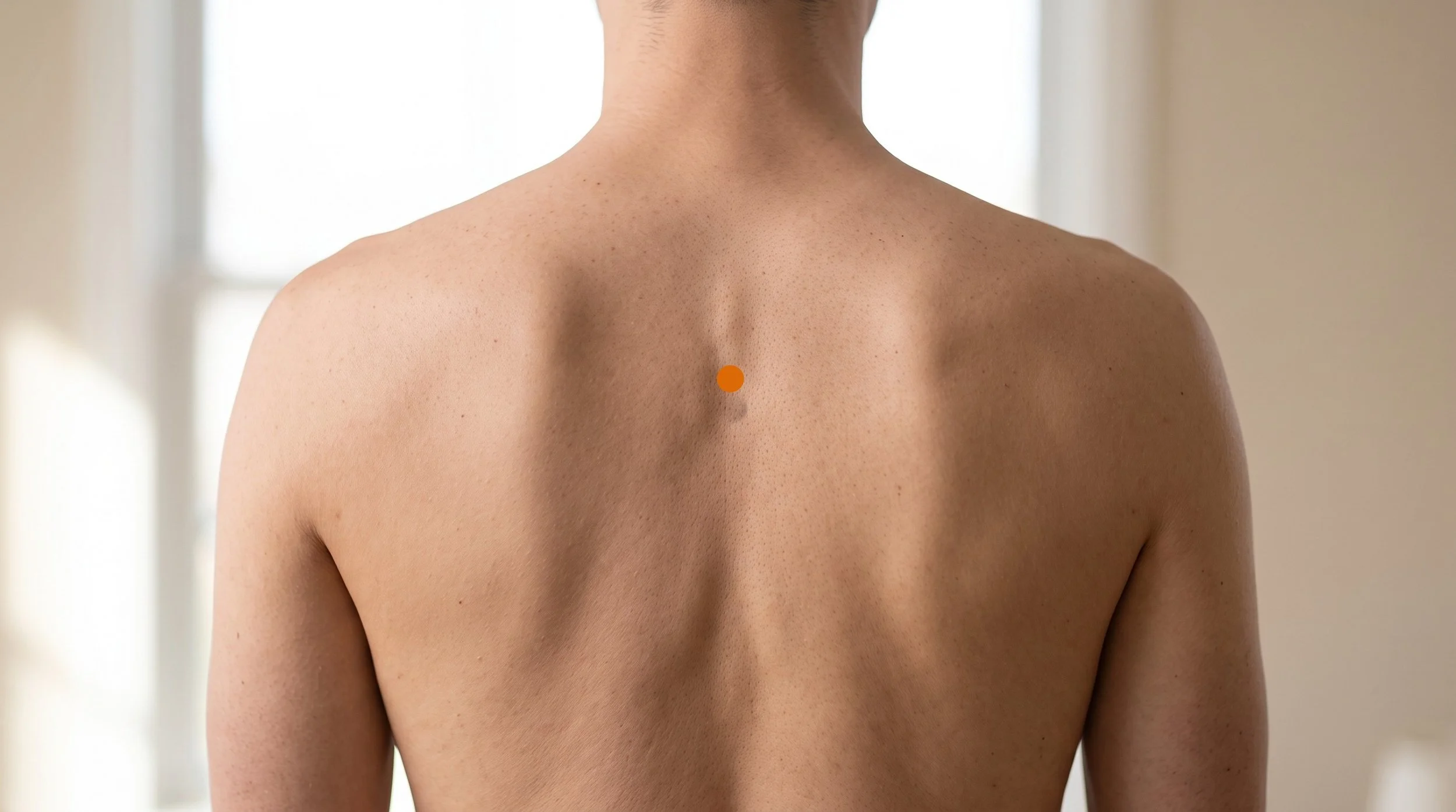
DU12 Acupuncture Point (Shenzhu)
The Body Pillar Below the Third Thoracic Vertebra: Anatomy, Mechanism, and Why This Midline Point Sits Where Breathing, Upper Back Tension, and Nervous System Arousal Overlap
DU12 (Shenzhu, translated as Body Pillar), also written GV12, is a Governing Vessel point on the midline of the upper back, in the small depression just below the tip of the third thoracic spinous process. In plain terms, if you run a finger down the bumps of the spine from the base of the neck, DU12 sits three interspaces below the prominent C7 vertebra, level with the root of the scapular spine and level with BL13, the back-shu points of the Lung.
That position is the whole clinical story: it is a midline point sitting in the middle of the thoracic segments that supply the airways, the heart, and the muscles people load every day at a keyboard.
Classically it was used for heat in the chest with cough and wheezing, for agitation and severe spirit disturbance, for convulsive disorders in children, and for stiffness of the upper spine, and modern practice keeps it in rotation for breathing complaints, interscapular tension, and stress-driven upper back holding patterns.
- DU12 lies below the T3 spinous process on the midline of the upper back, needled through skin, supraspinous ligament, and interspinous ligament, with the erector spinae and deeper multifidus and semispinalis thoracis immediately lateral (Deadman et al., 2009).
- The traditional actions attributed to it (clearing heat from the Lung and Heart, calming the spirit, and pacifying wind) map onto a point sitting in the mid-upper thoracic segments where somatic, visceral, and sympathetic pathways converge, so we describe them as historical categories rather than literal energy movement (Deadman et al., 2009; Cunningham, 2000).
- Innervation comes from the medial branch of the dorsal ramus of the third thoracic spinal nerve, with the posterior branch of the third intercostal artery supplying the area, which places the needle in the same segmental neighborhood as airway and cardiac afferents entering the T1 to T5 cord levels (Cheng, 1999).
- Needle stimulation of this kind recruits A-delta and C fiber input that engages spinal gating and descending inhibitory pathways involving endogenous opioid, serotonergic, and noradrenergic systems (Zhao, 2008), and pooled trial data support modest, durable effects of acupuncture for chronic musculoskeletal pain (Vickers et al., 2018).
- The respiratory research picture is mixed and honest about it: a Cochrane review found insufficient evidence to recommend acupuncture for chronic asthma (McCarney et al., 2004), while a placebo-needling controlled trial reported improved dyspnea on exertion in COPD (Suzuki et al., 2012), so DU12 is best framed as a supportive part of care rather than a stand-alone respiratory treatment.
- De qi at DU12 is typically a dull, spreading heaviness or pressure at the midline that may broaden sideways under the shoulder blades or travel a short distance up or down the spine, and it should never be sharp, electric, or radiating into the limbs.
Tight Upper Back and Shallow Breathing That Will Not Settle?
Desk work, stress, and long screen hours tend to park tension right where DU12 sits, between the shoulder blades at the top of the thoracic spine. At Morningside Acupuncture we combine gentle needling at Shenzhu with the Lung shu points, thoracic paraspinal work, and dry needling of the rhomboids and mid trapezius when the exam supports it. Most patients notice easier breathing mechanics and less interscapular gripping within a few sessions. Schedule a visit and we will map out where your tension is actually coming from.
Schedule NowAnatomy of DU12: Why the Space Below T3 Is Such an Important Location
DU12 sits directly on the midline in the depression below the spinous process of T3, roughly level with the root of the scapular spine. From the surface inward, the needle passes through fairly thick skin and subcutaneous tissue, then the fascia of the trapezius as it crosses the midline, then the supraspinous ligament, and finally the interspinous ligament between T3 and T4 (Deadman et al., 2009). Immediately lateral to that midline column sit the rhomboids, the erector spinae group, and deeper still the multifidus and semispinalis thoracis.
This is a heavily loaded region. Sustained forward head posture, protracted shoulders, laptop work, and carrying bags on one side all keep the upper thoracic extensors and scapular retractors working eccentrically for hours, which is why so many patients report a persistent ache or a bar of tightness at exactly this level.
The nerve supply is straightforward and clinically useful: the medial branch of the posterior ramus of the third thoracic spinal nerve innervates the tissue at this point, and the posterior branch of the third intercostal artery supplies it (Cheng, 1999). That single fact explains most of what DU12 is traditionally used for.
The T1 through T5 cord segments receive somatic input from the upper thoracic skin, ligaments, and paraspinal muscles, and they also receive visceral afferent traffic from the airways and heart while sending sympathetic preganglionic fibers toward those same structures. When several inputs converge on shared dorsal horn neurons, needling the somatic side of that circuit may alter how the segment processes and reports sensation, and stimulation of this type is known to engage spinal gating along with descending inhibitory pathways using endogenous opioid, serotonergic, and noradrenergic signaling (Zhao, 2008).
Individual patient data pooled across chronic pain trials suggest these effects translate into real, if moderate, clinical benefit that persists over time (Vickers et al., 2018).
Depth discipline matters here more than almost anywhere else on the back. The spinal canal lies roughly 1.25 to 1.75 cun beneath the skin at this level, varying considerably with body build, so the standard convention is a perpendicular-oblique insertion angled superiorly to a depth of 0.5 to 1 cun (Deadman et al., 2009). Angling the needle up along the interspinous ligament keeps it in dense connective tissue and well short of the canal.
Because the point is on the midline over bone and ligament rather than over the pleural dome, pneumothorax is not a concern at DU12 itself, though the paravertebral and interscapular points we often combine with it do require careful angling. Any sharp, electric, or radiating sensation is a signal to withdraw and reposition rather than to continue stimulating.
Related Governing Vessel Related Back Shu PointsDU12 (GV12) at a Glance: Classification, Location, and Clinical Use
| Category | Detail |
|---|---|
| Traditional Name | Shenzhu (Body Pillar), DU12 in Deadman's A Manual of Acupuncture |
| Channel Classification | Governing Vessel (Du mai), the midline yang channel of the back (DU12, also written GV12) |
| Point Categories | A Governing Vessel point below the third thoracic vertebra. It carries no five-shu, hui-meeting, or extraordinary vessel intersection designation in the reference literature. Its identity comes instead from its level with BL13, the Lung back-shu points, and from its classical grouping with the spirit-calming and wind-pacifying points of this channel, contrasted with DU11 just below, which classical sources direct toward Heart and Lung deficiency rather than excess (Deadman et al., 2009). |
| Precise Location | On the midline of the upper back, in the depression below the spinous process of T3, three interspaces below the prominent C7 spinous process and level with the root of the scapular spine. |
| Tissue Stimulated | Skin and subcutaneous tissue, trapezius fascia at the midline, supraspinous ligament, and the T3 to T4 interspinous ligament, with erector spinae, rhomboids, multifidus, and semispinalis thoracis immediately lateral. See our Pain Finder Upper Back Shoulder Arm guide for regional referral patterns. |
| Needle Depth / Direction | Perpendicular-oblique insertion directed superiorly, 0.5 to 1 cun. Caution: the spinal canal lies approximately 1.25 to 1.75 cun deep depending on build, so depth is kept conservative and deep perpendicular needling is avoided. Moxibustion and cupping over the surrounding paraspinals are commonly used. |
| De Qi Sensation | A dull, heavy, spreading pressure at the midline that often broadens laterally toward the shoulder blades. Sharp, electric, or limb-radiating sensations are not the goal and prompt immediate repositioning. |
| Primary Clinical Uses | Cough, wheezing, and chest tightness (traditionally described as heat in the chest); upper back and interscapular stiffness; stress, agitation, and restlessness; classical listings for convulsive disorders and childhood fright conditions; supportive use in chronic respiratory complaints. |
| Common Point Combinations |
|
Deadman, Al-Khafaji, and Baker's A Manual of Acupuncture traces the heat-clearing reputation of Shenzhu back as far as the Essential Questions, where the point was already associated with clearing heat from the chest, and later texts kept expanding on that theme. Because DU12 sits level with BL13, the Lung back-shu points, it was traditionally credited with clearing heat from the Lung in presentations of cough, labored breathing, and fever.
The classical logic then extends outward: warm disease literature described the Lung and Heart as closely linked, with Lung heat readily transferring to the Heart, which is how a point on the upper back came to be listed for florid spirit disturbance, including delirious speech, rage, and the vivid descriptions of raving and mad walking that appear in older sources.
Classical texts also placed it among the Governing Vessel points said to pacify wind, hence its listings for epilepsy, clonic spasm, and opisthotonos, alongside childhood fright conditions and skin sores.
Deadman draws a sharp contrast with DU11 just below, which classical practice directed toward deficiency of the Heart and Lung, while DU12 was reserved for their excess and heat presentations. What is striking is the coherence of the pattern: a single midline point at T3 gathered indications spanning the airways, the mind, and the spine itself, and every one of those systems shares segmental neural territory at that level.
Why DU12 Is Used for Agitation and Restless Breathing, Not Just a Stiff Upper Back
The most surprising thing about DU12 to a new patient is that a point on the upper back is being used for chest tightness, shallow breathing, and a keyed-up nervous system. The segmental explanation is fairly clean. The tissue at DU12 is innervated by the medial branch of the T3 dorsal ramus (Cheng, 1999), and the T1 to T5 spinal segments are also the level where visceral afferent traffic from the airways and heart arrives, and where sympathetic outflow to those same structures departs.
Dorsal horn neurons in that region receive input from more than one source, so a strong, well-localized somatic signal from a needle can change how that segment is processing everything else arriving there. In practical terms, patients frequently report that the chest feels less constricted and the breath drops lower after upper thoracic needling, even though nothing was needled on the chest itself.
Beyond the segment, needle stimulation recruits supraspinal machinery. Afferent input from acupuncture needling activates descending inhibitory control from the periaqueductal gray and rostral ventromedial medulla, with endogenous opioid, serotonergic, and noradrenergic mediation, which reduces the gain on incoming nociceptive signals throughout the region (Zhao, 2008).
There is also a measurable autonomic dimension. A systematic review and meta-analysis of randomized trials found that needling was associated with shifts in heart rate variability indices consistent with increased parasympathetic tone compared with placebo procedures, although the trials were few and heterogeneous (Hamvas et al., 2023). That aligns with what patients describe during treatment at points like DU12: slower breathing, a heavy relaxed feeling in the upper back, and sometimes drowsiness. It does not prove that Shenzhu specifically produces those effects, and we are careful not to overstate it.
Finally, there is the mechanical layer that classical texts also noticed when they listed spinal stiffness among DU12's indications. The upper thoracic spine is the base that the neck sits on, and restriction there tends to push compensation into the cervical spine and shoulder girdle. Restoring segmental mobility and reducing paraspinal muscle tone at T3 to T5 often makes neck and shoulder treatment hold better, which is why we rarely treat this point in isolation.
What the Research Shows for DU12 (GV12)
One note on naming before the evidence: in the research literature this point is almost always listed as GV12, the WHO standard code, so GV12 is the term to search if you want to read the studies below in full.
It is worth being direct about the state of the evidence. There are essentially no trials that isolate DU12 on its own. Acupuncture research tests multi-point protocols, and DU12 typically appears as one component of a back and chest prescription for respiratory complaints, or as part of a spinal protocol for upper back pain, alongside points like BL13, DU14, and LU points. What the literature can tell us is whether the treatment packages that contain this point tend to help, and what plausible mechanisms exist.
The respiratory evidence is genuinely mixed, the chronic pain evidence is more robust, and the anxiety and autonomic evidence is suggestive but limited by trial quality. Read the table below as context for a clinical decision, not as proof of a point-specific effect.
| Study | Type | Focus | Key Finding |
|---|---|---|---|
| Vickers et al., 2018 | Individual patient data meta-analysis | Acupuncture for chronic musculoskeletal, headache, and osteoarthritis pain across nearly 21,000 patients | Acupuncture was associated with greater pain reduction than both sham and no-acupuncture controls, with effects that persisted over follow-up, supporting its use for chronic pain including spinal complaints. |
| McCarney et al., 2004 | Cochrane systematic review | Acupuncture for chronic asthma | The reviewers concluded there was not enough good-quality evidence to make recommendations about acupuncture for asthma, with included trials small and inconsistent. |
| Suzuki et al., 2012 | Randomized placebo-needling controlled trial | Dyspnea on exertion in COPD, using a back and chest point protocol alongside standard medication | Patients receiving real needling reported greater improvement in exertional breathlessness than those receiving placebo needling, though the trial was single-region and blinding of the intervention has been questioned. |
| Yang et al., 2021 | Systematic review and meta-analysis | Acupuncture for anxiety disorders across 20 randomized controlled trials | Acupuncture showed beneficial effects on anxiety symptoms compared with controls, but the authors emphasized that higher-quality trials are needed before drawing firm conclusions. |
| Hamvas et al., 2023 | Systematic review and meta-analysis | Effect of manual needling on heart rate variability compared with placebo | Pooled data suggested a shift toward increased parasympathetic tone after needling, offering a plausible mechanism for the calming effects patients describe, though only nine trials met inclusion criteria. |
| Gattie et al., 2017 | Systematic review and meta-analysis | Trigger point dry needling for musculoskeletal pain conditions | Dry needling showed favorable short-term effects on pain compared with sham or no treatment, with evidence quality rated low to moderate and longer-term effects less certain. |
Stress You Feel in Your Chest and Between Your Shoulder Blades?
Classical texts reached for DU12 when agitation and heat in the chest showed up together, and that pairing is still recognizable in patients who describe a tight chest, a racing mind, and a locked upper back. Our clinicians use Shenzhu acupuncture alongside calming distal points and breath-focused treatment to encourage a parasympathetic shift during the session. Treatment is quiet, unhurried, and tailored to how you present that day. Book an appointment and see how your body responds.
Schedule NowDU12 in the Context of Trigger Point Work
Acupuncture is defined by the tool, an acupuncture needle, and that same needle is used across hundreds of styles including trigger point dry needling. At DU12 the two frameworks overlap almost perfectly. The point sits at the midline of a region that is dense with myofascial pain generators: the rhomboid major and minor, the middle and lower trapezius, the thoracic iliocostalis and longissimus, levator scapulae above, and serratus posterior superior tucked beneath the scapula.
Trigger points in these muscles refer pain into the interscapular region, along the medial scapular border, and up into the neck, and they are among the most common findings in patients who arrive describing a knot between the shoulder blades that never fully releases (Simons et al., 1999). DU12 itself is a ligamentous midline target rather than a muscle belly, so it complements rather than duplicates that work.
In practice, our clinicians typically start with DU12 and the adjacent Huatuojiaji points at T3 to T5 to influence the segment broadly, then move laterally to needle the specific muscles that reproduced the patient's symptoms on examination. Local twitch responses in the rhomboids or mid trapezius often coincide with an immediate change in interscapular tenderness, and pooled trial data support short-term pain improvement from dry needling in musculoskeletal conditions, with the caveat that evidence quality is low to moderate and long-term effects remain uncertain (Gattie et al., 2017).
We usually pair the session with scapular strengthening and thoracic mobility work, because needling reduces symptoms while loading and movement are what keep them from returning.
DU12 Upper Back and Breathing Treatment at NYC's Highest-Rated Acupuncture Clinic
Morningside Acupuncture is the highest-rated acupuncture and dry needling clinic in New York City with over 500 five-star Google reviews, and our approach blends classical point selection with orthopedic assessment and myofascial needling. DU12 is one of the points we return to when upper back stiffness, chest tightness, and stress-related holding patterns overlap in the same patient. Every treatment plan is built around your exam findings, your goals, and a realistic timeline. Schedule your appointment today.
Schedule NowFrequently Asked Questions
Is DU12 the same point as GV12?
Yes. DU12 and GV12 are two codes for the same point, Shenzhu. DU comes from Du Mai, the Chinese name of the Governing Vessel, and it is the code used in most Chinese texts and many acupuncture schools. GV is the WHO standard abbreviation and the one you will see in most Western textbooks and research papers. You will also come across it written as Du 12, GV-12, or Governing Vessel 12. Whichever code is used, the location and the uses are the same.
What does DU12 feel like when needled?
Most people feel a brief pinch as the needle passes the skin, then a dull, heavy, spreading pressure at the midline of the upper back. That heavy ache is the de qi sensation, and it often broadens sideways toward the shoulder blades or travels a short distance up or down the spine. Some patients describe a warm or sinking feeling, and many notice their breathing deepen while the needles are retained. What you should not feel is anything sharp, electric, or shooting into the arms. Tell your acupuncturist right away if you do, and the needle will be withdrawn and repositioned.
Why treat a point on my upper back for cough, chest tightness, or stress?
Because that part of your back shares nerve segments with your airways, your heart, and the sympathetic fibers that supply them. DU12 is innervated by the T3 dorsal ramus, and the T1 to T5 spinal segments handle both somatic input from the upper back and visceral input from the chest (Cheng, 1999). Needling the somatic side of that shared circuitry may change how the segment processes signals from the chest, and needling more broadly engages descending inhibitory pathways and appears to shift autonomic balance toward parasympathetic activity (Zhao, 2008; Hamvas et al., 2023). Classical texts arrived at similar clinical use through a different explanatory language, listing DU12 for heat in the chest with cough and for agitation and restlessness (Deadman et al., 2009). We use the point as a supportive part of a treatment plan, not as a replacement for respiratory or mental health care.
Can I press DU12 myself between sessions?
You can, though the location makes self-application awkward since it is squarely between your shoulder blades. The simplest method is to lie on your back on the floor with a tennis ball or lacrosse ball positioned just to one side of the spine at the level of the root of the scapular spine, since pressing directly on the spinous process is uncomfortable and unnecessary. Let your body weight sink onto the ball for 30 to 60 seconds per spot, breathing slowly, and repeat two or three times per side. Alternatively, ask a partner to apply steady thumb pressure over the midline depression below T3 for 30 to 60 seconds, repeated a few times. A warm pack over the upper back for 10 to 15 minutes works well before or instead of pressure. Stop if you feel any radiating or electric sensation, and never use sharp objects on yourself at home.
Is DU12 safe to needle?
In trained hands, yes, provided depth is respected. The main anatomical consideration is that the spinal canal lies roughly 1.25 to 1.75 cun beneath the skin at this level, varying with body build, so the standard technique is a shallow oblique insertion angled superiorly to 0.5 to 1 cun rather than deep perpendicular needling (Deadman et al., 2009). Because the point is on the midline over ligament and bone, it does not carry the pneumothorax risk that applies to points lateral to the spine over the lung fields, though the paravertebral points often combined with it do require careful angling. Expect the usual minor possibilities of any needling: brief soreness, small bruises, or a short-lived heavy feeling afterward. Tell your practitioner if you take blood thinners, have a spinal implant or hardware, have had thoracic surgery, or have a skin infection over the area.
Where exactly is DU12 located?
DU12 is on the midline of the upper back, in the depression immediately below the spinous process of the third thoracic vertebra. To find it, tip your head forward and locate the most prominent bump at the base of the neck, which is usually C7, then count down three interspaces. A useful cross-check is that DU12 sits approximately level with the root of the scapular spine, and level with BL13, the Lung back-shu points, which are about 1.5 cun to either side. DU11 sits below T5 and DU13 sits below T1, so DU12 falls between them on the same midline.
References
- Deadman, P., Al-Khafaji, M., & Baker, K. (2009). A manual of acupuncture. Journal of Chinese Medicine Publications.
- Cheng, X. (Ed.). (1999). Chinese acupuncture and moxibustion (Rev. ed.). Foreign Languages Press.
- Maciocia, G. (2005). The foundations of Chinese medicine: A comprehensive text for acupuncturists and herbalists (2nd ed.). Elsevier Churchill Livingstone.
- Cunningham, P. M. (2000). Acupuncture points: A practical guide to classical and modern usage. Odyssey Press.
- Simons, D. G., Travell, J. G., & Simons, L. S. (1999). Travell & Simons' myofascial pain and dysfunction: The trigger point manual, Vol. 1: Upper half of body (2nd ed.). Williams & Wilkins.
- Zhao, Z. Q. (2008). Neural mechanism underlying acupuncture analgesia. Progress in Neurobiology, 85(4), 355-375. https://doi.org/10.1016/j.pneurobio.2008.05.004
- Vickers, A. J., Vertosick, E. A., Lewith, G., MacPherson, H., Foster, N. E., Sherman, K. J., Irnich, D., Witt, C. M., & Linde, K. (2018). Acupuncture for chronic pain: Update of an individual patient data meta-analysis. Journal of Pain, 19(5), 455-474. https://doi.org/10.1016/j.jpain.2017.11.005
- McCarney, R. W., Brinkhaus, B., Lasserson, T. J., & Linde, K. (2004). Acupuncture for chronic asthma. Cochrane Database of Systematic Reviews, 2004(1), CD000008. https://doi.org/10.1002/14651858.CD000008.pub2
- Suzuki, M., Muro, S., Ando, Y., Omori, T., Shiota, T., Endo, K., Sato, S., Aihara, K., Matsumoto, M., Suzuki, S., Itotani, R., Ishitoko, M., Hara, Y., Takemura, M., Ueda, T., Kagioka, H., Hirabayashi, M., Fukui, M., & Mishima, M. (2012). A randomized, placebo-controlled trial of acupuncture in patients with chronic obstructive pulmonary disease (COPD): The COPD-acupuncture trial (CAT). Archives of Internal Medicine, 172(11), 878-886. https://doi.org/10.1001/archinternmed.2012.1233
- Yang, X. Y., Yang, N. B., Huang, F. F., Ren, S., & Li, Z. J. (2021). Effectiveness of acupuncture on anxiety disorder: A systematic review and meta-analysis of randomised controlled trials. Annals of General Psychiatry, 20, 9. https://doi.org/10.1186/s12991-021-00327-5
- Hamvas, S., Hegyi, P., Kiss, S., Lohner, S., McQueen, D., & Havasi, M. (2023). Acupuncture increases parasympathetic tone, modulating HRV: Systematic review and meta-analysis. Complementary Therapies in Medicine, 72, 102905. https://doi.org/10.1016/j.ctim.2022.102905
- Gattie, E., Cleland, J. A., & Snodgrass, S. (2017). The effectiveness of trigger point dry needling for musculoskeletal conditions by physical therapists: A systematic review and meta-analysis. Journal of Orthopaedic & Sports Physical Therapy, 47(3), 133-149. https://doi.org/10.2519/jospt.2017.7096
Disclaimer: This web site is intended for educational and informational purposes only. Reading this website does not constitute providing medical advice or any professional services. This information should not be used for diagnosing or treating any health issue or disease. Those seeking medical advice should consult with a licensed physician. Seek the advice of a medical doctor or other qualified health professional for any medical condition. If you think you have a medical emergency, call 911 or go to the emergency room. No acupuncturist-patient relationship is created by reading this website or using the information. Morningside Acupuncture PLLC and its employees and contributors do not make any express or implied representations with respect to the information on this site or its use. For any legal interpretation of scope of practice in your state, consult a licensed attorney or regulatory authority.
Read more from our blog



