DU11 Acupuncture Point (Shendao)
The Spirit Pathway Below the Fifth Thoracic Vertebra: Anatomy, Mechanism, and Why a Midline Upper Back Point Sits at the Crossroads of Calm and Thoracic Tension
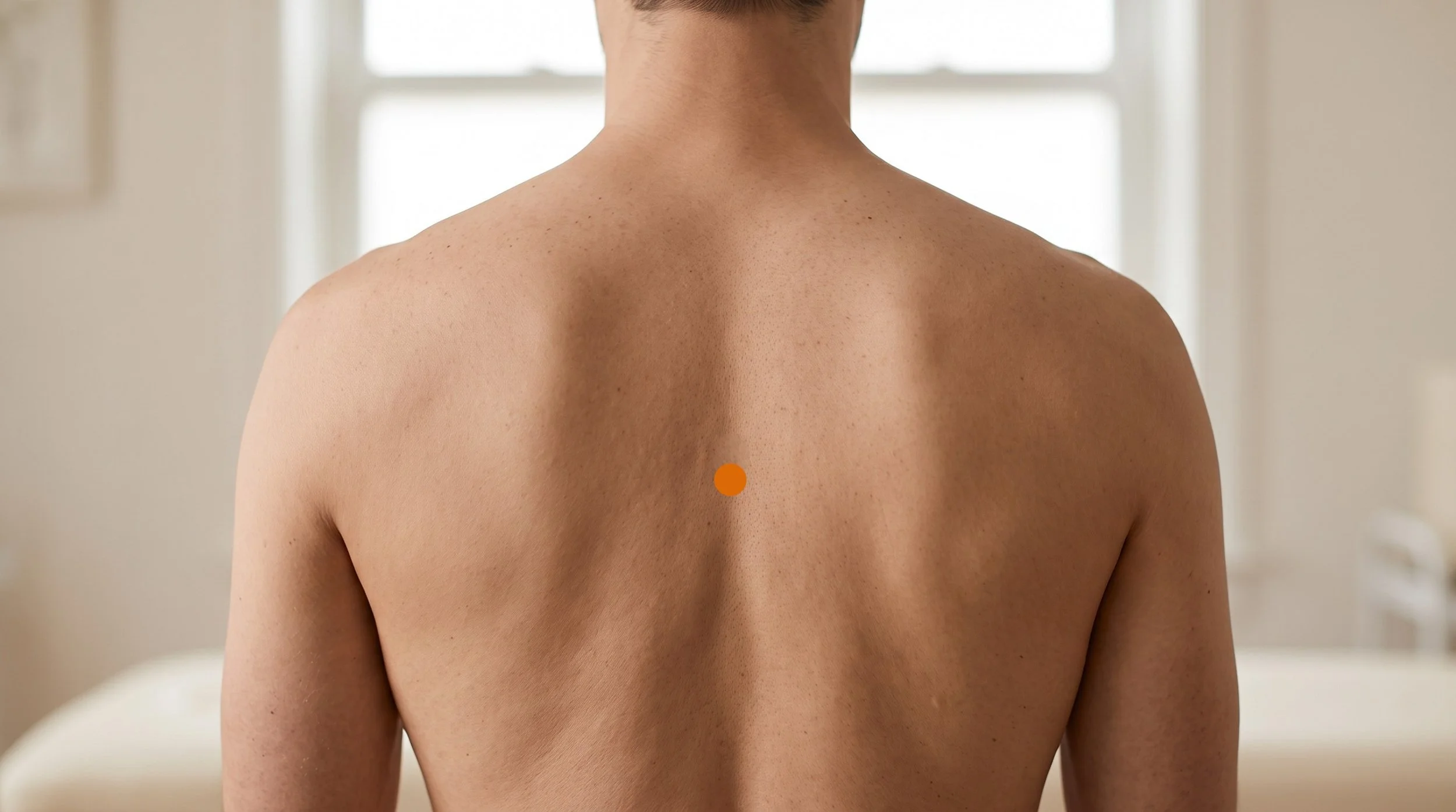
DU11 (Shendao, often translated as Spirit Pathway or Mind Way), also written GV11, is the Governing Vessel point in the small depression just below the spinous process of the fifth thoracic vertebra, right on the midline of the upper back between the shoulder blades. It sits at exactly the same horizontal level as BL15, the back-shu point associated with the Heart, and that shared level is the whole reason classical writers gave this point a spirit-related name and a spirit-related indication list.
Clinically the GV11 acupuncture point matters for two overlapping reasons: it lies in the stiff, guarded mid-thoracic segment where people hold stress and desk posture, and it sits over the spinal levels whose autonomic outflow serves the heart and lungs, which is why practitioners reach for it when tight interscapular muscles, shallow breathing, palpitations and an anxious, scattered feeling all show up in the same person.
- DU11 is a midline point below the T5 spinous process. The needle passes through skin and thin subcutaneous fascia into the supraspinous and interspinous ligaments, with the trapezius, rhomboid and deep erector spinae fibers immediately to either side, so the tissue it engages is ligamentous and paraspinal rather than muscular bulk.
- Traditional sources list DU11 for sadness and anxiety, poor memory, fright palpitations, timidity with shortness of breath, and pain with a cold sensation in the upper back. Read neurophysiologically, that cluster describes an upper thoracic segment where somatic tension, breathing pattern and cardiac autonomic tone all converge.
- The point sits in the T5 to T6 dermatome and myotome, supplied by the medial branches of the thoracic dorsal rami, the same spinal levels that carry sympathetic outflow to the heart and lungs. Needle input at this level recruits segmental spinal circuits and supraspinal descending inhibitory pathways that damp nociceptive traffic (Zhao, 2008).
- Research on acupuncture for anxiety and mood is encouraging but modest and methodologically mixed: meta-analyses report reductions in anxiety scores while flagging bias and heterogeneity (Yang et al., 2021; Li et al., 2022), and the Cochrane review of acupuncture for depression judged the evidence low quality overall (Smith et al., 2018). Sham-controlled trials also suggest needling can shift heart rate variability toward parasympathetic dominance (Hamvas et al., 2023).
- In practice DU11 is a supporting point inside a larger protocol, not a stand-alone treatment. Large pooled data show acupuncture outperforming sham and usual care for chronic musculoskeletal pain with effects that persist over time (Vickers et al., 2018), and prospective safety data put serious events at a very low rate in trained hands (Witt et al., 2009).
- De qi at DU11 is usually a deep, dull, slightly heavy ache at the midline that may spread sideways between the shoulder blades, sometimes with a warm settling feeling down the back. Sharp, electric or radiating sensation is not the goal and tells the clinician to withdraw and change angle.
Anxious, Wired and Tight Between the Shoulder Blades?
Anxiety rarely stays in the head, and most of our NYC patients describe it as a band of tension across the mid back with breath that never quite reaches the bottom of the lungs. At Morningside Acupuncture we use DU11 alongside points on the arms and legs to settle the thoracic paraspinals while giving the nervous system a chance to downshift. Treatments are calm, precise and built around what your body is actually doing, not a generic template. Schedule a visit and let's map your pattern together.
Schedule NowAnatomy of DU11: Why the T5 to T6 Interspinous Space Is Such an Important Location
DU11 lies on the posterior midline in the shallow dip between the spinous processes of the fifth and sixth thoracic vertebrae. Under the skin there's very little fat here, then the supraspinous ligament, then the interspinous ligament running between the two bony processes. Just lateral to the needle path sit the lower trapezius and rhomboid fibers, and deeper still the semispinalis thoracis, multifidus and rotatores that fine-tune segmental control of the thoracic spine.
This is the part of the back that absorbs sustained flexion at a desk, the weight of a bag carried on one shoulder, and the low-grade bracing that comes with stress, which is why the interspinous tissues at this level are so often tender to firm palpation.
Sensory supply to the skin and ligaments here comes from the medial cutaneous branches of the posterior rami of the fifth and sixth thoracic spinal nerves, with the deeper paraspinal muscles served by the corresponding medial branches. Those same spinal segments receive visceral afferent traffic from the heart and great vessels, and they house the preganglionic sympathetic neurons that project to the cardiac and pulmonary plexuses. When two inputs, one from the body wall and one from a viscus, converge on the same dorsal horn neurons, stimulating the somatic side can modulate how that segment behaves overall.
Needling also engages the broader analgesic machinery: afferent volleys from acupuncture needles recruit descending inhibitory pathways from the midbrain and brainstem and drive release of endogenous opioids and monoamines that reduce dorsal horn excitability (Zhao, 2008). This gives a plausible account of why a point on the back can influence both local stiffness and a diffuse sense of chest tightness.
The safety consideration at DU11 is depth, not the pleura. Because the point is exactly on the midline, the lungs aren't directly beneath it, but the spinal canal sits roughly 1.25 to 1.75 cun below the skin surface depending on build, and the interlaminar space is not far off the needle path. For that reason the standard technique is oblique insertion angled superiorly, 0.5 to 1 cun, never deep perpendicular needling.
Several classical texts went further and listed DU11 as contraindicated to needling altogether, which is why many practitioners keep the technique shallow, use moxibustion, or treat the surrounding tissues instead. Prospective observational data across hundreds of thousands of patients indicate that serious adverse events from acupuncture are rare when practitioners respect regional anatomy (Witt et al., 2009).
Related Governing Vessel Related Pain Finder Upper Back Shoulder ArmDU11 (GV11) at a Glance: Classification, Location, and Clinical Use
| Category | Detail |
|---|---|
| Traditional Name | Shendao (Spirit Pathway, also translated Mind Way), Governing Vessel 11, DU11 |
| Channel Classification | Governing Vessel (Du Mai), the midline yang channel of the back (DU11, also written GV11) |
| Point Categories | A regular Governing Vessel point on the posterior midline below the fifth thoracic vertebra. The reference texts list no meeting, crossing, five-shu or hui-meeting designation for this point. Its defining classification is positional: it sits level with BL15, the Heart back-shu point, and several classical texts record it as contraindicated to needling. Modern Chinese sources also identify this area as the so-called Barefoot Doctor point. |
| Precise Location | On the posterior midline of the upper back, in the depression below the spinous process of the fifth thoracic vertebra (five intervertebral spaces below C7), level with BL15 which lies 1.5 cun to either side. |
| Tissue Stimulated | Skin and thin subcutaneous fascia, supraspinous and interspinous ligaments of the T5 to T6 segment, with trapezius, rhomboid and deep thoracic erector fibers immediately lateral. See our Pain Finder: Upper Back, Shoulder and Arm for referral patterns from these muscles. |
| Needle Depth / Direction | Oblique insertion directed superiorly, 0.5 to 1 cun. Deep perpendicular needling is avoided because the spinal canal lies approximately 1.25 to 1.75 cun deep depending on body build. Several classical texts consider the point contraindicated to needling, so gentle shallow oblique technique is the norm and moxibustion is an accepted alternative. |
| De Qi Sensation | A deep, dull, heavy ache at the midline that often spreads across the interscapular region, sometimes with a warm or settling quality and a spontaneous deeper breath. Sharp, electric or radiating sensation is not sought and prompts immediate adjustment. |
| Primary Clinical Uses | Traditionally used for sadness, anxiety and disorientation, poor memory, fright palpitations, timidity with shortness of breath, cough and cardiac discomfort, and pain with a cold sensation of the upper back. In modern practice it supports treatment of stress-related interscapular tension, shallow breathing patterns and anxiety. |
| Common Point Combinations |
|
The Deadman text frames Shendao by its neighborhood: it sits in the upper back region traditionally assigned to the Lung, at the same level as the Heart's back-shu point. In that framework the Lung governs qi, the Heart houses the spirit, and the gathering qi of the chest supplies both, so a shortfall there was said to leave the spirit poorly nourished. The indications that follow from this traditional attribution are strikingly consistent: low energy and breathlessness on one side, timidity, fright palpitations, disorientation, forgetfulness and sadness on the other.
The same source notes that DU11, like many Governing Vessel points, was also used to settle internally generated wind ascending the spine, and to address fevers and heat patterns, including an old indication for heat in the Liver drawn from the Essential Questions that later writers quietly dropped. What's striking is how tidily the classical list maps onto a single spinal region: the ancient authors grouped breath, heartbeat and mood together at T5 long before segmental innervation was described.
Why DU11 Is Used for Anxiety, Palpitations and a Chest That Won't Let You Breathe Deeply
It surprises most patients that a point on the back gets used for anxiety and racing heartbeat. The anatomy makes it less strange. The heart and lungs send sensory information into the spinal cord at roughly the upper five thoracic segments, and those same segments send sympathetic fibers back out to the chest. Skin, ligament and muscle from the T5 to T6 region report into that identical stretch of dorsal horn. When two streams share a relay, they influence each other, which is why cardiac irritation can be felt as interscapular ache and why sustained mid-back guarding can make the chest feel closed.
Needling at DU11 puts a controlled, non-threatening sensory input into that shared relay, and patients often describe the first deep breath in hours within a minute or two of the needle settling.
Beyond the segment, needle stimulation activates descending pain-control pathways that run from the periaqueductal gray and rostral ventromedial medulla down to the spinal cord, releasing endogenous opioids and monoamines that reduce how readily dorsal horn neurons fire (Zhao, 2008). This is a general acupuncture mechanism rather than something unique to Shendao, but it explains the two-part experience patients report: local softening of the paraspinal tissue plus a broader drop in overall reactivity.
Sham-controlled trials measuring heart rate variability suggest that needling can nudge autonomic balance toward parasympathetic dominance, though the trials are small and the parameters vary (Hamvas et al., 2023).
None of this means DU11 treats anxiety on its own, and it isn't a substitute for mental health care. What it offers is a physiologically sensible way to address the body's contribution to an anxious state: the braced upper back, the shallow apical breathing, the sense of pressure behind the sternum. Used as one element of a well-built treatment, the Shendao calming point gives the clinician a way to work directly on the segment where those complaints live.
What the Research Shows for DU11 (GV11)
One note on naming before the evidence: in the research literature this point is almost always listed as GV11, the WHO standard code, so GV11 is the term to search if you want to read the studies below in full.
A realistic word on evidence before the table: no clinical trial has isolated DU11 and measured what it does by itself. The research base tests multi-point protocols in which a point like DU 11 back may or may not appear, so the honest reading is that these studies tell us about acupuncture as a whole treatment package, and DU11's role is inferred from anatomy, segmental reasoning and long clinical use rather than from point-specific trials. The quality picture is mixed, with several reviews noting high risk of bias in the underlying studies.
| Study | Type | Focus | Key Finding |
|---|---|---|---|
| Yang et al., 2021 | Systematic review and meta-analysis | Acupuncture for anxiety disorders | Pooled results favored acupuncture over control conditions for anxiety symptoms, though the authors emphasized methodological limitations across the included trials. |
| Li et al., 2022 | PRISMA-compliant systematic review and meta-analysis | Acupuncture for generalized anxiety disorder | Acupuncture was associated with reduced anxiety scores and few side effects, but the authors called for larger, higher-quality trials before drawing firm conclusions. |
| Smith et al., 2018 | Cochrane systematic review | Acupuncture for depression | Any benefit over control conditions appeared small and the certainty of evidence was rated low, so results should be interpreted cautiously. |
| Hamvas et al., 2023 | Systematic review and meta-analysis of sham-controlled RCTs | Acupuncture and heart rate variability | Real needling was associated with changes in HRV indices suggesting increased parasympathetic tone, while sham groups showed no comparable shift, based on a small number of trials. |
| Vickers et al., 2018 | Individual patient data meta-analysis | Acupuncture for chronic musculoskeletal pain | Acupuncture was superior to both sham and no-acupuncture controls for chronic pain, with effects that persisted over about twelve months. |
| Witt et al., 2009 | Prospective observational safety study | Adverse events across 229,230 patients | Most reported events were minor, such as bruising or transient needling pain, and serious events were rare in appropriately trained practice. |
Want Upper Back Relief That Also Calms Your Nervous System?
Mid-thoracic stiffness from long hours at a laptop responds well to needling, but relief lasts longer when the stress loop driving the guarding is addressed too. We combine gentle oblique needling at DU11 with dry needling of the rhomboids, mid and lower trapezius and thoracic erectors, plus breathing and mobility cues you can use between visits. Most patients notice the interscapular area loosening within the first few sessions. Book an appointment and see how your back feels when it stops bracing.
Schedule NowDU11 in the Context of Trigger Point Work
The midline at T5 sits in the middle of prime myofascial territory. Trigger points in the rhomboid major and minor, the middle and lower trapezius, the thoracic iliocostalis and the deep multifidus and rotatores all refer pain into the interscapular region, which is exactly where patients point when they describe the ache the classical texts called pain and cold sensation of the upper back (Simons et al., 1999).
At Morningside we often treat DU11 with a shallow oblique needle while working the surrounding musculature separately, since the point itself lies in ligament rather than in a taut band. Because acupuncture is defined by the use of an acupuncture needle, and dry needling is one of the many styles within that scope, the same session can move fluidly between classical point selection and myofascial targets.
A practical note on sequencing: we usually address the trigger points that reproduce a patient's referral pattern first, then use DU11 and adjacent midline points such as DU12 to consolidate the segment and encourage a slower breathing pattern. Needle angle matters here. On the midline the technique stays oblique and superficial, while paraspinal dry needling of the thoracic erectors is angled toward the lamina to keep the pleura out of the path. Patients who present with both an anxious, keyed-up state and stubborn interscapular tightness tend to be the best candidates for this combined approach.
DU11 Anxiety and Upper Back Pain Treatment at NYC's Highest-Rated Acupuncture Clinic
Morningside Acupuncture is the highest-rated acupuncture and dry needling clinic in New York City with over 500 five-star Google reviews, and our licensed acupuncturists treat anxiety, palpitations with stress, and stubborn upper back pain every week. We use the Shendao calming point within evidence-informed protocols that pair traditional point selection with modern pain science and myofascial assessment. Every plan is individualized, and we explain what we're doing and why at each step. Schedule your visit at our Upper West Side clinic today.
Schedule NowFrequently Asked Questions
Is DU11 the same point as GV11?
Yes. DU11 and GV11 are two codes for the same point, Shendao. DU comes from Du Mai, the Chinese name of the Governing Vessel, and it is the code used in most Chinese texts and many acupuncture schools. GV is the WHO standard abbreviation and the one you will see in most Western textbooks and research papers. You will also come across it written as Du 11, GV-11, or Governing Vessel 11. Whichever code is used, the location and the uses are the same.
What does DU11 feel like when needled?
Most people feel a brief pinch at the skin followed by a deep, dull, heavy ache right at the midline that can spread sideways between the shoulder blades. Many patients describe a warm, settling sensation and take a noticeably deeper breath within a minute or two. Because the needle is shallow and angled upward, the feeling is usually mild rather than intense. Anything sharp, electric or radiating is not the intended sensation and means the practitioner should withdraw and change the angle.
Why treat the back for anxiety and palpitations instead of a point on the wrist?
Both approaches have a rationale, and clinicians often use them together. Wrist points work through distal mechanisms and widespread descending inhibition, while DU11 works segmentally: it lies over the spinal levels that receive sensory input from the heart and lungs and send sympathetic fibers back to them (Zhao, 2008). That segmental relationship is also why the classical texts placed a spirit-related point at the same level as the Heart back-shu point. If a patient's anxiety shows up physically as a braced upper back and shallow breathing, treating where that pattern lives often makes sense.
Can I press DU11 myself between sessions?
You can, though its midline location makes self-application awkward. The simplest method is to lie on your back with a tennis ball or firm massage ball placed just below the level of the shoulder blade spines, letting body weight provide the pressure, and breathe slowly for 60 to 90 seconds. If someone can help, ask them to apply steady thumb pressure over the dip below the fifth thoracic spinous process for 30 to 60 seconds, repeated two or three times, at a firmness that reads as a satisfying ache rather than pain. Two or three short sessions a day is plenty. Stop if you get sharp pain, tingling down the arms or any change in breathing, and check with your clinician first if you have osteoporosis, a spinal implant, recent trauma or a bleeding disorder.
Is DU11 safe to needle?
It's safe in trained hands with the correct technique, and it deserves respect. Needling is done obliquely and directed superiorly, 0.5 to 1 cun, never deep and perpendicular, because the spinal canal lies roughly 1.25 to 1.75 cun below the skin depending on body build. Several classical texts listed the point as contraindicated to needling altogether, which is why many practitioners keep it shallow or use moxibustion instead. Prospective safety data across large patient numbers show that serious adverse events from acupuncture are rare when practitioners know the regional anatomy (Witt et al., 2009). Always see a licensed acupuncturist for any point on the spine.
Where exactly is DU11 located?
Find C7, the most prominent bump at the base of the neck when you bow your head, then count down five intervertebral spaces. Governing vessel 11 sits on the posterior midline in the small depression just below the spinous process of the fifth thoracic vertebra. A useful cross-check is BL15, the Heart back-shu point, which lies 1.5 cun to each side at the same level, so DU11 is the midline point on that same horizontal line.
References
- Deadman, P., Al-Khafaji, M., & Baker, K. (2009). A manual of acupuncture. Journal of Chinese Medicine Publications.
- O'Connor, J., & Bensky, D. (Eds. & Trans.). (1981). Acupuncture: A comprehensive text. Shanghai College of Traditional Medicine. Eastland Press.
- Kim, H. (2008). Handbook of Oriental medicine (3rd ed.). Harmony & Balance Press.
- Cunningham, P. M. (2000). Acupuncture points: A practical guide to classical and modern usage. Odyssey Press.
- Maciocia, G. (2005). The foundations of Chinese medicine: A comprehensive text for acupuncturists and herbalists (2nd ed.). Elsevier Churchill Livingstone.
- Simons, D. G., Travell, J. G., & Simons, L. S. (1999). Travell & Simons' myofascial pain and dysfunction: The trigger point manual, Vol. 1: Upper half of body (2nd ed.). Williams & Wilkins.
- Zhao, Z. Q. (2008). Neural mechanism underlying acupuncture analgesia. Progress in Neurobiology, 85(4), 355-375. https://doi.org/10.1016/j.pneurobio.2008.05.004
- Vickers, A. J., Vertosick, E. A., Lewith, G., MacPherson, H., Foster, N. E., Sherman, K. J., Irnich, D., Witt, C. M., & Linde, K. (2018). Acupuncture for chronic pain: Update of an individual patient data meta-analysis. Journal of Pain, 19(5), 455-474. https://doi.org/10.1016/j.jpain.2017.11.005
- Yang, X. Y., Yang, N. B., Huang, F. F., Ren, S., & Li, Z. J. (2021). Effectiveness of acupuncture on anxiety disorder: A systematic review and meta-analysis of randomised controlled trials. Annals of General Psychiatry, 20(1), 9. https://doi.org/10.1186/s12991-021-00327-5
- Li, M., Liu, X., Ye, X., & Zhuang, L. (2022). Efficacy of acupuncture for generalized anxiety disorder: A PRISMA-compliant systematic review and meta-analysis. Medicine, 101(49), e30076. https://doi.org/10.1097/MD.0000000000030076
- Smith, C. A., Armour, M., Lee, M. S., Wang, L. Q., & Hay, P. J. (2018). Acupuncture for depression. Cochrane Database of Systematic Reviews, 3(3), CD004046. https://doi.org/10.1002/14651858.CD004046.pub4
- Hamvas, S., Hegyi, P., Kiss, S., Lohner, S., McQueen, D., & Havasi, M. (2023). Acupuncture increases parasympathetic tone, modulating HRV: Systematic review and meta-analysis. Complementary Therapies in Medicine, 72, 102905. https://doi.org/10.1016/j.ctim.2022.102905
- Witt, C. M., Pach, D., Brinkhaus, B., Wruck, K., Tag, B., Mank, S., & Willich, S. N. (2009). Safety of acupuncture: Results of a prospective observational study with 229,230 patients and introduction of a medical information and consent form. Forschende Komplementarmedizin, 16(2), 91-97. https://doi.org/10.1159/000209315
Disclaimer: This web site is intended for educational and informational purposes only. Reading this website does not constitute providing medical advice or any professional services. This information should not be used for diagnosing or treating any health issue or disease. Those seeking medical advice should consult with a licensed physician. Seek the advice of a medical doctor or other qualified health professional for any medical condition. If you think you have a medical emergency, call 911 or go to the emergency room. No acupuncturist-patient relationship is created by reading this website or using the information. Morningside Acupuncture PLLC and its employees and contributors do not make any express or implied representations with respect to the information on this site or its use. For any legal interpretation of scope of practice in your state, consult a licensed attorney or regulatory authority.
Read more from our blog