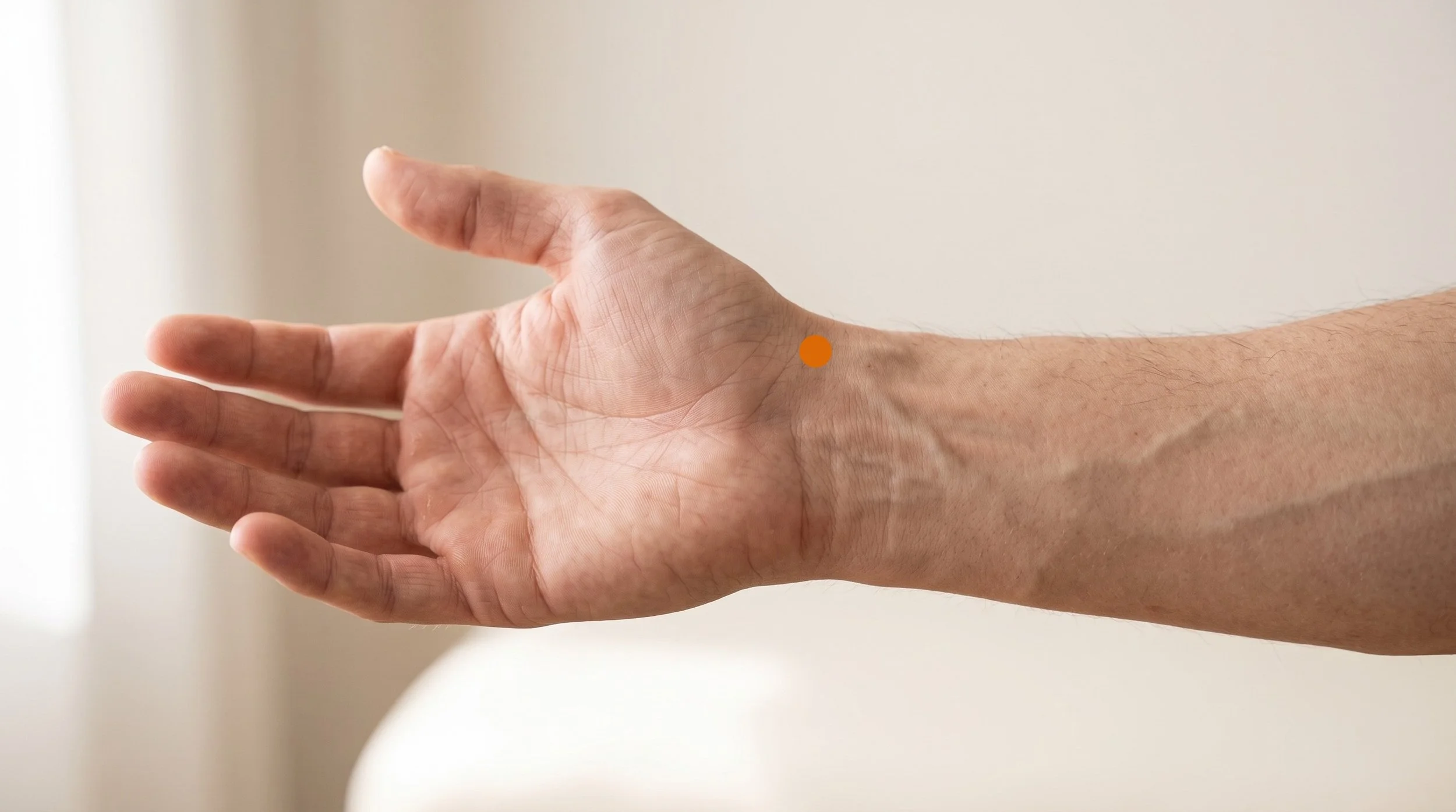
LU7 Acupuncture Point (Lieque)
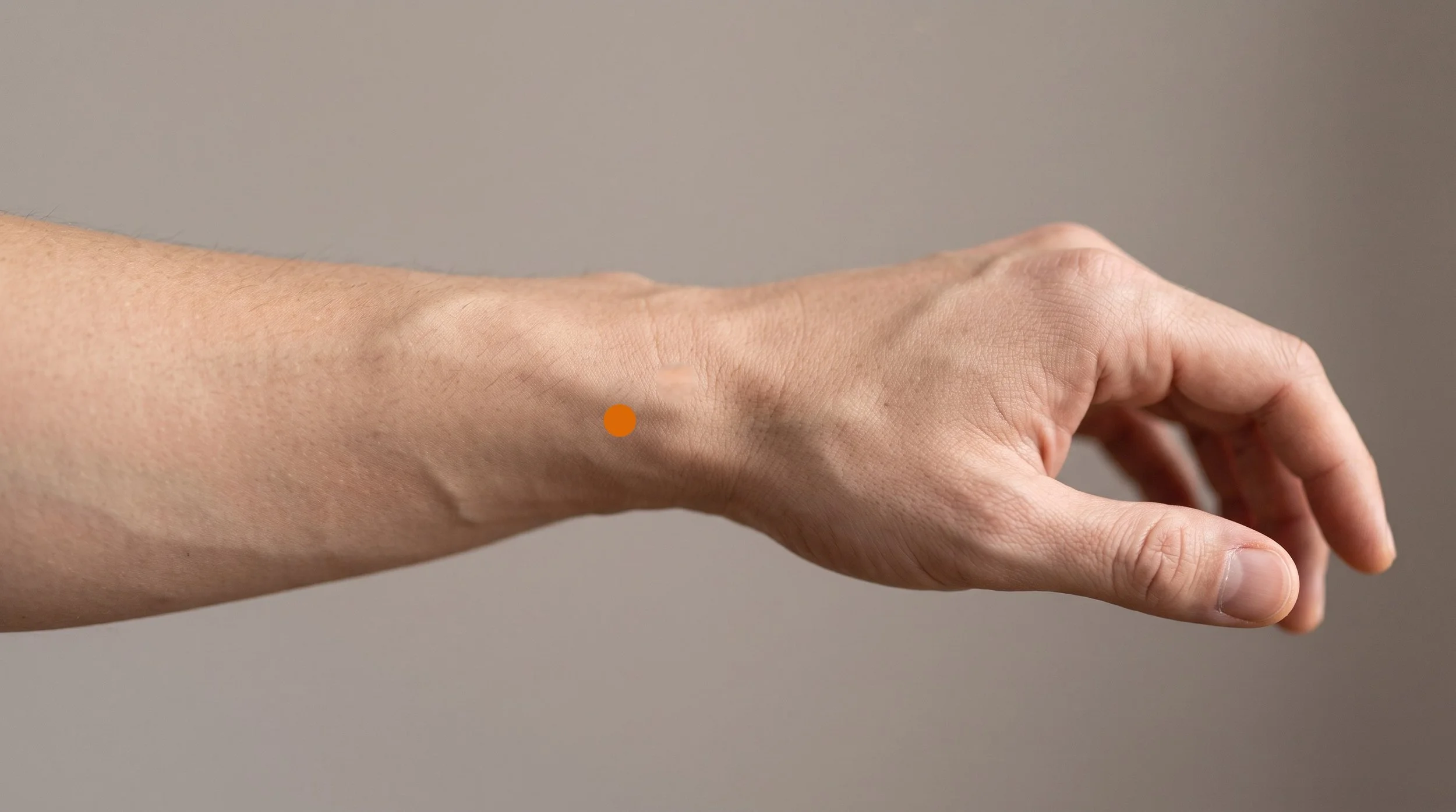
LU7 Acupuncture Point
Broken Sequence at the Radial Wrist: Anatomy, Mechanism, and Why a Forearm Point Anchors Neck, Headache, and Breathing Treatment
LU7 (Lieque, often translated as Broken Sequence and sometimes written as lung 7 or the lie que point) sits on the thumb side of the forearm, roughly one and a half cun above the wrist crease, just above the bony bump of the radial styloid in the small gap between the brachioradialis and abductor pollicis longus tendons. In traditional terms it carries an unusual amount of responsibility for a wrist point: it's the luo-connecting point of the Lung channel, the confluent point that opens the Conception Vessel, and one of the four command points, the one assigned to the head and nape. Clinically that means acupuncturists reach for it far from the forearm, for stiff necks, one-sided headaches, throat and sinus complaints, cough and breathing support, and for local thumb and wrist pain. The reason it stays in constant use has less to do with tradition than with where it lives: dense tendon and retinacular tissue directly over the superficial branch of the radial nerve, a location that reliably produces strong, radiating needle sensation.
- Location and layers: LU7 lies about 1.5 cun proximal to the wrist crease on the radial forearm, superior to the radial styloid process, in the cleft between the brachioradialis and abductor pollicis longus tendons. The needle passes through thin skin and superficial fascia into a tendinous, retinacular zone with very little muscle bulk, which is why the point feels sharper than most forearm points.
- Traditional categories, read neurophysiologically: the luo-connecting designation links the Lung channel with its paired Large Intestine channel, which does reach the face and head, and the command point of the head and nape designation reflects long empirical use for headache and cervical stiffness. Modern language for the same observation is heterosegmental modulation: distal input converges on spinal and brainstem circuits that also process neck and cranial afferents (Zhao, 2008).
- Nerve and mechanism story: the superficial branch of the radial nerve crosses this region, so needling recruits well myelinated and small diameter afferents that project to the C6 and C7 dorsal horn and onward to brainstem structures involved in descending pain control, including serotonergic and noradrenergic pathways and endogenous opioid release (Zhao, 2008).
- Research picture: reviews test multi-point protocols rather than LU7 alone. Pooled individual patient data support small to moderate, durable effects of acupuncture for chronic musculoskeletal pain including neck pain (Vickers et al., 2018), a Cochrane review of neck disorders found moderate-quality evidence for short-term relief compared with sham (Trinh et al., 2016), and a more recent review reported sustained adjunctive benefit at three and six months while showing no clear separation from sham (Fang et al., 2024).
- Headache and respiratory context: Cochrane reviews support acupuncture for episodic migraine prophylaxis, judged at least non-inferior to prophylactic drug treatment, and for tension-type headache prevention (Linde et al., 2016a; Linde et al., 2016b). LU7 also appears in respiratory protocols, and a 2025 meta-analysis of acupuncture-based care in COPD reported improvements in walking distance and spirometry with mostly moderate-quality trials (Li et al., 2025).
- De qi and practice framing: needling is usually oblique or nearly transverse, directed proximally toward the elbow, about 0.5 to 1 cun, with the skin pinched up and the cephalic vein avoided. Patients commonly report a distinctly electric, buzzing sensation running toward the thumb or up the forearm, and a brief ache that settles within seconds.
Stiff Neck That Won't Turn or Headaches That Start at the Base of the Skull?
At Morningside Acupuncture we treat neck stiffness and headache as one problem with several layers, from cervical joint irritation to upper trapezius and scalene tension. LU7 is one of the distal points we use to get range of motion moving before we needle the neck itself, often paired with LI4 and with local points in the suboccipital region. Patients can usually rotate and side-bend further within the same visit, which makes the local work far more comfortable. Book a session and we'll map your pattern before a single needle goes in.
Schedule NowAnatomy of LU7: Why the Radial Styloid Cleft Is Such an Important Location
Slide a fingertip from the anatomical snuffbox straight up over the full length of the radial styloid and it drops into a small groove. That groove is LU7, bounded by the tendon of brachioradialis toward the forearm midline and the abductor pollicis longus tendon on the thumb side, with the extensor pollicis brevis tendon running alongside. Underneath is the periosteum of the radius and the thickened fascia and retinaculum that hold these tendons against bone. This is a load-bearing corner of the arm. Every gripping, twisting, wringing, and thumb-abducting task tensions the same tissue, which is why repetitive keyboard use, tool work, racket sports, and hours of holding a phone leave this area sore and stiff. Because there's minimal muscle padding, the tissue here transmits mechanical stimulus efficiently and gives the clinician immediate, unambiguous feedback.
The nerve geography is what makes LU7 clinically interesting. The superficial branch of the radial nerve emerges from beneath brachioradialis and crosses this region on its way to the dorsal thumb and web space, carrying afferents that enter the spinal cord at roughly C6 and C7. Needling at LU7 recruits both larger myelinated fibers and smaller nociceptive afferents, and that barrage does two things. Locally, it produces segmental inhibition at the dorsal horn levels that also serve the lateral neck, shoulder girdle, and radial forearm, which is one plausible reason a wrist point may ease cervical stiffness. Systemically, sustained afferent input engages descending inhibitory control from the midbrain and brainstem, with serotonergic, noradrenergic, and endogenous opioid mediation described across animal and human work (Zhao, 2008). Cranial complaints add a second route: the trigeminocervical complex receives convergent input from upper cervical segments, which offers a mechanism for how neck-directed treatment may influence headache patterns (Linde et al., 2016b).
The main safety structure here is vascular. The cephalic vein runs superficially across the radial forearm near LU7, and the radial artery lies more medially near LU9, so both are respected by the standard technique: pinch the skin up, angle the needle obliquely or nearly transversely along the forearm rather than plunging perpendicular, and insert about 0.5 to 1 cun proximally toward the elbow. Some texts favor a shallower oblique insertion of 0.3 to 0.5 cun. Needling toward the hand is traditionally described when the goal is thumb and wrist pain rather than head, neck, or chest symptoms. Expected sensation is strong and electric rather than dull, so a slow, controlled insertion and a check-in with the patient matter more here than at bulkier points.
Related Best Acupuncture Points For Neck Pain Related Best Acupuncture Points For HeadachesLU7 at a Glance: Classification, Location, and Clinical Use
| Category | Detail |
|---|---|
| Traditional Name | Lieque (Broken Sequence), an old term for lightning, sometimes rendered as Branching Cleft |
| Channel Classification | Seventh point of the Lung channel of Hand Taiyin (Lung channel) |
| Point Categories | Luo-connecting point of the Lung channel; confluent (opening) point of the Conception Vessel, paired with KI6; command point of the head and nape in Gao Wu's grouping of four command points; one of Ma Dan-yang's heavenly star points |
| Precise Location | Radial aspect of the forearm, about 1.5 cun proximal to the wrist crease and roughly 1.5 cun above LI5, superior to the styloid process of the radius, in the cleft between the brachioradialis and abductor pollicis longus tendons |
| Tissue Stimulated | Skin, superficial fascia, and retinacular tissue over the radial styloid, adjacent to the brachioradialis tendon and the abductor pollicis longus and extensor pollicis longus and brevis tendons; superficial branch of the radial nerve; cephalic vein nearby |
| Needle Depth / Direction | Oblique to nearly transverse insertion 0.5 to 1 cun directed proximally toward the elbow (0.3 to 0.5 cun in shallower approaches), skin pinched up, cephalic vein avoided; directed distally toward the hand when treating thumb and wrist pain |
| De Qi Sensation | Sharp, electric, or buzzing sensation that often radiates toward the thumb or travels up the forearm, sometimes with a brief local ache; the classical name referencing lightning may reflect exactly this |
| Primary Clinical Uses | Neck stiffness and restricted cervical rotation, headache including one-sided headache, cough and breathing support, throat and nasal complaints, radial-side wrist and thumb pain |
| Common Point Combinations |
|
In the classical literature summarized by Deadman, Al-Khafaji, and Baker, LU7 is credited with releasing the exterior and dispersing wind, restoring the Lung's descending function, settling wind and phlegm, benefiting the head and nape, opening and regulating the Conception Vessel, governing the water passages, and freeing the channel to ease pain. Its traditional indication lists are unusually broad and cluster into a few themes: acute exterior patterns with chills, fever, and nasal symptoms; cough, wheeze, and shortness of breath; head and face complaints such as one-sided headache, neck and nape stiffness, toothache, facial deviation, and lockjaw; urinary and lower abdominal problems by way of the Conception Vessel; a small group of psycho-emotional signs including poor memory, shared with the luo points of the other yin channels; and local pain of the wrist, thumb, and shoulder. Three separate classical groupings, Ma Dan-yang's heavenly star points, Gao Wu's four command points, and the eight confluent point methods of the Ode of the Obstructed River, each single LU7 out specifically for the head region. What makes that convergence striking is that the Lung channel itself never rises above the throat, so the classical authors were describing an effect their own channel map didn't predict, and they explained it through the point's bridge to the Large Intestine channel and through wind's tendency to strike the upper body.
Why LU7 Is Used for Neck Stiffness and Headache When It Sits at the Wrist
Patients reasonably ask how a needle above the wrist could change a neck that won't turn. The most useful answer is convergence. Afferents from the LU7 region travel with the superficial radial nerve into the C6 and C7 spinal segments, and those same segments receive input from the lateral neck, shoulder girdle, and upper limb. Input arriving from one part of a segment can dampen the excitability of neurons processing pain from another part, so distal needling gives us a way to reduce protective muscle guarding before we touch tissue that's already irritable (Zhao, 2008). In practice this often looks unremarkable and works well: we needle LU7, ask for a few slow rotations, and cervical range improves enough that local needling and manual work become tolerable.
The second layer is descending inhibition. Sustained needle stimulation, with or without electrical stimulation, activates midbrain and brainstem circuits that project back down the cord and turn the volume down on incoming pain signals, using serotonergic, noradrenergic, and endogenous opioid mechanisms (Zhao, 2008). This is a system-wide effect rather than a local one, which is part of why treatment sessions often leave patients relaxed and slightly sleepy, and why effects on pain can outlast the appointment. Pooled individual patient data across chronic pain conditions including neck pain show modest effects that persist over months rather than fading immediately after the treatment course (Vickers et al., 2018), and a review focused specifically on durability found sustained adjunctive benefit for chronic neck pain at three and six months (Fang et al., 2024).
For headache, a third pathway matters. Upper cervical afferents converge with trigeminal input in the trigeminocervical complex, which is why neck tension and headache so often travel together and why treatment aimed at the neck may change headache frequency. Cochrane reviews report benefit for episodic migraine prophylaxis, described as at least non-inferior to standard prophylactic medication, and a small but real advantage over sham for tension-type headache prevention (Linde et al., 2016a; Linde et al., 2016b). LU7 is one point inside those broader protocols, not the reason they work, and we frame it that way with patients.
What the Research Shows for LU7
It's worth being clear about what the evidence can and cannot say. No high-quality trial isolates LU7 as a stand-alone treatment, and the reviews below tested full protocols in which LU7 was one of several points, usually alongside local cervical, cranial, or thoracic points. What the research supports is the treatment approach LU7 belongs to, not the point in isolation. Effect sizes for pain are typically small to moderate, comparisons with sham needling are often narrower than comparisons with usual care, and trial quality is uneven, especially in respiratory research. That's a reasonable basis for using acupuncture as part of care for neck pain, headache, and breathing support, and not a basis for promising specific outcomes.
| Study | Type | Focus | Key Finding |
|---|---|---|---|
| Vickers et al., 2018 | Individual patient data meta-analysis | Chronic musculoskeletal pain, including neck pain, headache, and osteoarthritis | Acupuncture outperformed both sham and no-acupuncture controls, with modest effects that appeared to persist rather than disappear immediately after treatment ended. |
| Trinh et al., 2016 | Cochrane systematic review (since withdrawn pending update) | Acupuncture for mechanical neck disorders across 27 randomized trials | Moderate-quality evidence suggested better pain relief than sham at treatment completion and short-term follow-up, with less pain and disability than wait-list control. |
| Fang et al., 2024 | Systematic review and meta-analysis | Durability of acupuncture effects in chronic neck pain, 18 randomized trials | As an adjunct to usual care, acupuncture was associated with sustained pain relief at three and six months, though it didn't separate significantly from sham acupuncture. |
| Linde et al., 2016a | Cochrane systematic review | Acupuncture for prevention of episodic migraine | Acupuncture reduced headache frequency compared with sham and usual care, and was judged at least non-inferior to prophylactic drug treatment at three months. |
| Linde et al., 2016b | Cochrane systematic review | Acupuncture for prevention of tension-type headache | Adding acupuncture to routine care reduced headache frequency, with a small but statistically significant advantage over sham needling. |
| Li et al., 2025 | Systematic review and meta-analysis | Acupuncture-based treatment in chronic obstructive pulmonary disease, 25 trials | Pooled results favored acupuncture-based care for six-minute walk distance, breathlessness ratings, FEV1, and FVC, though most included trials were of moderate quality. |
| Zhao, 2008 | Narrative review of experimental mechanism research | Neural pathways underlying acupuncture analgesia | Needle stimulation engages spinal segmental inhibition plus descending serotonergic, noradrenergic, and opioid-mediated control, offering a plausible basis for effects distant from the needled site. |
Wrist and Thumb Pain From Typing, Lifting, or Holding a Phone All Day?
The radial wrist takes a beating in New York City work and commuting life, and LU7 sits directly in the tissue that complains: the first dorsal compartment tendons and the brachioradialis region. We combine gentle needling at LU7 with dry needling of forearm muscles that refer pain into the thumb, plus loading advice so the tissue tolerates your actual day. Our acupuncturists are licensed and trained in both traditional channel theory and orthopedic assessment. Schedule an evaluation and we'll tell you honestly what we expect from care.
Schedule NowLU7 in the Context of Trigger Point Work
At Morningside Acupuncture, LU7 rarely travels alone. For neck stiffness we use it as a distal opener and then dry needle the muscles actually generating the complaint: upper trapezius, the levator scapulae attachment near the superior angle, the scalenes, and the suboccipital group when headache is part of the picture. For radial wrist and thumb pain we work closer to the point itself, needling brachioradialis, the abductor pollicis longus and extensor pollicis brevis region of the first dorsal compartment, extensor pollicis longus, and flexor pollicis longus, since referral from these muscles frequently lands exactly where patients point when they say the thumb side of the wrist hurts.
There's real overlap between the point location and myofascial targets here, which is a practical advantage. LU7 sits at the interval between the brachioradialis and abductor pollicis longus tendons, so the same access window used for the classical point lets us assess tenderness, tendon glide, and taut bands in the adjacent muscle bellies. When forearm tissue is highly reactive we keep LU7 shallow and oblique and do the heavier work proximally, then reassess grip and thumb movement in the same visit. The point is used as a bridge between channel-based selection and anatomy-based needling, not as a substitute for either.
LU7 Neck Pain and Headache Treatment at NYC's Highest-Rated Acupuncture Clinic
Morningside Acupuncture is the highest-rated acupuncture and dry needling clinic in New York City with over 500 five-star Google reviews, and points like LU7 are part of nearly every neck and headache treatment plan we build. Sessions blend classical point selection with trigger point dry needling, movement retraining, and clear expectations about how many visits you're likely to need. Whether your complaint is a locked neck, recurring migraines, a nagging cough, or thumb-side wrist pain, we'll build a plan around it. Schedule your visit at our Midtown Manhattan office and get started this week.
Schedule NowFrequently Asked Questions
What does LU7 feel like when needled?
Most patients describe something distinctly electric: a quick buzz, tingle, or zing that runs toward the thumb or travels up the forearm, sometimes with a short-lived local ache or heaviness. Because there's little muscle padding over the radial styloid, the sensation tends to be sharper and more immediate than at fleshier points like ST36. It should be strong but tolerable, and it usually settles within a few seconds. Persistent burning or a jolt that keeps repeating means the needle needs adjusting, so speak up rather than waiting it out.
Why treat a stiff neck or headache at the wrist instead of the neck itself?
Two reasons, one practical and one physiological. Practically, an irritable neck often guards against direct pressure, so getting range of motion moving from a distance first makes local treatment much more comfortable. Physiologically, afferents from the LU7 area enter the spinal cord at levels that also receive input from the neck and shoulder girdle, and needle input at one part of a segment can reduce excitability in circuits processing pain elsewhere in that segment, alongside broader descending inhibition from the brainstem (Zhao, 2008). Classical sources arrived at the same clinical habit from a different direction, listing LU7 as the command point of the head and nape. In most sessions we use both distal and local points rather than choosing between them.
Can I press LU7 myself between sessions?
Yes, and it's one of the easier points to find on yourself. Turn your palm toward the ceiling, then run a fingertip from the base of your thumb up over the bony ridge of the wrist until it drops into a small groove roughly two finger-widths above the wrist crease, between two tendons. Press with the pad of your thumb using firm but comfortable pressure, about a 4 or 5 out of 10, holding for 30 to 60 seconds and repeating two or three times per side. Small circular pressure works too. For a stiff neck, press one side while slowly turning your head toward the tight direction, up to your comfortable limit. Two or three short rounds a day is plenty. Stop if you get sharp shooting pain into the thumb, and don't press hard over a vein you can see.
Is LU7 safe to needle?
In trained hands, yes, with a few specifics. The cephalic vein runs superficially in this area and the radial artery lies closer to the wrist crease toward LU9, so the standard technique lifts the skin and angles the needle obliquely or nearly transversely along the forearm rather than perpendicular into the wrist. Depth is modest, generally 0.5 to 1 cun proximally. Because the superficial radial nerve crosses here, brief electric sensations are expected, but sustained radiating pain means repositioning. Minor bruising is the most common side effect and matters more for people on blood thinners. LU7 is also a Conception Vessel confluent point with traditional gynecological indications, so if you're pregnant or trying to conceive, tell your acupuncturist so point selection can be adjusted. Always seek care from a licensed acupuncturist using sterile single-use needles.
Where exactly is LU7 located?
On the radial (thumb) side of the forearm, about 1.5 cun proximal to the wrist crease and roughly 1.5 cun above LI5 in the anatomical snuffbox, sitting just above the styloid process of the radius in the cleft between the brachioradialis and abductor pollicis longus tendons. The reliable way to find this lu 7 point location is to place a fingertip in the snuffbox and slide it straight up over the entire length of the radial styloid until it falls into a small depression. Cross-check it: the spot should be tender to moderate pressure, and it should sit between two palpable tendons rather than on top of bone.
References
- Deadman, P., Al-Khafaji, M., & Baker, K. (2009). A manual of acupuncture. Journal of Chinese Medicine Publications.
- Maciocia, G. (2005). The foundations of Chinese medicine: A comprehensive text for acupuncturists and herbalists (2nd ed.). Elsevier Churchill Livingstone.
- Maciocia, G. (2006). The channels of acupuncture: Clinical use of the secondary channels and eight extraordinary vessels. Churchill Livingstone Elsevier.
- O'Connor, J., & Bensky, D. (Eds. & Trans.). (1981). Acupuncture: A comprehensive text. Shanghai College of Traditional Medicine. Eastland Press.
- Kim, H. (2008). Handbook of Oriental medicine (3rd ed.). Harmony & Balance Press.
- Filshie, J., White, A., & Cummings, M. (Eds.). (2016). Medical acupuncture: A Western scientific approach (2nd ed.). Elsevier.
- Zhao, Z. Q. (2008). Neural mechanism underlying acupuncture analgesia. Progress in Neurobiology, 85(4), 355-375. https://doi.org/10.1016/j.pneurobio.2008.05.004
- Vickers, A. J., Vertosick, E. A., Lewith, G., MacPherson, H., Foster, N. E., Sherman, K. J., Irnich, D., Witt, C. M., & Linde, K. (2018). Acupuncture for chronic pain: Update of an individual patient data meta-analysis. Journal of Pain, 19(5), 455-474. https://doi.org/10.1016/j.jpain.2017.11.005
- Trinh, K., Graham, N., Irnich, D., Cameron, I. D., & Forget, M. (2016). Acupuncture for neck disorders. Cochrane Database of Systematic Reviews, 2016(5), CD004870. https://doi.org/10.1002/14651858.CD004870.pub4
- Fang, J., Shi, H., Wang, W., Chen, H., Yang, M., Gao, S., Yao, H., Zhu, L., Yan, Y., & Liu, Z. (2024). Durable effect of acupuncture for chronic neck pain: A systematic review and meta-analysis. Current Pain and Headache Reports, 28(9), 957-969. https://doi.org/10.1007/s11916-024-01267-x
- Linde, K., Allais, G., Brinkhaus, B., Fei, Y., Mehring, M., Vertosick, E. A., Vickers, A., & White, A. R. (2016a). Acupuncture for the prevention of episodic migraine. Cochrane Database of Systematic Reviews, 2016(6), CD001218. https://doi.org/10.1002/14651858.CD001218.pub3
- Linde, K., Allais, G., Brinkhaus, B., Fei, Y., Mehring, M., Shin, B. C., Vickers, A., & White, A. R. (2016b). Acupuncture for the prevention of tension-type headache. Cochrane Database of Systematic Reviews, 2016(4), CD007587. https://doi.org/10.1002/14651858.CD007587.pub2
- Li, M., Zheng, S., Lederer, A. K., & Huber, R. (2025). Efficacy of acupuncture-based treatment in chronic obstructive pulmonary disease: A systematic review and meta-analysis. Complementary Therapies in Medicine, 93, 103211. https://doi.org/10.1016/j.ctim.2025.103211
Disclaimer: This web site is intended for educational and informational purposes only. Reading this website does not constitute providing medical advice or any professional services. This information should not be used for diagnosing or treating any health issue or disease. Those seeking medical advice should consult with a licensed physician. Seek the advice of a medical doctor or other qualified health professional for any medical condition. If you think you have a medical emergency, call 911 or go to the emergency room. No acupuncturist-patient relationship is created by reading this website or using the information. Morningside Acupuncture PLLC and its employees and contributors do not make any express or implied representations with respect to the information on this site or its use. For any legal interpretation of scope of practice in your state, consult a licensed attorney or regulatory authority.
Read more from our blog