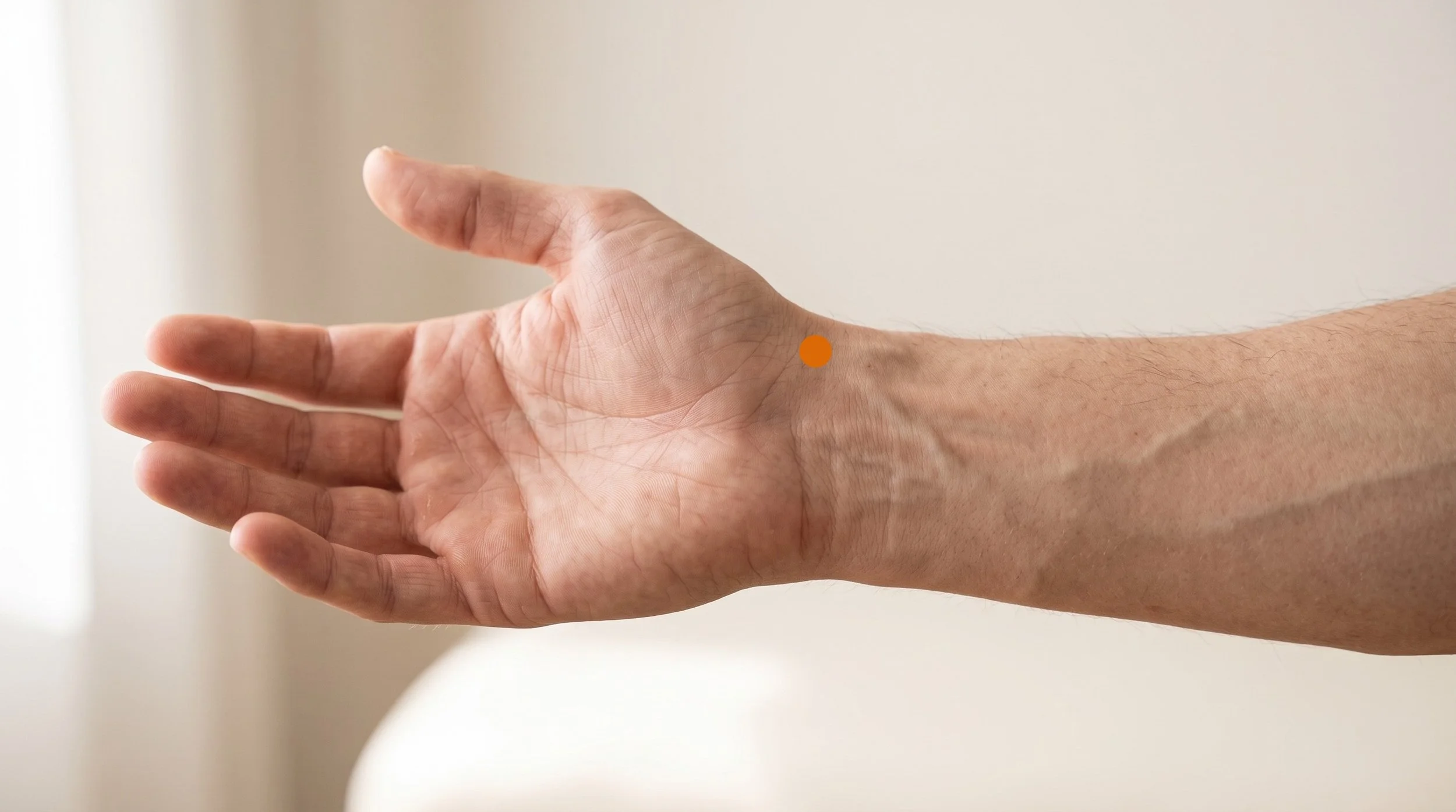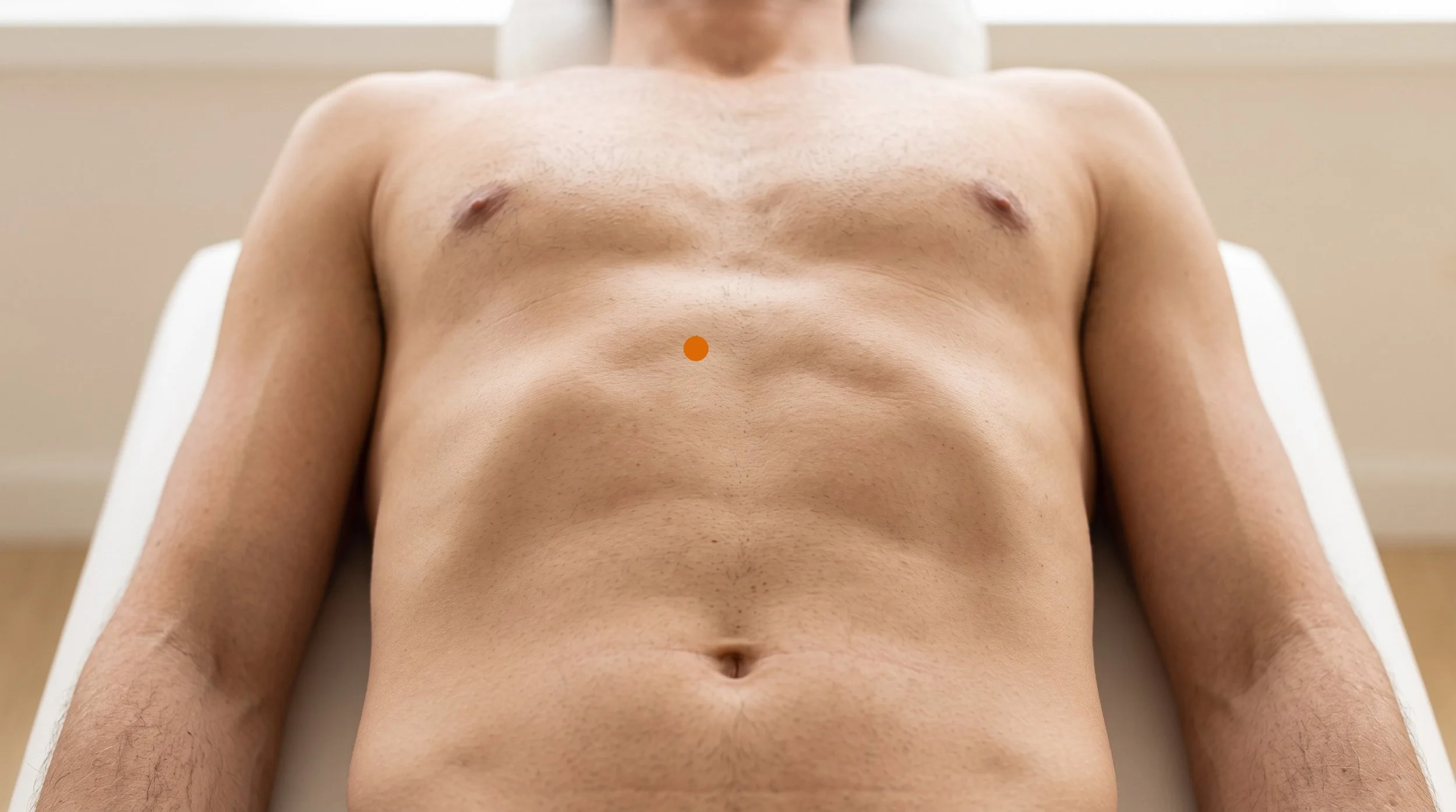
KD21 Acupuncture Point (Youmen)
The Hidden Gate Beneath the Ribs: Anatomy, Mechanism, and Why This Upper Abdominal Kidney Point Is Used for Nausea, Epigastric Fullness, and Rib Pain
KD21 (Youmen), also written KI21, often translated as Hidden Gate or Hidden Door, is the highest abdominal point on the Kidney channel, sitting 6 cun above the navel and just 0.5 cun to the side of the midline, level with CV14 and tucked under the point of the breastbone inside the costal angle. In classical texts it's described as the final meeting point of the Kidney channel with the Penetrating vessel, and the name itself is worth noting: in modern Chinese, Youmen is the anatomical word for the pylorus, the outlet valve of the stomach.
Clinically, the KI21 acupuncture point matters because it sits directly over the upper abdominal wall at the same spinal segments that carry sensation from the stomach, duodenum, and lower esophagus, which is why kidney 21 shows up in traditional treatment of nausea, retching, epigastric fullness, loss of appetite, and rib-side or lower chest discomfort that tracks toward the back.
- Location and layers: KI 21 lies on the upper abdomen, 6 cun above the umbilicus and half a cun lateral to the midline beside CV14, where a needle passes skin, a thin fat layer, and the medial fibers of rectus abdominis inside its sheath, immediately below the xiphoid and the costal angle.
- Traditional categories, translated: the point manuals classify Youmen as a crossing point of the Kidney channel with the Penetrating vessel, and traditionally credit it with harmonizing the Stomach, directing rebellious (upward-moving) qi downward, and freeing the chest and rib region. In modern terms, those descriptions map onto segmental modulation of upper gastrointestinal afferent input and abdominal wall tone (Uchida et al., 2017).
- Nerve geography: the KI 21 abdomen site is supplied by anterior cutaneous branches of the lower thoracoabdominal nerves (roughly T6 to T8), the same cord segments that receive stomach and duodenal afferents traveling in the greater splanchnic nerve, so needling here converges with visceral input rather than acting at a distance (Ma, 2020).
- Mechanism: needling body wall points can trigger somato-autonomic reflexes that alter gastric motility and secretion, and abdominal points appear to recruit different autonomic pathways than limb points do, which may explain why local epigastric needling behaves differently from distal antiemetic points (Uchida et al., 2017; Ma, 2020).
- Research picture: a Cochrane review of acupuncture for functional dyspepsia found some symptom and quality of life signals but rated the trials as limited (Lan et al., 2014), and mechanistic reviews report shifts in gastric accommodation, motility, and autonomic balance alongside symptom change (Guo et al., 2020). Nothing here is point-specific for Youmen acupuncture, so claims stay modest.
- De qi at KD21 is usually a dull, spreading pressure or heaviness under the ribs, sometimes a warm ache that drifts toward the back or a soft twitch of the abdominal wall. Sharp, electric, or radiating sensations mean the needle should be withdrawn and repositioned.
Struggling With Nausea, Reflux Sensations, or Constant Fullness After Meals?
Upper abdominal discomfort rarely responds to a single point, and we don't treat it that way. At Morningside Acupuncture we use KD21 alongside points like CV12, PC6, and ST36, combined with careful palpation of the epigastrium and costal margin, to address both the gut symptoms and the guarded, braced abdominal wall that often accompanies them. Sessions are calm, precise, and built around your history rather than a template. Schedule a visit and let's map out what's actually driving your symptoms.
Schedule NowAnatomy of KD21: Why the Upper Abdomen Beneath the Xiphoid Is Such an Important Location
KD21 sits high on the abdomen, a finger's width off the midline and level with CV14, right where the two costal margins converge under the tip of the sternum. A needle placed here passes through skin, a thin subcutaneous layer, and then the medial fibers of rectus abdominis close to the linea alba, all wrapped in the rectus sheath.
This is loaded tissue in daily life: the diaphragm attaches around the costal margin just above, the upper rectus works during every cough, sit-up, and forward-bent hour at a desk, and chronic bracing (from stress, reflux, or post-surgical guarding) tends to concentrate exactly in this band. Patients with epigastric complaints often present with a hard, tender, breath-holding upper abdomen long before anything shows on imaging.
The nerve supply explains most of the point's clinical behavior. The skin and muscle here are innervated by anterior cutaneous branches of the lower thoracoabdominal nerves, roughly the T6 to T8 segments, and those same spinal levels receive visceral afferents from the stomach, duodenum, and lower esophagus traveling in the greater splanchnic nerve. Somatic and visceral fibers converge on shared dorsal horn neurons, which is the standard explanation for why stomach irritation is felt as epigastric ache and why needling the abdominal wall can influence how that segment processes input.
Beyond the segmental level, needling recruits endogenous opioid and descending inhibitory pathways that dampen dorsal horn transmission more broadly (Zhao, 2008), and somatic stimulation of the trunk can reflexively modulate autonomic output to the gut through somato-autonomic reflex arcs (Uchida et al., 2017; Ma, 2020).
Depth discipline matters more at KD21 than at almost any other Kidney channel point. Deep to the abdominal wall lie the peritoneum, the stomach, and, under the right-sided point, the left lobe of the liver, and the superior epigastric vessels run within the rectus sheath nearby. The Deadman manual gives 0.5 to 1 cun perpendicular and warns explicitly that deep needling in thin patients risks the liver on the right and the peritoneum on the left.
In practice we needle shallower than the textbook maximum, angle slightly away from the costal margin, adjust for body composition, and avoid the point entirely in pregnancy, with hepatomegaly, hernia, recent abdominal surgery, or any undiagnosed acute abdominal pain.
Related Kidney Channel Related PC6 Acupuncture PointKD21 (KI21) at a Glance: Classification, Location, and Clinical Use
| Category | Detail |
|---|---|
| Traditional Name | Youmen (Hidden Gate, also rendered Hidden Door); the same word names the pylorus in modern Chinese |
| Channel Classification | Kidney channel of the Foot Shao Yin, point 21 of 27, the last of the abdominal points before the channel enters the chest (KD21, also written KI21) |
| Point Categories | Meeting (crossing) point of the Kidney channel with the Penetrating vessel (Chong Mai); the final Penetrating vessel point on the Kidney channel's abdominal run, which begins at KD11 and ends here |
| Precise Location | Upper abdomen, 6 cun above the center of the umbilicus and 0.5 cun lateral to the anterior midline, level with CV14, just below the xiphoid inside the costal angle |
| Tissue Stimulated | Skin and subcutaneous tissue, medial fibers of rectus abdominis within the rectus sheath, and the fascial interface with the external abdominal oblique as it blends toward the midline |
| Needle Depth / Direction | Perpendicular 0.5 to 1 cun per the classical range, typically needled shallower and slightly obliquely in thin patients; never angled deeply toward the right costal margin, where the liver lies beneath |
| De Qi Sensation | Dull, heavy pressure or spreading fullness under the ribs, occasionally a warm ache tracking toward the mid-back; sharp, electric, or breath-catching sensation means reposition |
| Primary Clinical Uses | Nausea, retching and vomiting, epigastric fullness with poor appetite or early satiety, reflux-type discomfort, chest and rib pain that radiates to the back, and a guarded, tender upper abdominal wall |
| Common Point Combinations |
|
The commentary in Deadman's point manual frames KD21 through the Classic of Difficulties, which describes disease of the Penetrating vessel as counterflow qi together with abdominal urgency. Counterflow means anything moving upward that should be moving down: nausea, retching, vomiting, cough. Abdominal urgency refers to acute cramping, historically tied to dysenteric conditions.
Because Youmen is the last of the Kidney channel points that intersect the Penetrating vessel, the classical sources give it that whole cluster, and they add fullness below the heart with no pleasure in eating, chest and rib pain radiating to the back, and, more unexpectedly, poor memory and redness of the eyes starting at the inner corner. That eye indication is shared across nearly all the abdominal Penetrating vessel points, and the manual notes that many depictions of the vessel show it terminating near the inner eye rather than the lips.
What's striking is the internal consistency: a group of points on one vessel carries one coherent symptom set from abdomen to eye, which is exactly the kind of pattern-level thinking that classical point selection rests on, presented here as traditional attribution rather than verified physiology.
Why KD21 Is Used for Chest and Rib Pain That Radiates to the Back
Patients are often surprised that a point on the belly is chosen for discomfort felt under the ribs, across the lower chest, or between the shoulder blades. The segmental map makes it less mysterious. The tissue at KD21 is supplied by the T6 to T8 nerves, and those nerves wrap the trunk like bands: the same segment that innervates this patch of abdominal wall also innervates the corresponding strip of rib cage and back. Add the visceral afferents from the stomach and duodenum entering at those same levels, and you have three inputs (skin, muscle, viscera) sharing dorsal horn real estate.
When one input is irritated, the whole segment can become sensitized, and pain gets reported anywhere along the band. Needling the accessible front end of that band gives the nervous system a strong, well-localized competing input.
Two mechanisms are usually invoked. The first is descending inhibition: needle stimulation activates brainstem-mediated pathways and endogenous opioid systems that reduce transmission through the dorsal horn, an effect documented across decades of experimental work (Zhao, 2008).
The second is autonomic: somatic stimulation of the trunk can reflexively change gastric motility, secretion, and blood flow through somato-autonomic reflex arcs, and the effect appears to depend on where you stimulate and how strongly, with abdominal sites behaving differently from limb sites (Uchida et al., 2017; Ma, 2020). For a patient whose rib pain rides along with bloating, early fullness, or nausea, both mechanisms are plausibly in play at once.
None of this makes KD21 a standalone treatment. It's a segmentally sensible local point that we add when the exam points to the epigastric band, and we still expect the bulk of the clinical work to come from the full protocol, the manual therapy, and the behavioral pieces around meals, breathing, and stress.
What the Research Shows for KD21 (KI21)
One note on naming before the evidence: in the research literature this point is almost always listed as KI21, the WHO standard code, rather than KD21, so KI21 is the term to search if you want to read the studies below in full.
There's no clinical trial isolating Youmen, and it would be misleading to imply otherwise. What exists is research on multi-point acupuncture protocols for upper gastrointestinal complaints, on acupoint stimulation for nausea and vomiting, and on the physiology that would let an abdominal point influence gut function at all. KD21 appears inside protocols rather than as the tested variable, so the honest framing is that the evidence supports the approach in which this point participates, not the point by itself. Quality across this literature is uneven, and the more rigorous reviews are consistently cautious.
| Study | Type | Focus | Key Finding |
|---|---|---|---|
| Lan et al., 2014 | Cochrane systematic review | Manual acupuncture and electroacupuncture for functional dyspepsia | Reviewers found some signals for symptom and quality of life improvement, but rated trial quality as low enough that firm conclusions weren't possible. |
| Guo et al., 2020 | Systematic review of clinical and mechanistic studies | Acupuncture and electroacupuncture in functional dyspepsia | Reports changes in gastric accommodation, motility, and autonomic measures alongside symptom improvement, though designs and stimulation parameters vary widely. |
| Lee et al., 2025 | Cochrane network meta-analysis | PC6 acupoint stimulation for postoperative nausea and vomiting | Suggests acupoint stimulation combined with antiemetics may reduce nausea and vomiting compared with sham, with uncertainty about minor adverse effects. |
| Uchida et al., 2017 | Narrative physiology review | Somatoautonomic reflexes underlying needling of the body wall | Describes how somatic afferent input can reflexively alter visceral function, while cautioning that most data come from anesthetized animals. |
| Ma, 2020 | Neuroanatomy review | Acupoint location, stimulation intensity, and autonomic pathway selectivity | Argues that abdominal and limb points can drive different autonomic reflexes, which may explain site-dependent effects on gut motility. |
| Vickers et al., 2018 | Individual patient data meta-analysis | Acupuncture for chronic pain conditions | Effects were modest but statistically significant against sham and no-acupuncture controls, and persisted over follow-up. |
Rib and Lower Chest Tightness That Travels Into Your Back?
Pain that wraps from beneath the ribs toward the mid-back is a classic indication for KD21, and it's also a pattern where abdominal wall trigger points, breathing mechanics, and visceral irritation overlap. Our clinicians assess all three before choosing needles, then pair Youmen with dry needling of rectus abdominis and the obliques when the tissue exam supports it. Most patients notice easier breathing and less bracing within a few sessions. Book an evaluation to get a clear plan.
Schedule NowKD21 in the Context of Trigger Point Work
The upper abdominal wall is one of the more underappreciated sources of epigastric symptoms. Trigger points in the upper fibers of rectus abdominis can refer pain horizontally across the mid-back and produce a heartburn-like or nauseated sensation, and points in the external oblique near the costal margin can generate the same epigastric burning, sometimes described by patients as indigestion that antacids don't touch (Simons et al., 1999). KD21 sits squarely within that territory, which means the same needle insertion can serve as a classical point and as a myofascial target depending on what palpation reveals.
We assess before deciding: if firm pressure at the point reproduces the patient's familiar ache, the muscular contribution is real and worth treating directly.
In a typical Morningside session for this presentation, KD21 is one element among several. We might needle the upper rectus abdominis and the oblique attachments along the costal margin, add CV12 and ST36 for the digestive picture, use PC6 when nausea leads the complaint, and finish with diaphragm-focused breathing work so the treated tissue isn't immediately re-braced. Dry needling and acupuncture are the same tool here, an acupuncture needle, applied with different reasoning, and there's no conflict in using both frames in one visit. Abdominal needling is always done shallow and slow, with the patient's build, medical history, and any surgical scars accounted for first.
KD21 Digestive Discomfort Treatment at NYC's Highest-Rated Acupuncture Clinic
Morningside Acupuncture is the highest-rated acupuncture and dry needling clinic in New York City with over 500 five-star Google reviews, and our Upper West Side practice sees a steady stream of patients with nausea, bloating, appetite changes, and stress-linked digestive complaints. We combine classical point selection like KD21 and its traditional pairings with orthopedic assessment and modern dry needling of the abdominal wall. Every plan is explained in plain language, with realistic timelines and no overselling. Schedule your first session and we'll get started.
Schedule NowFrequently Asked Questions
Is KD21 the same point as KI21?
Yes. KD21 and KI21 are two abbreviations for the same point, Youmen, point 21 of the Kidney channel. KI is the WHO standard code and the one you will see in most textbooks and research papers. KD is the form used by many American schools and clinics. You will also come across it written as Kidney 21 or K21. Whichever code is used, the location and the uses are the same.
What does KD21 feel like when needled?
Most people feel a dull, spreading pressure or a sense of heaviness just under the ribs, sometimes with a warm ache that drifts toward the back or a soft flutter in the abdominal wall. Because the point sits over a sensitive area, we insert slowly and shallowly, and the sensation should build gently rather than arriving as a jolt. Sharp, electric, or breath-catching feelings aren't the goal and mean the needle gets adjusted right away. A mild sense of the stomach settling or gurgling during treatment is common and generally welcome.
Why needle the abdomen for nausea instead of just using PC6 on the wrist?
Both approaches are legitimate, and we often use them together. PC6 is a distal point with the largest research base for nausea and vomiting, working through pathways that don't share a spinal segment with the stomach. KD21 is a local point that sits over the same T6 to T8 segments carrying stomach and duodenal afferents, so it engages the problem segmentally and also treats the tight, guarded abdominal wall that so often accompanies chronic upper gut symptoms. Research suggests abdominal and limb points may recruit somewhat different autonomic reflexes (Ma, 2020), which is a good argument for using both rather than choosing between them.
Can I press KD21 myself between sessions?
Yes, and self-acupressure at kidney 21 is low risk when done gently. Find the tip of your breastbone, come down slightly into the soft area below it, then move about a thumb's width to either side of the midline. Use flat finger pads rather than a fingertip, press in slowly to a moderate, tolerable pressure, and hold for 30 to 60 seconds while breathing into your lower ribs. Repeat two or three times per side, once or twice a day, ideally not right after a large meal. Ease off if you feel sharp pain, pulsing, or lightheadedness, and skip it entirely if you're pregnant, have known liver enlargement, an abdominal hernia, or a recent abdominal surgery. Acupressure is a supplement to care, not a substitute for evaluating persistent digestive symptoms.
Is KD21 safe to needle?
In trained hands, yes, but it carries more depth-related caution than most points. The peritoneum lies just deep to the abdominal wall, and the left lobe of the liver sits beneath the right-hand point, which is why the classical manuals limit insertion to about 0.5 to 1 cun and warn against deep needling in thin patients. Practitioners adjust depth to body composition, angle away from the costal margin, and use clean technique throughout. We avoid the point during pregnancy, with organ enlargement, hernia, recent abdominal surgery, or undiagnosed acute abdominal pain, and any new or severe epigastric symptom deserves a medical workup before it's treated as a musculoskeletal or functional problem.
Where exactly is KD21 located?
KD21 is on the upper abdomen, 6 cun above the center of the navel and 0.5 cun lateral to the front midline, which places it level with CV14 and just below the xiphoid process inside the costal angle. Practically, that's roughly two-thirds of the way from the navel up to the base of the sternum, a thumb's width off center. There's a point on each side, and the right-side location is the one that sits over the liver, so needling technique differs slightly between them.
References
- Deadman, P., Al-Khafaji, M., & Baker, K. (2009). A manual of acupuncture. Journal of Chinese Medicine Publications.
- Maciocia, G. (2005). The foundations of Chinese medicine: A comprehensive text for acupuncturists and herbalists (2nd ed.). Elsevier Churchill Livingstone.
- Cunningham, P. M. (2000). Acupuncture points: A practical guide to classical and modern usage. Odyssey Press.
- Maciocia, G. (2006). The channels of acupuncture: Clinical use of the secondary channels and eight extraordinary vessels. Churchill Livingstone Elsevier.
- Simons, D. G., Travell, J. G., & Simons, L. S. (1999). Travell & Simons' myofascial pain and dysfunction: The trigger point manual, Vol. 1: Upper half of body (2nd ed.). Williams & Wilkins.
- Lan, L., Zeng, F., Liu, G. J., Ying, L., Wu, X., Liu, M., & Liang, F. R. (2014). Acupuncture for functional dyspepsia. Cochrane Database of Systematic Reviews, 2014(10), CD008487. https://doi.org/10.1002/14651858.CD008487.pub2
- Guo, Y., Wei, W., & Chen, J. D. Z. (2020). Effects and mechanisms of acupuncture and electroacupuncture for functional dyspepsia: A systematic review. World Journal of Gastroenterology, 26(19), 2440-2457. https://doi.org/10.3748/wjg.v26.i19.2440
- Lee, A., Zhang, J. Z., Xie, J., Cheng, V., Wong, M. K. H., & Yau, D. K. W. (2025). Stimulation of the wrist acupuncture point PC6 for preventing postoperative nausea and vomiting: A network meta-analysis. Cochrane Database of Systematic Reviews, 9(9), CD003281. https://doi.org/10.1002/14651858.CD003281.pub5
- Uchida, S., Kagitani, F., & Sato-Suzuki, I. (2017). Somatoautonomic reflexes in acupuncture therapy: A review. Autonomic Neuroscience, 203, 1-8. https://doi.org/10.1016/j.autneu.2016.11.001
- Ma, Q. (2020). Somato-autonomic reflexes of acupuncture. Medical Acupuncture, 32(6), 362-366. https://doi.org/10.1089/acu.2020.1488
- Zhao, Z. Q. (2008). Neural mechanism underlying acupuncture analgesia. Progress in Neurobiology, 85(4), 355-375. https://doi.org/10.1016/j.pneurobio.2008.05.004
- Vickers, A. J., Vertosick, E. A., Lewith, G., MacPherson, H., Foster, N. E., Sherman, K. J., Irnich, D., Witt, C. M., & Linde, K. (2018). Acupuncture for chronic pain: Update of an individual patient data meta-analysis. Journal of Pain, 19(5), 455-474. https://doi.org/10.1016/j.jpain.2017.11.005
Disclaimer: This web site is intended for educational and informational purposes only. Reading this website does not constitute providing medical advice or any professional services. This information should not be used for diagnosing or treating any health issue or disease. Those seeking medical advice should consult with a licensed physician. Seek the advice of a medical doctor or other qualified health professional for any medical condition. If you think you have a medical emergency, call 911 or go to the emergency room. No acupuncturist-patient relationship is created by reading this website or using the information. Morningside Acupuncture PLLC and its employees and contributors do not make any express or implied representations with respect to the information on this site or its use. For any legal interpretation of scope of practice in your state, consult a licensed attorney or regulatory authority.
Read more from our blog