KI11 Acupuncture Point (Henggu)
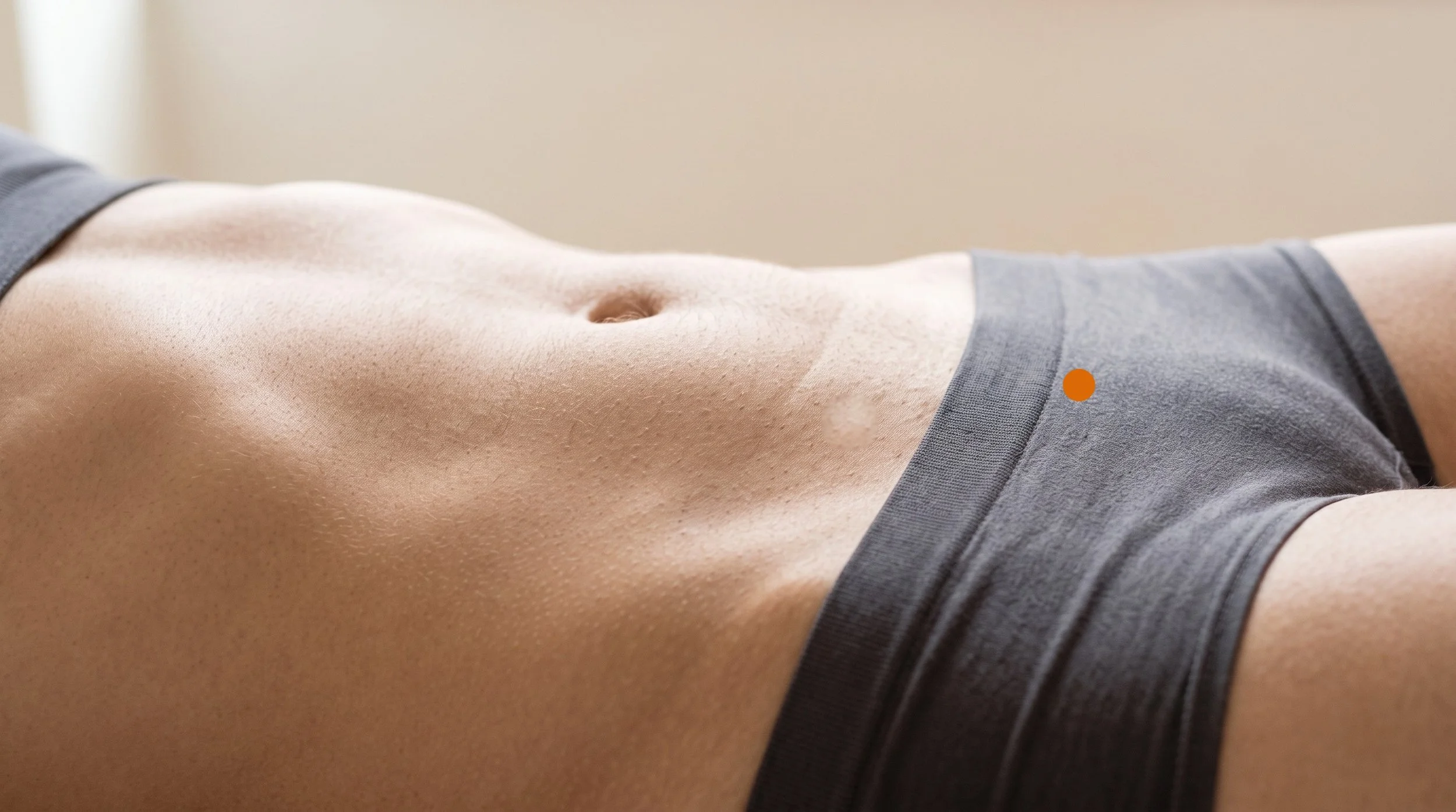
KI11 Acupuncture Point (Henggu)
The Pubic Bone Point of the Kidney Channel: Anatomy, Mechanism, and Why KI11 Sits at the Crossroads of Urinary, Pelvic, and Low Back Complaints
KI11, called Henggu in pinyin and usually translated as Pubic Bone, is the first of the eleven Kidney channel points that climb the abdomen just beside the midline. You can find it in plain terms by tracing straight down the front of the body from the navel to the top ridge of the pubic bone, then moving about a fingertip's width to one side: that small hollow at the upper border of the pubic symphysis, level with CV2 and roughly 5 cun below the umbilicus, is the ki11 acupuncture point (Deadman et al., 2007).
Its clinical interest comes from geography. This is the lowest point on the anterior abdominal wall where the needle sits directly over the bladder and within the same spinal segments that carry sensation from the lower urinary tract, the groin, and the lower abdominal wall, which is why classical texts grouped urinary difficulty, genital pain, and hypogastric pain under one heading here, and why modern practitioners think about kidney 11 in terms of segmental input to the lower pelvis rather than anything mystical.
- Location and layers: KI11 lies 0.5 cun lateral to the midline at the superior border of the pubic symphysis, level with CV2, so the needle passes skin, subcutaneous fat, the anterior rectus sheath, and the lowest fibers of rectus abdominis close to their pubic attachment (Deadman et al., 2007). The bladder sits immediately deep to this area when it is full.
- Traditional categories, translated: classical sources list KI11 as a meeting point of the Kidney channel with the Penetrating vessel and credit it with benefiting the lower jiao (Deadman et al., 2007; Maciocia, 2006). Read neurophysiologically, that is a description of a point whose effects are concentrated in the lower abdomen and pelvis, exactly the territory its nerve supply serves.
- Mechanism: the skin and muscle here are supplied by the lowest thoracolumbar nerves (roughly T12 to L1, the iliohypogastric and ilioinguinal territory), and those segments converge in the spinal cord with afferents from the bladder and pelvic structures, a pattern that can produce reflex changes in autonomic outflow to pelvic organs (Uchida et al., 2017).
- Beyond the segment: needling also recruits diffuse pain-modulating systems, including descending inhibition and endogenous opioid mechanisms, which is part of why point selection alone does not explain acupuncture's analgesic effects (Zhao, 2008; Vickers et al., 2018).
- Research picture: trials in pelvic and urinary conditions typically test multi-point lumbosacral and lower abdominal protocols rather than KI11 in isolation, with reasonably encouraging results for chronic prostatitis and chronic pelvic pain syndrome and for stress urinary incontinence (Sun et al., 2021; Liu et al., 2017).
- De qi and practice: patients usually report a dull, heavy, slightly spreading ache low in the abdomen, sometimes with a sensation drifting toward the pubic bone or groin. The bladder should be emptied before treatment and insertion kept shallow, since deep needling over a distended bladder is the main risk here (Deadman et al., 2007).
Struggling With Lower Abdominal, Bladder, or Pelvic Discomfort?
At Morningside Acupuncture, we treat lower abdominal and pelvic complaints with a plan, not a guess: careful history, a check of the abdominal wall for tender bands and referral patterns, then a point selection that may include KI11 alongside sacral and distal points. Because the lower abdomen is a sensitive area, we explain every step, use gentle shallow technique, and always have you empty your bladder first. Many patients notice that abdominal tension and urinary urgency respond within a handful of sessions. Schedule a visit and let's map out what is driving your symptoms.
Schedule NowAnatomy of KI11: Why the Superior Border of the Pubic Symphysis Is Such an Important Location
KI11 sits on a bony shelf. The superior border of the pubic symphysis is where the lowest fibers of rectus abdominis converge onto the pubic crest, where the linea alba ends, and where the inguinal region begins to curve away laterally. Under the needle there is skin, a variable pad of subcutaneous fat, the anterior rectus sheath, and then muscle that is often thin and easily loaded.
This tissue takes strain from repetitive flexion and rotation, from postural collapse in prolonged sitting, and from postpartum and post-surgical healing, all of which can leave the lower abdominal wall tender and protective in a way that patients describe as bladder pressure or groin ache rather than muscle pain (Simons et al., 1999).
The nerve geography explains most of what this point does. Cutaneous and muscular supply to the region comes from the lowest thoracolumbar nerves, principally the iliohypogastric and ilioinguinal branches arising around T12 and L1, and those same spinal segments receive sympathetic afferents from the bladder and lower pelvic structures. When afferents from skin and muscle enter a segment that also processes visceral input, stimulation of the body wall can alter the excitability of that segment and, through spinal and supraspinal circuits, shift autonomic output to the organs it serves.
This somatoautonomic pathway has been mapped in detail in animal work, including reflex changes in bladder contraction after somatic stimulation, though the authors are careful to note that anesthetized animal responses do not translate directly to conscious patients (Uchida et al., 2017). Layered on top of the segmental effect is a more general analgesic response involving descending inhibitory pathways and endogenous opioid signaling (Zhao, 2008).
The safety story at KI11 is straightforward and non-negotiable. A full bladder rises out of the pelvis and sits directly deep to this point, so deep perpendicular insertion can reach it. Standard practice is to have the patient void before treatment and to keep perpendicular insertion in the 0.5 to 1 cun range, adjusting for body habitus (Deadman et al., 2007). Because this is a lower abdominal point close to the midline, it is also avoided during pregnancy, and clinicians take extra care in patients with abdominal or pelvic surgical history, hernia repair mesh, or reduced sensation in the region.
Related Kidney Channel Related Rectus Abdominis Trigger PointsKI11 at a Glance: Classification, Location, and Clinical Use
| Category | Detail |
|---|---|
| Traditional Name | Henggu (Pubic Bone), KI11, also written KID-11 or K-11 |
| Channel Classification | Kidney channel of the foot Shao Yin, first point of the abdominal section |
| Point Categories | Meeting (crossing) point of the Kidney channel with the Penetrating vessel (Chong mai); the first of the eleven Kidney channel points running beside the midline of the abdomen with that vessel; no five-shu, xi-cleft, or hui-meeting designation |
| Precise Location | Lower abdomen, 5 cun below the umbilicus at the superior border of the pubic symphysis, 0.5 cun lateral to the midline and level with CV2 (Qugu). Note that the Great Compendium places this point and the several above it one cun lateral to the midline instead |
| Tissue Stimulated | Skin and subcutaneous tissue of the lower abdomen, anterior rectus sheath, and the lowest fibers of the rectus abdominis near its pubic attachment, with the deeper transverse abdominis layer nearby |
| Needle Depth / Direction | Perpendicular insertion 0.5 to 1 cun, angled to stay within the abdominal wall. The bladder must be emptied before treatment because deep insertion over a distended bladder can penetrate it |
| De Qi Sensation | A dull, heavy, spreading ache low in the abdomen, sometimes with a mild pulling sensation toward the pubic bone, groin, or bladder region; sharp or electric sensation means the needle should be adjusted |
| Primary Clinical Uses | Traditionally used for urinary retention and painful urinary dysfunction, hypogastric and genital pain, seminal emission and impotence in classical listings, and lumbar pain attributed to qi stagnation; used clinically today as a local point for lower abdominal wall tension and lower urinary tract symptoms |
| Common Point Combinations |
|
In the traditional literature summarized by Deadman and colleagues, KI11 is given one broad action, benefiting the lower jiao, and a tight cluster of indications that all belong to the same anatomical neighborhood: inability to urinate, the five categories of painful urinary dysfunction, pain and retraction of the genitals, shan disorder, and pain low in the abdomen, along with seminal emission, impotence, bedwetting, and states of depletion involving the five zang.
Prolapse of the uterus and rectum appear as well, which fits a point sitting at the floor of the abdominal wall. What makes the classical entry striking is the one indication that seems out of place, redness of the eyes beginning at the inner canthus, a symptom belonging to a channel region far from the pubic bone. That entry is presented here as a traditional attribution rather than a clinical claim, but it is a reminder that classical point indications were organized around channel relationships and observed clinical pairings, not around anatomy as we now describe it.
Why KI11 Is Used for Low Back Pain That Seems to Start in the Front
Patients are often surprised that a point on the pubic bone appears in classical formulas for lumbar pain. The Ode of Xi-hong pairs KI11 with SP2 for qi stagnation with low back pain and difficulty standing, and the underlying logic makes sense in modern terms. The lower abdominal wall and the lower lumbar segments share spinal levels, so an irritable or guarded abdominal wall keeps the same segments busy that drive the lumbar extensors.
Travell and Simons documented that abdominal wall trigger points can refer pain into the back and mimic visceral complaints, which is exactly the clinical picture classical authors were describing in their own vocabulary (Simons et al., 1999).
The second half of the story is central rather than local. Needling recruits descending pain-modulating pathways from the brainstem and engages endogenous opioid signaling, effects that are not limited to the segment stimulated (Zhao, 2008). That is one reason individual patient data from nearly 21,000 patients across chronic pain trials found acupuncture superior to both sham and no-acupuncture controls, with effects persisting over time (Vickers et al., 2018). Segmental input from a point like KI11 and these broader mechanisms work together, which is why we rarely use one point alone.
For urinary and pelvic complaints, the same reasoning applies with the autonomic nervous system in the foreground. Somatic stimulation over the lower abdomen can reflexively modulate bladder activity through spinal circuits, and that mechanism has been characterized experimentally, with the caveat that findings in anesthetized animals may not map cleanly onto conscious patients (Uchida et al., 2017). Clinically, we treat KI11 as one useful input into a pelvic segment, not as a switch that controls the bladder.
What the Research Shows for KI11
There is no clinical trial of KI11 by itself, and it would be misleading to suggest otherwise. What exists is a body of research on multi-point protocols for urinary, pelvic, and low back conditions in which lower abdominal and lumbosacral points are used together, sometimes including points adjacent to KI11 such as CV3 and CV4. The reasonable way to read this evidence is that the anatomical region KI11 belongs to has been studied with encouraging but variable results, that effect sizes over sham controls are often modest, and that the strongest signals come from trials with pragmatic comparators. Studies suggest benefit for several conditions in this territory; none of them isolate a single point's contribution.
| Study | Type | Focus | Key Finding |
|---|---|---|---|
| Sun et al., 2021 | Multicenter randomized sham-controlled trial | Chronic prostatitis and chronic pelvic pain syndrome in men, 20 sessions over 8 weeks | Acupuncture produced greater symptom improvement than sham, with benefit sustained through 24 weeks of follow-up. |
| Liu et al., 2017 | Multicenter randomized clinical trial | Electroacupuncture at lumbosacral points for stress urinary incontinence in women | Electroacupuncture reduced urine leakage compared with sham electroacupuncture over 6 weeks of treatment. |
| Zhong et al., 2018 | Systematic review and meta-analysis | Electroacupuncture for postoperative urinary retention | Pooled results favored electroacupuncture, though the authors flagged methodological limitations that temper confidence in the estimate. |
| Mu et al., 2020 | Cochrane systematic review | Acupuncture for chronic nonspecific low back pain, 33 trials and 8,270 participants | Acupuncture may offer little additional pain relief over sham immediately after treatment, but appeared more helpful than no treatment or usual care with mostly low to moderate certainty evidence. |
| Vickers et al., 2018 | Individual patient data meta-analysis | Chronic musculoskeletal and headache pain across 39 trials | Acupuncture outperformed both sham and no-acupuncture controls, with effects persisting over about a year. |
| Uchida et al., 2017 | Narrative review of experimental physiology | Somatoautonomic reflexes elicited by needling, including bladder responses | Somatic stimulation can reflexively alter visceral function through spinal and supraspinal autonomic circuits, though animal findings may not transfer directly to patients. |
Low Back Pain That Also Feels Tight Across the Lower Belly?
Low back pain rarely lives only in the back. Deep abdominal wall tension, guarding after abdominal or pelvic surgery, and irritable lower thoracolumbar segments can all keep the lumbar spine locked up, and classical texts paired KI11 with distal points precisely for lumbar pain with difficulty standing. We combine front and back treatment, adding dry needling of the abdominal and lumbar muscles when the exam calls for it. Book an evaluation and we'll treat the whole segment rather than chasing one sore spot.
Schedule NowKI11 in the Context of Trigger Point Work
The ki 11 abdomen location overlaps with a clinically important myofascial zone. The lowest fibers of rectus abdominis attach right at the pubic crest, and Travell and Simons described trigger points in this lower rectus region that can refer pain across the low back and produce symptoms patients interpret as bladder or pelvic complaints, including urinary urgency and cramping (Simons et al., 1999). When we palpate before needling and find a taut, exquisitely tender band just above the pubic bone, we are looking at a myofascial finding and a classical point in the same square inch. Whether the needle is called acupuncture or dry needling, it is the same tool and the same tissue response.
In practice, henggu acupuncture at Morningside is often one part of a session that also addresses the rectus abdominis, the abdominal obliques, and the deeper transverse abdominis, along with lumbar paraspinals and quadratus lumborum when low back pain is part of the picture. We keep insertion at KI11 shallow and controlled, we confirm the bladder is empty, and we treat the abdominal wall with lighter stimulation than we would use on a thick posterior muscle.
For patients whose pain sits between the back and the belly, treating both surfaces of the same spinal segment tends to hold better than treating either one alone.
KI11 Pelvic and Low Back Pain Treatment at NYC's Highest-Rated Acupuncture Clinic
Morningside Acupuncture is the highest-rated acupuncture and dry needling clinic in New York City with over 500 five-star Google reviews, and our Midtown practice blends classical point selection with modern pain science. Points like KI11 are used within a broader plan that may include sacral points, distal Kidney and Spleen channel points, and targeted dry needling of the abdominal wall. Every session is licensed, clean-needle, and built around your goals rather than a template. Schedule your appointment today.
Schedule NowFrequently Asked Questions
What does KI11 feel like when needled?
Most patients feel a dull, heavy, mildly spreading ache low in the abdomen, sometimes with a faint pulling sensation toward the pubic bone or groin. That heaviness is the de qi response and it usually settles within a few seconds. Because the abdominal wall is thin here, we use gentle technique and shallow insertion, so KI11 is typically less intense than points in thick limb muscles. Anything sharp, burning, or electric is a signal to adjust the needle, and we ask you to speak up right away if you feel it.
Why needle the pubic bone for symptoms that feel like they come from the bladder?
Because the two share spinal segments. Skin and muscle at KI11 are supplied by the lowest thoracolumbar nerves, and those same segments receive afferent input from the bladder and lower pelvic structures. Stimulating the body wall in a segment that also processes visceral input can shift autonomic output to the organs served by that segment, a pathway documented in experimental studies of somatoautonomic reflexes (Uchida et al., 2017). Nothing is being moved through the pelvis; the effect is nerve-mediated and segmental, layered on top of the broader pain-modulating response that needling produces (Zhao, 2008).
Can I press KI11 myself between sessions?
Yes, with a light touch. Empty your bladder first, lie on your back with your knees bent and a pillow under your head so the abdominal wall relaxes, then find the top edge of your pubic bone in the midline and slide about half a finger's width to one side. Press downward and slightly toward the bone with a fingertip at a pressure that feels like a firm, tolerable ache, roughly a four or five out of ten, never sharp. Hold for 30 to 60 seconds, breathe slowly, then release and repeat two or three times per side, once or twice a day. Skip it entirely if you are pregnant, if the area is bruised, numb, or recently operated on, or if pressing reproduces sharp pain, and see a clinician promptly for new urinary retention, fever, blood in the urine, or severe pelvic pain.
Is KI11 safe to needle?
It is safe in trained hands with two conditions respected. First, the bladder must be emptied before treatment, since a distended bladder rises directly beneath this point and deep insertion can reach it; standard depth is 0.5 to 1 cun perpendicular (Deadman et al., 2007). Second, KI11 is a lower abdominal point close to the midline, so it is avoided during pregnancy and used with extra caution in patients with hernia repair, prior pelvic or abdominal surgery, altered sensation, or bleeding risk. At Morningside we use sterile single-use needles, palpate carefully before insertion, and adjust depth for body habitus.
Where exactly is KI11 located?
On the lower abdomen at the superior border of the pubic symphysis, 5 cun below the umbilicus and 0.5 cun lateral to the midline, level with CV2 (Deadman et al., 2007). To find it, trace straight down the midline from the navel until your fingertip meets the firm upper ridge of the pubic bone, then move about a fingertip's width to either side; KI11 is the small depression just above the bony edge. It is worth noting that the Great Compendium places this point one cun lateral to the midline, so older texts and modern charts can differ slightly.
References
- Deadman, P., Al-Khafaji, M., & Baker, K. (2009). A manual of acupuncture. Journal of Chinese Medicine Publications.
- Maciocia, G. (2006). The channels of acupuncture: Clinical use of the secondary channels and eight extraordinary vessels. Churchill Livingstone Elsevier.
- Simons, D. G., Travell, J. G., & Simons, L. S. (1999). Travell & Simons' myofascial pain and dysfunction: The trigger point manual, Vol. 1: Upper half of body (2nd ed.). Williams & Wilkins.
- Sun, Y., Liu, Y., Liu, B., Zhou, K., Yue, Z., Zhang, W., Fu, W., Yang, J., Li, N., He, L., Zang, Z., Su, T., Fang, J., Ding, Y., Qin, Z., Song, H., Hu, H., Zhao, H., Mo, Q., Zhou, J., Wu, J., Liu, X., Wang, W., Pang, R., Chen, H., Wang, X., & Liu, Z. (2021). Efficacy of acupuncture for chronic prostatitis/chronic pelvic pain syndrome: A randomized trial. Annals of Internal Medicine, 174(10), 1357-1366. https://doi.org/10.7326/M21-1814
- Liu, Z., Liu, Y., Xu, H., He, L., Chen, Y., Fu, L., Li, N., Lu, Y., Su, T., Sun, J., Wang, J., Yue, Z., Zhang, W., Zhao, J., Zhou, Z., Wu, J., Zhou, K., Ai, Y., Zhou, J., Pang, R., Wang, Y., Qin, Z., Yan, S., Li, H., Luo, L., & Liu, B. (2017). Effect of electroacupuncture on urinary leakage among women with stress urinary incontinence: A randomized clinical trial. JAMA, 317(24), 2493-2501. https://doi.org/10.1001/jama.2017.7220
- Zhong, Y., Zeng, F., Li, J., Yang, Y., Zhong, S., & Song, Y. (2018). Electroacupuncture for postoperative urinary retention: A systematic review and meta-analysis. Evidence-Based Complementary and Alternative Medicine, 2018, 7612618. https://doi.org/10.1155/2018/7612618
- Mu, J., Furlan, A. D., Lam, W. Y., Hsu, M. Y., Ning, Z., & Lao, L. (2020). Acupuncture for chronic nonspecific low back pain. Cochrane Database of Systematic Reviews, 12(12), CD013814. https://doi.org/10.1002/14651858.CD013814
- Uchida, S., Kagitani, F., & Sato-Suzuki, I. (2017). Somatoautonomic reflexes in acupuncture therapy: A review. Autonomic Neuroscience, 203, 1-8. https://doi.org/10.1016/j.autneu.2016.11.001
- Vickers, A. J., Vertosick, E. A., Lewith, G., MacPherson, H., Foster, N. E., Sherman, K. J., Irnich, D., Witt, C. M., & Linde, K. (2018). Acupuncture for chronic pain: Update of an individual patient data meta-analysis. Journal of Pain, 19(5), 455-474. https://doi.org/10.1016/j.jpain.2017.11.005
- Zhao, Z. Q. (2008). Neural mechanism underlying acupuncture analgesia. Progress in Neurobiology, 85(4), 355-375. https://doi.org/10.1016/j.pneurobio.2008.05.004
Disclaimer: This web site is intended for educational and informational purposes only. Reading this website does not constitute providing medical advice or any professional services. This information should not be used for diagnosing or treating any health issue or disease. Those seeking medical advice should consult with a licensed physician. Seek the advice of a medical doctor or other qualified health professional for any medical condition. If you think you have a medical emergency, call 911 or go to the emergency room. No acupuncturist-patient relationship is created by reading this website or using the information. Morningside Acupuncture PLLC and its employees and contributors do not make any express or implied representations with respect to the information on this site or its use. For any legal interpretation of scope of practice in your state, consult a licensed attorney or regulatory authority.
Read more from our blog



