KI12 Acupuncture Point (Dahe)
KI2 Acupuncture Point (Rangu)
The Great Luminance Point Above the Pubic Bone: Anatomy, Mechanism, and Why KI12 Anchors Lower Abdominal Work for Pelvic and Reproductive Health
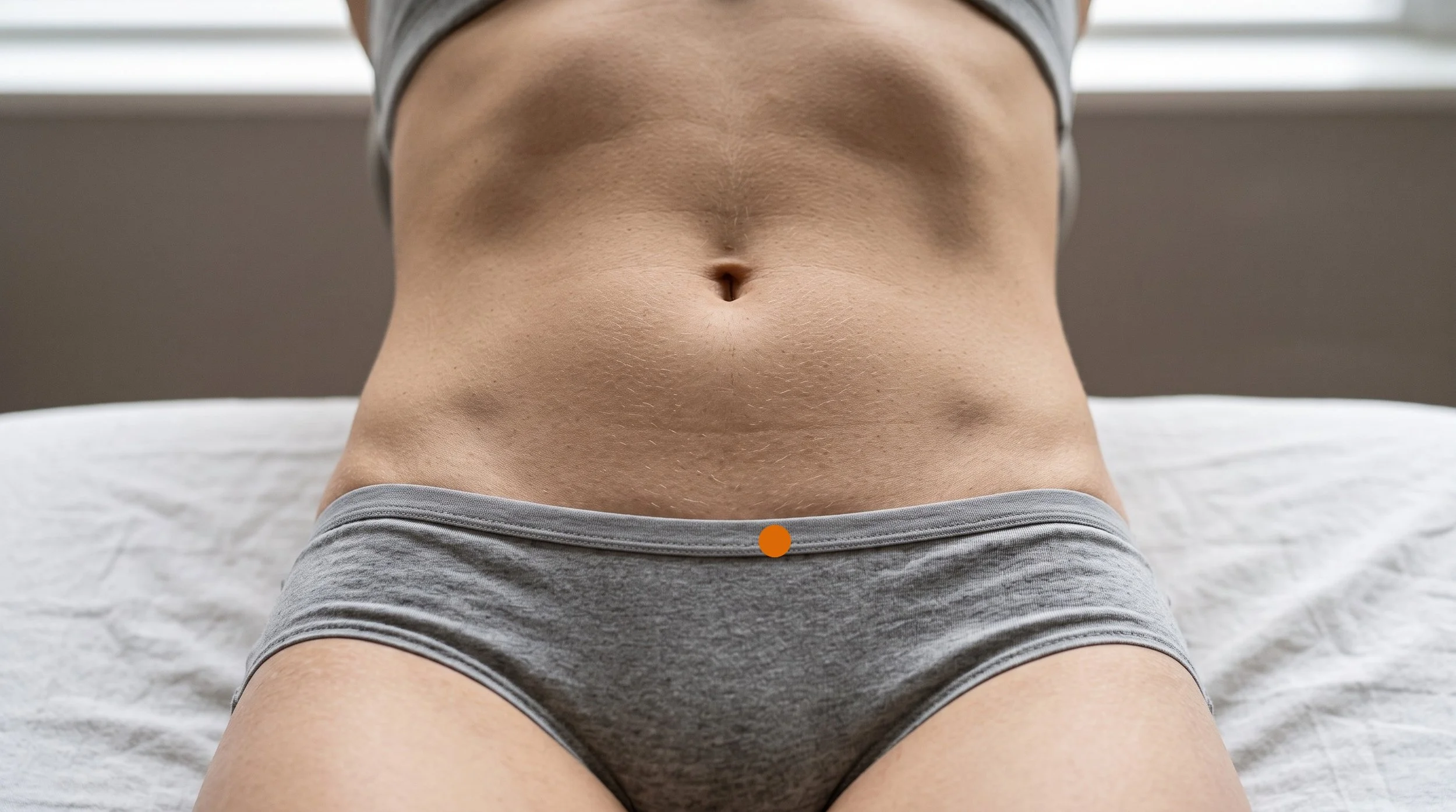
KI12, called Dahe in Chinese and usually translated as Great Luminance, sits very low on the abdomen, one thumb width above the top edge of the pubic bone and a half thumb width off the midline, level with CV3. It's a small target in a crowded neighborhood: the lower fibers of the rectus abdominis lie under the needle, the bladder sits below and behind it, and the nerve supply to that patch of skin comes from the same spinal levels that feed sympathetic fibers to the bladder, uterus, and prostate.
Classically it belongs to the cluster of Kidney channel points on the lower abdomen that were traditionally used to tonify the Kidneys and astringe essence, and it's also listed as a meeting point of the Kidney channel with the Penetrating vessel (Chong mai). In modern practice the ki12 acupuncture point is used less as a standalone remedy and more as a segmental anchor within lower abdominal protocols for pelvic, urinary, and reproductive complaints, and it deserves the same respect for depth and bladder position that every suprapubic point requires.
- Location and layers: KI12 lies 4 cun below the umbilicus, 1 cun above the superior border of the pubic symphysis, and 0.5 cun lateral to the midline, level with CV3, so the needle passes skin, subcutaneous fat, the anterior rectus sheath, and the lower fibers of rectus abdominis before reaching deeper fascia (Deadman et al., 2007).
- Traditional attributions, translated: classical sources credit Dahe with tonifying the Kidneys and holding essence in place, and its listed indications cluster around genital pain, seminal emission, deficiency-type vaginal discharge, and prolapse (Deadman et al., 2007). In neurophysiological terms these are pelvic autonomic and pelvic floor complaints mapped onto a low abdominal segment.
- Nerve story: the skin and muscle at kidney 12 are supplied by anterior cutaneous branches of the lower thoracic and first lumbar nerves, levels that also feed sympathetic outflow to the bladder, uterus, and male reproductive tract, giving a plausible route for somato-visceral reflex effects alongside descending pain inhibition (Zhao, 2008).
- Research picture: trials rarely isolate single points, but lower abdominal and lumbosacral needling protocols have been tested in stress urinary incontinence (Liu et al., 2017), dysmenorrhea (Smith et al., 2016), and assisted reproduction (Cheong et al., 2013), with results that range from encouraging to inconclusive.
- Vascular and autonomic effects: an early physiological study found reduced uterine artery blood flow impedance after a course of electroacupuncture in women with high baseline pulsatility index, which studies suggest reflects segmental sympathetic modulation rather than any direct effect on the ovary (Stener-Victorin et al., 1996).
- De qi and practice framing: patients usually report a heavy, warm, slightly aching spread toward the pubic bone or deep pelvis rather than a sharp sensation, and the bladder should be emptied before needling because deep insertion over a full bladder is the main avoidable risk (Deadman et al., 2007).
Struggling With Pelvic, Bladder, or Reproductive Symptoms in NYC?
Persistent pelvic heaviness, urinary urgency, painful periods, and fertility related stress often involve the same lower abdominal segment that KI12 sits in. At Morningside Acupuncture we combine gentle suprapubic needling with distal points, lumbosacral work, and dry needling of the abdominal wall when the muscles themselves are part of the problem. Every treatment starts with a full history and a clear plan rather than a template. Schedule a visit and we'll map out where to start.
Schedule NowAnatomy of KI12: Why the Lower Rectus Abdominis Just Above the Pubic Bone Is Such an Important Location
Working from the surface inward, a needle at KI12 passes through thin lower abdominal skin, a subcutaneous fat layer that's often generous just above the pubis, the anterior layer of the rectus sheath, and then the tapering lower fibers of rectus abdominis as they converge toward their pubic attachment. Deep to the muscle lie transversalis fascia, preperitoneal fat, and the peritoneum, with the bladder sitting immediately behind and below when it's full.
This is a heavily loaded corner of the abdominal wall: it takes tension from sitting posture, from repeated bracing and flexion, from pregnancy and delivery, and from the scar tissue left by cesarean sections, hernia repairs, and laparoscopic ports. Palpation before needling often reveals a tender, ropy band or a boggy, guarded quality that patients haven't consciously noticed.
The nerve geography is what makes this small patch clinically interesting. Sensation and motor supply to the lowest rectus fibers come from the anterior cutaneous and muscular branches of the lower thoracic nerves and the iliohypogastric nerve, so the ki 12 abdomen location sits squarely in the lower thoracic and first lumbar segments. Those same segments carry sympathetic fibers through the hypogastric plexus to the bladder, uterus, prostate, and vas deferens, which means afferent input from the abdominal wall and afferent input from pelvic organs converge on overlapping dorsal horn neurons.
Needling here can therefore recruit segmental spinal circuits, engage descending inhibitory pathways involving opioid, serotonergic, and noradrenergic transmission, and shift autonomic tone in the pelvis (Zhao, 2008). It also explains why deep pelvic complaints can feel referred to a spot that looks purely muscular, and why acupuncture research in persistent pain has emphasized central as well as local mechanisms (Vickers et al., 2018).
Safety follows directly from what lies beneath. A distended bladder rises out of the pelvis and can reach or pass the level of KI12, so classical and modern texts agree that the bladder should be emptied before treatment and that deep insertion is avoided (Deadman et al., 2007). Standard needling is perpendicular, 0.5 to 1 cun, adjusted downward in slim patients and in anyone with an intra-abdominal device, recent surgery, or altered anatomy. The inferior epigastric vessels run further laterally, but the region as a whole is vascular enough that steady technique and light pressure after withdrawal are worthwhile. Lower abdominal points including Dahe are conventionally avoided during pregnancy, and any suspected pregnancy should be discussed before treatment.
Related Kidney Channel Related Rectus Abdominis Trigger PointsKI12 at a Glance: Classification, Location, and Clinical Use
| Category | Detail |
|---|---|
| Traditional Name | Dahe (Great Luminance), Kidney 12 |
| Channel Classification | Kidney channel of the foot Shaoyin, twelfth point, lower abdomen |
| Point Categories | Meeting point of the Kidney channel with the Penetrating vessel (Chong mai). Grouped with the neighboring Kidney abdominal points traditionally described as tonifying the Kidneys and astringing essence. No five-shu, hui-meeting, or command point designation. |
| Precise Location | On the lower abdomen, 4 cun below the umbilicus and 1 cun above the superior border of the pubic symphysis, 0.5 cun lateral to the anterior midline, level with CV3 (Zhongji) |
| Tissue Stimulated | Suprapubic skin and subcutaneous fat, anterior rectus sheath, and the lower fibers of rectus abdominis, with adjacent transverse abdominis and abdominal oblique fascia nearby |
| Needle Depth / Direction | Perpendicular insertion 0.5 to 1 cun, shallower in slim patients. The bladder must be emptied first, since deep insertion can penetrate a full bladder. Moxibustion and gentle warming are commonly added over the region. |
| De Qi Sensation | Deep, heavy, warm ache that may spread toward the pubic bone, the groin, or the deep pelvis, sometimes with a mild bladder awareness that settles quickly |
| Primary Clinical Uses | Traditionally used for seminal emission, genital pain, impotence, deficiency-type vaginal discharge, and prolapse. Modern clinical use centers on pelvic, urinary, menstrual, and fertility related complaints as part of lower abdominal protocols. |
| Common Point Combinations |
|
Deadman, Al-Khafaji, and Baker's A Manual of Acupuncture presents Dahe as a point whose traditional function is to supplement the Kidneys and hold essence in place, and the indication list follows that logic closely: seminal emission, pain of the genitals, impotence, retraction of the penis, deficiency-taxation and red vaginal discharge, and uterine prolapse. The commentary frames seminal emission as a problem of either heat forcing fluid outward or a weakened gate of essence failing to contain it, with the female counterpart of leakage described as a deficiency pattern of discharge rather than a damp-heat one.
What's striking about this traditional grouping is its internal consistency: a single anatomical band of points low on the abdomen was assigned to containment and consolidation in both sexes, well before anyone described the sympathetic outflow that shares those spinal levels. These are historical attributions rather than physiological claims, but the anatomical coherence is hard to miss.
Why KI12 Is Used for Bladder, Menstrual, and Reproductive Complaints Rather Than Local Abdominal Pain
Most patients expect an abdominal point to treat abdominal pain, and KI12 can certainly help with a tender, guarded abdominal wall. Its more common role, though, is as a segmental input to the pelvis. The skin, fascia, and muscle at this location report to the lower thoracic and first lumbar spinal segments, and those segments also supply sympathetic fibers to the bladder, uterus, prostate, and associated vasculature.
When afferent traffic from a needle converges with afferent traffic from a pelvic organ on the same dorsal horn neurons, the nervous system can respond with changes in local blood flow, smooth muscle tone, and pain sensitivity rather than a purely local effect (Zhao, 2008).
On top of that segmental route, needling recruits descending inhibitory pathways from the brainstem that dampen ascending nociceptive signaling, which is part of why acupuncture effects in persistent pain conditions tend to outlast the treatment session itself (Vickers et al., 2018; Zhao, 2008). There's also a measurable vascular story in the pelvis.
In a small early study of infertile women with high uterine artery pulsatility index, a course of electroacupuncture using abdominal and leg points was followed by reduced blood flow impedance, a finding interpreted as sympathetic modulation of the uterine vasculature (Stener-Victorin et al., 1996). That study was small and uncontrolled, so it should be read as a mechanistic hint rather than proof of clinical benefit.
Put together, this is why kidney 12 usually appears in a protocol rather than alone. Pair it with CV3 or CV4 on the midline and you cover the same segment more broadly. Add SP6 or KI3 in the leg and you bring in distal input that engages different spinal levels and supraspinal circuits. Add lumbosacral points and you approach the same nerve supply from behind. The point contributes a precise, well-placed abdominal input, and the rest of the prescription does the rest of the work.
What the Research Shows for KI12
It's worth being direct about what the evidence can and can't say. No high quality trial has tested KI12 in isolation, and almost none of the published research names it specifically. What exists are trials and reviews of multi-point protocols in which lower abdominal and lumbosacral points are used together, so the honest framing is that KI12 is one plausible component of protocols that have shown mixed results. The strongest signal comes from stress urinary incontinence, where a large sham-controlled trial reported meaningful reductions in leakage.
Dysmenorrhea and assisted reproduction reviews are far more cautious, and male reproductive outcomes remain poorly studied. Read the table below as a map of the research landscape around this region of the abdomen, not as evidence for a single point.
| Study | Type | Focus | Key Finding |
|---|---|---|---|
| Liu et al., 2017 | Multicenter randomized sham-controlled trial (JAMA) | Electroacupuncture involving the lumbosacral region for women with stress urinary incontinence | Electroacupuncture was associated with greater reductions in urine leakage than sham over six weeks, suggesting pelvic segmental needling may help selected patients. |
| Smith et al., 2016 | Cochrane systematic review | Acupuncture and acupressure for primary dysmenorrhea | The review concluded there's insufficient evidence to determine whether acupuncture or acupressure reduce period pain, with low quality data across most comparisons. |
| Cheong et al., 2013 | Cochrane systematic review | Acupuncture as an adjunct to assisted reproductive technology cycles | Across twenty randomized trials, the reviewers found no evidence that adjunctive acupuncture improves live birth or pregnancy rates in assisted conception. |
| Stener-Victorin et al., 1996 | Prospective non-randomized physiological study | Uterine artery blood flow impedance in infertile women receiving electroacupuncture | Pulsatility index fell after a treatment course, which studies suggest may reflect reduced sympathetic vasoconstriction, though the sample was very small. |
| Zhang et al., 2023 | Systematic review and meta-analysis (Sexual Medicine) | Acupuncture for premature ejaculation | Seven trials totaling roughly 600 participants produced low quality evidence, so no confident conclusion could be drawn about acupuncture versus drug therapy. |
| Jia et al., 2021 | Systematic review and meta-analysis (Medicine) | Acupuncture for oligospermia and asthenozoospermia | Acupuncture alone didn't outperform placebo or medication for semen quality, and evidence for acupuncture added to medication was too weak to be conclusive. |
| Zhao, 2008 | Narrative review of mechanisms | Neural pathways underlying acupuncture analgesia | Needling activates peripheral afferents that engage spinal and descending inhibitory systems, providing a mechanistic frame for segmental abdominal points. |
Want a Lower Abdominal Treatment Plan That Respects Your Anatomy?
Points like Dahe sit close to the bladder, so technique and depth matter more than needle count. Our licensed acupuncturists use clean, precise insertion, ask you to empty your bladder first, and adjust angle and depth to your body rather than to a chart. Many patients notice a settled, warm feeling in the lower abdomen during the session itself. Book an appointment to see how dahe acupuncture fits into a broader plan.
Schedule NowKI12 in the Context of Trigger Point Work
KI12 sits directly over the lower rectus abdominis, a muscle whose taut bands can refer pain across the low back and around the pelvic brim and can mimic visceral complaints closely enough to confuse the picture (Simons et al., 1999).
At Morningside we palpate the abdominal wall before we needle it, checking whether tenderness increases when the patient tenses the muscle, which points toward the wall rather than the organs beneath. When the wall is clearly involved, we treat the ki12 acupuncture point alongside dry needling of rectus abdominis, and often the obliques and transverse abdominis as well, using shallow angles and constant awareness of what lies deeper.
Cesarean and hernia repair scars deserve particular attention here, since the scar line frequently crosses this exact region and can leave a band of altered sensation, restricted glide, and guarded breathing patterns. Careful needling of the surrounding tissue, combined with breath work and gradual loading, often changes how the lower abdomen feels and moves.
Since acupuncture is defined by the use of an acupuncture needle, this blending of channel points and myofascial targets is one technique family rather than two competing systems, and the same needle can serve a segmental purpose and a myofascial one in the same session.
KI12 Pelvic and Reproductive Health Treatment at NYC's Highest-Rated Acupuncture Clinic
Morningside Acupuncture is the highest-rated acupuncture and dry needling clinic in New York City with over 500 five-star Google reviews, and our Upper West Side practice sees pelvic, menstrual, urinary, and fertility related concerns every week. We use KI12 alongside CV3, CV4, SP6, and lumbosacral points, and we coordinate with your physician, pelvic floor therapist, or fertility clinic when that's appropriate. Care is unhurried, evidence informed, and tailored to your cycle or treatment calendar. Schedule your first session and let's build the plan together.
Schedule NowFrequently Asked Questions
What does KI12 feel like when needled?
Most people describe a heavy, warm, mildly aching sensation that spreads toward the pubic bone or into the deep pelvis. Some feel a brief pulling under the skin as the needle passes the rectus sheath, and a few notice a passing bladder awareness that settles within a minute. Sharp or electric sensations aren't expected, and you should tell your acupuncturist immediately if you feel one so the needle can be adjusted or removed.
Why needle the lower abdomen for symptoms that feel deeper in the pelvis?
Because the skin and muscle at this level share spinal segments with the bladder, uterus, and male reproductive structures. Sensory input from a needle in the lower thoracic and first lumbar dermatomes converges with input from those organs in the spinal cord, which gives the nervous system a route to modulate autonomic tone, local blood flow, and pain sensitivity (Zhao, 2008). Traditional texts described the same region in terms of the Kidneys and the Penetrating vessel, which is a different language for a broadly overlapping territory.
Can I press KI12 myself between sessions?
Yes, gentle acupressure is reasonable for most people. Empty your bladder first, lie on your back with knees bent so the abdominal wall relaxes, and find the spot one thumb width above the top of your pubic bone and a half thumb width to either side of the midline. Press straight down with a fingertip using moderate, comfortable pressure for 30 to 60 seconds per side, breathing slowly, and repeat two or three times for a total of three to five minutes. You can do this once or twice daily. Stop if pressure produces sharp pain, urinary urgency that doesn't settle, or any increase in symptoms, and skip it entirely if you're pregnant or might be, or if you've had recent abdominal surgery, without clearing it with your clinician first.
Is KI12 safe to needle?
In trained hands it is, provided two rules are followed. The bladder is emptied before treatment, because a full bladder rises above the pubic bone and can be reached by deep insertion, and depth is kept within roughly 0.5 to 1 cun, less in slim patients (Deadman et al., 2007). Lower abdominal points including Dahe are conventionally avoided during pregnancy. Tell your acupuncturist about recent abdominal surgery, hernia repairs, an IUD or other implanted device, or any bleeding disorder or blood thinner so technique can be adjusted.
Where exactly is KI12 located?
Find the top edge of the pubic symphysis in the midline, then move up one cun, about one thumb width, to the level of CV3. From there move 0.5 cun laterally, roughly half a thumb width, and you're at KI12 on that side. Measured from above, it's 4 cun below the center of the umbilicus. Practitioners typically use proportional cun measurement, dividing the distance from the umbilicus to the pubic symphysis into 5 equal parts, since body proportions vary.
References
- Deadman, P., Al-Khafaji, M., & Baker, K. (2009). A manual of acupuncture. Journal of Chinese Medicine Publications.
- Maciocia, G. (2006). The channels of acupuncture: Clinical use of the secondary channels and eight extraordinary vessels. Churchill Livingstone Elsevier.
- Simons, D. G., Travell, J. G., & Simons, L. S. (1999). Travell & Simons' myofascial pain and dysfunction: The trigger point manual, Vol. 1: Upper half of body (2nd ed.). Williams & Wilkins.
- Zhao, Z. Q. (2008). Neural mechanism underlying acupuncture analgesia. Progress in Neurobiology, 85(4), 355-375. https://doi.org/10.1016/j.pneurobio.2008.05.004 [VERIFY BEFORE PUBLISHING]
- Vickers, A. J., Vertosick, E. A., Lewith, G., MacPherson, H., Foster, N. E., Sherman, K. J., Irnich, D., Witt, C. M., & Linde, K. (2018). Acupuncture for chronic pain: Update of an individual patient data meta-analysis. Journal of Pain, 19(5), 455-474. https://doi.org/10.1016/j.jpain.2017.11.005 [VERIFY BEFORE PUBLISHING]
- Liu, Z., Liu, Y., Xu, H., He, L., Chen, Y., Fu, L., Li, N., Lu, Y., Su, T., Sun, J., Wang, J., Yue, Z., Zhang, W., Zhao, J., Zhou, Z., Wu, J., Zhou, K., Ai, Y., Zhou, J., Pang, R., Wang, Y., Qin, Z., Yan, S., Li, H., Luo, L., & Liu, B. (2017). Effect of electroacupuncture on urinary leakage among women with stress urinary incontinence: A randomized clinical trial. JAMA, 317(24), 2493-2501. https://doi.org/10.1001/jama.2017.7220 [VERIFY BEFORE PUBLISHING]
- Smith, C. A., Armour, M., Zhu, X., Li, X., Lu, Z. Y., & Song, J. (2016). Acupuncture for dysmenorrhoea. Cochrane Database of Systematic Reviews, 2016(4), CD007854. https://doi.org/10.1002/14651858.CD007854.pub3 [VERIFY BEFORE PUBLISHING]
- Cheong, Y. C., Dix, S., Hung Yu Ng, E., Ledger, W. L., & Farquhar, C. (2013). Acupuncture and assisted reproductive technology. Cochrane Database of Systematic Reviews, 2013(7), CD006920. https://doi.org/10.1002/14651858.CD006920.pub3 [VERIFY BEFORE PUBLISHING]
- Stener-Victorin, E., Waldenstrom, U., Andersson, S. A., & Wikland, M. (1996). Reduction of blood flow impedance in the uterine arteries of infertile women with electro-acupuncture. Human Reproduction, 11(6), 1314-1317. https://doi.org/10.1093/oxfordjournals.humrep.a019378 [VERIFY BEFORE PUBLISHING]
- Zhang, H., Colonnello, E., Sansone, A., Wang, F., Guo, J., Wang, C., Zhang, Y., & Jannini, E. A. (2023). Acupuncture for premature ejaculation: A systematic review and meta-analysis. Sexual Medicine, 11(3), qfad034. https://doi.org/10.1093/sexmed/qfad034 [VERIFY BEFORE PUBLISHING]
- Jia, W., et al. (2021). Acupuncture for oligospermia and asthenozoospermia: A systematic review and meta-analysis. Medicine, 100(48), e27816. https://doi.org/10.1097/MD.0000000000027816 [VERIFY BEFORE PUBLISHING]
Disclaimer: This web site is intended for educational and informational purposes only. Reading this website does not constitute providing medical advice or any professional services. This information should not be used for diagnosing or treating any health issue or disease. Those seeking medical advice should consult with a licensed physician. Seek the advice of a medical doctor or other qualified health professional for any medical condition. If you think you have a medical emergency, call 911 or go to the emergency room. No acupuncturist-patient relationship is created by reading this website or using the information. Morningside Acupuncture PLLC and its employees and contributors do not make any express or implied representations with respect to the information on this site or its use. For any legal interpretation of scope of practice in your state, consult a licensed attorney or regulatory authority.
Read more from our blog



