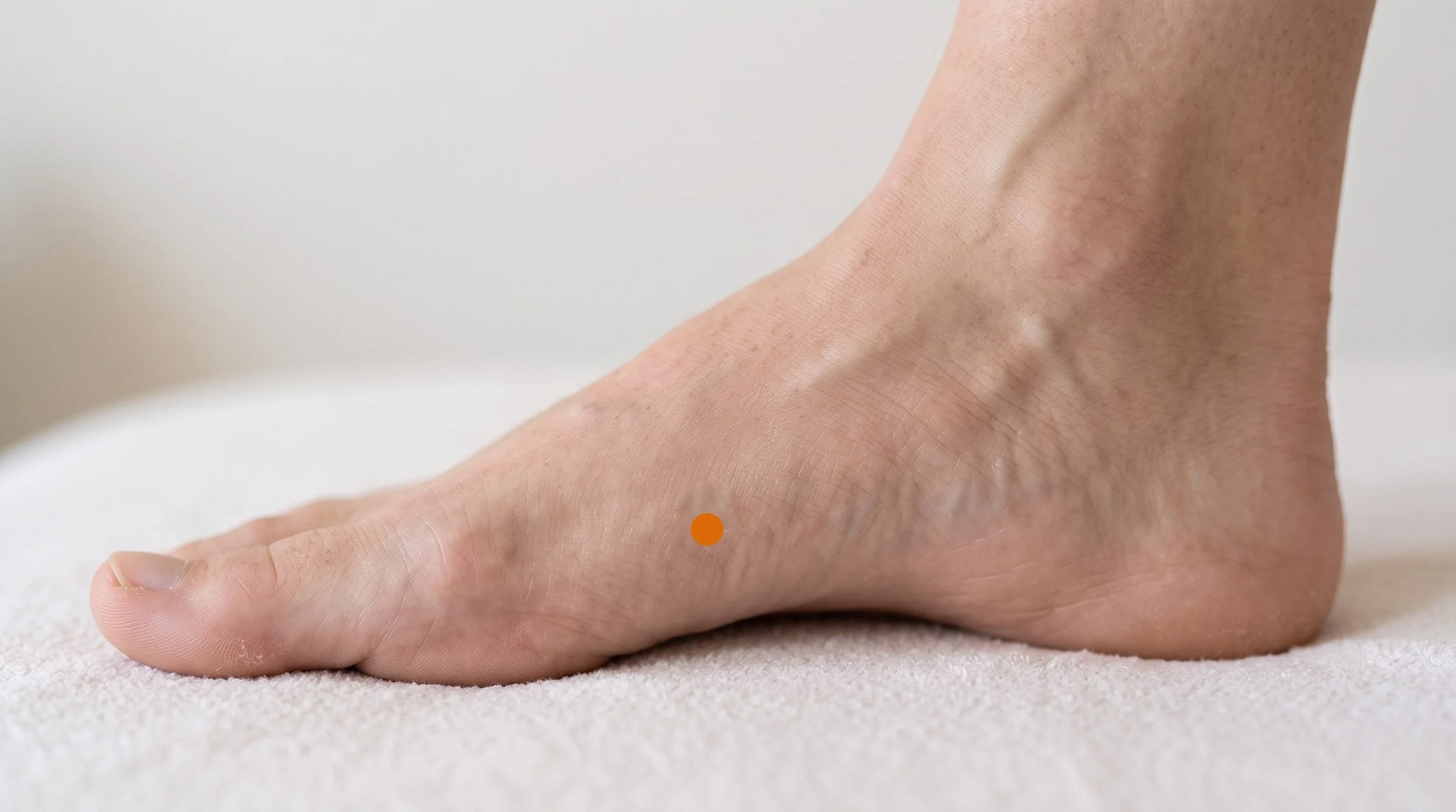
SP4 Acupuncture Point (Gongsun)
The Grandfather Grandson Point on the Medial Arch: Anatomy, Mechanism, and Why One Small Foot Point Links Digestion, Stress, and Arch Pain
SP4, known in Chinese as Gongsun and usually rendered in English as Grandfather Grandson, sits on the inside edge of the foot just behind the bump at the base of the big toe's long bone, in the soft hollow where the pale sole skin meets the darker skin of the foot's top surface.
Classically it is described as the luo-connecting point of the Spleen channel and the confluent point of the Penetrating Vessel (Deadman et al., 2007), which is a traditional way of saying that this small point was assigned an unusually broad clinical territory: the upper and lower abdomen, the chest, and the emotional tone that accompanies digestive complaints. In a modern clinic the sp4 acupuncture point earns its place for three practical reasons.
It sits directly in the abductor hallucis, a muscle that works hard in anyone with arch or heel pain; it is densely supplied by branches of the medial plantar nerve, which makes it a reliable source of strong afferent input; and it is the classical partner of PC6, still one of the most studied pairings in acupuncture for gut and stress-related symptoms.
- Location and layers: spleen 4 lies on the medial foot in the depression distal and inferior to the base of the first metatarsal, at the junction of the red and white skin, with the needle passing through thin skin and fascia into the abductor hallucis muscle belly (Deadman et al., 2007). A useful sp 4 location trick is to find SP3 at the head of the first metatarsal and slide back along the shaft roughly one cun until the finger drops into the hollow at the bone's base.
- Traditional categories, translated: the luo-connecting designation and confluent point status of the Penetrating Vessel are classical organizing concepts, not anatomical claims (Deadman et al., 2007). Neurophysiologically they map onto something testable: strong distal limb input that reaches brainstem autonomic and pain-modulating centers rather than acting locally on the abdomen.
- Nerve story: branches of the medial plantar nerve (a tibial nerve division carrying roughly L4 to S2 fibers) supply both the skin and the abductor hallucis here, so needling generates dense A-delta and C-fiber traffic that engages spinal and supraspinal analgesic circuitry (Zhao, 2008).
- Research picture: acupuncture protocols that routinely include SP4 have been tested most in upper gut disorders, where a recent meta-analysis found moderate to high certainty evidence of symptom and quality of life improvement over sham in functional dyspepsia (Li et al., 2026), while Cochrane's irritable bowel review found no advantage over sham (Manheimer et al., 2012). The honest summary is condition-dependent, not uniformly positive.
- Clinical practice framing: at Morningside we use SP4 in two distinct ways, as a distal regulating point paired with PC6 for stress-linked digestive complaints, and as a local point in the medial arch when the abductor hallucis is tender, taut, or reproducing a patient's foot symptoms (Simons et al., 1999).
- De qi at this point is usually a firm, dull ache or a spreading heaviness through the arch, sometimes with a light electrical flicker toward the big toe if a cutaneous branch is brushed. The foot is sensitive, so needle insertion is often felt more sharply here than on the limbs, and the sensation typically settles within a few seconds.
Stress Wrecking Your Digestion? Let's Treat Both at Once
Bloating, reflux, cramping, and appetite changes rarely arrive on their own; they usually track with sleep, deadlines, and nervous system load. At Morningside Acupuncture we use SP4 with its classical partner PC6 as part of a treatment aimed at the autonomic side of digestive symptoms, alongside abdominal and lower limb points chosen for your presentation. Most patients notice changes in symptom intensity and pattern over a short course of care rather than after a single visit. Schedule a visit and let's map your pattern properly.
Schedule NowAnatomy of SP4: Why the Base of the First Metatarsal Is Such an Important Location
Run your thumb along the inside of your foot from the ball toward the ankle and you will feel the long shaft of the first metatarsal end in a flare where it meets the medial cuneiform. Just behind and below that flare is a soft hollow, and that hollow is SP4. Under the thin, mobile skin here sits the plantar aponeurosis border and then the abductor hallucis, the thick sausage of muscle that forms the fleshy inner wall of the arch.
This muscle is loaded every time you push off, and it works overtime in feet that pronate heavily, in runners increasing mileage, and in anyone standing on hard city floors for long shifts. That mechanical reality is why the point is so often tender in patients who came in to talk about their heel, not their arch.
The sensory supply here comes from terminal branches of the medial plantar nerve, itself a division of the tibial nerve, with contributions from the saphenous nerve over the more dorsal skin at the red and white skin border. Because the point sits in a nerve-rich, muscle-dense zone, a needle placed here recruits a large volume of small-diameter afferents.
Experimental work on acupuncture analgesia indicates that this kind of input activates spinal segmental gating and then engages descending inhibitory pathways from the periaqueductal gray and rostral ventromedial medulla, with endogenous opioid and monoamine involvement (Zhao, 2008). Clinically, that translates into two effects worth separating: local relief in the arch itself through segmental mechanisms at the lumbosacral levels, and broader, non-segmental modulation that may explain why a foot point has ever been used for the abdomen.
Deeper in this region lie the medial plantar artery and its branches, plus the tendon of tibialis anterior inserting nearby. Standard needling is perpendicular, 0.5 to 1 cun (Deadman et al., 2007), with some texts favoring the shallower end of that range at 0.3 to 0.5 cun depending on foot size and tissue thickness (Kim, 2015). Because the plantar tissues are vascular and sensitive, we angle to stay in muscle rather than driving toward bone, withdraw and redirect if a sharp radiating sensation persists, and apply firm post-needle pressure. Feet also carry a higher infection and healing risk in patients with diabetes or vascular disease, which shapes both point choice and technique.
Related Abductor Hallucis Trigger Points Related Spleen ChannelSP4 at a Glance: Classification, Location, and Clinical Use
| Category | Detail |
|---|---|
| Traditional Name | Gongsun (Grandfather Grandson) |
| Channel Classification | Spleen channel of the foot (fourth point of the Spleen channel), medial foot |
| Point Categories | Luo-connecting point of the Spleen channel; confluent (opening) point of the Penetrating Vessel, classically paired with PC6 as the confluent point of the Yin Linking Vessel |
| Precise Location | On the medial side of the foot, in the depression distal and inferior to the base of the first metatarsal bone, at the junction of the red and white skin. Locate SP3 first, then slide proximally along the metatarsal shaft roughly 1 cun into the hollow at the base of the bone. |
| Tissue Stimulated | Skin and superficial fascia of the medial arch, then the abductor hallucis muscle belly, with branches of the medial plantar nerve and nearby deep intrinsic foot muscles |
| Needle Depth / Direction | Perpendicular insertion 0.5 to 1 cun into the abductor hallucis; shallower insertion of 0.3 to 0.5 cun is common in smaller or sensitive feet |
| De Qi Sensation | Firm dull ache or spreading heaviness through the medial arch, occasionally a brief electrical flicker toward the big toe; the initial pinch is often sharper here than on the limbs |
| Primary Clinical Uses | Stress-linked digestive upset, epigastric and abdominal discomfort with bloating or cramping, nausea when paired with PC6, medial arch and plantar heel pain, first metatarsophalangeal and midfoot symptoms |
| Common Point Combinations |
|
Deadman, Al-Khafaji and Baker's A Manual of Acupuncture describes SP4 as a point whose traditional actions center on harmonizing the middle burner, strengthening the Spleen, moving stagnant qi, resolving dampness, settling the mind, and regulating the Penetrating Vessel. In that traditional framework the Spleen and Stomach are treated as a functionally paired unit, one ascending and one descending, one disliking dampness and the other dryness, and SP4 is presented as the meeting point of that relationship because its connecting channel runs to the Stomach and on to the intestines.
That is why classical indication lists for this single foot point sprawl across the whole digestive tract: upper abdominal complaints such as epigastric pain, vomiting, and loss of appetite on one side, and lower abdominal complaints such as rumbling, diarrhea, dysenteric disorders, and cramping pain on the other, with sudden acute episodes of combined vomiting and diarrhea listed as well.
The texts add a second cluster that is easy to overlook: emotional and sleep-related indications including restlessness, insomnia, agitation, and much sighing, which the classical authors explained through the Spleen channel's connection to the Heart and chest. Presented as traditional attribution rather than physiology, the striking thing is the pattern itself, since the same point was independently chosen century after century for the specific overlap of gut symptoms and emotional strain that modern gastroenterology now calls disorders of gut-brain interaction.
Why SP4 Is Used for Stomach and Abdominal Symptoms From a Point on the Foot
The first thing to say plainly is that SP4 does not sit anywhere near the abdomen, and the segmental story that explains local pain relief in the arch does not explain gut effects. Needling here strongly stimulates lumbosacral afferents, which is excellent for the foot itself, since input and symptoms share spinal levels and can be gated at the dorsal horn (Zhao, 2008). The abdominal viscera, by contrast, report to lower thoracic and upper lumbar segments, so any effect on the gut has to travel a longer route.
That longer route runs through the brainstem. Sustained small-fiber input from a distal limb point activates descending pain-modulating pathways and adjacent autonomic nuclei, including regions of the medulla involved in vagal outflow and sympathetic tone (Zhao, 2008). This is the plausible pathway by which distal points influence gastric emptying, gut motility, and the arousal state that so often accompanies digestive symptoms.
In a rat model of functional dyspepsia with mood disturbance, electroacupuncture applied specifically at PC6 and SP4 was associated with improved gastric emptying alongside reductions in hypothalamic CRH, pituitary ACTH, and adrenal corticosterone, which the authors interpreted as dampening of an overactive stress axis (Xing et al., 2023). Animal data cannot be read directly onto patients, but it does describe a mechanism worth taking seriously.
For patients, the practical version is this: SP4 is not treating the stomach the way an antacid does. It appears to work on the regulatory layer, the part of the nervous system that sets gut motility and sensitivity in the context of stress. That is also why we rarely use it alone, and why the digestive results we see are usually gradual and pattern-level rather than immediate.
What the Research Shows for SP4
A caution before the table: almost no clinical trial isolates SP4. Studies test whole protocols, typically four to twelve points, and SP4 is one contributor among them, most often alongside PC6, ST36, REN12, and abdominal points. What the evidence can tell us is whether treatments containing this point help specific conditions, not what percentage of that help the point itself provides. Results are also condition-dependent, with upper gut disorders looking more promising than lower gut ones in the current literature.
| Study | Type | Focus | Key Finding |
|---|---|---|---|
| Li et al., 2026 | Systematic review and meta-analysis (23 RCTs, 2,454 participants) | Acupuncture for functional dyspepsia | Moderate to high certainty evidence suggested acupuncture probably improves dyspepsia symptoms and quality of life compared with sham, without an increase in adverse events. |
| Manheimer et al., 2012 | Cochrane systematic review (17 RCTs, 1,806 participants) | Acupuncture for irritable bowel syndrome | Sham-controlled trials of good methodological quality did not show acupuncture to be superior to sham for symptom severity or quality of life, though it outperformed two antispasmodic drugs in Chinese comparative trials. |
| Clark & Tighe, 2012 | Systematic review | Acupuncture for plantar heel pain | The authors reported that acupuncture appeared broadly comparable to conventional treatment options for heel pain, while noting substantial heterogeneity and methodological limits across the included studies. |
| Llurda-Almuzara et al., 2021 | Updated systematic review and meta-analysis | Dry needling for plantar heel pain and plantar fasciitis | Pooled results suggested dry needling may reduce plantar heel pain, with the caveat that trial quality and follow-up durations varied considerably. |
| Vickers et al., 2018 | Individual patient data meta-analysis (about 21,000 patients) | Acupuncture for chronic musculoskeletal, headache, and osteoarthritis pain | Acupuncture produced modest but statistically robust benefits over both sham and no-acupuncture controls, with effects largely persisting at 12 months. |
| Xing et al., 2023 | Controlled animal experiment (rat model) | Electroacupuncture at PC6 and SP4 in functional dyspepsia with mood disturbance | Electroacupuncture at this classical point pair was associated with improved gastric emptying and lower CRH, ACTH, and corticosterone levels, suggesting a stress axis mechanism that still requires confirmation in humans. |
Arch and Heel Pain That Will Not Settle?
Plantar heel pain often involves more than the fascia itself, and the abductor hallucis under SP4 is a frequent contributor to medial arch and inner heel symptoms. We combine acupuncture at SP4 with dry needling of the intrinsic foot muscles, calf work, and loading advice so that the foot gets both symptom relief and a plan. If morning steps are the worst part of your day, that is a pattern we treat often. Book an evaluation and we will assess the whole chain from calf to toes.
Schedule NowSP4 in the Context of Trigger Point Work
SP4 sits directly over the abductor hallucis, which is one of the more clinically useful muscles in the foot and a common source of medial arch and inner heel symptoms. Trigger points in this muscle can refer along the inside border of the foot toward the heel and the base of the big toe, a distribution that overlaps closely with what patients describe as plantar fasciitis (Simons et al., 1999). When we palpate the SP4 hollow and find a taut, exquisitely tender band that reproduces the patient's familiar pain, we are no longer treating an abstract point; we are treating a specific muscle with a specific referral.
Because acupuncture is defined by the use of an acupuncture needle rather than by the theoretical map used to choose the target, the same filiform needle serves both purposes.
In practice a foot treatment at Morningside rarely stops at one location. We commonly combine SP4 with dry needling of the flexor hallucis brevis, adductor hallucis, and the deeper intrinsic foot muscles, then work proximally into gastrocnemius, soleus, and tibialis posterior, since calf restriction loads the plantar tissues on every step. Local twitch responses in the intrinsics are usually brief and are followed by a familiar deep ache for a day or so.
That local myofascial work sits alongside, not instead of, the channel-based use of SP4, and patients with both foot pain and stress-related digestive symptoms often end up with a treatment that uses the same point for two different reasons in the same session.
SP4 Digestive and Foot Pain Treatment at NYC's Highest-Rated Acupuncture Clinic
Morningside Acupuncture is the highest-rated acupuncture and dry needling clinic in New York City with over 500 five-star Google reviews, and our approach blends classical point selection with modern pain science and orthopedic assessment. SP4 shows up in our treatment plans for stress-linked digestive complaints, abdominal discomfort, and medial arch pain, always as one component of a broader strategy rather than a standalone fix. You will get a clear explanation of what we are needling and why. Schedule your appointment today.
Schedule NowFrequently Asked Questions
What does SP4 feel like when needled?
Expect a brief pinch at the skin, since the medial foot is more sensitive than most limb locations, followed by a firm dull ache or a spreading sense of heaviness through the arch. Some people feel a short electrical flicker toward the big toe, which fades quickly. If the abductor hallucis is irritable, the ache can be strong and may reproduce your familiar foot symptoms, which is clinically useful information. Sensation usually eases within seconds and most patients are comfortable resting with the needles in place.
Why treat digestion from a point on the foot instead of the abdomen?
Distal points like SP4 are not chosen because they are closer to the stomach; they are chosen because strong input from a nerve-rich area of the limb reaches brainstem regions that help regulate autonomic outflow and pain processing (Zhao, 2008). In practice we often use both, needling the abdomen locally and SP4 distally in the same treatment. Distal points also let us keep working when the abdomen is too tender to needle, and they allow the patient to stay comfortably positioned. The classical texts arrived at the same pairing of foot and abdomen for their own reasons, which is a nice historical convergence rather than proof of mechanism.
Can I press SP4 myself between sessions?
Yes, and it is one of the easier points to self-treat. Sit with one ankle crossed over the opposite knee, find the bump at the base of your big toe's long bone by sliding your thumb back along the inner edge of your foot, and settle into the soft hollow just behind and below it. Press with your thumb at a firmness that feels like a satisfying ache rather than sharp pain, hold for 30 to 60 seconds, then release, and repeat two or three times per foot. For digestive discomfort, many patients like combining this with pressure at PC6 on the inner forearm, holding both for one to two minutes while breathing slowly. For arch soreness, small circular pressure or slow rolling with a ball along the medial arch for two to three minutes can be more useful than static holding. Stop if you get numbness, tingling that lingers, or pain that increases afterward.
Is SP4 safe to needle?
In trained hands it is a low-risk point. There are no organs or major vessels at risk at the standard perpendicular depth of 0.5 to 1 cun (Deadman et al., 2007), though the medial plantar artery runs deeper in the region, so we needle into muscle rather than pressing toward bone. Brief soreness in the arch for a day afterward is the most common reaction, and minor bruising can occur since the foot is vascular. We take extra care, and often choose shallower needling or a different point, in patients with diabetes, peripheral neuropathy, poor circulation, active foot infection, or open skin, because foot tissue heals more slowly in these situations. Tell your practitioner about any of these conditions before treatment.
Where exactly is SP4 located?
SP4 is on the medial side of the foot, in the depression distal and inferior to the base of the first metatarsal bone, at the junction of the red and white skin where the paler sole meets the darker dorsal skin. The most reliable way to find it is to locate SP3 in the depression just behind the head of the first metatarsal, then slide your finger backward along the shaft of that bone for roughly one cun until it drops into the hollow at the bone's base. You should feel soft muscle rather than hard bone under your fingertip, and in most people the spot is noticeably tender compared with the tissue on either side.
References
- Deadman, P., Al-Khafaji, M., & Baker, K. (2009). A manual of acupuncture. Journal of Chinese Medicine Publications.
- Kim, H. (2008). Handbook of Oriental medicine (3rd ed.). Harmony & Balance Press.
- Maciocia, G. (2006). The channels of acupuncture: Clinical use of the secondary channels and eight extraordinary vessels. Churchill Livingstone Elsevier.
- Simons, D. G., Travell, J. G., & Simons, L. S. (1999). Travell & Simons' myofascial pain and dysfunction: The trigger point manual, Vol. 1: Upper half of body (2nd ed.). Williams & Wilkins.
- Zhao, Z. Q. (2008). Neural mechanism underlying acupuncture analgesia. Progress in Neurobiology, 85(4), 355-375. https://doi.org/10.1016/j.pneurobio.2008.05.004
- Vickers, A. J., Vertosick, E. A., Lewith, G., MacPherson, H., Foster, N. E., Sherman, K. J., Irnich, D., Witt, C. M., & Linde, K. (2018). Acupuncture for chronic pain: Update of an individual patient data meta-analysis. Journal of Pain, 19(5), 455-474. https://doi.org/10.1016/j.jpain.2017.11.005
- Manheimer, E., Cheng, K., Wieland, L. S., Min, L. S., Shen, X., Berman, B. M., & Lao, L. (2012). Acupuncture for treatment of irritable bowel syndrome. Cochrane Database of Systematic Reviews, 2012(5), CD005111. https://doi.org/10.1002/14651858.CD005111.pub3
- Li, X. X., Hu, Z. Y., Li, Z. C., Tang, J., Liu, Y. Y., Zeng, D. H., Zhou, Q. Q., Ma, W. B., Lan, L., & Wang, L. (2026). Efficacy and safety of acupuncture for functional dyspepsia: An updated meta-analysis of randomized controlled trials. Frontiers in Medicine, 13, 1718632. https://doi.org/10.3389/fmed.2026.1718632
- Clark, R. J., & Tighe, M. (2012). The effectiveness of acupuncture for plantar heel pain: A systematic review. Acupuncture in Medicine, 30(4), 298-306. https://doi.org/10.1136/acupmed-2012-010183
- Llurda-Almuzara, L., Labata-Lezaun, N., Meca-Rivera, T., Navarro-Santana, M. J., Cleland, J. A., Fernandez-de-las-Penas, C., & Perez-Bellmunt, A. (2021). Is dry needling effective for the management of plantar heel pain or plantar fasciitis? An updated systematic review and meta-analysis. Pain Medicine, 22(7), 1630-1641. https://doi.org/10.1093/pm/pnab114
- Xing, B., Qin, S., Zhan, L., et al. (2023). Regulating effects of Neiguan (PC6) and Gongsun (SP4) on hypothalamic-pituitary-adrenal axis in rats with functional dyspepsia. Journal of Acupuncture and Tuina Science, 21, 247-253. https://doi.org/10.1007/s11726-023-1382-4
Disclaimer: This web site is intended for educational and informational purposes only. Reading this website does not constitute providing medical advice or any professional services. This information should not be used for diagnosing or treating any health issue or disease. Those seeking medical advice should consult with a licensed physician. Seek the advice of a medical doctor or other qualified health professional for any medical condition. If you think you have a medical emergency, call 911 or go to the emergency room. No acupuncturist-patient relationship is created by reading this website or using the information. Morningside Acupuncture PLLC and its employees and contributors do not make any express or implied representations with respect to the information on this site or its use. For any legal interpretation of scope of practice in your state, consult a licensed attorney or regulatory authority.
Read more from our blog



